
|
시장보고서
상품코드
2121328
혼합현실 : 시장 점유율 분석, 업계 동향과 통계, 성장 예측(2026-2031년)Mixed Reality - Market Share Analysis, Industry Trends & Statistics, Growth Forecasts (2026 - 2031) |
||||||
 Mordor Intelligence
Mordor Intelligence에 따르면 혼합현실(MR) 시장 규모는 2025년 58억 7,000만 달러에서 2026년에는 84억 1,000만 달러로 확대되고, 2026년부터 2031년까지 CAGR 43.3%로 성장하여 2031년에는 507억 9,000만 달러에 달할 것으로 예측됩니다.
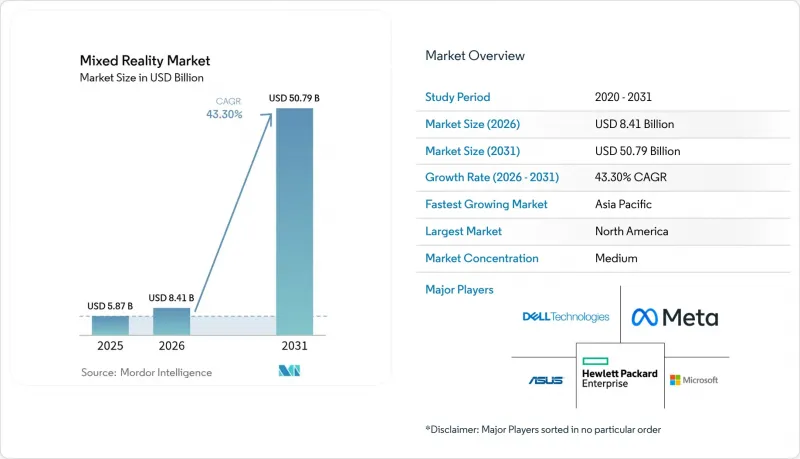
본 보고서는 구성요소(하드웨어, 소프트웨어, 기타), 기기 유형(독립형 MR 헤드셋, 유선형 MR 헤드셋, 기타), 용도(교육·시뮬레이션, 제품 설계·시제품 제작, 원격 지원·협업, 기타), 최종사용자 산업(헬스케어, 제조·산업, 교육, 기타), 지역별로 분류되어 있습니다. 시장 전망은 금액(달러) 기준으로 제시되어 있습니다.
세계 혼합현실(MR) 시장의 동향 및 인사이트
기업용 교육·협업 수요의 급증
현재 보잉(Boeing)과 같은 기업에서는 혼합현실(MR)을 활용한 교육 프로그램을 통해 교육 시간을 75% 단축하고, 지식 습득률을 90%까지 높이고 있으며, 이러한 구체적인 비용 절감 효과가 이사회 차원의 지원을 뒷받침하고 있습니다. 하이브리드 근무로의 전환이 지속되는 가운데, 3D 모델의 공동 편집, 실시간 주석 달기, 공간 화이트보드 기능 등을 가능하게 하는 몰입형 다중 사용자용 디지털 워크스페이스의 가치가 높아지고 있습니다. 산업 부문의 조립 제조업체에서는 고령화되는 기술자를 위해 헤드셋을 활용한 가이드를 도입하여, 조직의 전문 지식을 유지하면서 조립 오류를 줄이고 있습니다. 이러한 도입은 안전한 클라우드 연결을 통해 이루어지기 때문에 기업은 출장으로 인한 지연을 초래하지 않고도 전문 지식을 전 세계적으로 공유할 수 있습니다. 인공지능 모듈은 연수생의 성과에 따라 과제의 난이도를 동적으로 조정하고, 개인별 학습 곡선을 촉진함으로써 숙달에 걸리는 시간을 단축합니다.
5G와 엣지 컴퓨팅이 실현하는 저지연 MR
상용 5G의 보급과 고밀도 엣지 노드 덕분에 왕복 지연 시간이 20밀리초 이하로 단축되어, 사실감 넘치는 3D 자산과의 생생한 상호작용이 가능해졌습니다. 현장의 엔지니어는 현장 영상을 원격지의 전문가에게 실시간으로 전송하고, 전문가는 공간적 주석을 추가하여 실시간으로 수리 작업을 지도합니다. 네트워크 에지로의 연산 오프로드를 통해 헤드셋의 경량화와 배터리 사용 시간 연장이 실현되어, 교대 근무가 필요한 산업 분야에서 매우 중요한 이점이 되고 있습니다. 아시아태평양의 통신 사업자들은 네트워크 슬라이싱 시범 사업을 주도하고 있으며, 트래픽이 가장 많은 시간대에도 우선순위가 높은 혼합 현실(MR) 세션에 대역폭을 보장하고 있습니다. 제조 거점에 대한 커버리지 범위가 확대됨에 따라, 로봇 원격 조작이나 외과 수술의 원격 지도 등 지연에 민감한 작업도 기술적으로 실현 가능해지고 있습니다.
초기 하드웨어 비용의 고가
엔터프라이즈급 헤드 마운트 디스플레이의 가격은 3,299달러에서 4,999달러로, 특히 이익률이 낮은 산업 분야에서는 IT 예산을 압박하고 있습니다. 일반 소비자층의 보급 상황도 유사한 과제를 안고 있으며, 조사에 따르면 잠재 고객의 65%가 가격을 가장 큰 장벽으로 꼽고 있습니다. 각 벤더사는 자금 부담을 줄이기 위해 리스 모델이나 사용자 단위 구독제를 시도하고 있지만, 광학 등급의 도파관 및 맞춤형 실리콘 칩으로 인해 부품 원가는 여전히 높은 수준을 유지하고 있습니다. 고품질 영상과 낮은 지연 시간에 대한 수요로 인해 제조사들은 특수한 공급망에 얽매여 있어, 부품의 상품화는 더딘 편입니다. XREAL Beam Pro와 같이 200달러 미만의 컴패니언 디바이스는 저비용 진입의 길을 제시하고 있지만, 광범위한 혼합현실(MR) 시장은 여전히 ‘높은 가격’이라는 장벽에 직면해 있습니다.
부문 분석
서비스 부문은 기업들이 도입 규모를 확대함에 따라 시스템 설계, 애플리케이션 개발, 라이프사이클 지원에 대한 수요가 증가하고 있음을 반영하여 연평균 성장률(CAGR) 44.57%로 성장할 것으로 예측됩니다. 2025년에도 하드웨어는 혼합현실(MR) 시장 규모의 63.84%를 차지하며, 수익의 기반으로서 그 역할을 확고히 하고 있습니다. 각 벤더사는 매니지드 서비스를 다년 계약에 포함시킴으로써 일회용 기기 판매에 그치지 않는 안정적인 수익원을 확보하고 있습니다. 도입 후 지원은 기기군의 규정 준수 및 성능을 유지하기 위해 펌웨어 업데이트, 공간 맵 관리, 보안 패치가 필요하기 때문에 매우 중요합니다.
프로페셔널 서비스 팀은 현재 헤드셋의 텔레메트리 데이터를 MES, ERP 또는 PACS 플랫폼과 연동하는 등 복잡한 미들웨어 통합 작업에 매진하고 있습니다. 이러한 부가가치를 통해 높은 시간당 단가가 정당화되며, 고객 락인 현상이 더욱 심화됩니다. 클라우드 네이티브 제공 모델은 패치 배포 및 분석 대시보드를 간소화하지만, 그만큼 조직은 종량제 요금제에 대응하기 위한 새로운 예산 한도를 확보해야 할 필요에 직면하게 됩니다. 플랫폼이 성숙해짐에 따라 로우코드 개발 도구로의 전환으로 인해 향후 서비스 성장세가 둔화될 가능성은 있으나, 전문 컨설팅 기업이 큰 시장 점유율을 확보할 수 있는 기간은 적어도 향후 3년 동안은 지속될 전망입니다.
스탠드얼론형 헤드셋은 2025년 혼합현실(MR) 시장 점유율의 52.10%를 차지했으며, 2031년까지 연평균 성장률(CAGR) 44.25%로 성장할 것으로 전망됩니다. 무선 폼팩터는 케이블에 얽매이지 않는 움직임이 안전성과 생산성을 높이는 제조 라인이나 의료 현장에서 지지를 얻고 있습니다. 스냅드래곤과 애플 실리콘 통합 칩셋은 현재 안정적인 발열 상태에서 콘솔급 그래픽 성능을 구현하고 있어 백팩형 PC의 필요성을 없애고 있습니다. 미래를 내다보는 로드맵에서는 메타서피스 안테나가 추가되어 부피를 늘리지 않으면서도 5G 수신 성능이 향상될 전망입니다.
유선 연결형 시스템은 높은 폴리곤 수의 프로토타입 제작에 워크스테이션급 렌더링이 필요한 설계 엔지니어들 사이에서 여전히 틈새 수요를 유지하고 있습니다. 한편, 스마트폰을 활용하는 키트는 전 세계 스마트폰 보급률을 배경으로 비용을 중시하는 소비자층을 개척하고 있습니다. 프로젝션 방식의 솔루션은 고글이 필요 없는 룸 스케일 시각화를 중시하는 건축 설계 사무소를 대상으로 합니다. 기기 제조사들은 인사이드-아웃 방식의 6자유도(6-DoF) 트래킹으로의 전환을 가속화하고 있으며, 이를 통해 설정 번거로움이 줄어들고 공공장소에서 적용 가능한 사용 사례가 확대되고 있습니다.
지역별 분석
북미는 초기 기업용 파일럿 프로젝트와 고밀도 5G 네트워크를 기반으로 2025년 지출의 38.05%를 차지하며 선두를 유지했습니다. 이 지역에는 최상위 플랫폼 벤더 다수가 거점을 두고 있어 개념 증명(PoC) 주기의 신속화에 기여하고 있습니다. 한편, 아시아태평양은 견고한 가전제품 공급망과 정부 주도의 야심 찬 디지털화 계획에 힘입어 연평균 성장률(CAGR) 44.80%로 다른 모든 지역을 능가하는 성장이 예상됩니다. 중국의 국내 출하대수는 2023년에 26만 2,000대에 달했으며, 전년 대비 154.4% 증가한 성장률은 수요가 성숙 단계에 접어들고 있음을 보여줍니다.
인도의 XR(확장 현실) 투자액은 2020년 20억 달러 미만에서 2022년에는 65억 달러를 넘어, 기업용 및 엔터테인먼트용 플랫폼 모두에 대한 수요가 증가하고 있음을 보여줍니다. 유럽에서는 엄격한 데이터 개인정보 보호 규제로 인해 벤더들이 산업 기업용으로 맞춤형의 안전한 온프레미스형 도입을 유도하는 가운데, 꾸준한 성장을 보이고 있습니다. 라틴아메리카와 중동에서는 주로 설비 투자 유연성을 갖춘 석유·가스 및 통신 부문을 중심으로 산발적인 도입이 이루어지고 있습니다. 아프리카는 뒤처져 있지만, 합리적인 가격의 기기가 보급됨에 따라 모바일 우선 솔루션을 통해 비약적인 발전을 이룰 가능성이 있습니다.
기타 혜택
- 엑셀 형식의 시장 예측(ME) 시트
- 3개월간 애널리스트 지원
자주 묻는 질문
목차
제1장 소개
제2장 조사 방법
제3장 주요 요약
제4장 시장 구도
제5장 시장 규모와 성장 예측
제6장 경쟁 구도
제7장 시장 기회와 향후 전망
KSM 26.09.03According to Mordor Intelligence, the mixed reality market size is expected to grow from USD 5.87 billion in 2025 to USD 8.41 billion in 2026 and is forecast to reach USD 50.79 billion by 2031 at 43.3% CAGR over 2026-2031.
This report is Segmented by Component (Hardware, Software, and More), Device Type (Standalone MR Headsets, Tethered MR Headsets, and More), Application (Training and Simulation, Product Design and Prototyping, Remote Assistance and Collaboration, and More), End-User Industry (Healthcare, Manufacturing and Industrial, Education, and More), and Geography. The Market Forecasts are Provided in Terms of Value (USD).
Global Mixed Reality Market Trends and Insights
Enterprise Training and Collaboration Demand Surge
Mixed reality training programs now slash instruction time by 75% and raise knowledge retention to 90% at firms such as Boeing, demonstrating hard savings that drive board-level sponsorship. A continued shift toward hybrid work increases the value of immersive, multi-user digital workspaces that allow 3D model co-editing, real-time annotation, and spatial whiteboarding. Industrial assemblers embed headset-based guidance for aging technicians, cutting assembly errors while preserving institutional expertise. Because these deployments operate over secure cloud links, companies can pool specialist knowledge globally without incurring travel delays. Artificial intelligence modules dynamically adapt task difficulty to a trainee's performance, fostering individualized learning curves that reduce time to competency.
5G and Edge-Computing Enabled Low-Latency MR
Commercial 5G rollouts and dense edge nodes now cut round-trip latency to below 20 ms, enabling lifelike interaction with photorealistic 3D assets. Field engineers livestream on-site video to remote experts who overlay spatial annotations that guide repairs in real time. Compute off-loading to the network edge keeps headset form factors light and extends battery cycles, a crucial benefit for shift-length industrial usage. APAC operators spearhead network slicing pilots that guarantee bandwidth for high-priority mixed reality sessions even during peak traffic windows. As coverage spreads across manufacturing corridors, latency-sensitive tasks such as robotic tele-operation and surgical tele-mentoring become technically feasible.
High Upfront Hardware Cost
Enterprise-grade head-mounted displays list from USD 3,299 to USD 4,999, straining IT budgets, especially in sectors with narrow margins. Consumer uptake mirrors the issue; surveys show 65% of prospects cite price as the primary deterrent. Vendors experiment with leasing models and per-seat subscriptions to smooth cash burdens, but optical-grade waveguides and custom silicon keep bill-of-materials high. Component commoditization is slow because demand for premium image quality and low latency locks manufacturers into specialized supply chains. Sub-USD 200 companion devices such as XREAL Beam Pro hint at a low-cost on-ramp, yet the broader mixed reality market still contends with sticker shock.
Other drivers and restraints analyzed in the detailed report include:
- Big-Tech Investment Wave in MR Ecosystem
- Aging-Workforce Push for Spatial Expert Guidance
- Limited Battery Life for Outdoor Workflows
For complete list of drivers and restraints, kindly check the Table Of Contents.
Segment Analysis
The services segment is forecast to grow at a 44.57% CAGR, reflecting rising demand for system design, application development, and lifecycle support as enterprises scale deployments. Hardware still constituted 63.84% of mixed reality market size in 2025, cementing its role as the baseline revenue driver. Vendors bundle managed services into multi-year contracts, stabilizing income streams beyond one-time device sales. Post-implementation support becomes critical as firmware updates, spatial map management, and security patches are required to keep fleets compliant and performant.
Professional services teams now tackle complex middleware integration, linking headset telemetry to MES, ERP, or PACS platforms. This added value justifies premium hourly rates and deepens customer lock-in. Cloud-native delivery models simplify patch distribution and analytics dashboards, yet they push organizations to secure new budget lines for consumption-based fees. As platforms mature, a shift toward low-code authoring tools could eventually temper services growth, but the window remains at least three years wide where expert consultancies capture sizable wallet share.
Standalone headsets represented 52.10% of the 2025 mixed reality market share and are projected for a 44.25% CAGR through 2031. Untethered form factors find favor in manufacturing lines and healthcare wards where cable-free movement boosts safety and productivity. Integrated Snapdragon and Apple silicon chipsets now deliver console-grade graphics at sustainable thermals, eliminating the need for backpack PCs. Forward-looking roadmaps add metasurface antennas to improve 5G reception without bulk.
Tethered rigs retain a niche among design engineers who require workstation-class rendering for high-polygon prototypes. Meanwhile, smartphone-enabled kits carve out a cost-sensitive consumer segment, riding on global handset penetration levels. Projection-based solutions target architecture studios that value room-scale visualization without goggles. Device makers increasingly converge on inside-out 6-DoF tracking, reducing setup friction and expanding addressable use cases across public venues.
Complete Report Scope:
- By Component
- Hardware
- Head-Mounted Displays
- Optical See-Through HMDs
- Video See-Through HMDs
- Sensors and Tracking Systems
- Processors and Memory
- Head-Mounted Displays
- Software
- SDKs and Platforms
- Visualization Software
- Services
- Integration and Deployment
- Support and Maintenance
- Hardware
- By Device Type
- Standalone MR Headsets
- Tethered MR Headsets
- Smartphone-Enabled MR Devices
- Projection-Based MR Systems
- By Application
- Training and Simulation
- Product Design and Prototyping
- Remote Assistance and Collaboration
- Surgical Planning and Visualization
- Entertainment and Gaming
- Education and Cultural Experience
- Other Applications
- By End-user Industry
- Healthcare
- Manufacturing and Industrial
- Architecture, Engineering and Construction
- Education
- Media and Entertainment
- Defense and Aerospace
- Retail and E-commerce
- Other End-user Industries
- By Geography
- North America
- United States
- Canada
- South America
- Brazil
- Argentina
- Rest of South America
- Europe
- Germany
- United Kingdom
- France
- Italy
- Spain
- Russia
- Rest of Europe
- Asia Pacific
- China
- Japan
- India
- South Korea
- Australia and New Zealand
- Rest of Asia Pacific
- Middle East and Africa
- Middle East
- United Arab Emirates
- Saudi Arabia
- Turkey
- Rest of Middle East
- Africa
- South Africa
- Nigeria
- Rest of Africa
- Middle East
- North America
Geography Analysis
North America led with 38.05% of 2025 spending, anchored by early enterprise pilots and dense 5G coverage grids. The region houses most top-tier platform vendors, facilitating faster proof-of-concept cycles. Asia Pacific, however, is set to outpace all peers at a 44.80% CAGR, catalyzed by robust consumer electronics supply chains and ambitious state-sponsored digital agendas. China's domestic shipments reached 262,000 AR units in 2023, a 154.4% annual jump that signals maturing demand.
India's extended reality outlays surged from below USD 2 billion in 2020 to beyond USD 6.5 billion by 2022, revealing an appetite for enterprise and entertainment platforms alike. Europe shows steady gains as strict data-privacy regulation nudges vendors toward secure on-premises deployments tailored to industrial firms. Latin America and the Middle East exhibit sporadic adoption, mainly in the oil & gas and telecom sectors that possess capex flexibility. Africa lags but may leapfrog via mobile-first solutions as affordable devices proliferate.
- Acer Incorporated
- Alphabet Inc.
- Apple Inc.
- AsusTek Computer Inc.
- Dell Technologies Inc.
- Hewlett Packard Enterprise Company
- HTC Corporation
- Lenovo Group Limited
- Magic Leap, Inc.
- Meta Platforms, Inc.
- Microsoft Corporation
- Qualcomm Technologies, Inc.
- Samsung Electronics Co., Ltd.
- Sony Group Corporation
- Vuzix Corporation
- Varjo Technologies Oy
- PTC Inc.
- Ultraleap Limited
- Unity Software Inc.
- NVIDIA Corporation
- Snap Inc.
- RealWear, Inc.
- Seiko Epson Corporation
- Valve Corporation
- XREAL Inc.
Additional Benefits:
- The market estimate (ME) sheet in Excel format
- 3 months of analyst support
TABLE OF CONTENTS
1 INTRODUCTION
- 1.1 Study Assumptions and Market Definition
- 1.2 Scope of the Study
2 RESEARCH METHODOLOGY
3 EXECUTIVE SUMMARY
4 MARKET LANDSCAPE
- 4.1 Market Overview
- 4.2 Market Drivers
- 4.2.1 Enterprise training and collaboration demand surge
- 4.2.2 5G and edge-computing enabled low-latency MR
- 4.2.3 Big-Tech investment wave in MR ecosystem
- 4.2.4 Aging-workforce push for spatial expert guidance
- 4.2.5 Regulatory nods for MR-assisted surgery
- 4.2.6 Passthrough-first consumer devices reduce cybersickness
- 4.3 Market Restraints
- 4.3.1 High upfront hardware cost
- 4.3.2 Data-privacy and security concerns
- 4.3.3 Limited battery life for outdoor workflows
- 4.3.4 Fragmented hand/eye-tracking standards
- 4.4 Regulatory Landscape
- 4.5 Technological Outlook
- 4.6 Porter's Five Forces Analysis
- 4.6.1 Bargaining Power of Suppliers
- 4.6.2 Bargaining Power of Buyers
- 4.6.3 Threat of New Entrants
- 4.6.4 Threat of Substitutes
- 4.6.5 Intensity of Competitive Rivalry
- 4.7 MR HMD Component Vendors
- 4.8 Comparative Analysis (VR vs AR vs MR)
5 MARKET SIZE AND GROWTH FORECASTS (VALUE)
- 5.1 By Component
- 5.1.1 Hardware
- 5.1.1.1 Head-Mounted Displays
- 5.1.1.1.1 Optical See-Through HMDs
- 5.1.1.1.2 Video See-Through HMDs
- 5.1.1.2 Sensors and Tracking Systems
- 5.1.1.3 Processors and Memory
- 5.1.1.1 Head-Mounted Displays
- 5.1.2 Software
- 5.1.2.1 SDKs and Platforms
- 5.1.2.2 Visualization Software
- 5.1.3 Services
- 5.1.3.1 Integration and Deployment
- 5.1.3.2 Support and Maintenance
- 5.1.1 Hardware
- 5.2 By Device Type
- 5.2.1 Standalone MR Headsets
- 5.2.2 Tethered MR Headsets
- 5.2.3 Smartphone-Enabled MR Devices
- 5.2.4 Projection-Based MR Systems
- 5.3 By Application
- 5.3.1 Training and Simulation
- 5.3.2 Product Design and Prototyping
- 5.3.3 Remote Assistance and Collaboration
- 5.3.4 Surgical Planning and Visualization
- 5.3.5 Entertainment and Gaming
- 5.3.6 Education and Cultural Experience
- 5.3.7 Other Applications
- 5.4 By End-user Industry
- 5.4.1 Healthcare
- 5.4.2 Manufacturing and Industrial
- 5.4.3 Architecture, Engineering and Construction
- 5.4.4 Education
- 5.4.5 Media and Entertainment
- 5.4.6 Defense and Aerospace
- 5.4.7 Retail and E-commerce
- 5.4.8 Other End-user Industries
- 5.5 By Geography
- 5.5.1 North America
- 5.5.1.1 United States
- 5.5.1.2 Canada
- 5.5.2 South America
- 5.5.2.1 Brazil
- 5.5.2.2 Argentina
- 5.5.2.3 Rest of South America
- 5.5.3 Europe
- 5.5.3.1 Germany
- 5.5.3.2 United Kingdom
- 5.5.3.3 France
- 5.5.3.4 Italy
- 5.5.3.5 Spain
- 5.5.3.6 Russia
- 5.5.3.7 Rest of Europe
- 5.5.4 Asia Pacific
- 5.5.4.1 China
- 5.5.4.2 Japan
- 5.5.4.3 India
- 5.5.4.4 South Korea
- 5.5.4.5 Australia and New Zealand
- 5.5.4.6 Rest of Asia Pacific
- 5.5.5 Middle East and Africa
- 5.5.5.1 Middle East
- 5.5.5.1.1 United Arab Emirates
- 5.5.5.1.2 Saudi Arabia
- 5.5.5.1.3 Turkey
- 5.5.5.1.4 Rest of Middle East
- 5.5.5.2 Africa
- 5.5.5.2.1 South Africa
- 5.5.5.2.2 Nigeria
- 5.5.5.2.3 Rest of Africa
- 5.5.5.1 Middle East
- 5.5.1 North America
6 COMPETITIVE LANDSCAPE
- 6.1 Market Concentration
- 6.2 Strategic Moves
- 6.3 Market Share Analysis
- 6.4 Company Profiles (includes Global level Overview, Market level overview, Core Segments, Financials as available, Strategic Information, Market Rank/Share for key companies, Products and Services, and Recent Developments)
- 6.4.1 Acer Incorporated
- 6.4.2 Alphabet Inc.
- 6.4.3 Apple Inc.
- 6.4.4 AsusTek Computer Inc.
- 6.4.5 Dell Technologies Inc.
- 6.4.6 Hewlett Packard Enterprise Company
- 6.4.7 HTC Corporation
- 6.4.8 Lenovo Group Limited
- 6.4.9 Magic Leap, Inc.
- 6.4.10 Meta Platforms, Inc.
- 6.4.11 Microsoft Corporation
- 6.4.12 Qualcomm Technologies, Inc.
- 6.4.13 Samsung Electronics Co., Ltd.
- 6.4.14 Sony Group Corporation
- 6.4.15 Vuzix Corporation
- 6.4.16 Varjo Technologies Oy
- 6.4.17 PTC Inc.
- 6.4.18 Ultraleap Limited
- 6.4.19 Unity Software Inc.
- 6.4.20 NVIDIA Corporation
- 6.4.21 Snap Inc.
- 6.4.22 RealWear, Inc.
- 6.4.23 Seiko Epson Corporation
- 6.4.24 Valve Corporation
- 6.4.25 XREAL Inc.
7 MARKET OPPORTUNITIES AND FUTURE OUTLOOK
- 7.1 White-space and Unmet-Need Assessment