
|
시장보고서
상품코드
2121400
아시아태평양의 모바일 클라우드 : 시장 점유율 분석, 업계 동향과 통계, 성장 예측(2026-2031년)Asia-Pacific Mobile Cloud - Market Share Analysis, Industry Trends & Statistics, Growth Forecasts (2026 - 2031) |
||||||
 Mordor Intelligence
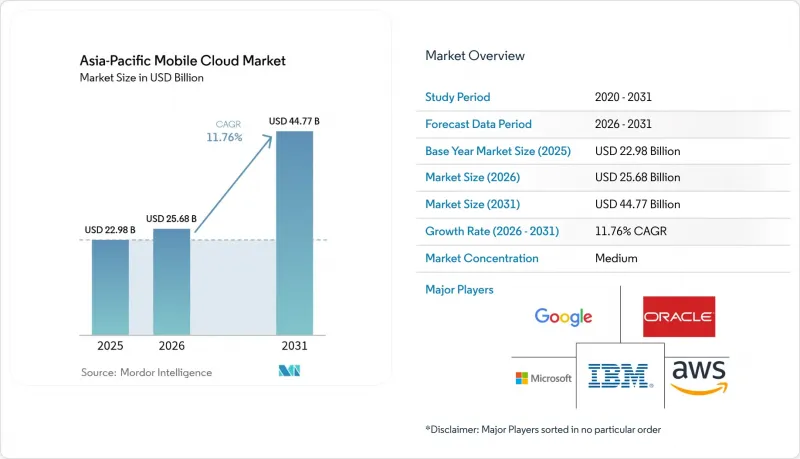
Mordor Intelligence에 의하면, 2026년 아시아태평양의 모바일 클라우드 시장 규모는 256억 8,000만 달러로 추정되며, 2025년 229억 8,000만 달러에서 2031년에는 447억 7,000만 달러에 달할 것으로 예측됩니다.
또한 2026-2031년 연평균 성장률(CAGR)은 11.76%를 나타낼 것으로 전망됩니다.
본 보고서는 서비스 유형(모바일 플랫폼 서비스(MPaaS), 모바일 기기 관리 통합형 클라우드, 모바일 컨텐츠 배포/엣지 CDN 등), 도입 모델(퍼블릭 클라우드, 프라이빗 클라우드, 하이브리드 클라우드, 멀티 클라우드), 사용자 유형(기업, 일반 소비자), 산업 분야(게임, 교육 등), 그리고 지역별로 분류되어 있습니다. 시장 전망은 금액(달러) 기준으로 제시되어 있습니다.
아시아태평양의 모바일 클라우드 시장 동향 및 인사이트
아시아태평양 주요 경제권에서의 5G 네트워크의 급속한 확산
중국에서는 2024년 말까지 368만 개의 5G 기지국이 도입되어 모바일 클라우드 워크로드에 대해 15밀리초 미만의 지연을 실현했습니다. 한국의 통신 사업자는 2024년에 84억 달러를 투자하여 mm파 커버리지를 확충하고, 전자상거래 앱에서 실시간 재고 동기화를 실현했습니다. 인도의 통신 사업자는 2025년 중반까지 45만 곳의 5G 기지국을 가동하여 핀테크 플랫폼이 클라우드 백엔드에서 API 호출 시 50밀리초 미만의 지연 시간을 달성할 수 있도록 했습니다. 일본의 NTT 도코모는 독립형 5G와 엣지 노드를 연동하여 게임 지연 시간을 4G에 비해 40% 단축했습니다. 싱가포르 규제 당국은 2025년까지 전국적인 5G 도입을 의무화했으며, 이에 따라 기업들은 엣지 네이티브 배포를 위한 모바일 앱 재구축을 가속화했습니다.
점차 늘어나는 ‘모바일 전용’ 소비자층이 기기 내 클라우드 스토리지를 요구하고 있습니다.
인도에서는 2024년 ‘모바일 전용’ 인터넷 사용자가 7억 8,000만 명에 달하고, 온라인 이용자의 68%를 차지하고 있으며, 휴대폰 기반 클라우드 백업이 필수적입니다. 인도네시아의 770억 달러 규모 디지털 경제의 92%는 스마트폰을 통해 거래되고 있으며, 소매업체들은 원터치 결제를 위해 클라우드 백엔드에 의존하고 있습니다. 필리핀에서는 8,900만 명의 모바일 인터넷 가입자가월18GB의 데이터를 사용하며, 클라우드 기반 동영상 캐시에 대한 수요를 주도하고 있습니다. 베트남에서는 슈퍼앱 문화의 부상으로 차량 호출 서비스, 결제, 전자상거래가 클라우드 규모의 API를 통해 처리되고 있으며, 이러한 API는 모바일 플랫폼에서 탄력적으로 확장될 수 있어야 합니다. 이 시장의 소비자들은 데스크톱 사용자보다 프리미엄 스토리지 요금제에 대한 지불 의향이 높아, 모바일 클라우드 공급업체의 지속적인 수익을 강화하고 있습니다.
아시아태평양의 뿌리 깊은 국경을 초월한 데이터 주권 장벽
중국의 ‘개인정보 보호법’은 클라우드 제공업체에 개인 데이터를 국내에 보관할 것을 의무화하고 있으며, 이로 인해 운영 비용을 증가시키는 도시 수준의 데이터센터 구축이 요구되고 있습니다. 인도의 ‘디지털 개인 데이터 보호법’도 유사한 현지화를 의무화하고 있어, 하이퍼스케일러 기업들은 규정 준수를 위해 수십억 달러 규모의 인프라 구축에 나서지 않을 수 없게 되었습니다. 인도네시아의 ‘규정 71’과 베트남의 ‘사이버 보안법’은 모두 국경을 넘는 데이터 복제를 저해하고 있어, 지역적 아키텍처의 분열을 초래하고 있습니다. 이러한 규제로 인해 기업들은 아시아 전역을 아우르는 플랫폼을 구축하기 전에 관할 구역별 규정 준수 여부를 확인해야 하므로, 멀티 클라우드 도입이 지연되고 있습니다. 이미 주권형 클라우드를 운영하고 있는 국내 제공업체들이 유리한 입지를 차지함에 따라, 아시아태평양의 모바일 클라우드 시장 내 경쟁 구도는 복잡해지고 있습니다.
부문 분석
모바일 백엔드 서비스(MBaaS)는 개발 주기를 단축하는 턴키 방식의 인증, 데이터베이스, 푸시 알림 모듈을 제공함으로써 2025년 매출의 38.10%를 차지하며, 아시아태평양의 모바일 클라우드 시장 점유율에서 가장 큰 비중을 차지했습니다. 엣지를 기반으로 하는 모바일 컨텐츠 전송은 게임 및 스트리밍 앱의 지연 요건을 반영하여 2031년까지 연평균 성장률(CAGR) 11.79%를 나타낼 것으로 예측됩니다. 개발자들이 사용자로부터 10밀리초 이내의 거리에 컴퓨팅 리소스를 배치하게 됨에 따라, 엣지 CDN 서비스에 기인한 아시아태평양의 모바일 클라우드 시장 규모는 2026년부터 2031년 사이에 2배 이상으로 증가할 것으로 예측됩니다. Tencent Cloud의 180개 엣지 노드는 이미 WeChat 미니 프로그램의 동영상 로딩 시간을 3분의 1로 단축했습니다. 알리바바 클라우드는 차이나 모바일과 제휴하여 5G 기지국에 마이크로 데이터센터를 병설함으로써 증강현실(AR)을 활용한 상거래를 지원하고 있습니다. 동남아시아에서는 Google Cloud의 ‘Anthos for Mobile’을 통해 은행이 On-Premise 랙이나 퍼블릭 존에 컨테이너화된 서비스를 배포하여 데이터 상주 요건을 충족할 수 있게 되었습니다. 엣지 CDN 벤더가 서버리스 컴퓨팅을 통합하고, MBaaS 제공업체가 전 세계적인 파일 및 미디어 배포 서비스를 시작함에 따라 경쟁의 경계가 모호해지고, 벤더 간의 통합이 가속화되고 있습니다.
기업들은 MBaaS를 선호하는 주된 이유로 비용 최적화를 꼽으며, 사내 스택에 비해 시장 출시 기간이 40-50% 단축된다고 보고하고 있습니다. 인도의 핀테크 샌드박스에 참여하는 스타트업들은 미리 구축된 ID 인증, 분석, 알림 모듈을 활용하여 8주 이내에 결제 API를 반복적으로 개선하고 있습니다. 엣지 CDN의 성장은 모바일 단말기 사용 시간 증가와 밀접한 관련이 있습니다. GSMA의 추산에 따르면, 2024년 아시아태평양 사용자는 하루 평균 5.2시간을 스마트폰으로 보내고 있으며, 이러한 이용 행태가 캐시 수요를 가속화하고 있습니다. 아시아태평양의 모바일 클라우드 업계의 부문 구성은 동영상, 게임, 몰입형 커머스의 점유율 확대에 따라 변화할 것으로 예상되며, 백엔드 제공업체들은 경쟁력을 유지하기 위해 경량 에지 노드를 통합할 수밖에 없을 것입니다.
퍼블릭 클라우드는 온디맨드 가격 책정, 가장 광범위한 지리적 커버리지, 그리고 탄탄한 개발자 생태계 덕분에 2025년에는 매출의 63.20%를 차지했습니다. 그러나 은행과 병원이 데이터 보관 요건과 세계 확장성 사이의 균형을 모색함에 따라, 하이브리드 및 멀티 클라우드 구성은 연평균 성장률(CAGR) 11.72%로 확대될 것으로 예측됩니다. 아시아태평양의 모바일 클라우드 시장에서 하이브리드 아키텍처에 기인한 시장 규모는 2026년 93억 8,000만 달러에서 2031년에는 163억 3,000만 달러로 확대될 것으로 예측됩니다. DBS 은행은 분석에는 AWS를 활용하면서도 트랜잭션을 프라이빗 노드를 통해 처리함으로써 총 비용을 22% 절감하고 있습니다. 커먼웰스 은행은 고객 데이터를 국내에 보관하면서 AI 모델 훈련을 해외에서 수행하기 위해 듀얼 퍼블릭 클라우드를 채택하고 있으며, 이는 조직이 규정 준수 및 성능을 어떻게 최적화하고 있는지를 보여줍니다.
프라이빗 클라우드 도입이 가장 활발한 곳은 중국입니다. 중국에서는 국영 기업과 대형 인터넷 기업들이 사이버 보안 지침을 준수하기 위해 자국 주도의 모바일 클라우드를 운영하고 있습니다. 라쿠텐 등 일본의 복합 기업들은 On-Premise 엣지 노드와 퍼블릭 클라우드의 버스트 용량을 결합하여 변동하는 모바일 워크로드를 처리하고 있습니다. 하이브리드 환경의 확대에 따라 통합된 컨트롤 플레인 소프트웨어에 대한 수요가 증가하고 있습니다. VMware, Red Hat, IBM은 클러스터 전체에서 보안 정책을 조정하기 위한 도구를 개발하고 있습니다.
기타 혜택:
- 엑셀 형식 시장 예측(ME) 시트
- 3개월간의 애널리스트 지원
자주 묻는 질문
목차
제1장 서론
제2장 조사 방법
제3장 주요 요약
제4장 시장 구도
제5장 시장 규모와 성장 예측
제6장 경쟁 구도
제7장 시장 기회와 향후 전망
LSH 26.09.09According to Mordor Intelligence, Asia-Pacific mobile cloud market size in 2026 is estimated at USD 25.68 billion, growing from 2025 value of USD 22.98 billion with 2031 projections showing USD 44.77 billion, growing at 11.76% CAGR over 2026-2031.
This report is Segmented by Service Type (Mobile Platform-As-A-Service, Mobile Device Management-Integrated Cloud, Mobile Content Delivery/Edge CDN, and More), Deployment Model (Public Cloud, Private Cloud, Hybrid and Multi-Cloud), User Type (Enterprise, and Consumer), Industry Vertical (Gaming, Education, and More), and Geography. The Market Forecasts are Provided in Terms of Value (USD).
Asia-Pacific Mobile Cloud Market Trends and Insights
Rapid Rollout of 5G Networks Across Key Asia-Pacific Economies
China deployed 3.68 million 5G base stations by late 2024, delivering sub-15 millisecond latency for mobile cloud workloads. South Korean carriers invested USD 8.4 billion in 2024 to densify millimeter-wave coverage, enabling real-time inventory sync for e-commerce apps. India's operators activated 450,000 5G sites by mid-2025, enabling fintech platforms to achieve sub-50-millisecond API calls on cloud backends. Japan's NTT Docomo linked standalone 5G with edge nodes, cutting gaming latency by 40% versus 4G. Singapore's regulator mandated nationwide 5G by 2025, spurring enterprises to rebuild mobile apps for edge-native deployment.
Rising Mobile-Only Consumer Base Demanding On-Device Cloud Storage
India counted 780 million mobile-only internet users in 2024, representing 68% of online citizens and making handset-based cloud backup a necessity. Indonesia's USD 77 billion digital economy is 92% smartphone-transacted, so retailers rely on cloud backends for one-tap checkout. The Philippines logged 89 million mobile internet subscribers who consumed 18 GB of data monthly, driving demand for cloud-based video caching. Vietnam's rising super-app culture funnels ride-hailing, payments, and e-commerce through cloud-scale APIs that must elastically scale on mobile platforms. Consumers in these markets are showing higher willingness to pay for premium storage tiers than desktop users, strengthening recurring revenue for mobile cloud vendors.
Persistent Cross-Border Data-Sovereignty Barriers in Asia-Pacific
China's Personal Information Protection Law obliges cloud providers to keep personal data inside national borders, requiring city-level data centers that raise operating costs. India's Digital Personal Data Protection Act enforces similar localization, prompting hyperscalers to commit multi-billion-dollar builds to satisfy compliance. Indonesia's Regulation 71 and Vietnam's Cybersecurity Law both deter cross-border replication, fragmenting regional architectures. These rules slow multi-cloud adoption because enterprises must validate jurisdictional compliance before deploying Asia-wide platforms. Domestic providers that already operate sovereign clouds gain an edge, complicating competitive dynamics in the Asia-Pacific mobile cloud market.
Other drivers and restraints analyzed in the detailed report include:
- Government-Funded Digital-Nation Programs
- Enterprise Shift Toward Edge-Enabled mPaaS for Ultra-Low Latency Apps
- Rising Spectrum-Usage Fees Limiting Telco Cloud CAPEX
For complete list of drivers and restraints, kindly check the Table Of Contents.
Segment Analysis
Mobile Backend-as-a-Service accounted for 38.10% of 2025 revenue, the largest slice of Asia-Pacific mobile cloud market share, by delivering turnkey authentication, database, and push-notification modules that compress development cycles. Edge-anchored Mobile Content Delivery is forecast to grow at an 11.79% CAGR through 2031, mirroring latency needs of gaming and streaming apps. The Asia-Pacific mobile cloud market size derived from edge CDN services is projected to more than double between 2026 and 2031 as developers position compute within 10 milliseconds of users. Tencent Cloud's 180 edge nodes already shave video load times by one-third for WeChat mini-programs. Alibaba Cloud's tie-up with China Mobile co-locates micro-data centers at 5G towers to support augmented reality commerce. In Southeast Asia, Google Cloud's Anthos for Mobile enables banks to deploy containerized services across on-premise racks and public zones, meeting data-residency requirements. Competitive lines are blurring as edge CDN vendors embed serverless compute while MBaaS providers launch global file and media delivery services, intensifying vendor consolidation.
Enterprises cite cost optimization as a key reason for favoring MBaaS, reporting a 40-50% faster time-to-market compared to in-house stacks. Start-ups in India's fintech sandbox iterate payment APIs in under eight weeks by relying on pre-built identity, analytics, and notification modules. Edge CDN growth is tied to rising mobile screen time. GSMA estimates Asia-Pacific users spent 5.2 hours per day on smartphones in 2024, a behavior that accelerates cache demand. The Asia-Pacific mobile cloud industry segment mix is likely to evolve as video, gaming, and immersive commerce gain share, forcing backend providers to integrate lightweight edge nodes to remain competitive.
Public cloud captured 63.20% revenue in 2025 thanks to on-demand pricing, broadest geographic coverage, and rich developer ecosystems. Hybrid and multi-cloud configurations, however, are forecast to expand at an 11.72% CAGR as banks and hospitals balance residency mandates with global scalability. The Asia-Pacific mobile cloud market size attributable to hybrid architectures is expected to rise from USD 9.38 billion in 2026 to USD 16.33 billion in 2031. DBS Bank routes transactions through private nodes while leveraging AWS for analytics, trimming total cost by 22%. Commonwealth Bank uses dual public clouds to keep customer data local but train AI models abroad, demonstrating how organizations optimize compliance and performance.
Private cloud adoption is most prevalent in China, where state-linked enterprises and large internet firms run sovereign mobile clouds to align with cybersecurity directives. Japanese conglomerates such as Rakuten blend on-premise edge nodes with public burst capacity to process fluctuating mobile workloads. As hybrid footprints widen, demand rises for unified control-plane software; VMware, Red Hat, and IBM are tailoring tools to orchestrate security policies across clusters.
Complete Report Scope:
- By Service Type
- Mobile Backend-as-a-Service (MBaaS)
- Mobile Platform-as-a-Service (mPaaS)
- Mobile Device Management-integrated Cloud
- Mobile Content Delivery / Edge CDN
- By Deployment Model
- Public Cloud
- Private Cloud
- Hybrid and Multi-Cloud
- By User Type
- Enterprise
- Consumer
- By Industry Vertical
- Gaming
- Banking, Financial Services and Insurance (BFSI)
- Media and Entertainment
- Education
- Healthcare
- Travel and Hospitality
- Retail and E-commerce
- Government and Public Sector
- Other Industry Verticals
- By Country
- China
- Japan
- India
- Australia
- South Korea
- Singapore
- Indonesia
- Malaysia
- Philippines
- Rest of Asia-Pacific
List of Companies Covered in this Report:
- Amazon Web Services, Inc.
- Microsoft Corporation
- Alibaba Cloud Computing Co., Ltd.
- Google LLC
- Huawei Technologies Co., Ltd.
- IBM Corporation
- Oracle Corporation
- SAP SE
- Tencent Cloud Computing (Beijing) Co., Ltd.
- Fujitsu Limited
- Rakuten Group, Inc.
- NTT Communications Corporation
- Salesforce, Inc.
- Akamai Technologies, Inc.
- VMware, Inc.
- Baidu, Inc.
- HCL Technologies Limited
- Infosys Limited
- ZTE Corporation
- Nokia Corporation
- Ericsson AB
- SoftBank Corp.
- SK Telecom Co., Ltd.
Additional Benefits:
- The market estimate (ME) sheet in Excel format
- 3 months of analyst support
TABLE OF CONTENTS
1 INTRODUCTION
- 1.1 Study Assumptions and Market Definition
- 1.2 Scope of the Study
2 RESEARCH METHODOLOGY
3 EXECUTIVE SUMMARY
4 MARKET LANDSCAPE
- 4.1 Market Overview
- 4.2 Market Drivers
- 4.2.1 Rapid Rollout Of 5G Networks Across Key Asia-Pacific Economies
- 4.2.2 Rising Mobile-Only Consumer Base Demanding On-Device Cloud Storage
- 4.2.3 Government-Funded Digital-Nation Programs (E.G., India's Digital India, Indonesia's 1000 Start-Ups)
- 4.2.4 Enterprise Shift Toward Edge-Enabled Mpaas For Ultra-Low Latency Apps
- 4.2.5 Proliferation Of Super-Apps Generating Massive Real-Time Data Workloads
- 4.2.6 OEM-Driven "Device-Bundled Cloud" Subscriptions Boosting ARPU
- 4.3 Market Restraints
- 4.3.1 Persistent Cross-Border Data-Sovereignty Barriers In Asia-Pacific
- 4.3.2 Skills Shortage In Cloud-Native Mobile DevSecOps
- 4.3.3 Energy-Cost Spikes At Hyperscale Data-Centers In Japan And Australia
- 4.3.4 Rising Spectrum-Usage Fees Limiting Telco Cloud CAPEX
- 4.4 Industry Value Chain Analysis
- 4.5 Regulatory Landscape
- 4.6 Technological Outlook
- 4.7 Porter's Five Forces Analysis
- 4.7.1 Bargaining Power of Suppliers
- 4.7.2 Bargaining Power of Buyers
- 4.7.3 Threat of New Entrants
- 4.7.4 Intensity of Competitive Rivalry
- 4.7.5 Threat of Substitutes
5 MARKET SIZE AND GROWTH FORECASTS (VALUE)
- 5.1 By Service Type
- 5.1.1 Mobile Backend-as-a-Service (MBaaS)
- 5.1.2 Mobile Platform-as-a-Service (mPaaS)
- 5.1.3 Mobile Device Management-integrated Cloud
- 5.1.4 Mobile Content Delivery / Edge CDN
- 5.2 By Deployment Model
- 5.2.1 Public Cloud
- 5.2.2 Private Cloud
- 5.2.3 Hybrid and Multi-Cloud
- 5.3 By User Type
- 5.3.1 Enterprise
- 5.3.2 Consumer
- 5.4 By Industry Vertical
- 5.4.1 Gaming
- 5.4.2 Banking, Financial Services and Insurance (BFSI)
- 5.4.3 Media and Entertainment
- 5.4.4 Education
- 5.4.5 Healthcare
- 5.4.6 Travel and Hospitality
- 5.4.7 Retail and E-commerce
- 5.4.8 Government and Public Sector
- 5.4.9 Other Industry Verticals
- 5.5 By Country
- 5.5.1 China
- 5.5.2 Japan
- 5.5.3 India
- 5.5.4 Australia
- 5.5.5 South Korea
- 5.5.6 Singapore
- 5.5.7 Indonesia
- 5.5.8 Malaysia
- 5.5.9 Philippines
- 5.5.10 Rest of Asia-Pacific
6 COMPETITIVE LANDSCAPE
- 6.1 Market Concentration
- 6.2 Strategic Moves
- 6.3 Market Share Analysis
- 6.4 Company Profiles (includes Global level Overview, Market level overview, Core Segments, Financials as available, Strategic Information, Market Rank/Share for key companies, Products and Services, and Recent Developments)
- 6.4.1 Amazon Web Services, Inc.
- 6.4.2 Microsoft Corporation
- 6.4.3 Alibaba Cloud Computing Co., Ltd.
- 6.4.4 Google LLC
- 6.4.5 Huawei Technologies Co., Ltd.
- 6.4.6 IBM Corporation
- 6.4.7 Oracle Corporation
- 6.4.8 SAP SE
- 6.4.9 Tencent Cloud Computing (Beijing) Co., Ltd.
- 6.4.10 Fujitsu Limited
- 6.4.11 Rakuten Group, Inc.
- 6.4.12 NTT Communications Corporation
- 6.4.13 Salesforce, Inc.
- 6.4.14 Akamai Technologies, Inc.
- 6.4.15 VMware, Inc.
- 6.4.16 Baidu, Inc.
- 6.4.17 HCL Technologies Limited
- 6.4.18 Infosys Limited
- 6.4.19 ZTE Corporation
- 6.4.20 Nokia Corporation
- 6.4.21 Ericsson AB
- 6.4.22 SoftBank Corp.
- 6.4.23 SK Telecom Co., Ltd.
7 MARKET OPPORTUNITIES AND FUTURE OUTLOOK
- 7.1 White-Space and Unmet-Need Assessment