|
시장보고서
상품코드
2121458
매니지드 서비스 : 시장 점유율 분석, 업계 동향과 통계, 성장 예측(2026-2031년)Managed Services - Market Share Analysis, Industry Trends & Statistics, Growth Forecasts (2026 - 2031) |
||||||
 Mordor Intelligence
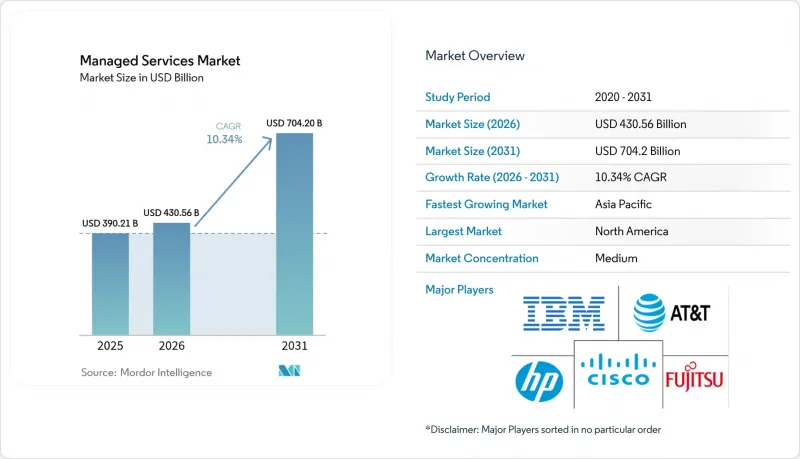
매니지드 서비스 시장 규모는 2026년에 4,305억 6,000만 달러로 추정되며, 2025년 3,902억 1,000만 달러에서 확대되어 2031년에는 7,042억 달러에 달할 것으로 예측됩니다.
2026년부터 2031년까지의 연평균 성장률(CAGR)은 10.34%가 될 것으로 전망됩니다.
본 보고서는 도입 형태(온프레미스, 클라우드), 서비스 유형(매니지드 데이터센터, 매니지드 보안, 매니지드 커뮤니케이션 등), 기업 규모(중소기업, 대기업), 최종사용자 업종(BFSI, IT·통신, 제조업 등) 및 지역별로 분류되어 있습니다. 시장 예측은 금액(달러)으로 표시됩니다.
세계 매니지드 서비스 시장의 동향 및 인사이트
하이브리드 클라우드의 복잡화가 매니지드 서비스 도입을 촉진
하이브리드 클라우드 아키텍처는 온프레미스, 프라이빗 클라우드 및 여러 퍼블릭 클라우드를 결합한 것으로, 운영상의 복잡성을 증가시켜 사내 팀만으로는 관리에 어려움을 겪고 있습니다. Microsoft의 ‘EU 데이터 경계’와 같은 규제 이니셔티브에서는 데이터의 현지화된 처리가 요구되고 있으며, 이로 인해 기업들은 규정 준수, 이식성 및 통일된 보안 정책을 보장할 수 있는 공급자로의 전환을 강요받고 있습니다. 분산 환경 전반에 걸친 원활한 워크로드 이식성과 실시간 정책 적용은 관리형 인프라 및 보안 서비스에 대한 장기적인 수요를 확고히 하고 있습니다.
비용 최적화에 대한 압박으로 인해 아웃소싱 결정이 가속화되고 있습니다.
지속적인 이익률 압박으로 인해, 매니지드 서비스를 통해 고정적인 IT 간접비가 변동비로 전환되고 있습니다. 액센츄어가 미국 공군과 체결한 16억 달러 규모의 ‘Cloud One’ 계약과 같은 대규모 변혁 프로젝트는 기업들이 아웃소싱을 단순한 전술적 수단이 아닌 전략적 수단으로 인식하고 있음을 보여줍니다. 프로바이더는 자동화, AI 도구, 인증된 인재 풀을 패키지로 제공하며, 이를 통해 구매 기업은 초기 자본 지출을 피하면서 새로운 기능을 활용할 수 있게 됩니다.
데이터 주권에 관한 규제가 서비스 제공 모델을 제약하고 있습니다
현지 처리를 의무화하는 규제로 인해 공급업체는 각 관할 구역에 중복된 인프라를 구축할 수밖에 없게 되어, 규모의 경제가 훼손되고 전 세계적인 서비스 제공이 복잡해지고 있습니다. 마이크로소프트의 ‘EU 데이터 경계’는 제공업체가 여러 지역의 고객에게 서비스를 제공하기 위해 감당해야 하는 추가 자본 및 운영상의 오버헤드를 여실히 보여줍니다.
부문 분석
2025년 현재, 클라우드 도입은 매니지드 서비스 시장의 52.35% 점유율을 차지하고 있으며, 하이브리드 클라우드가 2031년까지 연평균 성장률(CAGR) 11.92%를 기록함에 따라 그 격차는 더욱 벌어지고 있습니다. 온디맨드로 리소스를 구축하고, 데이터 규제를 준수하며, 엣지 워크로드를 통합할 수 있다는 점이 기업들이 온프레미스 모델에서 전환하는 이유입니다. 액센츄어의 ‘Cloud One’ 참여와 같은 하이퍼스케일러와의 제휴는 공동 혁신이 어떻게 대규모 다년 계약 확보로 이어지는지를 보여줍니다.
클라우드 도입을 통해 제공업체는 인프라를 통합하고, 패치 적용을 자동화하며, AI를 활용한 비용 최적화를 대규모로 전개할 수 있게 되므로, 매니지드 서비스 시장이 그 혜택을 누리고 있습니다. 데이터 기밀성이 높은 분야에서는 프라이빗 클라우드가 여전히 중요하며, 반면 쉽게 리팩토링할 수 없는 레거시 워크로드에 대해서는 온프레미스 서비스가 계속해서 이용되고 있습니다. 멀티 클라우드 오케스트레이션과 FinOps 보고서를 숙지한 공급자야말로 새로운 지출을 확보하는 데 있어 가장 유리한 입장에 있습니다.
2025년에는 매니지드 인프라 서비스가 매출의 38.40%를 차지했으며, 이는 이기종 혼합 환경을 지속적으로 운영해야 하는 기본적인 요구를 반영한 것입니다. 그러나 랜섬웨어 및 규정 준수 위반에 따른 벌금에 대한 경영진의 우려를 반영하여, 매니지드 보안 서비스가 연평균 성장률(CAGR) 11.72%로 성장을 주도하고 있습니다. AI를 활용한 위협 헌팅, 제로 트러스트 도입, 그리고 자동화된 사고 격리가 시장에서 승자를 돋보이게 하고 있습니다.
사이버 보험사들이 인수 기준을 강화함에 따라 보안 관련 관리형 서비스 시장의 규모는 확대될 것으로 예상됩니다. 각 제공업체는 SOC-as-a-Service를 규정 준수 보고 및 테이블탑 훈련과 결합함으로써 높은 수익률을 자랑하는 지속적인 수익을 창출하고 있습니다. 네트워크 및 통신 서비스는 5G 구축의 혜택을 받고 있으며, 데이터센터 에너지 관리 제품은 지속가능성에 관한 규제 강화의 호재를 누리고 있습니다.
지역별 분석
북미는 조기 클라우드 전환, 사이버 규제 및 높은 IT 지출에 힘입어 2025년에도 매출 점유율 32.40%를 유지했습니다. 미국 공군의 ‘Cloud One’과 같은 연방 정부 프로그램 덕분에 대규모 관리형 서비스 계약의 가시성이 높아지고 있습니다. BFSI(은행·금융·보험) 및 의료 분야 고객이 계속해서 수요의 기반을 형성하고 있으며, 공급업체들은 이 지역을 AI 및 엣지 컴퓨팅 시범 도입의 발판으로 활용하고 있습니다.
아시아태평양은 2031년까지 연평균 성장률(CAGR) 11.28%를 기록하며 가장 빠르게 성장하는 지역입니다. 중국의 제조업 현대화, 인도의 디지털 공공 인프라 추진, 그리고 일본의 노후화된 플랜트 현대화로 인해 레거시 시스템과 클라우드 워크로드를 연결할 수 있는 공급업체에 대한 지출이 집중되고 있습니다. 하이퍼스케일러는 주권 클라우드 요구 사항을 충족하기 위해 현지 MSP와 제휴하고 있는 반면, 아세안 국가 정부는 ‘클라우드 우선’ 정책을 채택하여 판매 주기가 단축되고 있습니다.
유럽에서는 GDPR, 디지털 운영 복원력 법, 그리고 지속가능성에 관한 규제로 인해 규정 준수 복잡성이 증가하는 가운데, 꾸준한 확장이 관찰되고 있습니다. 독일은 ‘인더스트리 4.0’ 관리형 서비스를 추진하고 있으며, 영국은 브렉시트 이후 금융 규제에서 MSP에 의존하고 있고, 프랑스는 주권 클라우드 프레임워크를 중시하고 있습니다. 각 제공업체는 환경 목표를 달성하기 위해 현지화된 데이터센터 및 재생에너지 조달을 통해 차별화를 꾀하고 있습니다. 중동 및 아프리카는 여전히 발전 단계에 있지만, 스마트 시티 및 전자 정부 프로젝트를 배경으로 급속히 성장하고 있습니다.
기타 혜택:
- 엑셀 형식의 시장 예측(ME) 시트
- 3개월간의 애널리스트 지원
자주 묻는 질문
목차
제1장 소개
제2장 조사 방법
제3장 주요 요약
제4장 시장 구도
제5장 시장 규모와 성장 예측
제6장 경쟁 구도
제7장 시장 기회와 향후 전망
KSM 26.09.03According to Mordor Intelligence, managed services market size in 2026 is estimated at USD 430.56 billion, growing from 2025 value of USD 390.21 billion with 2031 projections showing USD 704.2 billion, growing at 10.34% CAGR over 2026-2031.
This report is Segmented by Deployment (On-Premises, Cloud), Service Type (Managed Data Center, Managed Security, Managed Communications, and More), Enterprise Size (Small and Medium Enterprises, Large Enterprises), End-User Vertical (BFSI, IT and Telecommunication, Manufacturing, and More), and by Geography. The Market Forecasts are Provided in Terms of Value (USD).
Global Managed Services Market Trends and Insights
Hybrid-cloud complexity drives managed services adoption
Hybrid-cloud architectures combine on-premises, private, and multiple public clouds, elevating operational complexity that internal teams struggle to master. Regulatory initiatives such as the Microsoft EU Data Boundary require localized data handling, pushing enterprises toward providers that can guarantee compliance, portability, and unified security policies.Seamless workload portability and real-time policy enforcement across distributed environments cement long-term demand for managed infrastructure and security offerings.
Cost optimization pressures accelerate outsourcing decisions
Persistent margin pressure turns fixed IT overhead into a variable line item through managed services. Large transformation deals such as Accenture's USD 1.6 billion Cloud One contract with the U.S. Air Force illustrate how enterprises view outsourcing as strategic, not merely tactical. Providers bundle automation, AI tooling, and certified talent pools, allowing buyers to avoid up-front capital outlays while still accessing emerging capabilities.
Data-sovereignty regulations constrain service delivery models
Mandates requiring localized processing force providers to duplicate infrastructure in each jurisdiction, reducing economies of scale and complicating global delivery. Microsoft's EU Data Boundary illustrates the additional capital and operational overhead that providers must absorb to serve multi-region clients.
Other drivers and restraints analyzed in the detailed report include:
- Cybersecurity threat evolution demands specialized response capabilities
- Edge computing expansion creates remote management requirements
- Vendor lock-in concerns limit long-term commitments
For complete list of drivers and restraints, kindly check the Table Of Contents.
Segment Analysis
Cloud deployment held 52.35% share of the managed services market in 2025 and is widening its lead as hybrid cloud posts a 11.92% CAGR through 2031. The ability to spin up resources on demand, comply with data regulations, and integrate edge workloads explains why enterprises migrate from on-premises models. Hyperscaler alliances, like Accenture's engagement on Cloud One, show how co-innovation can unlock large multiyear deals.
The managed services market benefits as cloud deployment allows providers to pool infrastructure, automate patches, and roll out AI-driven cost-optimization at scale. Private cloud remains relevant for data-sensitive sectors, while on-premises services persist for legacy workloads that cannot be refactored easily. Providers that master multi-cloud orchestration and FinOps reporting are best positioned to capture new spend.
Managed infrastructure services owned 38.40% revenue in 2025, reflecting the baseline need to keep heterogeneous estates running. Yet managed security services lead growth with an 11.72% CAGR, mirroring board-level concern over ransomware and compliance fines. AI-enabled threat hunting, zero-trust rollouts, and automated incident containment set market winners apart.
The managed services market size for security offerings is expected to accelerate as cyber-insurance carriers tighten underwriting criteria. Providers are bundling SOC-as-a-service with compliance reporting and tabletop exercises, creating high-margin recurring revenue. Network and communication services gain from 5G roll-outs, while data-center energy management products ride sustainability mandates.
Complete Report Scope:
- By Deployment
- On-premise
- Cloud
- Public Cloud
- Private Cloud
- Hybrid Cloud
- By Service Type
- Managed Data Center
- Managed Security
- Managed Communications
- Managed Network
- Managed Infrastructure
- Managed Mobility
- Others
- By Enterprise Size
- Small and Medium Enterprises (SMEs)
- Large Enterprises
- By End-user Vertical
- BFSI
- IT and Telecommunication
- Healthcare and Life Sciences
- Manufacturing
- Retail and E-commerce
- Government and Public Sector
- Energy and Utilities
- Media and Entertainment
- Others (Education, Non-Profit)
- By Geography
- North America
- United States
- Canada
- Mexico
- South America
- Brazil
- Argentina
- Rest of South America
- Europe
- Germany
- United Kingdom
- France
- Italy
- Spain
- Rest of Europe
- Asia-Pacific
- China
- Japan
- India
- South Korea
- Southeast Asia
- Rest of Asia-Pacific
- Middle East and Africa
- Middle East
- Saudi Arabia
- United Arab Emirates
- Turkey
- Rest of Middle East
- Africa
- South Africa
- Nigeria
- Egypt
- Rest of Africa
- Middle East
- North America
Geography Analysis
North America retained 32.40% revenue share in 2025, buoyed by early cloud migration, cyber regulations, and high IT spend. Federal programs such as the U.S. Air Force Cloud One create visibility for large managed services contracts. BFSI and healthcare customers continue to anchor demand, and providers use the region as a launchpad for AI and edge pilots.
Asia-Pacific is the fastest-growing region at 11.28% CAGR to 2031. China's manufacturing upgrades, India's digital-public-infrastructure push, and Japan's aging plant modernization funnel spend toward providers capable of bridging legacy and cloud workloads. Hyperscalers team with local MSPs to address sovereign-cloud requirements, while ASEAN governments adopt cloud-first mandates that shorten sales cycles.
Europe shows steady expansion as GDPR, Digital Operational Resilience Act, and sustainability rules heighten compliance complexity. Germany drives Industry 4.0 managed services, the United Kingdom leans on MSPs for post-Brexit financial regulation, and France emphasizes sovereign-cloud frameworks. Providers differentiate through localized data centers and green-energy sourcing to meet environmental targets. The Middle East and Africa remain nascent but grow quickly on smart-city and e-government projects.
- IBM Corporation
- Cisco Systems Inc.
- Fujitsu Ltd
- ATandT Inc.
- Hewlett Packard Enterprise (HPE)
- Microsoft Corporation
- Verizon Communications Inc.
- Dell Technologies Inc.
- Nokia Corporation
- Deutsche Telekom AG (T-Systems)
- Rackspace Technology Inc.
- Tata Consultancy Services Ltd
- Wipro Ltd
- Accenture plc
- Capgemini SE
- HCL Technologies Ltd
- Cognizant Technology Solutions
- NTT Data Corp.
- DXC Technology Co.
- Lumen Technologies Inc.
- Orange Business Services
Additional Benefits:
- The market estimate (ME) sheet in Excel format
- 3 months of analyst support
TABLE OF CONTENTS
1 INTRODUCTION
- 1.1 Study Assumptions and Market Definition
- 1.2 Scope of the Study
2 RESEARCH METHODOLOGY
3 EXECUTIVE SUMMARY
4 MARKET LANDSCAPE
- 4.1 Market Overview
- 4.2 Market Drivers
- 4.2.1 Shift to hybrid-cloud operating models
- 4.2.2 Cost-optimization pressure on enterprise IT budgets
- 4.2.3 Rising cyber-threat volume and compliance mandates
- 4.2.4 Edge-computing roll-outs demanding remote managed services
- 4.2.5 Cyber-insurance prerequisites for 24/7 managed detection and response
- 4.2.6 Sustainability and green-IT regulations driving managed power/cooling
- 4.3 Market Restraints
- 4.3.1 Persistent data-sovereignty and privacy regulations
- 4.3.2 Multi-vendor integration and legacy interoperability challenges
- 4.3.3 Vendor lock-in risk and high exit costs of long-term MSP contracts
- 4.3.4 Talent shortages within MSPs limiting service-quality scalability
- 4.4 Supply-Chain Analysis
- 4.5 Regulatory Landscape
- 4.6 Technological Outlook
- 4.7 Porter's Five Forces Analysis
- 4.7.1 Threat of New Entrants
- 4.7.2 Bargaining Power of Buyers
- 4.7.3 Bargaining Power of Suppliers
- 4.7.4 Threat of Substitutes
- 4.7.5 Competitive Rivalry
- 4.8 Assesment of Macroeconomic Factors on the market
5 MARKET SIZE AND GROWTH FORECASTS (VALUE)
- 5.1 By Deployment
- 5.1.1 On-premise
- 5.1.2 Cloud
- 5.1.2.1 Public Cloud
- 5.1.2.2 Private Cloud
- 5.1.2.3 Hybrid Cloud
- 5.2 By Service Type
- 5.2.1 Managed Data Center
- 5.2.2 Managed Security
- 5.2.3 Managed Communications
- 5.2.4 Managed Network
- 5.2.5 Managed Infrastructure
- 5.2.6 Managed Mobility
- 5.2.7 Others
- 5.3 By Enterprise Size
- 5.3.1 Small and Medium Enterprises (SMEs)
- 5.3.2 Large Enterprises
- 5.4 By End-user Vertical
- 5.4.1 BFSI
- 5.4.2 IT and Telecommunication
- 5.4.3 Healthcare and Life Sciences
- 5.4.4 Manufacturing
- 5.4.5 Retail and E-commerce
- 5.4.6 Government and Public Sector
- 5.4.7 Energy and Utilities
- 5.4.8 Media and Entertainment
- 5.4.9 Others (Education, Non-Profit)
- 5.5 By Geography
- 5.5.1 North America
- 5.5.1.1 United States
- 5.5.1.2 Canada
- 5.5.1.3 Mexico
- 5.5.2 South America
- 5.5.2.1 Brazil
- 5.5.2.2 Argentina
- 5.5.2.3 Rest of South America
- 5.5.3 Europe
- 5.5.3.1 Germany
- 5.5.3.2 United Kingdom
- 5.5.3.3 France
- 5.5.3.4 Italy
- 5.5.3.5 Spain
- 5.5.3.6 Rest of Europe
- 5.5.4 Asia-Pacific
- 5.5.4.1 China
- 5.5.4.2 Japan
- 5.5.4.3 India
- 5.5.4.4 South Korea
- 5.5.4.5 Southeast Asia
- 5.5.4.6 Rest of Asia-Pacific
- 5.5.5 Middle East and Africa
- 5.5.5.1 Middle East
- 5.5.5.1.1 Saudi Arabia
- 5.5.5.1.2 United Arab Emirates
- 5.5.5.1.3 Turkey
- 5.5.5.1.4 Rest of Middle East
- 5.5.5.2 Africa
- 5.5.5.2.1 South Africa
- 5.5.5.2.2 Nigeria
- 5.5.5.2.3 Egypt
- 5.5.5.2.4 Rest of Africa
- 5.5.5.1 Middle East
- 5.5.1 North America
6 COMPETITIVE LANDSCAPE
- 6.1 Market Concentration
- 6.2 Strategic Moves
- 6.3 Market Share Analysis
- 6.4 Company Profiles (includes Global level Overview, Market level overview, Core Segments, Financials as available, Strategic Information, Market Rank/Share for key companies, Products and Services, and Recent Developments)
- 6.4.1 IBM Corporation
- 6.4.2 Cisco Systems Inc.
- 6.4.3 Fujitsu Ltd
- 6.4.4 ATandT Inc.
- 6.4.5 Hewlett Packard Enterprise (HPE)
- 6.4.6 Microsoft Corporation
- 6.4.7 Verizon Communications Inc.
- 6.4.8 Dell Technologies Inc.
- 6.4.9 Nokia Corporation
- 6.4.10 Deutsche Telekom AG (T-Systems)
- 6.4.11 Rackspace Technology Inc.
- 6.4.12 Tata Consultancy Services Ltd
- 6.4.13 Wipro Ltd
- 6.4.14 Accenture plc
- 6.4.15 Capgemini SE
- 6.4.16 HCL Technologies Ltd
- 6.4.17 Cognizant Technology Solutions
- 6.4.18 NTT Data Corp.
- 6.4.19 DXC Technology Co.
- 6.4.20 Lumen Technologies Inc.
- 6.4.21 Orange Business Services
7 MARKET OPPORTUNITIES AND FUTURE OUTLOOK
- 7.1 White-space and Unmet-need Assessment