|
시장보고서
상품코드
2121483
북미의 탄소섬유 : 시장 점유율 분석, 업계 동향과 통계, 성장 예측(2026-2031년)North America Carbon Fiber - Market Share Analysis, Industry Trends & Statistics, Growth Forecasts (2026 - 2031) |
||||||
 Mordor Intelligence
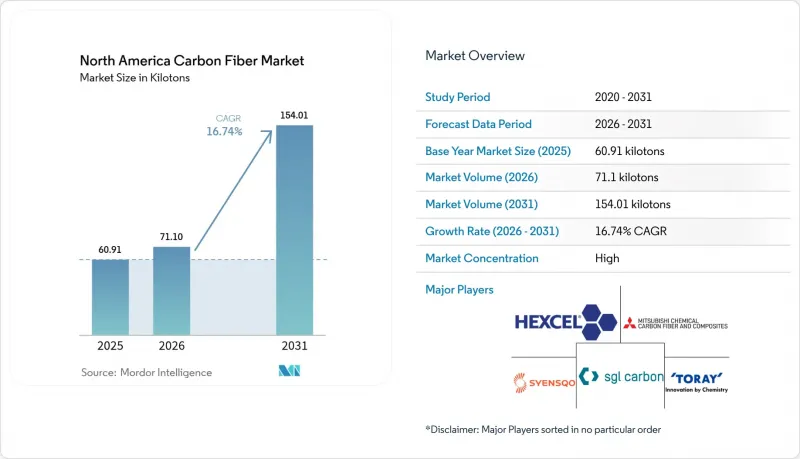
Mordor Intelligence에 의하면, 북미의 탄소섬유 시장 규모는 2025년 60.91 킬로톤에서 2026년에는 71.1킬로톤에 이르고, 2026-2031년 CAGR 16.74%로 성장을 지속하여 2031년에는 154.01킬로톤에 이를 것으로 예측됩니다.
본 보고서는 원재료(폴리아크릴로니트릴(PAN), 석유 피치, 레이온), 유형(버진 탄소섬유(VCF), 재생 탄소섬유(RCF)), 용도(복합재료, 섬유 등),최종 사용자 산업(항공우주 및 방위, 대체 에너지 등), 지역(미국, 캐나다 등)별로 분류되어 있습니다. 시장 예측은 수량(톤) 기준으로 제시되어 있습니다.
북미의 탄소섬유 시장 동향 및 인사이트
경량 차량에 대한 수요 증가
자동차의 전동화로 인해 북미의 탄소섬유 시장은 새로운 경량화 전략의 중심에 자리 잡고 있습니다. 제너럴 모터스(GM)의 시범 테스트에서 드러나듯이, 자동차 제조업체들은 자동 섬유 배치 라인을 활용하여 주력 모델에 구조 부품을 적용하고 있습니다. 미국 에너지부의 연방 연구개발 자금 투입으로 배터리 팩 하우징용 연성 탄소섬유 복합재료 개발이 가속화되고 있습니다. 연비 규제와 소비자의 주행 거리 기대감이 양산 플랫폼 전반에 걸쳐 향후 수년간 지속될 수요를 뒷받침하고 있습니다.
항공우주 및 방위 분야에서의 활용 확대
차세대 항공기 및 초음속 방어 시스템에는 고탄성률 섬유가 필수적이기 때문에 항공우주 분야는 북미의 탄소섬유 시장에서 계속해서 주도적인 위치를 유지하고 있습니다. 도레이는 NASA의 HiCAM 프로그램을 위해 열경화성 및 열가소성 프리프레그를 공급하며, 단기간 내에 제조가 가능한 복합재 주익 개발을 추진하고 있습니다. 콜린스 에어로스페이스는 스포캔 공장의 탄소-탄소 브레이크 생산 능력을 확대하기 위해 2억 달러를 투자한 반면, GE 에어로스페이스는 미국 내 복합재 부품 생산에 10억 달러 가까이를 할당하고 있어 장기적인 수요 전망이 더욱 밝아지고 있습니다.
규제에 기인한 원자재 공급 리스크
백악관 및 캐나다 정부의 중요 자재 재검토는 PAN 전구체 수입에 대한 감시가 강화되고 있음을 시사합니다. 수출 통제 목록 및 환경 허가 기준 강화와 같은 정책 전환은 북미의 탄소섬유 시장에서 공급 부족을 초래하고, 규정 준수 비용을 상승시킬 가능성이 있습니다.
부문 분석
2025년, PAN은 북미의 탄소섬유 시장의 91.20%를 차지했습니다. 이 부문은 입증된 강도 대 중량비와 충분히 파악된 공급망의 혜택을 받고 있습니다. 대조적으로, 석유 피치 및 레이온은 자동차 및 건설 업계의 구매자들이 극한 인장 강도보다 저비용을 우선시하고 있기 때문에 연평균 성장률(CAGR) 18.25%로 성장할 것으로 전망됩니다. Advanced Carbon Products LLC는 메소페이즈 피치 기반 탄소섬유 전구체를 개발 중이며, 이는 기존의 PAN 기반 제조 방식에 비해 상당한 비용 절감 기회를 제공합니다.
이러한 수요의 변화는 전구체 선택의 폭을 다양화하는 공급업체에 유리하게 작용합니다. 피치의 수율(70% 이상)은 PAN(55%)을 상회하며, 용광로의 에너지 소비량이 일정하다면 1kg당 비용을 절감할 수 있습니다. 압력 용기나 토목 인프라와 같은 대중 시장용 응용 분야에서는 이러한 경제성 덕분에 대체 전구체가 점점 더 유력한 선택지로 떠오르고 있습니다.
항공우주 및 방위 분야에서는 완벽한 추적성이 요구되기 때문에 2025년 북미의 탄소섬유 시장 규모에서 버진 섬유는 75.40%의 점유율을 유지했습니다. 반면, 재생 섬유는 연평균 성장률(CAGR) 18.48%를 나타낼 것으로 예측됩니다. Vartega사는 버진 섬유에 필적하는 기계적 특성을 실현하면서도 비용을 절반으로 줄이고, CO2 배출량을 96-99% 감축하는 데 성공했습니다.
OEM 업체들의 재생 중간재 채택이 증가하고 있습니다. 보잉사가 KyronTEX 사이드월 패널을 채택한 것은 재생 소재를 사용하더라도 엄격한 객실 내장 요건을 충족할 수 있음을 보여줍니다. 재생 스트랜드를 사용한 자동차용 사출 성형 컴파운드는 현재 완제품 비용을 최대 30% 절감하고 있어, 대량 채택을 촉진하고 있습니다.
기타 혜택:
- 엑셀 형식 시장 예측(ME) 시트
- 3개월간의 애널리스트 지원
자주 묻는 질문
목차
제1장 서론
제2장 조사 방법
제3장 주요 요약
제4장 시장 구도
제5장 시장 규모와 성장 예측
제6장 경쟁 구도
제7장 시장 기회와 향후 전망
LSH 26.09.09According to Mordor Intelligence, the North America carbon fiber market size is expected to grow from 60.91 kilotons in 2025 to 71.1 kilotons in 2026 and is forecast to reach 154.01 kilotons by 2031 at 16.74% CAGR over 2026-2031.
This report is Segmented by Raw Material (Polyacrylonitrile (PAN), Petroleum Pitch and Rayon), Type (Virgin Carbon Fiber (VCF), Recycled Carbon Fiber (RCF)), Application (Composite Materials, Textiles, and More), End-User Industry (Aerospace and Defense, Alternative Energy, and More), and Geography (United States, Canada, and More). The Market Forecasts are Provided in Terms of Volume (tons).
North America Carbon Fiber Market Trends and Insights
Rising Demand from Lightweight Vehicles
Automotive electrification positions the North America carbon fiber market at the center of new lightweight strategies. Automakers use automated-fiber-placement lines to integrate structural parts in mainstream models, as shown by General Motors' pilot trials. Federal R&D funding from the U.S. Department of Energy accelerates ductile carbon-fiber composite development for battery-pack housings. Regulations on fuel economy and consumer range expectations underpin sustained multi-year demand across volume platforms.
Accelerating Usage in Aerospace and Defense
Aerospace keeps its lead within the North America carbon fiber market because next-generation aircraft and hypersonic defense systems require high-modulus fiber. Toray supplies thermoset and thermoplastic prepregs for NASA's HiCAM program to improve fast-build composite wings. Collins Aerospace invested USD 200 million to enlarge Spokane carbon-carbon brake capacity, while GE Aerospace earmarked almost USD 1 billion for U.S. composite part production, reinforcing long-cycle demand visibility.
Regulatory-Driven Supply Risk for Raw Materials
Critical-material reviews by the White House and the Canadian government signal heightened scrutiny of PAN precursor imports. Policy shifts, such as export-control lists or stricter environmental permits, could pinch supply and raise compliance costs for the North America carbon fiber market.
Other drivers and restraints analyzed in the detailed report include:
- Growing Utilization from Wind Energy Sector
- Expansion of High-Performance Sporting Goods
- Limited Recycling Infrastructure and Quality Variance
For complete list of drivers and restraints, kindly check the Table Of Contents.
Segment Analysis
PAN commanded 91.20% of the North America carbon fiber market in 2025. The segment benefits from proven strength-to-weight ratios and well-understood supply chains. Petroleum-pitch and rayon, in contrast, are set to grow at an 18.25% CAGR because auto and construction buyers prioritize lower cost over ultimate tensile strength. Advanced Carbon Products LLC has developed a mesophase pitch carbon fiber precursor, offering a significant cost-saving opportunity compared to the conventional PAN-based production method.
Demand shifts favor suppliers that diversify precursor choice. Higher yield rates that exceed 70% for pitch versus 55% for PAN can cut per-kilogram costs when furnace energy remains constant. For mass-market uses such as pressure vessels or civil infrastructure, these economics make alternative precursors increasingly credible options.
Virgin fiber retained 75.40% share of the North America carbon fiber market size in 2025 because aerospace and defense require full traceability. Recycled fiber, however, is projected to post a 18.48% CAGR. Vartega reached mechanical properties comparable to virgin fiber but at half the cost and 96-99% lower CO2 footprint.
OEM acceptance of recycled intermediates is rising. Boeing's use of KyronTEX sidewall panels shows that strict cabin-interior requirements can be met with reclaimed content. Automotive injection-molding compounds with recycled strands now cut finished-part cost by up to 30%, spurring volume adoption.
Complete Report Scope:
- By Raw Material
- Polyacrylonitrile (PAN)
- Peroleum Pitch and Rayon
- By Type
- Virgin Carbon Fiber (VCF)
- Recycled Carbon Fiber (RCF)
- By Application
- Composite Materials
- Textiles
- Micro-electrodes
- Catalysis
- By End-user Industry
- Aerospace and Defense
- Alternative Energy
- Automotive
- Construction and Infrastructure
- Sporting Goods
- Other End-user Industries (Marine and Maritime)
- By Geography
- United States
- Canada
- Mexico
- Rest of North America
List of Companies Covered in this Report:
- A&P Technology, Inc.
- ACP Composites Inc.
- DowAksa
- Gurit Services AG
- Hexcel Corporation
- HS HYOSUNG USA
- Jiangsu Hengshen Co., Ltd.
- Mitsubishi Chemical Carbon Fiber and Composites Inc.
- Present Advanced Composites Inc.
- SGL Carbon
- Syensqo
- TEIJIN LIMITED
- Toray Industries Inc.
- Vartega Inc.
Additional Benefits:
- The market estimate (ME) sheet in Excel format
- 3 months of analyst support
TABLE OF CONTENTS
1 Introduction
- 1.1 Study Assumptions and Market Definition
- 1.2 Scope of the Study
2 Research Methodology
3 Executive Summary
4 Market Landscape
- 4.1 Market Overview
- 4.2 Market Drivers
- 4.2.1 Rising Demand from Lightweight Vehicles
- 4.2.2 Accelerating Usage in Aerospace and Defense
- 4.2.3 Growing Utilization from Wind Energy Sector
- 4.2.4 Expansion of High-Performance Sporting Goods
- 4.2.5 Adoption in Hydrogen Storage Tanks for Heavy-Duty Mobility
- 4.3 Market Restraints
- 4.3.1 High Research and Development, and Capital Expenditure
- 4.3.2 Regulatory-Driven Supply Risk for Raw Materials
- 4.3.3 Limited Recycling Infrastructure and quality variance
- 4.4 Value Chain Analysis
- 4.5 Porter's Five Forces
- 4.5.1 Bargaining Power of Suppliers
- 4.5.2 Bargaining Power of Buyers
- 4.5.3 Threat of New Entrants
- 4.5.4 Threat of Substitutes
- 4.5.5 Competitive Rivalry
5 Market Size and Growth Forecasts (Volume)
- 5.1 By Raw Material
- 5.1.1 Polyacrylonitrile (PAN)
- 5.1.2 Peroleum Pitch and Rayon
- 5.2 By Type
- 5.2.1 Virgin Carbon Fiber (VCF)
- 5.2.2 Recycled Carbon Fiber (RCF)
- 5.3 By Application
- 5.3.1 Composite Materials
- 5.3.2 Textiles
- 5.3.3 Micro-electrodes
- 5.3.4 Catalysis
- 5.4 By End-user Industry
- 5.4.1 Aerospace and Defense
- 5.4.2 Alternative Energy
- 5.4.3 Automotive
- 5.4.4 Construction and Infrastructure
- 5.4.5 Sporting Goods
- 5.4.6 Other End-user Industries (Marine and Maritime)
- 5.5 By Geography
- 5.5.1 United States
- 5.5.2 Canada
- 5.5.3 Mexico
- 5.5.4 Rest of North America
6 Competitive Landscape
- 6.1 Market Concentration
- 6.2 Strategic Moves
- 6.3 Market Share(%)/Ranking Analysis
- 6.4 Company Profiles (includes Global level Overview, Market level overview, Core Segments, Financials as available, Strategic Information, Market Rank/Share for key companies, Products and Services, and Recent Developments)
- 6.4.1 A&P Technology, Inc.
- 6.4.2 ACP Composites Inc.
- 6.4.3 DowAksa
- 6.4.4 Gurit Services AG
- 6.4.5 Hexcel Corporation
- 6.4.6 HS HYOSUNG USA
- 6.4.7 Jiangsu Hengshen Co., Ltd.
- 6.4.8 Mitsubishi Chemical Carbon Fiber and Composites Inc.
- 6.4.9 Present Advanced Composites Inc.
- 6.4.10 SGL Carbon
- 6.4.11 Syensqo
- 6.4.12 TEIJIN LIMITED
- 6.4.13 Toray Industries Inc.
- 6.4.14 Vartega Inc.
7 Market Opportunities and Future Outlook
- 7.1 White-space and unmet-need assessment