

|
시장보고서
상품코드
2121631
벤젠 : 시장 점유율 분석, 업계 동향과 통계, 성장 예측(2026-2031년)Benzene - Market Share Analysis, Industry Trends & Statistics, Growth Forecasts (2026 - 2031) |
||||||
 Mordor Intelligence
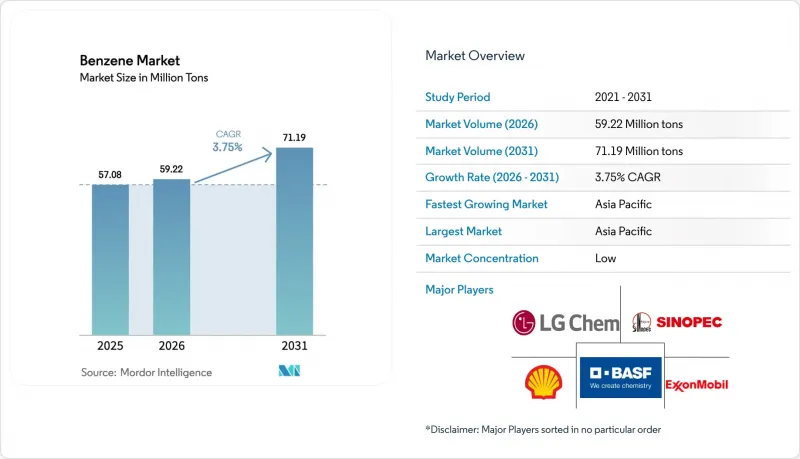
Mordor Intelligence에 따르면 벤젠 시장 규모는 2025년 5,708만 톤에서 2026년에는 5,922만 톤으로 확대되고, 2026년부터 2031년까지 CAGR 3.75%를 기록하며 2031년까지 7,119만 톤에 달할 것으로 예측됩니다.
본 보고서는 유도체(에틸벤젠, 쿠멘, 알킬벤젠, 시클로헥산, 니트로벤젠, 기타 유도체), 최종사용자 산업(플라스틱·폴리머,수지·접착제, 농약, 의약품, 페인트 및 코팅·용제), 그리고 지역(아시아태평양, 북미, 유럽, 남미, 중동 및 아프리카)별로 분류되어 있습니다. 시장 예측은 톤 기준으로 제시되어 있습니다.
세계 벤젠 시장의 동향 및 인사이트
포장 및 자동차 분야의 스티렌계 폴리머 수요 증가
2025년에는 스티렌 단량체의 소비량이 전 세계 벤젠 공급량의 약 51%를 차지하며, 포장용 폴리스티렌 시장 및 자동차 내장재용 아크릴로니트릴 부타디엔 스티렌(ABS) 수지 시장을 뒷받침하고 있습니다. 아시아태평양에서는 E-Commerce 물류 및 콜드체인의 확장에 힘입어 폴리스티렌 소비량이 연평균 4-5%의 성장률을 기록하고 있는 반면, 북미 및 유럽에서는 일회용 플라스틱 규제를 배경으로 수요 증가율이 2% 미만에 그치고 있습니다. 자동차 경량화가 진행됨에 따라 ABS 및 아크릴로니트릴-스티렌 수지가 대시보드와 외장 트림에 채택되고 있어, 포장 분야의 수요가 둔화되더라도 벤젠 처리량은 유지되고 있습니다. 2025년 11월에 가동을 시작하는 BASF의 잔장(湛江)에 위치한 연산 100만 톤 규모의 크래커·스티렌 복합 시설 등 통합형 투자는 이익을 확보하고 가격 변동을 완화하는 전략적 병설의 좋은 사례입니다. 포장 및 자동차 양 분야에서의 재고 주기는 동시 다발적인 공급망 리스크를 초래하므로, 벤젠 시장에 진출한 기업들에게는 유연한 생산 일정 수립이 필수적입니다.
아시아 통합형 생산 사업자의 다운스트림 화학제품 생산능력 확충
2023년부터 2025년까지 아시아의 복합 시설에서는 시노펙-아람코의 100억 달러 규모 푸젠성 프로젝트와릴라이언스의 97억 5,000만 달러 규모 원유-화학제품 전환 시설을 핵심으로 연간 약 1,200만 톤의 방향족 화합물 생산능력이 추가되었습니다. 원유에서 방향족 화합물로 직접 전환하는 기술은 유럽의 나프타 크래커 방식에 비해 벤젠의 현금 원가를 톤당 50-80달러 절감하여 경쟁 격차를 더욱 벌리고 있습니다. 2025년 4월 얀부에서 연간 150만 톤 규모의 방향족 화합물 플랜트 구축에 대한 기본 합의가 이루어짐에 따라, 이 모델은 페르시아만 지역으로 확대되어, 해당 지역은 유럽 및 아프리카로의 스윙 수출국으로서의 지위를 확립하게 될 것입니다. 아시아의 현물 가격은 공급 과잉 사이클을 반영하여 2025년 1월 톤당 900달러에서 2025년 7월에는 톤당 728달러까지 하락했습니다. 그 결과, 비통합형 생산자들은 가동률을 낮추거나 손익분기점에서 수출을 해야 하는 상황에 몰리게 되었으며, 벤젠 시장에서 다운스트림 부문과의 연계 필요성이 부각되었습니다.
엄격한 직업적 노출 한계치와 소송 위험
OSHA(미국 직업안전보건청)는 벤젠 노출 상한선을 시간 가중 평균 1ppm으로 정하고 있으며, 유럽연합(EU)의 REACH 체계에서도 유사한 기준치가 설정되어 있습니다. 이에 따라 지속적인 대기 모니터링, 개인보호구 착용 및 건강 감시가 의무화되었습니다. 규제 준수로 인해 성숙한 지역에서는 생산 비용이 톤당 5-10달러 증가합니다. 정유소 근로자와의 화해를 포함한 소송 판례로 인해 배상 책임 보험료가 상승하고 있으며, 2026년 6월로 예정된 INEOS의 사니아 공장 철수 등 공장 폐쇄가 가속화되고 있습니다. 중국 규제 당국이 단속을 강화하기 시작하면서 일부 아시아 거점의 기존 비용 우위는 점차 줄어들고 있습니다. 규정 준수를 위한 막대한 지출과 부진한 현지 파생 제품 수요가 맞물리면서, 벤젠 시장의 생산능력을 통합형 저비용 거점으로 재분배하는 합리화 흐름이 가속화되고 있습니다.
부문별 분석
2025년, 에틸벤젠은 세계 수요의 51.40%를 차지하며, 폴리스티렌, ABS, 스티렌-부타디엔 고무용 스티렌 모노머를 통해 벤젠 시장의 핵심 축을 이루고 있습니다. 벤젠 시장 전체적으로는 소폭의 확대가 예상되지만, 폴리스티렌의 성장은 선진국의 포장 관련 법규에 의해 억제되고 있습니다. 쿠멘은 건축용 패널 및 폴리카보네이트 유리 관련 페놀·아세톤계 생산 라인의 공급원으로서 매우 중요한 역할을 하고 있습니다. 니트로벤젠은 현재 시장 규모는 작지만, 폴리우레탄 단열재의 보급 확대와 자동차 경량화를 배경으로 4.48%라는 가장 높은 연평균 성장률(CAGR)을 기록하고 있습니다. 알킬벤젠은 계면활성제에 대한 안정적인 수요에 기여하고 있으며, 시클로헥산은 나일론 6의 기반이 되고 있습니다. 말레산 무수물이나 클로로벤젠 등의 특수 용도 시장은 전체적으로 여전히 제한적입니다. 이러한 유도체 간에 생산량을 유연하게 전환할 수 있는 통합형 복합 플랜트는, 특히 스티렌의 경기 침체기에 단일 유도체 플랜트에서는 얻을 수 없는 다각화의 이점을 누리고 있습니다.
벤젠 시장에서의 점유율 우위로 인해 에틸벤젠의 가격 결정력이 높아지고 있지만, 견조한 이익률은 ISO 인증을 획득한 공급망이 프리미엄을 확보하고 있는 니트로벤젠 및 의약용 아닐린 쪽으로 점점 더 이동하고 있습니다. 유럽의 범용 에틸벤젠 플랜트는 스프레드 축소에 직면하고 있는 반면, 현지 MDI 시설과 연계된 아시아의 니트로벤젠 생산 설비는 안정적인 수익을 올리고 있습니다. 스티렌 스프레드가 축소되었을 때, 에틸벤젠에서 니트로벤젠으로 벤젠을 재분배하는 등 파생 제품 간의 유연한 전환은 통합형 생산자에게 전술적 수단으로 부상하고 있습니다. 다운스트림 부문을 보유하지 않은 일반 공급업체는 수출 차익 거래에 의존할 수밖에 없어, 운임, 환율, 현물 가격 변동 위험에 노출되어 있습니다.
지역별 분석
아시아태평양은 2025년에 전 세계 생산량의 55.80%를 차지했으며, 2031년까지 연평균 성장률(CAGR) 4.32%를 기록할 전망입니다. 중국만 해도 연간 1,800만 톤 이상의 생산능력을 보유하고 있으며, 여기에 더해 중국석유화학(Sinopec)의 여러 거점에서의 확장 및 2027년 가동 개시를 목표로 건설 중인 푸젠성 콤플렉스가 생산능력을 더욱 강화할 전망입니다. 인도의 ‘릴라이언스(Reliance)’사가 추진하는 원유에서 화학제품으로의 전환 허브는 연간 350만 톤의 BTX 생산능력을 추가하여, 2028년까지 인도를 순수출국으로 도약시킬 전망입니다. 일본과 한국은 수율 최적화와 특수 파생 제품 생산에 중점을 두고 있으며, 잉여 벤젠을 대만으로 수출하고 있습니다. 태국과 말레이시아는 각각 PTT 세계 케미컬사의 연간 242만 톤,켐원(ChemOne)사의 연간 65만 6,000톤 프로젝트를 통해 지역 물류 격차를 메우고 있습니다. 낮은 현금 비용, 유연한 원료 구성, 그리고 자사용 파생 제품의 조합이 벤젠 시장에서 아시아태평양의 주도적 지위를 공고히 하고 있습니다.
북미에서는 미국 멕시코만 연안의 정유소와 에틸렌 크래커가 핵심을 이루고 있지만, 에탄을 원료로 사용하는 방향으로의 전환으로 인해 벤젠의 제품별 생산량이 감소하여 스티렌 제조사들은 수입에 의존할 수밖에 없는 상황입니다. OSHA(미국 산업안전보건청)가 정한 1ppm의 노출 한계치와 소송 관련 비용의 증가로 인해 고정비가 상승하면서, INEOS사의 사니아 공장 폐쇄 계획으로 대표되는 플랜트 합리화가 진행되고 있습니다. 캐나다와 멕시코는 소규모 생산능력만을 보유하고 있어, 유지보수나 예기치 못한 가동 중단 시에는 수입에 의존하고 있습니다.
유럽에서는 에너지 가격, REACH 규정 준수, 설비 노후화로 인해 이익률이 압박받고 있습니다. BASF의 베르반트 네트워크는 통합을 통해 경쟁력을 유지하고 있는 반면, 독립 기업들은 사업 매각이나 가동 중단을 선택지로 검토하고 있습니다. 중동 및 아시아의 수출업자들이 앤트워프·로테르담·암스테르담 터미널을 목표로 삼고 있어, 수입 의존도는 더욱 높아지고 있습니다. 네덜란드에서 진행 중인 SABIC의 전기 가열로 등의 프로젝트는 배출량 감축과 가동 유연성 향상을 목표로 하고 있습니다.
남미의 벤젠 시장은 브라질의 브라스크엠(Braskem)이 운영하는 주요 화학 시스템이 지배적입니다. 2025년 가동 중단으로 인해 수출이 감소했을 뿐만 아니라, 지역 가격에도 부정적인 영향을 미쳤습니다. ‘트랜스포마 수르’ 및 ‘트랜스포마 리우’ 프로그램에 따라 가스 원료의 비중이 증가함에 따라, 향후 벤젠의 부생 생산량이 감소하여 공급이逼迫될 가능성이 있습니다. 아르헨티나를 비롯한 생산국의 공급량은 극히 적기 때문에 추가 수요는 수입을 통해 충당될 가능성이 있습니다.
중동 및 아프리카에서는 아람코-시노펙의 얀부 프로젝트와 주바이르의 아미랄 콤플렉스가 페르시아만 지역의 통합형 방향족 화합물 생산을 확대하고 있습니다. 홍해 및 페르시아만 터미널을 통한 수출 옵션을 통해, 이 지역은 유럽 및 아프리카를 대상으로 하는 스윙 공급자로서의 입지를 확고히 하고 있습니다. 남아프리카의 수요는 여전히 수입에 의존하고 있습니다. 홍해에서의 운송 차질 등 물류 리스크가 여전히 존재하기 때문에 구매자들은 벤젠 시장에서 계약 포트폴리오의 다각화를 모색하고 있습니다.
기타 혜택:
- 엑셀 형식의 시장 예측(ME) 시트
- 3개월간 애널리스트 지원
자주 묻는 질문
목차
제1장 소개
제2장 조사 방법
제3장 주요 요약
제4장 시장 구도
제5장 시장 규모와 성장 예측
제6장 경쟁 구도
제7장 시장 기회와 향후 전망
KSM 26.09.07According to Mordor Intelligence, the benzene market size is expected to grow from 57.08 million tons in 2025 to 59.22 million tons in 2026 and is forecast to reach 71.19 million tons by 2031 at a 3.75% CAGR over 2026-2031.
This report is Segmented by Derivative (Ethylbenzene, Cumene, Alkylbenzene, Cyclohexane, Nitrobenzene, and Other Derivatives), End-User Industry (Plastics & Polymers, Resins & Adhesives, Agrochemicals, Pharmaceuticals, Paints, and Coatings & Solvents), and Geography (Asia-Pacific, North America, Europe, South America, and Middle East and Africa). The Market Forecasts are Provided in Terms of Volume (Tons).
Global Benzene Market Trends and Insights
Increasing Demand for Styrene-Based Polymers in Packaging & Automotive
Styrene monomer consumed about 51% of global benzene supply in 2025, underpinning polystyrene markets for packaging and acrylonitrile-butadiene-styrene resins for automotive interiors. Asia-Pacific registers 4-5% annual growth in polystyrene consumption, supported by e-commerce logistics and cold-chain expansion, while North American and European demand grows below 2% amid single-use plastics restrictions. Automotive lightweighting pushes ABS and styrene-acrylonitrile resins into dashboards and exterior trim, sustaining benzene throughput even when packaging moderates. Integrated investments such as BASF's 1 million tpa cracker-styrene complex in Zhanjiang, started in November 2025, exemplify strategic co-location that captures margin and mitigates price volatility. Inventory cycles in both packaging and automotive impose simultaneous supply-chain risks, making flexible production scheduling critical for benzene market participants.
Capacity Additions for Downstream Chemicals by Integrated Producers in Asia
Between 2023 and 2025, Asian complexes added about 12 million tpa of aromatics, anchored by Sinopec-Aramco's USD 10 billion Fujian project and Reliance's USD 9.75 billion crude-to-chemicals facility. Direct crude-to-aromatics technology trims benzene cash costs by USD 50-80 per ton versus European naphtha cracker routes, widening the competitiveness gap. The April 2025 framework for a 1.5 million tpa aromatics plant in Yanbu extends this model to the Gulf, positioning the region as a swing exporter to Europe and Africa. Spot prices in Asia fell from USD 900 per ton in January 2025 to USD 728 per ton in July 2025, reflecting the oversupply cycle. Non-integrated producers consequently curtailed run rates or exported at breakeven, underscoring the necessity of downstream linkages within the benzene market.
Stringent Occupational Exposure Limits & Litigation Risk
OSHA caps benzene exposure at 1 ppm time-weighted average, with similar thresholds under the European Union's REACH framework, compelling continuous air monitoring, personal protective equipment, and medical surveillance. Compliance adds USD 5-10 per ton to production costs in mature regions. Litigation precedents, including refinery worker settlements, elevate liability premiums and accelerate plant closures such as INEOS's scheduled Sarnia exit in June 2026. Regulators in China have begun tightening enforcement, narrowing historical cost advantages for some Asian sites. High compliance spending, combined with muted local derivative demand, underpins a wave of rationalization that redistributes benzene market capacity toward integrated low-cost hubs.
Other drivers and restraints analyzed in the detailed report include:
- Recovery of Construction Sector Boosting Phenol & Caprolactam Chains
- Growing Adoption of Alkylbenzene-Based Surfactants in Emerging Markets
- Volatility of Crude-Oil-Linked Feedstock Prices
For complete list of drivers and restraints, kindly check the Table Of Contents.
Segment Analysis
Ethylbenzene held 51.40% of global demand in 2025, anchoring the benzene market through styrene monomer for polystyrene, ABS, and styrene-butadiene rubber. While the overall benzene market sees slight expansion, growth in polystyrene is tempered by packaging legislation in developed economies. Cumene plays a pivotal role, feeding into phenol-acetone chains associated with construction panels and polycarbonate glazing. Nitrobenzene, while smaller today, records the highest 4.48% CAGR, supported by the polyurethane insulation push and automotive lightweighting. Alkylbenzene contributes to steady surfactant demand, and cyclohexane underpins nylon-6. Specialty outlets such as maleic anhydride and chlorobenzenes collectively remain limited. Integrated complexes, able to swing output among these derivatives, capture diversification benefits unavailable to single-derivative plants, especially during styrene down-cycles.
The benzene market share leadership gives ethylbenzene pricing influence, yet margin resilience increasingly gravitates toward nitrobenzene and pharmaceutical aniline, where ISO-certified supply chains secure premiums. Commodity ethylbenzene plants in Europe face tightening spreads, while Asian nitrobenzene units linked to local MDI facilities post stable earnings. Cross-derivative optionality, such as reallocating benzene from ethylbenzene to nitrobenzene when styrene spreads compress, emerges as a tactical lever for integrated producers. Merchant suppliers without downstream capture must rely on export arbitrage, exposing them to freight, currency, and spot volatility.
Complete Report Scope:
- By Derivative
- Ethylbenzene
- Cumene
- Alkylbenzene
- Cyclohexane
- Nitrobenzene
- Other Derivatives (Aniline, Maleic Anhydride, and more)
- By End-user Industry
- Plastics and Polymers
- Resins & Adhesives
- Agrochemicals
- Pharmaceuticals
- Paints, Coatings, and Solvents
- Geography
- Asia-Pacifc
- China
- India
- Japan
- South Korea
- ASEAN Countries
- Rest of Asia-Pacific
- North America
- United States
- Canada
- Mexico
- Europe
- Germany
- United Kingdom
- France
- Italy
- Spain
- Russia
- NORDIC Countries
- Rest of Europe
- South America
- Brazil
- Argentina
- Rest of South America
- Middle East and Africa
- Saudi Arabia
- South Africa
- Rest of Middle East and Africa
- Asia-Pacifc
Geography Analysis
Asia-Pacific retained 55.80% of global volume in 2025 and is set to post a 4.32% CAGR through 2031. China alone runs more than 18 million tpa of capacity, augmented by Sinopec's multi-site expansions and the Fujian complex under construction for a 2027 start-up. India's Reliance crude-to-chemicals hub adds 3.5 million tpa BTX capability, elevating the country to net-export status by 2028. Japan and South Korea emphasize yield optimization and specialty derivatives, exporting surplus benzene to Taiwan. Thailand and Malaysia fill regional logistics gaps through PTT Global Chemical's 2.42 million tpa and ChemOne's 656 thousand tpa projects, respectively. Lower cash costs, flexible feed slates, and captive derivatives collectively anchor Asia-Pacific leadership in the benzene market.
In North America, US Gulf Coast refineries and ethylene crackers form the backbone, yet the pivot toward ethane feed reduces benzene co-product output, forcing styrene makers to import. OSHA's 1 ppm exposure limit and litigation premiums raise fixed costs, prompting plant rationalization exemplified by INEOS's Sarnia closure plan. Canada and Mexico contribute modest capacity, relying on imports during maintenance or unplanned outages.
In Europe, energy pricing, REACH compliance, and aging assets compress margins. BASF's Verbund network maintains competitiveness through integration, while independent units review divestment or shutdown options. Import reliance deepens as Middle Eastern and Asian exporters target Antwerp-Rotterdam-Amsterdam terminals. Projects such as SABIC's electrically heated furnace in the Netherlands aim to cut emissions and enhance operational flexibility.
South America's benzene market is dominated by Braskem's main chemicals system in Brazil. Operational disruptions in 2025 trimmed exports and weighed on regional prices. The Transforma Sul and Transforma Rio programs will raise gas feedstock share, likely lowering future benzene co-production and tightening supply. Argentina and other producers contribute minor volumes, so incremental demand may be met by imports.
In the Middle East and Africa, Aramco-Sinopec's Yanbu project and the Amiral complex at Jubail expand integrated aromatics in the Gulf. Export optionality through Red Sea and Gulf terminals positions the region as a swing supplier to Europe and Africa. South African demand remains import-oriented. Logistics risks, such as Red Sea transit disruptions, persist, encouraging buyers to diversify contract portfolios within the benzene market.
- BASF
- Braskem S.A.
- Chevron Phillips Chemical Co. LLC
- China Petrochemical Corporation
- Eastman Chemical Company
- Exxon Mobil Corporation
- Formosa Chemicals & Fibre Corporation
- INEOS
- LG Chem
- LyondellBasell Industries N.V.
- Marathon Petroleum Corp.
- Maruzen Petrochemical
- Mitsubishi Chemical Group Corporation.
- PTT Global Chemical PCL
- Reliance Industries Limited
- SABIC
- Shell
- SIBUR
- TotalEnergies
Additional Benefits:
- The market estimate (ME) sheet in Excel format
- 3 months of analyst support
TABLE OF CONTENTS
1 Introduction
- 1.1 Study Assumptions & Market Definition
- 1.2 Scope of the Study
2 Research Methodology
3 Executive Summary
4 Market Landscape
- 4.1 Market Overview
- 4.2 Market Drivers
- 4.2.1 Increasing demand for styrene-based polymers in packaging and automotive
- 4.2.2 Capacity additions for downstream chemicals by integrated producers in Asia
- 4.2.3 Recovery of construction sector boosting phenol and caprolactam chains
- 4.2.4 Growing adoption of alkylbenzene-based surfactants in emerging markets
- 4.2.5 Growing demand for benzene from pharmaceutical industry
- 4.3 Market Restraints
- 4.3.1 Stringent occupational exposure limits and litigation risk
- 4.3.2 Volatility of crude-oil-linked feedstock prices
- 4.3.3 Competing C4 aromatics routes for downstream derivatives
- 4.4 Value Chain Analysis
- 4.5 Regulatory Landscape
- 4.6 Technological Outlook
- 4.7 Price Analysis
- 4.8 Porter's Five Forces
- 4.8.1 Bargaining Power of Suppliers
- 4.8.2 Bargaining Power of Buyers
- 4.8.3 Threat of New Entrants
- 4.8.4 Threat of Substitutes
- 4.8.5 Degree of Competition
5 Market Size & Growth Forecasts (Volume)
- 5.1 By Derivative
- 5.1.1 Ethylbenzene
- 5.1.2 Cumene
- 5.1.3 Alkylbenzene
- 5.1.4 Cyclohexane
- 5.1.5 Nitrobenzene
- 5.1.6 Other Derivatives (Aniline, Maleic Anhydride, and more)
- 5.2 By End-user Industry
- 5.2.1 Plastics and Polymers
- 5.2.2 Resins & Adhesives
- 5.2.3 Agrochemicals
- 5.2.4 Pharmaceuticals
- 5.2.5 Paints, Coatings, and Solvents
- 5.3 Geography
- 5.3.1 Asia-Pacifc
- 5.3.1.1 China
- 5.3.1.2 India
- 5.3.1.3 Japan
- 5.3.1.4 South Korea
- 5.3.1.5 ASEAN Countries
- 5.3.1.6 Rest of Asia-Pacific
- 5.3.2 North America
- 5.3.2.1 United States
- 5.3.2.2 Canada
- 5.3.2.3 Mexico
- 5.3.3 Europe
- 5.3.3.1 Germany
- 5.3.3.2 United Kingdom
- 5.3.3.3 France
- 5.3.3.4 Italy
- 5.3.3.5 Spain
- 5.3.3.6 Russia
- 5.3.3.7 NORDIC Countries
- 5.3.3.8 Rest of Europe
- 5.3.4 South America
- 5.3.4.1 Brazil
- 5.3.4.2 Argentina
- 5.3.4.3 Rest of South America
- 5.3.5 Middle East and Africa
- 5.3.5.1 Saudi Arabia
- 5.3.5.2 South Africa
- 5.3.5.3 Rest of Middle East and Africa
- 5.3.1 Asia-Pacifc
6 Competitive Landscape
- 6.1 Market Concentration
- 6.2 Strategic Moves
- 6.3 Market Share(%)/Ranking Analysis
- 6.4 Company Profiles (includes Global level Overview, Market level overview, Core Segments, Financials as available, Strategic Information, Market Rank/Share for key companies, Products & Services, and Recent Developments)
- 6.4.1 BASF
- 6.4.2 Braskem S.A.
- 6.4.3 Chevron Phillips Chemical Co. LLC
- 6.4.4 China Petrochemical Corporation
- 6.4.5 Eastman Chemical Company
- 6.4.6 Exxon Mobil Corporation
- 6.4.7 Formosa Chemicals & Fibre Corporation
- 6.4.8 INEOS
- 6.4.9 LG Chem
- 6.4.10 LyondellBasell Industries N.V.
- 6.4.11 Marathon Petroleum Corp.
- 6.4.12 Maruzen Petrochemical
- 6.4.13 Mitsubishi Chemical Group Corporation.
- 6.4.14 PTT Global Chemical PCL
- 6.4.15 Reliance Industries Limited
- 6.4.16 SABIC
- 6.4.17 Shell
- 6.4.18 SIBUR
- 6.4.19 TotalEnergies
7 Market Opportunities & Future Outlook
- 7.1 White-space and Unmet-need Assessment
- 7.2 Increasing focus on the production of bio-based benzene


