

|
시장보고서
상품코드
2121672
자동차 타이어 : 시장 점유율 분석, 업계 동향과 통계, 성장 예측(2026-2031년)Automotive Tires - Market Share Analysis, Industry Trends & Statistics, Growth Forecasts (2026 - 2031) |
||||||
 Mordor Intelligence
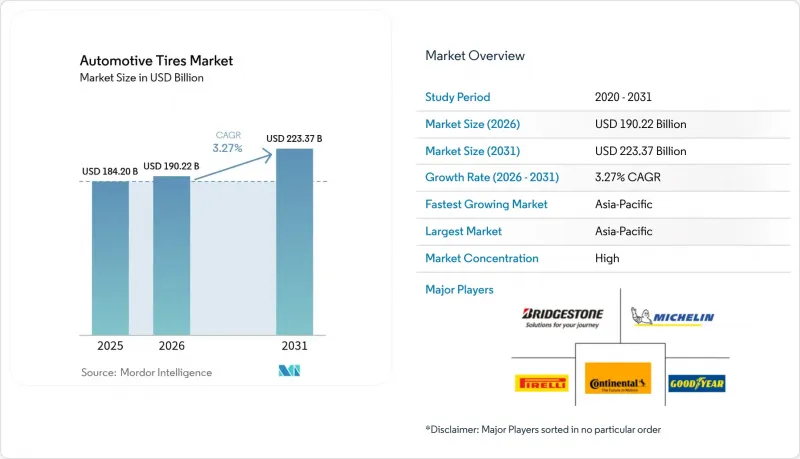
Mordor Intelligence에 따르면 자동차 타이어 시장 규모는 2026년에 1,902억 2,000만 달러로 추정되며, 2025년 1,842억 달러에서 확대되어 2031년에는 2,233억 7,000만 달러에 달할 것으로 예측됩니다.
2026년부터 2031년까지 연평균 성장률(CAGR) 3.27%로 성장할 것으로 전망됩니다.
본 보고서는 타이어 종류(여름용 타이어, 겨울용 타이어 등), 타이어 구조(레이디얼 타이어, 바이아스 타이어 등), 차량 유형(승용차 등), 용도(온로드, 오프로드), 최종사용자(OEM, 애프터마켓), 림 크기(15인치 미만 등), 구동 방식(ICE, BEV 등), 그리고 지역별로 분류되어 있습니다. 시장 예측은 금액(달러) 및 수량(단위)으로 제시되어 있습니다.
세계 자동차 타이어 시장의 동향 및 인사이트
전동화에 힘입은 초저소음 타이어 수요
전기 구동 시스템으로 인해 엔진의 가림 소음이 사라지기 때문에 타이어와 노면 간의 상호작용이 음향 측면에서 주요 요인이 됩니다. 고급 EV 제조사들은 차량 내 소음을 최대 20%까지 줄여주는 소음 제거 폼 제품이나 최적화된 트레드 패턴에 더 높은 프리미엄을 지불하고 있습니다. 유럽연합(EU)의 외부 소음 규제 강화가 이러한 추세를 뒷받침하고 있으며, 현재 자동차 타이어 시장에서는 규제 준수와 승차감을 모두 충족시키기 위해 주류 부문에서도 유사한 기술이 요구되고 있습니다. 공급업체는 성능 요건과 규제를 충족하고, 경쟁이 치열한 OE(순정) 채택을 확보하는 동시에, 원자재 비용 상승에도 불구하고 가격 규율을 유지할 수 있습니다.
중국 내 저RRR 타이어 채택 의무화
제6단계 연비 규제에서는 연비를 15% 개선해야 할 의무가 부과되어 있어, 구름 저항이 주목받고 있습니다. 국내 및 세계 브랜드들은 연구개발 주기를 18개월로 단축하고, 8%의 연비 향상을 실현하는 실리카를 풍부하게 함유한 컴파운드 개발을 추진하고 있습니다. 중국 형식 인증에서 달성된 성과는 아시아 전역의 생산으로 빠르게 확산되어, 중복된 연구개발 비용을 들이지 않고도 자동차 타이어 시장 전체의 기본 기술을 향상시키고 있습니다.
동남아시아의 고무나무 잎병 영향
페스탈로티옵시스(Pestalotiopsis) 감염으로 인해 인도네시아의 라텍스 생산량이 감소함에 따라 천연 고무 현물 가격이 전년 대비 33% 상승하여 전 세계 타이어 제조사의 이익률이 압박받고 있습니다. 감염된 나무가 수유 가능한 성숙기에 도달하기까지 최대 10년이 소요되기 때문에 회복은 더딘 상황입니다. 생산자들은 구아유르와 러시아 민들레로 조달원을 다각화하고 있지만, 상업적 규모의 생산을 시작하기까지는 아직 몇 시즌이 더 필요하므로 중기적으로는 비용 압박이 지속될 전망입니다.
부문 분석
올시즌 타이어는 다양한 기후 조건에서 연중 사용할 수 있는 편의성에 힘입어, 2025년에도 자동차용 타이어 시장 점유율의 61.78%를 차지하며 1위를 유지했습니다. 겨울용 타이어는 점유율은 작지만, 유럽의 안전 기준 강화에 따라 보급이 확대됨에 따라 2026년부터 2031년까지 연평균 성장률(CAGR) 4.12%로 가장 높은 성장률을 기록할 것으로 예측됩니다. 여름용 타이어는 기온이 항상 높은 지역에서 계속해서 인기를 끌고 있는 반면, 올테레인/머드테레인 패턴의 타이어는 오프로드 성능을 중시하는 SUV 소유자들을 매료시키고 있습니다. 각 제조사는 현재 고실리카 배합 컴파운드와 적응형 사이프를 결합하여 하나의 트레드로 고온 환경과 소량의 눈 모두에 대응할 수 있도록 하고 있으며, 이를 통해 딜러의 재고 관리 복잡성을 줄이고 있습니다.
연구 개발(R&D) 투자는 전기자동차(EV)의 수요에도 대응하고 있습니다. 발포 인서트를 통해 차내 소음을 줄이고, 고무 배합을 통해 영하에서도 유연성을 유지함으로써 프리미엄 겨울용 타이어가 전기자동차 구매자에게 매력적인 선택지가 되고 있습니다. 또한, 배송용 밴에서 ‘세 개의 산과 눈송이’ 마크 인증을 지정하는 차량 함대가 증가하고 있어, 규제 적용 범위가 확대되고 있음을 알 수 있습니다. 한편, 데이터 기반 타이어 로테이션 서비스는 트레드 수명을 연장하고, 수익을 부가가치가 높은 겨울용 타이어 교체 패키지로 전환시키고 있습니다. 이러한 상호 작용하는 동향으로 인해 계절 한정 제품 라인은 단순한 온도대 구분을 훨씬 뛰어넘어 진화하고 있습니다.
레이디얼 구조는 연비 효율, 안정적인 핸들링, 그리고 긴 트레드 수명 덕분에 2025년에는 자동차용 타이어 시장 점유율의 85.72%를 차지했습니다. 바이어스 구조는 저속·고부하 틈새 시장에서 여전히 입지를 유지하고 있지만, 그 영향력은 계속 축소되고 있습니다. 가장 혁신적인 발전은 비공기식/에어리스 부문입니다. 건설, 군사 및 지면 유지 관리 차량들이 펑크에 강하고 가동 시간을 확보할 수 있는 타이어를 요구하고 있어, 2031년까지 연평균 5.49%의 성장이 예상됩니다. 열가소성 플라스틱으로 만든 스포크와 복합 소재로 만든 웹 덕분에 기존 레이디얼 타이어와의 구름 저항 차이는 점차 줄어들고 있습니다.
파일럿 프로그램 결과, 펑크 수리 및 가동 중단 시간을 고려할 때 에어리스 타이어가 수명주기 비용 절감을 가져온다는 사실이 입증되었으며, 이에 따라 각 OEM 업체들은 차기 개발 주기에서 승용차용 시험 도입을 계획하고 있습니다. 레이디얼 타이어 공급업체들은 강도를 저하시키지 않으면서 질량을 줄이는 강화 비드 필러나 더 얇은 스틸 벨트로 이에 대응하며, 전기자동차의 차량 총중량이 증가하는 상황에서도 시장 점유율을 지키려 하고 있습니다. 재활용 가능성에 관한 규제로 인해, 사용 후 타이어 처리를 간소화하는 단일 소재 에어리스 타이어 설계에 대한 관심이 더욱 높아지고 있습니다. 그 결과, 완전한 대체가 아닌 두 가지 길을 병행하는 혁신 경쟁이 펼쳐지고 있습니다.
2025년 판매 대수에서 승용차가 차지하는 비율은 56.63%에 달해, 자동차 타이어 시장 규모의 핵심으로서의 입지를 확고히 하고 있습니다. SUV와 크로스오버 차량의 점유율이 지속적으로 확대되면서, 타이어 제조사들은 더 높은 하중 지수와 더 큰 직경의 타이어 개발로 내몰리고 있습니다. 특히 눈부신 성장을 보이고 있는 것은 BEV 전용 타이어로, 전 세계 전기자동차 등록 대수가 급증하는 가운데 연평균 성장률(CAGR)은 10.63%로 견조한 성장세가 예상됩니다. 배터리 무게 증가와 순간 토크로 인해 더 견고한 케이싱, 실리카가 풍부하게 함유된 트레드, 그리고 방음 댐퍼에 대한 수요가 높아지고 있습니다.
플랫폼 설계 초기 단계에서 프리미엄 자동차 제조사들은 BEV 전용 타이어의 공동 개발을 점점 더 적극적으로 추진하고 있으며, 브랜드 고유의 사이즈를 도입함으로써 교체용 타이어 매출을 확보하고 있습니다. 교체용 타이어 시장에서는 주행 거리 최적화를 내세우는 마케팅 덕분에, 가격에 민감한 구매자라도 1회 충전당 주행 거리 증가를 확인할 수 있다면 15-30%의 가격 프리미엄을 수용하는 추세입니다. 한편, 소형 상용차의 전동화에 따라 소포 배송 업무를 위해 사이드월을 강화한 새로운 SKU가 등장하고 있습니다. 이러한 차량 구성의 변화로 인해 공급망 전반에 걸쳐 제품의 복잡성이 가속화되고 있습니다.
지역별 분석
2025년, 아시아는 자동차용 타이어 시장의 54.12%를 차지했으며, 2031년까지 연평균 성장률(CAGR) 6.31%라는 최고 수준을 유지했습니다. 중국은 방대한 OEM 기반을 통해 지역 내 우위를 확립하고 있는 반면, 인도에서는 SUV 붐이 18-20인치 타이어와 고급 수입 타이어에 대한 수요를 견인하고 있습니다. 동남아시아의 고무나무 잎병으로 인해 천연고무 공급이 제한되고 있으며, 이로 인해 합성 고무의 다양화와 과유르(guayule) 등의 대체 작물 재배가 촉진되고 있습니다.
북미는 성숙한 교체용 타이어 판매와 상용차 차량군에서의 스마트 타이어 플랫폼의 급속한 보급에 힘입어 2위를 차지했습니다. 미국 IRA(인플레이션 억제법)에 의해 촉진된 국내 합성 고무 생산능력은 공급망 리스크를 낮추고 있는 반면, 전기자동차 보급률 상승은 주행 거리와 소음 저감을 우선시한 특수 타이어 라인에 대한 수요를 뒷받침하고 있습니다.
유럽에서는 계속해서 프리미엄 제품과 지속가능한 제품이 중시되고 있습니다. 2024년 라벨 표시 개정으로 인해 소비자들은 고품질 교체용 타이어를 선택하게 되었으며, 기술력이 뛰어난 제품 라인업을 갖춘 브랜드가 우위를 점하고 있습니다. 그러나 카본블랙의 물류 문제로 인해 리드타임이 길어지고 재고 비용이 증가함에 따라, 재생 카본블랙에 대한 관심이 높아지고 있으며, 공급업체와의 협력 강화가 진행되고 있습니다.
기타 혜택:
- 엑셀 형식의 시장 예측(ME) 시트
- 3개월간의 애널리스트 지원
자주 묻는 질문
목차
제1장 소개
제2장 조사 방법
제3장 주요 요약
제4장 시장 구도
제5장 시장 규모와 성장 예측
제6장 경쟁 구도
제7장 시장 기회와 향후 전망
KSM 26.09.07According to Mordor Intelligence, automotive tire market size market size in 2026 is estimated at USD 190.22 billion, growing from 2025 value of USD 184.20 billion with 2031 projections showing USD 223.37 billion, growing at 3.27% CAGR over 2026-2031.
This report is Segmented by Tire Type (Summer, Winter, and More), Tire Design (Radial, Bias, and More), Vehicle Type (Passenger Cars and More), Application (On-Road and Off-Road), End User (OEM and Aftermarket) Rim-Size (Less Than 15 Inches and More), Propulsion (ICE, BEV, and More) and Geography. The Market Forecasts are Provided in Terms of Value (USD) and Volume (Units).
Global Automotive Tires Market Trends and Insights
Electrification-Led Demand for Ultra-Low-Noise Tires
Electric drivetrains remove engine masking noise, placing tire-road interaction at the acoustic forefront. Premium EV makers pay more premiums for noise-canceling foam products and tuned tread patterns that cut in-cabin decibels by up to 20%.The European Union's stricter exterior-noise limits reinforce this trend, and the automotive tire market now sees mainstream segments requesting similar technology for compliance and comfort. Suppliers can meet performance and regulation, secure coveted OE fitments, and maintain price discipline despite higher raw-material costs.
Mandatory low-RRR Rire Adoption in China
Phase-6 fuel-efficiency rules mandate a 15% consumption improvement, spotlighting rolling resistance. Domestic and global brands are compressing R&D cycles to 18 months to deliver silica-rich compounds capable of 8% fuel-economy gains. Gains achieved for Chinese homologation rapidly cascade into broader Asian production, elevating baseline technology across the automotive tire market without duplicative R&D spend.
Southeast-Asian Rubber-Leaf Disease Impact
Pestalotiopsis infestation has cut latex yields in Indonesia, pushing natural-rubber spot prices up 33% year-on-year and squeezing margins for tire plants worldwide. Recovery is slow because affected trees need up to 10 years to reach tapping maturity. Producers diversify toward guayule and Russian dandelion sources, yet commercial scale remains several seasons away, sustaining cost pressure through the medium term.
Other drivers and restraints analyzed in the detailed report include:
- 18-inch-plus Rim Boom in Indian SUVs
- EU-2024 Tire-Label Revamp
- Excess EV Curb-Weight Accelerating Warranty Claims
For complete list of drivers and restraints, kindly check the Table Of Contents.
Segment Analysis
All-season products maintained leadership in 2025 with 61.78% of the automotive tire market share, helped by their year-round convenience in varied climates. Winter tires, although smaller, are projected to post the fastest 4.12% CAGR between 2026 and 2031 as safety mandates in Europe widen adoption. Summer lines remain popular in regions with consistently high temperatures, while all-terrain/mud-terrain patterns capture SUV owners who value off-road capability. Manufacturers now blend high-silica compounds with adaptive sipes so a single tread can tolerate both heat and light snow, lowering inventory complexity for dealers.
R&D spending also targets electric-vehicle needs: foam inserts reduce cabin noise and rubber chemistries hold flexibility below freezing, making premium winter SKUs attractive to EV buyers. More fleets specify three-peak-mountain-snowflake certification on delivery vans, underscoring growing regulatory reach. Meanwhile, data-driven tire rotation services lengthen tread life, shifting revenue toward value-added winter-changeover packages. These interplay trends ensure seasonal lines evolve well beyond simple temperature bands.
Radial construction captured 85.72% of the automotive tire market share in 2025, due to fuel efficiency, stable handling, and long tread life. Bias ply endures in low-speed, heavy-load niches, yet its influence keeps shrinking. The most disruptive advance is the non-pneumatic/airless segment, which is forecast to grow 5.49% annually through 2031 as construction, military, and grounds-maintenance fleets seek puncture-proof uptime. Thermoplastic spokes and composite webs are narrowing the rolling-resistance gap with conventional radials.
Pilot programs show airless tires delivering lifecycle cost savings once puncture repairs and downtime are factored in, persuading OEMs to schedule passenger-car trials in the next development cycle. Radial suppliers answer with reinforced bead fillers and slimmer steel belts that trim mass without sacrificing strength, aiming to defend share while EV curb weights climb. Regulations on recyclability further elevate interest in single-material airless designs that simplify end-of-life processing. The outcome is a two-track innovation race rather than an outright substitution.
Passenger cars accounted for 56.63% of the 2025 volume, cementing their place at the core of automotive tire market size. SUVs and crossovers continue encroaching, nudging tire makers toward higher load indices and taller diameters. The standout growth story is BEV-specific tires, slated for a robust 10.63% CAGR as global electric-vehicle registrations soar. Added battery mass and instant torque drive demand for stronger casings, silica-rich treads, and acoustic dampers.
During early platform engineering, premium automakers increasingly co-develop bespoke BEV tires, embedding brand-exclusive dimensions that lock in replacement revenue. In the replacement channel, range-optimization marketing persuades cost-sensitive buyers to accept 15-30% price premiums when they can verify extra miles per charge. Meanwhile, light-commercial-vehicle electrification sparks new SKUs with reinforced sidewalls for parcel-delivery duty. This vehicle-mix evolution accelerates product complexity throughout the supply chain.
Complete Report Scope:
- By Tire Type
- Summer
- Winter
- All-Season
- All-Terrain / Mud-Terrain
- By Tire Design
- Radial
- Bias
- Non-pneumatic / Airless
- By Vehicle Type
- Passenger Cars
- SUVs & Crossovers
- Light Commercial Vehicles
- Heavy Commercial Trucks & Buses
- Two-Wheelers
- Off-the-Road & Specialty (OTR, Agriculture, Mining, Racing)
- By Application
- On-Road
- Off-Road (Construction, Mining, Agriculture)
- By End User
- OEM
- Aftermarket (Replacement & Retread)
- By Rim Size
- Below 15 inches
- 15 - 20 inches
- Above 20 inches
- By Propulsion
- Internal-Combustion Vehicles
- Battery-Electric Vehicles
- Hybrid & Fuel-Cell Vehicles
- Geography
- North America
- United States
- Canada
- Rest of North America
- Europe
- Germany
- United Kingdom
- France
- Italy
- Rest of Europe
- Asia-pacific
- China
- Japan
- India
- South Korea
- Rest of Asia-Pacific
- South America
- Brazil
- Argentina
- Rest of South America
- Middle East
- GCC
- Turkey
- Rest of Middle East
- Africa
- South Africa
- Nigeria
- Rest of Africa
- North America
Geography Analysis
Asia held 54.12% of the automotive tire market in 2025 and sustained the highest 6.31% CAGR to 2031. China anchors regional dominance through its vast OEM base, while India's SUV boom fuels demand for 18-20-inch sizes and premium imports. Rubber-leaf disease in Southeast Asia constrains natural rubber supply, encouraging synthetic rubber diversification and alternative crops such as guayule.
North America ranks second, supported by mature replacement sales and rapid adoption of smart-tire platforms in commercial fleets. Domestic synthetic-rubber capacity fostered by the U.S. IRA reduces supply-chain risk, while rising EV penetration spurs specialized tire lines that prioritize range and noise reduction.
Europe continues to prioritize premium and sustainable products. The 2024 label overhaul guides consumers toward high-grade replacements, rewarding brands with technology-rich portfolios. Carbon-black logistics challenges, however, lengthen lead times and boost inventory costs, prompting interest in recovered carbon black and tighter supplier collaboration.
- Bridgestone Corporation
- Michelin Group
- Goodyear Tire & Rubber Company
- Continental AG
- Pirelli & C. SpA
- Hankook Tire & Technology
- Yokohama Rubber Co., Ltd.
- Sumitomo Rubber Industries
- MRF Ltd.
- Apollo Tyres
- JK Tyre & Industries
- Kumho Tire
- Toyo Tire Corporation
- Nexen Tire
- Zhongce Rubber Group
- Linglong Tire
- CEAT Ltd.
- Sailun Group
- Nokian Tyres
- Triangle Tire
Additional Benefits:
- The market estimate (ME) sheet in Excel format
- 3 months of analyst support
TABLE OF CONTENTS
1 Introduction
- 1.1 Scope of the Study
2 Research Methodology
3 Executive Summary
4 Market Landscape
- 4.1 Market Drivers
- 4.1.1 Electrification-led demand for ultra-low-noise tires in EU passenger cars
- 4.1.2 Mandatory low-RRR tire adoption to meet China Phase-6 fuel norms
- 4.1.3 IoT-enabled smart-tire contracts in North-American last-mile fleets
- 4.1.4 On-shored synthetic-rubber capacity under U.S. IRA boosting local supply security
- 4.1.5 18-inch-plus rim boom in Indian SUVs lifting ASP per unit
- 4.1.6 EU-2024 tyre-labelling revamp pushing A-rated replacement demand
- 4.2 Market Restraints
- 4.2.1 Southeast-Asian rubber-leaf disease inflating raw-material costs
- 4.2.2 Excess EV curb-weight accelerating warranty claims
- 4.2.3 Carbon-black shipping bottlenecks in Europe
- 4.2.4 Impending US PFAS ban on fluorinated mould-release agents
- 4.3 Value / Supply-Chain Analysis
- 4.4 Regulatory or Technological Outlook
- 4.5 Porter's Five Forces
- 4.5.1 Threat of New Entrants
- 4.5.2 Bargaining Power of Buyers / Consumers
- 4.5.3 Bargaining Power of Suppliers
- 4.5.4 Threat of Substitute Products
- 4.5.5 Intensity of Competitive Rivalry
5 Market Size & Growth Forecasts (Value & Volume)
- 5.1 By Tire Type
- 5.1.1 Summer
- 5.1.2 Winter
- 5.1.3 All-Season
- 5.1.4 All-Terrain / Mud-Terrain
- 5.2 By Tire Design
- 5.2.1 Radial
- 5.2.2 Bias
- 5.2.3 Non-pneumatic / Airless
- 5.3 By Vehicle Type
- 5.3.1 Passenger Cars
- 5.3.2 SUVs & Crossovers
- 5.3.3 Light Commercial Vehicles
- 5.3.4 Heavy Commercial Trucks & Buses
- 5.3.5 Two-Wheelers
- 5.3.6 Off-the-Road & Specialty (OTR, Agriculture, Mining, Racing)
- 5.4 By Application
- 5.4.1 On-Road
- 5.4.2 Off-Road (Construction, Mining, Agriculture)
- 5.5 By End User
- 5.5.1 OEM
- 5.5.2 Aftermarket (Replacement & Retread)
- 5.6 By Rim Size
- 5.6.1 Below 15 inches
- 5.6.2 15 - 20 inches
- 5.6.3 Above 20 inches
- 5.7 By Propulsion
- 5.7.1 Internal-Combustion Vehicles
- 5.7.2 Battery-Electric Vehicles
- 5.7.3 Hybrid & Fuel-Cell Vehicles
- 5.8 Geography
- 5.8.1 North America
- 5.8.1.1 United States
- 5.8.1.2 Canada
- 5.8.1.3 Rest of North America
- 5.8.2 Europe
- 5.8.2.1 Germany
- 5.8.2.2 United Kingdom
- 5.8.2.3 France
- 5.8.2.4 Italy
- 5.8.2.5 Rest of Europe
- 5.8.3 Asia-pacific
- 5.8.3.1 China
- 5.8.3.2 Japan
- 5.8.3.3 India
- 5.8.3.4 South Korea
- 5.8.3.5 Rest of Asia-Pacific
- 5.8.4 South America
- 5.8.4.1 Brazil
- 5.8.4.2 Argentina
- 5.8.4.3 Rest of South America
- 5.8.5 Middle East
- 5.8.5.1 GCC
- 5.8.5.2 Turkey
- 5.8.5.3 Rest of Middle East
- 5.8.6 Africa
- 5.8.6.1 South Africa
- 5.8.6.2 Nigeria
- 5.8.6.3 Rest of Africa
- 5.8.1 North America
6 Competitive Landscape
- 6.1 Strategic Moves
- 6.2 Market Share Analysis
- 6.3 Company Profiles (includes Global level Overview, Market level overview, Core Segments, Financials as available, Strategic Information, Market Rank / Share for key companies, Products & Services, and Recent Developments)
- 6.3.1 Bridgestone Corporation
- 6.3.2 Michelin Group
- 6.3.3 Goodyear Tire & Rubber Company
- 6.3.4 Continental AG
- 6.3.5 Pirelli & C. SpA
- 6.3.6 Hankook Tire & Technology
- 6.3.7 Yokohama Rubber Co., Ltd.
- 6.3.8 Sumitomo Rubber Industries
- 6.3.9 MRF Ltd.
- 6.3.10 Apollo Tyres
- 6.3.11 JK Tyre & Industries
- 6.3.12 Kumho Tire
- 6.3.13 Toyo Tire Corporation
- 6.3.14 Nexen Tire
- 6.3.15 Zhongce Rubber Group
- 6.3.16 Linglong Tire
- 6.3.17 CEAT Ltd.
- 6.3.18 Sailun Group
- 6.3.19 Nokian Tyres
- 6.3.20 Triangle Tire
7 Market Opportunities & Future Outlook
- 7.1 White-space & Unmet-Need Assessment


