

|
시장보고서
상품코드
2121746
소프트드링크 포장 : 시장 점유율 분석, 업계 동향과 통계, 성장 예측(2026-2031년)Soft Drinks Packaging - Market Share Analysis, Industry Trends & Statistics, Growth Forecasts (2026 - 2031) |
||||||
 Mordor Intelligence
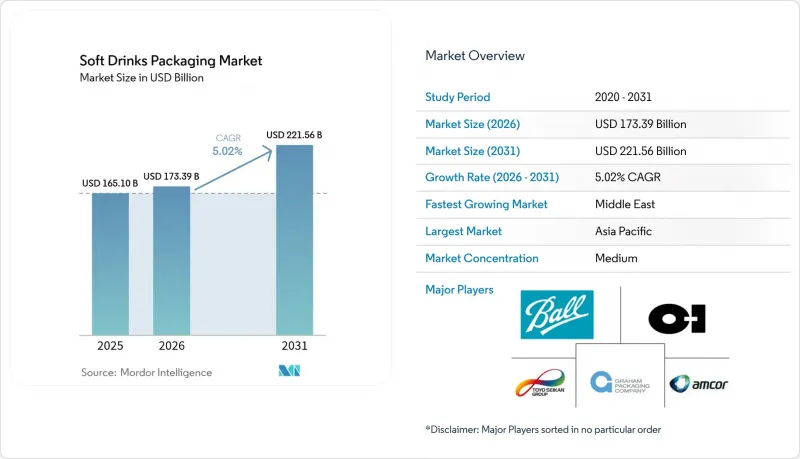
Mordor Intelligence에 따르면 2026년 소프트드링크 포장 시장의 규모는 1,733억 9,000만 달러로 추정되고 있으며, 2025년 1,651억 달러에서 확대하며, 2031년에는 2,215억 6,000만 달러에 달할 것으로 예측됩니다.
2026-2031년 동안 연평균 성장률(CAGR) 5.02%로 성장할 것으로 전망됩니다.
이 보고서에서는 산업을 소재별(플라스틱, 금속, 유리, 기타), 제품 유형별(병, 캔, 종이팩·무균팩, 기타), 용량별(250mL 이하, 251-600mL, 기타),마개 유형(나사식 마개·스포츠 캡, 크라운·풀탭, 기타), 청량음료 카테고리(탄산 청량음료, 주스·넥타, 기타), 지역별로 분류하고 있습니다. 시장 예측은 금액(달러) 기준으로 제시되어 있습니다.
전 세계 청량음료 포장 시장의 동향 및 인사이트
PET병의 경량화 및 rPET 도입 급증
규제 목표와 비용 압박으로 인해 각 변환 업체들은 수지 사용량 감축을 강요받고 있으며, 일부 일본산 PET병은 현재 20g 미만으로, 기존 무게의 절반 수준입니다. 높은 회수율(일본 90%, 유럽 75%)이 폐쇄형 순환 경제를 지원하고 있으며, 인도의 가네샤 에코펫(Ganesha EcoPet)사는 2026년까지 국내 병 폐기물의 25%를 회수하는 것을 목표로 rPET 생산량을 4만 2,000톤으로 확대하고 있습니다. 경량화를 통해 재료비를 15-20% 절감하고 운송시 배출량도 줄일 수 있지만, 보관 기간 중의 풍미를 유지하기 위해서는 뛰어난 산소 및 CO₂ 차단성이 요구됩니다.
프리미엄 포장을 추구하는 ‘기능성 탄산음료’ SKU의 성장
2026년까지 1,981억 달러에 달할 것으로 예상되는 전 세계 기능성 음료 매출은, 건강에 대한 배려를 강조하고 원료의 스토리를 전달할 수 있는 포장을 요구하고 있습니다. Z세대는 이미 이 카테고리의 성장의 38%를 주도하고 있으며, 투명성을 중시하므로 펩시코는 포장 비용에 20-30%를 추가하는 것을 정당화할 수 있는 스토리를 포장에 담도록 하고 있습니다. 금속캔은 차광성과 뛰어난 가스 차단성 덕분에 방부제를 사용하지 않고도 유효 성분을 보호하고 보존 안정성을 유지할 뿐만 아니라, 고급스러운 느낌을 주어 지지를 얻고 있습니다.
확대 생산자 책임(EPR) 수수료로 인한 이익률 압박
미국 5개 주에서는 2031년까지 가정 쓰레기 재활용 비용의 90%를 생산자에게 전가하는 EPR 법을 제정했습니다. 재활용 가능성을 고려한 설계와 연계된 환경 조정 요금은 포장 비용을 2-3% 상승시켜, 기업이 더 가볍고 단일 소재의 포장으로 전환을 추진하는 가운데 음료의 이익률을 압박할 가능성이 있습니다. 여러 주의 PRO(생산자 책임 제도)에 대응하는 것은 관리상의 부담을 가중시키고, 규정 위반에 따른 제재 위험을 높입니다.
부문 분석
2025년에는 PET 및 rPET병이 매출의 70.80%를 차지하며 시장을 장악했습니다. 이는 비용, 투명성, 생산 라인과의 호환성 측면에서 수십 년 동안 일관되게 우위를 유지해 온 것을 반영합니다. 2025년 PET 청량음료 포장 시장 규모는 1,169억 달러에 달할 것으로 예상되며, 식품 등급 rPET의 공급이 개선됨에 따라 안정적인 한 자릿수 중반대의 성장이 전망됩니다. 아반티움(Avantium)의 PEF와 다니머(Danimer)의 PHA 개발 파이프라인은 바이오플라스틱의 연평균 성장률(CAGR) 16.8%를 지원하고 있습니다. 바이오플라스틱은 현재 틈새 시장이지만, 뛰어난 차단 성능과 전 생애 주기에 걸친 환경 부담 감소 덕분에 프리미엄 카테고리를 개발할 준비가 되어 있습니다.
브랜드의 타겟 전환, 탄소 중립(넷 제로)에 대한 공약, 재활용 소재 함유율 의무화로 인해 가격에 민감한 시장에서도 rPET의 채택이 가속화되고 있으며, 인도는 2025년까지 PCR(소비 후 재활용) 소재 함유율을 30%로 의무화하고 있습니다. 알루미늄 캔은 무한히 재활용이 가능하고 유럽에서의 재활용률이 76.1%에 달한다는 장점이 있지만, 가격 변동이 심한 프리미엄 가격으로 인해 가공업체의 이익률이 압박받고 있습니다. 유리는 크라프트 제품 라인에서 여전히 고급스러운 느낌을 유지하고 있지만, 물류상의 부담을 수반합니다. 한편, 판지 혁신 기업은 임박한 금지 조치가 시행되기 전에 PFAS 코팅의 대체 재료를 서둘러 모색하고 있습니다.
병은 확립된 블로우 성형 설비, 폭넓은 SKU 크기, 랩 라벨의 표시 면적 덕분에 2025년 매출의 58.45%를 차지할 것으로 전망됩니다. 병형 청량음료 포장 시장 규모는 경량 프리폼을 실현하는 배리어 기술의 혁신에 힘입어 2031년까지 1,246억 달러를 넘어설 것으로 예측됩니다. 한편, Z세대가 용량보다 휴대성이나 인스타그램에 잘 어울리는 실루엣을 중요시함에 따라 슬림한 알루미늄 캔은 연평균 성장률(CAGR) 8.42%로 급성장하고 있습니다.
소매업체들은 이 포장 형태의 높은 진열 효율을 높이 평가하고 있으며, 브랜드 측은 동일한 충전량으로 최대 20%의 가격 인상을 실현하고 있습니다. 테트라팩이 식물 유래 HDPE 캡으로의 전환을 추진하는 가운데, 냉장 주스 매대에서는 종이팩의 점유율이 확대되고 있습니다. 소포장은 신흥 시장에서 여전히 필수적이며, 환경세 도입이 임박한 상황에서도 매우 저렴한 진입 장벽을 계속 제공하고 있습니다.
지역별 분석
아시아태평양의 매출 점유율 42.60%는 중산층의 구매력 급증, 도시 지역의 밀집된 소매망, 저비용 rPET 순환을 촉진하는 견고한 사용 후 PET 회수 시스템에 기인합니다. 일본의 PET 회수율 90%는 국내 가공업체에 원료를 공급하고 있는 반면, 중국은 야심찬 재생 재료 함유율 목표를 달성하기 위해 화학 재활용 거점에 대한 보조금을 지원하고 있습니다. 인도의 EPR(생산자 책임 회수) 로드맵은 병 등급 rPET에 대한 수요를 높이고 있으며, 이 지역은 순환 경제 확대의 선도적 존재로서의 입지를 확고히 하고 있습니다.
중동은 2031년까지 6.74%라는 가장 높은 연평균 성장률(CAGR)을 기록할 것으로 전망됩니다. 이는 사우디아라비아와 아랍에미리트가 식량안보 문제 해결을 위해 현지 캔용 시트 압연 라인 및 음료 공장 건설을 급속도로 추진하고 있기 때문입니다. 젊은 층은 세련된 캔에 담긴 에너지 음료를 선호하는 경향이 있으며, 세계 알루미늄 가격 변동에도 불구하고 금속 수요를 지원하고 있습니다. 지속가능한 산업 클러스터에 대한 정부의 인센티브는 걸프협력회의(GCC) 회원국의 충전 라인에서 rPET 프리폼 채택을 더욱 촉진하고 있습니다.
북미에서는 EPR(확대 생산자 책임)에 따른 비용 측면의 역풍과 알루미늄 시트 공급 부족에 직면하고 있지만, 신규 SKU의 시장 출시 기간을 단축하는 AI 기반 설계 소프트웨어의 선구적인 실증 테스트의 혜택을 받고 있습니다. 유럽은 계속해서 규제 면에서 주도권을 잡고 있습니다. PPWR(플라스틱 포장 재활용 규정)에 따른 재활용 가능성 의무화가 단일 소재 연질 필름 및 첨단 탈중합 기술에 대한 투자를 촉진하고 있습니다. 남미에서는 브라질에 신설된 ALPLA의 HDPE 재활용 플랜트와 도시 지역 밀레니얼 세대의 기능성 음료 소비 확대에 힘입어 꾸준한 성장이 예상됩니다. 아프리카는 여전히 개발도상국 단계이지만, 도시 확장과 콜드 체인 물류 확충을 배경으로 두 자릿수의 수량 성장을 기록하고 있습니다. 다만, 수거 인프라가 미비하여 rPET의 보급은 제한되고 있습니다.
기타 혜택
- 엑셀 형식의 시장 예측(ME) 시트
- 3개월간의 애널리스트 지원
자주 묻는 질문
목차
제1장 서론
제2장 조사 방법
제3장 개요
제4장 시장 구도
제5장 시장 규모와 성장 예측
제6장 경쟁 구도
제7장 시장 기회와 향후 전망
KSA 26.09.03According to Mordor Intelligence, soft drink packaging market size in 2026 is estimated at USD 173.39 billion, growing from 2025 value of USD 165.1 billion with 2031 projections showing USD 221.56 billion, growing at 5.02% CAGR over 2026-2031.
This report Segments the Industry Into by Material (Plastic, Metal, Glass and More), Product Type (Bottle, Can, Cartons and Boxes), Capacity (Less Than 250 Ml, 251-600 Ml and More), Closure Type (Screw and Sports Caps, Crown and Pull-Tab and More), Soft-Drink Category (Carbonated Soft Drinks, Juices and Nectars and More) and Geography. The Market Forecasts are Provided in Terms of Value (USD).
Global Soft Drinks Packaging Market Trends and Insights
Surge in PET bottle lightweighting and rPET integration
Regulatory targets and cost pressure are pushing converters to cut resin use, with some Japanese PET bottles now below 20 g-half the traditional weight. High collection rates-90% in Japan versus 75% in Europe-underpin closed-loop economics, while India's Ganesha Ecopet is scaling to 42,000 t rPET to capture 25% of local bottle waste by 2026. Lightweighting trims material cost 15-20% and lowers freight emissions, but demands superior oxygen and CO2 barriers to safeguard taste over shelf life.
Growth of "functional soda" SKUs demanding premium packs
Global functional beverage sales headed toward USD 198.1 billion by 2026 are forcing packs that signal health credentials and enable ingredient storytelling. Gen-Z already drives 38% of category expansion and values transparency, prompting PepsiCo to embed on-pack narratives that justify 20-30% higher packaging spend. Metal cans win favor for their light-blocking and superior gas barriers that protect active compounds without preservatives, sustaining shelf stability and delivering premium cues.
Extended Producer-Responsibility (EPR) fees squeezing margins
Five U.S. states have enacted EPR laws that shift 90% of curbside recycling costs to producers by 2031. Eco-modulated charges tied to design recyclability can push packaging spend up 2-3%, compressing beverage margins while firms retool to lighter, mono-material formats. Navigating multiple state PROs adds administrative load and penalty risk for non-compliance.
Other drivers and restraints analyzed in the detailed report include:
- On-the-go slim-can demand from Gen-Z consumers
- Bottle-to-bottle chemical recycling capacity build-out
- Volatile aluminium premiums and supply bottlenecks
For complete list of drivers and restraints, kindly check the Table Of Contents.
Segment Analysis
PET and rPET bottles dominated with 70.80% revenue in 2025, reflecting a decades-long alignment of cost, clarity, and line compatibility. The soft drink packaging market size for PET equated to USD 116.9 billion in 2025 and is set for stable mid-single-digit expansion as the supply of food-grade rPET improves. Avantium's PEF and Danimer's PHA pipelines underpin a 16.8% CAGR for bioplastics, a niche today but one poised to carve premium categories with superior barrier metrics and lower cradle-to-grave footprints.
Shifting brand targets, net-zero pledges, and recycled-content quotas are hastening rPET uptake even in price-sensitive markets, with India mandating 30% PCR by 2025. Aluminium cans benefit from infinite recyclability and a 76.1% European recycling rate, yet volatile premiums dent converter margins. Glass retains cachet in craft lines but carries logistics penalties, while paperboard innovators scramble to replace PFAS coatings before looming bans take hold.
Bottles commanded 58.45% of 2025 sales thanks to entrenched blow-molding fleets, broad SKU sizes, and wrap-label real estate. The soft drink packaging market size for bottles is forecast to cross USD 124.6 billion by 2031, aided by barrier innovations allowing lower-weight preforms. Slim aluminum cans, however, are surging at 8.42% CAGR as Gen-Z ranks portability and Instagram-ready silhouettes above volume.
Retailers embrace the format's shelf efficiencies, and brands glean up to 20% price uplifts on identical fill volumes. Cartons gain share in chilled juice aisles as Tetra Pak shifts to plant-derived HDPE caps. Sachets remain vital in emerging markets, delivering ultra-low-cost entry points even as eco-taxes loom.
Complete Report Scope:
- By Material
- Plastic (PET, rPET, HDPE, Bioplastics)
- Metal (Aluminium, Steel)
- Glass
- Paper and Paperboard
- Flexible and Compostable Films
- By Product Type
- Bottles
- Cans
- Cartons and Aseptic Bricks
- Pouches and Sachets
- Bag-in-Box / Dispense Packs
- By Capacity
- Less Than 250 ml
- 251-600 ml
- 601-1 L
- More Than 1 L Family Packs
- By Closure Type
- Screw and Sports Caps
- Crown and Pull-tab
- Snap-on / Press-fit
- Smart / Connected Closures
- By Soft-Drink Category
- Carbonated Soft Drinks
- Juices and Nectars
- Energy and Functional Drinks
- RTD Tea and Coffee
- Flavoured and Sparkling Water
- By Geography
- North America
- United States
- Canada
- Mexico
- South America
- Brazil
- Argentina
- Rest of South America
- Europe
- Germany
- United Kingdom
- France
- Italy
- Spain
- Rest of Europe
- Asia-Pacific
- China
- Japan
- India
- South Korea
- Australia
- Rest of Asia-Pacific
- Middle East
- Israel
- Saudi Arabia
- United Arab Emirates
- Turkey
- Rest of Middle East
- Africa
- South Africa
- Egypt
- Rest of Africa
- North America
Geography Analysis
Asia-Pacific's 42.60% revenue share stems from surging middle-class purchasing power, dense urban retail, and robust post-consumer PET recovery systems that fuel low-cost rPET loops. Japan's 90% PET collection rate supplies domestic converters, while China subsidizes chemical recycling hubs to beat ambitious recycled-content goals. India's EPR roadmap intensifies demand for bottle-grade rPET, positioning the region as a bellwether for circular-economy scale-up.
The Middle East posts the highest 6.74% CAGR to 2031 as Saudi Arabia and the UAE fast-track local can-sheet rolling lines and beverage plants in pursuit of food-security agendas. Youthful demographics gravitate to energy drinks packaged in sleek cans, reinforcing metal demand despite global aluminium price swings. Government incentives for sustainable industry clusters further spur adoption of rPET preforms in Gulf Cooperation Council filling lines.
North America wrestles with EPR-induced cost headwinds and aluminium sheet tightness, yet benefits from first-mover commercial trials of AI-driven design software that cuts new-SKU timelines. Europe continues to set the regulatory pace: the PPWR's recyclability mandates catalyze investment in mono-material flexible films and advanced depolymerization. South America secures steady gains through Brazil's new ALPLA HDPE recycling plant and rising consumption of functional drinks among urban millennials. Africa, still nascent, observes double-digit volume growth on the back of urban sprawl and expanding cold-chain logistics, though inadequate collection infrastructure tempers rPET uptake.
- Amcor PLC
- Ball Corporation
- Tetra Pak International SA
- Crown Holdings Inc.
- Toyo Seikan Group Holdings Ltd
- Owens-Illinois Inc.
- Graham Packaging Company
- Ardagh Group SA
- CAN-PACK SA
- Refresco Group NV
- CKS Packaging Inc.
- Pacific Can China Holdings
- Berry Global Group Inc.
- Silgan Holdings Inc.
- Huhtamaki Oyj
- Mondi plc
- WestRock Company
- Plastipak Holdings Inc.
- UFlex Ltd.
- Nihon Yamamura Glass Co. Ltd
- Vetropack Holding AG
- Visy Industries
Additional Benefits:
- The market estimate (ME) sheet in Excel format
- 3 months of analyst support
TABLE OF CONTENTS
1 INTRODUCTION
- 1.1 Study Assumptions and Market Definition
- 1.2 Scope of the Study
2 RESEARCH METHODOLOGY
3 EXECUTIVE SUMMARY
4 MARKET LANDSCAPE
- 4.1 Market Overview
- 4.2 Market Drivers
- 4.2.1 Surge in PET bottle lightweighting and rPET integration
- 4.2.2 Growth of "functional soda" SKUs demanding premium packs
- 4.2.3 On-the-go slim-can demand from Gen-Z consumers
- 4.2.4 Bottle-to-bottle chemical recycling capacity build-out
- 4.2.5 AI-enabled design platforms cutting packaging development lead-times
- 4.2.6 Carbon-negative PEF and PHA pilots reaching commercial scale
- 4.3 Market Restraints
- 4.3.1 Extended Producer-Responsibility (EPR) fees squeezing margins
- 4.3.2 Volatile aluminium premiums and supply bottlenecks
- 4.3.3 PFAS phase-outs disrupting barrier-coated paperboard
- 4.3.4 Retailer bans on single-use secondary plastics
- 4.4 Regulatory Landscape
- 4.5 Technological Outlook
- 4.6 Porter's Five Forces Analysis
- 4.6.1 Threat of New Entrants
- 4.6.2 Bargaining Power of Suppliers
- 4.6.3 Bargaining Power of Buyers
- 4.6.4 Threat of Substitutes
- 4.6.5 Competitive Rivalry
- 4.7 Investment Analysis (CapEx and MandA Trends)
5 MARKET SIZE AND GROWTH FORECASTS (VALUES)
- 5.1 By Material
- 5.1.1 Plastic (PET, rPET, HDPE, Bioplastics)
- 5.1.2 Metal (Aluminium, Steel)
- 5.1.3 Glass
- 5.1.4 Paper and Paperboard
- 5.1.5 Flexible and Compostable Films
- 5.2 By Product Type
- 5.2.1 Bottles
- 5.2.2 Cans
- 5.2.3 Cartons and Aseptic Bricks
- 5.2.4 Pouches and Sachets
- 5.2.5 Bag-in-Box / Dispense Packs
- 5.3 By Capacity
- 5.3.1 Less Than 250 ml
- 5.3.2 251-600 ml
- 5.3.3 601-1 L
- 5.3.4 More Than 1 L Family Packs
- 5.4 By Closure Type
- 5.4.1 Screw and Sports Caps
- 5.4.2 Crown and Pull-tab
- 5.4.3 Snap-on / Press-fit
- 5.4.4 Smart / Connected Closures
- 5.5 By Soft-Drink Category
- 5.5.1 Carbonated Soft Drinks
- 5.5.2 Juices and Nectars
- 5.5.3 Energy and Functional Drinks
- 5.5.4 RTD Tea and Coffee
- 5.5.5 Flavoured and Sparkling Water
- 5.6 By Geography
- 5.6.1 North America
- 5.6.1.1 United States
- 5.6.1.2 Canada
- 5.6.1.3 Mexico
- 5.6.2 South America
- 5.6.2.1 Brazil
- 5.6.2.2 Argentina
- 5.6.2.3 Rest of South America
- 5.6.3 Europe
- 5.6.3.1 Germany
- 5.6.3.2 United Kingdom
- 5.6.3.3 France
- 5.6.3.4 Italy
- 5.6.3.5 Spain
- 5.6.3.6 Rest of Europe
- 5.6.4 Asia-Pacific
- 5.6.4.1 China
- 5.6.4.2 Japan
- 5.6.4.3 India
- 5.6.4.4 South Korea
- 5.6.4.5 Australia
- 5.6.4.6 Rest of Asia-Pacific
- 5.6.5 Middle East
- 5.6.5.1 Israel
- 5.6.5.2 Saudi Arabia
- 5.6.5.3 United Arab Emirates
- 5.6.5.4 Turkey
- 5.6.5.5 Rest of Middle East
- 5.6.6 Africa
- 5.6.6.1 South Africa
- 5.6.6.2 Egypt
- 5.6.6.3 Rest of Africa
- 5.6.1 North America
6 COMPETITIVE LANDSCAPE
- 6.1 Market Concentration
- 6.2 Strategic Moves
- 6.3 Market Share Analysis
- 6.4 Company Profiles (includes Global level Overview, Market level Overview, Core Segments, Financials as available, Strategic Information, Market Rank/Share, Products and Services, Recent Developments)
- 6.4.1 Amcor PLC
- 6.4.2 Ball Corporation
- 6.4.3 Tetra Pak International SA
- 6.4.4 Crown Holdings Inc.
- 6.4.5 Toyo Seikan Group Holdings Ltd
- 6.4.6 Owens-Illinois Inc.
- 6.4.7 Graham Packaging Company
- 6.4.8 Ardagh Group SA
- 6.4.9 CAN-PACK SA
- 6.4.10 Refresco Group NV
- 6.4.11 CKS Packaging Inc.
- 6.4.12 Pacific Can China Holdings
- 6.4.13 Berry Global Group Inc.
- 6.4.14 Silgan Holdings Inc.
- 6.4.15 Huhtamaki Oyj
- 6.4.16 Mondi plc
- 6.4.17 WestRock Company
- 6.4.18 Plastipak Holdings Inc.
- 6.4.19 UFlex Ltd.
- 6.4.20 Nihon Yamamura Glass Co. Ltd
- 6.4.21 Vetropack Holding AG
- 6.4.22 Visy Industries
7 MARKET OPPORTUNITIES AND FUTURE OUTLOOK
- 7.1 White-space and Unmet-Need Assessment


