

|
시장보고서
상품코드
2121801
영유아 영양 시장 : 시장 점유율 분석, 업계 동향 및 통계, 성장 예측(2026-2031년)Infant Nutrition - Market Share Analysis, Industry Trends & Statistics, Growth Forecasts (2026 - 2031) |
||||||
 Mordor Intelligence
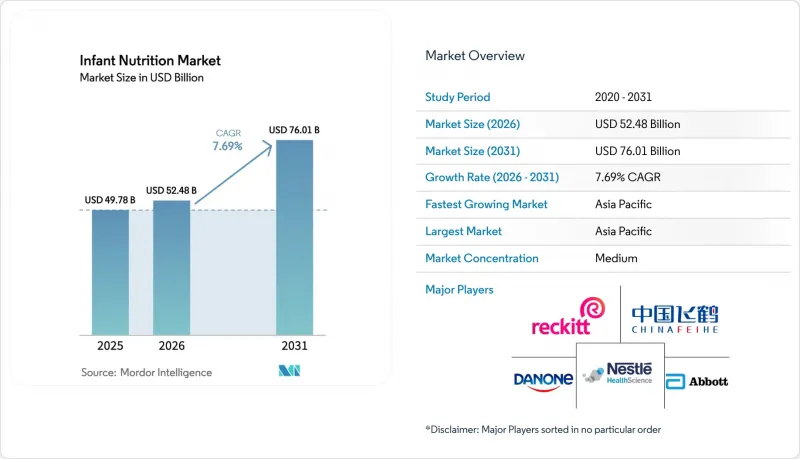
Mordor Intelligence에 의하면, 영유아 영양 시장 규모는 2025년 497억 8,000만 달러로 평가되었고, 2026년 524억 8,000만 달러에서 2031년까지 760억 1,000만 달러로 확대될 것으로 예측되며, 2026-2031년 연평균 복합 성장률(CAGR)은 7.69%를 나타낼 전망입니다.
본 보고서는 제품 카테고리별(영아용 조제분유, 베이비 시리얼 등), 연령대별(0-6개월(스테이지 1) 등), 조제분유 형태별(분말 등), 특성별(일반형, 유기농, 클린 라벨/무첨가 당·무첨가물), 유통 채널별(슈퍼마켓 및 하이퍼마켓 등), 지역별(북미 등)로 분류되어 있습니다. 시장 예측은 금액(달러) 기준으로 제시되어 있습니다.
세계의 영유아 영양 시장 동향 및 인사이트
여성의 노동 참여율 상승과 맞벌이 가정 증가로 인해 분유 및 간편한 이유식에 대한 의존도가 높아지고 있습니다.
많은 시장에서 여성의 노동력 참여율은 높은 반면, 유급 휴가나 직장 내 수유 지원에 관한 보호 조치는 여전히 미흡하여, 이로 인해 육아를 담당하는 사람들의 일상적인 시간적 제약이 커지고, 조제분유나 간편한 이유식에 대한 수요가 증가하고 있습니다. 멕시코의 경우, 예측 기간 동안 시장 규모 성장 전망을 통해 직장에 복귀하는 부모의 역할과 외출 시 수유에 편리한 즉석 제품의 매력이 부각되고 있으며, 이것이 영유아 영양 시장에서 해당 카테고리의 성장세를 뒷받침하고 있습니다. 캐나다에서는 이민에 따른 인구 증가와 유기농 조리 식품에 대한 선호도가 높아지면서, 맞벌이 라이프스타일에 맞춘 제품에 대한 수요가 증가하고 있습니다. 조리 시간을 단축하고 분량 조절을 간소화하는 제품 혁신은 가사 부담을 늘리지 않으면서도 신뢰할 수 있는 영양을 원하는 일하는 부모들의 요구에 부응하고 있으며, 이러한 영향으로 영유아 영양 시장에서는 편의성이 높은 형태로의 브랜드 전환이 촉진되고 있습니다. 이러한 시너지 효과로 인해 적정한 프리미엄 가격이 책정된 편의성이 높은 제품으로의 비중 전환이 지속되고 있으며, 이는 성숙 시장에서 판매 수량 감소 압력을 상쇄하는 데 일조하고 있습니다.
프리미엄화와 클린 라벨·유기농 수요가 가치 성장을 확대
보호자들은 검증된 품질 지표와 원재료의 투명성을 중시하고 있으며, 새로운 규제가 검사 및 정보 공개 관행을 법적으로 정함으로써 이러한 추세를 더욱 뒷받침하고 있습니다. 캘리포니아주의 AB-899 법에 따르면 납, 비소, 카드뮴, 수은에 관한 중금속 검사 결과 공개가 의무화되어 있어, 이에 따라 각 브랜드는 엄격한 감시를 선제적으로 대비하기 위해 원재료 조달 기준을 강화하고 제품 배합을 재검토해야 하는 상황에 놓여 있습니다. 주요 브랜드들은 제3자 기관의 인증 획득이나 제품 라인업 재검토를 통해 이에 대응하고 있으며, Gerber는 자사 제품군 전체에서 100건 이상의 ‘클린 라벨 프로젝트(Clean Label Project)’ 인증을 획득했다고 밝혔습니다. 이러한 노력은 인증 마크나 공개된 기준을 안전성과 연결지어 생각하는 부모들 사이에서 신뢰를 쌓아가고 있습니다. 새로운 프리미엄 제품들은 이중 인증과 단계적인 성분 조정을 통해 시장에서 입지를 다져가고 있습니다. 예를 들어, Happy Family Organics의 제품은 USDA 및 EU 인증을 받은 유럽산으로, 독자적인 프리바이오틱스와 프로바이오틱스 시스템을 채택하고 있으며, 이러한 성분 구성과 조달 방식을 반영한 프리미엄 가격대로 포지셔닝되어 있습니다. 중부 및 동유럽 각지의 소비자들은 현지에서 구하기 어려운 경우 다른 EU 시장에서 유기농 유아식을 수입하려는 의향을 보이고 있으며, 안전성이나 제품 구색이 해외 제품이 더 우수하다고 인식될 때 프리미엄화가 수요 주도적으로 진행된다는 사실을 뒷받침하고 있습니다. 이러한 소비 행태는 판매량이 정체되어 있더라도 부가가치를 확대하며, 이는 영유아 영양 시장의 주요 동향으로 자리 잡고 있습니다.
출생률 하락이 판매량을 억제
일부 주요 경제국의 출산율 하락은 신규 소비자층을 축소시켜, 영유아 영양 시장에 있어 지속적인 판매량 감소의 역풍이 되고 있습니다. 이러한 인구 동향은 가족 지원을 목적으로 한 정책 조치가 시행되고 있음에도 불구하고 출산율이 낮은 수준을 유지하고 있는 동아시아 및 남유럽의 일부 지역에서 가장 두드러집니다. 각 기업은 임산부용 영양 식품이나 유아용 분유와 같은 인접한 생애 단계로의 사업 확대, 그리고 가정의 평생 가치를 높이는 성인용 영양 식품 라인을 전개함으로써 이러한 상황에 적응하고 있습니다. 프리미엄화는 판매량 감소를 상쇄하는 데 일조하고 있습니다. 이는 해당 카테고리를 계속 이용하는 부모들이 과학적 근거와 품질 인증을 받은 제품으로 구매를 전환하고 있기 때문입니다. 그 결과, 성장의 구성비는 광범위한 판매량 증가보다는 가치 확대와 지리적 다각화로 전환되고 있습니다.
부문 분석
2025년 시장 규모에서 영아용 분유는 54.24%를 차지했으나, 조리된 이유식은 2031년까지 연평균 성장률(CAGR) 9.12%로 확대될 것으로 예측되어, 영아 영양 시장 내 구성비에서 꾸준한 변화를 보이고 있습니다. 조제분유는 의학적으로 필요한 경우나 예측 가능성과 시간 절약을 중시하는 직장인 부모층 사이에서 모유 대체품으로서 여전히 확고한 입지를 다지고 있습니다. 분말 유형의 ‘1회 제공당 비용’이라는 우위는 조리 완료 유형이 편의성을 무기로 시장 점유율을 확대하고 있는 상황에서도 기본적인 수요를 계속 지탱하고 있습니다. 캐나다에서는 카테고리 동향으로, 유기농 표시와 식감의 다양성이 현대의 수유 습관과 부합함에 따라 조리 완제품의 꾸준한 성장이 나타나고 있으며, 이는 영유아 영양 시장에서 뚜렷한 편의성 지향 경향을 뒷받침하고 있습니다. 영양 강화 시리얼은 생후 6-12개월 기간 동안의 영양 부족을 보충하는 수단으로서의 역할을 계속하고 있으며, 시리얼의 철분 함유량을 표준화하자는 제안이 실현된다면 브랜드에 관계없이 일관된 품질이 확보될 것입니다.
조리 식품은 휴대성, 분량 조절, 맛의 다양성 면에서 뛰어나며, 영유아 영양 시장에서 맞벌이 가정의 일상적인 부담을 덜어주고 있습니다. 포장과 표시도 중요한 요소이며, 조사에 따르면 영유아용 소매 프로모션에서 건강 관련 메시지나 천연 식품 이미지의 사용이 증가하고 있는 것으로 밝혀졌습니다. 이는 표시가 규제에 의해 제한되는 경우에도 소비자의 인식에 영향을 미치고 있습니다. 염소 분유와 같은 특수한 하위 부문은 보호자의 선택 폭을 더욱 넓혀주고 있습니다. 임상 데이터에 따르면, 염소 분유를 섭취하는 영아는 우유 기반 대체품에 비해 알레르기 반응이 적은 것으로 나타났으며, 이 결과는 ‘소화가 잘 되는’이라는 포지셔닝과 소아과 의사의 지침에 따른 대상별 사용을 뒷받침하고 있습니다. 따라서 영유아 영양 산업은 가치 추구와 가정 내 구조적인 시간적 제약 사이의 균형을 맞추고 있으며, 그 결과 조제분유와 즉석형 제품 모두가 이 카테고리의 성장 중심축으로 자리 잡고 있습니다. 오염 물질 규제를 준수하기 위한 지속적인 배합 재검토와 클린 라벨 기준의 꾸준한 발전으로 인해, 이 카테고리의 두 축 모두에서 프리미엄 가격 책정이 유지될 전망입니다.
0-6개월 부문은 2025년 시장 가치의 39.41%를 차지했으며, 완전 모유 수유 규범과 임상 감독 강화로 인해 여전히 수요의 주축을 이루고 있습니다. 이로 인해 영유아 영양 시장 점유율에서 이 기간의 처방 및 권고의 영향력이 집중되고 있습니다. 많은 양육자들이 초기 단계의 긍정적인 경험을 통해 브랜드 충성도를 유지하기 때문에 각 브랜드는 1단계에서의 임상적 엄격성을 바탕으로 신뢰성을 구축하고, 이를 후속 단계로 이어가고 있습니다. 생후 6-12개월 기간은 보충식 시작 시기에 해당하며, 유아용 시리얼에 특정 미량 영양소를 포함하라는 제안은 이 기간에 인정되는 결핍 위험에 대한 규제 당국의 집중적인 관심을 반영하고 있습니다. 유아용 부문은 8.34%의 예측 연평균 성장률(CAGR)을 기록하며 성장의 원동력으로 두드러지고 있으며, 아이들이 가족과 같은 식사로 전환할 때 식사의 영양 균형에 대해 부모에게 안심을 주는 기능성 표기가 이를 뒷받침하고 있습니다. 브랜드가 초기 단계에서의 신뢰를 변화하는 영양 요구에 맞춘 식사 제공을 하는 라이프사이클 접근 방식으로 전환할 수 있다면, 영유아 영양 시장은 그 혜택을 누리게 될 것입니다.
생후 몇 개월 된 영아 및 유아용 조제유는 성분 과학을 활용하여 활동량과 인지 발달에 맞춘 영양 프로파일을 조정하고 있으며, 대사체학 연구를 통해 각 연령 단계별 아미노산 및 당류의 차이가 입증되었습니다. 동남아시아 및 기타 고성장 지역의 브랜드 제품들은 계속해서 마이크로바이옴과 소화에 미치는 효과를 강조하고 있으며, 2025년 아세안 전역에서 출시된 신단계 제품도 그 한 예입니다. 이를 통해 임상적 특징이 보호자의 관심을 끄는 데 있어 중요한 역할을 한다는 점이 재확인되었습니다. 일본에서는 수십 년에 걸친 연구 개발과 임상적 검증을 전면에 내세우는 브랜드가 높은 인지도와 전문가들의 지지를 유지하며, 식이 전환기에 있는 어린이를 위한 성장 단계별 조정 분유에 대한 보호자의 신뢰를 높이고 있습니다. 영유아 영양 시장에서는 선택지가 확대되는 가운데, 투명성이 높은 성장 단계 정의와 임상시험에 기반한 효능 표기가 앞으로도 차별화의 핵심이 될 것입니다.
지역별 분석
아시아태평양은 2025년 시장 규모의 42.65%를 차지했으며, 2030년까지 연평균 성장률(CAGR) 9.24%로 전 세계 시장의 성장을 주도하고 있습니다. 이는 영유아 영양 시장 수요 형성에 있어 해당 지역이 중심적인 역할을 하고 있음을 뒷받침합니다. 주요 국가들의 도시화와 소득 증가로 인해 육아를 하는 사람들이 일과 가정을 양립하려 노력하는 가운데, 프리미엄 제품 및 클린 라벨 제품에 대한 선호도가 높아지고 있습니다. 대만의 HMO 관련 규정안에서 볼 수 있듯이, 규제 개정이 제품의 성분 구성과 허용되는 효능 표기를 이끌고 있으며, 이에 따라 유아용 제품 포트폴리오 전반에 걸쳐 첨단 성분의 채택이 더욱 확대될 가능성이 있습니다. 아세안 전역에서의 신규 브랜드 전개에서는 혼잡한 매장에서 차별화를 꾀하기 위해 마이크로바이옴 및 소화 기능 지원을 강조하고 있으며, 현지 임상 관행에 맞추어 각 성장 단계에 따른 포지셔닝이 이루어지고 있습니다. 국경을 초월한 플랫폼을 통해 국제적인 조제분유 및 유아식에 대한 접근성이 확대되는 가운데, 각 브랜드는 ‘코드’ 준수를 관리하는 동시에 원재료의 투명성과 검사에 대한 높은 기대에 부응해야 합니다. 아시아태평양의 영유아 영양 시장은 여전히 전 세계 가치 성장의 견인차 역할을 하고 있으며, 옴니채널 생태계가 인지도를 높이고 과학에 기반한 새로운 기능의 보급을 가속화하고 있습니다.
북미는 영유아 영양 시장에서 성숙해 가고 있지만 견고한 수요 기반을 보이고 있으며, 인구 유입과 클린 라벨 및 유기농 제품에 대한 소비자의 꾸준한 관심이 이를 뒷받침하고 있습니다. 이 지역에서는 여전히 업계 재편이 진행 중이며, 주요 기업 3곳이 소매 매출의 대부분을 차지하고 있고, WIC(여성·영유아·아동 영양 보조 프로그램) 계약 상황이 각 주별 조제분유 경쟁 구도를 형성하고 있습니다. 정책 환경은 공급 안정성과 시장 진입에 있어 여전히 핵심적인 역할을 하고 있으며, 공식 승인 절차가 진행되는 동안 공급이 부족한 시기에는 재량에 따른 집행 프로그램이 제품의 접근성을 확대하는 데 기여하고 있습니다. 이러한 체계를 통해 일부 브랜드는 사업 규모를 확장하고 임상 프로그램을 구축할 수 있게 되었습니다. 최근의 혼란에서 얻은 교훈을 바탕으로 데이터 가시성, 품질 보증 및 비상 대응 계획에 시스템 전반적으로 집중하게 되었으며, 이는 가족을 지원하는 소매업체와 기관에게 핵심적인 기대 사항이 되었습니다. 캐나다의 유아용 식품 및 특수 용도 식품 규제 현대화 노력 역시 안전성과 혁신을 모두 지원하는 조화롭고 증거 기반의 성분 기준으로의 전환을 시사하고 있습니다.
유럽은 영유아 영양 시장에서 프리미엄 제품 및 유기농 제품의 보급 중심지로서의 위치를 계속 유지하고 있으며, 다층적인 인증 제도와 엄격한 성분 규제가 제품 라인업을 형성하고 있습니다. EU와 USDA의 이중 인증을 받은 제품에 대한 인지도는 높아지고 있으며, 중동부 유럽의 일부 시장에서는 부모들이 원하는 선택지나 형태의 제품을 구하기 위해 유기농 수입품을 구매하고 있습니다. 각국의 규제 당국은 모든 연령 단계에 걸친 표시 및 마케팅 감독 체계를 지속적으로 정교화하고 있으며, 기업들은 차별화를 강화하기 위해 임상 검증 및 영양 과학에 대한 투자를 중점적으로 진행하고 있습니다. 소아과 의사들로부터 오랫동안 지지를 받아온 유서 깊은 브랜드는 신뢰와 엄격한 품질 관리를 통해 시장 점유율을 유지하고 있는 반면, 신규 진출기업들은 ‘클린 라벨’이나 ‘위장에 부담 없는’ 등의 어필을 무기로 시장에서 입지를 다지고 있습니다. EU 내 국경 간 전자상거래는 제품의 다양성을 뒷받침하며, 현지에서는 반드시 구할 수 없는 특정 조제분유나 유아식을 가족들이 구매할 수 있도록 지원하고 있습니다. 중기적으로는 프리미엄화와 성장 단계의 확대가 이 지역 소비자층 일부의 인구통계학적 압력을 상쇄하는 주요 원동력이 될 것입니다.
기타 혜택 :
- 엑셀 형식 시장 예측(ME) 시트
- 3개월간의 애널리스트 지원
자주 묻는 질문
목차
제1장 서론
제2장 조사 방법
제3장 주요 요약
제4장 시장 구도
제5장 시장 규모 및 성장 예측
제6장 경쟁 구도
제7장 시장 기회 및 향후 전망
AJY 26.09.09According to Mordor Intelligence, the infant nutrition market size is projected to expand from USD 49.78 billion in 2025 and USD 52.48 billion in 2026 to USD 76.01 billion by 2031, registering a CAGR of 7.69% between 2026 to 2031.
This report is Segmented by Product Category (Infant Formula, Baby Cereals and More), Age Group (0-6 Months (Stage 1) and More), Formula Form (Powder, and More), Nature (Conventional, Organic, Clean Label/No Added Sugars & Additives), Distribution Channel (Supermarkets/Hypermarkets, and More), and Geography (North America and More). The Market Forecasts are Provided in Terms of Value (USD).
Global Infant Nutrition Market Trends and Insights
Rising Female Workforce Participation and Dual-Income Households Increasing Reliance On Formula and Convenient Complementary Foods
Women's labor-force engagement is high in many markets, while protections for paid leave and workplace breastfeeding support remain inconsistent, which raises daily-time constraints for caregivers and contributes to demand for formula and convenient complementary foods. In Mexico, value growth projections through the forecast horizon highlight the role of parents returning to workplaces and the appeal of ready-to-serve products for on-the-go feeding, which sustains category momentum within the infant nutrition market. In Canada, immigration-supported population gains and a preference for organic prepared foods have lifted demand for products aligned to dual-income lifestyles. Product innovation that reduces preparation time and simplifies portion control connects with working parents who seek reliable nutrition without additional household labor, an effect that has reinforced brand switching toward convenient formats in the infant nutrition market. The combined effect is a sustained mix shift toward higher-convenience products that carry a modest premium, which helps offset unit-volume pressure in mature markets.
Premiumization And Clean-Label or Organic Demand Expanding Value Growth
Parents are prioritizing verified quality signals and ingredient transparency, and new regulations are reinforcing this direction by codifying testing and disclosure practices. California's AB-899 requires heavy-metal testing disclosures for lead, arsenic, cadmium, and mercury, which has pushed brands to tighten raw material sourcing and reformulate to stay ahead of scrutiny. Major brands have responded with third-party certifications and portfolio cleanups, with Gerber citing more than 100 Clean Label Project certifications across its range, a position that builds trust among caregivers who associate seals and published standards with safety. New premium entries are anchoring position with dual certifications and staged formulations, as seen in Happy Family Organics' USDA and EU-certified European-made formula with a proprietary prebiotic and probiotic system, positioned at a premium price point to reflect its formulation and sourcing.Consumers across parts of Central and Eastern Europe show a willingness to import organic baby foods from other EU markets when local availability is limited, reinforcing how premiumization can be demand-led where safety and selection are perceived as stronger abroad. These behaviors expand value even if volumes are flat, which has become a central dynamic of the infant nutrition market.
Falling Birth Rates Limiting Volumes
Birth-rate declines in several large economies reduce the pool of new consumers, which creates persistent volume headwinds for the infant nutrition market. This demographic pattern is most acute in parts of East Asia and Southern Europe, where fertility rates remain low despite policy responses that aim to support families. Companies are adapting by expanding into adjacent life stages such as maternal nutrition and toddler milks, as well as exploring adult nutrition lines that extend household lifetime value. Premiumization helps offset the volume drag, since parents who remain in the category are trading up to products with validated science and quality labels. The net effect is a shift in growth mix toward value expansion and geographic diversification rather than broad-based volume gains.
Other drivers and restraints analyzed in the detailed report include:
- Ingredient Science Innovation Enabling Premium Differentiation And Pricing Power
- Omnichannel Expansion and Cross-Border E-Commerce Improving Access And Affordability
- Stricter Marketing Rules Reduce Promotion
For complete list of drivers and restraints, kindly check the Table Of Contents.
Segment Analysis
Infant formula held 54.24% of 2025 value, while prepared baby food is projected to expand at a 9.12% CAGR through 2031, signaling a steady mix shift within the infant nutrition market. Formula remains entrenched as a breast-milk substitute in medically indicated use and among working caregivers who value predictability and time savings. The powder segment's cost-per-serving advantage sustains baseline demand even as the prepared category draws share on convenience features. In Canada, category trends show steady growth for prepared options where organic claims and texture variety align with modern feeding routines, reinforcing the pull toward convenience that is evident in the infant nutrition market. Fortified cereals continue to serve as a vehicle to address nutrient gaps during the 6-12 month window, and proposals to standardize iron levels in cereal would anchor consistent quality across brands.
Prepared foods stand out for portability, portion control, and flavor variety that ease the daily burden on dual-income households in the infant nutrition market. Packaging and labeling are part of the equation, with research documenting the increased use of health messaging and images of whole foods in retail promotions for infants and toddlers, which shapes perception even when claims are limited by policy. Specialty sub-segments such as goat-milk formula continue to widen caregiver choice, with clinical data indicating lower sensitivities for infants on goat-milk powder compared with cow-milk alternatives, a result that supports digestive-comfort positioning and targeted usage under pediatric guidance. The infant nutrition industry is therefore balancing the search for value with structural time constraints at home, which keeps both formula and ready-to-eat options central to category growth. Continued reformulation for contaminants compliance and steady progress on clean-label standards should sustain premium pricing in both pillars of the category.
The 0-6 months segment captured 39.41% of 2025 value and remains the anchor of demand due to exclusive feeding norms and higher clinical oversight, which concentrates prescription and recommendation influence in this window of the infant nutrition market share. Brands rely on Stage 1's clinical rigor to build credibility that flows into later stages, since many caregivers maintain loyalty after successful early experiences. The 6-12 months window marks the start of complementary feeding, and proposals to include specific micronutrients in infant cereals reflect regulators' focus on known deficiency risks during this period. The toddler segment stands out as a growth engine with an 8.34% projected CAGR, supported by functional claims that reassure parents about dietary adequacy as children shift to family foods. The infant nutrition market benefits when brands can translate early-stage trust into a lifecycle approach that aligns feeding to evolving nutrient needs.
Formulas for older infants and toddlers are leveraging ingredient science to tailor profiles to activity and cognitive development, with metabolomic work underscoring differences in amino acids and sugars across age stages. Branded solutions in Southeast Asia and other high-growth regions continue to emphasize microbiome and digestion benefits, as seen with new-stage launches across ASEAN in 2025, which reinforced the role of clinical features in capturing caregiver attention. In Japan, brand franchises that highlight decades of R&D and clinical validation maintain high awareness and professional endorsement, reinforcing parent confidence in stage-based formulas for children who are transitioning diets. The infant nutrition market will continue to rely on transparent stage definitions and trial-backed claims to stand out as choice expands.
Complete Report Scope:
- By Product Category
- Infant Formula
- Baby Cereals (Dried)
- Prepared Baby Food
- By Age Group
- 0-6 months (Stage 1)
- 6-12 months (Stage 2)
- 12-36 months (Toddler/Growing-up Milks & Foods)
- By Formula Form
- Powder
- Liquid Concentrate
- Ready-to-Feed (RTF)
- By Nature
- Conventional
- Organic
- Clean-label/No added sugars & additives
- By Distribution Channel
- Supermarkets/Hypermarkets
- Pharmacies/Medical Stores
- Specialty Mom & Baby Stores
- Online & Direct-to-Consumer
- Convenience & Grocery Stores
- By Geography
- North America
- United States
- Canada
- Mexico
- Europe
- Germany
- France
- United Kingdom
- Italy
- Spain
- Rest of Europe
- Asia-Pacific
- China
- Japan
- India
- South Korea
- Australia
- Rest of Asia-Pacific
- Middle East & Africa
- GCC
- South Africa
- Rest of Middle East & Africa
- South America
- Brazil
- Argentina
- Rest of South America
- North America
Geography Analysis
Asia-Pacific accounts for 42.65% of 2025 value and is pacing global expansion at a 9.24% CAGR through 2030, which underscores the region's central role in demand formation for the infant nutrition market. Urbanization and rising incomes in large countries are reinforcing premium and clean-label preferences as caregivers balance work and family needs. Regulatory updates are guiding product formulations and permissible claims, as seen in Taiwan's draft rules on HMOs that would enable wider adoption of advanced ingredients across the early-childhood portfolio. Brand launches across ASEAN have emphasized microbiome and digestive support to stand out in crowded shelves, with stage-appropriate positioning aligned to local clinical practice. As cross-border platforms increase access to international formulas and baby foods, brands must manage Code compliance while meeting high expectations on ingredient transparency and testing. The infant nutrition market in Asia-Pacific remains the anchor of global value growth, with omnichannel ecosystems amplifying awareness and speeding adoption of new science-led features.
North America represents a mature but resilient demand base for the infant nutrition market, supported by population inflows and steady consumer interest in clean-label and organic products. Consolidation remains a feature of the region, where the top three players control a large share of retail value, and WIC contracting shapes competitive dynamics in formula across states. The policy environment retains a central role in supply stability and market entry, with enforcement discretion programs helping expand product access during tight supply periods while formal approvals progress, a pathway that enabled several brands to scale and build clinical programs. Lessons from recent disruptions prompted a system-wide focus on data visibility, quality assurance, and contingency planning, which has become a core expectation of retailers and agencies that serve families. Canada's regulatory modernization effort on infant foods and special dietary uses similarly signals a shift toward harmonized and evidence-based compositional standards that support both safety and innovation.
Europe remains a center of premium and organic adoption in the infant nutrition market, with layered certifications and strict compositional rules shaping portfolios. EU and USDA dual-certified offerings have grown in visibility, and parents in some Central and Eastern European markets are sourcing organic imports to access preferred choices and formats. National regulators continue to refine labeling and marketing oversight across age stages, and companies are steering investments toward clinical validation and nutritional science to strengthen differentiation. Established brands with long-standing pediatric endorsements maintain share through trust and rigorous quality controls, while new entrants use clean-label and gentle-on-the-gut narratives to gain footholds. Cross-border e-commerce within the EU supports product diversity and helps families access specific formulas and baby foods that are not always stocked locally. Over the medium term, premiumization and stage expansion will be the main levers to balance demographic pressures in parts of the region's consumer base.
- Abbott Laboratories
- Arla Foods amba
- Beingmate Baby & Child
- Bellamy's Organic
- Bobbie
- Bubs Australia
- ByHeart
- China Feihe Ltd.
- Danone
- H&H Group (Biostime)
- Hero Group (Hero Baby)
- HiPP GmbH & Co. Vertrieb KG
- Holle baby food AG
- Junlebao Dairy
- Kendal Nutricare (Kendamil)
- Kraft Heinz (Heinz Baby)
- Meiji Holdings Co., Ltd.
- Morinaga Milk Industry Co., Ltd.
- Nestle S.A.
- Reckitt
- Royal FrieslandCampina N.V. (Friso)
- Synutra International
- Vinamilk (Dielac)
Additional Benefits:
- The market estimate (ME) sheet in Excel format
- 3 months of analyst support
TABLE OF CONTENTS
1 Introduction
- 1.1 Study Assumptions & Market Definition
- 1.2 Scope of the Study
2 Research Methodology
3 Executive Summary
4 Market Landscape
- 4.1 Market Overview
- 4.2 Market Drivers
- 4.2.1 Rising Female Workforce Participation and Dual-Income Households Increasing Reliance on Formula and Convenient Complementary Foods
- 4.2.2 Premiumization and Clean-Label/Organic Demand Expanding Value Growth
- 4.2.3 Ingredient Science Innovation Enabling Premium Differentiation and Pricing Power
- 4.2.4 Omnichannel Expansion and Cross-Border E-Commerce Improving Access and Affordability
- 4.2.5 Rising Goat/Alt-Milk & Hypoallergenic Options
- 4.2.6 Specialty Medical Nutrition Gaining Adoption
- 4.3 Market Restraints
- 4.3.1 Falling Birth Rates Limiting Volumes
- 4.3.2 Stricter Marketing Rules Reduce Promotion
- 4.3.3 Safety Issues/Recalls Hurting Trust
- 4.3.4 Tougher Standards/Re-registration Increasing Costs
- 4.4 Value / Supply-Chain Analysis
- 4.5 Regulatory Landscape
- 4.6 Technological Outlook
- 4.7 Porter's Five Forces Analysis
- 4.7.1 Threat of New Entrants
- 4.7.2 Bargaining Power of Suppliers
- 4.7.3 Bargaining Power of Buyers
- 4.7.4 Threat of Substitutes
- 4.7.5 Intensity of Competitive Rivalry
5 Market Size & Growth Forecasts (Value in USD)
- 5.1 By Product Category
- 5.1.1 Infant Formula
- 5.1.2 Baby Cereals (Dried)
- 5.1.3 Prepared Baby Food
- 5.2 By Age Group
- 5.2.1 0-6 months (Stage 1)
- 5.2.2 6-12 months (Stage 2)
- 5.2.3 12-36 months (Toddler/Growing-up Milks & Foods)
- 5.3 By Formula Form
- 5.3.1 Powder
- 5.3.2 Liquid Concentrate
- 5.3.3 Ready-to-Feed (RTF)
- 5.4 By Nature
- 5.4.1 Conventional
- 5.4.2 Organic
- 5.4.3 Clean-label/No added sugars & additives
- 5.5 By Distribution Channel
- 5.5.1 Supermarkets/Hypermarkets
- 5.5.2 Pharmacies/Medical Stores
- 5.5.3 Specialty Mom & Baby Stores
- 5.5.4 Online & Direct-to-Consumer
- 5.5.5 Convenience & Grocery Stores
- 5.6 By Geography
- 5.6.1 North America
- 5.6.1.1 United States
- 5.6.1.2 Canada
- 5.6.1.3 Mexico
- 5.6.2 Europe
- 5.6.2.1 Germany
- 5.6.2.2 France
- 5.6.2.3 United Kingdom
- 5.6.2.4 Italy
- 5.6.2.5 Spain
- 5.6.2.6 Rest of Europe
- 5.6.3 Asia-Pacific
- 5.6.3.1 China
- 5.6.3.2 Japan
- 5.6.3.3 India
- 5.6.3.4 South Korea
- 5.6.3.5 Australia
- 5.6.3.6 Rest of Asia-Pacific
- 5.6.4 Middle East & Africa
- 5.6.4.1 GCC
- 5.6.4.2 South Africa
- 5.6.4.3 Rest of Middle East & Africa
- 5.6.5 South America
- 5.6.5.1 Brazil
- 5.6.5.2 Argentina
- 5.6.5.3 Rest of South America
- 5.6.1 North America
6 Competitive Landscape
- 6.1 Market Concentration
- 6.2 Market Share Analysis
- 6.3 Company Profiles (includes Global level Overview, Market level overview, Core Segments, Financials as available, Strategic Information, Market Rank/Share for key companies, Products and Services, and Recent Developments)
- 6.3.1 Abbott Laboratories
- 6.3.2 Arla Foods amba
- 6.3.3 Beingmate Baby & Child
- 6.3.4 Bellamy's Organic
- 6.3.5 Bobbie
- 6.3.6 Bubs Australia
- 6.3.7 ByHeart
- 6.3.8 China Feihe Ltd.
- 6.3.9 Danone S.A.
- 6.3.10 H&H Group (Biostime)
- 6.3.11 Hero Group (Hero Baby)
- 6.3.12 HiPP GmbH & Co. Vertrieb KG
- 6.3.13 Holle baby food AG
- 6.3.14 Junlebao Dairy
- 6.3.15 Kendal Nutricare (Kendamil)
- 6.3.16 Kraft Heinz (Heinz Baby)
- 6.3.17 Meiji Holdings Co., Ltd.
- 6.3.18 Morinaga Milk Industry Co., Ltd.
- 6.3.19 Nestle S.A.
- 6.3.20 Reckitt
- 6.3.21 Royal FrieslandCampina N.V. (Friso)
- 6.3.22 Synutra International
- 6.3.23 Vinamilk (Dielac)
7 Market Opportunities & Future Outlook
- 7.1 White-space & unmet-need assessment


