|
시장보고서
상품코드
2121832
유럽의 생검 기기 : 시장 점유율 분석, 업계 동향과 통계, 성장 예측(2026-2031년)Europe Biopsy Devices - Market Share Analysis, Industry Trends & Statistics, Growth Forecasts (2026 - 2031) |
||||||
 Mordor Intelligence
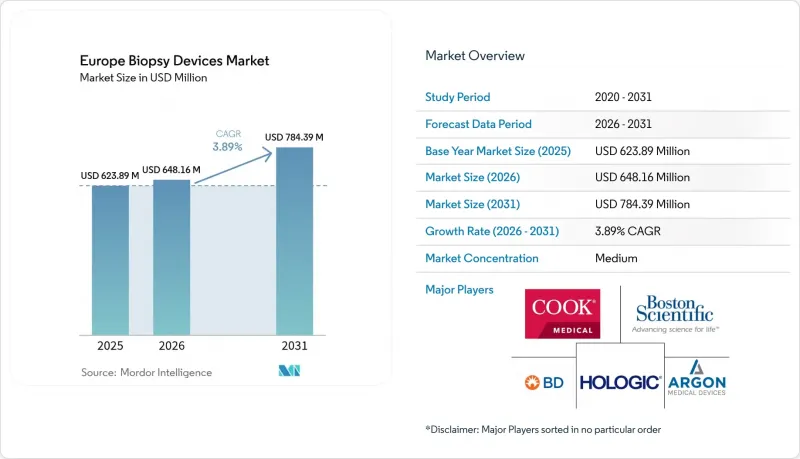
Mordor Intelligence에 따르면 2026년 유럽의 생검 기기 시장 규모는 6억 4,816만 달러로 추정되고 있으며, 2025년 6억 2,389만 달러에서 확대하며, 2031년에는 7억 8,439만 달러에 달할 것으로 예측됩니다.
2026-2031년까지 연평균 성장률(CAGR) 3.89%로 성장할 것으로 전망됩니다.
이 보고서는 제품별(바늘을 이용한 생검 기구[코어 생검 기기 등], 시술 트레이, 기타), 용도별(유방 생검, 폐 생검, 대장 생검, 기타), 최종사용자별(병원, 진단·영상 센터, 기타), 지역별(독일, 영국, 프랑스, 이탈리아,스페인, 기타)로 분류되어 있습니다. 시장 예측은 금액(달러) 기준으로 제시되어 있습니다.
유럽 생검 기기 시장의 동향 및 인사이트
저침습 시술에 대한 선호도 증가
다기관 공동 연구를 통해 기존 경직장 경로에 비해 감염률이 낮으면서도 진단 정확도를 저해하지 않는 것으로 밝혀짐에 따라 경회음부 전립선 생검은 현재 주요 비뇨기과 센터에서 표준 치료법으로 자리 잡고 있습니다. 작은 간 병변에 대한 MRI 유도 하 자유 손 기술은 90%의 임상 성공률을 달성하고 있으며, 지금까지 CT 유도에 의존해 왔던 종양학과 부문으로의 보급이 촉진되고 있습니다. 이러한 환자 친화적인 기법은 회복 기간을 단축하고 입원 일수를 줄일 수 있으며, 보험사의 비용 절감 목표와도 부합합니다. 현재 연구팀은 세포내 바이오마커를 통증 없이 채취할 수 있는 나노니들 패치에 대한 검사를 진행 중이며, 이 획기적인 기술은 2026년까지 임상 현장에 도입될 가능성이 있습니다. 이러한 진전으로 인해 규제상의 장벽이 높아지는 상황에서도 유럽의 생검 기기 시장은 꾸준한 성장세를 유지할 것으로 전망됩니다.
EU-27 회원국의 암 검진 프로그램 확대
유럽연합 집행위원회의 ‘암 퇴치 계획’에서는 2025년까지 유방암, 자궁경부암, 대장암의 선별검사 대상 비율을 90%로 높이기 위해 40억 유로를 배정했으며, 그 대상 범위는 폐암과 전립선암으로도 확대되었습니다. 체계적인 프로그램이 기회적 선별검사를 대체함에 따라 의료 시스템은 표준화된 생검 키트, 훈련용 마네킹, AI를 활용한 영상 소프트웨어의 구매를 불가피하게 하고 있습니다. 2025년 사망률 예측 최신 데이터에 따르면 50-69세 여성의 유방암 사망자 수는 이미 9.8% 감소했으며, 이 결과는 각국의 검진 예산에 대한 정치적 지지를 지원하고 있습니다. 기존에 설비가 부족했던 중동부 유럽 국가들에서는 접근성 격차를 해소하기 위해 EU의 결속 기금을 이동식 생검 유닛에 투입하고 있습니다. 이러한 정책 주도형 수요로 인해 의료기기 공급업체들은 예측 가능한 다년간의 수주 파이프라인을 확보하게 되었습니다.
제품 리콜 및 안전 관련 공지
Hologic은 통증, 감염, 위치 이탈과 관련된 188건의 유해 사건 보고를 접수하고, 9만 1,000개 이상의 ‘BioZorb 3D 마커’를 자발적으로 리콜했습니다. 이에 따라 클래스 I 리콜이 발령되었으며, 규제 당국의 모니터링이 강화되고 있습니다. 또한 FDA는 스테인리스 파편에 의한 오염 위험이 있는 위치 결정용 일회용 바늘 키트를 지적했고, 이에 따라 EU에서는 경계 공지가 발령되어 조달이 일시 중단되었습니다. 현재 병원 측은 공급업체에 대한 감사를 엄격히 시행하고, 로트별 실시간 추적 가능성을 요구하고 있으며, 이로 인해 판매 주기가 장기화되고 제조사의 지원 비용이 증가하고 있습니다. 이러한 일련의 사건들은 유럽 생검 기기 시장의 단기적인 수량 증가세를 둔화시키고 있지만, 견고한 품질관리 시스템의 전략적 가치를 더욱 공고히 하고 있습니다.
부문 분석
2025년, 바늘 기반 시스템은 매출 점유율 47.62%를 차지하며 유럽 생검 기기 시장을 독점했습니다. 또한 의사들이 샘플링 오류를 최소화하는 코어 방식 및 진공 보조 방식 플랫폼으로 전환함에 따라 2031년까지 연평균 성장률(CAGR) 7.89%로 성장할 것으로 예상됩니다. 현재의 코어 생검 장치는 더 날카로운 선단 설계, 독자적인 코팅, 게놈 분석용 조직 구조를 유지하는 조절형 삽입 길이가 특징입니다. 진공 보조식 핸드피스는 한 번의 절개로 여러 개의 연속적인 조직 코어를 채취할 수 있으며, 재시술 횟수를 줄일 수 있습니다. VACIS 검사에서는 저악성도의 비침윤성 유관암에 대해 진공 절제가 수술을 피할 수 있는 대안으로 자리 잡고 있습니다. 또한 유방 보존 수술을 안내하는 정위용 와이어나 방사성 시드 시스템에 대한 수요도 꾸준히 이어지고 있으나, 그 보급 상황은 보험 환급 제도에 따라 다릅니다. 디지털 가이드 콘솔은 전자기 추적 기능과 실시간 초음파를 통합하여 바쁜 외래 센터의 업무 흐름을 원활하게 합니다. NeoDynamics의 펄스 기술이 탑재된 기기는 시술 시간 단축과 시술자의 숙련 기간 단축을 목표로 한 지속적인 혁신을 상징합니다.
시술 트레이, 마커, 보조 키트는 지속적인 소모품 매출을 창출하여 공급업체를 자본 예산 주기로부터 보호합니다. MDR(의료기기 규정) 준수 비용이 신규 진입을 제한하고 있으므로 가격 경쟁은 여전히 완만한 수준을 유지하고 있습니다. 병원들은 코어 니들, 진공 시스템, 위치 파악 툴, AI 지원 콘솔과 같은 포괄적인 제품 포트폴리오에 더해, 선별 검사 워크플로우를 중단시키지 않는 현장 서비스 역량을 제공하는 공급업체를 우선적으로 선택하고 있습니다.
기타 혜택
- 엑셀 형식의 시장 예측(ME) 시트
- 3개월간의 애널리스트 지원
자주 묻는 질문
목차
제1장 서론
제2장 조사 방법
제3장 개요
제4장 시장 구도
제5장 시장 규모와 성장 예측
제6장 경쟁 구도
제7장 시장 기회와 향후 전망
KSA 26.09.03According to Mordor Intelligence, Europe biopsy devices market size in 2026 is estimated at USD 648.16 million, growing from 2025 value of USD 623.89 million with 2031 projections showing USD 784.39 million, growing at 3.89% CAGR over 2026-2031.
This report is Segmented by Product (Needle-Based Biopsy Instruments [Core Biopsy Devices, and More], Procedure Trays, and More), Application (Breast Biopsy, Lung Biopsy, Colorectal Biopsy, and More), End User (Hospitals, Diagnostic & Imaging Centers, and More), and Geography (Germany, United Kingdom, France, Italy, Spain, and More). The Market Forecasts are Provided in Terms of Value (USD).
Europe Biopsy Devices Market Trends and Insights
Increasing Preference for Minimally-Invasive Procedures
Transperineal prostate biopsies now represent standard-of-care across leading urology centers after a multicenter trial showed lower infection rates than the traditional transrectal route, without compromising diagnostic accuracy. MRI-guided freehand techniques for small liver lesions reach 90% clinical success, encouraging their dissemination to oncology units that previously relied on CT guidance. Such patient-friendly modalities shorten recovery time and reduce hospital stays, aligning with payer cost-containment goals. Research groups are now testing nanoneedle patches capable of sampling intracellular biomarkers painlessly, a breakthrough that could reach clinical practice by 2026. These advances should keep the Europe biopsy devices market on a steady adoption curve even as regulatory hurdles rise.
Rising Cancer Screening Programs Across EU-27
The European Commission's Beating Cancer Plan earmarked EUR 4 billion to achieve 90% screening coverage for breast, cervical, and colorectal cancers by 2025, and has broadened scope to lung and prostate cancers. Organized programs replace opportunistic screening, compelling health systems to buy standardized biopsy kits, training mannequins, and AI-enabled image-review software. Updated mortality projections for 2025 already show a 9.8% decline in breast-cancer deaths among women aged 50-69, a result that is reinforcing political support for national screening budgets. Central and Eastern European countries, historically under-equipped, are channeling EU cohesion funds into mobile biopsy units to close access gaps. This policy-driven demand supports a predictable, multi-year order pipeline for device suppliers.
Product Recalls & Safety Notices
Hologic voluntarily withdrew more than 91,000 BioZorb 3D markers after 188 adverse-event reports of pain, infection, and migration, triggering a Class I recall and heightening regulatory scrutiny. The FDA also flagged Stereotactic disposable needle kits that risked stainless-steel debris contamination, prompting EU vigilance notices and procurement freezes. Hospitals now impose stricter supplier audits and require real-time batch traceability, lengthening sales cycles and raising support costs for manufacturers. These episodes dampen near-term volume growth within the Europe biopsy devices market but reinforce the strategic value of robust quality-management systems.
Other drivers and restraints analyzed in the detailed report include:
- Shift Toward Ambulatory & Outpatient Biopsy Centers
- EU In-Vitro Diagnostic Regulation Driving Device Upgrades
- Stringent MDR Certification Timelines Causing Supply Gaps
For complete list of drivers and restraints, kindly check the Table Of Contents.
Segment Analysis
Needle-based systems dominated the Europe biopsy devices market with a 47.62% revenue share in 2025, and they will grow at an 7.89% CAGR toward 2031 as physicians upgrade to core and vacuum-assisted platforms that minimize sampling errors. Core devices now feature sharper tip designs, proprietary coatings, and adjustable throw lengths that preserve tissue architecture for genomic assays. Vacuum-assisted handpieces collect multiple contiguous cores through a single incision, reducing repeat procedures; the VACIS trial even positions vacuum excision as a surgery-sparing option for low-grade ductal carcinoma in situ. Steady demand also persists for localization wires and radioactive seed systems that guide breast-conserving surgery, although adoption varies with reimbursement. Digital guidance consoles integrate electromagnetic tracking with real-time ultrasound, easing workflow in busy ambulatory centers. NeoDynamics' pulse-technology device underscores continuing innovation aimed at shortening procedure time and operator learning curves.
Procedure trays, markers, and ancillary kits deliver recurring consumable sales that insulate vendors from capital-budget cycles. Price competition remains moderate because MDR compliance costs limit new entrants. Hospitals prioritize suppliers that offer comprehensive portfolios-core needles, vacuum systems, localization tools, and AI-ready consoles-along with field-service capabilities that ensure uninterrupted screening workflows.
Complete Report Scope:
- By Product
- Needle-based Biopsy Instruments
- Core Biopsy Devices
- Aspiration Biopsy Needles
- Vacuum-assisted Biopsy Devices
- Procedure Trays
- Localization Wires
- Other Products
- Needle-based Biopsy Instruments
- By Application
- Breast Biopsy
- Lung Biopsy
- Colorectal Biopsy
- Prostate Biopsy
- Other Applications
- By End User
- Hospitals
- Diagnostic & Imaging Centers
- Ambulatory Surgical Centers
- Others
- Geography
- Germany
- United Kingdom
- France
- Italy
- Spain
- Rest of Europe
List of Companies Covered in this Report:
- Beckton Dickinson
- Hologic
- Devicor Medical Products
- Cook Group
- Boston Scientific
- Intact Medical
- Gallini Medical
- TSK Laboratory Europe
- Argon Medical Devices
- Medtronic
- Olympus
- Cardinal Health
- Danaher
- Stryker
- IZI Medical Products
- FUJIFILM
- Merit Medical Systems
Additional Benefits:
- The market estimate (ME) sheet in Excel format
- 3 months of analyst support
TABLE OF CONTENTS
1 Introduction
- 1.1 Study Assumptions & Market Definition
- 1.2 Scope of the Study
2 Research Methodology
3 Executive Summary
4 Market Landscape
- 4.1 Market Overview
- 4.2 Market Drivers
- 4.2.1 Increasing Preference For Minimally-Invasive Procedures
- 4.2.2 Rising Cancer Screening Programs Across EU-27
- 4.2.3 Shift Toward Ambulatory & Outpatient Biopsy Centers
- 4.2.4 Technological Convergence Of Imaging-Guided Robotics
- 4.2.5 EU In-Vitro Diagnostic Regulation Driving Device Upgrades
- 4.3 Market Restraints
- 4.3.1 Product Recalls & Safety Notices
- 4.3.2 Stringent MDR Certification Timelines Causing Supply Gaps
- 4.3.3 Limited Reimbursement For Novel Vacuum-Assisted Systems
- 4.4 Regulatory Landscape
- 4.5 Technological Outlook
- 4.6 Porter's Five Forces
- 4.6.1 Threat of New Entrants
- 4.6.2 Bargaining Power of Buyers
- 4.6.3 Bargaining Power of Suppliers
- 4.6.4 Threat of Substitutes
- 4.6.5 Intensity of Competitive Rivalry
5 Market Size & Growth Forecasts (Value, USD)
- 5.1 By Product
- 5.1.1 Needle-based Biopsy Instruments
- 5.1.1.1 Core Biopsy Devices
- 5.1.1.2 Aspiration Biopsy Needles
- 5.1.1.3 Vacuum-assisted Biopsy Devices
- 5.1.2 Procedure Trays
- 5.1.3 Localization Wires
- 5.1.4 Other Products
- 5.1.1 Needle-based Biopsy Instruments
- 5.2 By Application
- 5.2.1 Breast Biopsy
- 5.2.2 Lung Biopsy
- 5.2.3 Colorectal Biopsy
- 5.2.4 Prostate Biopsy
- 5.2.5 Other Applications
- 5.3 By End User
- 5.3.1 Hospitals
- 5.3.2 Diagnostic & Imaging Centers
- 5.3.3 Ambulatory Surgical Centers
- 5.3.4 Others
- 5.4 Geography
- 5.4.1 Germany
- 5.4.2 United Kingdom
- 5.4.3 France
- 5.4.4 Italy
- 5.4.5 Spain
- 5.4.6 Rest of Europe
6 Competitive Landscape
- 6.1 Market Concentration
- 6.2 Market Share Analysis
- 6.3 Company Profiles (includes Global level Overview, Market level overview, Core Business Segments, Financials, Headcount, Key Information, Market Rank, Market Share, Products and Services, and analysis of Recent Developments)
- 6.3.1 Becton, Dickinson and Company
- 6.3.2 Hologic Inc.
- 6.3.3 Devicor Medical Products Inc.
- 6.3.4 Cook Medical
- 6.3.5 Boston Scientific Corporation
- 6.3.6 Intact Medical Corporation
- 6.3.7 Gallini Medical
- 6.3.8 TSK Laboratory Europe BV
- 6.3.9 Argon Medical Devices
- 6.3.10 Medtronic plc
- 6.3.11 Olympus Corporation
- 6.3.12 Cardinal Health
- 6.3.13 Danaher Corporation
- 6.3.14 Stryker Corporation
- 6.3.15 IZI Medical Products
- 6.3.16 FUJIFILM Holdings Corporation
- 6.3.17 Merit Medical Systems
7 Market Opportunities & Future Outlook
- 7.1 White-space & Unmet-need Assessment