

|
시장보고서
상품코드
2121867
전분 유도체 : 시장 점유율 분석, 업계 동향과 통계, 성장 예측(2026-2031년)Starch Derivatives - Market Share Analysis, Industry Trends & Statistics, Growth Forecasts (2026 - 2031) |
||||||
 Mordor Intelligence
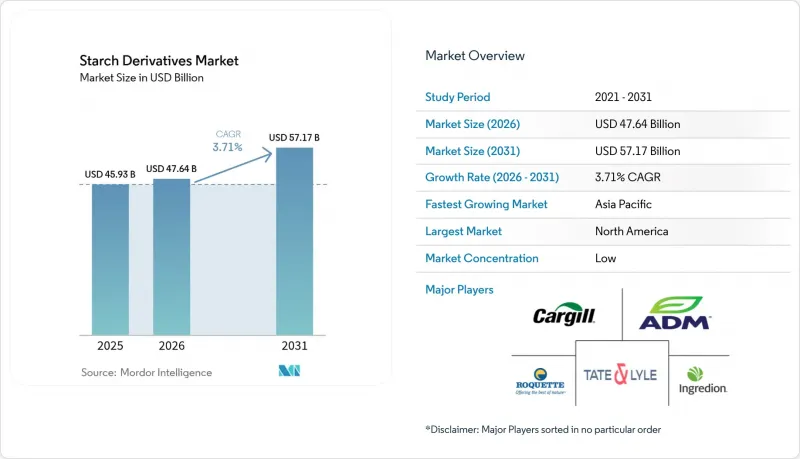
Mordor Intelligence에 의하면, 전분 유도체 시장 규모는 2025년 459억 3,000만 달러에서 2026년에는 476억 4,000만 달러에 이르고, 2026-2031년 CAGR 3.71%로 성장을 지속하여 2031년에는 571억 7,000만 달러에 달할 것으로 예측됩니다.
본 보고서에서는 업계를 ‘유형’(포도당 시럽, 고과당 옥수수 시럽, 말토덱스트린 등), ‘원료’(옥수수, 밀, 타피오카, 감자, 기타 원료), ‘형태’(분말 및 액체),용도(식품 및 음료, 제약 업계 등), 지역(북미, 유럽, 아시아태평양, 중동 및 아프리카 등)으로 분류하고 있습니다. 본 보고서에서는 시장 규모를 금액(달러)으로 제시하고 있습니다.
세계 전분 유도체 시장 동향 및 인사이트
식품 및 음료 분야의 천연 감미료 수요 증가
규제 체계는 합성 감미료보다 천연 유래 감미료를 점점 더 우선시하는 경향을 보이고 있으며, FDA의 ‘일반적으로 안전하다고 인정되는(GRAS)’ 지정에 따라 전분 기반 감미 시스템에 대한 승인 절차가 간소화되고 있습니다. FDA가 말토덱스트린을 ‘덱스트로스 환산치가 20 미만인 비감미성 당류 중합체’로 분류함에 따라, 식품 용도에서 합성 감미료에 비해 유리한 입지가 확립되었습니다. 천연 성분을 선호하는 소비자의 기호 변화로 인해 음료 부문 전반에서 제품 재처방 움직임이 진행되고 있으며, 합성 첨가물 함량을 줄이면서도 식감을 유지하는 전분 유래 식감 조절제에 대한 지속적인 수요가 발생하고 있습니다. 이러한 동향은 음료 분야에 그치지 않고 기능성 식품 분야로도 확산되고 있으며, 클린 라벨 요건에 따라 화학적으로 가공된 대체품보다 천연 유래의 변성 전분이 사양으로 채택되고 있습니다. 규제 당국이 성분의 투명성을 중시함에 따라, 천연 성분 표기가 요구되는 용도에서 전분 유도체의 경쟁력이 높아지고 있습니다.
제빵 및 제과 분야에서의 전분 유래 포도당 시럽에 대한 높은 수요
제빵 및 제과 분야에서는 포도당 시럽이 가진 독자적인 기능성, 특히 결정화를 억제하고 유통 기한을 연장하면서도 식품 안전 규제를 준수할 수 있는 점이 활용되고 있습니다. FAO(유엔 식량농업기구)의 코덱스 알리멘타리우스 기준에서는 포도당 시럽이 가공식품에 있어 필수적인 기능성 원료로 인정받고 있어, 세계 시장에서의 채택을 뒷받침하고 있습니다. 효소 처리 기술의 혁신으로 덱스트로스 상당량을 조절한 포도당 시럽의 제조가 가능해졌으며, 제조업체는 규제 준수를 유지하면서 특정 용도에 맞추어 단맛의 강도나 갈변 특성을 최적화할 수 있게 되었습니다. 유럽의 식품 안전 체계에서는 고급 제과 분야에서 합성 대체품보다 천연 유래 포도당 시럽이 선호되므로, 시장에서 차별화할 기회가 생기고 있습니다. 이 용도의 기술적 복잡성과 규제 요건은 진입 장벽으로 작용하고 있으며, 승인된 배합을 보유한 기존 기업들은 가격 결정력을 유지하면서 인접 카테고리로 사업을 확장할 수 있게 되었습니다.
농산물 원료 가격 변동이 업계 수익성에 영향을 미침
원자재 가격 변동은 전분 유도체의 수익성에 큰 영향을 미치고 있습니다. 농산물 시장은 기상 이변이나 세계 공급망에 영향을 미치는 지정학적 긴장의 영향을 받기 쉽기 때문입니다. 미국 농무부(USDA)의 작물 보고서에 따르면, 주요 전분 생산 지역에서 수확량에 큰 편차가 나타나고 있으며, 이는 하류 가공업체의 원자재 확보 가능성 및 가격에 직접적인 영향을 미치고 있습니다. 특히 옥수수 전분 시장은 농업 정책의 변경이나 무역 규제에 매우 민감하여, 가격 변동이 통합형 가공업체의 이익률을 압박하고 있습니다. 주요 농업 지역의 기상 조건으로 인한 공급 차질로 인해 제조업체는 재고 수준을 높게 유지할 수밖에 없으며, 그 결과 운전 자본 수요가 증가하고 운영 유연성이 저하되고 있습니다. 정부의 농업 지원 프로그램과 무역 정책은 원자재 가격에 추가적인 불확실성을 초래하고 있으며, 비용 변동을 관리하기 위해서는 정교한 헤지 전략이 요구되고 있습니다.
부문 분석
시클로덱스트린은 2031년까지 연평균 성장률(CAGR)이 4.92%로 가장 빠르게 성장하는 부문으로 부상하고 있습니다. 이는 시클로덱스트린의 독특한 분자 구조 덕분에 약물의 용해성을 향상시키고 서방형 제제를 구현할 수 있는 의약품 용도에 대해 FDA가 승인을 내린 것이 원동력이 되고 있습니다. FDA가 사이클로덱스트린을 약물 전달 시스템에서 안전한 부형제로 인정함에 따라, 여러 치료 분야에서 상업적 실현 가능성이 높아지고 있습니다. 말토덱스트린은 2025년에 33.78%의 시장 점유율을 차지하고 있으며, 식품 용도 전반에서 GRAS(일반적으로 안전하다고 인정되는 물질)로서의 지위가 확립된, 증량제 및 풍미 운반체로서의 범용성을 반영하고 있습니다. 포도당 시럽은 가공 식품에서의 기능적 이점을 인정하는 FAO 코덱스 규격에 힘입어 제빵 용도에서 안정적인 수요를 유지하고 있습니다. 덱스트린은 환경 규제로 인해 천연 유래 대체재가 우선시되는 접착제 및 생분해성 포장재 분야의 산업적 용도 확대의 혜택을 받고 있습니다.
사이클로덱스트린을 기반으로 한 의약품 제제에 대한 최근 규제 당국의 승인은 이 부문이 정교한 약물 전달 플랫폼으로 진화하고 있음을 보여주며, 그 용도는 여러 치료 분야로 확대되고 있습니다. 유형별 세분화는 기존의 상품 카테고리보다는 규제 준수 요건을 점점 더 반영하는 추세이며, 특수 유도체는 기술적 차별화와 확립된 승인 절차를 통해 프리미엄 가격을 실현하고 있습니다. 변형 시클로덱스트린은 용해성 향상에 대해 규제 당국의 인정을 받아, 의약품 및 뉴트라슈티컬 시장에서 용도 특화 유도체에 대한 기회를 창출하고 있습니다.
타피오카는 천연 글루텐 프리 특성과 전 세계 시장의 클린 라벨 규정 준수를 강점으로, 2031년까지 연평균 성장률(CAGR) 4.7%를 기록하며 가장 빠르게 성장하는 원료원이 되고 있습니다. 옥수수는 확립된 미국 농무부(USDA)의 품질 기준과 일관된 품질 및 규제 준수를 보장하는 종합적인 공급망 인프라에 힘입어, 2025년에는 62.61%의 시장 점유율을 차지하며 시장을 주도하고 있습니다. 밀 유래 파생 제품은 유럽 시장의 특수 용도로 사용되고 있으며, EU의 품질 기준이 식품 용도에서의 프리미엄 위치를 뒷받침하고 있습니다. 감자 전분은 그 기능적 이점이 규제 당국에 의해 인정받고 있는 점을 바탕으로, 우수한 성막성이 요구되는 용도에서 프리미엄 가격을 유지하고 있습니다. 쌀 전분은 아시아 시장에서 중요성이 커지고 있으며, 현지 식품 안전 규제가 전통적 및 현대적 식품 용도에서의 사용을 뒷받침하고 있습니다.
조달처 다각화 전략에는 규제 리스크 관리에 대한 고려가 반영되어 있으며, 기업들은 규제 변경에도 불구하고 공급망의 회복력을 확보하기 위해 여러 조달처에 대한 승인을 유지하고 있습니다. 다양한 전분 원료의 규제 상황 비교는 시장 세분화의 기회를 창출하고 있으며, 유기농 인증 및 비유전자변형(비GMO) 인증은 건강 지향적인 소비자층에서 프리미엄 위치를 가능하게 하고 있습니다. 농업 투입재 및 가공 방법을 규정하는 규제 체계는 원료 선정 결정에 점점 더 큰 영향을 미치고 있으며, 종합적인 규정 준수 프로그램을 갖춘 공급업체가 우대받고 있습니다.
지역별 분석
북미는 식품 및 의약품 용도의 전분 유도체 승인을 위한 명확한 로드맵을 제시한 종합적인 FDA 규제 체제의 뒷받침을 받아, 2025년에는 35.96%의 점유율을 유지하며 시장을 주도하고 있습니다. 이 지역은 일관된 원료 공급을 보장하는 USDA의 농업 품질 기준과 수출 경쟁력을 뒷받침하는 확립된 우수 제조 기준(GMP)의 혜택을 받고 있습니다. 의약품 용도 분야의 규제 안정성은 북미 공급업체에 경쟁 우위를 제공하며, FDA 승인 절차는 세계 시장에서 프리미엄 위치를 확보할 수 있게 해줍니다. 이 지역의 성숙한 규제 환경은 소비자 보호를 보장하는 안전 기준을 유지하면서도 특수 용도 분야의 혁신을 지원하고 있습니다.
아시아태평양은 2031년까지 연평균 성장률(CAGR)이 5.02%에 달하며, 가장 빠르게 성장하는 지역으로 부상하고 있습니다. 이는 아세안(ASEAN) 시장 전체의 규제 조화 노력에 힘입어 전분 유도체에 대한 표준화된 승인 절차가 마련된 것이 원동력이 되고 있습니다. 이 지역의 식품 안전 체계는 국제 기준과의 부합성을 높여가고 있으며, 제품의 품질과 안전성을 확보하는 동시에 다국적 공급업체의 규정 준수 비용을 절감하고 있습니다. 이 지역의 성장은 국제적인 품질 기준을 인정하는 규제 체계에 힘입어 확대되고 있는 의약품 제조 역량을 반영하고 있습니다. 식품 가공의 산업화를 촉진하는 정부의 이니셔티브에 힘입어, 진화하는 안전 요건을 준수하는 기술적으로 고도화된 전분 유도체에 대한 수요가 발생하고 있습니다.
유럽에서는 식품 및 의약품 분야의 전분 유도체 용도에 대한 명확한 지침을 제시한 유럽식품안전청(EFSA)의 종합적인 안전성 평가를 바탕으로 꾸준한 성장이 나타나고 있습니다. 이 지역의 엄격한 규제 체계는 진입 장벽이 되는 한편, 승인된 제품 포트폴리오와 종합적인 규정 준수 프로그램을 갖춘 기존 공급업체를 보호하고 있습니다. EU의 환경 규제는 석유 유래 대체재보다 생분해성이 뛰어난 전분 기반 소재를 우선시하고 있어, 지속 가능한 포장 용도를 위한 시장 기회를 창출하고 있습니다. 이 지역의 지속가능성에 대한 집중은 순환 경제의 원칙과 환경 보호 기준을 준수하는 천연 유래 변성 전분에 대한 규제적 지원을 뒷받침하고 있습니다.
기타 혜택:
- 엑셀 형식 시장 예측(ME) 시트
- 3개월간의 애널리스트 지원
자주 묻는 질문
목차
제1장 서론
제2장 조사 방법
제3장 주요 요약
제4장 시장 구도
제5장 시장 규모와 성장 예측
제6장 경쟁 구도
제7장 시장 기회와 향후 전망
LSH 26.09.09According to Mordor Intelligence, the starch derivatives market size is expected to grow from USD 45.93 billion in 2025 to USD 47.64 billion in 2026 and is forecast to reach USD 57.17 billion by 2031 at 3.71% CAGR over 2026-2031.
This report Segments the Industry Into Type (Glucose Syrup, High Fructose Corn Syrup, Maltodextrin, and More), Source (Maize, Wheat, Tapioca, Potato, and Other Sources), Form (Powder and Liquid), Application (Food and Beverage, Pharmaceutical Industry, and More), and Geography (North America, Europe, Asia-Pacific, Middle East and Africa, and More). The Report Offers the Market Size in Terms of Value (USD).
Global Starch Derivatives Market Trends and Insights
Growing Demand for Natural Sweeteners in Food and Beverage
Regulatory frameworks increasingly favor naturally-derived sweeteners over synthetic alternatives, with the FDA's Generally Recognized as Safe (GRAS) designation streamlining approval pathways for starch-based sweetening systems. The FDA's classification of maltodextrin as a non-sweet saccharide polymer with dextrose equivalent below 20 positions it advantageously against synthetic alternatives in food applications. Consumer preference shifts toward natural ingredients drive reformulation initiatives across beverage categories, creating sustained demand for starch-derived texturizing agents that maintain mouthfeel while reducing synthetic additive content. The trend extends beyond beverages into functional foods, where clean-label requirements drive specification of naturally-derived starch modifications over chemically-processed alternatives. Regulatory bodies' emphasis on ingredient transparency strengthens the competitive position of starch derivatives in applications requiring natural ingredient declarations.
High Demand for Starch-Based Glucose Syrup in Bakery and Confectionary
Bakery and confectionery applications leverage glucose syrups' unique functional properties, particularly their ability to control crystallization and extend shelf life while maintaining compliance with food safety regulations. The FAO's Codex Alimentarius standards recognize glucose syrups as essential functional ingredients in processed foods, supporting their adoption across global markets. Enzymatic processing innovations enable glucose syrup production with tailored dextrose equivalent values, allowing manufacturers to optimize sweetness intensity and browning characteristics for specific applications while maintaining regulatory compliance. European food safety frameworks favor naturally-derived glucose syrups over synthetic alternatives in premium confectionery segments, creating market differentiation opportunities. The application's technical complexity and regulatory requirements create barriers to entry, enabling established players with approved formulations to maintain pricing power while expanding into adjacent categories.
Volatility in Agricultural Raw Material Costs Affect Industry Profitability
Raw material price volatility significantly impacts starch derivative profitability, with agricultural commodity markets subject to weather-related disruptions and geopolitical tensions affecting global supply chains. USDA crop reports indicate significant yield variations in key starch-producing regions, directly affecting raw material availability and pricing for downstream processors. Corn starch markets demonstrate particular sensitivity to agricultural policy changes and trade regulations, with price fluctuations creating margin pressure for integrated processors. Weather-related disruptions in key agricultural regions force manufacturers to maintain higher inventory levels, increasing working capital requirements and reducing operational flexibility. Government agricultural support programs and trade policies create additional uncertainty in raw material pricing, requiring sophisticated hedging strategies to manage cost volatility.
Other drivers and restraints analyzed in the detailed report include:
- Increased Adoption of High Fructose Corn Syrup (HFCS) in Beverage Formulation
- Amplifying Demand for Clean Label and Non-GMO Ingredients
- Rising Consumer Shift Away from Artificial Additives
For complete list of drivers and restraints, kindly check the Table Of Contents.
Segment Analysis
Cyclodextrin emerges as the fastest-growing segment with 4.92% CAGR through 2031, driven by FDA approvals for pharmaceutical applications where its unique molecular structure enables drug solubility enhancement and controlled release formulations. The FDA's recognition of cyclodextrins as safe excipients in drug delivery systems supports commercial viability across multiple therapeutic categories. Maltodextrin commands 33.78% market share in 2025, reflecting its versatility as a bulking agent and flavor carrier with established GRAS status across food applications. Glucose syrups maintain steady demand in bakery applications, supported by FAO Codex standards that recognize their functional benefits in processed foods. Dextrins benefit from expanding industrial uses in adhesives and biodegradable packaging, where environmental regulations favor naturally-derived alternatives.
Recent regulatory approvals for cyclodextrin-based pharmaceutical formulations demonstrate the segment's evolution toward sophisticated drug delivery platforms, with applications extending across multiple therapeutic areas. The type segmentation increasingly reflects regulatory compliance requirements rather than traditional commodity categories, with specialty derivatives commanding premium pricing through technical differentiation and established approval pathways. Modified cyclodextrins receive regulatory recognition for enhanced solubility properties, creating opportunities for application-specific derivatives in pharmaceutical and nutraceutical markets.
Tapioca represents the fastest-growing source at 4.7% CAGR through 2031, benefiting from its naturally gluten-free properties and compliance with clean-label regulations across global markets. Maize dominates with a 62.61% market share in 2025, supported by established USDA quality standards and a comprehensive supply chain infrastructure that ensures consistent quality and regulatory compliance. Wheat-based derivatives serve specialized applications in European markets, where EU quality standards support premium positioning in food applications. Potato starch commands premium pricing in applications requiring superior film-forming properties, supported by regulatory recognition of its functional benefits. Rice starch gains importance in Asian markets, where local food safety regulations support its use in traditional and modern food applications.
Source diversification strategies reflect regulatory risk management considerations, with companies maintaining multiple source approvals to ensure supply chain resilience despite regulatory changes. The comparative regulatory status of different starch sources creates market segmentation opportunities, with organic and non-GMO certifications enabling premium positioning in health-conscious consumer segments. Regulatory frameworks governing agricultural inputs and processing methods increasingly influence source selection decisions, favoring suppliers with comprehensive compliance programs.
Complete Report Scope:
- By Type
- Glucose Syrups
- High Fructose Corn Syrup (HFCS)
- Maltodextrin
- Cyclodextrin
- Dextrins
- Others
- By Source
- Maize
- Wheat
- Potato
- Tapioca
- Others
- By Form
- Powder
- Liquid
- By Application
- Food and Beverage
- Bakery
- Confectionary
- Beverage
- Others
- Pharmaceutial
- Personal Care and Cosmetics
- Animal Feed
- Others
- Food and Beverage
- By Geography
- North America
- United States
- Canada
- Mexico
- Rest of North America
- Europe
- Germany
- United Kingdom
- Italy
- France
- Spain
- Netherlands
- Rest of Europe
- Asia-Pacific
- China
- India
- Japan
- Australia
- Rest of Asia-Pacific
- South America
- Brazil
- Argentina
- Rest of South America
- Middle East and Africa
- South Africa
- Saudi Arabia
- United Arab Emirates
- Rest of Middle East and Africa
- North America
Geography Analysis
North America maintains market leadership with 35.96% share in 2025, supported by comprehensive FDA regulatory frameworks that establish clear pathways for starch derivative approval across food and pharmaceutical applications. The region benefits from USDA agricultural quality standards that ensure consistent raw material supply and established good manufacturing practices that support export competitiveness. Regulatory stability in pharmaceutical applications creates competitive advantages for North American suppliers, with FDA approval pathways enabling premium positioning in global markets. The region's mature regulatory environment supports innovation in specialty applications while maintaining safety standards that ensure consumer protection.
Asia-Pacific emerges as the fastest-growing region with 5.02% CAGR through 2031, driven by regulatory harmonization initiatives across ASEAN markets that create standardized approval pathways for starch derivatives. Regional food safety frameworks increasingly align with international standards, reducing compliance costs for multinational suppliers while ensuring product quality and safety. The region's growth reflects expanding pharmaceutical manufacturing capabilities supported by regulatory frameworks that recognize international quality standards. Government initiatives promoting food processing industrialization create demand for technically sophisticated starch derivatives that comply with evolving safety requirements.
Europe demonstrates steady growth supported by comprehensive EFSA safety assessments that establish clear guidelines for starch derivative applications across food and pharmaceutical sectors. The region's stringent regulatory framework creates barriers to entry while protecting established suppliers with approved product portfolios and comprehensive compliance programs. EU environmental regulations favor biodegradable starch-based materials over petroleum-based alternatives, creating market opportunities for sustainable packaging applications. The region's focus on sustainability drives regulatory support for naturally-derived starch modifications that comply with circular economy principles and environmental protection standards.
- Archer Daniels Midland Company
- Cargill, Incorporated
- Ingredion Inc.
- Tate & Lyle Plc
- Roquette Freres S.A.
- Sudzucker AG
- Angel Starch & Food Pvt Ltd
- Tereos S.A.
- Royal Avebe
- Grain Processing Corp.
- Universal Starch Chem Allied Ltd.
- Gujarat Ambuja Exports Limited
- Thai Wah Public Co.
- Qingdao CBH Co.
- Matsutani Chemical Industry Co., Ltd.
- DSM-Firmenich
- Sunar Group
- Shandong Baolingbao
- Crespel & Deiters GmbH & Co. KG
- Bharat Starch
Additional Benefits:
- The market estimate (ME) sheet in Excel format
- 3 months of analyst support
TABLE OF CONTENTS
1 INTRODUCTION
- 1.1 Study Assumptions & Market Definition
- 1.2 Scope of the Study
2 RESEARCH METHODOLOGY
3 EXECUTIVE SUMMARY
4 MARKET LANDSCAPE
- 4.1 Market Overview
- 4.2 Market Drivers
- 4.2.1 Growing Demand for Natural Sweeteners in Food and Beverage
- 4.2.2 High Demand for Starch-Based Glucose Syrup in Bakery and Confectionary
- 4.2.3 Increased Adoption of High Fructose Corn Syrup (HFCS) in Beverage Formulation
- 4.2.4 Multi-Functional Benefits Associated with Starch Derivatives
- 4.2.5 Amplifying Demand for Clean Label and Non-GMO Ingredients
- 4.2.6 Technological Advancements in Enzymatic Processing of Starch
- 4.3 Market Restraints
- 4.3.1 Volatility in Agricultural Raw Material Costs Affect Industry Profitability
- 4.3.2 Health Concerns Linked to High Fructose Corn Syrup Consumption
- 4.3.3 Rising Consumer Shift Away from Artificial Additives
- 4.3.4 Allergy Risks and Labeling Requirements for Various Starch Additives
- 4.4 Supply Chain Analysis
- 4.5 Regulatory Outlook
- 4.6 Porter's Five Forces
- 4.6.1 Threat of New Entrants
- 4.6.2 Bargaining Power of Buyers/Consumers
- 4.6.3 Bargaining Power of Suppliers
- 4.6.4 Threat of Substitute Products
- 4.6.5 Intensity of Competitive Rivalry
5 MARKET SIZE AND GROWTH FORECASTS (VALUE)
- 5.1 By Type
- 5.1.1 Glucose Syrups
- 5.1.2 High Fructose Corn Syrup (HFCS)
- 5.1.3 Maltodextrin
- 5.1.4 Cyclodextrin
- 5.1.5 Dextrins
- 5.1.6 Others
- 5.2 By Source
- 5.2.1 Maize
- 5.2.2 Wheat
- 5.2.3 Potato
- 5.2.4 Tapioca
- 5.2.5 Others
- 5.3 By Form
- 5.3.1 Powder
- 5.3.2 Liquid
- 5.4 By Application
- 5.4.1 Food and Beverage
- 5.4.1.1 Bakery
- 5.4.1.2 Confectionary
- 5.4.1.3 Beverage
- 5.4.1.4 Others
- 5.4.2 Pharmaceutial
- 5.4.3 Personal Care and Cosmetics
- 5.4.4 Animal Feed
- 5.4.5 Others
- 5.4.1 Food and Beverage
- 5.5 By Geography
- 5.5.1 North America
- 5.5.1.1 United States
- 5.5.1.2 Canada
- 5.5.1.3 Mexico
- 5.5.1.4 Rest of North America
- 5.5.2 Europe
- 5.5.2.1 Germany
- 5.5.2.2 United Kingdom
- 5.5.2.3 Italy
- 5.5.2.4 France
- 5.5.2.5 Spain
- 5.5.2.6 Netherlands
- 5.5.2.7 Rest of Europe
- 5.5.3 Asia-Pacific
- 5.5.3.1 China
- 5.5.3.2 India
- 5.5.3.3 Japan
- 5.5.3.4 Australia
- 5.5.3.5 Rest of Asia-Pacific
- 5.5.4 South America
- 5.5.4.1 Brazil
- 5.5.4.2 Argentina
- 5.5.4.3 Rest of South America
- 5.5.5 Middle East and Africa
- 5.5.5.1 South Africa
- 5.5.5.2 Saudi Arabia
- 5.5.5.3 United Arab Emirates
- 5.5.5.4 Rest of Middle East and Africa
- 5.5.1 North America
6 COMPETITIVE LANDSCAPE
- 6.1 Market Concentration
- 6.2 Strategic Moves
- 6.3 Market Ranking Analysis
- 6.4 Company Profiles (includes Global-level Overview, Market-level Overview, Core Segments, Financials (if available), Strategic Information, Market Rank/Share, Products & Services, Recent Developments)
- 6.4.1 Archer Daniels Midland Company
- 6.4.2 Cargill, Incorporated
- 6.4.3 Ingredion Inc.
- 6.4.4 Tate & Lyle Plc
- 6.4.5 Roquette Freres S.A.
- 6.4.6 Sudzucker AG
- 6.4.7 Angel Starch & Food Pvt Ltd
- 6.4.8 Tereos S.A.
- 6.4.9 Royal Avebe
- 6.4.10 Grain Processing Corp.
- 6.4.11 Universal Starch Chem Allied Ltd.
- 6.4.12 Gujarat Ambuja Exports Limited
- 6.4.13 Thai Wah Public Co.
- 6.4.14 Qingdao CBH Co.
- 6.4.15 Matsutani Chemical Industry Co., Ltd.
- 6.4.16 DSM-Firmenich
- 6.4.17 Sunar Group
- 6.4.18 Shandong Baolingbao
- 6.4.19 Crespel & Deiters GmbH & Co. KG
- 6.4.20 Bharat Starch


