

|
시장보고서
상품코드
2125450
전분 및 전분 유도체 시장 : 시장 점유율 분석, 업계 동향 및 통계, 성장 예측(2026-2031년)Starch And Starch Derivatives - Market Share Analysis, Industry Trends & Statistics, Growth Forecasts (2026 - 2031) |
||||||
 Mordor Intelligence
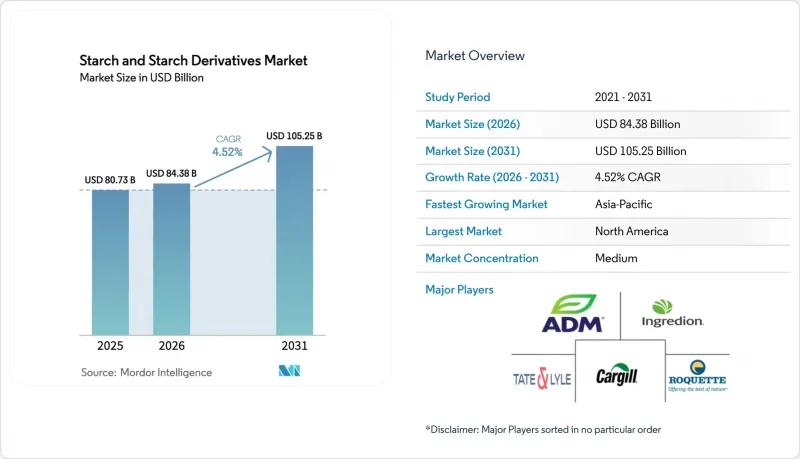
Mordor Intelligence에 의하면, 전분 및 전분 유도체 시장 규모는 2025년에 807억 3,000만 달러로 평가되었고, 2026년 843억 8,000만 달러에서 2031년까지 1,052억 5,000만 달러에 이를 것으로 예측되며, 예측 기간(2026-2031년) CAGR은 4.52%를 나타낼 전망입니다.
본 보고서는 유형별(천연 전분, 가공 전분, 전분 유도체), 원료별(옥수수, 밀, 감자, 타피오카, 기타), 용도별(식품 및 음료, 의약품, 퍼스널케어 및 화장품, 동물사료, 섬유, 종이 및 골판지, 기타), 지역별로 분류되어 있습니다. 시장 예측은 금액(달러) 기준으로 제시되어 있습니다.
세계의 전분 및 전분 유도체 시장 동향과 인사이트
전 세계 가공식품 및 편의식품 산업의 급속한 확대
유엔 식량농업기구(FAO)에 따르면, 도시화와 맞벌이 가구 증가로 인해 식사 준비 시간이 단축된 것을 배경으로, 2025년에는 전 세계 가공식품 및 편의식품 매출액이 2조 8,000억 달러에 달했고, 전년 대비 6.2%의 성장률을 기록했습니다. 이러한 급증은 인스턴트 식품, 소스, 제빵 제품에서 전분이 증점제, 안정제 및 식감 조절제 역할을 함에 따라 전분 수요를 직접적으로 끌어올리고 있습니다. 가공 전분 산업은 천연 전분으로는 얻을 수 없는 내열성 및 동결-해동 내성을 갖춘 품종을 제조업체들이 요구함에 따라 특히 큰 혜택을 보고 있습니다. 동남아시아와 사하라 이남 아프리카의 신흥 시장에서는 서유럽권에서 보였던 인스턴트 식품의 보급 곡선이 재현되고 있으며, 2024년에는 인도네시아의 인스턴트 면 소비량이 11% 증가하고, 2025년에는 나이지리아의 냉동 식품 수입량이 14% 증가할 것으로 전망됩니다. 이러한 동향들은 모두, 그동안 신선 식재료에 의존해 온 공급망에 전분 유도체를 도입한다는 것을 의미합니다. 이러한 구조적 변화는 가공업체들이 콜드체인 물류보다 상온 보관이 가능한 제조 방식을 우선시하는 가운데, 개발도상국의 미미한 GDP 성장조차도 평균을 상회하는 전분 유도체 수요 증가로 이어질 것임을 시사합니다.
식물 유래 및 기능성 원료로 향하는 소비자 트렌드
2025년, 북미 및 유럽의 식물성 식품 매출액은 290억 달러를 넘어 전년 대비 9.4%의 성장을 기록했습니다. 이 분야에서 전분은 육류 대체품 및 유제품 무첨가 제품에서 중요한 결합제 및 유화제 역할을 하고 있습니다. 완두콩 단백질 버거, 오트밀 요거트, 캐슈넛 기반 치즈는 모두 동물성 지방이나 단백질의 식감 및 녹는 방식을 재현하기 위해 가공 전분에 의존하고 있습니다. 이러한 용도에서는 클린 라벨 전략에 부합하는 비유전자변형(비GMO) 및 글루텐 프리 인증을 획득했기 때문에 타피오카 전분이나 감자 전분이 선호되어 사용되고 있습니다. 기능성 음료 브랜드에서는 프리바이오틱스 섬유질로 저항성 전분, 특히 고아밀로오스 옥수수 전분을 배합하고 있으며, 2024년에 발표된 임상시험에서는 8주간 매일 섭취한 후 장내 미생물 군집의 다양성이 개선된 것으로 나타났습니다. 미국 식품의약국(FDA)에 따르면, 기능성 식품용 난소화성 전분의 매출액은 2025년에 13% 증가하여 기존 가공 전분을 넘어섰습니다. 이는 각 브랜드가 식이섬유 함량을 강조하여 프리미엄 가격을 책정하고 있기 때문입니다. 이처럼 식물 유래와 기능성 트렌드가 융합되는 가운데, 전분 제품 포트폴리오는 세분화가 진행되고 있으며, 합성 대체품에 비해 비용 경쟁력을 유지하면서도 인증받은 유기농, 비유전자변형, 알레르기 유발 물질 무함유 제품을 제공할 수 있는 공급업체가 우위를 점하고 있습니다.
농산물 원료 가격 변동이 이익률에 영향
2024년, 독일과 네덜란드의 감자 전분 생산자들은 가뭄으로 인한 괴경 수확량 감소로 인해 투입 비용이 22% 상승했습니다. 이러한 상황으로 인해 유럽연합 집행위원회의 지침에 따라 여러 전분 공장이 2025년 작물 재배 시기까지 가동을 중단할 수밖에 없게 되었습니다. 태국에서는 인력 부족과 바이오에탄올 공장 수요 증가를 배경으로 2024년 타피오카 뿌리 가격이 16% 상승했습니다. 이 같은 가격 급등으로 일본과 한국의 식품 제조업체에 공급하는 카사바 전분 수출업체의 이익률이 압박을 받았습니다. 강력한 헤지 수단이 없거나 농가와의 장기 계약에 묶여 있는 가공업체들은 가격 급등 시 300베이시스포인트를 넘는 이익률 압박에 직면했습니다. 이로 인해 수직 통합이 진행되고 있지만, 한편으로는 소규모 지역 사업자들에게는 자본 진입 장벽이 높아지는 결과로 이어지고 있습니다. 게다가 시장의 변동성으로 인해 조달 전략이 혼란스러워지면서, 일부 제조업체는 가격 하락 시 원료를 비축하고 있습니다. 이 전략에는 장점도 있지만, 연구개발이나 생산 능력 확대에 사용되어야 할 운전 자금과 창고 공간을 묶어두게 된다는 측면도 있습니다.
부문별 분석
2025년에는 식품, 음료, 의약품 분야의 포도당 시럽, 고과당 옥수수 시럽, 말토덱스트린의 광범위한 사용에 힘입어 전분 유도체 시장 점유율은 55.12%를 차지했습니다. 변성 전분은 2026년부터 2031년까지 연평균 성장률(CAGR) 5.86%를 나타낼 것으로 예측되며, 클린 라벨 요건으로 인해 배합 담당자들이 E 번호 표기가 필요 없는 화학 처리 전분의 성능을 재현하는 효소 변성 제품을 채택하고 있기 때문에 유도체 시장을 상회할 것으로 전망됩니다. 천연 전분은 골판지용 접착제나 섬유 풀 등 비용을 중시하는 용도에서 여전히 필수적이지만, 원자재 가격 변동과 동결-해동 및 높은 전단 조건 하에서의 기능성 한계와 같은 과제에 직면해 있습니다. 2025년, 포도당 시럽은 파생 제품 매출의 22%를 차지했으며, 주로 단맛과 수분 유지력이 중요한 제과·제빵 분야에서 활용되었습니다. 북미의 고과당 옥수수 시럽(HFCS) 소비량은 음료 브랜드들이 사탕수수 설탕이나 스테비아 혼합으로 전환함에 따라 2025년에 3% 감소했습니다. 그러나 미국 농무부에 따르면, 멕시코 및 동남아시아로의 HFCS 수출은 7% 증가하여 국내에서의 감소분을 상쇄했습니다.
미국 식품의약국(FDA)이 지적한 바와 같이, 말토덱스트린의 매출액은 2025년에 8.4% 증가했습니다. 이는 위 내용물의 배출이 빠르고 특유의 맛이 없는 것이 요구되는 스포츠 영양 식품 및 의약품 첨가제로의 용도가 주도한 결과입니다. 주로 접착제나 섬유용 사이징제에 사용되는 덱스트린은 전자상거래용 포장재 수요 증가와 방글라데시 및 베트남의 의류 수출 회복에 힘입어 2025년에 4.1%의 성장률을 기록했습니다. 가공 전분 시장은 효소법과 화학법이라는 하위 부문으로 나뉘어 있습니다. 가격이 15-20% 더 비싼 효소법 제품은 각 브랜드가 라벨 표기의 간소화를 우선시함에 따라, 2025년에는 가공 전분 판매량의 42%를 차지했습니다. 압출, 고압 균질화 또는 초음파 처리를 통해 제조되는 물리적 개질 전분은 여전히 틈새 시장으로 남아 있으며, 개질 전분 매출의 5% 미만을 차지하고 있습니다. 그러나 동결-해동 안정성을 확보하면서도 ‘비개질’ 표기를 추구하는 공급업체들로부터 연구 개발 투자를 유치하고 있습니다. 이러한 세분화는 범용적인 규모보다는 성능과 표기의 투명성이 혁신을 점점 더 주도하는 시장 변화를 반영하고 있습니다.
지역별 분석
2025년, 북미는 시장의 35.48%를 차지했습니다. 이는 미국의 고과당 옥수수 시럽 인프라, 캐나다의 밀 전분 수출, 그리고 멕시코의 가공식품 제조가 주도한 결과입니다. 이 지역의 식품 가공 업계는 제품 재조성에 중점을 두게 되면서, 동결-해동 안정성과 유통 기한을 유지하면서도 클린 라벨 기준을 충족하는 효소 변성 전분에 대한 수요가 증가했습니다. 미국의 옥수수 전분 생산량은 1,420만 메트르톤에 달했으며, 아처 다니엘스 미들랜드, 카길, 잉그레디온이 수직 통합형 공급망을 통해 습식 제분 능력의 68%를 장악하고 있습니다. 멕시코의 전분 소비량은 4.9% 증가했습니다. 이는 미국 내 식품 가공 사업의 니어쇼어링과 도시화에 따른 편의식품 수요 증가에 힘입은 결과입니다. FDA의 클린 라벨 관련 지침 및 USDA의 유기농 인증을 포함한 규제 체계는 효소 처리를 권장하고 있으며, 이로 인해 기준을 충족하는 전분에는 15-20%의 가격 프리미엄이 발생하고 있습니다.
아시아태평양은 2026-2031년 연평균 성장률(CAGR) 5.58%를 나타낼 것으로 예측되며, 이를 견인할 요인으로는 중국의 의약품 등급 전분 수요, 인도의 제네릭 의약품 수출, 인도네시아의 카사바 전분 생산 능력,태국의 타피오카 가공 규모입니다. 2025년, 중국의 전분 소비량은 680만 메트르톤에 달했으며, 바이오시밀러 생산 확대에 따라 그 중 22%가 의약품 첨가제로 사용되었습니다. 인도의 전분 시장은 7.3% 성장했으며, 중산층의 선호도가 편의성을 중시하는 방향으로 전환됨에 따라 골판지 포장을 위한 옥수수 전분과 가공식품용 기능성 전분 수요가 성장을 견인했습니다. 인도네시아와 태국은 카사바의 가뭄 저항성과 원료 비용을 8-12% 절감한 정부 보조금의 지원에 힘입어 140만 메트르톤의 타피오카 전분을 수출했습니다. 일본의 전분 소비량은 1.2% 감소했으나, 의약품 및 퍼스널케어 분야의 용도가 6.1% 증가하여 식품 부문의 어려움을 상쇄했습니다. 호주의 밀 전분 생산자들은 2025년 글루텐 프리 제품 수요 감소로 인해 이익률 압박에 직면하여 바이오에탄올 및 사료 시장으로의 전환을 강요받았습니다. 중국의 SAMR, 인도의 FSSAI, 일본의 후생노동성(MHLW)으로 대표되는 아시아태평양의 규제 불일치로 인해 다국적 공급업체의 규정 준수 비용이 증가했습니다.
독일은 2025년에 68만 메트릭톤의 감자 전분을 생산했으며, 그 중 58%가 프랑스, 이탈리아, 영국의 제약 및 식품 제조업체로 수출되었습니다. 네덜란드에서는 Avebe사의 협력 감자 전분 네트워크를 통해 42만 메트르톤을 생산했으며, 스칸디나비아 및 영국의 소매 시장에서 18-22%의 프리미엄 가격을 실현하는 비유전자변형(비GMO) 및 유기농 인증에 중점을 두었습니다. 폴란드의 옥수수 전분 생산량은 34만 메트르톤에 달했으며, 중동부 유럽의 골판지 포장 및 섬유 접착 용도로 공급되었습니다. 순수입국인 프랑스와 영국은 2025년에 29만 메트르톤의 변성 전분을 흡수했는데, 그 대부분은 클린 라벨 트렌드에 부합하는 효소 처리된 제품이었습니다. 남미의 전분 시장은 경쟁력 있는 원료 비용과 가공 식품 수요 증가에 힘입어, 브라질의 카사바 전분 생산과 아르헨티나의 옥수수 전분 수출에 이끌려 4.7% 성장했습니다. 아프리카와 중동에서는 2025년에 78만 미터톤의 전분이 소비되었습니다. 이집트, 사우디아라비아, 남아프리카공화국이 성장을 주도했으며, 수요는 제빵 및 의약품 용도에 집중되었습니다. 그러나 수입 의존도가 높고 환율 변동이 심해 다른 지역에 비해 성장이 제한되었습니다.
기타 혜택 :
- 엑셀 형식 시장 예측(ME) 시트
- 3개월간의 애널리스트 지원
자주 묻는 질문
목차
제1장 서론
제2장 조사 방법
제3장 주요 요약
제4장 시장 구도
제5장 시장 규모 및 성장 예측
제6장 경쟁 구도
제7장 시장 기회 및 향후 전망
AJY 26.09.15According to Mordor Intelligence, the starch and starch derivatives market size was valued at USD 80.73 billion in 2025 and estimated to grow from USD 84.38 billion in 2026 to reach USD 105.25 billion by 2031, at a CAGR of 4.52% during the forecast period (2026-2031).
This report is Segmented by Type (Native Starch, Modified Starch, and Starch Derivatives), Source (Maize, Wheat, Potato, Tapioca, and Others), Application (Food and Beverage, Pharmaceutical, Personal Care and Cosmetics, Animal Feed, Textile, Paper and Corrugating, and Others), and Geography. The Market Forecasts are Provided in Terms of Value (USD).
Global Starch And Starch Derivatives Market Trends and Insights
Rapid Expansion of the Global Processed and Convenience Food Industry
Processed and convenience food sales reached USD 2.8 trillion globally in 2025, expanding 6.2% year-over-year as urbanization and dual-income households shortened meal-preparation windows, according to the Food and Agriculture Organization. This surge directly lifts starch demand because starches function as thickeners, stabilizers, and texture modifiers in ready-to-eat meals, sauces, and bakery products. The modified starch industry benefits disproportionately, as manufacturers require heat-stable and freeze-thaw-resistant variants that native starches cannot deliver. Emerging markets in Southeast Asia and Sub-Saharan Africa are replicating Western convenience-food adoption curves, with Indonesia's instant-noodle consumption rising 11% in 2024 and Nigeria's frozen-food imports climbing 14% in 2025, both trends that embed starch derivatives into supply chains that previously relied on fresh ingredients. This structural shift suggests that even modest GDP growth in developing economies will translate into above-average starch-derivative uptake, as processors prioritize shelf-stable formulations over cold-chain logistics.
Shifting Consumer Trends Towards Plant-Based and Functional Ingredients
Plant-based food sales in North America and Europe exceeded USD 29 billion in 2025, growing 9.4% year-over-year, with starches serving as critical binders and emulsifiers in meat analogues and dairy-free products. Pea-protein burgers, oat-milk yogurts, and cashew-based cheeses all rely on modified starches to mimic the mouthfeel and melting properties of animal-derived fats and proteins. Tapioca and potato starches are preferred in these applications because they carry non-GMO and gluten-free credentials that align with clean-label positioning. Functional-beverage brands are incorporating resistant starches, particularly high-amylose maize starch, as prebiotic fibers, with clinical trials published in 2024 demonstrating improved gut microbiome diversity after 8 weeks of daily consumption. Resistant starch sales for functional foods grew 13% in 2025, outpacing conventional modified starches, as brands leverage fiber-content claims to command premium pricing, according to the Food and Drug Administration. This convergence of plant-based and functional trends is fragmenting starch portfolios, rewarding suppliers that can offer certified organic, non-GMO, and allergen-free variants while maintaining cost competitiveness against synthetic alternatives.
Volatility in Agricultural Raw Material Prices Impacting Profit Margins
In 2024, potato starch producers in Germany and the Netherlands encountered a 22% increase in input costs due to drought-induced declines in tuber yields. This situation forced several mills to suspend operations until the 2025 plantings, in line with European Commission directives. In Thailand, tapioca-root prices rose by 16% in 2024, driven by labor shortages and increased demand from bioethanol plants. This price hike compressed margins for cassava-starch exporters supplying food manufacturers in Japan and South Korea. Processors without strong hedging mechanisms or tied to long-term farmer contracts faced margin compressions exceeding 300 basis points during price spikes. This has encouraged vertical integration, although it has also created higher capital barriers for smaller regional players. Additionally, market volatility has disrupted procurement strategies, with some manufacturers stockpiling feedstocks during price drops. While this strategy can be advantageous, it ties up working capital and warehouse space that could otherwise support R&D or capacity expansion.
Other drivers and restraints analyzed in the detailed report include:
- Cost-Effectiveness of Starch Compared to Other Hydrocolloids
- Widespread Use of Starch as a Fat Replacer in Food and Beverage Applications
- Limited Functional Stability and Shelf Life of Native Starches
For complete list of drivers and restraints, kindly check the Table Of Contents.
Segment Analysis
In 2025, starch derivatives held a 55.12% market share, driven by the extensive use of glucose syrups, high-fructose corn syrup, and maltodextrin in food, beverage, and pharmaceutical applications. Modified starch is projected to grow at a 5.86% CAGR from 2026 to 2031, surpassing derivatives as clean-label mandates push formulators toward enzymatically modified variants that replicate chemical starch performance without E-number disclosures. Native starch remains essential for cost-sensitive uses like corrugated-board adhesives and textile sizing but faces challenges from raw-material volatility and limited functionality in freeze-thaw or high-shear conditions. Glucose syrups accounted for 22% of derivative sales in 2025, primarily serving confectionery and bakery sectors where sweetness and moisture retention are key. High-fructose corn syrup (HFCS) consumption in North America declined by 3% in 2025 as beverage brands shifted to cane sugar and stevia blends. However, HFCS exports to Mexico and Southeast Asia rose by 7%, offsetting domestic declines, according to the U.S. Department of Agriculture.
Maltodextrin sales grew 8.4% in 2025, driven by sports nutrition and pharmaceutical excipient applications requiring rapid gastric emptying and neutral taste, as noted by the U.S. Food and Drug Administration. Dextrins, mainly used in adhesives and textile sizing, grew 4.1% in 2025, supported by e-commerce packaging growth and garment export recoveries in Bangladesh and Vietnam. The modified starch market is splitting into enzymatic and chemical sub-segments. Enzymatic variants, with a 15-20% price premium, captured 42% of modified-starch volume in 2025 as brands prioritized label simplicity. Physically modified starches-processed through extrusion, high-pressure homogenization, or ultrasound-remain niche, representing less than 5% of modified-starch sales. However, they are attracting R&D investments from suppliers seeking "unmodified" label claims while ensuring freeze-thaw stability. This segmentation reflects a market shift where performance and label transparency increasingly drive innovation over commodity scale.
Complete Report Scope:
- By Type
- Native Starch
- Modified Starch
- Starch Derivatives
- Glucose Syrups
- High Fructose Corn Syrup (HFCS)
- Maltodextrin
- Dextrins
- Others
- By Source
- Maize
- Wheat
- Potato
- Tapioca
- Others
- By Application
- Food And Beverage
- Pharmaceutical
- Personal Care And Cosmetics
- Animal Feed
- Textile
- Paper And Corrugating
- Others
- By Geography
- North America
- United States
- Canada
- Mexico
- Rest of North America
- Europe
- United Kingdom
- Germany
- Spain
- France
- Italy
- Sweden
- Poland
- Netherlands
- Russia
- Rest of Europe
- Asia-Pacific
- China
- India
- Japan
- Australia
- Indonesia
- Thailand
- Vietnam
- Malaysia
- Rest of Asia-Pacific
- South America
- Brazil
- Argentina
- Chile
- Peru
- Colombia
- Rest of South America
- Middle East and Africa
- Saudi Arabia
- South Africa
- United Arab Emirates
- Egypt
- Morocco
- Rest of Middle East and Africa
- North America
Geography Analysis
In 2025, North America accounted for 35.48% of the market, driven by the U.S.'s high-fructose corn syrup infrastructure, Canada's wheat-starch exports, and Mexico's processed-food manufacturing. The region's food-processing sector shifted focus to reformulation, increasing demand for enzymatically modified starches that meet clean-label standards while maintaining freeze-thaw stability and shelf life. U.S. corn-starch production reached 14.2 million metric tons, with Archer Daniels Midland, Cargill, and Ingredion controlling 68% of wet-milling capacity through vertically integrated supply chains. Mexico's starch consumption rose 4.9%, supported by nearshoring of U.S. food-processing operations and growing demand for convenience foods due to urbanization. Regulatory frameworks, including FDA clean-label guidance and USDA organic certification, favor enzymatic modifications, creating a 15-20% price premium for compliant starches.
Asia-Pacific is projected to grow at a 5.58% CAGR from 2026 to 2031, led by China's pharmaceutical-grade starch demand, India's generic-drug exports, Indonesia's cassava-starch capacity, and Thailand's tapioca-processing scale. In 2025, China consumed 6.8 million metric tons of starch, with 22% used for pharmaceutical excipients as biosimilar production expanded. India's starch market grew 7.3%, driven by maize-starch demand for corrugated packaging and modified starches in processed foods as middle-class preferences shifted toward convenience. Indonesia and Thailand exported 1.4 million metric tons of tapioca starch, benefiting from cassava's drought tolerance and government subsidies that reduced feedstock costs by 8-12%. Japan's starch consumption declined 1.2%, but pharmaceutical and personal-care applications grew 6.1%, offsetting food-sector challenges. Australian wheat-starch producers faced margin pressures in 2025 due to declining gluten-free co-product demand, prompting shifts to bioethanol and animal-feed markets. Regulatory fragmentation in Asia-Pacific, led by China's SAMR, India's FSSAI, and Japan's MHLW, increased compliance costs for multinational suppliers.
Germany produced 680,000 metric tons of potato starch in 2025, with 58% exported to pharmaceutical and food manufacturers in France, Italy, and the UK. The Netherlands, through Avebe's cooperative potato-starch network, produced 420,000 metric tons, emphasizing non-GMO and organic certifications that command 18-22% premiums in Scandinavian and UK retail markets. Poland's maize-starch output reached 340,000 metric tons, serving corrugated-packaging and textile-sizing applications in Central and Eastern Europe. France and the UK, as net importers, absorbed 290,000 metric tons of modified starches in 2025, primarily enzymatic variants aligned with clean-label trends. South America's starch market grew 4.7%, driven by Brazil's cassava-starch production and Argentina's maize-starch exports, supported by competitive feedstock costs and rising processed-food demand. The Middle East and Africa consumed 780,000 metric tons of starch in 2025, led by Egypt, Saudi Arabia, and South Africa, with demand focused on bakery and pharmaceutical applications. However, import dependency and currency volatility constrained growth compared to other regions.
- Archer Daniels Midland Company
- Cargill, Incorporated
- Ingredion Inc.
- Tate & Lyle PLC
- Roquette Freres S.A.
- Sudzucker Group
- Avebe U.A.
- AGRANA Beteiligungs-AG
- Tereos S.A.
- Grain Processing Corporation
- Manildra Group
- Japan Corn Starch Co. Ltd
- Angel Starch & Food Pvt Ltd
- Gulshan Polyols Ltd
- Universal Starch-Chem Allied Ltd
- SPAC Starch Products (India) Private Ltd.
- Everest Starch India Pvt. Ltd.
- Sage Oil LLC
- Medikonda Nutrients
- Meelunie B.V.
Additional Benefits:
- The market estimate (ME) sheet in Excel format
- 3 months of analyst support
TABLE OF CONTENTS
1 INTRODUCTION
- 1.1 Study Assumptions and Market Definition
- 1.2 Scope of the Study
2 RESEARCH METHODOLOGY
3 EXECUTIVE SUMMARY
4 MARKET LANDSCAPE
- 4.1 Market Overview
- 4.2 Market Drivers
- 4.2.1 Rapid Expansion Of The Global Processed And Convenience Food Industry
- 4.2.2 Shifting Consumer Trends Towards Plant-Based And Functional Ingredients
- 4.2.3 Cost-Effectiveness Of Starch Compared To Other Hydrocolloids
- 4.2.4 Widespread Use Of Starch As A Fat Replacer In Food And Beverage Applications
- 4.2.5 Advancements In Enzymatic And Physical Modification Techniques
- 4.2.6 Adoption Of Starch Derivatives In Industrial Applications Beyond Food
- 4.3 Market Restraints
- 4.3.1 Volatility In Agricultural Raw Material Prices Impacting Profit Margins
- 4.3.2 Limited Functional Stability And Shelf Life Of Native Starches
- 4.3.3 Quality Concerns Due To Genetically Modified Ingredient Adulteration
- 4.3.4 Regulatory Complexity In Labeling Modified Or Functional Starches
- 4.4 Supply Chain Analysis
- 4.5 Regulatory Landscape
- 4.6 Technological Outlook
- 4.7 Porter's Five Forces
- 4.7.1 Threat of New Entrants
- 4.7.2 Bargaining Power of Buyers
- 4.7.3 Bargaining Power of Suppliers
- 4.7.4 Threat of Substitutes
- 4.7.5 Competitive Rivalry
5 MARKET SIZE AND GROWTH FORECASTS
- 5.1 By Type
- 5.1.1 Native Starch
- 5.1.2 Modified Starch
- 5.1.3 Starch Derivatives
- 5.1.3.1 Glucose Syrups
- 5.1.3.2 High Fructose Corn Syrup (HFCS)
- 5.1.3.3 Maltodextrin
- 5.1.3.4 Dextrins
- 5.1.3.5 Others
- 5.2 By Source
- 5.2.1 Maize
- 5.2.2 Wheat
- 5.2.3 Potato
- 5.2.4 Tapioca
- 5.2.5 Others
- 5.3 By Application
- 5.3.1 Food And Beverage
- 5.3.2 Pharmaceutical
- 5.3.3 Personal Care And Cosmetics
- 5.3.4 Animal Feed
- 5.3.5 Textile
- 5.3.6 Paper And Corrugating
- 5.3.7 Others
- 5.4 By Geography
- 5.4.1 North America
- 5.4.1.1 United States
- 5.4.1.2 Canada
- 5.4.1.3 Mexico
- 5.4.1.4 Rest of North America
- 5.4.2 Europe
- 5.4.2.1 United Kingdom
- 5.4.2.2 Germany
- 5.4.2.3 Spain
- 5.4.2.4 France
- 5.4.2.5 Italy
- 5.4.2.6 Sweden
- 5.4.2.7 Poland
- 5.4.2.8 Netherlands
- 5.4.2.9 Russia
- 5.4.2.10 Rest of Europe
- 5.4.3 Asia-Pacific
- 5.4.3.1 China
- 5.4.3.2 India
- 5.4.3.3 Japan
- 5.4.3.4 Australia
- 5.4.3.5 Indonesia
- 5.4.3.6 Thailand
- 5.4.3.7 Vietnam
- 5.4.3.8 Malaysia
- 5.4.3.9 Rest of Asia-Pacific
- 5.4.4 South America
- 5.4.4.1 Brazil
- 5.4.4.2 Argentina
- 5.4.4.3 Chile
- 5.4.4.4 Peru
- 5.4.4.5 Colombia
- 5.4.4.6 Rest of South America
- 5.4.5 Middle East and Africa
- 5.4.5.1 Saudi Arabia
- 5.4.5.2 South Africa
- 5.4.5.3 United Arab Emirates
- 5.4.5.4 Egypt
- 5.4.5.5 Morocco
- 5.4.5.6 Rest of Middle East and Africa
- 5.4.1 North America
6 COMPETITIVE LANDSCAPE
- 6.1 Market Concentration
- 6.2 Strategic Moves
- 6.3 Market Positioning Analysis
- 6.4 Company Profiles (includes Global level Overview, Market level overview, Core Segments, Financials as available, Strategic Information, Market Rank/Share for key companies, Products and Services, and Recent Developments)
- 6.4.1 Archer Daniels Midland Company
- 6.4.2 Cargill, Incorporated
- 6.4.3 Ingredion Inc.
- 6.4.4 Tate & Lyle PLC
- 6.4.5 Roquette Freres S.A.
- 6.4.6 Sudzucker Group
- 6.4.7 Avebe U.A.
- 6.4.8 AGRANA Beteiligungs-AG
- 6.4.9 Tereos S.A.
- 6.4.10 Grain Processing Corporation
- 6.4.11 Manildra Group
- 6.4.12 Japan Corn Starch Co. Ltd
- 6.4.13 Angel Starch & Food Pvt Ltd
- 6.4.14 Gulshan Polyols Ltd
- 6.4.15 Universal Starch-Chem Allied Ltd
- 6.4.16 SPAC Starch Products (India) Private Ltd.
- 6.4.17 Everest Starch India Pvt. Ltd.
- 6.4.18 Sage Oil LLC
- 6.4.19 Medikonda Nutrients
- 6.4.20 Meelunie B.V.


