

|
시장보고서
상품코드
2122925
인도의 전분 및 전분 유도체 : 시장 점유율 분석, 업계 동향 및 통계, 성장 예측(2026-2031년)India Starch And Starch Derivative - Market Share Analysis, Industry Trends & Statistics, Growth Forecasts (2026 - 2031) |
||||||
 Mordor Intelligence
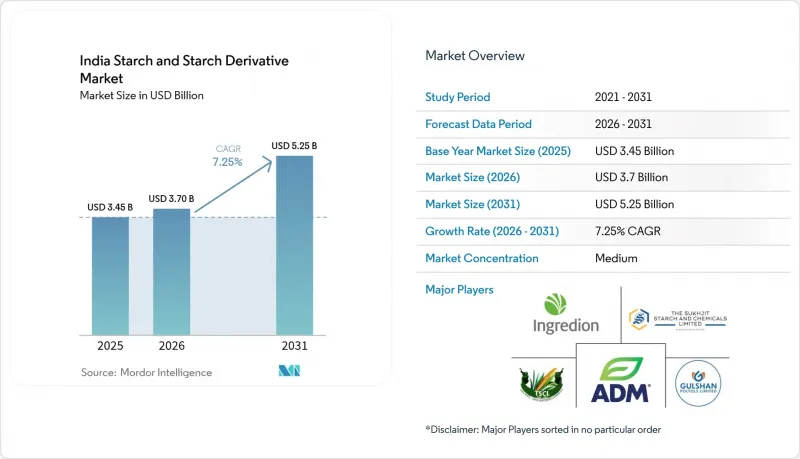
Mordor Intelligence에 의하면, 인도의 전분 및 전분 유도체 시장 규모는 2025년에 34억 5,000만 달러로 평가되었습니다. 2026년 37억 달러에서 2031년까지 52억 5,000만 달러에 이를 것으로 예상되며, 예측 기간(2026-2031년) CAGR은 7.25%를 나타낼 전망입니다.

본 보고서는 유형(천연 전분, 가공 전분, 전분 유도체), 원료(옥수수, 밀, 타피오카, 기타),형태(분말, 액체), 용도(식음료, 의약품, 퍼스널케어 및 화장품, 동물사료, 섬유, 종이 및 골판지, 기타), 지역별로 분류되어 있습니다. 시장 예측은 금액(달러) 기준으로 제시되어 있습니다.
인도의 전분 및 전분 유도체 시장 동향과 인사이트
풍부한 국내 옥수수 공급망의 통합
미국 농무부(USDA) 해외농업국의 보고서에 따르면, 2024/25년도 인도의 옥수수 생산량은 3,700만 톤에 달했습니다. 이러한 견조한 옥수수 생산량은 전분 제조업체에 전략적 이점을 제공합니다. 국내 공급망을 통합함으로써 인도는 수입 의존도를 낮출 뿐만 아니라, 특히 세계 옥수수 가격 변동이 지속되는 상황에서 비용 측면에서도 우위를 점하고 있습니다. 인도에서는 옥수수 생산량의 약 14%가 전분 제조에 사용되고 있으며, 이는 산업 확장을 위한 견고한 기반이 되고 있습니다. 이 부문은 기술 통합을 통해 농업 부문의 현대화를 목표로 하는 ‘디지털 농업 미션’과 같은 정부 주도의 노력으로부터 큰 혜택을 받고 있습니다. 또한, 저장 및 가공 시설을 포함한 수확 후 인프라 구축이 진전됨에 따라 공급망이 강화되고 있습니다. 이러한 발전은 농업 생산성을 높일 뿐만 아니라, 수입에 의존하는 경쟁사들에 비해 국내 제조업체에 유리한 입지를 제공하여 전분 제조 산업의 장기적인 성장을 가속하고 있습니다.
클린 라벨 가공 전분에 대한 수요 급증
인도에서는 클린 라벨 제품으로의 전환이 식품 가공 부문을 변화시키고 있으며, 미국 농무부에 따르면 해당 부문 시장 규모는 2025-26 회계연도까지 5,350억 달러에 달할 전망입니다. 건강에 대한 의식이 높아지는 도시 지역 소비자들은 합성 첨가물의 천연 대체품으로서 가공 전분에 주목하고 있습니다. 『Food Ingredients First』에 따르면, 기업들은 현재 클린 라벨 배합을 우선시하고 있으며, 식감이나 입안에서의 느낌을 향상시키기 위해 가공 전분 시스템을 적극적으로 활용하고 있습니다. 특히, 가교 전분은 가공 식품에서 뛰어난 안정성과 기능적 이점으로 인해 인기를 얻고 있습니다. 이는 레트로그라데이션이나 동결-해동 과정에 대한 내성이 뛰어나기 때문입니다. 식품 제조업체들은 규제 기준을 준수할 뿐만 아니라 제품 품질을 유지하기 위해서도 이러한 가공 전분을 채택하고 있으며, 이로 인해 베이커리, 유제품, 편의식품 부문에서 수요가 꾸준히 증가하고 있습니다.
에탄올로의 용도 전환 증가에 따른 옥수수 가격 변동
인도가 옥수수 수출국에서 순수입국으로 전환됨에 따라 가격에 큰 변동이 발생하고 있습니다. 연간 600만-700만 톤을 소비하는 에탄올 수요에 힘입어 옥수수 가격은 1 퀸탈당 27.35달러까지 급등했습니다. 이러한 가격 급등은 전분 제조업체의 원료 비용에 직접적인 영향을 미치고 있으며, 조달 능력이 제한적인 중소 제조업체에 가장 큰 타격을 주고 있습니다. 이러한 과제에 대응하기 위해 정부는 공급 부족을 해소하고자 관세를 인하한 유전자 변형 옥수수 수입을 검토하고 있습니다. 그러나 규제 당국의 승인 일정에 대해서는 여전히 불투명한 상황입니다. 한편, 가금류 생산자들은 광범위한 공급망에 가해지는 부담과 이것이 전분 산업의 경쟁력에 미치는 영향을 강조하며, 옥수수의 무관세 수입을 강력히 요구하고 있습니다. 많은 전분 파생 제품의 생산 비용 중 60-70%를 옥수수가 차지하고 있기 때문에 이러한 가격 변동은 제조업체의 계획 수립에 큰 장애물이 되고 있습니다. 그 결과, 각 기업은 고도 헤지 전략을 채택하거나, 비용 증가분을 다운스트림 고객에게 전가하는 것 중 하나를 선택할 수밖에 없는 상황에 처해 있습니다.
부문별 분석
2025년, 천연 전분은 비용 측면에서의 우위와 식품 가공 및 산업 부문에서의 폭넓은 용도를 바탕으로 39.92%라는 압도적인 시장 점유율을 차지했습니다. 한편, 가공 전분은 가장 빠르게 성장하는 부문으로, 2031년까지 연평균 성장률(CAGR) 7.90%로 확대될 것으로 예측됩니다. 이러한 급속한 성장은 안정성 향상, 식감 조절, 클린 라벨 기준 준수 등 고도의 기능이 요구되는 특수한 용도에 의해 주도되고 있습니다. 글루코스 시럽이나 말토덱스트린 등의 전분 유도체는 에탄올 산업과 식품 가공 산업 양쪽 모두에서 강한 수요가 나타나고 있습니다. 특히, 글루코스 시럽은 에탄올 혼합에 관한 정부 규제의 혜택을 받고 있습니다.
이러한 부문별 동향은 인도의 산업 환경이 변화하고 있음을 여실히 보여주고 있습니다. 기존 천연 전분은 섬유 및 제지 부문에서 자리 잡았으나, 의약품 및 특수 식품용 고부가가치 개질 제품으로의 뚜렷한 전환이 관찰됩니다. 가교 전분은 가공 식품에서의 안정성 덕분에 인기가 높아지고 있습니다. 동시에, RSC Pharm이 지적한 바와 같이, 사이클로덱스트린 유도체는 약물 전달 시스템에 대한 응용이 증가하고 있습니다. 고과당 옥수수 시럽(HFCS)과 덱스트린은 틈새 시장을 대상으로 하고 있지만, 천연 감미료와의 경쟁에 직면해 있으며, 이는 클린 라벨 제품으로의 소비자들의 광범위한 전환을 반영하고 있습니다.
2025년에는 옥수수가 시장 점유율의 62.05%를 차지했습니다. 이는 인도가 경작 면적 기준 세계 4위의 생산국일 뿐만 아니라, 구자라트주, 펀자브주, 마하라슈트라주에 집중된 견고한 습식 제분 인프라에 힘입은 결과입니다. 감자 유래 전분은 가장 빠르게 성장하는 부문으로, 2031년까지 연평균 성장률(CAGR)이 8.41%를 나타낼 것으로 예측됩니다. 이러한 성장은 감자 전분의 뛰어난 기능과 의약품 첨가제 및 특수 식품으로의 사용 확대에 힘입은 것입니다. 밀 유래 전분은 기존 용도에서 안정적인 수요를 유지하고 있는 반면, 타피오카 전분은 특정 점도 특성이 필요한 전문적인 산업 수요를 충족시키고 있습니다.
전분 원료의 다양화는 가격 변동에 대한 우려가 커지는 가운데, 각 제조업체가 리스크 관리에 힘쓰며 단일 원료에 대한 의존도를 낮추려 하고 있음을 보여줍니다. 예를 들어, 아닐 리미티드(Anil Limited)는 하루 550톤의 처리 능력을 갖춘 인도 최대 규모의 옥수수 습식 제분 시설을 운영하고 있으며, 이는 옥수수 가공 분야에서 규모의 경제성을 보여주고 있습니다. 또한, 번야드 밀레트 전분과 같은 대체 원료도 그 지속가능성과 독자적인 물리화학적 특성으로 인해 주목받고 있지만, 상업적 확장성에는 여전히 한계가 있습니다.
기타 혜택
- 엑셀 형식 시장 예측(ME) 시트
- 3개월간의 애널리스트 지원
자주 묻는 질문
목차
제1장 서론
제2장 조사 방법
제3장 주요 요약
제4장 시장 구도
제5장 시장 규모 및 성장 예측
제6장 경쟁 구도
제7장 시장 기회 및 향후 전망
KTH 26.09.08According to Mordor Intelligence, the indian starch and starch derivatives market size was valued at USD 3.45 billion in 2025 and estimated to grow from USD 3.7 billion in 2026 to reach USD 5.25 billion by 2031, at a CAGR of 7.25% during the forecast period (2026-2031).
This report is Segmented by Type (Native Starch, Modified Starch, Starch Derivatives), Source (Maize, Wheat, Tapioca, Others), Form (Powder, Liquid), Application (Food and Beverage, Pharmaceutical, Personal Care & Cosmetics, Animal Feed, Textile, Paper and Corrugating, Others) and Geography. The Market Forecasts are Provided in Terms of Value (USD).
India Starch And Starch Derivative Market Trends and Insights
Abundant Domestic Maize Supply Chain Integration
In 2024/25, India's corn production is projected to hit 37 million metric tons, as reported by the USDA Foreign Agriculture Service . This robust maize output offers strategic benefits to starch manufacturers. By integrating domestic supply chains, India not only curtails its reliance on imports but also gains a cost edge, especially amidst the backdrop of fluctuating global corn prices.In India, approximately 14% of maize production is directed towards starch manufacturing, setting a robust foundation for the industry's expansion. This segment benefits significantly from government initiatives such as the Digital Agriculture Mission, which aims to modernize the agricultural sector through technology integration. Additionally, advancements in post-harvest infrastructure, including storage and processing facilities, have strengthened the supply chain. These developments not only boost agricultural productivity but also position domestic manufacturers advantageously against their import-dependent counterparts, fostering long-term growth in the starch manufacturing industry.
Surge in Demand for Clean-Label Modified Starches
In India, a shift towards clean-label products is transforming the food processing sector, which is on track to hit USD 535 billion by 2025-26, as per the U.S. Department of Agriculture. Urban consumers, becoming more health-conscious, are turning to modified starches as natural substitutes for synthetic additives. Companies are now prioritizing clean-label formulations, heavily leaning on modified starch systems to enhance texture and mouthfeel, according to Food Ingredients First. Notably, cross-linked starches are emerging as favorites due to their superior stability and functional benefits in processed foods, showcasing better resistance to retrogradation and freeze-thaw challenges. Food manufacturers are not only adopting these modified starches to comply with regulatory standards but also to uphold product quality, driving consistent demand growth in the bakery, dairy, and convenience food sectors.
Corn-Price Volatility from Rising Ethanol Diversion
India's shift from being a corn exporter to a net importer has led to significant price fluctuations. Corn prices have jumped to USD 27.35 per quintal, driven by ethanol demand, which consumes 6-7 million tons annually. This surge in prices has a direct effect on the raw material costs for starch manufacturers, hitting smaller players with limited procurement power the hardest. In response to these challenges, the government is contemplating the import of genetically modified corn at reduced duties to address supply shortages. However, the timeline for regulatory approvals remains a gray area. Meanwhile, poultry producers are pushing for duty-free corn imports, highlighting the strain on the broader supply chain and its implications for the starch industry's competitiveness. With corn accounting for 60-70% of production costs for many starch derivatives, this volatility poses significant planning hurdles for manufacturers. As a result, companies are either resorting to advanced hedging strategies or passing the increased costs onto their downstream customers.
Other drivers and restraints analyzed in the detailed report include:
- E-commerce-Driven Paper & Packaging Starch Uptake
- Government Ethanol-Blending Push Boosting Glucose Syrups
- Quality Concerns Due to Genetically Modified Ingredient Adulteration
For complete list of drivers and restraints, kindly check the Table Of Contents.
Segment Analysis
In 2025, native starches command a dominant 39.92% market share, leveraging cost advantages and widespread applications in food processing and industrial sectors. Meanwhile, modified starches are the fastest-growing segment, projected to expand at an 7.90% CAGR through 2031. This surge is fueled by their specialized applications, which demand enhanced functional properties like improved stability, texture modification, and adherence to clean-label standards. Starch derivatives, such as glucose syrups and maltodextrin, are witnessing strong demand from both the ethanol and food processing industries. Notably, glucose syrups are reaping benefits from government mandates on ethanol blending.
These segment dynamics underscore India's evolving industrial landscape. While traditional native starches found their footing in textiles and paper, there's a notable shift towards higher-value modified products catering to pharmaceuticals and specialty foods. Cross-linked starches are becoming popular for their stability in processed foods. At the same time, cyclodextrin derivatives are seeing a rise in drug delivery system applications, as highlighted by RSC Pharm. Although high fructose corn syrup (HFCS) and dextrins cater to niche markets, they grapple with competition from natural sweeteners, reflecting a broader consumer shift towards clean-label products.
In 2025, maize accounts for 62.05% of the market share, supported by India's position as the 4th largest global producer by area and a robust wet-milling infrastructure concentrated in Gujarat, Punjab, and Maharashtra. Potato-based starches are the fastest-growing segment, with an expected CAGR of 8.41% through 2031. This growth is driven by their superior functional properties and increasing use in pharmaceutical excipients and specialty food products. Wheat-based starches continue to see steady demand in traditional applications, while tapioca starches cater to specialized industrial needs requiring specific viscosity characteristics.
The diversification of starch sources highlights manufacturers' efforts to manage risks and reduce reliance on single feedstocks amid concerns over price volatility. For example, Anil Limited operates one of India's largest corn wet-milling facilities, with a capacity of 550 tonnes per day, showcasing the scale advantages in maize processing. Additionally, alternative sources like barnyard millet starch are being explored for their sustainability and unique physicochemical properties, although their commercial scalability remains limited.
Complete Report Scope:
- By Type
- Native Starch
- Modified Starch
- Starch Derivatives
- Glucose Syrups
- High Fructose Corn Syrup (HFCS)
- Maltodextrin
- Dextrins
- Others
- By Source
- Maize
- Wheat
- Tapioca
- Others
- By Form
- Powder
- Liquid
- By Application
- Food and Beverage
- Pharmaceutial
- Personal Care & Cosmetics
- Animal Feed
- Textile
- Paper and Corrugating
- Others
List of Companies Covered in this Report:
- Archer Daniels Midland Company
- Cargill Inc.
- Ingredion Incorporated
- Gulshan Polyols Ltd
- Tirupati Starch & Chemicals Ltd
- Sukhjit Starch & Chemicals Ltd
- Gayatri Bio Organics Ltd
- Universal Starch Chem Allied Ltd
- Sahyadri Starch & Industries Pvt Ltd
- Gujarat Ambuja Exports Ltd
- Bluecraft Agro Pvt Ltd
- Angel Starch & Food Pvt Ltd
- RVP Starch Pvt Ltd
- Spac Starch Products (India) Ltd
- Shalom Sales Indore
- Roquette Freres SA
- Tate & Lyle PLC
- Tereos Syral
- Avebe UA
- BASF-SE
Additional Benefits:
- The market estimate (ME) sheet in Excel format
- 3 months of analyst support
TABLE OF CONTENTS
1 INTRODUCTION
- 1.1 Study Assumptions & Market Definition
- 1.2 Scope of the Study
2 RESEARCH METHODOLOGY
3 EXECUTIVE SUMMARY
4 MARKET LANDSCAPE
- 4.1 Market Overview
- 4.2 Market Drivers
- 4.2.1 Abundant domestic maize supply chain integration
- 4.2.2 Surge in demand for clean-label modified starches
- 4.2.3 E-commerce-driven paper & packaging starch uptake
- 4.2.4 Government ethanol-blending push boosting glucose syrups
- 4.2.5 Emergence of starch-based bioplastics replacing single-use plastics
- 4.2.6 Cyclodextrin adoption in Indian pharma drug-delivery systems
- 4.3 Market Restraints
- 4.3.1 Corn-price volatility from rising ethanol diversion
- 4.3.2 Quality Concerns Due to Genetically Modified Ingredient Adulteration
- 4.3.3 Sub-scale wet-milling plants limiting quality consistency
- 4.3.4 Regulatory uncertainty on single-use plastic alternatives adoption
- 4.4 Supply Chain Analysis
- 4.5 Regulatory Outlook
- 4.6 Porter's Five Forces
- 4.6.1 Threat of New Entrants
- 4.6.2 Bargaining Power of Buyers/Consumers
- 4.6.3 Bargaining Power of Suppliers
- 4.6.4 Threat of Substitute Products
- 4.6.5 Intensity of Competitive Rivalry
5 MARKET SIZE AND GROWTH FORECAST
- 5.1 By Type
- 5.1.1 Native Starch
- 5.1.2 Modified Starch
- 5.1.3 Starch Derivatives
- 5.1.3.1 Glucose Syrups
- 5.1.3.2 High Fructose Corn Syrup (HFCS)
- 5.1.3.3 Maltodextrin
- 5.1.3.4 Dextrins
- 5.1.3.5 Others
- 5.2 By Source
- 5.2.1 Maize
- 5.2.2 Wheat
- 5.2.3 Tapioca
- 5.2.4 Others
- 5.3 By Form
- 5.3.1 Powder
- 5.3.2 Liquid
- 5.4 By Application
- 5.4.1 Food and Beverage
- 5.4.2 Pharmaceutial
- 5.4.3 Personal Care & Cosmetics
- 5.4.4 Animal Feed
- 5.4.5 Textile
- 5.4.6 Paper and Corrugating
- 5.4.7 Others
6 COMPETITIVE LANDSCAPE
- 6.1 Market Concentration
- 6.2 Strategic Moves
- 6.3 Market Ranking Analysis
- 6.4 Company Profiles (includes Global level Overview, Market level overview, Core Segments, Financials as available, Strategic Information, Market Rank/Share for key companies, Products & Services, and Recent Developments)
- 6.4.1 Archer Daniels Midland Company
- 6.4.2 Cargill Inc.
- 6.4.3 Ingredion Incorporated
- 6.4.4 Gulshan Polyols Ltd
- 6.4.5 Tirupati Starch & Chemicals Ltd
- 6.4.6 Sukhjit Starch & Chemicals Ltd
- 6.4.7 Gayatri Bio Organics Ltd
- 6.4.8 Universal Starch Chem Allied Ltd
- 6.4.9 Sahyadri Starch & Industries Pvt Ltd
- 6.4.10 Gujarat Ambuja Exports Ltd
- 6.4.11 Bluecraft Agro Pvt Ltd
- 6.4.12 Angel Starch & Food Pvt Ltd
- 6.4.13 RVP Starch Pvt Ltd
- 6.4.14 Spac Starch Products (India) Ltd
- 6.4.15 Shalom Sales Indore
- 6.4.16 Roquette Freres SA
- 6.4.17 Tate & Lyle PLC
- 6.4.18 Tereos Syral
- 6.4.19 Avebe UA
- 6.4.20 BASF-SE


