|
시장보고서
상품코드
2121881
남미의 자동차 시장 : 시장 점유율 분석, 업계 동향 및 통계, 성장 예측(2026-2031년)South America Automotive - Market Share Analysis, Industry Trends & Statistics, Growth Forecasts (2026 - 2031) |
||||||
 Mordor Intelligence
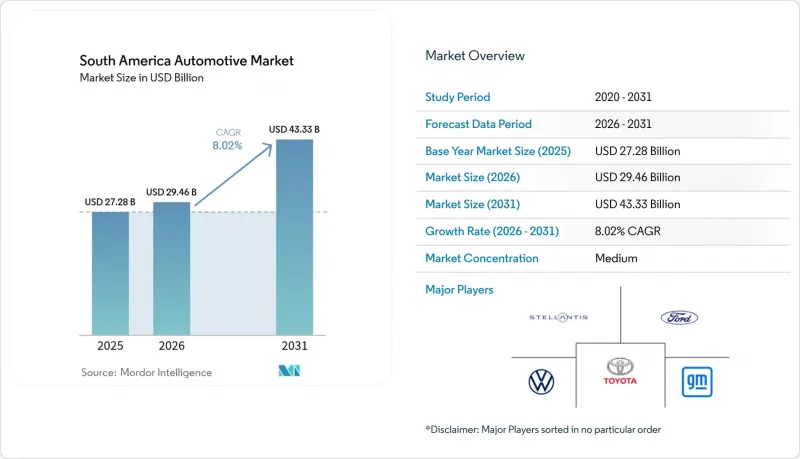
Mordor Intelligence에 의하면, 남미의 자동차 시장 규모는 2025년 272억 8,000만 달러로 평가되었고, 2026년에는 294억 6,000만 달러로 추정되고, 2026-2031년 CAGR 8.02%로 성장을 지속할 전망이며, 2031년에는 433억 3,000만 달러에 이를 것으로 예측됩니다.
본 보고서는 차종별(승용차, 상용차, 이륜차, 오프로드 차량), 구동 방식별(내연기관 차량 및 전기차), 판매 채널별(OEM/직접 판매, 딜러/소매, 기타), 최종 사용자별(개인/민간, 중소기업용 차량, 기타) 및 국가별로 분류되어 있습니다. 시장 예측은 금액(달러) 기준으로 제시되어 있습니다.
남미의 자동차 시장 동향 및 인사이트
지역별 차량 플랫폼에 대한 OEM 투자
남미에서는 기존 차량 및 전동화 차량의 판매 확대에 더해, 폭스바겐 AG와 스텔란티스 NV와 같은 주요 기업들의 투자 활성화로 인해 수익성이 향상되고 있습니다. 스텔란티스 단독 투자액은 56억 유로에 달하며, 이는 해당 지역 역사상 최대 규모의 단일 투자 프로젝트입니다. 폭스바겐 AG는 현지 사용 조건에 맞춘 아르헨티나 거점의 ‘아마록’ 프로그램에 5억 8,000만 달러를 배정했습니다. 동시에, 도요타 자동차와 BMW 그룹은 하이브리드 및 플렉스 연료 구동 시스템에 초점을 맞춘 다년간의 사업 확장을 발표했습니다. 5개 모델을 아우르며 연간 판매량 80만 대를 목표로 하는 GM과 현대의 제휴와 같은 공동 프로젝트는 비용 구조의 공유와 제품 출시 주기의 가속화를 위한 전환을 보여줍니다. 이러한 지역 특화 플랫폼은 환율 리스크를 줄이고, 지역 규제 기준을 충족하며, 메르코수르의 관세 우대 조치를 활용함으로써 남미 자동차 시장의 경쟁력을 종합적으로 높이고 있습니다.
팬데믹 이후의 GDP 회복과 소비자 신용 확대
이 지역의 GDP는 2025년에 전년 대비 1.9% 증가에서 2.5% 증가로 확대될 것으로 예측되며, 기준 금리가 높은 수준을 유지하고 있음에도 불구하고 가계 소득 증가와 자동차 대출 수요 증가로 이어질 것으로 전망됩니다. 브라질 경제는 2024년에 3.4% 성장할 전망이며, 실업률은 6.5%에 그쳐 자동차 구매를 뒷받침하는 환경이 조성되어 있습니다. 아르헨티나에서는 개혁으로 인해 월간 인플레이션율이 2.8%로 하락하며 자동차 구매자를 위한 새로운 대출 경로가 열린 반면, 콜롬비아에서는 제조업 생산량이 해마다 증가하고 있어 남미 자동차 시장의 성장세를 뒷받침하고 있습니다. 자금 조달 비용은 여전히 억제되고 있지만, 대다수 중앙은행에서 통화 완화 정책이 진행되고 있어 대출 이용 편의성은 점차 회복될 전망입니다. 거시경제 펀더멘털의 강화로 인해 2025년 한 해 동안 쇼룸 방문객 수와 수주 잔고가 증가할 것으로 예측됩니다.
높은 수준을 유지하는 대출 금리와 인플레이션에 따른 자동차 가격 상승
브라질의 세릭 금리는 2025년에 14.25%까지 상승하여 자동차 대출 금리를 끌어올리고, 구매 부담을 가중시키고 있습니다. 아르헨티나의 인플레이션율은 완화되었으나, 페소 환율 변동으로 인해 대출 스프레드는 여전히 넓게 유지되고 있으며, 지역 통화의 변동이 수입 가격 전망을 불투명하게 만들고 있습니다. 각 자동차 제조업체들은 현재 상환 기간 연장 및 금리 지원 조치를 제공하고 있지만, 신용 이용률은 여전히 팬데믹 이전 수준보다 낮습니다. 그 결과, 남미 자동차 시장의 단기 판매 대수는 금융 환경이 완화될 때까지 잠재적 수준에 미치지 못할 가능성이 있습니다.
부문 분석
2025년 기준, 승용차는 남미 자동차 시장 규모의 73.68%를 차지했으며, 도시화 진전과 중산층 소득 증가를 호재로 삼아 2031년까지 연평균 성장률(CAGR) 11.95%로 확대될 것으로 예측됩니다. SUV와 크로스오버 차량은 높은 좌고와 안전성에 대한 긍정적인 평가로 수요를 견인하는 한편, 소형 세단은 휘발유 가격 급등 속에서도 우수한 연비 덕분에 일정한 입지를 유지하고 있습니다. 판매 대수는 적지만, 상용차는 농업 및 광업의 주요 노선에서 물류를 뒷받침하고 있으며, 브라질의 농장에서는 소형 픽업트럭이 선호되고, 칠레의 구리 수출을 지탱하고 있는 것은 대형 트럭입니다. 이륜차는 비용 효율이 뛰어난 이동 수단으로서 교통 체증이 심한 대도시에서 급속히 보급되고 있는 반면, 오프로드용 장비는 유틸리티 지출을 호재로 삼아 성장하고 있습니다.
승용차의 성장세는 스텔란티스가 2030년까지 40종 이상의 신제품을 출시할 계획에 힘입어 더욱 가속화되고 있습니다. 이들 중 상당수는 유연 연료 구동 시스템에 대응하는 현지화 플랫폼을 채택하고 있습니다. 또한, 금융 프로모션은 그렇지 않으면 쇼룸 방문객 수를 감소시킬 우려가 있는 대출 금리 상승이라는 역풍을 완화하는 것을 목적으로 하고 있습니다. 한편, 중고차용 디지털 플랫폼은 트레이드인(차량 임베디드)의 유동성을 높이고, 실질적인 교체 비용을 절감하며, 판매 회전율을 유지하고 있습니다. 차종 구성에서는 남미 자동차 시장이 개인의 이동 수단에 대한 요구와 상업용 운송 수요를 어떻게 양립시키고 있는지가 뚜렷이 드러납니다.
2025년 시점에서 남미 자동차 시장에서 내연기관 차량의 점유율은 72.95%를 유지했으나, 재정적 인센티브와 중국 현지 생산에 따른 가격 차이의 축소로 인해 배터리식 전기차는 연평균 성장률(CAGR) 11.15%로 급속히 확대되고 있습니다. 브라질의 E30 제도는 플렉스 연료 엔진에 대해 비용 면에서의 경쟁력을 확보하는 역할을 수행하고 있으며, 휘발유 수입을 줄이는 동시에 국내 에탄올 수요를 증가시키고 있습니다. 하이브리드 차량은 과도기 기술로서의 역할을 수행하고 있으며, 특히 에탄올 대응 모델은 휘발유 차량에 비해 훨씬 더 큰 폭의 배출 감축을 실현하고 있습니다.
디젤 차량은 수천 킬로미터에 달하는 장거리 운송 노선에서 여전히 중요한 역할을 하고 있는 반면, CNG는 급유 네트워크가 잘 갖춰진 지자체 소유 차량에서 틈새 용도로 활용되고 있습니다. 연료전지 연구개발은 아직 초기 단계이지만, 현대자동차가 브라질을 대상으로 발표한 11억 달러 규모의 수소 로드맵에 힘입어 주목을 받고 있습니다. C부문 BEV에 대한 수입 관세가 2026년까지 35%로 인상되는 가운데, 현지 모터 및 배터리 공장의 가동을 통해 합리적인 가격을 유지하고 보급을 가속화함으로써 남미 자동차 시장의 구동 방식 구도를 서서히 변화시켜 나갈 것으로 예측됩니다.
기타 혜택 :
- 엑셀 형식 시장 예측(ME) 시트
- 3개월간 애널리스트 지원
자주 묻는 질문
목차
제1장 서론
제2장 조사 방법
제3장 주요 요약
제4장 시장 구도
제5장 시장 규모 및 성장 예측
제6장 경쟁 구도
제7장 시장 기회 및 향후 전망
AJY 26.09.09According to Mordor Intelligence, the south american automotive market size is expected to grow from USD 27.28 billion in 2025 to USD 29.46 billion in 2026 and is forecast to reach USD 43.33 billion by 2031 at 8.02% CAGR over 2026-2031.
This report is Segmented by Vehicle Type (Passenger Cars, Commercial Vehicles, Two-Wheelers, and Off-Highway Vehicles), Propulsion Type (Internal-Combustion Engine and Electrified Vehicles), Sales Channel (OEM/Direct, Dealer/Retail, and More), End User (Individual/Private, SME Fleets, and More), and Country. The Market Forecasts are Provided in Terms of Value (USD).
South America Automotive Market Trends and Insights
OEM Investments in Regional Vehicle Platforms
In South America, growing sales of traditional and electrified vehicles and heightened investments from major players like Volkswagen AG and Stellantis NV have increased profitability. Stellantis alone invested EUR 5.6 billion, the most significant single commitment in regional history . Volkswagen AG allocated USD 580 million to an Argentina-based Amarok program tailored to local duty-cycle needs. At the same time, Toyota Motor and BMW Group announced multi-year expansions focusing on hybrid and flex-fuel drivetrains. Joint projects such as the GM-Hyundai collaboration covering five models and targeting 800,000 annual sales illustrate a pivot toward shared cost structures and accelerated product cadence. These localized platforms reduce currency risk, meet regional regulatory norms, and leverage Mercosur tariff preferences, collectively enhancing the competitiveness of the South American automotive market.
Post-Pandemic Rebound in GDP and Consumer Credit Availability
Regional GDP is projected to increase by 2.5% in 2025, up from 1.9% the previous year, which is expected to lift household incomes and stimulate automotive lending, even as benchmark rates remain elevated . Brazil's economy expanded by 3.4% in 2024, with an unemployment rate of 6.5%, creating a supportive backdrop for vehicle purchases. Argentina's reforms have cut monthly inflation to 2.8%, unlocking new credit channels for auto buyers, while Colombia's manufacturing output is growing annually, reinforcing the momentum in the South American automotive market. Although financing costs remain restrained, easing monetary conditions across most central banks should gradually revive loan accessibility. Stronger macroeconomic fundamentals are expected to translate into higher showroom traffic and order backlogs throughout 2025.
Elevated Financing Rates and Inflation-Driven Vehicle Prices
Brazil's Selic rate climbed to 14.25% in 2025, pushing automotive loan coupons as high as and squeezing affordability. Although Argentina's inflation has moderated, peso volatility keeps lending spreads wide, while regional currency fluctuations cloud import-price visibility. OEMs now offer tenures and subsidized rates, but credit penetration still lags pre-pandemic norms. Consequently, near-term volumes in the South American automotive market may undershoot potential until monetary conditions ease.
Other drivers and restraints analyzed in the detailed report include:
- Chinese OEM Green-Field EV Plants Using Mercosur Tariff Breaks
- Digitally Enabled Used-Car Platforms Boosting Trade-Ins
- Semiconductor Supply Volatility for Local Assembly
For complete list of drivers and restraints, kindly check the Table Of Contents.
Segment Analysis
Passenger cars accounted for 73.68% of the South American automotive market size in 2025 and are projected to expand at a 11.95% CAGR through 2031, benefiting from rising urbanization and middle-class income gains. SUVs and crossovers lead the surge, prized for higher seating positions and perceived safety, whereas compact sedans preserve a foothold due to fuel efficiency at premium pump prices. Though smaller in unit terms, commercial vehicles underpin logistics in agriculture and mining corridors, with light pickups favored by Brazilian farms and heavy trucks powering Chilean copper exports. Two-wheelers are proliferating in congested megacities as cost-effective mobility, while off-highway equipment enjoys tailwinds from public works spending.
The passenger-car momentum is reinforced by Stellantis' plan to launch more than 40 new products by 2030, many of them on localized platforms geared to flexible-fuel drivetrains. Financing promotions aim to mitigate loan-rate headwinds that otherwise dampen showroom traffic. Meanwhile, used-car digital platforms improve trade-in liquidity, lowering the effective upgrade cost and sustaining turnover. The vehicle-type mix underscores how the South American automotive market balances personal-mobility aspirations with commercial transport imperatives.
Internal-combustion engines retained 72.95% of the South American automotive market in 2025; however, battery electrics are accelerating at a 11.15% CAGR as fiscal incentives and localized Chinese production narrow the price gaps. Brazil's E30 scheme provides a cost-parity hedge for flex-fuel engines, reducing gasoline imports and increasing domestic ethanol demand. Hybrids serve as a bridge technology, especially ethanol-compatible variants that achieve greater emission reductions compared to gasoline equivalents.
Diesel retains relevance in heavy-duty routes that span thousands of kilometers, while CNG finds niche use in municipal fleets where refueling networks exist. Fuel-cell exploration is nascent but gaining attention following Hyundai's USD 1.1 billion hydrogen roadmap for Brazil. As import tariffs on C-segment BEVs rise to 35% by 2026, localized motor and battery plants are expected to protect affordability and accelerate adoption, gradually shifting the propulsion landscape of the South American automotive market.
Complete Report Scope:
- By Vehicle Type
- Passenger Cars
- Hatchbacks
- Sedans
- SUVs and Crossovers
- MPVs
- Commercial Vehicles
- Light Commercial Pick-ups
- Light Commercial Vans
- Heavy Trucks
- Buses and Coaches
- Two-Wheelers
- Motorcycles
- Scooters/Mopeds
- Off-Highway Vehicles
- Agricultural Tractors
- Construction Equipment
- Passenger Cars
- By Propulsion Type
- Internal-Combustion (ICE)
- Gasoline
- Diesel
- Flexible-Fuel (Ethanol)
- Natural Gas (CNG/LNG)
- Electrified Vehicles
- Battery-Electric (BEV)
- Hybrid Electric (HEV)
- Plug-in Hybrid (PHEV)
- Fuel-Cell (FCEV)
- Internal-Combustion (ICE)
- By Sales Channel
- OEM / Direct Sales
- Dealer and Retail Sales
- Fleet and Corporate Sales
- Online Direct-to-Consumer
- By End User
- Individual / Private Consumers
- Small and Medium Enterprise Fleets
- Large Corporate Fleets
- Government and Municipal Fleets
- Mobility Operators (Ride-hailing, Car-sharing)
- By Country
- Brazil
- Argentina
- Chile
- Peru
- Colombia
- Ecuador
- Rest of South America
List of Companies Covered in this Report:
- Stellantis NV
- Volkswagen AG
- General Motors Company
- Toyota Motor Corporation
- Ford Motor Company
- Hyundai Motor Company
- Nissan Motor Co. Ltd.
- Honda Motor Co. Ltd.
- Renault S.A.
- Mercedes-Benz Group AG
- Kia Corporation
- BYD Company Limited
- Chery Automobile Co. Ltd.
- Great Wall Motor Co. Ltd.
- Geely Automobile Holdings
- BMW AG
- Volvo Car AB
Additional Benefits:
- The market estimate (ME) sheet in Excel format
- 3 months of analyst support
TABLE OF CONTENTS
1 Introduction
- 1.1 Study Assumptions and Market Definition
- 1.2 Scope of the Study
2 Research Methodology
3 Executive Summary
4 Market Landscape
- 4.1 Market Overview
- 4.2 Market Drivers
- 4.2.1 Post-Pandemic Rebound in GDP and Consumer Credit Availability
- 4.2.2 Expansion of Flexible-Fuel Incentives in Brazil
- 4.2.3 OEM Investments in Regional Vehicle Platforms
- 4.2.4 Chinese OEM Green-Field EV Plants Using Mercosur Tariff Breaks
- 4.2.5 Digitally Enabled Used-Car Platforms Boosting Trade-Ins.
- 4.2.6 Mining-Royalty Funded EV Purchase Subsidies
- 4.3 Market Restraints
- 4.3.1 Elevated Financing Rates and Inflation-Driven Vehicle Prices
- 4.3.2 Semiconductor Supply Volatility for Local Assembly
- 4.3.3 Port Congestion Delaying CKD Kits and Battery Imports
- 4.3.4 Consumer Distrust in Inter-City Charging-Network Reliability
- 4.4 Value / Supply-Chain Analysis
- 4.5 Regulatory Landscape
- 4.6 Technological Outlook
- 4.7 Porter's Five Forces
- 4.7.1 Threat of New Entrants
- 4.7.2 Bargaining Power of Buyers
- 4.7.3 Bargaining Power of Suppliers
- 4.7.4 Threat of Substitutes
- 4.7.5 Intensity of Competitive Rivalry
5 Market Size and Growth Forecasts (Value, USD)
- 5.1 By Vehicle Type
- 5.1.1 Passenger Cars
- 5.1.1.1 Hatchbacks
- 5.1.1.2 Sedans
- 5.1.1.3 SUVs and Crossovers
- 5.1.1.4 MPVs
- 5.1.2 Commercial Vehicles
- 5.1.2.1 Light Commercial Pick-ups
- 5.1.2.2 Light Commercial Vans
- 5.1.2.3 Heavy Trucks
- 5.1.2.4 Buses and Coaches
- 5.1.3 Two-Wheelers
- 5.1.3.1 Motorcycles
- 5.1.3.2 Scooters/Mopeds
- 5.1.4 Off-Highway Vehicles
- 5.1.4.1 Agricultural Tractors
- 5.1.4.2 Construction Equipment
- 5.1.1 Passenger Cars
- 5.2 By Propulsion Type
- 5.2.1 Internal-Combustion (ICE)
- 5.2.1.1 Gasoline
- 5.2.1.2 Diesel
- 5.2.1.3 Flexible-Fuel (Ethanol)
- 5.2.1.4 Natural Gas (CNG/LNG)
- 5.2.2 Electrified Vehicles
- 5.2.2.1 Battery-Electric (BEV)
- 5.2.2.2 Hybrid Electric (HEV)
- 5.2.2.3 Plug-in Hybrid (PHEV)
- 5.2.2.4 Fuel-Cell (FCEV)
- 5.2.1 Internal-Combustion (ICE)
- 5.3 By Sales Channel
- 5.3.1 OEM / Direct Sales
- 5.3.2 Dealer and Retail Sales
- 5.3.3 Fleet and Corporate Sales
- 5.3.4 Online Direct-to-Consumer
- 5.4 By End User
- 5.4.1 Individual / Private Consumers
- 5.4.2 Small and Medium Enterprise Fleets
- 5.4.3 Large Corporate Fleets
- 5.4.4 Government and Municipal Fleets
- 5.4.5 Mobility Operators (Ride-hailing, Car-sharing)
- 5.5 By Country
- 5.5.1 Brazil
- 5.5.2 Argentina
- 5.5.3 Chile
- 5.5.4 Peru
- 5.5.5 Colombia
- 5.5.6 Ecuador
- 5.5.7 Rest of South America
6 Competitive Landscape
- 6.1 Market Concentration
- 6.2 Strategic Moves
- 6.3 Market Share Analysis
- 6.4 Company Profiles (Includes Global level Overview, Market-level Overview, Core Segments, Financials as available, Strategic Information, Market Rank/Share for key companies, Products & Services, Recent Developments)
- 6.4.1 Stellantis NV
- 6.4.2 Volkswagen AG
- 6.4.3 General Motors Company
- 6.4.4 Toyota Motor Corporation
- 6.4.5 Ford Motor Company
- 6.4.6 Hyundai Motor Company
- 6.4.7 Nissan Motor Co. Ltd.
- 6.4.8 Honda Motor Co. Ltd.
- 6.4.9 Renault S.A.
- 6.4.10 Mercedes-Benz Group AG
- 6.4.11 Kia Corporation
- 6.4.12 BYD Company Limited
- 6.4.13 Chery Automobile Co. Ltd.
- 6.4.14 Great Wall Motor Co. Ltd.
- 6.4.15 Geely Automobile Holdings
- 6.4.16 BMW AG
- 6.4.17 Volvo Car AB