

|
시장보고서
상품코드
2121945
당뇨병 치료제 : 시장 점유율 분석, 업계 동향과 통계, 성장 예측(2026-2031년)Diabetes Drugs - Market Share Analysis, Industry Trends & Statistics, Growth Forecasts (2026 - 2031) |
||||||
 Mordor Intelligence
Mordor Intelligence에 따르면 당뇨병 치료제 시장 규모는 2025년 906억 달러에서 2026년에는 937억 9,000만 달러로 확대하며, 2026-2031년에 CAGR 3.52%로 추이하며, 2031년에는 1,115억 달러에 달할 것으로 예측됩니다.
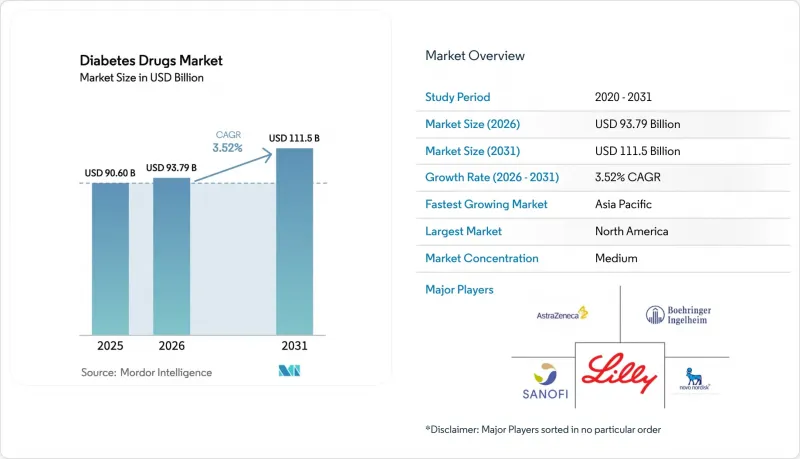
이 보고서는 약물 분류(경구용 당뇨병 치료제[비구아나이드계, α-글루코시다아제 억제제 등], 인슐린, 비인슐린계 주사제, 복합제),투여 경로(경구, 피하, 정맥 내), 유통 채널(온라인 약국 등) 및 지역(북미 등)별로 분류되어 있습니다. 시장 예측은 금액() 기준으로 제시되어 있습니다.
전 세계 당뇨병 치료제 시장의 동향 및 인사이트
전 세계 당뇨병 유병률 증가와 조기 검진
국제당뇨병연맹(IDF)의 기록에 따르면 2024년 성인 당뇨병 환자 수는 5억 8,870만 명으로 2021년 대비 45% 증가했으나, 여전히 2억 5,170만 명이 진단받지 못한 상태이며, 중국, 인도,및 걸프 국가들에서 대규모 선별 검사를 통해 이 거대한 잠재 수요가 서서히 발굴되기 시작하고 있습니다. 아프리카는 72.6%라는 가장 높은 미진단율을 보이고 있지만, 아시아태평양은 전체 사례의 60%를 차지하며, 의료 인프라가 급속히 확대되고 있는 지역에서 성장이 집중되고 있습니다. 걸프협력회의(GCC) 회원국 정부는 HbA1c 검사에 대한 보조금 지원 및 SGLT-2 억제제의 보험 적용을 시행하고 있으며, 인도네시아와 파키스탄은 급증하는 제2형 당뇨병 발생에 대응하기 위해 현재 이 모델을 따르고 있습니다. 일본과 한국에서는 HbA1c 검사를 기업 건강검진에 포함시키고 있으며, 이를 통해 치료 시작 시기를 약 3년 앞당기고, 평생 약물 투여 기간을 연장하고 있습니다. 선별 검사의 보급이 확대됨에 따라 진단된 유병률은 역학적 예측만을 기반으로 한 수치보다 더 빠르게 상승하고 있으며, 당뇨병 치료제 시장은 지속적으로 확대되고 있습니다.
신흥 시장의 의료비 지출 증가
중국은 2023년 국가 약가 등재 리스트 개정에서 세마글루타이드, 듀라글루타이드, 엠파글리플로진, 다파글리플로진을 추가했습니다. 이로 인해 14억 명의 국민이 보험 적용 대상이 되었으며, 주요 도시의 GLP-1 제제 처방량은 전년 대비 68% 증가했습니다. 인도는 2024-2026년에 지역 단위의 당뇨병 클리닉 및 바이오시밀러 인슐린 조달에 12억 달러를 배정하고, 시범 주에서 환자의 본인 부담금을 40% 감면했습니다. 브라질의 공적 의료제도는 그라루긴 바이오시밀러를 원개발 제품보다 55% 할인된 가격으로 발주하고 있으며, 아르헨티나와 콜롬비아도 현재 제한된 예산을 효율적으로 활용하기 위해 이 모델을 따르고 있습니다. 이러한 움직임으로 인해 본인 부담 환자들이 보험 적용 대상으로 전환되면서 경구용 당뇨병 치료제 및 바이오시밀러 인슐린의 판매량이 확대되고 있습니다. 2031년까지 아시아태평양과 라틴아메리카를 합친 당뇨병 치료제 지출 증가분의 약 80%를 차지하며, 이는 북미와 유럽의 가격 압박을 상쇄하는 이상의 효과를 가져올 것입니다.
GLP-1 관련 췌장염 및 갑상선 위험에 대한 안전성 우려
미국에서는 모든 GLP-1 제제에 갑상선 관련 박스 경고가 기재되어 있으며, 유럽의 첨부 문서도 이를 따르고 있습니다. 따라서 관련 가족력이 있는 환자에게 처방할 때는 신중을 기해야 합니다. 2024년 《Nature Medicine》지의 총설에서는 GLP-1 요법이 췌장염 및 담낭 질환의 상대적 위험 증가, 그리고 위장 장애로 인한 15-20%의 조기 중단과 관련이 있다고 지적되었으며, 이에 따라 첨부 문서가 개정되고 투여량 점진적 증량 일정이 완만하게 조정되었습니다. 위마비 공개 지연과 관련된 소송으로 인해 더욱 신중한 접근이 요구되었으며, 부작용을 완화하기 위해 용량 증량 기간이 장기화되었습니다. EMA(유럽의약품청)는 산발적인 자살 충동 보고를 받아 2025년에 안전성 조사를 시작했으며, 독일과 프랑스에서는 신규 환자에 대한 투여가 일시적으로 중단되었습니다. 이러한 문제들은 당뇨병에 비해 위험과 이점의 균형이 명확하지 않은 비만 치료 처방에서 특히 큰 부담으로 작용하고 있습니다.
부문별 분석
인슐린은 2025년 매출의 56.56%를 차지했으나,GLP-1 수용체 작용제나 듀얼 작용제가 기초 인슐린의 신규 투여를 대체하고 있으므로 비인슐린계 주사제는 2031년까지 연평균 성장률(CAGR) 4.25%로 확대되고 있으며, 이는 모든 약물 군 중에서 가장 빠른 성장 속도입니다. 틸제파티드는 2024년 3분기 단독으로 31억 달러의 매출을 기록했으며, 단일 작용제인 세마글루티드의 5-10%에 비해 15-20%라는 체중 감량 효과 측면에서 상업적 우위를 보여주었습니다. 경구용 SGLT-2 및 DPP-4 억제제는 다기관에 대한 유익성을 보여주는 데이터와 제네릭 DPP-4의 공급 확대에 힘입어 처방 점유율의 28%를 차지했습니다. 졸트파이(Zoltfy)나 신저디(Singerdi)와 같은 복합제는 치료 요법을 단순화하지만, 비용에 민감한 시장에서는 여전히 보험 환급 제약을 받고 있으며, 점유율은 8%에 그치고 있습니다.
기초 인슐린은 의사가 GLP-1 수용체 작용제를 선택하여 투여 시작을 늦추는 경향이 있으므로 성숙 시장에서 판매량이 두 자릿수 감소세를 보였습니다. 한편, 유럽에서는 바이오시밀러인 그랄긴 및 데글루덱이 브랜드 제품의 가격을 압박하고 있습니다. 볼러스 인슐린은 제1형 당뇨병에서 수요를 유지하고 있지만, 이 분야에서도 피아스프와 같은 속효성 아날로그 제제가 식후 혈당 조절을 개선함으로써 시장 점유율을 확대하고 있습니다. 저소득 국가 시장에서는 여전히 기존의 인간 인슐린 제제가 주류를 이루고 있습니다. 이는 고온에서 보관이 가능하며, 아날로그 제제보다 훨씬 저렴하기 때문입니다. 주 1회 투여형 인슐린인 이코덱(Ikodec)과 에프시트라(Fcitra)는 2024년 유럽에서 승인된 후 미국 승인을 기다리고 있는 상황이지만, 당뇨병 치료제 시장 규모에 미치는 단기적인 영향은 제한적입니다.
지역별 분석
북미는 2025년 매출의 42.13%를 차지하고 있지만, 가격 규제와 바이오시밀러의 부상으로 인해 연평균 성장률(CAGR)은 2.8%에 그쳐 세계 평균 성장률을 밑돌 것으로 전망됩니다. 미국의 정가는 여전히 유럽의 5배 수준이며, 판매량 증가세가 주춤함에도 불구하고 환자 1인당 지출액은 유지되고 있습니다. 캐나다에서는 엄격한 HbA1c 기준치로 인해 GLP-1 제제의 보험 적용이 제한되어 있으며, 도입이 억제되고 있습니다. 반면 멕시코에서는 공공 입찰을 통해 글라루긴을 세계 최저가로 조달하고 있습니다.
아시아태평양은 2031년까지 연평균 성장률(CAGR) 5.51%로 가장 빠르게 성장하는 지역이며, 1억 4,000만 명의 환자 기반과 최신 약물에 대한 보험 적용을 배경으로 중국이 주도하고 있습니다. 인도의 WHO 인증 바이오시밀러는 70개국에 수출되고 있으며, 인도는 저비용 공급 거점으로서의 입지를 확고히 하고 있습니다. 일본에서는 DPP-4 억제제가 주류를 이루고 있는데, 이는 비만율이 낮아 체중 관리를 주안점으로 하는 GLP-1 수용체 작용제의 도입이 시급하지 않다는 임상 현장의 다른 실정을 반영하고 있습니다. 한국에서는 인슐린 펌프와 연속 혈당 모니터에 대한 광범위한 보조금이 시행되고 있으며, 세계 최고의 클로즈드 루프 도입률을 실현하고 있습니다.
2025년 유럽 시장의 점유율에는 다양한 동향이 숨어 있습니다. 바이오시밀러 인슐린은 이미 판매량의 상당 부분을 차지하고 있으며, 강제적인 대체 조치로 인해 추가적인 확산이 확실시되고 있습니다. 중동 및 아프리카는 2025년 세계 매출에서 차지하는 비중은 작지만, 보조금이 지급되는 걸프 국가들에 집중되어 있습니다. 그러나 외국인 거주자는 지원 대상에서 제외되어 있으며, 유병률은 높음에도 불구하고 판매량은 제한적입니다. 남미 역시 마찬가지로 양극화되어 있습니다. 브라질에서는 공적 의료보험을 통한 인슐린 적용 대상이 800만 명의 환자에 달하지만, 민간 시장에서 GLP-1 제제에 대한 접근성은 여전히 고소득층으로 한정되어 있습니다.
기타 혜택:
- 엑셀 형식의 시장 예측(ME) 시트
- 3개월간의 애널리스트 지원
자주 묻는 질문
목차
제1장 서론
제2장 조사 방법
제3장 개요
제4장 시장 구도
제5장 시장 규모와 성장 예측
제6장 경쟁 구도
제7장 시장 기회와 향후 전망
KSA 26.09.04According to Mordor Intelligence, the diabetes drugs market size is expected to grow from USD 90.60 billion in 2025 to USD 93.79 billion in 2026 and is forecast to reach USD 111.5 billion by 2031 at 3.52% CAGR over 2026-2031.
This report is Segmented by Drug Class (Oral Anti-Diabetic Drugs [Biguanides, Alpha-Glucosidase Inhibitors, and More], Insulin, Non-Insulin Injectable Drugs, and Combination Drugs), Route of Administration (Oral, Subcutaneous, and Intravenous), Distribution Channel (Online Pharmacies, and More), and Geography (North America, and More). The Market Forecasts are Provided in Terms of Value (USD).
Global Diabetes Drugs Market Trends and Insights
Escalating Global Diabetes Prevalence & Earlier Screening
The International Diabetes Federation logged 588.7 million adults with diabetes in 2024, up 45% from 2021, yet 251.7 million remain undiagnosed, creating large latent demand that mass screening in China, India and Gulf states is beginning to unlock. Africa shows the highest undiagnosed rate at 72.6%, while Asia-Pacific hosts 60% of total cases, concentrating growth where healthcare infrastructure is scaling quickly. Gulf Cooperation Council governments subsidize HbA1c testing and SGLT-2 reimbursement, a blueprint Indonesia and Pakistan now emulate to counter fast-growing type 2 incidence. Japan and South Korea weave HbA1c checks into employer health exams, pulling treatment initiation forward by roughly three years and extending lifetime drug exposure. As screening penetrates deeper, diagnosed prevalence rises faster than epidemiology alone, permanently enlarging the diabetes drugs market.
Rising Healthcare Expenditures in Emerging Markets
China's 2023 update to the National Reimbursement Drug List added semaglutide, dulaglutide, empagliflozin and dapagliflozin, unlocking coverage for 1.4 billion citizens and lifting GLP-1 prescriptions 68% year over year in top-tier cities. India earmarked USD 1.2 billion for 2024-2026 to fund district-level diabetes clinics and biosimilar insulin procurement, cutting patient out-of-pocket spending by 40% in pilot states. Brazil's public health system awarded glargine biosimilar contracts at 55% discounts to originators, a model Argentina and Colombia now replicate to stretch limited budgets. These moves convert cash-pay patients to reimbursed status, boosting volume for oral antidiabetics and biosimilar insulin. Asia-Pacific and Latin America together will represent roughly 80% of incremental diabetes drug spending through 2031, more than offsetting price pressure in North America and Europe.
Safety Concerns Regarding GLP-1-Linked Pancreatitis & Thyroid Risks
All GLP-1 agents carry boxed thyroid warnings in the United States, mirrored by European labels, dampening prescriptions for patients with relevant family history. A 2024 Nature Medicine review linked GLP-1 therapy to higher relative risks of pancreatitis, gallbladder disease and 15-20% early discontinuation from gastrointestinal intolerance, prompting label revisions and slower uptitration schedules. Litigation over delayed gastroparesis disclosures added further caution, elongating dose-escalation to mitigate side effects. The EMA opened a safety probe in 2025 after isolated suicidal-ideation reports, temporarily stalling new-patient starts in Germany and France. These issues weigh most heavily on obesity prescriptions, where benefit-risk calculus is less clear than in diabetes.
Other drivers and restraints analyzed in the detailed report include:
- Strong Clinical Evidence & Guideline Endorsements for GLP-1 & SGLT-2 Classes
- Growing Adoption of Biosimilar Basal Insulins
- Public-Sector Insulin Price Caps & Tender-Based Procurement
For complete list of drivers and restraints, kindly check the Table Of Contents.
Segment Analysis
Insulin retained 56.56% of 2025 revenue, yet non-insulin injectables are expanding at a 4.25% CAGR through 2031, the strongest pace among all classes, as GLP-1 and dual agonists cannibalize basal insulin starts. Tirzepatide generated USD 3.1 billion in Q3 2024 alone, showcasing the commercial leverage of 15-20% weight-loss efficacy relative to single-agonist semaglutide's 5-10%. Oral SGLT-2 and DPP-4 inhibitors captured 28% of prescriptions, buoyed by multi-organ benefit data and generic DPP-4 availability. Combination agents such as Xultophy and Synjardy simplify regimens but remain reimbursement-constrained in cost-sensitive markets, limiting share to 8%.
Basal insulins saw double-digit volume erosion in mature regions as physicians delay initiation in favor of GLP-1s, while biosimilar glargine and degludec compress branded prices in Europe. Bolus insulins hold demand in type 1 diabetes, but even here faster-acting analogs like Fiasp gain share by improving post-meal control. Conventional human formulations still dominate low-income markets because they tolerate warmer storage and cost far less than analogs. Weekly insulins icodec and efsitora await U.S. clearance after European approval in 2024, with limited near-term impact on the diabetes drugs market size.
Complete Report Scope:
- By Drug Class
- Oral Anti-Diabetic Drugs
- Biguanides
- Alpha-glucosidase Inhibitors
- Dopamine-D2 Receptor Agonists
- SGLT-2 Inhibitors
- Canagliflozin (Invokana)
- Empagliflozin (Jardiance)
- Dapagliflozin (Farxiga/Forxiga)
- Ipragliflozin (Suglat)
- DPP-4 Inhibitors
- Sitagliptin (Januvia)
- Saxagliptin (Onglyza)
- Linagliptin (Tradjenta)
- Alogliptin (Nesina/Vipidia)
- Vildagliptin (Galvus)
- Sulfonylureas
- Meglitinides
- Insulin
- Basal / Long-acting
- Insulin Glargine (Lantus, Toujeo, Basaglar)
- Insulin Detemir (Levemir)
- Insulin Degludec (Tresiba)
- Bolus / Fast-acting
- Insulin Aspart (NovoRapid/Novolog)
- Insulin Lispro (Humalog)
- Insulin Glulisine (Apidra)
- Traditional Human Insulin
- Novolin / Actrapid / Insulatard
- Humulin
- Insuman
- Biosimilar Insulin
- Insulin Glargine Biosimilars
- Human Insulin Biosimilars
- Ultra-long-acting weekly analogues
- Basal / Long-acting
- Non-Insulin Injectable Drugs
- GLP-1 Receptor Agonists
- Liraglutide (Victoza)
- Exenatide (Byetta, Bydureon)
- Dulaglutide (Trulicity)
- Lixisenatide (Lyxumia)
- Dual & Triple Incretin Co-agonists
- Tirzepatide (Mounjaro)
- Retatrutide (Phase III)
- Amylin Analog
- GLP-1 Receptor Agonists
- Combination Drugs
- Combination Insulin
- Biphasic Insulin Aspart (NovoMix)
- Insulin Degludec + Aspart (Ryzodeg)
- Insulin Degludec + Liraglutide (Xultophy)
- Oral Combination
- Sitagliptin + Metformin (Janumet)
- Empagliflozin + Metformin (Synjardy)
- Combination Insulin
- Oral Anti-Diabetic Drugs
- By Route of Administration
- Oral
- Subcutaneous
- Intravenous
- By Distribution Channel
- Online Pharmacies
- Hospital Pharmacies
- Retail Pharmacies
- By Geography
- North America
- United States
- Canada
- Mexico
- Europe
- Germany
- United Kingdom
- France
- Italy
- Spain
- Rest of Europe
- Asia-Pacific
- China
- Japan
- India
- South Korea
- Australia
- Rest of Asia-Pacific
- Middle East & Africa
- GCC
- South Africa
- Rest of Middle East & Africa
- South America
- Brazil
- Argentina
- Rest of South America
- North America
Geography Analysis
North America held 42.13% of 2025 revenue but will trail the global growth average at a 2.8% CAGR amid price controls and biosimilar encroachment. U.S. list prices remain five-fold higher than Europe's, sustaining per-patient spend despite volume stagnation. Canada caps GLP-1 coverage with strict HbA1c thresholds, limiting uptake, while Mexico procures glargine at the world's lowest price via public tenders.
Asia-Pacific is the fastest-growing region at 5.51% CAGR to 2031, led by China's 140 million-patient pool and reimbursed access to modern agents. India's WHO-vetted biosimilars ship to 70 countries, positioning the country as the low-cost supply hub. Japan's DPP-4 dominance underscores differing clinical practice where low obesity reduces the urgency for weight-centric GLP-1s. South Korea's broad subsidy for insulin pumps and continuous glucose monitors fosters the world's highest closed-loop adoption rate.
Europe's share in 2025 masks diverging dynamics: biosimilar insulin already accounts for a notable share of volume, and mandatory substitution ensures further penetration. The Middle East and Africa capture a minor share of global revenue in 2025, concentrated in subsidized Gulf states, yet expatriate exclusion limits volume despite high prevalence. South America is similarly polarized: Brazil's public insulin coverage reaches 8 million patients, yet private-market GLP-1 access remains restricted to higher-income groups.
- AstraZeneca
- Biocon
- Boehringer Ingelheim
- Bristol-Myers Squibb
- Eli Lilly and Company
- Gan & Lee Pharmaceuticals
- Hanmi Pharmaceutical
- Innovent Biologics
- Johnson & Johnson
- Merck
- Mitsubishi Tanabe Pharma
- Novartis
- Novo Nordisk
- Pfizer
- Sanofi
- Sun Pharmaceuticals Industries
- Teva Pharmaceutical Industries
- Tonghua Dongbao
- Viatris (Mylan)
- Wockhardt
- Zealand Pharma
Additional Benefits:
- The market estimate (ME) sheet in Excel format
- 3 months of analyst support
TABLE OF CONTENTS
1 Introduction
- 1.1 Study Assumptions & Market Definition
- 1.2 Scope of the Study
2 Research Methodology
3 Executive Summary
4 Market Landscape
- 4.1 Market Overview
- 4.2 Market Drivers
- 4.2.1 Escalating global diabetes prevalence & earlier screening
- 4.2.2 Rising healthcare expenditures in emerging markets
- 4.2.3 Strong clinical evidence & guideline endorsements for GLP-1 & SGLT-2 classes
- 4.2.4 Growing adoption of biosimilar basal insulins
- 4.2.5 Once-weekly ultra-long-acting basal insulin analogues
- 4.2.6 Payor-integrated digital therapeutic bundling
- 4.3 Market Restraints
- 4.3.1 Safety concerns regarding GLP-1-linked pancreatitis & thyroid risks
- 4.3.2 Public-sector insulin price caps & tender-based procurement
- 4.3.3 Affordability gaps in low- and middle-income countries
- 4.3.4 Cold-chain integrity risk in last-mile delivery across tropical regions
- 4.4 Supply-Chain Analysis
- 4.5 Regulatory Outlook
- 4.6 Technological Outlook
- 4.7 Porter's Five Forces
- 4.7.1 Bargaining Power of Suppliers
- 4.7.2 Bargaining Power of Buyers
- 4.7.3 Threat of New Entrants
- 4.7.4 Threat of Substitutes
- 4.7.5 Intensity of Competitive Rivalry
5 Market Size & Growth Forecasts (Value, USD)
- 5.1 By Drug Class
- 5.1.1 Oral Anti-Diabetic Drugs
- 5.1.1.1 Biguanides
- 5.1.1.2 Alpha-glucosidase Inhibitors
- 5.1.1.3 Dopamine-D2 Receptor Agonists
- 5.1.1.4 SGLT-2 Inhibitors
- 5.1.1.4.1 Canagliflozin (Invokana)
- 5.1.1.4.2 Empagliflozin (Jardiance)
- 5.1.1.4.3 Dapagliflozin (Farxiga/Forxiga)
- 5.1.1.4.4 Ipragliflozin (Suglat)
- 5.1.1.5 DPP-4 Inhibitors
- 5.1.1.5.1 Sitagliptin (Januvia)
- 5.1.1.5.2 Saxagliptin (Onglyza)
- 5.1.1.5.3 Linagliptin (Tradjenta)
- 5.1.1.5.4 Alogliptin (Nesina/Vipidia)
- 5.1.1.5.5 Vildagliptin (Galvus)
- 5.1.1.6 Sulfonylureas
- 5.1.1.7 Meglitinides
- 5.1.2 Insulin
- 5.1.2.1 Basal / Long-acting
- 5.1.2.1.1 Insulin Glargine (Lantus, Toujeo, Basaglar)
- 5.1.2.1.2 Insulin Detemir (Levemir)
- 5.1.2.1.3 Insulin Degludec (Tresiba)
- 5.1.2.2 Bolus / Fast-acting
- 5.1.2.2.1 Insulin Aspart (NovoRapid/Novolog)
- 5.1.2.2.2 Insulin Lispro (Humalog)
- 5.1.2.2.3 Insulin Glulisine (Apidra)
- 5.1.2.3 Traditional Human Insulin
- 5.1.2.3.1 Novolin / Actrapid / Insulatard
- 5.1.2.3.2 Humulin
- 5.1.2.3.3 Insuman
- 5.1.2.4 Biosimilar Insulin
- 5.1.2.4.1 Insulin Glargine Biosimilars
- 5.1.2.4.2 Human Insulin Biosimilars
- 5.1.2.5 Ultra-long-acting weekly analogues
- 5.1.2.1 Basal / Long-acting
- 5.1.3 Non-Insulin Injectable Drugs
- 5.1.3.1 GLP-1 Receptor Agonists
- 5.1.3.1.1 Liraglutide (Victoza)
- 5.1.3.1.2 Exenatide (Byetta, Bydureon)
- 5.1.3.1.3 Dulaglutide (Trulicity)
- 5.1.3.1.4 Lixisenatide (Lyxumia)
- 5.1.3.2 Dual & Triple Incretin Co-agonists
- 5.1.3.2.1 Tirzepatide (Mounjaro)
- 5.1.3.2.2 Retatrutide (Phase III)
- 5.1.3.3 Amylin Analog
- 5.1.3.1 GLP-1 Receptor Agonists
- 5.1.4 Combination Drugs
- 5.1.4.1 Combination Insulin
- 5.1.4.1.1 Biphasic Insulin Aspart (NovoMix)
- 5.1.4.1.2 Insulin Degludec + Aspart (Ryzodeg)
- 5.1.4.1.3 Insulin Degludec + Liraglutide (Xultophy)
- 5.1.4.2 Oral Combination
- 5.1.4.2.1 Sitagliptin + Metformin (Janumet)
- 5.1.4.2.2 Empagliflozin + Metformin (Synjardy)
- 5.1.4.1 Combination Insulin
- 5.1.1 Oral Anti-Diabetic Drugs
- 5.2 By Route of Administration
- 5.2.1 Oral
- 5.2.2 Subcutaneous
- 5.2.3 Intravenous
- 5.3 By Distribution Channel
- 5.3.1 Online Pharmacies
- 5.3.2 Hospital Pharmacies
- 5.3.3 Retail Pharmacies
- 5.4 By Geography
- 5.4.1 North America
- 5.4.1.1 United States
- 5.4.1.2 Canada
- 5.4.1.3 Mexico
- 5.4.2 Europe
- 5.4.2.1 Germany
- 5.4.2.2 United Kingdom
- 5.4.2.3 France
- 5.4.2.4 Italy
- 5.4.2.5 Spain
- 5.4.2.6 Rest of Europe
- 5.4.3 Asia-Pacific
- 5.4.3.1 China
- 5.4.3.2 Japan
- 5.4.3.3 India
- 5.4.3.4 South Korea
- 5.4.3.5 Australia
- 5.4.3.6 Rest of Asia-Pacific
- 5.4.4 Middle East & Africa
- 5.4.4.1 GCC
- 5.4.4.2 South Africa
- 5.4.4.3 Rest of Middle East & Africa
- 5.4.5 South America
- 5.4.5.1 Brazil
- 5.4.5.2 Argentina
- 5.4.5.3 Rest of South America
- 5.4.1 North America
6 Competitive Landscape
- 6.1 Market Concentration
- 6.2 Market Share Analysis
- 6.3 Company Profiles (includes Global level Overview, Market level overview, Core Segments, Financials as available, Strategic Information, Market Rank/Share, Products & Services, Recent Developments)
- 6.3.1 AstraZeneca
- 6.3.2 Biocon
- 6.3.3 Boehringer Ingelheim
- 6.3.4 Bristol Myers Squibb
- 6.3.5 Eli Lilly and Company
- 6.3.6 Gan & Lee Pharmaceuticals
- 6.3.7 Hanmi Pharmaceutical
- 6.3.8 Innovent Biologics
- 6.3.9 Johnson & Johnson (Janssen)
- 6.3.10 Merck & Co.
- 6.3.11 Mitsubishi Tanabe Pharma
- 6.3.12 Novartis
- 6.3.13 Novo Nordisk
- 6.3.14 Pfizer
- 6.3.15 Sanofi
- 6.3.16 Sun Pharmaceutical Industries
- 6.3.17 Teva Pharmaceuticals
- 6.3.18 Tonghua Dongbao
- 6.3.19 Viatris (Mylan)
- 6.3.20 Wockhardt
- 6.3.21 Zealand Pharma
7 Market Opportunities & Future Outlook
- 7.1 White-space & Unmet-Need Assessment


