

|
시장보고서
상품코드
2122173
미국의 활성탄 : 시장 점유율 분석, 업계 동향과 통계, 성장 예측(2026-2031년)United States Activated Carbon - Market Share Analysis, Industry Trends & Statistics, Growth Forecasts (2026 - 2031) |
||||||
 Mordor Intelligence
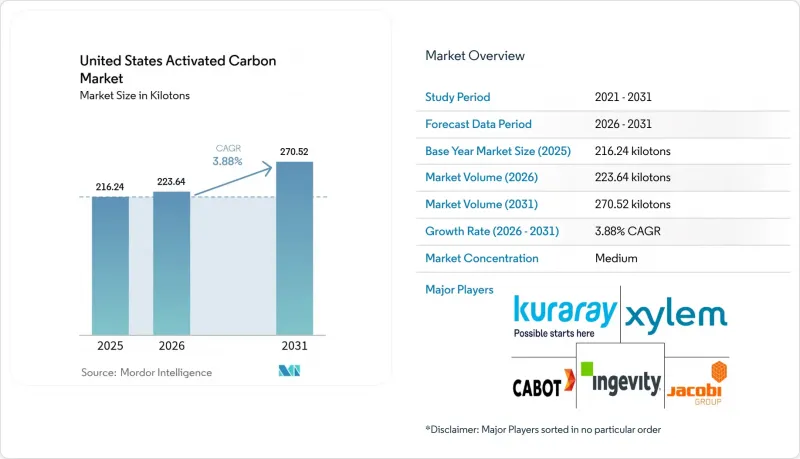
Mordor Intelligence에 따르면 미국의 활성탄 시장 규모는 2025년 216.24 킬로톤에서 2026년에는 223.64 킬로톤으로 확대하며, 2031년까지 270.52 킬로톤에 달할 것으로 예상되고 있으며, 2026-2031년에 CAGR 3.88%로 성장할 것으로 전망되고 있습니다.
이 보고서는 제품 유형(과립형 활성탄, 분말형 활성탄, 압출 성형 또는 펠릿형 활성탄), 용도(정수, 가스 정화, 금속 추출, 의약품, 기타 용도), 최종사용자 산업(수처리, 식품 및 음료, 헬스케어, 자동차 등)별로 분류되어 있습니다. 시장 전망은 톤 단위로 표시되어 있습니다.
미국 활성탄 시장의 동향 및 인사이트
음용수내 PFAS/PFOA에 관한 EPA 규정
2024년 4월 발표된 ‘국가 1차 음용수 규정(National Primary Drinking Water Regulation)’에서는PFOA 및 PFOS의 최대 허용 농도를 4 parts per trillion으로 설정하였으며, 이에 따라 2029년까지 약 6,000-8,000개의 지역 상수도 시스템이 입상 활성탄층 도입을 피할 수 없게 될 것입니다. 연방 정부의 PFAS 대책 자금 및 주 정부의 회전 대출 제도를 통해 계약 체결이 가속화되고 있으며, NSF/ANSI 61 규격 인증을 취득하고 국내 재생 능력을 갖춘 공급업체가 우대받고 있습니다. 소규모 상수도 사업자들은 공동 구매 협정을 통해 협력하여 단가 인하를 도모하고 있으며, 미시간주와 뉴욕주를 비롯한 각 주는 투자 회수 기간을 단축하기 위한 매칭 보조금을 제공하고 있습니다. 틈새 시장인 저유량 설비에서는 이온교환수지가 채택되는 사례도 보이지만, 활성탄의 다중 오염 물질 대응 능력과 잔류물 관리의 간편함 덕분에 그 우위는 유지되고 있습니다. 공급업체들은 현재 획기적인 발전을 예측하는 IoT 센서를 여과재와 세트로 판매하고 있으며, 이러한 서비스 모델을 통해 수년에 걸친 애프터마켓 수익을 확보하고 있습니다.
석탄 화력 발전소의 수은 배출 단계적 폐지
2024년 ‘수은 및 대기 유해 물질 기준(MATS)’ 개정에 따라기존 설비의 배출 제한치가 0.003파운드/GWh로 하향 조정되어, 2027년 말까지 30GW 규모의 갈탄 및 아역청탄 화력 발전 설비에서 분말 활성탄 주입이 필요하게 됩니다. 500MW 보일러 1기당 연간 5,000-1만 5,000톤의 수요가 증가하며, 브롬계 등급은 수은과 SO3의 이중 회수로 인해 가격 프리미엄이 붙습니다. 석탄 화력 발전소 폐쇄 일정에 따른 선물 곡선의 변동성으로 인해 공급업체들은 10년 단위 계약보다 2-3년의 지수 연동형 계약을 선호하는 추세입니다. 2030년 이후 석탄 화력 발전소의 폐지가 가속화됨에 따라 각 공급업체들은 45Q 크레딧 대상이 되는 가스 터빈식 탄소 포집 프로젝트에 주력하고 있으며, 이를 통해 석탄 수요 감소를 일부 상쇄하고 있습니다.
버진 증기 활성화에 따른 높은 에너지 비용
증기 활성화에는 톤당 3-5MWh의 에너지가 소비되며, 천연가스 가격 변동은 공급에 대한 헤지 조치가 없는 플랜트의 이익률을 압박하고 있습니다. 재활성화는 에너지 소비량을 약 40% 절감할 수 있으며, 부담 경감으로 이어지지만, 식수 사용자들은 재사용된 매체를 승인하기 전에 엄격한 침출수 검사를 요구하고 있습니다. 제45V조의 수소 세액 공제로 인해 2028년까지 전해 증기를 이용한 생산이 가능해질 수 있지만, 자본 측면의 장벽으로 인해 중기적으로는 대다수의 생산자가 기존 연료를 계속 사용하게 될 것입니다. 따라서 각 공급업체는 계약을 헨리 허브 선물 가격에 연동하거나, 바이오매스 유래 합성 가스를 시험적으로 도입하고 있습니다. 이 전략을 통해 재생 가능 연료 크레딧을 획득할 수 있지만, 공정 제어가 복잡해집니다.
부문 분석
2025년에는 과립 활성탄이 판매량의 46.37%를 차지했습니다. 이는 공공 사업체 및 산업 사용자들이 역세척 시의 안정성과 지역내 재활성화로에 대한 쉬운 접근성을 선호했기 때문입니다. 재활성화 능력은 기업의 지속가능성 목표를 충족시키고, 구매자를 버진 활성탄 가격 변동으로부터 보호하는 순환형 조달 모델의 기반이 되고 있습니다. 반면, 압출 성형 또는 펠릿화된 활성탄은 2026-2031년까지 연평균 4.34%의 성장률을 보일 것으로 예상되며, 이는 미국 전체 활성탄 시장의 성장률을 상회할 것으로 전망됩니다. Tier 3 규제가 의무화한 자동차용 증발 배출 캐니스터에서는 부탄의 돌파를 줄이기 위해 대구경 펠릿의 채택이 확대되고 있는 반면, 제약 업계의 연속 생산 라인에서는 펠릿의 낮은 취성이 중요시되고 있습니다.
압출 성형 기술의 혁신이 가치 제안을 새롭게 바꾸고 있습니다. 쿠라레가 2024년에 출시한 비표면적 1,200 m2/g의 4mm 펠릿은 기존의 3mm 제품에 비해 흡착 능력이 20% 향상되었습니다. 제너럴 모터스(GM)의 5억 달러 규모의 하이브리드 트럭 프로그램으로 인해 적어도 2028년까지는 캐니스터 수요가 견고하게 유지될 전망입니다. 한편, 분말 활성탄은 여전히 전술적인 용도에 그치고 있으며, 지표수 처리 시설에서 간헐적으로 발생하는 맛·냄새 문제나 석탄 화력 발전소의 수은 주입 용도로 활용되고 있습니다. 이러한 동향들이 복합적으로 작용하여, 제품 형태별 미국 활성탄 시장의 규모가 다각적인 특성을 띠고 있음을 지원하고 있습니다.
기타 혜택:
- 엑셀 형식의 시장 예측(ME) 시트
- 3개월간의 애널리스트 지원
자주 묻는 질문
목차
제1장 서론
제2장 조사 방법
제3장 개요
제4장 시장 구도
제5장 시장 규모와 성장 예측
제6장 경쟁 구도
제7장 시장 기회와 향후 전망
KSA 26.09.04According to Mordor Intelligence, the United States activated carbon market size is expected to increase from 216.24 kilotons in 2025 to 223.64 kilotons in 2026 and reach 270.52 kilotons by 2031, growing at a CAGR of 3.88% over 2026-2031.
This report is Segmented by Product Type (Granular Activated Carbon, Powdered Activated Carbon, and Extruded or Pelletized Activated Carbon), Application (Water Purification, Gas Purification, Metal Extraction, Medicine, and Other Applications), End-User Industry (Water Treatment, Food and Beverage, Healthcare, Automotive, and More). The Market Forecasts are Provided in Terms of Volume (Tons).
United States Activated Carbon Market Trends and Insights
EPA Regulations on PFAS/PFOA in Drinking Water
The April 2024 National Primary Drinking Water Regulation sets a 4-parts-per-trillion maximum for PFOA and PFOS, forcing roughly 6,000-8,000 community systems to adopt granular activated carbon beds by 2029. Federal PFAS remediation funds and state revolving loans accelerate contract awards, rewarding vendors with NSF/ANSI 61 listings and domestic regeneration capacity. Smaller utilities collaborate through cooperative purchasing agreements to lower unit costs, and states including Michigan and New York provide matching grants that shorten payback periods. Ion-exchange resins appear in niche low-flow installations, but carbon's multi-contaminant profile and simpler residuals management preserve its dominance. Suppliers are now bundling media with IoT sensors that predict breakthrough, a service model that locks in multi-year aftermarket revenue.
Phase-Out of Mercury Emissions from Coal-Fired Utilities
The 2024 Mercury and Air Toxics Standards revision trims existing-unit limits to 0.003 lb/GWh, necessitating powdered activated carbon injection at 30 GW of lignite and sub-bituminous capacity by late 2027. Each 500-MW boiler adds 5,000-15,000 tons of annual demand, and brominated grades fetch price premiums for dual mercury-SO3 capture. Forward-curve volatility in coal retirement schedules prompts suppliers to favor two- to three-year indexed contracts rather than decade-long agreements. As retirements accelerate after 2030, vendors pivot toward gas-turbine carbon-capture projects that qualify for 45Q credits, partly offsetting the coal decline.
High Energy Cost of Virgin Steam Activation
Steam activation consumes 3-5 MWh per ton, and natural-gas price swings compress margins for plants without hedged supply. Reactivation, needing roughly 40% less energy, offers relief, yet potable-water users demand rigorous leachate testing before approving reused media. Section 45V hydrogen tax credits could enable electrolytic steam by 2028, but capital hurdles keep most producers on conventional fuel through the medium term. Vendors therefore index contracts to Henry Hub futures and experiment with biomass-derived syngas, a strategy that earns renewable-fuel credits but complicates process control.
Other drivers and restraints analyzed in the detailed report include:
- Tightening VOC Limits for Industrial Air Streams
- Rapid Expansion of Pharmaceutical API Capacity
- Competition from Silica Gel, Biochar, and Advanced Membranes
For complete list of drivers and restraints, kindly check the Table Of Contents.
Segment Analysis
Granular activate carbon commanded 46.37% of volume in 2025 as utilities and industrial users favored their backwash stability and ready access to regional reactivation kilns. Reactivation capacity underpins a circular procurement model that answers corporate sustainability goals and shields buyers from virgin-price volatility. At the same time, extruded or pelletized activated carbon is projected to grow 4.34% annually between 2026 and 2031, outpacing the broader United States activated carbon market. Automotive evaporative-emission canisters, mandated under Tier 3 regulations, increasingly specify larger-diameter pellets to mitigate butane breakthrough, while pharmaceutical continuous-manufacturing lines value the pellets' low friability.
Extruded innovation reshapes value propositions. Kuraray's 2024 4-mm pellet with 1,200 m2/g surface area offers 20% higher adsorption than legacy 3-mm formats. General Motors' USD 500 million hybrid-truck program keeps canister demand buoyant at least through 2028. Meanwhile, powdered carbon remains tactical, serving episodic taste-and-odor events in surface-water plants and mercury-injection duties at coal stations. Together, these dynamics reinforce the multi-speed nature of the United States activated carbon market size at the product-form level.
Complete Report Scope:
- By Product Type
- Granular Activated Carbon
- Powdered Activated Carbon
- Extruded or Pelletized Activated Carbon
- By Application
- Water Purification
- Gas Purification
- Metal Extraction
- Medicine
- Other Applications
- By End-user Industry
- Water Treatment
- Food and Beverage
- Healthcare
- Automotive
- Industrial Processing
- Other End-user Industries
List of Companies Covered in this Report:
- Advanced Emissions Solutions, Inc.
- Albemarle Corporation
- Arq, Inc.
- Boyce Carbon.
- Cabot Corporation
- Carbon Activated Corporation
- CarbUSA
- CPL Activated Carbons
- Donau Chemie AG
- General Carbon Corporation
- Ingevity
- JACOBI CARBONS GROUP
- KURARAY CO., LTD.
- Kureha Corporation
- Prominent Systems, Inc.
- Puragen Activated Carbons
- Veolia
- Xylem
Additional Benefits:
- The market estimate (ME) sheet in Excel format
- 3 months of analyst support
TABLE OF CONTENTS
1 Introduction
- 1.1 Study Assumptions and Market Definition
- 1.2 Scope of the Study
2 Research Methodology
3 Executive Summary
4 Market Landscape
- 4.1 Market Overview
- 4.2 Market Drivers
- 4.2.1 EPA Regulations on PFAS/PFOA in Drinking Water
- 4.2.2 Phase-Out of Mercury Emissions from Coal-Fired Utilities
- 4.2.3 Tightening VOC Limits for Industrial Air Streams
- 4.2.4 Rapid Expansion of Pharmaceutical API Capacity
- 4.2.5 Grid-Scale Super-capacitor Projects Using Activated Carbon
- 4.3 Market Restraints
- 4.3.1 High Energy Cost of Virgin Steam Activation
- 4.3.2 Competition from Silica Gel, Biochar and Advanced Membranes
- 4.3.3 Climate-Driven Supply Risk for Coconut-Shell Feedstocks
- 4.4 Value Chain Analysis
- 4.5 Porter's Five Forces
- 4.5.1 Bargaining Power of Suppliers
- 4.5.2 Bargaining Power of Consumers
- 4.5.3 Threat of New Entrants
- 4.5.4 Threat of Substitute Products and Services
- 4.5.5 Degree of Competition
5 Market Size and Growth Forecasts (Volume)
- 5.1 By Product Type
- 5.1.1 Granular Activated Carbon
- 5.1.2 Powdered Activated Carbon
- 5.1.3 Extruded or Pelletized Activated Carbon
- 5.2 By Application
- 5.2.1 Water Purification
- 5.2.2 Gas Purification
- 5.2.3 Metal Extraction
- 5.2.4 Medicine
- 5.2.5 Other Applications
- 5.3 By End-user Industry
- 5.3.1 Water Treatment
- 5.3.2 Food and Beverage
- 5.3.3 Healthcare
- 5.3.4 Automotive
- 5.3.5 Industrial Processing
- 5.3.6 Other End-user Industries
6 Competitive Landscape
- 6.1 Market Concentration
- 6.2 Strategic Moves
- 6.3 Market Share (%)/ Ranking Analysis
- 6.4 Company Profiles (includes Global level Overview, Market level overview, Core Segments, Financials as available, Strategic Information, Products and Services, and Recent Developments)
- 6.4.1 Advanced Emissions Solutions, Inc.
- 6.4.2 Albemarle Corporation
- 6.4.3 Arq, Inc.
- 6.4.4 Boyce Carbon.
- 6.4.5 Cabot Corporation
- 6.4.6 Carbon Activated Corporation
- 6.4.7 CarbUSA
- 6.4.8 CPL Activated Carbons
- 6.4.9 Donau Chemie AG
- 6.4.10 General Carbon Corporation
- 6.4.11 Ingevity
- 6.4.12 JACOBI CARBONS GROUP
- 6.4.13 KURARAY CO., LTD.
- 6.4.14 Kureha Corporation
- 6.4.15 Prominent Systems, Inc.
- 6.4.16 Puragen Activated Carbons
- 6.4.17 Veolia
- 6.4.18 Xylem
7 Market Opportunities and Future Outlook
- 7.1 White-space and Unmet-Need Assessment


