|
시장보고서
상품코드
2122174
유럽의 체외진단 : 시장 점유율 분석, 업계 동향 및 통계, 성장 예측(2026-2031년)Europe In-Vitro Diagnostics - Market Share Analysis, Industry Trends & Statistics, Growth Forecasts (2026 - 2031) |
||||||
 Mordor Intelligence
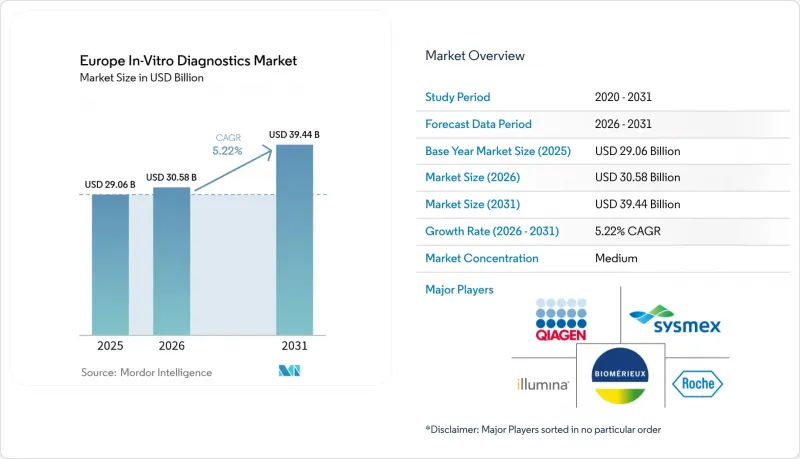
Mordor Intelligence에 의하면, 유럽의 체외진단 시장 규모는 2025년에 290억 6,000만 달러로 평가되었습니다. 2026년에 305억 8,000만 달러에 달하고, 2031년까지 394억 4,000만 달러에 이를 것으로 예측되며, 2026년부터 2031년에 걸쳐 CAGR 5.22%로 성장할 전망입니다.
본 보고서는 검사 유형(임상화학 등), 제품 및 서비스(시약 및 소모품 등), 사용 형태(일회용·재사용 가능), 검체 유형(혈액·혈청 등), 용도(감염병 등), 최종 사용자(학술·연구 기관 등), 지역(독일 등)별로 분류되어 있습니다. 시장 전망은 금액(달러) 기준으로 제시되어 있습니다.
유럽의 체외진단 시장 동향 및 인사이트
만성 질환 및 감염증 유병률 증가
현재 65-74세 유럽인의 50%가 여러 가지 질환을 앓고 있으며, 이는 2011년의 44%에서 증가한 수치로, 평균 수명과 건강 수명의 격차를 더욱 벌리고 있습니다. 2035년까지 혈압, 콜레스테롤, 혈당 수치를 연 1회 보편적으로 측정하는 것을 목표로 하는 유럽연합 집행위원회의 ‘세이프 하츠 플랜(Safe Hearts Plan)’에 따라, HbA1c, 지질 패널, 심장 바이오마커 및 종양 마커의 1인당 검사 건수가 증가하고 있습니다. 감염병 감시는 여전히 중요한 초점이며, HIV, 간염, 호흡기 바이러스 및 항생제 내성 프로파일링을 위한 통합 분자 패널이 병원 및 공중보건의 일상 업무 기반을 형성하고 있습니다. bioMerieux사와 Oxford Nanopore사의 ‘AmPORE-TB’ 출시는 약물 내성 결핵의 특성 평가를 위한 신속 시퀀싱으로의 전략적 전환을 의미합니다. 만성 질환 및 감염병 분야의 지속적인 수요는 유럽의 체외진단 시장의 연평균 성장률(CAGR)을 약 1.2포인트 끌어올릴 것으로 예측됩니다.
포인트 오브 케어(POC) 검사 도입 확대
재택치료 프로그램의 확대에 따라, 현장 진단(Point-of-Care) 방식은 현재 유럽의 체외진단 시장의 30% 이상을 차지하고 있습니다. 2024년까지 4억 5,000만 파운드가 투자된 잉글랜드의 ‘버추얼 워드(Virtual Ward)’ 이니셔티브는 환자 곁에서 검사를 활용하여 응급 입원을 줄이는 것을 목표로 하고 있습니다. 1시간 이내에 소화기 계통 검사 결과를 제공하는 FDA 승인 ‘QIAstat-Dx mini’ 패널은 1차 진료 및 약국 현장에서 사용하기 쉬운 카트리지의 도입을 상징하는 사례입니다. 또한, 현재 18개 OECD 회원국에서 승인된 약사 주도 검사 및 간호사가 관리하는 원격 모니터링 프로토콜이 검체 채취의 분산화를 촉진하고 있습니다. 보상 체계의 정비가 가속화되고 있는 점도 시장 성장을 더욱 뒷받침하고 있으며, 유럽의 체외진단 시장의 연평균 성장률(CAGR)을 0.9포인트 끌어올리고 있습니다.
EU IVDR에 기반한 엄격하고 장기적인 규제 승인 절차
2024년, IVD의 3분의 2가 여전히 2022년 EU IVDR에 따라 인증되었으며, 이는 인증 기관의 처리 능력에 부담을 주고 시장 출시까지의 기간을 길게 만들고 있습니다. 중소기업은 불균형할 정도로 많은 문서 작성 및 임상 증거 비용을 부담하고 있어, 시장에서 철수할 위험에 직면해 있습니다. 2025년 12월 유럽위원회의 제안에는 획기적인 의료기기에 대한 신속 승인 절차가 포함되어 있으나, 그 혜택이 실감되려면 2027년 이후가 되어야 합니다. 이로 인해 발생하는 병목 현상으로 인해 단기적으로는 유럽의 체외진단 시장의 연평균 성장률(CAGR)이 0.8포인트 하락할 것으로 전망됩니다.
부문별 분석
임상화학 분야는 2025년 매출의 32.12%를 차지했으나, 분자진단 분야는 연평균 성장률(CAGR) 7.43%로 가장 빠르게 확대될 것으로 예측되며, 이에 따라 유럽의 체외진단 시장에서 시퀀싱용 소모품 및 바이오인포매틱스 시장 규모가 확대될 전망입니다. EGFR, RET 및 NTRK 돌연변이에 대한 동반 진단 승인 및 각국의 시퀀싱 보조금 지원이 시약에 대한 지속적인 수요를 견인하고 있습니다. 하루 160건의 분자 검사를 수행할 수 있는 ‘QIAstat-Dx Rise’와 같은 고속 멀티플렉스 플랫폼은 분산된 급성기 의료의 검사량에 대응하기 위해 필요한 처리량 향상을 구현하고 있습니다. 만성 질환 관리에서는 일상적인 생화학 검사가 여전히 필수적이며, 병원 검사실의 기본 업무량을 지탱하고 있습니다.
감염병 패널 외에도 분자 검사는 종양학, 미세잔류병변 모니터링, 유전성 암 선별 검사 및 약물유전체학 분야로도 점차 확대되고 있습니다. 일루미나(Illumina)사의 CMS(의료보험제도)에 따라 보험 적용 대상이 된 ‘TruSight Oncology Comprehensive’ 워크플로는 보험사 측의 신뢰를 뒷받침하며, 지역 의료 센터에서의 도입을 원활하게 하고 있습니다. 순환기학 및 정신의학 분야에서 유전자형에 기반한 약물 투여량은 독일과 네덜란드에서 보험 적용 검토 대상이며, 이는 유럽의 체외진단 시장의 추가 확대를 위한 토대를 마련하고 있습니다.
화학 분석, 면역 측정, PCR 워크플로우용 정기 구독 키트로 인해 시약 및 소모품은 2025년 매출의 54.65%를 차지했습니다. 검사실이 미들웨어 연결 기능을 갖춘 모듈식 고에너지 효율 분석 장비를 선호하게 됨에 따라, 장비군은 교체 주기에 접어들고 있습니다. 검사실이 AI를 통한 결과 해석, 품질 대시보드, 사이버 보안 강화를 통합함에 따라 소프트웨어 및 서비스 매출은 연평균 성장률(CAGR) 8.11%로 증가할 전망입니다.
유럽 체외 진단 시장은 구독 모델(유전체 단위 분석 요금, 클라우드 LIS 모듈, 원격 교정 서비스 등)의 혜택을 받고 있으며, 이 모든 것이 예측 가능한 지속적 수익을 창출하고 있습니다. 젠티안 다이아그노스틱스(Gentian Diagnostics)가 2026년에 체결한, 기존의 고처리량 화학 분석 라인을 활용한 신규 분석법 공동 개발에 관한 제휴는 소규모 혁신 기업이 기존 기업의 기반을 활용하기 위한 ‘자산 경량화’ 접근 방식을 여실히 보여줍니다.
기타 혜택 :
- 엑셀 형식 시장 예측(ME) 시트
- 3개월간의 애널리스트 지원
자주 묻는 질문
목차
제1장 서론
제2장 조사 방법
제3장 주요 요약
제4장 시장 구도
제5장 시장 규모 및 성장 예측
제6장 경쟁 구도
제7장 시장 기회 및 향후 전망
KTH 26.09.04According to Mordor Intelligence, the Europe in-Vitro diagnostics market size is projected to be USD 29.06 billion in 2025, USD 30.58 billion in 2026, and reach USD 39.44 billion by 2031, growing at a CAGR of 5.22% from 2026 to 2031.
This report is Segmented by Test Type (Clinical Chemistry, and More), Product & Service (Reagents & Consumables, and More), Usability (Disposable and Reusable), Specimen Type (Blood/Serum, and More), Application (Infectious Diseases, and More), End User (Academic & Research Institutes, and More), and Geography (Germany, and More). Market Forecasts are Provided in Terms of Value (USD).
Europe In-Vitro Diagnostics Market Trends and Insights
Growing Prevalence of Chronic and Infectious Diseases
Multimorbidity now impacts 50% of Europeans aged 65-74, rising from 44% in 2011, further widening the gap between life expectancy and healthy life years. The European Commission's Safe Hearts Plan, targeting universal annual measurements of blood pressure, cholesterol, and blood sugar by 2035, is driving increased per-capita test volumes for HbA1c, lipid panels, cardiac biomarkers, and oncology markers. Infectious-disease surveillance remains a critical focus, with integrated molecular panels for HIV, hepatitis, respiratory viruses, and antimicrobial resistance profiling forming the backbone of routine hospital and public health operations. The launch of bioMerieux and Oxford Nanopore's AmPORE-TB marks a strategic shift toward rapid sequencing for the characterization of drug-resistant tuberculosis. Sustained demand across chronic and infectious disease segments is expected to contribute an estimated 1.2-percentage-point increase to the CAGR of the Europe in-vitro diagnostics market.
Increasing Adoption of Point-of-Care Testing
With the expansion of hospital-at-home programs, point-of-care formats now contribute to over 30% of the in-vitro diagnostics market in Europe. England's virtual ward initiative, supported by a GBP 450 million investment through 2024, leverages near-patient testing to reduce emergency admissions. The FDA-cleared QIAstat-Dx mini panels, which deliver gastrointestinal reports within one hour, exemplify the adoption of user-friendly cartridges in primary care and pharmacy settings. Additionally, pharmacist-led testing, now authorized in 18 OECD countries, and nurse-managed remote-monitoring protocols are driving the decentralization of sample collection. Accelerating reimbursement frameworks are further fueling market growth, contributing to a 0.9-percentage-point CAGR increase in Europe's in-vitro diagnostics market.
Stringent and Lengthy Regulatory Approval Processes Under EU IVDR
Two-thirds of IVDs still awaited certification under the 2022 EU IVDR as of 2024, straining notified-body capacity and elongating time-to-market. SMEs shoulder disproportionate documentation and clinical-evidence costs, risking market exits. A December 2025 European Commission proposal outlines accelerated pathways for breakthrough devices, yet relief will not materialize before 2027. The resulting bottleneck trims 0.8 percentage points from the Europe in-vitro diagnostics market CAGR in the short term.
Other drivers and restraints analyzed in the detailed report include:
- Expansion of National Genomic Medicine Programs
- Digital Health Integration: Enhancing Remote Sample Collection and Result Delivery
- Laboratory Workforce Shortages and Operational Constraints
For complete list of drivers and restraints, kindly check the Table Of Contents.
Segment Analysis
Clinical chemistry retained 32.12% of 2025 revenue, yet molecular diagnostics is forecast to expand fastest at 7.43% CAGR, lifting the Europe in-vitro diagnostics market size for sequencing consumables and bioinformatics. Companion diagnostic approvals for EGFR, RET, and NTRK mutations, combined with national sequencing subsidies, drive recurring demand for reagents. Rapid multiplex platforms such as QIAstat-Dx Rise, capable of 160 molecular tests daily, exemplify throughput gains needed to meet decentralized acute-care volumes. Routine biochemistry remains indispensable for chronic-disease management, anchoring base load in hospital labs.
Beyond infectious-disease panels, molecular assays are penetrating oncology, minimal residual disease monitoring, hereditary cancer screening, and pharmacogenomics. Illumina's CMS-reimbursed TruSight Oncology Comprehensive workflow underscores payer confidence, smoothing adoption in regional centers. Genotype-guided drug dosing in cardiology and psychiatry is on reimbursement agendas in Germany and the Netherlands, setting the stage for further Europe in-vitro diagnostics market expansion.
Reagents and consumables captured 54.65% of 2025 revenue thanks to recurring kits for chemistry, immunoassay, and PCR workflows. Instrument fleets are entering a replacement cycle as labs favor modular, energy-efficient analyzers with middleware connectivity. Software and services will rise at an 8.11% CAGR as laboratories integrate AI interpretation, quality dashboards, and cybersecurity hardening.
The Europe in-vitro diagnostics market benefits from subscription models: pay-per-genome analytics, cloud LIS modules, and remote calibration services, all generating predictable annuities. Gentian Diagnostics' 2026 partnership to co-develop a novel assay on an existing high-throughput chemistry line illustrates the asset-light route for smaller innovators to ride incumbent footprints.
Complete Report Scope:
- By Test Type
- Clinical Chemistry
- Immunodiagnostics
- Molecular Diagnostics
- Hematology
- Microbiology & Lateral Flow
- Coagulation
- Point-Of-Care (Rapid) Tests
- Other Tests
- By Product & Service
- Reagents & Consumables
- Instruments / Analyzers
- Software & Services
- By Usability
- Disposable IVD Devices
- Reusable IVD Devices
- By Specimen Type
- Blood / Serum
- Urine
- Saliva
- Tissue / Biopsy
- Other Specimen Types
- By Application
- Infectious Diseases
- Diabetes
- Cancer / Oncology
- Cardiology
- Autoimmune Disorders
- Nephrology & Renal Panels
- Prenatal / Genetic Screening
- Blood Screening
- Other Applications
- By End User
- Academic & Research Institutes
- Diagnostic Laboratories
- Home-Care / POC Centers
- Hospitals & Clinics
- Other End Users
- By Country
- Germany
- United Kingdom
- France
- Italy
- Spain
- Rest of Europe
List of Companies Covered in this Report:
- Abbott Laboratories
- Agilent Technologies
- Beckton Dickinson
- bioMerieux
- Bio-Rad Laboratories
- Danaher Corp. (Beckman Coulter & Cepheid)
- DiaSorin
- Diazyme Laboratories
- Eurofins
- EUROIMMUN Medizinische Labordiagnostika AG
- Roche
- Gentian Diagnostics ASA
- Grifols
- Hologic
- Illumina
- Mindray Bio-Medical
- QIAGEN
- QuidelOrtho Corp.
- Randox Laboratories
- Siemens Healthineers
- Sysmex Corp.
- Thermo Fisher Scientific
- Werfen
Additional Benefits:
- The market estimate (ME) sheet in Excel format
- 3 months of analyst support
TABLE OF CONTENTS
1 Introduction
- 1.1 Study Assumptions & Market Definition
- 1.2 Scope Of The Study
2 Research Methodology
3 Executive Summary
4 Market Landscape
- 4.1 Market Overview
- 4.2 Market Drivers
- 4.2.1 Growing Prevalence of Chronic and Infectious Diseases
- 4.2.2 Increasing Adoption of Point-of-Care Testing
- 4.2.3 Rising Geriatric Population and Preventive Screening Initiatives
- 4.2.4 Expansion of National Genomic Medicine Programs
- 4.2.5 Digital Health Integration Enhancing Remote Sample Collection And Result Delivery
- 4.2.6 Sustainability Mandates Driving Eco-Friendly IVD Consumables
- 4.3 Market Restraints
- 4.3.1 Stringent And Lengthy Regulatory Approval Processes Under EU IVDR
- 4.3.2 Reimbursement Uncertainty for High-Cost Molecular Diagnostics
- 4.3.3 Laboratory Workforce Shortages and Operational Constraints
- 4.3.4 Data Security and Privacy Concerns with Cloud-Connected Analyzers
- 4.4 Value / Supply-Chain Analysis
- 4.5 Regulatory Outlook
- 4.6 Technological Outlook
- 4.7 Porter's Five Forces Analysis
- 4.7.1 Threat Of New Entrants
- 4.7.2 Bargaining Power Of Buyers
- 4.7.3 Bargaining Power Of Suppliers
- 4.7.4 Threat Of Substitutes
- 4.7.5 Intensity Of Competitive Rivalry
5 Market Size & Growth Forecasts (Value, USD)
- 5.1 By Test Type
- 5.1.1 Clinical Chemistry
- 5.1.2 Immunodiagnostics
- 5.1.3 Molecular Diagnostics
- 5.1.4 Hematology
- 5.1.5 Microbiology & Lateral Flow
- 5.1.6 Coagulation
- 5.1.7 Point-Of-Care (Rapid) Tests
- 5.1.8 Other Tests
- 5.2 By Product & Service
- 5.2.1 Reagents & Consumables
- 5.2.2 Instruments / Analyzers
- 5.2.3 Software & Services
- 5.3 By Usability
- 5.3.1 Disposable IVD Devices
- 5.3.2 Reusable IVD Devices
- 5.4 By Specimen Type
- 5.4.1 Blood / Serum
- 5.4.2 Urine
- 5.4.3 Saliva
- 5.4.4 Tissue / Biopsy
- 5.4.5 Other Specimen Types
- 5.5 By Application
- 5.5.1 Infectious Diseases
- 5.5.2 Diabetes
- 5.5.3 Cancer / Oncology
- 5.5.4 Cardiology
- 5.5.5 Autoimmune Disorders
- 5.5.6 Nephrology & Renal Panels
- 5.5.7 Prenatal / Genetic Screening
- 5.5.8 Blood Screening
- 5.5.9 Other Applications
- 5.6 By End User
- 5.6.1 Academic & Research Institutes
- 5.6.2 Diagnostic Laboratories
- 5.6.3 Home-Care / POC Centers
- 5.6.4 Hospitals & Clinics
- 5.6.5 Other End Users
- 5.7 By Country
- 5.7.1 Germany
- 5.7.2 United Kingdom
- 5.7.3 France
- 5.7.4 Italy
- 5.7.5 Spain
- 5.7.6 Rest of Europe
6 Competitive Landscape
- 6.1 Market Concentration
- 6.2 Market Share Analysis
- 6.3 Company Profiles {(Includes Global Level Overview, Market Level Overview, Core Segments, Financials as Available, Strategic Information, Market Rank/Share for Key Companies, Products & Services, and Recent Developments)}
- 6.3.1 Abbott Laboratories
- 6.3.2 Agilent Technologies Inc.
- 6.3.3 Becton, Dickinson & Co.
- 6.3.4 bioMerieux SA
- 6.3.5 Bio-Rad Laboratories Inc.
- 6.3.6 Danaher Corp. (Beckman Coulter & Cepheid)
- 6.3.7 DiaSorin SpA
- 6.3.8 Diazyme Laboratories
- 6.3.9 Eurofins Scientific SE
- 6.3.10 EUROIMMUN Medizinische Labordiagnostika AG
- 6.3.11 F. Hoffmann-La Roche AG
- 6.3.12 Gentian Diagnostics ASA
- 6.3.13 Grifols S.A.
- 6.3.14 Hologic Inc.
- 6.3.15 Illumina Inc.
- 6.3.16 Mindray Bio-Medical
- 6.3.17 QIAGEN N.V.
- 6.3.18 QuidelOrtho Corp.
- 6.3.19 Randox Laboratories Ltd.
- 6.3.20 Siemens Healthineers AG
- 6.3.21 Sysmex Corp.
- 6.3.22 Thermo Fisher Scientific Inc.
- 6.3.23 Werfen
7 Market Opportunities & Future Outlook
- 7.1 White-Space & Unmet-Need Assessment