

|
시장보고서
상품코드
2122273
베트남의 디지털 사이니지 : 시장 점유율 분석, 업계 동향과 통계, 성장 예측(2026-2031년)Vietnam Digital Signage - Market Share Analysis, Industry Trends & Statistics, Growth Forecasts (2026 - 2031) |
||||||
 Mordor Intelligence
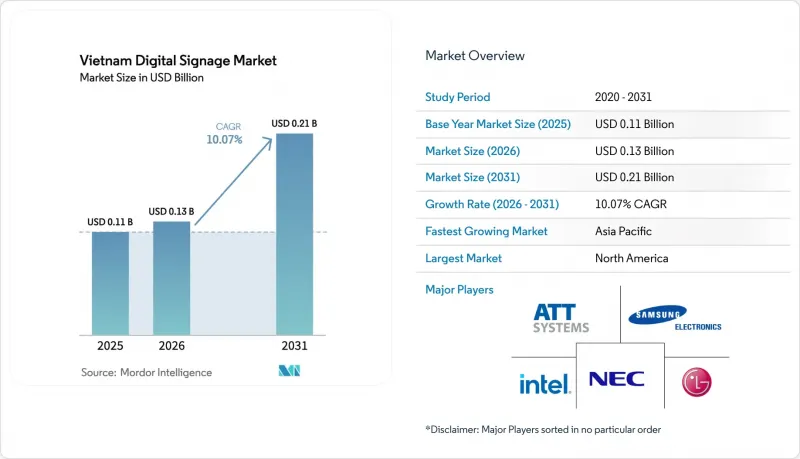
Mordor Intelligence에 의하면, 베트남의 디지털 사이니지 시장은 2026년에 1억 3,000만 달러에 달하고, 2031년까지 2억 1,000만 달러에 이를 것으로 예측되며, 예측 기간 중 연평균 복합 성장률(CAGR)은 10.07%를 기록할 전망입니다.
본 보고서는 유형별(싱글 패널 디스플레이, 비디오월, 토템/디지털 포스터, 기타), 구성 요소별(하드웨어, 소프트웨어, 서비스), 화면 크기별(32인치 이하, 32-52인치, 52-75인치, 기타),위치별(매장/실내, 실외), 최종 사용자 산업별(소매, 운송, 호스피탈리티, QSR, 기업, 기타)로 분류되어 있습니다. 시장 예측은 금액(달러)으로 표시되어 있습니다.
베트남의 디지털 사이니지 시장 동향 및 인사이트
LED 디스플레이 비용의 급격한 하락
삼성디스플레이의 박닌 OLED 생산 확대와 LG디스플레이의 하이퐁 투자로 인해 베트남은 패널 제조 거점으로 변모했으며, 납기 기간은 8주에서 4주 미만으로 단축되었습니다. BOE 테크놀로지의 바리아-붕타우 공장에서는 2025년부터 연간 700만 대의 디스플레이와 4,000만 대의 ePaper 유닛을 생산할 예정이며, 이에 따라 베트남의 디지털 사이니지 시장에 서비스를 제공하는 시스템 통합사업자의 입고 비용이 약 20-25% 절감될 것으로 예측됩니다. 현지 소매업체들은 그동안 대량 수입품에만 적용되던 가격으로 55인치 상업용 디스플레이를 구입할 수 있게 되었으며, 교체 주기가 36-48개월에서 18-24개월로 단축되었습니다. 비용 절감은 패스트푸드점이나 약국에서 주로 사용되는 32-52인치 크기 대에서 가장 두드러집니다. 마이크로 LED 파일럿 라인에서는 전력 소비가 40% 감소하고 수명이 10만 시간을 초과할 것으로 기대되며, 이러한 특성은 베트남의 습도가 높은 기후에서 옥외 광고를 운영하는 사업자에게 중요한 가치가 될 것입니다.
소매 체인의 확장과 다이내믹 광고에 대한 수요
WinCommerce는 2025년 4,300개 매장에서 2030년까지 10,000개 매장으로 확장할 계획이며, 계산대 대기 줄이나 엔드캡에 표준화된 디지털 사이니지를 정착시키려 하고 있습니다. 3,500억 달러 규모의 베트남 소매 산업에서 모던 트레이드의 점유율은 2030년까지 약 30%를 나타낼 것으로 예측되며, 이에 따라 인쇄 매체에서 연결형 스크린으로의 꾸준한 전환이 진행될 전망입니다. 이온 엔터테인먼트는 베타 미디어와 제휴하여 전국에 영화관을 전개할 예정입니다. 이러한 시설에는 비디오월, 디지털 포스터, 방문객 유치를 수익으로 전환하는 매점 구역의 키오스크가 도입될 예정입니다. CGV 베트남의 2024년 매출 급증에는 스크린 광고가 일부 기여했으며, 이는 네트워크화된 디스플레이가 가져다주는 추가 수익을 여실히 보여주고 있습니다. 따라서 이러한 요인으로 인해 컨텐츠 업데이트 빈도가 향상되었으며, 베트남의 디지털 사이니지 시장은 브랜드 일관성을 유지하기 위한 전략적 도구로서 그 위상이 강화되고 있습니다.
대형 LED 월에 필요한 막대한 초기 설비 투자
100인치 이상의 스크린의 경우, 설치 비용을 포함해 5만-15만 달러가 소요되며, 소규모 시설에서는 이 비용을 상각하기 어렵습니다. 6만 석을 자랑하는 PVF 스타디움이나 Vingroup이 운영하는 13만 5,000석 규모의 올림픽 복합 시설은 자금력이 있는 스폰서가 이러한 비용을 부담하고 있는 실례를 보여주고 있지만, 칸토나 빈의 쇼핑센터에서는 두 자릿수 금리와 30-40%의 계약금 요건에 직면해 있습니다. BrightSign이나 Scala, 스크린 단위의 구독 방식에 따른 임대 모델은 지지를 얻고 있지만, 여전히 광고주가 다년간의 계약을 체결할 의지에 의존하고 있습니다. 대안적인 자금 조달 구조가 성숙해지기 전까지는 자본 집약적인 특성으로 인해 지방 도시에서의 도입 속도가 둔화될 것이며, 그 결과 베트남의 디지털 사이니지 시장의 성장 궤도가 완만해질 것으로 예측됩니다.
부문 분석
2025년, 베트남의 디지털 사이니지 시장에서 싱글 패널 디스플레이는 43.88%의 점유율을 차지하고 있으며, 약국, 편의점, 은행 지점 등에서 ‘플러그 앤 플레이’ 방식의 편의성이 그 인기를 뒷받침하고 있습니다. 비디오월은 몰입감이 뛰어나지만, 구조적 보강과 정밀한 보정이 필요하기 때문에 도입이 플래그십 매장이나 제어실로 제한되어 있으며, 이 두 가지를 합쳐 수요의 약 5분의 1을 차지하고 있습니다. 프로젝션, 투명 OLED, 전자 종이, 홀로그래피 등 기타 대체 형태는 그 참신함으로 방문객을 끌어모으는 고급 소매점이나 박물관에서의 시범 도입에 힘입어 2031년까지 연평균 성장률(CAGR) 11.34%로 성장할 전망입니다.
몰입형 시설도 추가적인 견인력이 되고 있습니다. 6만 석을 보유한 PVF 스타디움에서는 주변을 둘러싼 LED 리본이 티켓 매출과는 별도로 스폰서 수익을 창출하고 있으며, 또한 베트남 건국 80주년 기념 행사를 위해 Absen이 설치한 2,000제곱미터 규모의 디스플레이는 대규모 도입에 대한 대응 능력을 돋보이게 하고 있습니다. 이러한 도입 사례는 인지도를 높이고 실험적인 시도를 가속화함으로써, 베트남의 디지털 사이니지 시장의 잠재 고객 기반을 확대되고 있습니다.
2025년 베트남의 디지털 사이니지 시장 규모에서 하드웨어가 차지하는 비중은 55.83%였으나, 설치, 유지보수, 크리에이티브, 운영 관리를 포함하는 서비스 부문은 2031년까지 연평균 11.43%의 성장이 예상됩니다. 삼성, LG, BOE의 현지 패널 생산으로 공급망이 단축되고 있지만, 부가가치는 원격 제어 및 가동률 보증으로 이동하고 있습니다. 화면당월10-15달러의 클라우드 CMS 플랫폼은 라이선싱 관련 설비 투자(CAPEX)를 불필요하게 하여, 중소기업이 최소한의 위험으로 시범 운영을 시작할 수 있게 해줍니다.
분석 기능을 통해 네트워크 수익화가 더욱 진전됩니다. HPT의 AI 탑재 사이니지 솔루션은 광고 게재율을 최대 20% 향상시키지만, 정령 13/2023을 준수하기 위해 인구 통계 로그의 암호화가 필수적입니다. 5G 커버리지율이 90%에 가까워짐에 따라, 실시간 펌웨어 업데이트로 현장 출장 대응이 30-40% 감소하여 서비스 수요가 더욱 높아집니다. 그 결과, 수익이 지속적 계약으로 전환되면서 베트남의 디지털 사이니지 시장이 하드웨어 의존형에서 서비스 중심의 경제 모델로 전환되는 추세가 더욱 강화되고 있습니다.
기타 혜택
- 엑셀 형식 시장 예측(ME) 시트
- 3개월간의 애널리스트 지원
자주 묻는 질문
목차
제1장 서론
제2장 조사 방법
제3장 주요 요약
제4장 시장 구도
제5장 시장 규모와 성장 예측
제6장 경쟁 구도
제7장 시장 기회와 향후 전망
LSH 26.09.04According to Mordor Intelligence, the Vietnam digital signage market was valued at USD 0.13 billion in 2026 and is projected to reach USD 0.21 billion by 2031, representing a 10.07% CAGR during the forecast period.
This report is Segmented by Type (Single-Panel Displays, Video Walls, Totems/Digital Posters, and More), Component (Hardware, Software, and Services), Screen Size (Below 32 Inch, 32-52 Inch, 52-75 Inch, and More), Location (In-store/Indoor, Outdoor), and End-User Industry (Retail, Transportation, Hospitality, QSR, Corporate, and More). The Market Forecasts are Provided in Terms of Value (USD).
Vietnam Digital Signage Market Trends and Insights
Rapid Decline in LED Display Costs
Samsung Display's Bac Ninh OLED expansion and LG Display's Haiphong investment have transformed Vietnam into a panel-manufacturing hub, reducing delivery lead times from eight weeks to less than four. BOE Technology's Ba Ria-Vung Tau factory will produce 7 million displays and 40 million ePaper units annually from 2025, reducing landed costs by an estimated 20-25% for integrators serving the Vietnam digital signage market. Local retailers can now acquire 55-inch commercial-grade screens at prices that were previously reserved for bulk imports, accelerating replacement cycles from 36-48 months to 18-24 months. Cost deflation is most pronounced in the 32-52 inch bracket that dominates quick-service restaurants and pharmacies. Pilot lines for micro-LEDs promise a 40% lower power draw and lifespans exceeding 100,000 hours, attributes that outdoor operators value in Vietnam's humid climate.
Retail Chain Expansion and Demand for Dynamic Advertising
WinCommerce plans to grow from 4,300 stores in 2025 to 10,000 by 2030, cementing standardized digital signage at checkout queues and end-caps. The modern trade share of Vietnam's USD 350 billion retail sector is expected to reach approximately 30% by 2030, leading to a steady shift from printed media to connected screens. AEON Entertainment's partnership with Beta Media to open cinemas nationwide will feature video walls, digital posters, and concession-area kiosks that monetize foot traffic. CGV Vietnam's 2024 revenue surge, driven partly by on-screen advertising, underscores the incremental margin that networked displays deliver. The driver therefore amplifies content-refresh frequencies and elevates the Vietnam digital signage market as a tactical tool for brand consistency.
High Upfront Capital Expenditure for Large-Format LED Walls
Screens above 100 inches cost USD 50,000-150,000 fully installed, an outlay that smaller venues struggle to amortize. The 60,000-seat PVF Stadium and Vingroup's 135,000-seat Olympic complex illustrate how deep-pocketed sponsors absorb these costs, yet shopping centers in Can Tho or Vinh face double-digit financing rates and 30-40% down-payment requirements. Leasing models from BrightSign and Scala, priced on a per-screen subscription, are gaining favor but still depend on advertisers' willingness to commit to multi-year contracts. Until alternative funding structures mature, capital intensity will temper rollout velocity in secondary cities, thereby moderating the Vietnam digital signage market growth trajectory.
Other drivers and restraints analyzed in the detailed report include:
- Government Smart-City and Smart-Transport Initiatives
- Adoption of Contactless Interactive Signage Post-COVID
- Cyber-Security and Data-Privacy Concerns in Networked Signage
For complete list of drivers and restraints, kindly check the Table Of Contents.
Segment Analysis
Single-panel displays held 43.88% of the Vietnam digital signage market in 2025, underscoring their plug-and-play appeal for pharmacies, convenience stores, and branch banks. Video walls, although immersive, require structural reinforcement and precision calibration, limiting adoption to flagship stores and control rooms that collectively account for roughly one-fifth of demand. Projection and other alternative formats, including transparent OLED, ePaper, and holography, are set to expand at an 11.34% CAGR through 2031, driven by luxury retail and museum pilots where novelty attracts foot traffic.
Immersive venues provide further traction. The 60,000-seat PVF Stadium features perimeter LED ribbons that generate sponsorship revenue independently of ticket sales, while Absen's 2,000-square-meter installation for Vietnam's 80th National Day highlights its scale readiness. Such deployments widen awareness and accelerate experimentation, thereby broadening the addressable base for the Vietnam digital signage market.
Hardware contributed 55.83% to the Vietnam digital signage market size in 2025, yet the services segment, including installation, maintenance, creative, and managed operations, is forecast to grow 11.43% annually through 2031. Local panel output from Samsung, LG, and BOE shortens supply chains, but value shifts toward remote orchestration and uptime guarantees. Cloud CMS platforms, priced at USD 10-15 per screen monthly, eliminate licensing CAPEX, allowing small enterprises to launch pilots with minimal risk.
Analytics layers further monetize networks. HPT's AI-enabled signage solution boosts ad fill rates up to 20% but must encrypt demographic logs to comply with Decree 13/2023. As 5G coverage approaches 90%, real-time firmware updates reduce truck rolls by 30-40%, further amplifying service demand. The outcome tilts revenue toward recurring contracts, reinforcing the Vietnam digital signage market's shift from hardware dependency to service-centric economics.
Complete Report Scope:
- By Signage Type
- Single-Panel Displays
- Video Walls
- Totems / Digital Posters
- Kiosks / Interactive Terminals
- Outdoor LED / Billboard / Street Furniture (DOOH)
- Other Signage Types (Projection, Etc.)
- By Component
- Hardware
- Display Panels
- Media Players and Controllers
- Mounts and Stands
- Other Hardwares
- Software
- Services
- Hardware
- By Screen Size
- Below 32 inch
- 32-52 inch
- 52-75 inch
- Above 75 inch
- Ultra-large Above 100"
- By Location
- In-store/Indoor
- Outdoor
- By End-user Industry
- Retail
- Transportation
- Hospitalitiy
- QSR
- Corporate
- Sports and Entertainment
- Healthcare
- Other End-user Industries
List of Companies Covered in this Report:
- Net and Com Integrated Telecom Co., Ltd.
- Vodatel Integrated Solutions (Vietnam) Co., Ltd.
- NEC Corporation
- ATT Systems (Vietnam) Pte. Ltd.
- Inavate AV Co., Ltd.
- Intel Corporation
- LG Electronics Inc.
- Samsung Electronics Co., Ltd.
- Panasonic Holdings Corporation
- Sony Group Corporation
- Sharp Corporation
- Daktronics, Inc.
- Leyard Optoelectronic Co., Ltd.
- Unilumin Group Co., Ltd.
- Absen Optoelectronic Co., Ltd.
- AOTO Electronics Co., Ltd.
- BrightSign, LLC
- Scala, Inc. (Stratacache Company)
- Advantech Co., Ltd.
- Christie Digital Systems USA, Inc.
- E Ink Holdings Inc.
- Visionect d.o.o.
- Vietnam Digital Signage Joint-Stock Company (VDS)
Additional Benefits:
- The market estimate (ME) sheet in Excel format
- 3 months of analyst support
TABLE OF CONTENTS
1 INTRODUCTION
- 1.1 Study Assumptions and Market Definition
- 1.2 Scope of the Study
2 RESEARCH METHODOLOGY
3 EXECUTIVE SUMMARY
4 MARKET LANDSCAPE
- 4.1 Market Overview
- 4.2 Market Drivers
- 4.2.1 Rapid decline in LED display costs
- 4.2.2 Retail chain expansion and demand for dynamic advertising
- 4.2.3 Government smart-city and smart-transport initiatives
- 4.2.4 Adoption of contactless interactive signage post-COVID
- 4.2.5 Roll-out of 5G and cloud CMS enabling real-time content updates
- 4.2.6 Localization of energy-efficient micro-LED production in Vietnam's industrial parks
- 4.3 Market Restraints
- 4.3.1 High upfront capital expenditure for large-format LED walls
- 4.3.2 Cyber-security and data-privacy concerns in networked signage
- 4.3.3 Fragmented local content-creation ecosystem limiting ROI
- 4.3.4 Heritage-zone regulations capping outdoor display brightness
- 4.4 Industry Value Chain Analysis
- 4.5 Regulatory Landscape
- 4.6 Technological Outlook
- 4.7 Porter's Five Forces Analysis
- 4.7.1 Threat of New Entrants
- 4.7.2 Bargaining Power of Buyers
- 4.7.3 Bargaining Power of Suppliers
- 4.7.4 Threat of Substitute Products
- 4.7.5 Intensity of Competitive Rivalry
- 4.8 Investment Trends and Funding Landscape
5 MARKET SIZE AND GROWTH FORECASTS (VALUE)
- 5.1 By Signage Type
- 5.1.1 Single-Panel Displays
- 5.1.2 Video Walls
- 5.1.3 Totems / Digital Posters
- 5.1.4 Kiosks / Interactive Terminals
- 5.1.5 Outdoor LED / Billboard / Street Furniture (DOOH)
- 5.1.6 Other Signage Types (Projection, Etc.)
- 5.2 By Component
- 5.2.1 Hardware
- 5.2.1.1 Display Panels
- 5.2.1.2 Media Players and Controllers
- 5.2.1.3 Mounts and Stands
- 5.2.1.4 Other Hardwares
- 5.2.2 Software
- 5.2.3 Services
- 5.2.1 Hardware
- 5.3 By Screen Size
- 5.3.1 Below 32 inch
- 5.3.2 32-52 inch
- 5.3.3 52-75 inch
- 5.3.4 Above 75 inch
- 5.3.5 Ultra-large Above 100"
- 5.4 By Location
- 5.4.1 In-store/Indoor
- 5.4.2 Outdoor
- 5.5 By End-user Industry
- 5.5.1 Retail
- 5.5.2 Transportation
- 5.5.3 Hospitalitiy
- 5.5.4 QSR
- 5.5.5 Corporate
- 5.5.6 Sports and Entertainment
- 5.5.7 Healthcare
- 5.5.8 Other End-user Industries
6 COMPETITIVE LANDSCAPE
- 6.1 Market Concentration
- 6.2 Strategic Moves
- 6.3 Market Share Analysis
- 6.4 Company Profiles (includes Global-level Overview, Market-level Overview, Core Segments, Financials as available, Strategic Information, Market Rank/Share, Products and Services, Recent Developments)
- 6.4.1 Net and Com Integrated Telecom Co., Ltd.
- 6.4.2 Vodatel Integrated Solutions (Vietnam) Co., Ltd.
- 6.4.3 NEC Corporation
- 6.4.4 ATT Systems (Vietnam) Pte. Ltd.
- 6.4.5 Inavate AV Co., Ltd.
- 6.4.6 Intel Corporation
- 6.4.7 LG Electronics Inc.
- 6.4.8 Samsung Electronics Co., Ltd.
- 6.4.9 Panasonic Holdings Corporation
- 6.4.10 Sony Group Corporation
- 6.4.11 Sharp Corporation
- 6.4.12 Daktronics, Inc.
- 6.4.13 Leyard Optoelectronic Co., Ltd.
- 6.4.14 Unilumin Group Co., Ltd.
- 6.4.15 Absen Optoelectronic Co., Ltd.
- 6.4.16 AOTO Electronics Co., Ltd.
- 6.4.17 BrightSign, LLC
- 6.4.18 Scala, Inc. (Stratacache Company)
- 6.4.19 Advantech Co., Ltd.
- 6.4.20 Christie Digital Systems USA, Inc.
- 6.4.21 E Ink Holdings Inc.
- 6.4.22 Visionect d.o.o.
- 6.4.23 Vietnam Digital Signage Joint-Stock Company (VDS)
7 MARKET OPPORTUNITIES AND FUTURE OUTLOOK
- 7.1 White-space and Unmet-Need Assessment


