|
시장보고서
상품코드
2122405
지게차 : 시장 점유율 분석, 업계 동향과 통계, 성장 예측(2025-2031년)Forklift Trucks - Market Share Analysis, Industry Trends & Statistics, Growth Forecasts (2025 - 2031) |
||||||
 Mordor Intelligence
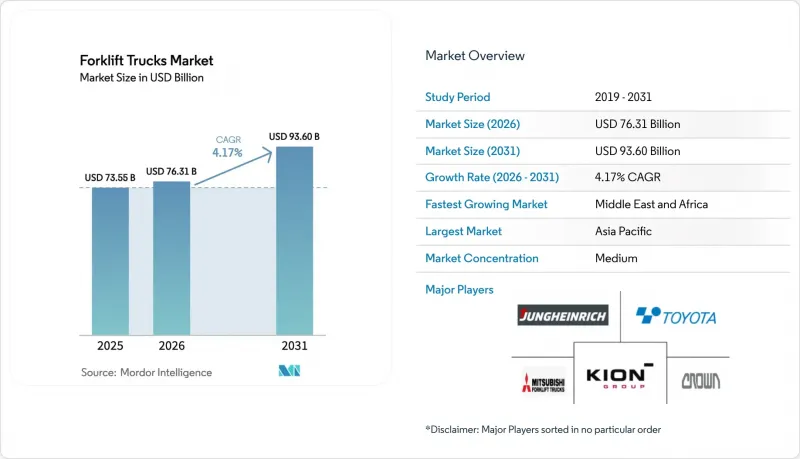
Mordor Intelligence에 따르면 지게차 시장 규모는 2025년에 735억 5,000만 달러로 평가되며, 2026년 763억 1,000만 달러에서 2031년까지 936억 달러에 달할 것으로 예측되고 있으며, 예측 기간(2026-2031년)에 CAGR은 4.17%에 달할 전망입니다.
이 보고서는 파워트레인 유형별(내연기관(ICE), 전동, 기타), 차량 등급별(클래스 I, 클래스 II, 클래스 III, 기타), 적재 용량별(5톤 이하, 5-15톤, 기타),최종사용자 산업별(제조업, 물류·창고업, 기타), 지역별로 분류되어 있습니다. 시장 예측은 금액(달러)과 수량(대)으로 제시되어 있습니다.
전 세계 지게차 시장의 동향 및 인사이트
아시아태평양의 배기가스 규제로 인한 전동 지게차 보급 촉진
중국은 대기오염 대책 계획의 일환으로, 가까운 시일 내에 주요 도시에서 비도로용 기계의 제로 배출을 의무화할 예정입니다. 인도의 ‘PM E-DRIVE’ 제도는 충전 인프라에 막대한 자금을 지원하는 동시에, 전동 지게차에 대해 상당한 규모의 자본 보조금을 지급하고 있습니다. 일본에서는 근로 시간 상한 규제로 인해 창고에서 급속 충전이 가능한 리튬이온 배터리를 탑재한 지게차의 도입이 진행되고 있습니다. 한편, 한국의 ‘그린 뉴딜 2.0’은 향후 10년 이내에 상용차 부문에서 전기자동차의 점유율을 대폭 높이는 것을 목표로 하고 있습니다. 이러한 노력들이 맞물려 아시아태평양의 지게차 시장에서 전기 지게차의 점유율은 향후 수년간 대폭 확대되어, 유럽 및 미국 국가들을 능가하는 속도로 성장할 것으로 예측됩니다.
북미의 자동화 및 E-Commerce(EC) 물류센터 확대
주요 E-Commerce 기업은 ‘라이트아웃(Light-Out)’형 풀필먼트 센터 구축을 가속화하며, 자율 이동 로봇과 첨단 창고 관리 시스템을 원활하게 통합하고 있습니다. 캘거리에 건설된 아마존의 광대한 신규 시설에는 여러 대의 FoxBot 로봇 유닛이 도입되어 통로 폭이 최적화되었으며, 팔레트 밀도가 대폭 향상되었습니다. 한편, 월마트가 매장 내에 드론과 청소 로봇을 도입함으로써 업무 효율이 향상되었을 뿐만 아니라, 좁은 통로용 리프트 트럭에 대한 투자 여지가 생겨났으며, 이들은 현재 자동 랙 시스템과 연동되어 가동되고 있습니다. 중요한 움직임으로, 프로로지스는 2024년에 ‘Prologis Labs’에 막대한 자금을 배정하여 미국과 유럽의 여러 거점에서 VisionNav 및 Multiway의 자율주행 지게차를 시험 운영할 준비를 마쳤습니다. 이러한 노력 덕분에 지게차 시장 전체가 둔화되는 추세 속에서도 향후 수년간 클래스 I 및 클래스 II 전동 지게차가 강력한 성장을 이룰 것으로 전망됩니다. 또한 IoT 소프트웨어와 배터리 분석 플랫폼의 통합은 빠르게 표준 요건으로 자리 잡고 있습니다.
전기 지게차의 높은 초기 비용으로 인한 보급 저해
리튬이온 기술을 채택한 전동 지게차는 디젤 방식에 비해 가격이 상당히 비쌉니다. 따라서 전동 지게차는 디젤 모델에 비해 가격대가 높게 형성되어 있습니다. 특히 배터리는 총 제조 비용의 상당 부분을 차지합니다. 최근 수년간 리튬 탄산염 가격은 상당한 변동성을 보이며 크게 요동치고 있습니다. 많은 중소기업은 담보 확보에 어려움을 겪고 있으며, 이로 인해 그린 파이낸스 이용이 제한되고 있습니다. 유럽투자은행(EIB)의 ‘클린 트랜스포트 시설(Clean Transport Facility)’은 매우 경쟁력 있는 금리를 제공하고 있지만, 직원 수가 제한적인 중소기업의 도입률은 여전히 낮은 수준입니다. 인도에서는 전기 트럭에 대한 보조금이 마련되어 있지만, 대상은 전체 차량 수의 극히 일부에 불과하여 이러한 인센티브의 보급 범위가 제한적이라는 점이 부각되고 있습니다. 또한 배터리 팩 비용이 대폭 하락하기 전까지는 특히 비용을 중시하는 구매자층을 중심으로 전기 지게차 도입이 제한된 상태가 지속될 것으로 보입니다.
부문 분석
사업자들이 수명 주기 비용 최소화를 추구하는 가운데, 2025년 출하 대수의 67.73%를 전기 모델이 차지했습니다. 전기 부문 내에서는 리튬이온 배터리가 큰 성장을 보이며, 몇 년 전과 비교하여 주류 선택지로 자리 잡았습니다. 수소연료전지식 지게차는 현재 시장 점유율이 극히 미미하지만, 주요 산업 현장의 도입에 힘입어 2031년까지 연평균 성장률(CAGR) 4.19%라는 견실한 성장세를 보이며 꾸준히 성장할 것으로 예상됩니다. 내연 기관은 주로 실외 및 신흥 시장의 용도에 대응하고 있으며, 여전히 상당한 시장 점유율을 유지하고 있습니다. 미국 에너지부(DOE)는 향후 몇 년 내에 수소 가격을 경쟁 수준으로 낮추는 것을 목표로 하고 있으며, 이로 인해 운영 비용 차이가 대폭 축소될 가능성이 있습니다. 저온 창고의 대규모 사용자들 사이에서는 신속한 연료 보급이 가능하고, 여러 교대 근무에 걸쳐 중단 없는 가동을 지원한다는 점에서 수소를 선호하는 경향이 강해지고 있습니다. 지게차 시장은 배터리 비용 하락에 대응하고 있으며, 각 OEM 업체들은 프리미엄 모델에서 납축전지를 단계적으로 폐지하고 있습니다.
현재로서는 수소가 지게차 시장의 극히 일부만을 차지하고 있습니다. 그러나 재생 가능 에너지 공급 능력의 확대와 항만 당국의 제로 배출 규제 도입에 따라 수소는 장기적인 대체 수단으로 인식되고 있습니다. 한편, 리튬이온 기술은 확립된 충전 인프라, 텔레매틱스와의 통합, 보험 위험을 줄여주는 안전 인증 개선에 힘입어 당분간 투자처로서 선호되는 선택지로 남아 있을 것으로 예상됩니다.
클래스 I 전동 승용 트럭은 EC 기업이 적재 효율을 높이기 위해 통로 폭을 8피트로 좁히고 있는 데 힘입어 연평균 성장률(CAGR) 4.25%로 성장하고 있습니다. 아마존의 캘거리 거점은 더 좁은 통로에서 자율주행형 승용 트럭을 도입하고 있으며, 이러한 변화를 여실히 보여주고 있습니다. 클래스 III 팔레트 트럭은 2025년 판매 대수에서 여전히 43.47%를 차지하며 선두를 유지하고 있지만, 포화 상태에 이른 소매 채널에서는 성장세가 둔화되고 있습니다. 클래스 II 협폭 통로용 차량은 고부가가치 SKU가 프리미엄 장비 도입을 지원하는 제약 및 전자 산업의 수혜를 받고 있습니다. 클래스 IV 및 V 내연기관 모델은 기복이 심한 지형이나 중장비가 가동되는 건설 현장에서 필수적인 존재로서, 합쳐서 일정한 시장 점유율을 유지했습니다. 2024년, 린데(Linde)사의 KAnIS 프로젝트에서는 마스크 로테르담에서 클래스 V 전동 차량과 5G 제어를 결합하여 대용량 자동화를 실증했습니다.
기동성이 뛰어난 클래스 I 기계 유형에 대한 수요는 창고 설계의 지속적인 재편을 시사합니다. 메자닌 및 자동 창고를 통합하는 시설이 늘어남에 따라 내비게이션의 정확도와 배터리 생산성이 각 OEM 업체의 차별화 요소가 될 것으로 보입니다. 지게차 시장에서 클래스 I 장비 시장 규모는 향후 10년이 끝날 무렵까지 클래스 III와의 격차를 더욱 벌릴 것으로 예측됩니다.
지역별 분석
2025년, 아시아태평양은 중국의 방대한 생산 규모를 바탕으로 지게차 시장에서 47.63%의 점유율을 차지했습니다. 중국 제조사인 Hangcha, Heli, EP는 동남아시아와 아프리카로 막대한 수량의 지게차를 수출하며 기존 공급업체들에 도전하고 있습니다.
2026년 중국내 도시 단위의 제로 배출 달성 기한에 따라 2028년까지 전기화 보급률은 5분의 4를 넘어설 것으로 전망됩니다. 인도에서는 ‘생산 연계형 인센티브(PLI) 프로그램’에 따른 창고 건설 확대로 인해 2027년까지 연간 수요가 대폭 증가할 것으로 전망됩니다. 중동 및 아프리카는 연평균 성장률(CAGR) 4.27%를 기록하며, 킹 살만 공항이나 제벨 알리의 냉장 창고 건설과 같은 메가 프로젝트를 주도하고 있습니다.
유럽은 수익의 대부분을 차지하고 있으며, 엄격한 EU 배터리 규제로 인해 리튬 채택이 가속화되고 있습니다. 북미는 수량 면에서는 적지만, 생산의 국내 복귀(리쇼어링)에 더해 안정적인 대규모 주문을 확보하는 기가팩토리 건설 계획의 혜택을 받고 있습니다. 남미는 통화 변동으로 인해 고급 전기자동차의 보급이 지연되고 있지만, 브라질의 곡물 수송 회랑에서 지역 밀착형 수요가 나타나고 있습니다.
기타 혜택
- 엑셀 형식의 시장 예측(ME) 시트
- 3개월간 애널리스트의 지원
자주 묻는 질문
목차
제1장 서론
제2장 조사 방법
제3장 개요
제4장 시장 구도
제5장 시장 규모와 성장 예측
제6장 경쟁 구도
제7장 시장 기회와 향후 전망
KSA 26.09.07According to Mordor Intelligence, the forklift trucks market size was valued at USD 73.55 billion in 2025 and estimated to grow from USD 76.31 billion in 2026 to reach USD 93.60 billion by 2031, at a CAGR of 4.17% during the forecast period (2026-2031).
This report is Segmented by Powertrain Type (Internal Combustion Engine (ICE), Electric, and More), Vehicle Class (Class I, Class II, Class III, and More), Load Capacity (Less Than 5 Tons, 5-15 Tons, and More), End-User Industry (Manufacturing, Logistics and Warehousing, and More), and Geography. Market Forecasts are Provided in Value (USD) and Volume (Units).
Global Forklift Trucks Market Trends and Insights
APAC's Emission Mandates Propel Electric Forklift Adoption
China mandates zero-emission non-road machines in major cities starting in the near future as part of its Air Pollution Action Plan . India's PM E-DRIVE scheme provides significant funding for charging infrastructure and offers a substantial capital grant for electric forklifts. Japan's working-hour ceiling is driving warehouses to adopt faster-charging lithium-ion fleets. Meanwhile, South Korea's Green New Deal 2.0 aims to achieve a considerable electric share for commercial vehicles within the next decade. Given these converging initiatives, the electric share of the forklift truck market in the Asia Pacific region is projected to grow significantly in the coming years, outpacing Western counterparts.
North America's Automated and E-commerce Warehouses Expand
E-commerce giants are ramping up the deployment of "lights-out" fulfillment centers, seamlessly integrating autonomous mobile robots with advanced warehouse management systems. Amazon's sprawling new facility in Calgary has integrated several FoxBot robotic units, optimizing aisle widths and significantly boosting pallet density . Meanwhile, Walmart's introduction of in-store drones and cleaning robots has not only streamlined operations but also liberated capital for narrow-aisle lift trucks, which now work in harmony with automated racking systems. In a significant move, Prologis has allocated substantial funding for Prologis Labs in 2024, setting the stage to test VisionNav and Multiway's autonomous forklifts at multiple sites across the United States and Europe . These initiatives are poised to drive strong growth for Class I and Class II electric units over the next few years, even as the broader forklift truck market sees a slowdown. Furthermore, the integration of IoT software and battery analytics platforms is swiftly becoming a standard requirement.
Electric Forklift's High Upfront Cost Hinders Adoption
Electric trucks, powered by lithium-ion technology, are significantly more expensive than their diesel counterparts. This places electric trucks in a higher price range compared to diesel models. Notably, batteries constitute a substantial portion of the total build cost. Over recent years, lithium-carbonate prices have shown considerable volatility, fluctuating widely. Many small enterprises face challenges in securing collateral, which limits their access to green financing. While the European Investment Bank's Clean Transport Facility offers highly competitive interest rates, adoption remains low among smaller firms with limited employee numbers. In India, subsidies are available for electric trucks, but they cover only a small fraction of the total fleet, highlighting the limited reach of such incentives. Additionally, until battery pack costs decrease significantly, the adoption of electric forklift trucks will remain constrained, particularly among cost-conscious buyers.
Other drivers and restraints analyzed in the detailed report include:
- European Cold-Chain Facilities Embrace Lithium-ion Forklifts
- Aging Forklift Fleet Replacement Cycle in Japan and South Korea
- Europe and Nordics Face Shortage of Skilled Forklift Operators
For complete list of drivers and restraints, kindly check the Table Of Contents.
Segment Analysis
Electric units accounted for 67.73% of 2025 shipments as operators chase a minimal lifetime cost. Within the electric segment, lithium-ion packs experienced substantial growth, becoming the dominant choice compared to their position a few years ago. While hydrogen fuel-cell forklifts currently hold a minimal share, they are expected to grow steadily with a robust CAGR of 4.19% through 2031, supported by deployments in key industrial operations. Internal combustion continues to maintain a considerable share, primarily catering to outdoor and emerging-market applications. The U.S. Department of Energy (DOE) aims to achieve a competitive hydrogen price within the next few years, which could significantly reduce operating-cost differences. Heavy users in cold storage increasingly prefer hydrogen due to its quick refueling capability, which supports uninterrupted multi-shift operations. The forklift truck market is adapting to declining battery costs, with OEMs gradually phasing out lead-acid batteries in premium models.
At present, hydrogen represents a very small portion of the forklift truck market. However, with the expansion of renewable energy capacities and the implementation of zero-emission mandates by port authorities, hydrogen is gaining recognition as a viable long-term alternative. Meanwhile, lithium-ion technology is expected to remain the preferred investment choice in the foreseeable future, driven by its established charging infrastructure, integration with telematics, and improved safety certifications that reduce insurance risks.
Class I electric rider trucks are growing at a 4.25% CAGR as e-commerce firms condense aisle widths to 8 feet for greater cube efficiency. Amazon's Calgary site illustrates the shift, using autonomous riders for narrower corridors. Class III pallet trucks still led 2025 volume at 43.47% but logged slower growth in saturated retail channels. Class II narrow-aisle machines benefit from pharmaceuticals and electronics verticals where high-value SKUs support premium equipment. Class IV and V combustion models held a combined share, indispensable on uneven terrains and heavy-construction zones. In 2024, Linde's KAnIS project combined Class V electrics with 5G controls at Maersk Rotterdam, showcasing high-capacity automation.
Demand for agile Class I units signals a lasting reorder of warehouse design. As more sites integrate mezzanines and automated storage, navigation accuracy and battery productivity will shape OEM differentiation. The Forklift trucks market size for Class I equipment is projected to widen its gap over Class III by the decade's end.
Complete Report Scope:
- By Powertrain Type
- Internal Combustion Engine (ICE)
- Electric
- Lead-acid
- Li-ion
- Hydrogen Fuel-cell Vehicle (HFCV)
- By Vehicle Class
- Class I (Electric Rider Trucks)
- Class II (Electric Narrow-Aisle)
- Class III (Electric Pallet)
- Class IV (ICE Cushion-Tire)
- Class V (ICE Pneumatic-Tire)
- By Load Capacity
- Less than 5 Tons
- 5-15 Tons
- Above 15 Tons
- By End-user Industry
- Manufacturing
- Logistics & Warehousing
- Construction & Infrastructure
- Retail & Wholesale
- Food & Beverage Cold-Chain
- By Geography
- North America
- United States
- Canada
- Rest of North America
- South America
- Brazil
- Argentina
- Rest of South America
- Europe
- Germany
- United Kingdom
- France
- Italy
- Spain
- Rest of Europe
- Asia Pacific
- China
- India
- Japan
- South Korea
- Rest of Asia Pacific
- Middle East and Africa
- United Arab Emirates
- Saudi Arabia
- South Africa
- Turkey
- Rest of Middle East and Africa
- North America
Geography Analysis
Asia Pacific held a 47.63% slice of the Forklift trucks market in 2025, anchored by China's vast production scale. Domestic makers Hangcha, Heli, and EP exported a massive number of units to Southeast Asia and Africa, challenging traditional suppliers.
China's city-level zero-emission deadline of 2026 is likely to drive electric penetration past four-fifths by 2028. India's warehousing build-out, tied to the Production-Linked Incentive program, could lift annual demand by a vast number of units by 2027. The Middle East and Africa, with a 4.27% CAGR, are driving megaprojects such as King Salman Airport and Jebel Ali's cold-store build.
Europe controls most of the revenue, with the strict EU Battery Regulation accelerating the uptake of lithium. North America, with a minimal volume, benefits from reshoring, as well as gigafactory pipelines that secure steady, heavy-duty orders. South America lags premium electrics due to currency volatility but finds localized demand in Brazil's grain corridors.
- Toyota Industries Corp.
- KION Group AG
- Jungheinrich AG
- Hyster-Yale Materials Handling Inc.
- Mitsubishi Logisnext Co. Ltd.
- Crown Equipment Corp.
- Hangcha Group Co.
- Doosan Industrial Vehicles Co. Ltd.
- Komatsu Ltd.
- Anhui Heli Co. Ltd.
- Clark Material Handling Co.
- Caterpillar Inc. (CAT Lift Trucks)
- Hyundai Material Handling
- Lonking Holdings Ltd.
- Manitou Group
- Godrej & Boyce Mfg. Co.
- EP Equipment Co.
- Liugong Machinery Co.
- UniCarriers Corp.
- SANY Group Co.
Additional Benefits:
- The market estimate (ME) sheet in Excel format
- 3 months of analyst support
TABLE OF CONTENTS
1 Introduction
- 1.1 Study Assumptions and Market Definition
- 1.2 Scope of the Study
2 Research Methodology
3 Executive Summary
4 Market Landscape
- 4.1 Market Overview
- 4.2 Market Drivers
- 4.2.1 Asia Pacific's Emission Mandates Propel Electric Forklift Adoption
- 4.2.2 North America's Automated and E-commerce Warehouses Expand
- 4.2.3 United States Forklift Demand Surges Amid Post-pandemic Manufacturing Reshoring
- 4.2.4 European Cold-Chain Facilities Embrace Lithium-ion Forklifts
- 4.2.5 Aging Forklift Fleet Replacement Cycle in Japan and South Korea
- 4.2.6 GCC's Infrastructure Investments Forge New Logistics Hubs
- 4.3 Market Restraints
- 4.3.1 Electric Forklift's High Upfront Cost Hinders Adoption
- 4.3.2 Europe and Nordics Face Shortage of Skilled Forklift Operators
- 4.3.3 OEM Margins Squeeze Amid Fierce Rental-Fleet Competition
- 4.3.4 Supply Chain Disruptions Hinder Component Availability
- 4.4 Value / Supply-Chain Analysis
- 4.5 Regulatory Landscape
- 4.6 Technological Outlook
- 4.7 Porter's Five Forces
- 4.7.1 Bargaining Power of Suppliers
- 4.7.2 Bargaining Power of Buyers
- 4.7.3 Threat of New Entrants
- 4.7.4 Threat of Substitutes
- 4.7.5 Competitive Rivalry
5 Market Size & Growth Forecasts (Value (USD) and Volume (Units))
- 5.1 By Powertrain Type
- 5.1.1 Internal Combustion Engine (ICE)
- 5.1.2 Electric
- 5.1.2.1 Lead-acid
- 5.1.2.2 Li-ion
- 5.1.3 Hydrogen Fuel-cell Vehicle (HFCV)
- 5.2 By Vehicle Class
- 5.2.1 Class I (Electric Rider Trucks)
- 5.2.2 Class II (Electric Narrow-Aisle)
- 5.2.3 Class III (Electric Pallet)
- 5.2.4 Class IV (ICE Cushion-Tire)
- 5.2.5 Class V (ICE Pneumatic-Tire)
- 5.3 By Load Capacity
- 5.3.1 Less than 5 Tons
- 5.3.2 5-15 Tons
- 5.3.3 Above 15 Tons
- 5.4 By End-user Industry
- 5.4.1 Manufacturing
- 5.4.2 Logistics & Warehousing
- 5.4.3 Construction & Infrastructure
- 5.4.4 Retail & Wholesale
- 5.4.5 Food & Beverage Cold-Chain
- 5.5 By Geography
- 5.5.1 North America
- 5.5.1.1 United States
- 5.5.1.2 Canada
- 5.5.1.3 Rest of North America
- 5.5.2 South America
- 5.5.2.1 Brazil
- 5.5.2.2 Argentina
- 5.5.2.3 Rest of South America
- 5.5.3 Europe
- 5.5.3.1 Germany
- 5.5.3.2 United Kingdom
- 5.5.3.3 France
- 5.5.3.4 Italy
- 5.5.3.5 Spain
- 5.5.3.6 Rest of Europe
- 5.5.4 Asia Pacific
- 5.5.4.1 China
- 5.5.4.2 India
- 5.5.4.3 Japan
- 5.5.4.4 South Korea
- 5.5.4.5 Rest of Asia Pacific
- 5.5.5 Middle East and Africa
- 5.5.5.1 United Arab Emirates
- 5.5.5.2 Saudi Arabia
- 5.5.5.3 South Africa
- 5.5.5.4 Turkey
- 5.5.5.5 Rest of Middle East and Africa
- 5.5.1 North America
6 Competitive Landscape
- 6.1 Market Concentration
- 6.2 Strategic Moves
- 6.3 Market Share Analysis
- 6.4 Company Profiles (includes Global Level Overview, Market Level Overview, Core Segments, Financials as Available, Strategic Information, Market Rank/Share for Key Companies, Products and Services, SWOT Analysis, and Recent Developments)
- 6.4.1 Toyota Industries Corp.
- 6.4.2 KION Group AG
- 6.4.3 Jungheinrich AG
- 6.4.4 Hyster-Yale Materials Handling Inc.
- 6.4.5 Mitsubishi Logisnext Co. Ltd.
- 6.4.6 Crown Equipment Corp.
- 6.4.7 Hangcha Group Co.
- 6.4.8 Doosan Industrial Vehicles Co. Ltd.
- 6.4.9 Komatsu Ltd.
- 6.4.10 Anhui Heli Co. Ltd.
- 6.4.11 Clark Material Handling Co.
- 6.4.12 Caterpillar Inc. (CAT Lift Trucks)
- 6.4.13 Hyundai Material Handling
- 6.4.14 Lonking Holdings Ltd.
- 6.4.15 Manitou Group
- 6.4.16 Godrej & Boyce Mfg. Co.
- 6.4.17 EP Equipment Co.
- 6.4.18 Liugong Machinery Co.
- 6.4.19 UniCarriers Corp.
- 6.4.20 SANY Group Co.
7 Market Opportunities & Future Outlook
- 7.1 White-space & Unmet-need Assessment