

|
시장보고서
상품코드
2122455
오피오이드 : 시장 점유율 분석, 업계 동향과 통계, 성장 예측(2026-2031년)Global Opioids - Market Share Analysis, Industry Trends & Statistics, Growth Forecasts (2026 - 2031) |
||||||
 Mordor Intelligence
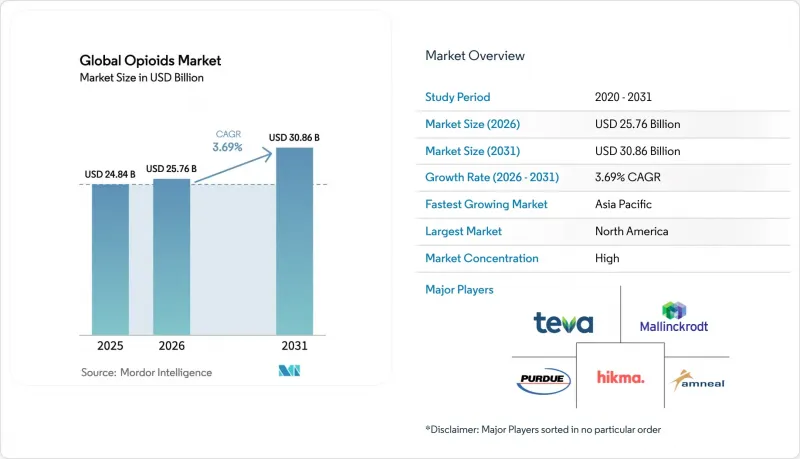
Mordor Intelligence에 의하면, 2026년 오피오이드 시장 규모는 257억 6,000만 달러로 추정되며, 2025년 248억 4,000만 달러에서 2031년에는 308억 6,000만 달러에 달할 것으로 예측됩니다.
또한 2026-2031년 연평균 성장률(CAGR)은 3.69%를 나타낼 전망입니다.
본 보고서에서는 업계를 제품 유형별(코데인, 펜타닐, 메페리진 등), 수용체 결합 방식별(강력한 작용제, 경도에서 중등도의 작용제 등),투여 경로별(경구, 비경구 등), 용도별(통증 관리, 감기·기침 등), 유통 채널(병원 등), 지역별로 분류하고 있습니다. 시장 규모 및 전망은 금액(달러)으로 표시되어 있습니다.
세계 오피오이드 시장 동향 및 인사이트
정형외과 질환 및 만성 통증 유병률 증가
인구 고령화, 비만, 그리고 앉아 있는 생활 습관으로 인해 퇴행성 관절염 및 등 질환의 유병률이 상승하고 있으며, 이는 오피오이드 시장 수요를 지속적으로 뒷받침하고 있습니다. 미국에서는 5,000만 명 이상의 성인이 만성 통증을 앓고 있으며, 비약물 요법이 효과를 보이지 않는 급성 통증의 경우 오피오이드가 여전히 필수적입니다. 현재, 고도의 치료 경로에서는 오피오이드에 보조적인 물리치료 및 심리적 지원을 병행하고 있습니다. 그러나 처방약 목록의 제한과 단계적 치료 의무화로 인해 치료 시작까지의 기간이 길어지고 있습니다. 유해사건을 최소화해야 한다는 압박으로 인해 시판 후 조사가 강화되고 있으며, 무단 개봉 방지 포장 및 비정상적인 처방 경향을 감지하는 분석 대시보드에 대한 투자가 촉진되고 있습니다. 그 결과, 실제 임상에서 안전성의 이점을 입증할 수 있는 제조업체는 오피오이드 시장 전체에서 우선적인 보험 환급을 확보하고, 처방 목록에서 상위 순위를 유지하고 있습니다.
서방형 오피오이드 제제로의 전환 추세
임상의들은 혈장 내 농도를 안정시키고 야간 돌발성 통증을 완화하기 위해 하루 1회 또는 2회 투여로 충분한 서방형 정제를 점점 더 많이 선택하고 있습니다. FDA의 지속적으로 발전하는 ADF(대체 투여법) 승인 절차 도입에 따라, 미세구 기술을 사용하여 분쇄나 주사를 통한 오남용을 방지하는 ‘Xtampza ER’ 등의 승인이 가속화되고 있습니다. 서방형 제품은 프리미엄 가격을 책정할 수 있기 때문에 처방량이 정체되어 있음에도 불구하고 단위 매출액을 끌어올리고 있습니다. 그러나 복잡한 제조 공정과 엄격한 오남용 시뮬레이션 시험은 신규 진입을 제한하고 높은 자본 요건을 발생시켜, 오피오이드 시장에서 기존 기업들의 경쟁 우위를 강화하고 있습니다.
대안으로서의 대마초 등장과 합법화
미국 39개 주 및 유럽의 많은 관할 구역에서 의료용 마리화나에 관한 법 제정으로 인해 대체 효과가 나타나고 있으며, 메디케이드 수급자에 대한 스케줄 III 오피오이드 처방량이 30% 가까이 감소하고 있습니다. 무작위 대조 시험에 따르면, 대마를 오피오이드와 병용할 경우, 특히 저용량 투여법에서 모르핀 환산량이 39.3% 감소하는 것으로 보고되었습니다. 하지만 대마초가 복잡한 수술에 필요한 고효능 오피오이드를 완전히 대체하는 것은 아니기 때문에 그 영향은 전문 병원보다 1차 진료 현장에서 더 두드러지게 나타나고 있습니다. 이러한 추세는 전반적인 처방량 증가를 억제하는 한편, 제약사들이 오피오이드 시장 내 중증도가 높은 틈새 시장을 공략하도록 유도하고 있습니다.
부문 분석
옥시코돈은 2025년에 오피오이드 시장 점유율의 31.62%를 차지했습니다. 이는 급성 및 만성 질환에 걸친 광범위한 적응증을 다루는 즉시 방출형 및 서방형 제형 모두에 대해 의사의 지지가 지속되고 있음을 반영합니다. 생체 이용률 프로파일, 예측 가능한 대사, 그리고 수십 년에 걸친 임상 경험 덕분에, DEA에 의한 할당량 삭감이나 제조 중단으로 인해 정기적으로 공급이 제한되고 있음에도 불구하고, 처방집에서의 높은 침투율은 유지되고 있습니다. 알보젠, 암니르, 캠버 등 여러 공급업체가 공급 부족을 보고하고 있으며, 이에 따라 병원 조달 팀은 조달 네트워크를 확대하여 의료 서비스의 연속성을 확보하기 위해 노력하고 있습니다. 시장 점유율 4.23%를 차지하는 메타돈은 오피오이드 대체 치료의 기반으로 계속 자리 잡고 있습니다. 혈장 반감기가 길어 금단 증상의 위험이 줄어들며, 치료 프로그램에서 매일 관찰 하에 투여되는 것을 뒷받침하고 있습니다.
모르핀과 하이드로코돈의 경우, 2015년 이후 하이드로코돈의 생산 할당량이 73% 감소했고, 제조 공정 지연으로 인해 모르핀 공급 부족이 발생함에 따라 여전히 공급 변동이 지속되고 있습니다. 메페리진은 신경독성이 있는 대사 산물에 대한 우려로 사용이 계속 감소하고 있는 반면, 옥시모르폰과 같은 틈새 시장용 약제는 공급 부족이 지속되고 있습니다. 억제력 중시와 공급망 관리의 철저한 이행이 맞물리면서, 오피오이드 시장의 경쟁 계층 구조가 재편되고 있습니다.
2025년에는 강력한 작용제가 오피오이드 시장 점유율의 50.15%를 차지하여, 중증 수술 후 암 치료 및 외상 치료에서 그 역할을 입증할 것으로 보입니다. μ 수용체를 완전히 활성화함으로써 타의 추종을 불허하는 효능을 발휘하지만, 위험을 경감하기 위해서는 지속적인 산소 포화도 모니터링과 투여량 단계적 감량 프로토콜의 신속한 이행이 필요합니다. 부분 작용제, 특히 시장 점유율 4.58%를 차지하는 부프레노르핀은 사전 대면 진료 없이 전자 처방전 발급을 허용하는 원격의료 규제 완화에 따라 시장을 지속적으로 확대되고 있습니다. 이러한 유연성 덕분에 치료 프로그램 참여자가 증가하여 전문 제조업체의 수익이 안정되고 있습니다.
오피오이드 업계에서는 중추신경계로의 침투를 최소화하고, 호흡 억제를 완화하면서도 진통 효과를 유지하는 말초 선택성 분자에 대한 연구 개발에 주력하고 있습니다. 나록손과 같은 길항제는 응급 의료 서비스에서 여전히 필수적인 보조 약물이며, 작용제 효과와 내포 선호성을 겸비한 새로운 이중 작용 분자가 2상 임상시험 단계에 접어들었습니다. 규제 당국의 감독이 강화되는 가운데, 수용체 결합 선택성은 오피오이드 시장에서 차별화 전략과 가치 창출을 결정짓는 요소로 점점 더 중요해질 것입니다.
지역별 분석
북미는 2025년에도 높은 수준의 외과 수술 능력, 종합적인 보험 적용 범위, 중증 환자 치료에서 강력한 진통제에 대한 지속적인 의존에 힘입어 오피오이드 시장에서 42.33%라는 압도적인 점유율을 유지했습니다. DEA(미국 마약단속국)에 의한 생산 할당량 감축(2015년 이후, 옥시코돈 68%, 하이드로코돈 73%)으로 인해 공급은 부족해졌지만, 수요는 줄어들지 않았으며, 조사 대상인 통증 환자 중 90%가 약물에 대한 접근이 어렵다고 보고했습니다. 미국의 의료 네트워크는 처방 관리 대책의 일환으로 수술 후 신규 투여 시작을 3.5% 줄이고, 정제 수를 41.8% 감축했으나, ADF 제품이 처방집 내 점유율을 확대함에 따라 가격 구조가 호전되어 해당 지역의 오피오이드 시장 규모는 여전히 확대되었습니다. 캐나다의 중앙 집중형 감시 시스템 덕분에 부정 유용은 낮은 수준으로 억제되고 있지만, 멕시코는 국내 수요와 완제 의약품의 수송 통로로서의 역할 사이에서 균형을 맞추고 있습니다.
유럽은 탄탄한 제조 능력과 견고한 통증 관리 인프라에 힘입어 지역별 시장 규모 중 두 번째로 큰 규모를 형성하고 있습니다. 독일, 프랑스, 영국에서는 ADF 조달을 우선시하는 반면, 이탈리아와 스페인에서는 오피오이드 사용을 갑작스러운 통증 발작으로 제한하는 다모달 치료에 대한 의존도가 높아지고 있습니다. 유럽 약물 및 약물 의존 모니터링 센터(EMCDDA)는 니타젠 계열 등 합성 오피오이드의 위협에 대한 대응 프로토콜을 조정하고, 각국의 처방 지침에 정보를 제공합니다. 브렉시트에 따른 세관 검사로 인해 절차상의 마찰이 발생했으나, 상호 승인 협정이 지속됨에 따라 영국과 프랑스 해협을 가로지르는 의약품의 안정적인 유통이 유지되어 오피오이드 시장 전체의 성장은 저해되지 않았습니다.
2025년에 오피오이드 시장 점유율 5.60%를 차지할 아시아태평양은 가장 빠르게 성장하는 지역으로, 2031년까지 연평균 성장률(CAGR) 5.65%를 나타낼 것으로 예측됩니다. 일본의 초고령화 사회는 경피 흡수형 및 경구 서방형 제제에 대한 안정적인 수요를 견인하고 있는 반면, 호주에서는 ‘닥터 쇼핑’을 억제하기 위해 실시간 처방 감시 시스템의 개선이 진행되고 있습니다. 중국에서는 2024년 7월 덱스트로메토르판이 제2류 향정신성 약물로 재분류된 것이 규제 물질에 관한 규정의 전반적인 강화 추세를 여실히 보여주고 있지만, 종양 센터 및 외상 센터에서의 심한 통증 치료 프로토콜은 유지되고 있습니다. 인도는 제조국이자 소비국이라는 이중 역할을 맡고 있으며, 국내 당국이 환자의 접근성과 오용 위험 사이의 균형을 맞추는 데 고심하고 있음에도 불구하고 수출 확대의 혜택을 누리고 있는 입장입니다. 인도네시아, 태국, 베트남의 수술 역량 확대는 지역 전체 수요를 더욱 끌어올리고 있으며, 이들 국가들이 합쳐져 오피오이드 시장의 장기적인 성장 전망을 뒷받침하고 있습니다.
기타 혜택:
- 엑셀 형식 시장 예측(ME) 시트
- 3개월간의 애널리스트 지원
자주 묻는 질문
목차
제1장 서론
제2장 조사 방법
제3장 주요 요약
제4장 시장 구도
제5장 시장 규모와 성장 예측
제6장 경쟁 구도
제7장 시장 기회와 향후 전망
LSH 26.09.03According to Mordor Intelligence, opioids market size in 2026 is estimated at USD 25.76 billion, growing from 2025 value of USD 24.84 billion with 2031 projections showing USD 30.86 billion, growing at 3.69% CAGR over 2026-2031.
This report Segments the Industry Into by Product Type (Codeine, Fentanyl, Meperidine, and More), by Receptor Binding (Strong Agonist, Mild To Moderate Agonist, and More), by Route of Administration (Oral, Parenteral, and More), by Application (Pain Management, Cold and Cough, and More), by Distribution Channel (Hospital, and More) and by Geography. The Market Sizes and Forecasts are Provided in Terms of Value (USD).
Global Opioids Market Trends and Insights
Rising Prevalence of Orthopedic Diseases & Chronic Pain
Population aging, obesity, and sedentary lifestyles are elevating rates of osteoarthritis and back disorders, sustaining demand within the opioids market. More than 50 million U.S. adults live with chronic pain, and opioids remain critical for breakthrough pain when non-pharmacological measures fail. Sophisticated care pathways now pair opioids with adjunctive physiotherapy and cognitive support, yet formulary restrictions and step-therapy mandates prolong time to therapy initiation. Pressure to minimize adverse events is intensifying post-marketing surveillance, spurring investment in tamper-resistant packaging and analytic dashboards that flag aberrant prescribing. As a result, manufacturers that can demonstrate real-world safety benefits are securing preferential reimbursement and sustaining high formulary tier placement across the opioids market.
Inclination Toward Extended-Release Opioid Formulations
Clinicians increasingly choose once- or twice-daily extended-release tablets to stabilize plasma concentrations and reduce nocturnal breakthrough pain. The FDA's evolving ADF pathway has accelerated approvals such as Xtampza ER, which employs microsphere technology to thwart crushing and injection abuse. Extended-release products command premium pricing, lifting unit revenues despite flat prescription volumes. Complex manufacturing processes and rigorous abuse-simulation studies, however, restrict new entrants and create elevated capital requirements, reinforcing the competitive positions of incumbents within the opioids market.
Advent & Legalization of Cannabis as an Alternative
Medical-marijuana legislation in 39 U.S. states and a growing number of European jurisdictions is producing substitution effects, cutting Schedule III opioid prescriptions among Medicaid patients by nearly 30%. Randomized trials report 39.3% reductions in morphine-milligram equivalents when cannabis is combined with opioids, especially for low-potency regimens. Nevertheless, cannabis does not fully replace high-potency opioids required for complex surgery, so its impact is more pronounced in primary care than in specialty hospitals. The trend restrains overall volume growth yet encourages manufacturers to target high-acuity niches in the opioids market.
Other drivers and restraints analyzed in the detailed report include:
- Rising Focus on Abuse-Deterrent Formulations (ADF)
- Growth in Surgical Procedures Requiring Peri-Operative Analgesia
- Prescription-Drug Abuse & Addiction Concerns
For complete list of drivers and restraints, kindly check the Table Of Contents.
Segment Analysis
Oxycodone secured 31.62% opioids market share in 2025, reflecting sustained physician preference for both immediate-release and extended-release formats that cover a wide spectrum of acute and chronic indications. Its bioavailability profile, predictable metabolism, and decades of clinical experience reinforce high formulary penetration even as DEA quota cuts and manufacturing outages periodically constrain supply. Multiple suppliers-Alvogen, Amneal, Camber-have reported shortages, prompting hospital purchasing teams to widen sourcing networks and preserve continuity of care. Methadone, with 4.23% share, remains a cornerstone of opioid-substitution treatment; long plasma half-life lowers withdrawal risk, supporting daily observed dosing within treatment programs.
Volatility persists for morphine and hydrocodone because hydrocodone production quotas have fallen 73% since 2015, and morphine shortages arise when manufacturing campaigns are delayed. Meperidine's use continues to erode due to neurotoxic metabolite concerns, while niche agents such as oxymorphone face sustained supply gaps. The emphasis on deterrence, combined with supply-chain diligence, is reshaping competitive tiers within the opioids market.
Strong agonists captured 50.15% opioids market share in 2025, underpinning their role in severe postoperative oncology and trauma care. Their full μ-receptor activation delivers unmatched potency, although risk mitigation requires continuous oxygen saturation monitoring and accelerated tapering protocols. Partial agonists, notably buprenorphine at 4.58% share, continue to expand under relaxation of telemedicine rules permitting e-prescribing without prior in-person visits . This flexibility boosts treatment-program enrollment and stabilizes revenue for specialized manufacturers.
The opioids industry is channeling R&D toward peripheral-selective molecules that minimize central nervous system penetration, thereby maintaining analgesia with reduced respiratory depression. Antagonists such as naloxone remain vital adjuncts across emergency medical services, and novel dual-action molecules that combine agonism with endocytic bias are entering Phase II trials. As regulatory scrutiny tightens, receptor-binding selectivity will increasingly define differentiation strategies and value capture in the opioids market.
Complete Report Scope:
- By Product Type
- Morphine
- Oxycodone
- Hydrocodone
- Meperidine
- Methadone
- Others
- By Receptor Binding
- Strong Agonist
- Mild-to-Moderate Agonist
- Partial Agonist
- Antagonist
- By Route of Administration
- Oral
- Parenteral / IV
- Transdermal
- Others (Sublingual, Nasal, etc.)
- By Application
- Pain Management
- Cancer Pain
- Neuropathic Pain
- Post-surgical / Traumatic Pain
- Osteoarthritis Pain
- Other Pain
- Cold & Cough
- Diarrhea
- Opioid-Dependence Therapy
- Others
- Pain Management
- By Distribution Channel
- Hospitals
- Retail Pharmacies
- Online Pharmacies
- By Geography
- North America
- United States
- Canada
- Mexico
- Europe
- Germany
- United Kingdom
- France
- Italy
- Spain
- Rest of Europe
- Asia-Pacific
- China
- Japan
- India
- Australia
- South Korea
- Rest of Asia-Pacific
- Middle East & Africa
- GCC
- South Africa
- Rest of Middle East & Africa
- South America
- Brazil
- Argentina
- Rest of South America
- North America
Geography Analysis
North America sustained a commanding 42.33% opioids market share in 2025, anchored by advanced surgical capacity, comprehensive insurance coverage, and continued reliance on potent analgesics for high-acuity care. DEA production-quota reductions-68% for oxycodone and 73% for hydrocodone since 2015-tightened supply but did not derail demand, prompting 90% of surveyed pain patients to report access difficulties. U.S. health networks responded with prescription stewardship that cut new postoperative starts by 3.5% and trimmed tablet counts by 41.8%, yet the opioids market size for the region still rose on price-mix uplift as ADF products captured greater formulary share. Canada's centralized monitoring system keeps diversion low, while Mexico balances domestic need with its role as a transit corridor for finished pharmaceuticals.
Europe forms the second-largest regional pool, supported by deep manufacturing capabilities and robust pain-care infrastructure. Germany, France, and the U.K. prioritize ADF procurement, while Italy and Spain increasingly rely on multimodal regimens that reserve opioids for breakthrough episodes. The European Monitoring Centre for Drugs and Drug Addiction coordinates response protocols for synthetic opioid threats such as nitazenes, informing national prescribing guidelines . Brexit-linked customs checks introduced procedural frictions, yet continued mutual-recognition agreements uphold stable medicine flow across the Channel, keeping overall opioids market growth intact.
Asia-Pacific, with 5.60% opioids market share in 2025, is the fastest-advancing geography and is projected to post 5.65% CAGR through 2031. Japan's super-aged demographic drives steady demand for transdermal and oral controlled-release formulations, while Australia refines its real-time prescription-monitoring system to curb doctor shopping. China's reclassification of dextromethorphan to Category II Psychotropic Drugs in July 2024 underscores a broader tightening of controlled-substance rules, though severe-pain protocols remain intact for oncology and trauma centers. India's dual role as manufacturer and consumer positions it to benefit from export expansion even as domestic authorities grapple with balancing patient access against diversion risks. Growing surgical capacity across Indonesia, Thailand, and Vietnam further elevates regional volume, collectively reinforcing long-term growth prospects for the opioids market.
- Abbvie
- Purdue Pharma
- Johnson & Johnson
- Mallinckrodt Pharmaceuticals
- Teva Pharmaceutical Industries
- Hikma Pharmaceuticals
- Endo International
- Pfizer
- Sun Pharmaceuticals Industries
- Vertice Pharma
- Amneal Pharma
- Zyla Life Sciences
- AcelRx Pharma
- Alcaliber
- Collegium Pharmaceutical
- Indivior
- Camurus AB
- Lupin
- Mundipharma
Additional Benefits:
- The market estimate (ME) sheet in Excel format
- 3 months of analyst support
TABLE OF CONTENTS
1 Introduction
- 1.1 Study Assumptions & Market Definition
- 1.2 Scope of the Study
2 Research Methodology
3 Executive Summary
4 Market Landscape
- 4.1 Market Overview
- 4.2 Market Drivers
- 4.2.1 Rising prevalence of orthopedic diseases & chronic pain
- 4.2.2 Inclination toward extended-release opioid formulations
- 4.2.3 Rising focus on abuse-deterrent formulations (ADF)
- 4.2.4 Growth in surgical procedures requiring peri-operative analgesia
- 4.2.5 Adoption of opioid-substitution therapy in emerging markets
- 4.2.6 Integration of digital therapeutics for personalized opioid dosing
- 4.3 Market Restraints
- 4.3.1 Advent & legalization of cannabis as an alternative
- 4.3.2 Prescription-drug abuse & addiction concerns
- 4.3.3 Stricter production quotas & regulatory curbs
- 4.3.4 Late-stage non-opioid analgesics (Nav1.7, TRPV1 etc.) reducing future demand
- 4.4 Value / Supply-Chain Analysis
- 4.5 Regulatory Landscape
- 4.6 Technological Outlook
- 4.7 Porter's Five Forces Analysis
- 4.7.1 Threat of New Entrants
- 4.7.2 Bargaining Power of Buyers
- 4.7.3 Bargaining Power of Suppliers
- 4.7.4 Threat of Substitute Products
- 4.7.5 Intensity of Competitive Rivalry
5 Market Size & Growth Forecasts
- 5.1 By Product Type
- 5.1.1 Morphine
- 5.1.2 Oxycodone
- 5.1.3 Hydrocodone
- 5.1.4 Meperidine
- 5.1.5 Methadone
- 5.1.6 Others
- 5.2 By Receptor Binding
- 5.2.1 Strong Agonist
- 5.2.2 Mild-to-Moderate Agonist
- 5.2.3 Partial Agonist
- 5.2.4 Antagonist
- 5.3 By Route of Administration
- 5.3.1 Oral
- 5.3.2 Parenteral / IV
- 5.3.3 Transdermal
- 5.3.4 Others (Sublingual, Nasal, etc.)
- 5.4 By Application
- 5.4.1 Pain Management
- 5.4.1.1 Cancer Pain
- 5.4.1.2 Neuropathic Pain
- 5.4.1.3 Post-surgical / Traumatic Pain
- 5.4.1.4 Osteoarthritis Pain
- 5.4.1.5 Other Pain
- 5.4.2 Cold & Cough
- 5.4.3 Diarrhea
- 5.4.4 Opioid-Dependence Therapy
- 5.4.5 Others
- 5.4.1 Pain Management
- 5.5 By Distribution Channel
- 5.5.1 Hospitals
- 5.5.2 Retail Pharmacies
- 5.5.3 Online Pharmacies
- 5.6 By Geography
- 5.6.1 North America
- 5.6.1.1 United States
- 5.6.1.2 Canada
- 5.6.1.3 Mexico
- 5.6.2 Europe
- 5.6.2.1 Germany
- 5.6.2.2 United Kingdom
- 5.6.2.3 France
- 5.6.2.4 Italy
- 5.6.2.5 Spain
- 5.6.2.6 Rest of Europe
- 5.6.3 Asia-Pacific
- 5.6.3.1 China
- 5.6.3.2 Japan
- 5.6.3.3 India
- 5.6.3.4 Australia
- 5.6.3.5 South Korea
- 5.6.3.6 Rest of Asia-Pacific
- 5.6.4 Middle East & Africa
- 5.6.4.1 GCC
- 5.6.4.2 South Africa
- 5.6.4.3 Rest of Middle East & Africa
- 5.6.5 South America
- 5.6.5.1 Brazil
- 5.6.5.2 Argentina
- 5.6.5.3 Rest of South America
- 5.6.1 North America
6 Competitive Landscape
- 6.1 Market Concentration
- 6.2 Market Share Analysis
- 6.3 Company Profiles (includes Global & Market-level Overviews, Core Segments, Financials, Strategic Info, Market Rank/Share, Products & Services, Recent Developments)
- 6.3.1 AbbVie (Allergan)
- 6.3.2 Purdue Pharma
- 6.3.3 Johnson & Johnson (Janssen)
- 6.3.4 Mallinckrodt
- 6.3.5 Teva Pharmaceutical
- 6.3.6 Hikma Pharmaceuticals
- 6.3.7 Endo International
- 6.3.8 Pfizer
- 6.3.9 Sun Pharma
- 6.3.10 Vertice Pharma
- 6.3.11 Amneal Pharma
- 6.3.12 Zyla Life Sciences
- 6.3.13 AcelRx Pharma
- 6.3.14 Alcaliber SA
- 6.3.15 Collegium Pharmaceutical
- 6.3.16 Indivior PLC
- 6.3.17 Camurus AB
- 6.3.18 Lupin Ltd
- 6.3.19 Mundipharma
7 Market Opportunities & Future Outlook
- 7.1 White-Space & Unmet-Need Assessment


