

|
시장보고서
상품코드
2122491
파티클 보드 : 시장 점유율 분석, 업계 동향 및 통계, 성장 예측(2026-2031년)Particle Board - Market Share Analysis, Industry Trends & Statistics, Growth Forecasts (2026 - 2031) |
||||||
 Mordor Intelligence
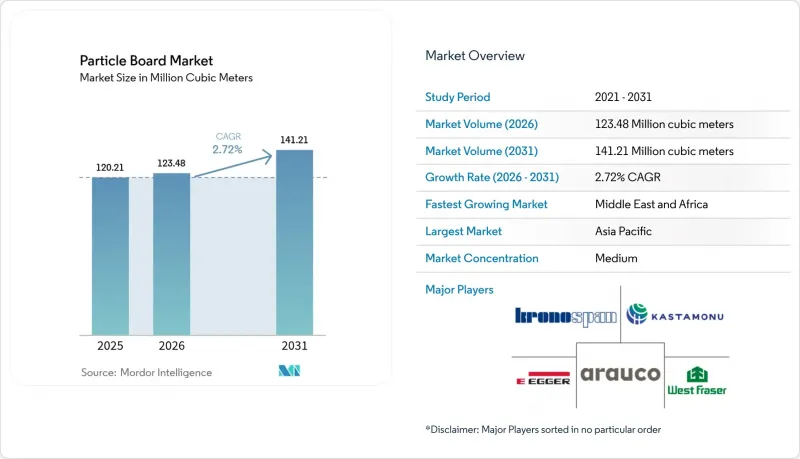
Mordor Intelligence에 의하면, 파티클 보드 시장 규모는 2025년 1억 2,021만 입방미터로 평가되었습니다. 2026년에는 1억 2,348만 입방미터로 확대되어 2031년까지 1억 4,121만 입방미터에 달하고 2026-2031년에 걸쳐 CAGR 2.72%를 나타낼 것으로 예측됩니다.

본 보고서는 원료별(목재 잔재, 바가스, 기타 원료), 용도별(가구, 건설, 인프라, 기타 용도), 지역별(아시아태평양, 북미, 유럽, 남미, 중동 및 아프리카)로 분류되어 있습니다. 시장 전망은 수량(입방미터) 기준으로 제시되어 있습니다.
세계의 파티클 보드 시장 동향 및 인사이트
아시아의 2·3선 도시에서 급속한 도시화로 인한 합리적인 가격의 주택 인테리어 수요 증가
인도, 중국, 동남아시아의 2·3선 도시에서는 인구 유입이 급증하고 있어, 아파트용으로 설계된 합리적인 가격의 인테리어 패널에 대한 수요가 높아지고 있습니다. 인도의 ‘프라단 만트리 아와스 요자나(Pradhan Mantri Awas Yojana)’는 파티클 보드 재질의 캐비닛과 옷장을 중시하며, 합리적인 가격의 주택 보급을 추진하고 있습니다. 중국의 도시화율은 더욱 높아질 것으로 예상되며, 성도(省都)의 가구 보급률은 연안 지역에 비해 뒤처져 있습니다. 중국 제조업체의 이전과 EU-베트남 자유무역협정(FTA)에 따른 관세 우대 조치를 활용함으로써, 베트남의 가구 수출은 전년 대비 대폭 증가했습니다. 이러한 지리적 근접성은 MDF에 비해 배송 비용을 대폭 절감할 뿐만 아니라, 현지 설치를 촉진하는 선순환을 만들어 내어 인근 도시 지역에서의 보급을 가속화하고 있습니다.
비내력 용도에서 MDF·합판에 대한 비용 측면의 우위
파티클 보드는 특히 캐비닛 본체, 선반, 눈에 띄지 않는 표면 등의 용도에서 MDF나 합판에 비해 비용 면에서 우위를 점하고 있습니다. MDF는 제조 과정에서 많은 전력을 소비하지만, 파티클 보드는 에너지 소비량이 적어 상당한 비용 절감으로 이어집니다. 베트남에서는 임금 상승이 매년 급격히 진행되고 있어, 서랍 바닥판이나 뒷판의 재료 선택에 변화가 생기고 있습니다. 고하중 가구 용도에서는 합판이 여전히 주류를 이루고 있지만, 대구경 나사, 금속 인서트, 접착제로 보강된 접합부의 도입으로 인해 합판의 우위는 서서히 약화되고 있습니다. 이러한 변화는 환율이 불안정한 시장에서 특히 두드러지며, 이러한 시장에서는 수입 합판의 가격이 국내산 패널의 원가보다 더 급격하게 변동할 가능성이 있습니다.
수지·메탄올 가격 변동에 따른 생산자 이익률 압박
2024년 중반, 유럽에서는 메탄올 현물 시세가 급등한 후 다시 하락했습니다. 이러한 가격 변동으로 인해 요소-포름알데히드 가격이 상승했고, 일반 제재소 제조업체의 EBITDA 마진이 압박을 받았습니다. 그러나 조지아 퍼시픽(Georgia-Pacific)과 같은 통합형 기업은 자체 생산 화학제품의 흐름을 활용함으로써 그 영향을 상쇄하는 데 성공했습니다. 원료 공급원이 중국, 중동, 미국 멕시코만 연안 지역에 집중되어 있어 지정학적 리스크가 큰 우려 요인으로 대두되고 있으며, 이는 수지 시장의 경제 상황이 본질적으로 불안정함을 시사합니다.
부문별 분석
2025년 원료의 76.25%를 목재 잔여물이 차지해, 물류 측면과 제조 공정에서 확고한 우위를 입증했습니다. 목재 잔여물을 원료로 하는 파티클 보드 시장 규모는 패널 생산량 전체 증가에 따라 확대될 전망이지만, 2031년까지 연평균 성장률(CAGR) 3.42%를 나타낼 것으로 예측되는 바가스에 점차 시장 점유율의 일부를 양보하게 될 것으로 보입니다. 이러한 성장에도 불구하고, 바가스 세계 시장 내 침투율은 제한적인 수준을 유지할 것으로 예측됩니다. 이러한 제약은 계절적인 공급 문제로 인해 공장이 지붕이 있는 저장 시설에 투자하거나 수지의 화학 성분을 변경해야 하는 데 기인합니다.
인도나 브라질에서는 바가스의 도입이 비용 절감을 주된 동력으로 삼고 있으며, 건조 중량 기준 납품 가격은 목재 잔재보다 현저히 낮습니다. 독일과 네덜란드에서는 매립 폐기물 감축 의무화에 힘입어 재생 목재가 파티클 보드 시장에서 상당한 점유율을 차지하고 있습니다.
지역별 분석
아시아태평양은 2025년 소비량의 45.44%를 차지했습니다. 막대한 설비 용량을 자랑하는 중국에서는 부동산 부문의 침체로 인해 국내 수요 증가가 둔화되고 있습니다. 한편, 인도는 2024년에 자원을 활용하여 국내 가구 수요와 수출 계약 모두에 대응했습니다. 아세안(ASEAN)은 무역 협정의 뒷받침을 받아 중국으로부터의 생산 이전을 유치하고 있는 반면, 일본은 고령화로 인한 수요 감소에 직면해 있습니다.
중동 및 아프리카는 2031년 연평균 성장률(CAGR)이 3.71%로 가장 빠르게 성장하고 있는 지역입니다. 이러한 성장은 ‘사우디 비전 2030’에 따른 합리적인 가격의 주택 인테리어 투자에 의해 주도되고 있습니다. 또한, 2024년 남아프리카공화국의 주택 시장 성장도 이 지역의 확장을 뒷받침하고 있습니다.
2025년, 북미는 전 세계 생산량의 상당 부분을 차지했습니다. 미국의 주택 착공 건수가 캐비닛 수요를 끌어올린 반면, 주로 CARB와 EPA의 엄격한 규제로 인해 상당한 공급 부족이 우려되고 있습니다. 한편, 유럽은 독일, 폴란드, 루마니아에 생산 거점을 두고 세계 시장에서 상당한 점유율을 차지했습니다. 그러나 2024년 초, 주로 천연가스 가격 변동으로 인해 이들 지역의 생산이 위축되었습니다. 남미는 세계 시장 점유율이 비교적 작으며, 브라질의 제재소들은 중국산 가격 경쟁력 있는 수입품에 대한 관세 보호를 적극적으로 요구하고 있습니다.
기타 혜택
- 엑셀 형식 시장 예측(ME) 시트
- 3개월간의 애널리스트 지원
자주 묻는 질문
목차
제1장 서론
제2장 조사 방법
제3장 주요 요약
제4장 시장 구도
제5장 시장 규모 및 성장 예측
제6장 경쟁 구도
제7장 시장 기회 및 향후 전망
KTH 26.09.08According to Mordor Intelligence, the particle board market size is expected to increase from 120.21 million cubic meters in 2025 to 123.48 million cubic meters in 2026 and reach 141.21 million cubic meters by 2031, growing at a CAGR of 2.72% over 2026-2031.
This report is Segmented by Raw Material (Wood Residue, Bagasse, and Other Raw Materials), Application (Furniture, Construction, Infrastructure, and Other Applications), and Geography (Asia-Pacific, North America, Europe, South America, and Middle-East and Africa). The Market Forecasts are Provided in Terms of Volume (Cubic Meters).
Global Particle Board Market Trends and Insights
Rapid Urbanization in Tier-2/3 Asian Cities Spurring Affordable Housing Interiors
As second- and third-tier cities in India, China, and Southeast Asia witness a surge in migration, the demand for budget-friendly interior panels, tailored for apartments, is on the rise. India's Pradhan Mantri Awas Yojana is steering the affordable housing narrative, emphasizing particle board cabinetry and wardrobes. China's urbanization rate is expected to grow further, and provincial capitals are trailing coastal areas in furniture penetration. Vietnamese furniture exports, bolstered by manufacturers shifting from China and capitalizing on EU-Vietnam FTA tariff benefits, saw a significant year-on-year surge. This proximity not only slashes delivered costs compared to MDF but also fuels a cycle of local installations, hastening adoption in nearby urban areas.
Cost Advantage vs. MDF and Plywood in Non-Load-Bearing Uses
Particle board boasts a cost advantage over MDF and plywood, particularly in applications like carcass, shelving, and concealed surfaces. While MDF consumes more electricity for production, particle board's lower energy consumption translates to significant savings. In Vietnam, wage inflation has surged annually, prompting a shift in material choices for drawer bottoms and backs. Although plywood continues to dominate in high-load furniture applications, the introduction of larger-diameter screws, metal inserts, and adhesive-reinforced joints is gradually diminishing plywood's stronghold. This shift is particularly pronounced in markets with volatile currencies, where the price of imported plywood can fluctuate more rapidly than domestic panel costs.
Volatile Resin and Methanol Prices Squeezing Producer Margins
In mid-2024, Europe witnessed a surge in methanol spot quotes before retracting. This volatility pushed urea-formaldehyde prices higher and squeezed EBITDA margins at merchant mills. However, integrated firms like Georgia-Pacific managed to absorb the impact, thanks to their captive chemistry streams. With feedstock concentrated in China, the Middle East, and the U.S. Gulf, geopolitical risks loom large, hinting at an inherently unstable resin economic landscape.
Other drivers and restraints analyzed in the detailed report include:
- Stringent Low-Formaldehyde Rules Boosting EU/NA Import Demand
- Sugar-Industry Decarbonization Freeing Up Bagasse Feedstock
- EU Deforestation Regulation Raising Compliance Costs for Asian Mills
For complete list of drivers and restraints, kindly check the Table Of Contents.
Segment Analysis
Wood residue delivered 76.25% of 2025 feedstock, confirming its entrenched logistical and process advantages. While the particle board market size for wood residue-based production is set to grow in tandem with the overall panel output, it will gradually yield a portion of its market share to bagasse, projected to grow at a 3.42% CAGR through 2031. Despite this growth, bagasse's global market penetration is expected to stay limited. This limitation arises as seasonal supply challenges compel mills to invest in covered storage and modify resin chemistry.
In India and Brazil, bagasse's adoption is driven by cost savings, with delivered prices significantly lower than wood residue on a dry-weight basis. In Germany and the Netherlands, recycled wood commands a notable share of the particle board market, bolstered by landfill-diversion mandates.
Complete Report Scope:
- By Raw Material
- Wood Residue
- Bagasse
- Other Raw Materials
- By Application
- Furniture
- Construction
- Infrastructure
- Other Applications
- By Geography
- Asia-Pacific
- China
- India
- Japan
- South Korea
- ASEAN Countries
- Rest of Asia-Pacific
- North America
- United States
- Canada
- Mexico
- Europe
- Germany
- United Kingdom
- France
- Italy
- Russia
- NORDIC Countries
- Rest of Europe
- South America
- Brazil
- Argentina
- Rest of South America
- Middle-East and Africa
- Saudi Arabia
- South Africa
- Rest of Middle-East and Africa
- Asia-Pacific
Geography Analysis
Asia-Pacific represented 45.44% of 2025 consumption. China, boasting substantial installed capacity, faces a slowdown in local uptake due to weaknesses in its property sector. Meanwhile, India utilized resources in 2024, catering to both domestic furniture needs and export contracts. ASEAN nations are attracting production shifts from China, bolstered by trade agreements, whereas Japan grapples with dwindling demand due to its aging demographics.
Middle-East and Africa is the fastest-growing region at 3.71% CAGR to 2031. This growth is fueled by Saudi Vision 2030's investment in affordable housing fit-outs. Additionally, South Africa's residential growth in 2024 lends further credence to the region's expansion.
North America represented a notable portion of global volume in 2025. While U.S. housing starts bolstered cabinet demand, a significant supply gap looms, largely due to stringent CARB and EPA regulations. Europe, on the other hand, contributed a considerable share to the global volume, with production hubs in Germany, Poland, and Romania. However, early 2024 saw output curbed in these regions, primarily due to fluctuations in natural gas prices. South America accounted for a smaller share of the global market, with Brazilian mills actively seeking tariff protections against competitively priced imports from China.
- ARAUCO
- Associate Decor
- Boise Cascade Company
- Century Prowud
- Century Plyboards (India) Ltd
- EGGER
- Georgia-Pacific
- Kastamonu Entegre
- Krifour Industries Pvt. Ltd.
- Kronoplus Limited
- Roseburg Forest Products
- Siam Riso Wood Products Co., Ltd.
- Sonae Arauco
- SWISS KRONO Group
- Timber Products Company
- West Fraser Timber Co.
Additional Benefits:
- The market estimate (ME) sheet in Excel format
- 3 months of analyst support
TABLE OF CONTENTS
1 Introduction
- 1.1 Study Assumptions and Market Definition
- 1.2 Scope of the Study
2 Research Methodology
3 Executive Summary
4 Market Landscape
- 4.1 Market Overview
- 4.2 Market Drivers
- 4.2.1 Rapid urbanisation in tier-2/3 Asian cities spurring affordable housing interiors
- 4.2.2 Cost advantage vs. MDF and plywood in non-load-bearing uses
- 4.2.3 Stringent low-formaldehyde rules boosting EU/NA import demand
- 4.2.4 Sugar-industry decarbonisation freeing up bagasse feedstock
- 4.2.5 AI-driven continuous-press optimisation lifting yields and cut-offs
- 4.3 Market Restraints
- 4.3.1 Volatile resin and methanol prices squeezing producer margins
- 4.3.2 EU Deforestation Regulation raising compliance costs for Asian mills
- 4.3.3 Moisture-related swelling limiting exterior applications
- 4.4 Value Chain Analysis
- 4.5 Porter's Five Forces
- 4.5.1 Bargaining Power of Suppliers
- 4.5.2 Bargaining Power of Buyers
- 4.5.3 Threat of New Entrants
- 4.5.4 Threat of Substitutes
- 4.5.5 Degree of Competition
5 Market Size and Growth Forecasts (Volume)
- 5.1 By Raw Material
- 5.1.1 Wood Residue
- 5.1.2 Bagasse
- 5.1.3 Other Raw Materials
- 5.2 By Application
- 5.2.1 Furniture
- 5.2.2 Construction
- 5.2.3 Infrastructure
- 5.2.4 Other Applications
- 5.3 By Geography
- 5.3.1 Asia-Pacific
- 5.3.1.1 China
- 5.3.1.2 India
- 5.3.1.3 Japan
- 5.3.1.4 South Korea
- 5.3.1.5 ASEAN Countries
- 5.3.1.6 Rest of Asia-Pacific
- 5.3.2 North America
- 5.3.2.1 United States
- 5.3.2.2 Canada
- 5.3.2.3 Mexico
- 5.3.3 Europe
- 5.3.3.1 Germany
- 5.3.3.2 United Kingdom
- 5.3.3.3 France
- 5.3.3.4 Italy
- 5.3.3.5 Russia
- 5.3.3.6 NORDIC Countries
- 5.3.3.7 Rest of Europe
- 5.3.4 South America
- 5.3.4.1 Brazil
- 5.3.4.2 Argentina
- 5.3.4.3 Rest of South America
- 5.3.5 Middle-East and Africa
- 5.3.5.1 Saudi Arabia
- 5.3.5.2 South Africa
- 5.3.5.3 Rest of Middle-East and Africa
- 5.3.1 Asia-Pacific
6 Competitive Landscape
- 6.1 Market Concentration
- 6.2 Strategic Moves
- 6.3 Market Share(%)/Ranking Analysis
- 6.4 Company Profiles (includes Global Overview, Market Overview, Core Segments, Financials, Strategic Information, Products and Services, Recent Developments)
- 6.4.1 ARAUCO
- 6.4.2 Associate Decor
- 6.4.3 Boise Cascade Company
- 6.4.4 Century Prowud
- 6.4.5 Century Plyboards (India) Ltd
- 6.4.6 EGGER
- 6.4.7 Georgia-Pacific
- 6.4.8 Kastamonu Entegre
- 6.4.9 Krifour Industries Pvt. Ltd.
- 6.4.10 Kronoplus Limited
- 6.4.11 Roseburg Forest Products
- 6.4.12 Siam Riso Wood Products Co., Ltd.
- 6.4.13 Sonae Arauco
- 6.4.14 SWISS KRONO Group
- 6.4.15 Timber Products Company
- 6.4.16 West Fraser Timber Co.
7 Market Opportunities and Future Outlook
- 7.1 White-space and Unmet-Need Assessment


