

|
시장보고서
상품코드
2122702
선박용 추진 엔진 : 시장 점유율 분석, 업계 동향 및 통계, 성장 예측(2026-2031년)Marine Propulsion Engine - Market Share Analysis, Industry Trends & Statistics, Growth Forecasts (2026 - 2031) |
||||||
 Mordor Intelligence
Mordor Intelligence에 의하면, 선박용 추진 엔진 시장 규모는 2026년에 396억 9,000만 달러에 달하고, 2031년까지 450억 달러에 이를 것으로 예상되며, 예측 기간(2026-2031년) CAGR 2.54%를 기록할 전망입니다.

본 보고서는 엔진 유형(디젤, 듀얼 연료, 가스 터빈, 기타), 용도(여객, 상업용 화물, 국방), 선박 유형(컨테이너선, 유조선, 벌크선, 기타),연료 유형(중유(HFO), 선박용 디젤유·경유, 기타), 출력 범위(1,000kW 이하, 1,001kW-5,000kW, 기타) 및 지역별로 분류되어 있습니다. 시장 전망은 금액(달러) 기준으로 제시되어 있습니다.
세계의 선박용 추진 엔진 시장 동향 및 인사이트
IMO Tier III·EEXI 준수가 개조를 촉진
특정 시기 이전에 건조된 선박의 선주는 배출 규제 구역 내 질소산화물 배출 제한을 준수하기 위해 SCR 또는 EGR 시스템 설치를 의무화하고 있습니다. 또한, 많은 선주는 운항의 유연성을 높이기 위해 이러한 업그레이드와 함께 듀얼 연료로의 개조도 실시했습니다. 에너지 효율 기존 선박 지수(EEXI)는 선체에 알파벳 등급을 부여하며, 등급이 낮은 선박은 유럽 시장에서 용선료 페널티를 부과받고 있습니다. MAN Energy Solutions의 SCR 장치 개조 수주는 증가하고 있으며, 이는 운임 변동기에 해운사들이 신조선 취항보다 기존 자산의 업그레이드에 주력하고 있음을 반영합니다. ‘FuelEU Maritime’는 온실가스 배출 강도에 대해 더 엄격한 제한을 시행할 예정이며, 이에 따라 유럽 선박 시장은 메탄올이나 암모니아 등의 연료로 전환이 가능한 엔진으로 전환하는 추세가 강화되고 있습니다. 현재의 선급 규정에서는 배기가스 모니터링이 엔진 제어 소프트웨어에 통합되어 있어, 이를 통해 금융 기관 및 보험사에 규정 준수 데이터가 제공되며, 이는 개조 추세에 기여하고 있습니다.
아시아태평양의 컨테이너선·LNG 운반선 신조 붐
중국과 한국의 조선소는 첨단 듀얼 연료 2행정 엔진을 탑재한 대형 선박의 수주에 힘입어 컨테이너선 인도 능력을 확대했습니다. LNG 운반선의 수주 잔고는 카타르의 노스필드 확장 계획 및 미국의 수출 터미널과 관련된 용선 계약에 힘입어 사상 최고 수준에 도달했습니다. 한화오션은 머스크사에 대한 향후 인도를 염두에 두고 설계된 메탄올 대응 모듈에 중점을 두고, 거제 엔진 통합 라인 강화에 막대한 투자를 단행했습니다. 일본 조선소는 암모니아 연료 연안 탱커에 주력하여, 일본 우편선(NYK)에 프로토타입을 성공적으로 인도했습니다. 동북아시아로의 엔진 생산 집중으로 리드타임은 단축되었으나, 미국의 첨단 제어 전자기기 수출 규제가 강화됨에 따라 지정학적 리스크도 높아지고 있습니다.
연료 가격 변동에 따른 엔진 선정의 복잡화
선박용 경유 가격은 큰 변동을 보이며, 듀얼 연료의 투자 회수 모델에 과제를 안겨주었습니다. 주요 시장의 LNG 벙커링 비용은 많은 LNG 수주를 뒷받침했던 예상 비용 절감 효과를 상쇄해 버렸습니다. 메탄올 가격은 공급 부족과 화학·해운 산업 수요 증가를 배경으로 일부 지역에서 대폭 상승했습니다. LNG 가격의 불리한 상황으로 인해 일부 듀얼 연료 선박은 연료유만으로 운항하는 방식으로 전환되었습니다. 메탄올 및 암모니아에 대한 헤지 수단이 제한적이었기 때문에 운항사는 계약 체결부터 인도까지의 기간 동안 가격 변동 위험에 노출될 수밖에 없었습니다.
부문별 분석
2025년, 선박용 추진 엔진 시장에서 디젤 엔진의 점유율은 66.12%를 차지했습니다. 이는 주로 디젤 엔진 운용에 대한 익숙함과 광범위한 부품 공급망 덕분입니다. 과거에는 순수 디젤 엔진에 배정되던 수주가 듀얼 연료 엔진으로 이동함에 따라, 디젤 엔진의 우위는 점차 후퇴하고 있습니다. 한때 군용 함정 전용으로 여겨졌던 가스 터빈이 하이브리드 구성으로 상용 설계에 재등장하고 있으며, 이 구성에서는 때때로 발생하는 고속 항해 요구에 대응하기 위해 터빈이 순항용 디젤 엔진을 보완합니다. 배터리와 중속 발전기를 통합한 하이브리드 전기 아키텍처는 항만에서의 배기 가스 배출을 줄여야 하는 유럽의 페리에서 보급이 확대되었습니다.
연료전지 패키지는 아직 발전 단계에 있지만, 유럽 페리에서의 실증 실험과 발라드(Ballard)사의 5만 가동 시간이라는 이정표를 배경으로 2031년 연평균 성장률(CAGR) 2.76%라는 가장 빠른 성장세를 기록했습니다. DNV와 로이드 레지스터가 연료전지와 암모니아에 관한 지침을 공표함에 따라 규제가 명확해지고 있습니다. 예측 가능한 항로를 가진 컨테이너 선단은 불규칙 항로에서 운항되는 벌크선보다 듀얼 연료로의 전환을 신속하게 진행하는 경향이 있습니다. 원자력 추진은 여전히 해군 전용이며, 상업 주기의 영향을 받지 않는 틈새 수요를 유지하고 있습니다. 전반적으로, 연료에 의존하지 않는 모듈식 엔진이 선박용 추진 엔진 시장에서 미래 수익의 ‘최적 지점’이 될 것으로 보입니다.
2025년, 상선 화물 운송은 선박 추진 엔진 시장 점유율의 57.37%를 차지했으며, 이는 화물 운송량의 많음과 연료 비용 경쟁의 치열함을 반영합니다. 화물 운항 사업자들은 열효율과 연료 선택의 폭을 중시하고 있으며, 그 결과 컨테이너선과 LNG 운반선에서 듀얼 연료식 2행정 엔진의 채택이 확대되고 있습니다. 2.41%의 성장률을 보이는 여객선 역시 환경 의식이 높은 여행객을 유치하기 위해 저배출 성능 추구를 추진하고 있습니다. 크루즈 선사는 항만에서의 배출량을 대폭 줄여주는 배터리 및 육상 전원 연결 시스템을 도입하고 있으며, 진동 저감형 크랭크샤프트를 통해 항해 중 승객의 쾌적함을 보장하고 있습니다. 국방 및 해안경비대의 조달에는 이중화 및 최고 속도와 같은 독자적인 기준이 적용되며, 설계가 선정되면 수년에 걸친 엔진 계약이 체결됩니다.
화물선에서 냉동 압축기를 구동하는 동력 인출 장치는 보조 발전기의 연료 소비량을 15% 줄여 즉각적인 비용 절감 효과를 가져오고 있습니다. 노르웨이의 근해 페리는 완전한 배터리 전기 추진 방식으로 운항되며, 1시간 미만의 항로에서 실용성을 입증하고 있습니다. 화물 운항 사업자는 연료비를 더욱 절감하기 위해 디지털 트윈을 활용한 스케줄링을 도입하고 있는 반면, 여객선 회사는 하이브리드 기능을 브랜드 차별화의 요소로 내세우고 있습니다. 해군 플랫폼에는 효율성과 전투 생존성을 모두 확보하기 위해 CODAD와 CODAG의 조합이 적용되어 있으며, 이를 통해 선박용 추진 엔진 산업 수요 안정성이 강화되고 있습니다.
지역별 분석
2025년, 아시아태평양은 43.36%의 점유율로 선박 추진 엔진 시장을 주도했습니다. 중국 조선소는 전 세계 총 톤수 인도량의 거의 절반을 공급했으며, 한국 조선사는 고부가가치 컨테이너선 및 LNG선 틈새 시장을 독점했습니다. 일본이 암모니아 대응 추진 시스템으로의 전환을 추진하고 있는 것은 해당 지역이 탄소 중립 부문에서 리더십을 추구하고 있음을 나타내는 반면, 인도의 방위 조선 프로그램은 디젤과 가스 터빈 엔진을 결합한 CODAG에 대한 수요를 뒷받침하고 있습니다. 남중국해에서의 탐사 활동이 활발해지는 가운데, 동남아시아 조선소들은 해양 지원선의 미수주 물량을 소화하고 있습니다. 수직 통합을 통해 현대중공업 엔진·머시너리는 자사 조선 라인에 엔진을 공급할 수 있게 되었으며, 이를 통해 납기 기간을 단축하고 이익률을 확보하고 있습니다.
2031년까지 연평균 성장률(CAGR) 3.37%를 나타낼 것으로 예측되는 중동은 사우디아라비아와 아랍에미리트의 정부계 자본이 신규 액화 플랜트에서 생산된 LNG를 수송하는 LNG 운반선에 주력하고 있는 데서 혜택을 보고 있습니다. 사우디 아람코(Saudi Aramco)의 장기 용선 계약에 따라, 2만 5,000kW를 초과하는 듀얼 연료식 2행정 엔진을 탑재한 선박 20-30척이 필요할 가능성이 있습니다. 아부다비는 항만 내 배출량을 줄이기 위해 하이브리드 전기식 항만 작업선에 투자하고 있습니다. 튀르키예의 조선소는 유럽 경쟁사보다 20% 낮은 견적 가격을 제시하여 해양 지원선 수주를 확보하고 있지만, 여전히 Tier III 엔진은 유럽 및 미국의 OEM에서 조달하고 있습니다. 지역 수요는 브렌트유 가격 동향과 밀접한 관련이 있으며, 60달러대로의 하락은 심해 프로젝트 계약을 연기시킬 가능성이 있습니다.
2025년, 유럽은 큰 점유율을 차지했습니다. 이는 노르웨이의 해상 풍력 발전 지원선에 대한 수요와, 티어 III 디젤 엔진 채택이 의무화된 독일 해군 프리깃함 계획에 힘입은 결과입니다. ‘FuelEU Maritime’는 온실가스 배출 제한을 매년 강화하고 있어, 유럽 선주들은 듀얼 연료 또는 하이브리드 동력으로의 전환을 강요받고 있습니다. 그렇지 않을 경우, 2031년까지 선박 1척당 최대 100만 유로의 벌금이 부과될 것입니다.
북미의 엔진 수요는 미 해군의 신조 프리깃함과 알래스카 어선단에서 비롯되었으며, 외딴 지역의 항만 서비스 네트워크에서는 커민즈와 캐터필러의 엔진이 주류를 이루고 있습니다. 남미와 아프리카는 여전히 규모는 작지만 전략적인 시장입니다. 브라질의 FPSO(부유식 생산·저장·하역 설비) 확장을 위해서는 중속 발전 세트가 필요하며, 나이지리아의 연안 운송에서는 노후화된 엔진이 가동되고 있지만, 자금 조달이 가능해지면 Tier III로 개조할 수 있는 좋은 기회가 될 것입니다.
기타 혜택
- 엑셀 형식 시장 예측(ME) 시트
- 3개월간의 애널리스트 지원
자주 묻는 질문
목차
제1장 서론
제2장 조사 방법
제3장 주요 요약
제4장 시장 구도
제5장 시장 규모 및 성장 예측
제6장 경쟁 구도
제7장 시장 기회 및 향후 전망
KTH 26.09.08According to Mordor Intelligence, the marine propulsion engine market size stood at USD 39.69 billion in 2026 and is projected to reach USD 45 billion by 2031, registering a 2.54% CAGR over the forecast period (2026-2031).
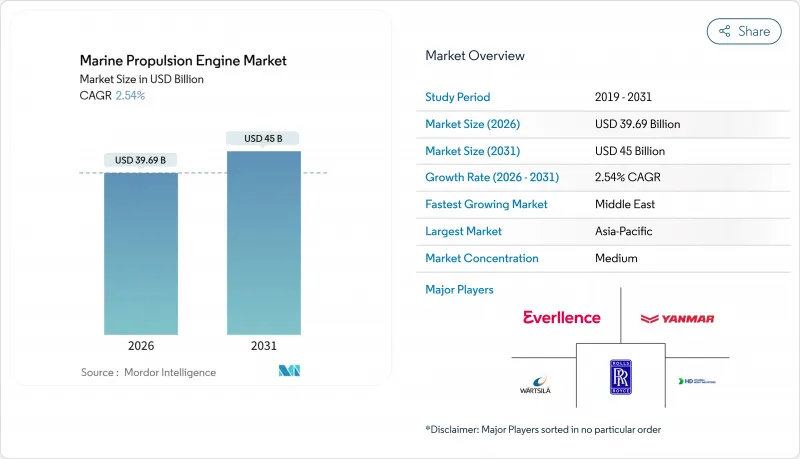
This report is Segmented by Engine Type (Diesel, Dual-Fuel, Gas Turbine, and More), Application (Passenger, Commercial Cargo, and Defense), Ship Type (Container Ship, Tanker, Bulk Carrier, and More), Fuel Type (Heavy Fuel Oil (HFO), Marine Diesel/Gas Oil, and More), Power Range (Up To 1, 000 KW, 1, 001 KW To 5, 000 KW, and More) and Geography. The Market Forecasts are Provided in Terms of Value (USD).
Global Marine Propulsion Engine Market Trends and Insights
IMO Tier III and EEXI Compliance Push Retrofits
Owners of vessels built before a specific period are required to install SCR or EGR systems to comply with nitrogen-oxide limits in emission-control zones. Many owners are also implementing dual-fuel conversions alongside these upgrades to achieve operational flexibility . The Energy Efficiency Existing Ship Index assigns letter grades to ship hulls, and vessels with lower grades have faced charter penalties in European markets. Retrofit orders for SCR units have increased at MAN Energy Solutions, reflecting carriers' focus on upgrading existing assets rather than commissioning new builds during freight rate fluctuations. FuelEU Maritime will enforce stricter limits on greenhouse-gas intensity, driving European-bound tonnage toward engines capable of transitioning to fuels like methanol or ammonia . Current classification regulations integrate emissions monitoring into engine control software, providing financiers and insurers with compliance data and contributing to the trend of retrofitting.
Asia-Pacific Container and LNG New-Build Boom
Chinese and South Korean shipyards increased container capacity deliveries, driven by orders for large vessels equipped with advanced dual-fuel two-stroke engines. LNG carrier orderbooks reached new heights, supported by charter commitments tied to Qatar's North Field expansion and export terminals in the United States. Hanwha Ocean invested significantly to enhance its Geoje engine-integration line, focusing on methanol-ready modules designed for future deliveries to Maersk. Japanese shipyards shifted their focus to ammonia-fueled coastal tankers, successfully delivering the prototype to Nippon Yusen. While the concentration of engine production in Northeast Asia has reduced lead times, it has also heightened geopolitical risks due to tighter export restrictions on advanced control electronics from the United States.
Fuel-Price Volatility Complicates Engine Choice
Marine gas oil prices experienced significant fluctuations, creating challenges for dual-fuel payback models. LNG bunker costs in key markets negated the anticipated savings that had driven many LNG orders. Methanol prices increased substantially in certain regions, driven by tight supply and rising demand from the chemical and shipping industries . A portion of dual-fuel vessels shifted to operating exclusively on fuel oil due to unfavorable LNG pricing. Limited availability of hedging tools for methanol or ammonia left operators exposed to price volatility during the period between contract signing and delivery.
Other drivers and restraints analyzed in the detailed report include:
- LNG/Methanol Dual-Fuel Uptake
- Port-Entry Zero-Emission Zones
- High Capex for SCR/EGR After-Treatment
For complete list of drivers and restraints, kindly check the Table Of Contents.
Segment Analysis
Diesel engines accounted for 66.12% of the marine propulsion engine market share in 2025, primarily due to their familiarity with service and a widespread network of parts. Leadership is eroding at the margins as dual-fuel engines take orders that were once committed to straight diesel engines. Gas turbines once reserved for naval craft are re-entering commercial designs in hybrid pairings, where a turbine supplements cruise diesels for occasional high-speed needs. Hybrid-electric architectures integrating batteries with medium-speed gensets gained ground in European ferries that must cut port-side emissions.
Fuel-cell packages, though embryonic, posted the fastest climb at a 2.76% CAGR through 2031 on the back of European ferry pilots and Ballard's 50,000 operating hours milestone. Regulatory clarity is improving, as DNV and Lloyd's Register have published guidelines for fuel cells and ammonia. Container fleets with predictable routes tend to convert to dual-fuel more quickly than bulk carriers that operate on tramp schedules. Nuclear propulsion remains strictly naval, sustaining niche demand that is insulated from commercial cycles. Overall, fuel-agnostic modular engines are the future revenue sweet spot for the marine propulsion engine market.
Commercial cargo accounted for 57.37% of the marine propulsion engine market share in 2025, reflecting the volume of commodities and competitive fuel-cost pressures. Cargo operators prioritize thermal efficiency and bunker optionality, resulting in a higher uptake of dual-fuel two-stroke engines on container and LNG carriers. Passenger vessels, which are growing at a rate of 2.41%, are also chasing low-emission credentials to attract environmentally conscious travelers. Cruise lines integrate batteries and shore-power interfaces that slash in-port emissions, and vibration-damped crankshafts protect guest comfort at sea. Defense and coast-guard procurement follows distinct criteria, such as redundancy and sprint speed, locking in multi-year engine contracts once a design is selected.
Power-takeoff arrangements that drive reefer compressors on cargo ships reduce auxiliary generator fuel consumption by 15%, providing a quick savings win. Short-sea ferries in Norway operate on fully battery-electric propulsion, demonstrating viability for crossings under one hour. Cargo operators adopt digital-twin scheduling to further reduce fuel costs, whereas passenger lines market hybrid capability as a brand differentiator. Naval platforms embed CODAD and CODAG combinations to deliver both efficiency and combat survivability, bolstering demand stability within the marine propulsion engine industry.
Complete Report Scope:
- By Engine Type
- Diesel
- Dual-Fuel (LNG, Methanol, Ammonia ready)
- Gas Turbine
- Hybrid-Electric
- Fuel-Cell
- Nuclear (Naval)
- By Application
- Passenger
- Commercial Cargo
- Defense / Coast Guard
- By Ship Type
- Container Ship
- Tanker
- Bulk Carrier
- Offshore Support Vessel
- Naval Ship
- Passenger / Cruise
- By Fuel Type
- Heavy Fuel Oil (HFO)
- Marine Diesel/Gas Oil
- Liquefied Natural Gas (LNG)
- Methanol
- Ammonia/Hydrogen
- By Power Range (kW)
- Up to 1,000 kW
- 1,001 kW to 5,000 kW
- 5,001 kW to 10,000 kW
- 10,001 kW to 20,000 kW
- Above 20,000 kW
- By Geography
- North America
- United States
- Canada
- Rest of North America
- South America
- Brazil
- Argentina
- Rest of South America
- Europe
- Germany
- United Kingdom
- France
- Spain
- Russia
- Rest of Europe
- Asia Pacific
- China
- Japan
- South Korea
- India
- Rest of Asia Pacific
- Middle East and Africa
- Saudi Arabia
- United Arab Emirates
- Turkey
- South Africa
- Nigeria
- Rest of Middle East and Africa
- North America
Geography Analysis
The Asia-Pacific region led the marine propulsion engine market with a 43.36% share in 2025. Chinese yards supplied nearly half of global deadweight deliveries, and South Korean builders dominated the high-value container and LNG niches. Japan's pivot toward ammonia-ready propulsion underscores the region's push for zero-carbon leadership, while India's defense shipbuilding programs bolster CODAG demand for combined diesel and gas-turbine engines. Southeast Asian yards fill offshore support vessel backlogs as exploration intensifies in the South China Sea. Vertical integration enables Hyundai Heavy Industries Engine & Machinery to supply its own shipbuilding lines, thereby compressing delivery times and securing margins.
The Middle East, forecasted to grow at a 3.37% CAGR through 2031, benefits from Saudi and Emirati sovereign capital targeting LNG carriers that will transport volumes from new liquefaction trains. Saudi Aramco's long-term charters could require 20-30 hulls with dual-fuel two-stroke engines above 25,000 kW. Abu Dhabi invests in hybrid-electric harbor craft to cut port emissions. Turkish yards capture offshore support orders by offering cost quotes 20% lower than those of European competitors, although they still source Tier III engines from Western OEMs. Regional demand remains closely tied to Brent crude trajectories, as a slide toward USD 60 may defer deepwater commitments.
Europe held a significant share in 2025, driven by Norway's demand for offshore wind support vessels and Germany's naval frigate programs, which specify Tier III diesels. FuelEU Maritime tightens greenhouse-gas limits annually, pushing European owners toward dual-fuel or hybrid power, or face fines of up to one million euros per hull by 2031.
North America's engine demand stems from the United States Navy's new frigates and Alaskan fishing fleets, where Cummins and Caterpillar engines dominate remote-port service networks. South America and Africa remain smaller but strategic markets. Brazil's FPSO expansions require medium-speed gensets, and Nigerian coastal shipping operates aging engines that are ripe for Tier III retrofits when financing becomes available.
- MAN Energy Solutions (Everllence)
- Rolls-Royce plc
- Wartsila Corporation
- Caterpillar Inc.
- HD Hyundai Heavy Industries Co., Ltd.
- Cummins Inc.
- Mitsubishi Heavy Industries Marine Machinery and Equipment Co., Ltd
- DAIHATSU INFINEARTH MFG. CO., LTD.
- YANMAR HOLDINGS CO., LTD
- General Electric Company
- Kawasaki Heavy Industries Ltd.
- ABB Ltd.
- Siemens Energy Marine
- Doosan Corporation
- STX Engine Co., Ltd.
- Weichai Heavy-Duty Engine
- Jiangsu CSSC Diesel
- Scania AB
Additional Benefits:
- The market estimate (ME) sheet in Excel format
- 3 months of analyst support
TABLE OF CONTENTS
1 Introduction
- 1.1 Study Assumptions and Market Definition
- 1.2 Scope of the Study
2 Research Methodology
3 Executive Summary
4 Market Landscape
- 4.1 Market Overview
- 4.2 Market Drivers
- 4.2.1 IMO Tier III and EEXI Mandates Accelerate Engine Retrofits
- 4.2.2 Surge in Asia-Pacific New-Build Orders for Container and LNG Carriers
- 4.2.3 Rapid Uptake of LNG / Methanol Dual-Fuel Designs
- 4.2.4 Port-Entry Zero-Emission Auxiliary Propulsion Zones
- 4.2.5 Digital-Twin Predictive-Maintenance Lowers Total Cost of Ownership
- 4.2.6 Defense CODAD / CODAG Procurement Boom
- 4.3 Market Restraints
- 4.3.1 Fuel-Price Volatility Complicates Engine Selection
- 4.3.2 High Capex For SCR, EGR and After-Treatment Systems
- 4.3.3 Limited Green-Methanol / Ammonia Bunkering Network
- 4.3.4 Rare-Earth Magnet Supply Risk for Electric Motors
- 4.4 Value-Chain Analysis
- 4.5 Regulatory Landscape
- 4.6 Technological Outlook
- 4.7 Porter's Five Forces
- 4.7.1 Bargaining Power of Suppliers
- 4.7.2 Bargaining Power of Buyers
- 4.7.3 Threat of New Entrants
- 4.7.4 Threat of Substitutes
- 4.7.5 Competitive Rivalry
5 Market Size and Growth Forecasts (Value (USD))
- 5.1 By Engine Type
- 5.1.1 Diesel
- 5.1.2 Dual-Fuel (LNG, Methanol, Ammonia ready)
- 5.1.3 Gas Turbine
- 5.1.4 Hybrid-Electric
- 5.1.5 Fuel-Cell
- 5.1.6 Nuclear (Naval)
- 5.2 By Application
- 5.2.1 Passenger
- 5.2.2 Commercial Cargo
- 5.2.3 Defense / Coast Guard
- 5.3 By Ship Type
- 5.3.1 Container Ship
- 5.3.2 Tanker
- 5.3.3 Bulk Carrier
- 5.3.4 Offshore Support Vessel
- 5.3.5 Naval Ship
- 5.3.6 Passenger / Cruise
- 5.4 By Fuel Type
- 5.4.1 Heavy Fuel Oil (HFO)
- 5.4.2 Marine Diesel/Gas Oil
- 5.4.3 Liquefied Natural Gas (LNG)
- 5.4.4 Methanol
- 5.4.5 Ammonia/Hydrogen
- 5.5 By Power Range (kW)
- 5.5.1 Up to 1,000 kW
- 5.5.2 1,001 kW to 5,000 kW
- 5.5.3 5,001 kW to 10,000 kW
- 5.5.4 10,001 kW to 20,000 kW
- 5.5.5 Above 20,000 kW
- 5.6 By Geography
- 5.6.1 North America
- 5.6.1.1 United States
- 5.6.1.2 Canada
- 5.6.1.3 Rest of North America
- 5.6.2 South America
- 5.6.2.1 Brazil
- 5.6.2.2 Argentina
- 5.6.2.3 Rest of South America
- 5.6.3 Europe
- 5.6.3.1 Germany
- 5.6.3.2 United Kingdom
- 5.6.3.3 France
- 5.6.3.4 Spain
- 5.6.3.5 Russia
- 5.6.3.6 Rest of Europe
- 5.6.4 Asia Pacific
- 5.6.4.1 China
- 5.6.4.2 Japan
- 5.6.4.3 South Korea
- 5.6.4.4 India
- 5.6.4.5 Rest of Asia Pacific
- 5.6.5 Middle East and Africa
- 5.6.5.1 Saudi Arabia
- 5.6.5.2 United Arab Emirates
- 5.6.5.3 Turkey
- 5.6.5.4 South Africa
- 5.6.5.5 Nigeria
- 5.6.5.6 Rest of Middle East and Africa
- 5.6.1 North America
6 Competitive Landscape
- 6.1 Market Concentration
- 6.2 Strategic Moves
- 6.3 Market Share Analysis
- 6.4 Company Profiles (Includes Global Level Overview, Market Level Overview, Core Segments, Financials as Available, Strategic Information, Market Rank/Share for Key Companies, Products and Services, SWOT Analysis, and Recent Developments)
- 6.4.1 MAN Energy Solutions (Everllence)
- 6.4.2 Rolls-Royce plc
- 6.4.3 Wartsila Corporation
- 6.4.4 Caterpillar Inc.
- 6.4.5 HD Hyundai Heavy Industries Co., Ltd.
- 6.4.6 Cummins Inc.
- 6.4.7 Mitsubishi Heavy Industries Marine Machinery and Equipment Co., Ltd
- 6.4.8 DAIHATSU INFINEARTH MFG. CO., LTD.
- 6.4.9 YANMAR HOLDINGS CO., LTD
- 6.4.10 General Electric Company
- 6.4.11 Kawasaki Heavy Industries Ltd.
- 6.4.12 ABB Ltd.
- 6.4.13 Siemens Energy Marine
- 6.4.14 Doosan Corporation
- 6.4.15 STX Engine Co., Ltd.
- 6.4.16 Weichai Heavy-Duty Engine
- 6.4.17 Jiangsu CSSC Diesel
- 6.4.18 Scania AB
7 Market Opportunities & Future Outlook
- 7.1 White-Space & Unmet-Need Assessment


