|
시장보고서
상품코드
2122713
바이오리액터 : 시장 점유율 분석, 업계 동향 및 통계, 성장 예측(2026-2031년)Bioreactor - Market Share Analysis, Industry Trends & Statistics, Growth Forecasts (2026 - 2031) |
||||||
 Mordor Intelligence
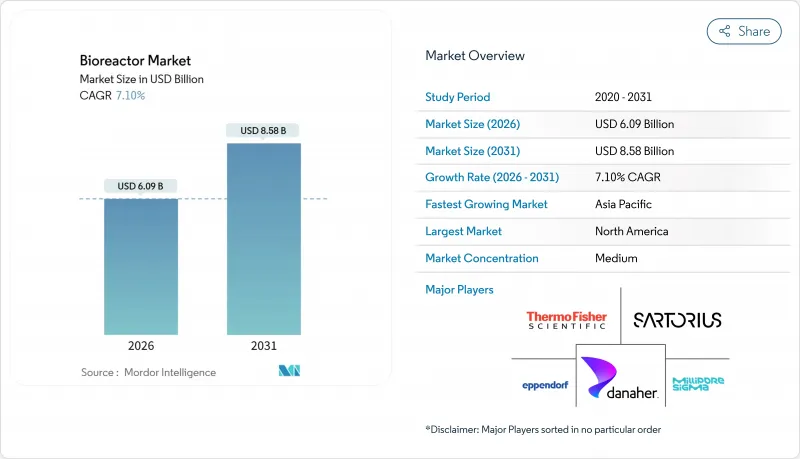
Mordor Intelligence에 의하면, 바이오리액터 시장 규모는 2026년에 60억 9,000만 달러로 추정되고 예측 기간(2026-2031년) CAGR 7.10%로 성장을 지속하여, 2031년까지 85억 8,000만 달러에 이를 전망입니다.

본 보고서는 유형별(유리, 기타), 용도별(실험실 규모 생산, 파일럿 규모 생산, 유틸리티 규모 생산), 용량별(5L-20L, 20L-200L, 200L-1,500L, 1,500L 초과),제어 유형(수동, 자동), 바이오프로세스(배치, 기타), 용도(의약품·바이오의약품 제조, 기타), 최종 사용자(바이오의약품·제약 기업, 기타), 지역(북미, 유럽, 기타)별로 분류되어 있습니다. 시장 전망은 금액(달러)으로 제시되어 있습니다.
세계의 바이오리액터 시장 동향 및 인사이트
확대되는 세포 및 유전자 치료제 제조 파이프라인
자가 CAR-T 치료나 동종 이식 치료용 분산형 제조 모델에서는 중앙 집중식 초대형 플랜트보다 설치 면적이 작은 설비가 선호됩니다. AGC Biologics는 2,000리터 용량의 일회용 용기를 갖춘 요코하마 거점에 3억 5,000만 달러를 투자하는 한편, 코펜하겐 캠퍼스에서는 2026년 가동을 예정하고 있는 16기의 유사한 유닛을 통해 생산 능력을 두 배로 늘렸습니다. Fujifilm 디오신 바이오테크놀러지스는 노스캐롤라이나주에서의 확장에 12억 미 달러를 투자하고 있으며, 바이러스 벡터 및 mRNA 프로그램을 위해 2만 리터 규모의 리액터를 활용할 예정입니다. AstraZeneca는 2025년에 메릴랜드주에 3억 달러 규모의 시설을 개설하여, 임상용 및 상용 세포 치료제 생산을 단일 거점으로 통합함으로써 기술 이전 주기를 가속화하고 있습니다. 이러한 움직임은 지적 재산권과 이익률을 보호하기 위해 전략적 생산 능력을 자체적으로 보유하는 방향으로의 전환을 나타내며, 바이오프로세스 엔지니어와 일회용 소모품을 둘러싼 경쟁을 심화시키고 있습니다. 그 결과, 바이오리액터 시장은 대규모 토목 공사가 필요 없이 전 세계 거점에서 복제 가능한, 모듈식이며 신속하게 도입 가능한 시스템으로 전환되고 있습니다.
일회용 바이오리액터 기술의 보급 확대
일회용 플랫폼은 이미 파일럿 단계의 도입 단계를 넘어, 현재는 초기 단계의 상업 생산에서 주류를 이루고 있습니다. Thermo Fisher Scientific은 2025년에 ‘HyPerforma DynaDrive 2.0’을 출시하여 전단 응력을 25% 저감하는 동시에 1억 cells/mL를 초과하는 세포 밀도에서 퍼퓨전을 실현했습니다. 이에 이어 살트리아스(Sartorius)는 ‘Biostat STR Generation 3’를 발표했습니다. 이 시스템에는 광학식 용존 산소(DO) 센서와 자동 pH 제어 기능이 통합되어 있어, 배치별 수동 교정에 소요되는 4시간을 단축했습니다. 규모의 한계는 계속해서 확대되고 있습니다. AGC Biologics는 5,000리터 규모의 일회용 생산을 계획하고 있으며, 과거에는 스테인리스 스틸 바이오리액터에서만 실현 가능하다고 여겨졌던 한계를 넓혀가고 있습니다. 생명주기평가(LCA)에 따르면, 재사용형 시스템은 일회용 시스템에 비해 플라스틱 폐기물을 3-5분의 1로 줄일 수 있는 것으로 밝혀졌으며, Cytiva나 Sartorius와 같은 공급업체들은 사용 후 필름과 튜브를 회수하여 GMP 적용 대상이 아닌 용도로 재활용하는 회수 프로그램을 시작하고 있습니다. 이러한 동향으로 인해 2026년에 바이오리액터 시장의 성장세가 주춤하지 않으면서도 지속가능성에 대한 관심이 유지되고 있습니다.
의료용 플라스틱 폴리머 공급망의 변동
2021년부터 2023년에 걸쳐 폴리에틸렌과 에틸렌-비닐 아세테이트 수지의 가격이 40%-60% 급등했으나, 2024년에는 안정화되었음에도 여전히 팬데믹 이전 수준보다 25% 높은 상태이며,일회용 어셈블리의 이익률을 압박하고 있습니다. 맞춤형 소모품의 리드타임은 2019년 12주에서 2024년에는 26주로 연장되어, CDMO 각사는 6개월 분의 안전 재고를 확보할 수밖에 없게 되었고, 운전자금이 묶여 있습니다. EU의 ‘일회용 플라스틱 지침’은 의료기기를 적용 대상에서 제외하고 있지만, 그럼에도 바이오프로세스 공급업체들에게 재활용 체계 구축을 요구하고 있습니다. Cytiva는 2025년, 사용 후 백을 회수하여 기계적 재생 처리를 위한 유럽용 회수 프로그램을 시작했습니다. 소규모 제조업체는 수지 공급업체와의 협상력이 부족하여, 대형 CDMO가 유리한 조건을 확보하는 양극화된 시장이 형성되고 있습니다. 한편, 중견 기업들은 생산 능력 확대 계획을 미루고 있어, 단기적으로는 바이오리액터 시장의 성장을 둔화시키고 있습니다.
지역별 분석
북미는 2025년 매출의 43.00%를 차지했으며, 이는 ‘프로젝트 넥스트젠(Project NextGen)’을 통한 50억 달러 규모의 자금 조달과 CDMO의 높은 집중도에 힘입은 결과입니다. 서모피셔의 6억 6,000만 달러 규모 매사추세츠주 확장 계획과 론자의 10억 달러 규모 뉴햄프셔주 프로젝트는 이 지역이 스테인리스 스틸 및 일회용 처리 능력 모두에 주력하고 있음을 보여줍니다. 캐나다의 16억 달러 규모의 ‘생명과학 전략’은 토론토와 몬트리올에 1,500리터급 하이브리드 라인에 자금을 지원함으로써 국경 간 의존도를 낮추었습니다. 보스턴과 샌프란시스코의 풍부한 인재 풀이 혁신을 뒷받침하고 있는 반면, 높은 인건비와 긴 허가 절차로 인해 일부 기업들은 해외의 더 우호적인 관할 구역으로의 확장을 추진하고 있습니다.
아시아태평양은 2031년 연평균 성장률(CAGR)이 8.30%로 가장 빠르게 성장하고 있는 지역입니다. 삼성바이오로직스의 23억 달러 규모 ‘바이오캠퍼스 4’는 한국에서 25만 6,000리터의 생산 능력을 제공하며, 한국을 EU 및 미국 시장을 겨냥한 바이오시밀러 거점으로 자리매김하고 있습니다. 우시 바이오로직스는 포유류와 미생물 발효를 결합한 18억 달러 규모의 시설 건설지로 싱가포르를 선정했습니다. 이는 이 도시 국가가 제공하는 적극적인 우대 조치를 반영한 것입니다. AGC 바이오로직스의 3억 5,000만 달러 규모의 요코하마 프로젝트는 국내 세포 치료제 생산 능력 확충에 초점을 맞추고 있는 반면, 인도의 바이오콘(Biocon)과 닥터 레디스(Doctor Reddy’s)는 규제상의 역풍에도 불구하고 대규모 항체 개발을 목표로 하고 있습니다.
유럽은 복잡한 규제가 있음에도 불구하고 여전히 견조한 시장을 보이고 있습니다. 독일, 스위스, 아일랜드는 2024년부터 2025년에 걸쳐 30억 달러 규모의 투자 확약을 확보했습니다. 베링거 인겔하임은 비베라흐에 1만 5,000리터 규모의 반응기 4기를 설치하기 위해 5억 유로를 투자하고 있습니다. 써모피셔사가 7억 8,000만 유로를 투자하는 코크 공장에서는 일회용 부품 제조 외에도 세포 치료 전용 시설이 구축되었으며, 아일랜드의 유리한 세제 혜택을 받고 있습니다. 영국이 모더나사와 mRNA 공급에 관해 5억 2,000만 파운드의 계약을 체결한 것은 정부가 생산 능력 확보에 적극적으로 나서고 있음을 보여줍니다. 한편, 사우디아라비아와 브라질은 국가 자급자족 전략의 일환으로 소규모 프로젝트를 계획하고 있으며, 2027년 이후 바이오리액터 시장에 기여할 것으로 기대됩니다.
기타 혜택
- 엑셀 형식 시장 예측(ME) 시트
- 3개월간의 애널리스트 지원
자주 묻는 질문
목차
제1장 서론
제2장 조사 방법
제3장 주요 요약
제4장 시장 구도
제5장 시장 규모 및 성장 예측
제6장 경쟁 구도
제7장 시장 기회 및 향후 전망
KTH 26.09.08According to Mordor Intelligence, the bioreactor market size is estimated at USD 6.09 billion in 2026, and is expected to reach USD 8.58 billion by 2031, at a CAGR of 7.10% during the forecast period (2026-2031).
This report is Segmented by Type (Glass, and More), Usage (Lab-Scale, Pilot-Scale, and Full-Scale), Scale (5L-20L, 20L-200L, 200L-1, 500L, and Above 1, 500L), Control Type (Manual and Automated), Bioprocess (Batch, and More), Application (Pharmaceutical & Biopharmaceutical, and More), End User (Biopharma, and More), and Geography (North America, Europe, and More). Market Forecasts are Provided in Value (USD).
Global Bioreactor Market Trends and Insights
Expanding Cell & Gene Therapy Manufacturing Pipelines
Distributed manufacturing models for autologous CAR-T and allogeneic therapies favor smaller-footprint equipment over centralized mega plants. AGC Biologics has earmarked USD 350 million for a Yokohama site featuring 2,000-liter single-use vessels, while its Copenhagen campus doubled capacity with 16 similar units scheduled for 2026 start-up. Fujifilm Diosynth Biotechnologies is investing USD 1.2 billion in a North Carolina expansion that will utilize 20,000-liter reactors for viral-vector and mRNA programs. AstraZeneca opened a USD 300 million facility in Maryland in 2025 to co-locate clinical and commercial cell therapy production, thereby accelerating technology transfer cycles. These moves show a shift toward owning strategic capacity to protect intellectual property and margins, increasing competition for bioprocess engineers and single-use consumables. As a result, the bioreactor market is moving toward modular, rapidly deployable suites that can be replicated across global sites without extensive civil construction.
Growing Adoption of Single-Use Bioreactor Technology
Single-use platforms have surpassed pilot adoption and now dominate early-stage commercial production. Thermo Fisher Scientific released the HyPerforma DynaDrive 2.0 in 2025, reducing shear stress by 25% and enabling perfusion at cell densities exceeding 100 million cells/mL. Sartorius followed with Biostat STR Generation 3, integrating optical DO sensors and automated pH control that removes four hours of manual calibration per batch. Scale ceilings continue to rise: AGC Biologics plans 5,000-liter single-use runs, pushing the boundaries once thought feasible only in stainless steel. While life-cycle assessments reveal that reusable systems generate three to five times less plastic waste than single-use systems, vendors such as Cytiva and Sartorius have launched take-back programs to recycle spent film and tubing for non-GMP applications. This dynamic keeps sustainability in focus without slowing the momentum of the bioreactor market as it heads into 2026.
Supply Chain Volatility for Medical-Grade Plastic Polymers
Spikes of 40%-60% in polyethylene and ethylene-vinyl-acetate resin pricing during 2021-2023 stabilized in 2024 but remain 25% above pre-pandemic levels, squeezing margins on single-use assemblies. Lead times for customized consumables increased from 12 weeks in 2019 to 26 weeks in 2024, forcing CDMOs to carry six months of safety stock, which ties up working capital. The EU's Single-Use Plastics Directive exempts medical devices yet still pressures bioprocess suppliers to establish recycling schemes; Cytiva launched a European take-back program in 2025 to collect spent bags for mechanical recovery. Smaller manufacturers lack negotiating leverage with resin suppliers, creating a bifurcated market where top CDMOs secure favorable terms. At the same time, mid-tier players delay capacity plans, dampening bioreactor market growth in the short term.
Other drivers and restraints analyzed in the detailed report include:
- Government Funding for Pandemic Vaccine Capacity
- Rising Demand for Microbial Fermentation in Alternative Proteins
- High Capital Expenditure for Large-Scale Stainless-Steel Facilities
For complete list of drivers and restraints, kindly check the Table Of Contents.
Geography Analysis
North America accounted for 43.00% of 2025 revenue, underpinned by Project NextGen's USD 5 billion funding and a high concentration of CDMOs. Thermo Fisher's USD 660 million Massachusetts expansion and Lonza's USD 1 billion New Hampshire project exemplify the region's commitment to both stainless-steel and single-use throughput. Canada's USD 1.6 billion Life Sciences Strategy reduced cross-border dependency by funding 1,500-liter hybrid lines in Toronto and Montreal. While deep talent pools in Boston and San Francisco sustain innovation, high labor costs and lengthy permitting cycles encourage some companies to expand to friendlier jurisdictions overseas.
The Asia-Pacific region is the fastest-growing geography, with an 8.30% CAGR through 2031. Samsung Biologics' USD 2.3 billion Bio Campus 4 delivers 256,000 liters in South Korea, positioning the country as a biosimilar powerhouse targeting EU and U.S. markets. WuXi Biologics chose Singapore for a USD 1.8 billion site combining mammalian and microbial fermentation, reflecting the city-state's aggressive incentives. AGC Biologics' USD 350 million Yokohama project focuses on domestic cell-therapy capacity, while India's Biocon and Dr. Reddy's target large-scale antibody work despite regulatory headwinds.
Europe remains a stalwart despite complex rules. Germany, Switzerland, and Ireland secured USD 3 billion in commitments for 2024-2025. Boehringer Ingelheim allocates EUR 500 million for four 15,000-liter reactors in Biberach. Thermo Fisher's EUR 780 million Cork plant will manufacture single-use components and feature a cell-therapy suite, supported by Ireland's favorable tax regime. The United Kingdom's GBP 520 million agreement with Moderna for mRNA supply underscores the government's willingness to underwrite capacity. Elsewhere, Saudi Arabia and Brazil plan smaller projects under national-self-sufficiency strategies, hinting at future contributions to the bioreactor market after 2027.
- ABEC
- Applikon Biotechnology
- Bioengineering
- Bionet Innovative Technologies
- Cellexus International Ltd.
- Danaher
- Distek Inc.
- Eppendorf
- Esco Lifesciences
- GE Healthcare (Cytiva)
- Getinge
- Infors HT
- Kuhner Shaker AG
- Merck
- Pall
- PBS Biotech Inc.
- Pierre Guerin Technologies
- Sartorius
- Solaris Biotech
- Thermo Fisher Scientific
Additional Benefits:
- The market estimate (ME) sheet in Excel format
- 3 months of analyst support
TABLE OF CONTENTS
1 Introduction
- 1.1 Study Assumptions & Market Definition
- 1.2 Scope of the Study
2 Research Methodology
3 Executive Summary
4 Market Landscape
- 4.1 Market Overview
- 4.2 Market Drivers
- 4.2.1 Expanding Cell & Gene Therapy Manufacturing Pipelines
- 4.2.2 Growing Adoption of Single-Use Bioreactor Technology
- 4.2.3 Government Funding for Pandemic Vaccine Capacity
- 4.2.4 Rising Demand for Microbial Fermentation in Alternative Proteins
- 4.2.5 Integration of Advanced Process Control and Digital Twins
- 4.2.6 Expansion of Regional Bio-Clusters in Emerging Economies
- 4.3 Market Restraints
- 4.3.1 Supply Chain Volatility for Medical-Grade Plastic Polymers
- 4.3.2 High Capital Expenditure for Large-Scale Stainless-Steel Facilities
- 4.3.3 Limited Availability of Skilled Bioprocess Engineers
- 4.3.4 Environmental Concerns Over Single-Use Waste Disposal
- 4.4 Regulatory Outlook
- 4.5 Porter's Five Forces Analysis
- 4.5.1 Threat Of New Entrants
- 4.5.2 Bargaining Power Of Buyers/Consumers
- 4.5.3 Bargaining Power Of Suppliers
- 4.5.4 Threat Of Substitute Products
- 4.5.5 Intensity Of Competitive Rivalry
5 Market Size & Growth Forecasts (Value, USD)
- 5.1 By Type
- 5.1.1 Glass
- 5.1.2 Stainless Steel
- 5.1.3 Single-Use
- 5.2 By Usage
- 5.2.1 Lab-Scale Production
- 5.2.2 Pilot-Scale Production
- 5.2.3 Full-Scale Production
- 5.3 By Scale
- 5.3.1 5 L - 20 L
- 5.3.2 20 L - 200 L
- 5.3.3 200 L - 1,500 L
- 5.3.4 Above 1,500 L
- 5.4 By Control Type
- 5.4.1 Manual
- 5.4.2 Automated (MFCs)
- 5.5 By Bioprocess
- 5.5.1 Batch
- 5.5.2 Fed-Batch
- 5.5.3 Continuous
- 5.6 By Application
- 5.6.1 Pharmaceutical & Biopharmaceutical Manufacturing
- 5.6.2 Cell & Gene Therapy
- 5.6.3 Industrial Biotechnology (Biofuels, Enzymes)
- 5.7 By End User
- 5.7.1 Biopharma & Pharma Companies
- 5.7.2 Contract Development & Manufacturing Organisations (CDMOs)
- 5.7.3 Other End Users
- 5.8 Geography
- 5.8.1 North America
- 5.8.1.1 United States
- 5.8.1.2 Canada
- 5.8.1.3 Mexico
- 5.8.2 Europe
- 5.8.2.1 Germany
- 5.8.2.2 United Kingdom
- 5.8.2.3 France
- 5.8.2.4 Italy
- 5.8.2.5 Spain
- 5.8.2.6 Rest Of Europe
- 5.8.3 Asia-Pacific
- 5.8.3.1 China
- 5.8.3.2 Japan
- 5.8.3.3 India
- 5.8.3.4 South Korea
- 5.8.3.5 Australia
- 5.8.3.6 Rest Of Asia-Pacific
- 5.8.4 Middle East And Africa
- 5.8.4.1 GCC
- 5.8.4.2 South Africa
- 5.8.4.3 Rest Of Middle East And Africa
- 5.8.5 South America
- 5.8.5.1 Brazil
- 5.8.5.2 Argentina
- 5.8.5.3 Rest Of South America
- 5.8.1 North America
6 Competitive Landscape
- 6.1 Market Concentration
- 6.2 Market Share Analysis
- 6.3 Company Profiles (Includes Global Level Overview, Market Level Overview, Core Business Segments, Financials, Headcount, Key Information, Market Rank, Market Share, Products And Services, And Analysis Of Recent Developments)
- 6.3.1 ABEC Inc.
- 6.3.2 Applikon Biotechnology BV
- 6.3.3 Bioengineering AG
- 6.3.4 Bionet Innovative Technologies
- 6.3.5 Cellexus International Ltd.
- 6.3.6 Danaher Corporation
- 6.3.7 Distek Inc.
- 6.3.8 Eppendorf AG
- 6.3.9 Esco Lifesciences Group
- 6.3.10 GE Healthcare (Cytiva)
- 6.3.11 Getinge AB
- 6.3.12 Infors HT
- 6.3.13 Kuhner Shaker AG
- 6.3.14 Merck KGaA
- 6.3.15 Pall Corporation
- 6.3.16 PBS Biotech Inc.
- 6.3.17 Pierre Guerin Technologies
- 6.3.18 Sartorius AG
- 6.3.19 Solaris Biotech
- 6.3.20 Thermo Fisher Scientific Inc.
7 Market Opportunities & Future Outlook
- 7.1 White-Space & Unmet-Need Assessment