

|
시장보고서
상품코드
2122996
산업용 센서 시장 : 시장 점유율 분석, 업계 동향 및 통계, 성장 예측(2026-2031년)Industrial Sensors - Market Share Analysis, Industry Trends & Statistics, Growth Forecasts (2026 - 2031) |
||||||
 Mordor Intelligence
Mordor Intelligence에 의하면, 산업용 센서 시장 규모는 2025년에 273억 9,000만 달러로 평가되었고, 2026년에 300억 1,000만 달러로 추정되고, 2031년까지 473억 5,000만 달러에 이를 것으로 예측되며, 2026-2031년 CAGR 9.55%로 성장할 전망입니다.
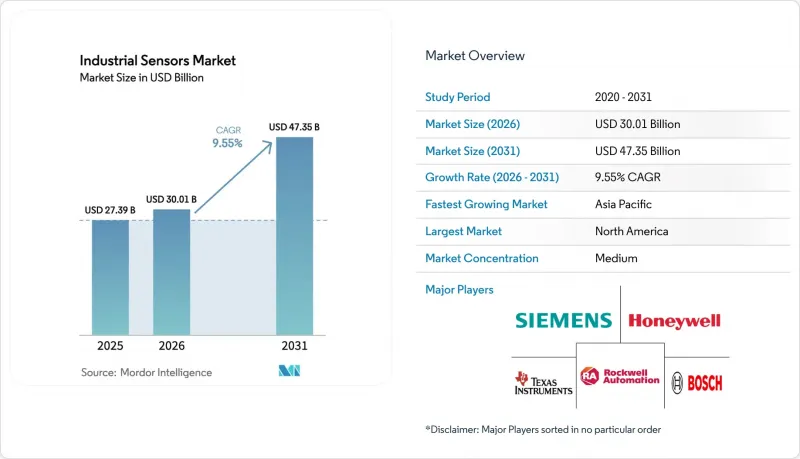
본 보고서는 센서 유형별(유량, 압력, 근접/면적, 레벨 등), 최종 사용자 산업별(화학제품 및 석유화학제품, 광업 및 금속, 전력 및 에너지 등), 기술별(유선/아날로그,유선/디지털 스마트, 무선 등), 통신 프로토콜별(필드버스, 산업용 이더넷 등), 지역별로 분류되어 있습니다. 시장 예측은 금액(달러) 기준으로 제시되어 있습니다.
세계의 산업용 센서 시장 동향 및 인사이트
인더스트리 4.0 및 IIoT 도입 급증
프라이빗 5G 네트워크, OPC UA 상호 운용성 및 IEC 63278-1 디지털 트윈 표준을 통해 기존의 데이터 사일로가 해소되어, 공장에서는 센서의 원격 측정 데이터를 통합된 분석 스택으로 스트리밍할 수 있게 되었습니다. 기업들이 독립형 SCADA 도입을 단계적으로 폐지하고 여러 공장에 걸쳐 확장 가능한 클라우드 네이티브 플랫폼으로의 전환을 추진하는 가운데, 지멘스는 2024년에 Xcelerator 구독 건수가 18% 증가했다고 기록했습니다. 결정론적 제어 루프에서 확률적 추론으로의 전환을 통해 일반적으로 7-14일 후의 조기 고장을 예측할 수 있게 되어, 긴급 정지로 인한 가동 중단 시간을 대폭 줄일 수 있습니다. 그러나 아세안 지역의 중소 제조업체들 사이에서는 사내에 IIoT 기술을 보유한 기업이 22%에 불과한 등 역량 격차가 보고되고 있으며, 이는 턴키 방식의 ‘센서 인 어 박스(Sensor-in-a-Box)’ 솔루션에 대한 수요를 부추기고 있습니다.
예지보수와 원격 모니터링 수요
예기치 못한 가동 중단으로 인해 G7 국가 공장에서 매년 약 500억 달러의 손실이 발생하고 있어, 이상이 발생한 지 수 분 이내에 이를 감지할 수 있는 진동, 온도, 음향 센서의 적극적인 도입이 진행되고 있습니다. 제약 업계에서는 2024년 공장의 68%가 예측 유지보수용 센서를 도입했으며, 이는 2022년의 41%에서 증가한 수치로, 생산성 향상 폭의 중앙값은 32%에 달했습니다. Honeywell Forge와 같은 플랫폼에서는 2024년에 연결된 자산이 23% 증가했습니다. 이는 원격지의 기술자가 증강현실(AR) 헤드셋과 실시간 대시보드를 활용하여 현장에 직접 방문하지 않고도 장비의 문제 해결을 수행했기 때문입니다. 그러나 Dragos에 따르면, 2024년 랜섬웨어 공격의 34%는 취약한 원격 액세스 게이트웨이를 악용한 것으로, 사이버 보안에 대한 우려는 여전히 최우선 과제입니다.
높은 자본 지출(CAPEX)과 통합의 복잡성
프로젝트의 총 비용은 센서 하드웨어에 그치지 않고, 게이트웨이, 현장 인프라, 미들웨어 라이선스, 시스템 통합 인건비까지 포함됩니다. 록웰의 자동 생성 제어 코드를 활용하는 경우에도, 일반적인 신규 스마트 팩토리 구축에는 여전히 18-24개월과 최대 13억 달러가 소요되므로, 중소기업에게는 진입 장벽이 되고 있습니다. 프로토콜의 비일관성으로 인해 엔지니어링 공수가 증가함에 따라, 단일 API 뒤에서 여러 네트워크를 추상화하는 슈나이더 일렉트릭의 ‘EcoStruxure’와 같은 벤더 플랫폼의 도입이 확대되고 있습니다.
부문 분석
이미지 및 비전 센서는 2031년까지 연평균 성장률(CAGR) 10.34%로 성장하고 있습니다. 이 부문의 산업용 센서 시장 규모는 2025년에 분당 1,000개 이상의 라인 속도를 유지하며 컨볼루션 신경망을 통해 인간 작업자를 대체한 품질 검사 라인에 힘입어 성장했습니다. 2024년에 출시된 소니의 24.5메가픽셀 세계 셔터 CMOS 칩은 미세한 결함을 감지하는 데 필요한 해상도를 검사 시스템에 제공합니다. 코그넥스(Cognex)의 보고서에 따르면, 조사 대상 제조업체의 37%가 제로 결함 요건의 가속화를 이유로 2년 이내에 비전 시스템 도입을 확대할 의사를 밝혔습니다.
압력 센서는 화학 및 석유화학 분야의 공정 제어 루프에서 확고한 역할을 수행하고 있어, 2025년에도 산업용 센서 시장에서 24.73%의 점유율을 유지했습니다. 그러나 성숙한 플랜트에서의 도입이 포화 상태에 도달하고 신규 설치가 정체되면서 매출 성장세는 둔화되고 있습니다. 코리올리식 및 초음파식 원리에 기반한 유량계는 거래량 계측 분야에 점차 확산되고 있으며, 터빈식 설계를 서서히 추월하고 있습니다. 근접 센서와 영역 센서는 로봇화의 물결을 타고, 안전 인터록 및 공작물 감지기로 기능하고 있습니다. 한편, 특수 진동 센서와 가스 누출 센서는 틈새 시장인 위험 경감 용도에서 고가 시장을 차지하고 있습니다.
생명과학 및 제약 분야는 2031년까지 연평균 성장률(CAGR) 10.11%를 나타낼 것으로 예측되며, 이는 각 산업군 중 가장 높은 성장 궤도입니다. 공정 분석 기술(PAT)용 센서는 FDA의 ‘신기술 프로그램’에서 권장하는 연속 생산 라인에 필수적입니다. ISPE의 조사 데이터에 따르면, 예측 유지보수의 도입률은 2024년에 68%로 급증하고 있으며, 이는 예기치 않은 가동 중단에 대한 무관용 정책을 반영하고 있습니다.
전력 및 에너지 분야의 성장 속도는 완만하지만, 재생에너지의 간헐성을 안정화하기 위해,IEEE C37.118 표준을 준수하며 GPS를 통해 동기화된 페이저 측정 장치가 송전망 현대화에 통합됨에 따라, 2025년 매출의 23.72%를 차지하고 있습니다. 화학 플랜트, 금속 가공, 식품 제조 업계에서는 안전성, 추적성 및 수율 관리 요건으로 인해 여전히 고밀도 센서 도입이 진행되고 있습니다. 한편, 항공우주, 수처리, 광업 각 업계에서는 가혹한 환경에서도 견딜 수 있는 견고한 트랜스듀서의 조달이 지속되고 있습니다.
지역별 분석
북미는 자동차 및 항공우주 분야에서 수십 년에 걸친 PROFINET 및 EtherNet/IP 도입에 힘입어 2025년 매출의 38.73%를 차지했습니다. ‘CHIPS and Science Act(CHIPS·과학법)’는 애리조나주 및 텍사스주 내 아날로그 센서 제조를 촉진하고 있으며, 이를 통해 리드 타임이 단축되고 지정학적 리스크가 완화되고 있습니다. 듀크 에너지(Duke Energy)와 같은 유틸리티자들은 송전망 안정성 확보에 관한 규제를 반영하여, 2024년에 PMU(전력 측정 장치) 및 스마트 계량기에 80억 달러를 투자했습니다. 캐나다에서는 톤당 80캐나다 달러(60달러)의 탄소 가격이 에너지 계측 장비의 교체를 촉진하고 있는 반면, 멕시코에서는 전기차 및 전자기기 분야의 니어쇼어링이 급속히 확대되면서 USMCA(미국·멕시코·캐나다 협정) 규정에 따라 새로운 수요가 창출되고 있습니다.
아시아태평양은 연평균 성장률(CAGR) 11.74%로 가장 빠르게 성장하고 있는 지역입니다. 중국의 ‘중국 제조 2025’ 계획은 대기업의 디지털화율 70%를 목표로 하고 있어 센서의 급속한 보급을 뒷받침하고 있습니다. 인도는 전자기기 및 제약 제조 분야에 260억 달러 규모의 생산 연계형 인센티브를 투입하여 공정 센서 및 비전 센서 수요를 끌어올리고 있습니다. 일본은 데이터 공유 측면에서 뒤처지는 모습이 보이지만, 로봇 공학 분야의 강점을 바탕으로 고정밀 엔코더 수주가 견조한 추세를 보이고 있으며, 한국에서는 반도체 팹이 클래스 1 클린룸을 유지하기 위한 환경 센서를 조달하고 있습니다. 아세안 국가들에서는 인건비 상승과 현지 기술자 부족이 지속되고 있어 턴키 방식의 센서 키트가 널리 채택되고 있습니다.
유럽도 이에 뒤이어, 독일의 ‘인더스트리 4.0’에 대한 투자와, 측정된 에너지 기준값에 따라 자금을 지원하는 EU의 ‘에너지 효율 지침’에 힘입고 있습니다. 지멘스, ABB, 슈나이더 일렉트릭 등의 벤더는 통합된 제품 포트폴리오를 활용하여 센서와 제어 소프트웨어의 교차 판매를 전개하고 있는 반면, 틈새 시장 업체인 시크 AG와 페펠 앤 푹스는 안전성이 극히 중요한 분야나 방폭 분야에서 주도적인 위치를 차지하고 있습니다. 브렉시트 이후의 규제 차이로 인해, EU로 수출하는 영국 수출업체들의 규정 준수 비용이 증가하고 있습니다. 남미, 중동 및 아프리카에서는 도입이 늦어지고 있지만, 브라질의 광업이나 걸프 연안 국가들의 업스트림 석유 및 가스 프로젝트에서는 배선 공사가 현실적으로 어려운 외딴 지역의 자산을 모니터링하기 위해 무선 진동 센서의 도입이 점점 더 요구되고 있습니다.
기타 혜택 :
- 엑셀 형식 시장 예측(ME) 시트
- 3개월간의 애널리스트 지원
자주 묻는 질문
목차
제1장 서론
제2장 조사 방법
제3장 주요 요약
제4장 시장 구도
제5장 시장 규모 및 성장 예측
제6장 경쟁 구도
제7장 시장 기회 및 향후 전망
AJY 26.09.07According to Mordor Intelligence, the industrial sensors market size is projected to be USD 27.39 billion in 2025, USD 30.01 billion in 2026, and reach USD 47.35 billion by 2031, growing at a CAGR of 9.55% from 2026 to 2031.
This report is Segmented by Sensor Type (Flow, Pressure, Proximity/Area, Level, and More), End-User Industry (Chemical and Petrochemicals, Mining and Metals, Power and Energy, and More), Technology (Wired/Analog, Wired/Digital Smart, Wireless, and More), Communication Protocol (Fieldbus, Industrial Ethernet, and More), and Geography. The Market Forecasts are Provided in Terms of Value (USD).
Global Industrial Sensors Market Trends and Insights
Industry 4.0 And IIoT Adoption Surge
Private-5G networks, OPC UA interoperability, and the IEC 63278-1 digital-twin standard are dissolving legacy data islands, letting factories stream sensor telemetry into unified analytics stacks. Siemens recorded an 18% uptick in Xcelerator subscriptions during 2024 as firms phased out standalone SCADA deployments in favor of cloud-native platforms that scale across multi-plant footprints. The shift from deterministic control loops to probabilistic inference allows early fault prediction, typically 7-14 days ahead, slashing emergency downtime. Still, small and medium manufacturers in ASEAN report capability gaps, with only 22% having in-house IIoT skills, which is driving turnkey "sensor-in-a-box" offerings.
Predictive-Maintenance And Remote-Monitoring Demand
Unplanned downtime costs G7 factories roughly USD 50 billion each year, prompting aggressive deployment of vibration, temperature, and acoustic sensors able to flag anomalies minutes after they appear. In pharmaceuticals, 68% of plants integrated predictive-maintenance sensors in 2024, up from 41% in 2022, delivering median productivity gains of 32%. Platforms such as Honeywell Forge grew connected assets by 23% in 2024 as remote technicians used augmented-reality headsets and live dashboards to troubleshoot equipment without traveling. Dragos, however, notes that 34% of 2024 ransomware incidents exploited vulnerable remote-access gateways, keeping cybersecurity front-of-mind.
High CAPEX And Integration Complexity
Total project costs extend well beyond sensor hardware to gateways, field infrastructure, middleware licenses, and system-integration labor. Even with Rockwell's auto-generated control code, a typical greenfield smart factory still demands 18-24 months and up to USD 1.3 billion, discouraging small and medium enterprises. Protocol heterogeneity inflates engineering hours, prompting higher uptake of vendor platforms such as Schneider's EcoStruxure that abstract multiple networks behind a single API.
Other drivers and restraints analyzed in the detailed report include:
- Robot-Centric Smart-Factory Expansion
- Rising Compliance With Net-Zero and Energy-Efficiency Mandates
- Cybersecurity Vulnerabilities of Networked Sensors
For complete list of drivers and restraints, kindly check the Table Of Contents.
Segment Analysis
Image and vision sensors are advancing at a 10.34% CAGR through 2031. The industrial sensors market size for this category was bolstered in 2025 by quality-inspection lines replacing human operators with convolutional networks that sustain line speeds above 1,000 parts per minute. Sony's 24.5-megapixel global-shutter CMOS chips, launched in 2024, give inspection systems the resolution needed to catch microscopic defects. Cognex reported that 37% of surveyed manufacturers intend to expand vision deployments within two years, citing accelerating zero-defect mandates.
Pressure sensors retained a 24.73% industrial sensors market share in 2025 thanks to their entrenched role in process-control loops across chemicals and petrochemicals. However, revenue growth is slowing as saturation in mature plants caps fresh installations. Flow meters built on Coriolis and ultrasonic principles are penetrating custody-transfer metering, edging out turbine designs. Proximity and area sensors ride the robotization wave, serving as safety interlocks and workpiece detectors, while specialized vibration and gas-leak sensors command premium price points in niche risk-mitigation roles.
The life sciences and pharmaceuticals segment is projected to record a 10.11% CAGR through 2031, the top growth trajectory among verticals. Process-analytical-technology sensors are essential for continuous manufacturing lines endorsed by the FDA's Emerging Technology Program. ISPE survey data show that predictive-maintenance adoption jumped to 68% in 2024, reflecting zero-tolerance for unplanned outages.
Power and energy, while slower growing, still represented 23.72% of 2025 revenue as grid-modernization efforts embed phasor measurement units synchronized via GPS under IEEE C37.118 to stabilize renewable intermittency. Chemical plants, metals operations, and food manufacturers remain sensor-dense due to safety, traceability, and yield-control requirements, whereas aerospace, water treatment, and mining continue to procure ruggedized transducers that survive extreme environments.
Complete Report Scope:
- By Sensor Type
- Flow
- Pressure
- Proximity / Area
- Level
- Temperature
- Image / Vision
- Photo-electric
- Other Sensor Types
- By End-user Industry
- Chemical and Petrochemicals
- Mining and Metals
- Power and Energy
- Food and Beverage
- Life Sciences and Pharmaceuticals
- Aerospace and Defense
- Water and Waste-water
- Other End-user Industries
- By Technology
- Wired / Analog
- Wired / Digital (Smart)
- Wireless
- Edge-AI / Virtual Sensors
- By Communication Protocol
- Fieldbus (PROFIBUS, Modbus)
- Industrial Ethernet (PROFINET, EtherNet/IP, EtherCAT)
- IO-Link
- Wireless ICPs (Wi-Sun, 6LoWPAN, BLE-Mesh)
- By Geography
- North America
- United States
- Canada
- Mexico
- South America
- Brazil
- Argentina
- Rest of South America
- Europe
- Germany
- United Kingdom
- France
- Italy
- Spain
- Rest of Europe
- Asia-Pacific
- China
- Japan
- India
- South Korea
- ASEAN
- Rest of Asia-Pacific
- Middle East and Africa
- Middle East
- Saudi Arabia
- United Arab Emirates
- Rest of Middle East
- Africa
- South Africa
- Nigeria
- Rest of Africa
- Middle East
- North America
Geography Analysis
North America controlled 38.73% of 2025 revenue, lifted by decades of PROFINET and EtherNet/IP deployments in automotive and aerospace. The CHIPS and Science Act is catalyzing domestic analog-sensor fabrication in Arizona and Texas, which shortens lead times and mitigates geopolitical risk. Utilities such as Duke Energy earmarked USD 8 billion in 2024 for PMUs and smart meters, reflecting grid-stability mandates. Canada's CAD 80 per-tonne (USD 60) carbon price drives energy-metering retrofits, while Mexico's nearshoring boom in EVs and electronics creates fresh demand under USMCA provisions.
Asia-Pacific is the fastest-growing region at an 11.74% CAGR. China's Made in China 2025 plan aims for 70% digitalization of large enterprises, fueling steep sensor uptake. India channeled USD 26 billion of Production-Linked Incentives into electronics and pharma manufacturing, lifting demand for process and vision sensors. Japan's strength in robotics, despite lagging data-sharing, sustains high-accuracy encoder orders, and South Korea's semiconductor fabs procure environmental sensors that maintain class 1 cleanrooms. ASEAN economies absorb turnkey sensor kits as labor costs rise and local skill shortages persist.
Europe follows closely, propelled by Germany's Industrie 4.0 investments and the EU's Energy Efficiency Directive, which predicates funding on metered energy baselines. Vendors such as Siemens, ABB, and Schneider leverage integrated portfolios to cross-sell sensors and control software, while niche players Sick AG and Pepperl+Fuchs dominate safety-critical and explosion-proof niches. Regulatory divergence post-Brexit raises compliance costs for U.K. exporters shipping into the EU. South America and the Middle East and Africa trail in adoption, though Brazil's mining and the Gulf's upstream oil and gas projects increasingly specify wireless vibration sensors to monitor remote assets where rewiring is impractical.
- Siemens AG
- Honeywell International Inc.
- Texas Instruments Incorporated
- Rockwell Automation Inc.
- Bosch Sensortec GmbH
- TE Connectivity Ltd.
- ABB Ltd.
- STMicroelectronics N.V.
- Infineon Technologies AG
- NXP Semiconductors N.V.
- Omron Corporation
- Sick AG
- Emerson Electric Co.
- Schneider Electric SE
- Balluff GmbH
- Pepperl+Fuchs SE
- Keyence Corporation
- IFM Electronic GmbH
- Yokogawa Electric Corporation
- Endress+Hauser AG
- Analog Devices Inc.
Additional Benefits:
- The market estimate (ME) sheet in Excel format
- 3 months of analyst support
TABLE OF CONTENTS
1 INTRODUCTION
- 1.1 Study Assumptions and Market Definition
- 1.2 Scope of the Study
2 RESEARCH METHODOLOGY
3 EXECUTIVE SUMMARY
4 MARKET LANDSCAPE
- 4.1 Market Overview
- 4.2 Market Drivers
- 4.2.1 Industry 4.0 / IIoT adoption surge
- 4.2.2 Predictive-maintenance and remote-monitoring demand
- 4.2.3 Robot-centric smart-factory expansion
- 4.2.4 Rising compliance with net-zero and energy-efficiency mandates
- 4.2.5 Edge-AI sensor nodes cut cloud latency
- 4.2.6 IO-Link retrofit wave in brown-field plants
- 4.3 Market Restraints
- 4.3.1 High CAPEX and integration complexity
- 4.3.2 Cyber-security vulnerabilities of networked sensors
- 4.3.3 Global semiconductor-supply disruption risk
- 4.3.4 Data-sovereignty rules limit cross-border analytics
- 4.4 Industry Value Chain Analysis
- 4.5 Regulatory Landscape
- 4.6 Technological Outlook
- 4.7 Porter's Five Forces Analysis
- 4.7.1 Bargaining Power of Suppliers
- 4.7.2 Bargaining Power of Buyers
- 4.7.3 Threat of New Entrants
- 4.7.4 Threat of Substitutes
- 4.7.5 Intensity of Competitive Rivalry
- 4.7.6 Assessment of Macroeconomic Trends on Market
5 MARKET SIZE AND GROWTH FORECASTS (VALUE)
- 5.1 By Sensor Type
- 5.1.1 Flow
- 5.1.2 Pressure
- 5.1.3 Proximity / Area
- 5.1.4 Level
- 5.1.5 Temperature
- 5.1.6 Image / Vision
- 5.1.7 Photo-electric
- 5.1.8 Other Sensor Types
- 5.2 By End-user Industry
- 5.2.1 Chemical and Petrochemicals
- 5.2.2 Mining and Metals
- 5.2.3 Power and Energy
- 5.2.4 Food and Beverage
- 5.2.5 Life Sciences and Pharmaceuticals
- 5.2.6 Aerospace and Defense
- 5.2.7 Water and Waste-water
- 5.2.8 Other End-user Industries
- 5.3 By Technology
- 5.3.1 Wired / Analog
- 5.3.2 Wired / Digital (Smart)
- 5.3.3 Wireless
- 5.3.4 Edge-AI / Virtual Sensors
- 5.4 By Communication Protocol
- 5.4.1 Fieldbus (PROFIBUS, Modbus)
- 5.4.2 Industrial Ethernet (PROFINET, EtherNet/IP, EtherCAT)
- 5.4.3 IO-Link
- 5.4.4 Wireless ICPs (Wi-Sun, 6LoWPAN, BLE-Mesh)
- 5.5 By Geography
- 5.5.1 North America
- 5.5.1.1 United States
- 5.5.1.2 Canada
- 5.5.1.3 Mexico
- 5.5.2 South America
- 5.5.2.1 Brazil
- 5.5.2.2 Argentina
- 5.5.2.3 Rest of South America
- 5.5.3 Europe
- 5.5.3.1 Germany
- 5.5.3.2 United Kingdom
- 5.5.3.3 France
- 5.5.3.4 Italy
- 5.5.3.5 Spain
- 5.5.3.6 Rest of Europe
- 5.5.4 Asia-Pacific
- 5.5.4.1 China
- 5.5.4.2 Japan
- 5.5.4.3 India
- 5.5.4.4 South Korea
- 5.5.4.5 ASEAN
- 5.5.4.6 Rest of Asia-Pacific
- 5.5.5 Middle East and Africa
- 5.5.5.1 Middle East
- 5.5.5.1.1 Saudi Arabia
- 5.5.5.1.2 United Arab Emirates
- 5.5.5.1.3 Rest of Middle East
- 5.5.5.2 Africa
- 5.5.5.2.1 South Africa
- 5.5.5.2.2 Nigeria
- 5.5.5.2.3 Rest of Africa
- 5.5.5.1 Middle East
- 5.5.1 North America
6 COMPETITIVE LANDSCAPE
- 6.1 Market Concentration
- 6.2 Strategic Moves
- 6.3 Market Share Analysis
- 6.4 Company Profiles (includes Global level Overview, Market level overview, Core Segments, Financials as available, Strategic Information, Market Rank/Share for key companies, Products and Services, and Recent Developments)
- 6.4.1 Siemens AG
- 6.4.2 Honeywell International Inc.
- 6.4.3 Texas Instruments Incorporated
- 6.4.4 Rockwell Automation Inc.
- 6.4.5 Bosch Sensortec GmbH
- 6.4.6 TE Connectivity Ltd.
- 6.4.7 ABB Ltd.
- 6.4.8 STMicroelectronics N.V.
- 6.4.9 Infineon Technologies AG
- 6.4.10 NXP Semiconductors N.V.
- 6.4.11 Omron Corporation
- 6.4.12 Sick AG
- 6.4.13 Emerson Electric Co.
- 6.4.14 Schneider Electric SE
- 6.4.15 Balluff GmbH
- 6.4.16 Pepperl+Fuchs SE
- 6.4.17 Keyence Corporation
- 6.4.18 IFM Electronic GmbH
- 6.4.19 Yokogawa Electric Corporation
- 6.4.20 Endress+Hauser AG
- 6.4.21 Analog Devices Inc.
7 MARKET OPPORTUNITIES AND FUTURE OUTLOOK
- 7.1 White-space and Unmet-need Assessment


