

|
시장보고서
상품코드
2123101
유럽의 섬유 시장 : 시장 점유율 분석, 업계 동향 및 통계, 성장 예측(2026-2031년)Europe Textile - Market Share Analysis, Industry Trends & Statistics, Growth Forecasts (2026 - 2031) |
||||||
 Mordor Intelligence
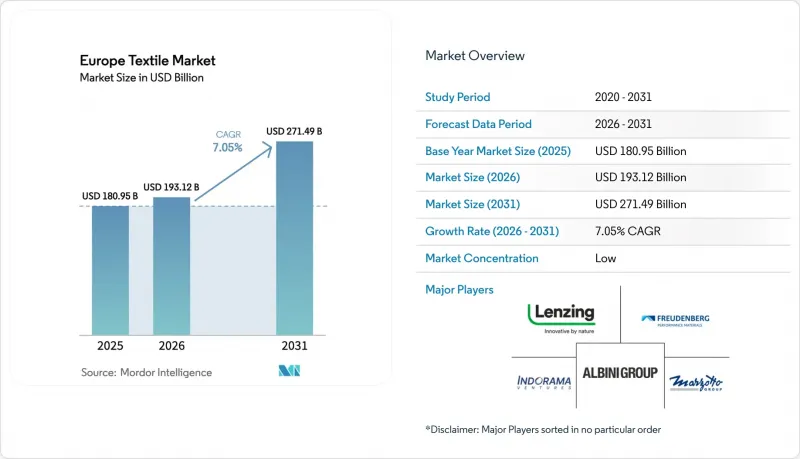
Mordor Intelligence에 의하면, 유럽의 섬유 시장 규모는 2025년 1,809억 5,000만 달러로 평가되었고, 2026년 1,931억 2,000만 달러에서 2031년까지 2,714억 9,000만 달러로 확대될 것으로 예측되며, 2026-2031년 연평균 복합 성장률(CAGR)은 7.05%를 나타낼 전망입니다.
본 보고서는 용도별(패션 및 의류, 산업용·기술용, 기타), 원재료별(천연섬유, 합성섬유, 기타), 가공 방법별(직물, 니트, 부직포, 3D 직물 및 스페이서 패브릭), 그리고 지역별(영국, 독일, 프랑스, 이탈리아,스페인, 베네룩스, 북유럽 국가, 기타 유럽)로 분류되어 있습니다. 시장 전망은 금액(달러) 기준으로 제시되어 있습니다.
유럽의 섬유 시장 동향 및 인사이트
2025년부터 EU-27 전역에서 섬유 폐기물 분리 수거 의무화
2025년 1월부터 모든 지자체에 대해 섬유 제품 전용 수거 거점을 설치할 의무가 부과되어, 연간 약 500만 톤의 의류가 유럽의 선별 거점으로 보내지게 되었습니다. 프랑스와 네덜란드 등 선도국들은 길가의 수거함과 사회적 기업 파트너와의 협력을 통해 60% 이상의 회수율을 달성했습니다. 이 규제로 인해 한 가지 과제가 부각되었습니다. 2025년 중반 시점에서 유럽에는 자동 선별 라인이 50개 미만에 불과했기 때문에 투자자들은 폴란드, 스페인, 포르투갈에 새로운 공장 건설에 8억 7,000만 달러를 투자했습니다. 현재 생산자들은 에코모듈레이션 비용 부담에 직면해 있으며, 이로 인해 트림이 분리 가능한 단일 소재 의류 디자인이 촉진되고 있습니다. 중기적으로는 이 회수 의무로 인해 재생 섬유공급량이 증가하여 순환형 공급 계약의 기반이 될 것으로 기대됩니다.
모빌리티 및 인프라용 고성능 테크니컬 텍스타일의 성장
전기차 제조업체들은 2025년까지 차량 1대당 테크니컬 텍스타일 사용량을 12kg 이상으로 늘리고, 경량화를 위해 배터리 케이스의 강재를 탄소섬유 복합재로 대체했습니다. EU 회원국들은 철도 및 고속도로 개보수에 1,300억 달러를 배정하여, 토양을 안정시키고 아스팔트 두께를 줄이는 지오텍스타일 수요를 끌어올렸습니다. 병원에서는 ISO 16604를 준수하는 물세탁 가능한 배리어 원단의 사용이 의무화되어, 난연성 및 항균성 소재의 구매가 촉진되었습니다. 하이브리드 스페이서 및 복합 구조에 관한 특허 출원 건수는 2024년에 18% 증가하여, 새로운 연구개발비 투입을 시사하고 있습니다. 이러한 장기적인 성장 요인으로 인해, 범용 폴리에스테르에 비해 3-5배의 이익률을 가져다주는 초고분자량 폴리에틸렌 및 아라미드 필라멘트에 대한 투자가 촉진되고 있습니다.
에너지 가격과 원자재 가격 변동이 낮은 이익률을 기록하는 생산 업체들을 압박
천연가스 가격은 2024년 초 1MWh당 130달러로 정점을 찍은 후 2025년 말에는 43달러까지 하락하여, 에너지 비용이 영업 비용의 70%에 달하는 염색 공장에 혼란을 가져왔습니다. 원유 가격이 배럴당 10달러 변동할 때마다 폴리머 가격은 8% 변동했으며, 면화 선물 가격은 파운드당 75달러에서 95달러 사이에서 변동했습니다. 헤지 수단이 없는 중소기업은 이익률이 급격히 축소되었으며, 폴란드와 루마니아에서는 자산 매각으로 내몰렸습니다. 위험을 분담하는 원가 가산 계약은 견고한 파트너십이 아닌 경우 여전히 드뭅니다. 따라서 가격의 불안정성은 생산 능력을 위협하고, 업계 재편을 가속화하고 있습니다.
부문별 분석
2025년, 패션 및 의류 부문은 유럽 섬유 시장 전체의 대부분을 차지하며 전체 시장 규모의 56.06%를 차지했습니다. 가장 빠르게 성장하고 있는 테크니컬 텍스타일 부문은 전기차 인테리어, 의료용 배리어 패브릭, 지오텍스타일 보강재에 힘입어 2031년까지 연평균 성장률(CAGR) 6.15%를 나타낼 것으로 예측됩니다. 독일의 자동차 제조업체들은 배터리 플랫폼의 경량화를 도모하기 위해 2025년에는 차량 1대당 12kg 이상의 테크니컬 텍스타일를 사용했습니다(2020년 9kg에서 증가). 또한, 병원에서는 ISO 16604를 준수하는 수술용 드레이프 사용이 의무화되면서 의료용 섬유 계약이 확대되었습니다. 방호복은 더욱 엄격해진 난연성 규제의 혜택을 받고 있으며, 스포츠웨어에는 생체 인식 데이터를 수집하는 전도성 실이 통합되어 있습니다. 이는 2024년 스마트 텍스타일 관련 특허가 18% 증가한 데 따른 결과입니다.
고급 패션 브랜드는 소비자 직접 판매 사이트나 매장 이벤트로 무게중심을 옮기고 있지만, 중저가 의류 업계는 이틀마다 신상 스타일을 공개하는 초고속 경쟁사들과의 경쟁에서 고전하고 있습니다. 이러한 양극화로 인해 방적 제조업체들은 기본 의류 수주와 고수익률의 기능성 섬유 수주 간의 균형을 맞추도록 요구받고 있습니다. 지역별 생산 체계도 재편되고 있습니다. 이탈리아는 계속해서 고급 셔츠 원단 생산의 중심지로서의 위상을 유지하는 한편, 독일과 프랑스는 자동차 및 항공우주 업계의 파트너 기업을 위한 기능성 섬유의 연구 개발을 주도하고 있습니다. 예측 기간 동안 유럽 섬유 시장은 의류 수요의 둔화를 상쇄하기 위해 산업용 수요에 의존하게 될 것입니다.
기타 혜택 :
- 엑셀 형식 시장 예측(ME) 시트
- 3개월간의 애널리스트 지원
자주 묻는 질문
목차
제1장 서론
제2장 조사 방법
제3장 주요 요약
제4장 시장 구도
제5장 시장 규모 및 성장 예측
제6장 경쟁 구도
제7장 시장 기회 및 향후 전망
AJY 26.09.07According to Mordor Intelligence, the Europe textile market size is projected to expand from USD 180.95 billion in 2025 and USD 193.12 billion in 2026 to USD 271.49 billion by 2031, registering a CAGR of 7.05% between 2026 to 2031.
This report is Segmented by Application (Fashion & Apparel, Industrial/Technical, and More), by Raw Material (Natural Fibers, Synthetic Fibers, and More), by Process (Woven, Knitted, Non-Woven, 3-D Weaving & Spacer Fabrics), and by Geography (United Kingdom, Germany, France, Italy, Spain, BENELUX, NORDICS, Rest of Europe). Market Forecasts are Provided in Value (USD).
Europe Textile Market Trends and Insights
Mandatory Separate Collection of Textile Waste Across EU-27 from 2025
From January 2025, all municipalities were required to install dedicated textile-collection points, redirecting roughly 5 million tonnes of garments per year into European sorting hubs. Early movers such as France and the Netherlands achieved collection rates above 60% by pairing curbside bins with social-enterprise partners. The regulation exposed a shortfall: Europe had fewer than 50 automated sorting lines in mid-2025, so investors committed USD 870 million to new plants in Poland, Spain, and Portugal. Producers now face eco-modulation fees, pushing them to design mono-material garments with detachable trims. Over the medium term, the collection mandate is expected to lift recycled-fiber availability and underpin circular supply contracts.
Growth of High-Performance Technical Textiles for Mobility and Infrastructure
Electric-vehicle makers increased technical-textile content to more than 12 kg per car in 2025, replacing steel in battery enclosures with carbon-fiber composites for weight savings. EU states earmarked USD 130 billion for rail and highway upgrades, lifting demand for geotextiles that stabilize soil and reduce asphalt thickness. Hospitals mandated washable barrier fabrics that meet ISO 16604, driving purchases of flame-retardant and antimicrobial materials. Patent filings for hybrid spacer-composite architectures rose 18% in 2024, signaling fresh R&D spend. The long-term driver pulls investment toward ultra-high-molecular-weight polyethylene and aramid filaments that earn margins three to five times those of commodity polyester.
Volatile Energy and Raw-Material Prices Squeezing Low-Margin Producers
Natural-gas costs peaked at USD 130 per MWh in early 2024 before sliding to USD 43 in late 2025, unsettling dyehouses where energy can reach 70% of operating costs. Crude swings of USD 10 per barrel drove 8% moves in polymer prices, while cotton futures oscillated between USD 75 and USD 95 per pound. SMEs without hedging tools saw margins evaporate, prompting asset sales in Poland and Romania. Cost-plus contracts that share risk remain rare outside deep partnerships. Price instability, therefore, threatens capacity and fuels consolidation.
Other drivers and restraints analyzed in the detailed report include:
- Rapid Changes in Fashion Cycles and Rise of Fast Fashion
- EU Digital Product Passport Enabling Data-Rich Circular Business Models
- High Capex Requirement for State-of-the-Art Recycling and Sorting Capacity
For complete list of drivers and restraints, kindly check the Table Of Contents.
Segment Analysis
In 2025, the fashion and apparel segment represented a significant majority of the overall Europe textile market, accounting for 56.06% of the total market size. The fastest-growing technical segment is forecast to clock a 6.15% CAGR through 2031, buoyed by electric-vehicle interiors, medical barrier fabrics, and geotextile reinforcement. German automakers used more than 12 kg of technical textiles per vehicle in 2025, up from 9 kg in 2020, to lighten battery platforms. Hospitals mandated ISO 16604-compliant drapes, expanding medical-textile contracts. Protective workwear profits from stricter flame-retardant rules, and sportswear integrates conductive yarns that capture biometric data, backed by 18% growth in smart-textile patents in 2024.
Premium fashion labels pivot to direct-to-consumer sites and store events, yet mid-market apparel grapples with ultra-fast competitors that post styles every two days. This bifurcation encourages mills to balance staple apparel orders with high-margin technical contracts. Regional production also realigns: Italy continues to anchor luxury shirting, while Germany and France lead technical-fabric R&D for automotive and aerospace partners. Over the forecast horizon, the Europe textile market will rely on industrial demand to offset slower apparel volumes.
Complete Report Scope:
- By Application
- Fashion & Apparel
- Industrial/Technical Textiles
- Household & Home Textiles
- Medical & Healthcare Textiles
- Automotive & Transport Textiles
- Others (Protective, Sports Textiles, etc.)
- By Raw Material
- Natural Fibers
- Cotton
- Wool
- Silk
- Synthetic Fibers
- Polyester
- Nylon
- Rayon / Viscose
- Acrylic
- Polypropylene
- Recycled Fibers
- Others (Speciality High-Performance Fibers (Aramid, Carbon, UHMWPE))
- Natural Fibers
- By Process / Technology
- Woven
- Knitted
- Non-woven
- Spunlaid (Spunbond / Melt-blown)
- Dry-laid Hydro-entangled
- Wet-Laid
- Needle-punched
- 3-D Weaving & Spacer Fabrics
- By Geography
- United Kingdom
- Germany
- France
- Italy
- Spain
- BENELUX (Belgium, Netherlands, and Luxembourg)
- NORDICS (Denmark, Finland, Iceland, Norway, and Sweden)
- Rest of Europe
List of Companies Covered in this Report:
- Lenzing AG
- Freudenberg Performance Materials
- Indorama Ventures (M&G Fibras Europe)
- Albini Group
- Marzotto Group
- Klopman International
- Schoeller Textil AG
- Borgers SE & Co. KG
- Ahlstrom-Munksjo
- Beaulieu Technical Textiles
- Don & Low Ltd
- ITV Denkendorf Produktservice
- Holland & Sherry
- Gebruder Otto
- TWE Group
- PFNonwovens Czech s.r.o
- HUESKER Synthetic GmbH
- Tirotex Textile Company
- Baltex
- Statex Produktions GmbH
Additional Benefits:
- The market estimate (ME) sheet in Excel format
- 3 months of analyst support
TABLE OF CONTENTS
1 Introduction
- 1.1 Study Assumptions & Market Definition
- 1.2 Scope of the Study
2 Research Methodology
3 Executive Summary
4 Market Landscape
- 4.1 Market Overview
- 4.2 Market Drivers
- 4.2.1 Rapid changes in fashion cycles & rise of fast fashion
- 4.2.2 Mandatory separate collection of textile waste across EU-27 from 2025
- 4.2.3 E-commerce & social-commerce platforms shortening design-to-shelf lead-times
- 4.2.4 Growth of high-performance technical textiles for mobility & infrastructure
- 4.2.5 EU "Digital Product Passport" enabling data-rich circular business models
- 4.2.6 Demand surge for Europe-grown flax, hemp & wool as low-carbon local fibres
- 4.3 Market Restraints
- 4.3.1 Volatile energy & raw-material prices squeezing low-margin producers
- 4.3.2 High capex requirement for state-of-the-art recycling & sorting capacity
- 4.3.3 Skilled-labour shortages in dyeing / finishing & advanced weaving
- 4.3.4 Fragmented SME base complicating compliance with new EU due-diligence rules
- 4.4 Value / Supply-Chain Analysis
- 4.5 Regulatory Outlook
- 4.6 Technological Outlook
- 4.7 Industry Attractiveness - Porter's Five Forces
- 4.7.1 Bargaining Power of Buyers
- 4.7.2 Bargaining Power of Suppliers
- 4.7.3 Threat of New Entrants
- 4.7.4 Threat of Substitutes
- 4.7.5 Competitive Rivalry
- 4.8 Impact of Geopolitics on Textile Market
5 Market Size & Growth Forecasts (Value, In USD Billion)
- 5.1 By Application
- 5.1.1 Fashion & Apparel
- 5.1.2 Industrial/Technical Textiles
- 5.1.3 Household & Home Textiles
- 5.1.4 Medical & Healthcare Textiles
- 5.1.5 Automotive & Transport Textiles
- 5.1.6 Others (Protective, Sports Textiles, etc.)
- 5.2 By Raw Material
- 5.2.1 Natural Fibers
- 5.2.1.1 Cotton
- 5.2.1.2 Wool
- 5.2.1.3 Silk
- 5.2.2 Synthetic Fibers
- 5.2.2.1 Polyester
- 5.2.2.2 Nylon
- 5.2.2.3 Rayon / Viscose
- 5.2.2.4 Acrylic
- 5.2.2.5 Polypropylene
- 5.2.3 Recycled Fibers
- 5.2.4 Others (Speciality High-Performance Fibers (Aramid, Carbon, UHMWPE))
- 5.2.1 Natural Fibers
- 5.3 By Process / Technology
- 5.3.1 Woven
- 5.3.2 Knitted
- 5.3.3 Non-woven
- 5.3.3.1 Spunlaid (Spunbond / Melt-blown)
- 5.3.3.2 Dry-laid Hydro-entangled
- 5.3.3.3 Wet-Laid
- 5.3.3.4 Needle-punched
- 5.3.4 3-D Weaving & Spacer Fabrics
- 5.4 By Geography
- 5.4.1 United Kingdom
- 5.4.2 Germany
- 5.4.3 France
- 5.4.4 Italy
- 5.4.5 Spain
- 5.4.6 BENELUX (Belgium, Netherlands, and Luxembourg)
- 5.4.7 NORDICS (Denmark, Finland, Iceland, Norway, and Sweden)
- 5.4.8 Rest of Europe
6 Competitive Landscape
- 6.1 Market Concentration
- 6.2 Strategic Moves
- 6.3 Market Share Analysis
- 6.4 Company Profiles {(includes Global level Overview, Market level overview, Core Segments, Financials as available, Strategic Information, Products & Services, and Recent Developments)}
- 6.4.1 Lenzing AG
- 6.4.2 Freudenberg Performance Materials
- 6.4.3 Indorama Ventures (M&G Fibras Europe)
- 6.4.4 Albini Group
- 6.4.5 Marzotto Group
- 6.4.6 Klopman International
- 6.4.7 Schoeller Textil AG
- 6.4.8 Borgers SE & Co. KG
- 6.4.9 Ahlstrom-Munksjo
- 6.4.10 Beaulieu Technical Textiles
- 6.4.11 Don & Low Ltd
- 6.4.12 ITV Denkendorf Produktservice
- 6.4.13 Holland & Sherry
- 6.4.14 Gebruder Otto
- 6.4.15 TWE Group
- 6.4.16 PFNonwovens Czech s.r.o
- 6.4.17 HUESKER Synthetic GmbH
- 6.4.18 Tirotex Textile Company
- 6.4.19 Baltex
- 6.4.20 Statex Produktions GmbH
7 Market Opportunities & Future Outlook
- 7.1 White-space & Unmet-Need Assessment


