|
시장보고서
상품코드
2123682
간염 치료제 시장 : 점유율 분석, 업계 동향과 통계, 성장 예측(2026-2031년)Hepatitis Therapeutics - Market Share Analysis, Industry Trends & Statistics, Growth Forecasts (2026 - 2031) |
||||||
 Mordor Intelligence
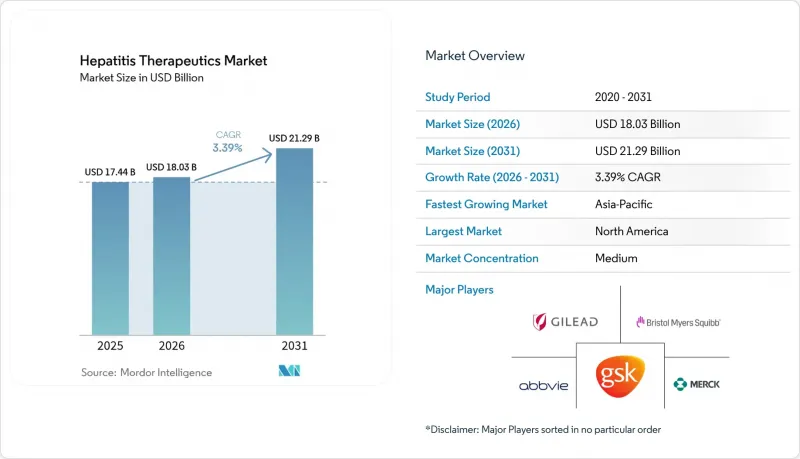
Mordor Intelligence에 의하면, 간염 치료제 시장 규모는 2025년 174억 4,000만 달러에서 2026년에는 180억 3,000만 달러로 확대되어 2026년부터 2031년까지 CAGR 3.39%로 성장을 지속하여, 2031년에는 212억 9,000만 달러에 이를 것으로 예측됩니다.
본 보고서는 질환 유형(A형 간염, B형 간염 등), 약물 분류(인터페론, 단일클론 항체 등), 투여 경로(경구 및 주사제), 유통 채널(오프라인 및 온라인), 최종 사용자(병원, 전문 클리닉 등), 지역(북미, 유럽,아시아태평양 등)별로 세분화되어 있습니다. 시장 예측은 금액(달러) 기준으로 제시되어 있습니다.
전 세계 간염 치료제 시장 동향 및 인사이트
바이러스성 간염의 높은 유병률
3억 400만 명 이상이 만성 B형 또는 C형 간염을 앓고 있으며, 이 환자층은 경제 변동과 무관하게 장기적인 수요를 뒷받침하고 있습니다. 중국과 인도에서만 3,500만 건 이상을 차지하고 있어, 아시아태평양은 간염 치료제 시장의 주요 성장 동력이 되고 있습니다. 만성 B형 간염 감염자 중 진단받은 비율은 고작 13%에 불과하며, 항바이러스 치료를 받고 있는 비율은 3%에 그쳐, 진단 부족이 미충족 의료 수요를 계속 부풀리고 있는 실정이 드러나고 있습니다. 유병률이 감소하고 있는 지역에서도 사망률은 상승하고 있어, 선별 검사 및 의료 연계 체계에 문제가 있음을 보여주고 있습니다. 각국 정부는 현재 이를 공중보건상의 비상사태로 규정하고 있습니다. 이러한 역학적 현실은 합리적인 가격으로 분산형 치료 모델을 확대할 수 있는 기업들에게 장기적인 판매량 성장을 뒷받침해 줄 것입니다.
모든 유전자형에 대응하는 DAA 요법의 신속한 도입
8주간의 범유전자형 병용 요법으로 치료 기간이 단축되었으며, 대부분의 상황에서 유전자형 검사가 불필요해졌습니다. 애브비(AbbVie)의 ‘MAVYRET’은 급성 C형 간염에 대한 최초의 8주 요법으로 FDA 승인을 획득하여 96%의 치유율을 기록함과 동시에 외래 방문 횟수를 대폭 줄였습니다. 아테아 파마슈티컬스의 베무니포스부비르·루자스부비르 병용 요법은 2상 임상시험에서 98%의 지속 바이러스학적 반응률을 보였으며, 2025년에 3상 임상시험으로 넘어갈 예정입니다. 치료 기간의 단축은 추적 조사 중 탈락률을 줄이고 지방 진료소에서의 치료 확대를 용이하게 하여, C형 간염 치료제 시장의 침투 가능성을 높이고 있습니다.
신흥 경제국에서의 불균등한 보험 적용
저·중소득 국가에서 DAA 요법에 대한 보험 적용을 시행하고 있는 곳은 불과 52%에 불과하며, 많은 국가에서는 전문의만이 처방할 수 있다는 규정을 두고 있어 접근 경로를 좁히고 있습니다. 카메룬에서 실시된 개발 임팩트 본드(DIB) 시범 사업에서는 96%의 완치율을 달성했으나, 이러한 노력은 여전히 국지적인 수준에 그치고 있어 혁신적인 자금 조달만으로는 체계적인 자금 부족을 극복할 수 없음을 보여줍니다. 이러한 격차로 인해 질병의 부담이 아닌 지불 능력이 치료 보급을 좌우하는 양극화된 C형 간염 치료제 시장이 형성되어, 환자 수가 가장 많은 지역의 성장 가능성이 제한되고 있습니다.
부문 분석
C형 간염은 95%가 넘는 치유율을 자랑하는 범유전자형 대응 요법에 힘입어 2025년에는 매출의 76.55%를 차지했습니다. 그럼에도 불구하고, B형 간염은 RNA 간섭, 단일클론 항체 및 캡시드 조립 조절제가 표면 항원 소실을 목표로 하는 다제 병용 요법에 통합됨에 따라, 2031년까지 연평균 성장률(CAGR) 4.78%로 다른 모든 적응증을 능가하는 성장이 예상됩니다. B형 간염 치료제 시장 규모는 꾸준한 성장 궤도에 올라 있으며, 새로운 기전을 통해 HBsAg 소실을 목표로 하는 여러 2상 및 3상 임상시험이 진행 중이어서 현재 진행 중인 전략적 전환을 뒷받침하고 있습니다.
기능적 치유에 대한 기대가 높아지는 가운데, 제약사들은 파이프라인 투자를 B형 간염 특화 플랫폼으로 재조정하고 있습니다. Arbutus Biopharma사의 imdusiran과 같이, 2a상 임상시험에서 50%의 기능적 치유율을 달성한 임상 프로그램은 성공적으로 시장에 진입한 기업이 얻을 수 있는 상업적 이점을 여실히 보여주고 있습니다. D형 간염은 틈새 시장이지만, ‘퍼스트-인-클래스(first-in-class)’ 치료제가 규제 장벽을 극복하면 급속한 보급이 이루어진다는 선례를 보여주고 있습니다.
2025년에는 NS5A 억제제가 매출의 34.61%를 차지하며, 그 원동력은 모든 유전자형에서 98%의 완치율을 달성한 소포스부비르/벨파타스비르였습니다. 그러나 단일클론 항체는 1,000종 이상의 항HBs 항체를 조합하여 현행 치료법에 비해 2,000배의 효능을 보이는 GIGA-2339 등의 후보 약물에 힘입어, 해당 분류 내에서 가장 빠른 연평균 성장률(CAGR) 4.16%를 나타낼 것으로 예측됩니다. 뉴클레오(티)이드계 역전사효소 억제제와 신약을 조합한 다제 병용 요법이 향후 승인 신청의 핵심을 이룰 것입니다.
후발 경쟁 기업들에게는 단일 자산의 강점보다 플랫폼의 폭이 더 중요해집니다. NS5A 억제제, siRNA 및 항체 자산을 사내에서 통합할 수 있는 기업은 유전자형, 섬유화 진행 단계 및 과거 치료에 대한 내성에 따라 치료법을 맞춤화할 수 있어, C형 간염 치료제 시장 전체에서 점유율을 확대할 수 있습니다.
지역별 분석
북미는 2025년에 매출의 40.15%를 차지하며, 2031년까지 연평균 성장률(CAGR) 3.30%로 성장할 전망입니다. 구독형 계약, 가치 기반 상환, 그리고 종합적인 메디케이드 커브아웃이 수요를 뒷받침하며, 정가 하락으로부터 판매량을 보호하고 있습니다. 제안된 연방 정부의 커브아웃 프로그램은 루이지애나주의 정액 요금 모델을 전국적으로 도입하는 것으로, 폭넓은 포트폴리오를 보유한 기업에 유리한, 예측 가능한 다년간의 조달 기간을 확립하게 될 것입니다. 캐나다의 중앙 집중형 조달과 멕시코에서 부상하고 있는 제네릭 의약품 거점이 이 지역의 판매량 안정성을 보완하고 있습니다.
유럽은 협력적인 근절 계획과 D형 간염 치료제 브레빌티드(Breviltiid)와 같은 새로운 치료법의 조기 도입에 힘입어 연평균 성장률(CAGR) 3.10%라는 안정적인 성장세를 보이고 있습니다. 이탈리아와 독일의 위험 분담형 지불 계약에서는 환급이 지속적인 바이러스학적 반응과 연동되어 있어, 예산을 확보하면서도 치료에 대한 접근성을 보장하고 있습니다. 지역적인 기준 가격 제도가 이익률에 압박을 가하고 있지만, 집중 승인 제도를 통해 다국간 출시가 가속화되어 개발 비용 회수가 빨라지고 있습니다.
아시아태평양은 연평균 성장률(CAGR) 4.42%로 성장을 주도하고 있습니다. 중국이 전국적인 선별 검사를 전개하고, 인도가 항바이러스제를 공적 보험에 포함함에 따라, 이 지역의 간염 치료제 시장 규모는 급속히 확대될 것으로 예측됩니다. 중국에서는 C형 간염 유병률이 31.54% 감소한 반면, 사망률은 28.60% 증가하여 진단 지연 문제가 부각되고 있습니다. 일본과 한국에서는 고령화 사회에서 적극적인 선별검사를 통해 고부가가치 수요를 창출하고 있는 반면, 호주의 성과 연계형 DAA 계약은 인근 국가 보건부들의 사례 연구가 되고 있습니다. 동남아시아 각국 정부는 WHO가 제시한 2030년 근절 목표를 달성하기 위해 특별 예산을 편성하고 있으며, 이는 지역의 추진력을 더욱 강화하고 있습니다.
기타 혜택:
- 엑셀 형식 시장 예측(ME) 시트
- 3개월간 애널리스트 지원
자주 묻는 질문
목차
제1장 서론
제2장 조사 방법
제3장 주요 요약
제4장 시장 구도
제5장 시장 규모와 성장 예측
제6장 경쟁 구도
제7장 시장 기회와 향후 전망
JHS 26.09.07According to Mordor Intelligence, the hepatitis therapeutics market size is expected to grow from USD 17.44 billion in 2025 to USD 18.03 billion in 2026 and is forecast to reach USD 21.29 billion by 2031 at 3.39% CAGR over 2026-2031.

This report is Segmented by Disease Type (Hepatitis A, Hepatitis B, and More), by Drug Class (Interferons, Monoclonal Antibodies, and More), Route of Administration (Oral and Injectable), Distribution Channel (Offline and Online), End-User (Hospitals, Specialty Clinics, and More) and Geography (North America, Europe, Asia-Pacific, and More). The Market Forecasts are Provided in Terms of Value (USD).
Global Hepatitis Therapeutics Market Trends and Insights
High Prevalence of Viral Hepatitis
More than 304 million people live with chronic hepatitis B or C, a pool that sustains long-run demand independent of economic fluctuations. China and India contribute over 35 million cases, positioning Asia-Pacific as the principal growth engine for the hepatitis therapeutics market. Only 13% of chronic hepatitis B infections are diagnosed, and a mere 3% receive antiviral therapy, underscoring how underdiagnosis continues to inflate unmet need. Mortality is rising even where incidence is falling, revealing gaps in screening and linkage-to-care pathways that governments now frame as public-health emergencies. These epidemiological realities fortify long-term volume growth for companies able to scale affordable, decentralized treatment models.
Rapid Launch of Pan-Genotypic DAA Regimens
Eight-week pan-genotypic combinations have condensed treatment courses and removed the need for genotype testing in most settings. AbbVie's MAVYRET received FDA clearance as the first 8-week therapy for acute hepatitis C, recording a 96% cure rate while slashing clinic visits. Atea Pharmaceuticals' bemnifosbuvir-ruzasvir combo posted a 98% sustained virologic response in Phase 2 and is moving into Phase 3 in 2025. Shorter regimens reduce loss-to-follow-up and ease scale-up in rural clinics, enhancing the hepatitis therapeutics market's penetration potential.
Uneven Reimbursement in Emerging Economies
Only 52% of low- and middle-income countries reimburse DAA therapy, with many imposing specialist-only prescribing rules that narrow access channels. Development Impact Bond pilots in Cameroon achieved 96% cure rates but remain localized, indicating innovative finance alone cannot overcome systemic funding gaps. These disparities create a two-tier hepatitis therapeutics market where ability to pay, not disease burden, dictates uptake, limiting upside in regions with the largest patient pools.
Other drivers and restraints analyzed in the detailed report include:
- Government-Led Awareness Campaigns & Vaccination Drives
- Expanding Reimbursement in High-Income Countries
- Stringent Regulatory Approval Timelines
For complete list of drivers and restraints, kindly check the Table Of Contents.
Segment Analysis
Hepatitis C retained 76.55% revenue in 2025, underpinned by pan-genotypic regimens exceeding 95% cure rates. Nevertheless, hepatitis B is projected to outpace all other indications at 4.78% CAGR through 2031 as RNA interference, monoclonal antibodies, and capsid-assembly modulators converge in multi-agent protocols aimed at surface-antigen loss. The hepatitis therapeutics market size for hepatitis B therapies is on a steady growth trajectory, with multiple Phase 2 and 3 trials targeting HBsAg clearance through novel mechanisms, reinforcing the strategic shift underway.
As functional-cure expectations rise, manufacturers are reprioritizing pipeline capital toward B-specific platforms. Clinical programs such as Arbutus Biopharma's imdusiran, which delivered a 50% functional cure rate in Phase 2a, highlight the commercial upside available to successful entrants. Hepatitis D, while niche, offers a precedent for accelerated adoption once first-in-class therapies clear regulatory hurdles.
NS5A inhibitors accounted for 34.61% revenue in 2025, anchored by sofosbuvir/velpatasvir's 98% cure performance across genotypes. Yet monoclonal antibodies are forecast to grow 4.16% CAGR, the fastest among classes, propelled by candidates such as GIGA-2339, which combines more than 1,000 anti-HBs antibodies and exhibits 2,000-fold greater potency than current options. Multi-class cocktails pairing nucleo(t)ide reverse-transcriptase inhibitors with novel agents form the centerpiece of future filings.
For late-entry competitors, platform breadth outweighs single-asset strength. Firms able to assemble NS5A, siRNA, and antibody assets under one roof can tailor regimens to genotype, fibrosis stage, and prior therapy resistance, deepening share of wallet across the hepatitis therapeutics market.
Complete Report Scope:
- By Disease Type
- Hepatitis A
- Hepatitis B
- Hepatitis C
- Hepatitis D
- Other Types
- By Drug Class
- Interferons
- Monoclonal Antibodies
- NS5A Inhibitors
- Nucleotide Analog RT Inhibitors
- Nucleotide Analog NS5B Inhibitors
- Multi-class Combinations
- Other Drug Classes
- By Route of Administration
- Oral
- Injectable
- By Distribution Channel
- Offline
- Online
- By End-User
- Hospitals
- Specialty Clinics
- Home-care Settings
- Other End-Users
- By Geography
- North America
- United States
- Canada
- Mexico
- Europe
- Germany
- United Kingdom
- France
- Italy
- Spain
- Rest of Europe
- Asia-Pacific
- China
- India
- Japan
- Australia
- South Korea
- Rest of Asia-Pacific
- Middle East and Africa
- GCC
- South Africa
- Rest of Middle East and Africa
- South America
- Brazil
- Argentina
- Rest of South America
- North America
Geography Analysis
North America held 40.15% of revenue in 2025 and advances at 3.30% CAGR to 2031. Subscription contracts, value-based reimbursement, and generous Medicaid carve-outs underpin demand and insulate volumes from list-price deflation. The proposed federal carve-out program would replicate Louisiana's flat-fee model nationally, establishing predictable multi-year procurement windows that favor companies with broad portfolios. Canada's centralized purchasing and Mexico's emergent generic hubs complement the region's volume stability.
Europe posts a steady 3.10% CAGR, powered by coordinated elimination plans and early adoption of novel modalities such as bulevirtide for hepatitis D. Risk-sharing payment contracts in Italy and Germany tie reimbursement to sustained virologic response, ensuring therapy access while safeguarding budgets. Regional reference pricing pressures margins, but centralized approvals expedite multi-country launches, allowing quicker payback on development costs.
Asia-Pacific is the growth pacesetter at 4.42% CAGR. The hepatitis therapeutics market size for the region is projected to expand quickly as China rolls out national screening and as India integrates antivirals into public insurance. China documented a 31.54% fall in hepatitis C incidence but a 28.60% mortality increase, underscoring diagnostic lag. Japan and South Korea furnish high-value demand through aggressive screening of aging populations, while Australia's outcomes-based DAA deal has become a case study for neighboring health ministries. Governments across Southeast Asia are earmarking special budgets to meet the WHO 2030 elimination milestone, further amplifying regional momentum.
- Abbvie
- Alnylam Pharmaceuticals
- Arbutus Biopharma Corporation
- Assembly Biosciences, Inc.
- Atea Pharmaceuticals
- Bristol-Myers Squibb
- Cipla
- Dr. Reddy's Laboratories
- Enanta Pharmaceuticals
- Roche
- Gilead Sciences
- Grifols
- GlaxoSmithKline
- Johnson & Johnson
- Merck
- Novartis
- Sun Pharmaceuticals Industries
- Viatris
- Vir Biotechnology, Inc.
- Zydus Lifesciences Ltd
Additional Benefits:
- The market estimate (ME) sheet in Excel format
- 3 months of analyst support
TABLE OF CONTENTS
1 Introduction
- 1.1 Study Assumptions & Market Definition
- 1.2 Scope of the Study
2 Research Methodology
3 Executive Summary
4 Market Landscape
- 4.1 Market Overview
- 4.2 Market Drivers
- 4.2.1 High prevalence of viral hepatitis
- 4.2.2 Rapid launch of pan-genotypic DAA regimens
- 4.2.3 Government-led awareness campaigns
- 4.2.4 Expanding reimbursement in high-income countries
- 4.2.5 Rise of pay-for-cure value-based contracts
- 4.2.6 AI-enabled drug-repurposing pipelines
- 4.3 Market Restraints
- 4.3.1 Uneven reimbursement in emerging economies
- 4.3.2 Stringent regulatory approval timelines
- 4.3.3 Stigma-driven under-diagnosis in PWID populations
- 4.3.4 API supply-chain concentration risk in LMICs
- 4.4 Value Chain Analysis
- 4.5 Regulatory Landscape
- 4.6 Technological Outlook
- 4.7 Porter's Five Forces Analysis
- 4.7.1 Threat of New Entrants
- 4.7.2 Bargaining Power of Suppliers
- 4.7.3 Bargaining Power of Buyers
- 4.7.4 Threat of Substitutes
- 4.7.5 Competitive Rivalry
5 Market Size & Growth Forecasts (Value)
- 5.1 By Disease Type
- 5.1.1 Hepatitis A
- 5.1.2 Hepatitis B
- 5.1.3 Hepatitis C
- 5.1.4 Hepatitis D
- 5.1.5 Other Types
- 5.2 By Drug Class
- 5.2.1 Interferons
- 5.2.2 Monoclonal Antibodies
- 5.2.3 NS5A Inhibitors
- 5.2.4 Nucleotide Analog RT Inhibitors
- 5.2.5 Nucleotide Analog NS5B Inhibitors
- 5.2.6 Multi-class Combinations
- 5.2.7 Other Drug Classes
- 5.3 By Route of Administration
- 5.3.1 Oral
- 5.3.2 Injectable
- 5.4 By Distribution Channel
- 5.4.1 Offline
- 5.4.2 Online
- 5.5 By End-User
- 5.5.1 Hospitals
- 5.5.2 Specialty Clinics
- 5.5.3 Home-care Settings
- 5.5.4 Other End-Users
- 5.6 By Geography
- 5.6.1 North America
- 5.6.1.1 United States
- 5.6.1.2 Canada
- 5.6.1.3 Mexico
- 5.6.2 Europe
- 5.6.2.1 Germany
- 5.6.2.2 United Kingdom
- 5.6.2.3 France
- 5.6.2.4 Italy
- 5.6.2.5 Spain
- 5.6.2.6 Rest of Europe
- 5.6.3 Asia-Pacific
- 5.6.3.1 China
- 5.6.3.2 India
- 5.6.3.3 Japan
- 5.6.3.4 Australia
- 5.6.3.5 South Korea
- 5.6.3.6 Rest of Asia-Pacific
- 5.6.4 Middle East and Africa
- 5.6.4.1 GCC
- 5.6.4.2 South Africa
- 5.6.4.3 Rest of Middle East and Africa
- 5.6.5 South America
- 5.6.5.1 Brazil
- 5.6.5.2 Argentina
- 5.6.5.3 Rest of South America
- 5.6.1 North America
6 Competitive Landscape
- 6.1 Market Concentration
- 6.2 Competitive Benchmarking
- 6.3 Market Share Analysis
- 6.4 Company Profiles (includes Global level Overview, Market level overview, Core Segments, Financials as available, Strategic Information, Market Rank/Share for key companies, Products & Services, and Recent Developments)
- 6.4.1 AbbVie Inc.
- 6.4.2 Alnylam Pharmaceuticals, Inc.
- 6.4.3 Arbutus Biopharma Corporation
- 6.4.4 Assembly Biosciences, Inc.
- 6.4.5 Atea Pharmaceuticals
- 6.4.6 Bristol Myers Squibb
- 6.4.7 Cipla Ltd
- 6.4.8 Dr. Reddy's Laboratories
- 6.4.9 Enanta Pharmaceuticals
- 6.4.10 F. Hoffmann-La Roche
- 6.4.11 Gilead Sciences
- 6.4.12 Grifols, S.A.
- 6.4.13 GSK plc
- 6.4.14 Johnson & Johnson
- 6.4.15 Merck & Co., Inc.
- 6.4.16 Novartis AG
- 6.4.17 Sun Pharmaceutical Industries Limited
- 6.4.18 Viatris Inc.
- 6.4.19 Vir Biotechnology, Inc.
- 6.4.20 Zydus Lifesciences Ltd
7 Market Opportunities & Future Outlook
- 7.1 White-space & Unmet-need Assessment