|
시장보고서
상품코드
2124026
스크린 인쇄 라벨 시장 : 시장 점유율 분석, 업계 동향 및 통계, 성장 예측(2026-2031년)Screen Print Label - Market Share Analysis, Industry Trends & Statistics, Growth Forecasts (2026 - 2031) |
||||||
 Mordor Intelligence
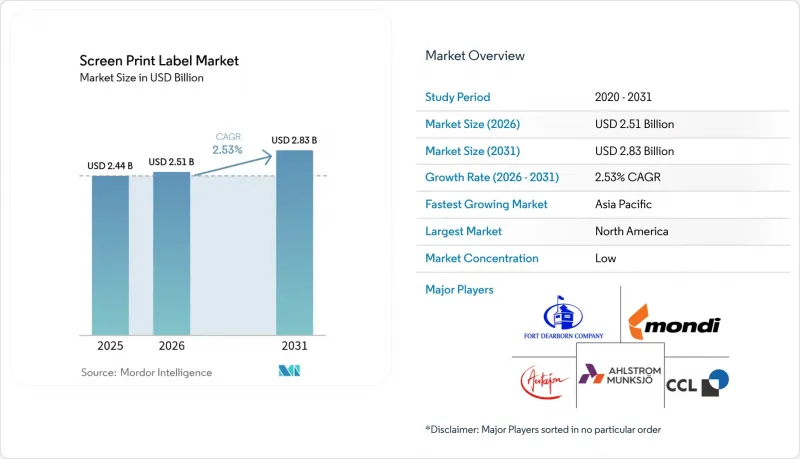
Mordor Intelligence에 의하면, 2026년 스크린 인쇄 라벨 시장 규모는 25억 1,000만 달러로 추정되고, 2025년 24억 4,000만 달러에서 확대해, 2031년에는 28억 3,000만 달러에 이를 것으로 예측됩니다.
2026-2031년 연평균 성장률(CAGR)은 2.53%가 될 것으로 전망됩니다.
본 보고서는 유형별(수축 슬리브 라벨, 라이너리스 라벨 등), 최종 사용자별(패션 및 의류, 식품, 음료 등), 인쇄 잉크 유형별(용제형, 수성, UV 경화형 등), 기판별(종이, 플라스틱 필름, 유리, 금속 등) 및 지역별로 분류되어 있습니다. 시장 예측은 금액(달러) 기준으로 제시되어 있습니다.
세계의 스크린 인쇄 라벨 시장 동향 및 인사이트
일용소비재를 위한 내구성 있는 브랜딩
브랜드 소유자들은 크세논 아크 조사, 반복적인 마모 및 리필 주기를 견딜 수 있는 라벨을 요구하고 있습니다. 유니레버는 2,000시간의 광노화 후에도 Delta E 2.0 이내의 색상 안정성을 요구하고 있으며, 이는 수성 스크린 잉크에 이산화티타늄을 고농도로 배합함으로써 달성되고 있습니다. 프록터 앤 갬블(P&G)의 ASTM D5264 기준 50 더블 러브(double rub) 임계값으로 인해, 용제형 디지털 잉크는 인증 목록에서 제외되었습니다. 유럽에서 리필 가능한 패키지로의 전환이 진행됨에 따라, 라벨은 박리되지 않고 15-20회의 고온 세척 주기를 견뎌야 합니다.
전자상거래 주문 처리용 내구성 있는 라벨
아마존의 2024년판 포장 규정에 따르면, 48시간 동안 물에 잠겨도 라벨이 손상되지 않아야 하며, 이에 따라 물류 센터에서는 아크릴계 접착제를 사용한 폴리에스테르 스크린 라벨의 채택이 확대되고 있습니다. ISTA 3L 낙하 시험에서는 40-60 G의 충격 하중이 가해지기 때문에 각 라벨 제조업체들은 접착제 도포 면적을 라벨 면적의 85%까지 확대되고 있습니다. 페덱스는 72시간 후의 박리 접착력을 최소 16온스/인치로 규정하고 있으나, 용제형 아크릴 스크린 잉크는 이 기준을 최대 35% 상회합니다.
다색 스크린 인쇄 설정에 드는 고비용
로터리식 설비에는 초기 비용으로 80만-120만 달러가 필요하며, 이는 보급형 디지털 인쇄기 가격의 4-5배에 해당합니다. 또한, 준비에 여전히 45-90분이 소요되기 때문에 소량 생산의 지연이나 폐기물 증가로 이어집니다. 그 때문에 신흥 시장의 각 컨버터 기업들은 금리가 하락하거나 수주가 더 긴 반복 주기로 전환될 때까지 생산 능력 확충을 미루고 있습니다.
부문 분석
수축 슬리브는 2025년 매출의 38.12%를 차지한 것으로 평가되었으며, 연평균 성장률(CAGR) 3.38%로 확대될 것으로 전망되어, 스크린 인쇄 라벨 시장이 범용 감압형 라벨 시장을 능가하는 성장을 이루는 한 요인이 되고 있습니다. 이 부문은 360도 그래픽 커버율, 최대 78%의 스팀 터널 수축률, 불규칙한 용기 디자인에 대한 적합성 등의 장점을 가지고 있습니다. ‘Pentalabel Boost’와 같은 에너지 절약형 필름은 증기 사용량을 30% 절감하여 용기 1개당 0.008-0.012달러의 비용 절감을 실현합니다. 라이너리스 솔루션은 시장 점유율 면에서는 뒤처지고 있지만, 폐기물이 없는 워크플로우를 추구하는 물류 업계 고객들로부터 지지를 받고 있습니다. 맥주 업계에서는 기존 유리병 생산 라인에 여전히 습식 접착 라벨이 사용되고 있지만, 캔의 보급에 따라 이 틈새 시장은 축소되는 추세입니다. 의류용 열전사 데칼과 내구재용 인몰드 성형 옵션도 제품 라인업을 풍부하게 하고 있으며, 각각이 가격 프리미엄을 유지하기 위한 특수한 요건을 충족하고 있습니다.
지속가능성과 진위성 확보가 추가적인 성장의 길을 열어주고 있습니다. 스크린 인쇄된 홀로그래픽 호일은 주류 및 화장품 업계의 위조 방지에 기여하고 있으며, 세척 가능한 잉크의 도입으로 재사용 가능한 포장의 순환 이용이 가능해졌습니다. 크래프트 음료 브랜드는 디지털 인쇄로는 생산 속도를 유지하면서 재현할 수 없는 엠보싱 바니시나 촉각 효과를 활용하고 있습니다. 수축 필름의 재활용은 여전히 과제로 남아 있지만, 단일 소재의 폴리에틸렌 슬리브와 박리성 접착제는 소매업체의 목표에 부합하는 사용 후 제품 처리 개선을 가져올 것으로 기대됩니다.
식품 브랜드는 알레르기 유발 물질 및 위조 방지에 관한 규제로 인해 판매량이 견조한 추세를 보이며 2025년 매출의 28.10%를 차지했으나, 화장품 및 퍼스널케어 분야는 4.38%라는 가장 높은 연평균 성장률(CAGR)이 예상됩니다. 고급 라인에서는 UV 스크린 인쇄만이 제공할 수 있는 메탈릭 잉크, 소프트 터치 니스, 그리고 화학적 내구성이 요구되고 있습니다. 로레알은 현재 유성 제제에 30일간 침지되어도 견딜 수 있도록 잉크의 가교 밀도를 85% 이상으로 규정하고 있습니다. 향후 도입될 FDA 건강 표시 라벨에서는 가변 데이터가 증가할 전망이지만, 하이브리드 스크린·디지털 워크플로우를 활용하면 색상 편차를 일으키지 않고 이 문제를 해결할 수 있습니다.
음료 분야에서는 크래프트 맥주 양조장이 장인 정신을 강조하는 질감 가공 라벨을 주문하고 있어 10%대 중반의 점유율을 차지하고 있습니다. 의약품의 일련번호 부여에는 600 dpi의 2차원 코드가 사용되는 반면, 산업용으로는 미네랄 스피릿에 노출되어도 견딜 수 있는 라벨이 요구됩니다. 패션 분야에서는 패스트 패션 브랜드들이 DTG(Direct-to-Garment) 인쇄를 채택함에 따라 라벨 수요가 완만하게 증가하고 있습니다. 그러나 명품 브랜드들은 여전히 브랜드의 전통을 중시하여 스크린 인쇄된 로고가 들어간 새틴 직조 라벨을 선호하고 있습니다.
지역별 분석
북미는 2025년 매출의 39.70%를 차지한 것으로 평가되었으며, 이는 ‘의약품 공급망 보안법(Drug Supply Chain Security Act)’에 따른 일련번호 부여가 두 자릿수의 재인쇄 수요를 유발했기 때문입니다. 미국의 각 컨버터 기업들은 UV-LED 생산 능력 확충에 최대 2억 2,000만 달러를 투자하여, 메탈릭 잉크와 촉감 마감을 요구하는 크래프트 음료 및 특산 식품 계약을 수주했습니다. 캐나다의 이중 언어 라벨 법에 따라 정보 밀도가 높아졌으며, 이는 불투명한 스크린 잉크에 유리하게 작용했습니다. 멕시코의 전자기기 마키라도라(수출가공구)에서는 260°C 리플로우에 대응하는 폴리이미드 라벨이 지정되어 지역적 수요가 더욱 강화되었습니다.
유럽은 매출의 약 4분의 1을 차지했습니다. ‘포장 및 포장 폐기물 규정’에 따라 2030년까지 라벨의 65%를 재생 소재로 구성해야 할 의무가 부과됨에 따라, 각 컨버터 기업들은 단일 소재 구조로의 전환을 추진하고 있습니다. 독일의 ‘VerpackG’에 따른 비재생 소재에 대한 과징금 및 영국의 UKCA 마크로의 전환으로 인해, 스크린 인쇄가 선호되는 소량 주문이 활성화되었습니다. 올리브 오일이나 와인의 원산지를 인증하기 위한 보안 홀로그램은 여전히 견조한 틈새 시장을 형성하고 있습니다.
아시아태평양에서는 2025년 후반으로 다가온 중국의 QR 코드 도입 기한으로 인해 수십억 개의 포장 식품에 영향이 미칠 것으로 예상에 따라, 2031년까지의 연평균 성장률(CAGR)은 4.98%를 나타낼 것으로 전망됩니다. 인도의 IS 17142,2024 접착 규격에 따라 습도가 높은 연안 지역에서는 습식 접착제의 채택이 가속화되고 있습니다. 일본의 무용제 인쇄기에 대한 세액 공제, 한국의 라벨 폐기물에 대한 보증금 제도, 호주의 ISO 22000 수출 기준 등이 해당 지역에서의 보급을 더욱 확대시키고 있습니다. 중동 및 아프리카의 성장률은 한 자릿수 중반을 기록하고 있으며, 사우디아라비아의 현지화 규정과 남아프리카공화국의 현지 조달 기준으로 인해 국내 인쇄기 도입이 진행되고 있습니다.
기타 혜택 :
- 엑셀 형식 시장 예측(ME) 시트
- 3개월간의 애널리스트 지원
자주 묻는 질문
목차
제1장 서론
제2장 조사 방법
제3장 주요 요약
제4장 시장 구도
제5장 시장 규모 및 성장 예측
제6장 경쟁 구도
제7장 시장 기회 및 향후 전망
AJY 26.09.11According to Mordor Intelligence, screen print label market size in 2026 is estimated at USD 2.51 billion, growing from 2025 value of USD 2.44 billion with 2031 projections showing USD 2.83 billion, growing at 2.53% CAGR over 2026-2031.
This report is Segmented by Type (Shrink Sleeves Label, Linerless Label, and More), End User (Fashion and Apparels, Food, Beverages, and More), Printing Ink Type (Solvent-Based, Water-Based, UV-Curable, and More), Substrate Material (Paper, Plastic Films, Glass, Metal, and More), and Geography. The Market Forecasts are Provided in Terms of Value (USD).
Global Screen Print Label Market Trends and Insights
Durable Branding for Fast-Moving Consumer Goods
Brand owners mandate labels that survive xenon-arc exposure, repeated abrasion, and refill-pack cycles. Unilever requires color stability within Delta E 2.0 after 2,000 hours of light aging, which water-based screen inks achieve through high titanium dioxide loading. Procter and Gamble's 50-double-rub threshold under ASTM D5264 keeps solvent-based digital inks off qualified lists. As Europe shifts to refillable packs, labels must also withstand 15-20 hot-wash cycles without delaminating.
Robust Labels for E-Commerce Fulfillment
Amazon's 2024 packaging rules require labels that remain intact after 48 hours of water immersion, directing fulfillment centers toward polyester screen constructions with acrylic adhesives. ISTA 3L drop tests add 40-60 G shock loads, so converters raise adhesive coverage to 85% of the footprint. FedEx specifies a minimum peel adhesion of 16 oz/in after 72 hours, which solvent-acrylic screen inks exceed by up to 35%.
High Cost of Multicolor Screen-Printing Setups
Rotary equipment needs USD 800,000-1.2 million upfront, four to five times the ticket price of an entry-level digital press. Make-ready still takes 45-90 minutes, delaying short runs and increasing scrap. Emerging-market converters, therefore, delay capacity additions until interest rates ease or orders shift to longer repeats.
Other drivers and restraints analyzed in the detailed report include:
- Advancements in UV-LED Screen Printing Equipment
- Smart-Label Integration with RFID and QR Codes
- Competition from Digital Inkjet Label Printing
For complete list of drivers and restraints, kindly check the Table Of Contents.
Segment Analysis
Shrink sleeves accounted for 38.12% of 2025 revenue and are expected to advance at a 3.38% CAGR, helping the screen print label market outpace commodity pressure-sensitive formats. The segment benefits from 360-degree graphic coverage, steam tunnel shrinkage of up to 78%, and compatibility with irregular container designs. Energy-efficient films such as Pentalabel Boost cut steam use by 30%, shaving USD 0.008-0.012 per container. Linerless solutions lag in share but appeal to logistics customers seeking waste-free workflows. Wet-glued labels cling to legacy glass-bottle lines in beer, yet this niche is shrinking as cans gain traction. Heat-transfer decals for apparel and in-mold options for durable goods complete the mix, each serving specialized requirements that sustain price premiums.
Sustainability and authentication extend the growth runway. Screen-printed holographic foils deter counterfeiters in the spirits and cosmetics industries, while washable inks enable the use of returnable packaging loops. Craft beverage brands exploit raised varnish and tactile effects that digital cannot replicate at production speed. Although shrink-film recycling remains a hurdle, mono-material polyethylene sleeves and delaminating adhesives promise end-of-life gains that align with retailer targets.
Food brands held 28.10% of 2025 sales as allergen and tamper-evidence rules kept volumes high, but cosmetics and personal care is set for the fastest 4.38% CAGR. Prestige lines demand metallic inks, soft-touch varnish, and chemical endurance that only UV-screen builds provide. L'Oreal now specifies ink cross-link density above 85% to survive 30-day immersion in oily formulations. Upcoming FDA healthy-claim labels add more variable data, a task that hybrid screen-digital workflows solve without color drift.
Beverage applications enjoy mid-teens share as craft breweries order textured labels that reinforce artisanal cues. Pharmaceutical serialization utilizes two-dimensional codes at 600 dpi, whereas industrial applications require labels that withstand exposure to mineral spirits. Fashion labels grow modestly as fast-fashion brands adopt direct-to-garment printing; yet, luxury houses still favor woven satin with screen-printed logos for their brand heritage.
Complete Report Scope:
- By Type
- Shrink Sleeves Label
- Linerless Label
- Wet-Glued Label
- Other Types
- By End User
- Fashion and Apparels
- Food
- Beverages
- Cosmetics and Personal Care
- Other End Users
- By Printing Ink Type
- Solvent-Based
- Water-Based
- UV-Curable
- Silicone Ink
- Other Printing Ink Types
- By Substrate Material
- Paper
- Plastic Films
- Glass
- Metal
- Fabric
- Other Substrates
- By Geography
- North America
- United States
- Canada
- Mexico
- South America
- Brazil
- Argentina
- Rest of South America
- Europe
- Germany
- United Kingdom
- France
- Italy
- Spain
- Rest of Europe
- Asia Pacific
- China
- Japan
- India
- South Korea
- Australia and New Zealand
- Rest of Asia Pacific
- Middle East and Africa
- Middle East
- Saudi Arabia
- United Arab Emirates
- Turkey
- Rest of Middle East
- Africa
- South Africa
- Egypt
- Nigeria
- Rest of Africa
- Middle East
- North America
Geography Analysis
North America accounted for 39.70% of 2025 revenue, driven by the Drug Supply Chain Security Act serialization, which spurred double-digit reprint demand. United States converters invested up to USD 220 million in UV-LED capacity, winning craft beverage and specialty food contracts that crave metallic inks and tactile finishes. Canada's bilingual label law increased information density, a benefit for opaque screen inks. Mexico's electronics maquiladoras specified polyimide labels rated for 260 °C reflow, reinforcing regional demand.
Europe accounted for roughly one-quarter of sales. The Packaging and Packaging Waste Regulation mandates 65% recycled content in labels by 2030, prompting converters to shift toward mono-material builds. Germany's VerpackG fees on non-recyclables and the United Kingdom's UKCA symbol changeover fueled short-run orders that favored screen printing. Security holograms for authenticating the origin of olive oil and wine remain a resilient niche.
The Asia-Pacific region is expected to post a 4.98% CAGR through 2031 due to China's late-2025 QR-code deadline, which will affect billions of packaged food units. India's IS 17142:2024 adhesion rule accelerates the adoption of wet glue in humid coastal corridors. Japanese tax credits for solvent-free presses, South Korean deposit fees on label waste, and Australian ISO 22000 export standards further expand regional uptake. Middle East and African growth hovers near mid-single digits, with Saudi localization rules and South African local-content thresholds prompting domestic press installations.
- 3M Company
- Ahlstrom-Munksjo Oyj
- Autajon Group
- Avery Dennison Corporation
- Brady Corporation
- CCL Industries Inc.
- Constantia Flexibles Group GmbH
- Coveris Group
- Fort Dearborn Company
- Fuji Seal International Inc.
- Gallus Ferd. Ruesch AG
- Huhtamaki Oyj
- Inland Label and Marketing Services LLC
- Lintec Corporation
- Mondi plc
- Multi-Color Corporation
- R.R. Donnelley and Sons Company
- SATO Holdings Corporation
- TSC Auto ID Technology Co. Ltd.
- UPM Raflatac (UPM-Kymmene Corporation)
- Xeikon (Flint Group)
Additional Benefits:
- The market estimate (ME) sheet in Excel format
- 3 months of analyst support
TABLE OF CONTENTS
1 INTRODUCTION
- 1.1 Study Assumptions and Market Definition
- 1.2 Scope of the Study
2 RESEARCH METHODOLOGY
3 EXECUTIVE SUMMARY
4 MARKET LANDSCAPE
- 4.1 Market Overview
- 4.2 Market Drivers
- 4.2.1 Rising Demand for Durable Branding Solutions in Fast-Moving Consumer Goods
- 4.2.2 Growth of E-Commerce Requiring Robust Packaging Labels
- 4.2.3 Advancements in UV-LED Screen Printing Equipment
- 4.2.4 Proliferation of Smart Label Features Integrating RFID and QR Codes
- 4.2.5 Sustainability Push Toward Solvent-Free Screen Printing Inks
- 4.2.6 Increasing Adoption of Heat-Resistant Labels in Electric Vehicle Batteries
- 4.3 Market Restraints
- 4.3.1 High Cost of Multicolor Screen Printing Setups
- 4.3.2 Competition from Digital Inkjet Label Printing
- 4.3.3 Volatility in Petrochemical Raw Material Prices for Inks
- 4.3.4 Stringent Environmental Regulations on Volatile Organic Compound Emissions
- 4.4 Industry Value Chain Analysis
- 4.5 Impact of Macroeconomic Factors on the Market
- 4.6 Regulatory Landscape
- 4.7 Technological Outlook
- 4.8 Porter's Five Forces Analysis
- 4.8.1 Threat of New Entrants
- 4.8.2 Bargaining Power of Buyers or Consumers
- 4.8.3 Bargaining Power of Suppliers
- 4.8.4 Threat of Substitute Products
- 4.8.5 Intensity of Competitive Rivalry
5 MARKET SIZE AND GROWTH FORECASTS (VALUE)
- 5.1 By Type
- 5.1.1 Shrink Sleeves Label
- 5.1.2 Linerless Label
- 5.1.3 Wet-Glued Label
- 5.1.4 Other Types
- 5.2 By End User
- 5.2.1 Fashion and Apparels
- 5.2.2 Food
- 5.2.3 Beverages
- 5.2.4 Cosmetics and Personal Care
- 5.2.5 Other End Users
- 5.3 By Printing Ink Type
- 5.3.1 Solvent-Based
- 5.3.2 Water-Based
- 5.3.3 UV-Curable
- 5.3.4 Silicone Ink
- 5.3.5 Other Printing Ink Types
- 5.4 By Substrate Material
- 5.4.1 Paper
- 5.4.2 Plastic Films
- 5.4.3 Glass
- 5.4.4 Metal
- 5.4.5 Fabric
- 5.4.6 Other Substrates
- 5.5 By Geography
- 5.5.1 North America
- 5.5.1.1 United States
- 5.5.1.2 Canada
- 5.5.1.3 Mexico
- 5.5.2 South America
- 5.5.2.1 Brazil
- 5.5.2.2 Argentina
- 5.5.2.3 Rest of South America
- 5.5.3 Europe
- 5.5.3.1 Germany
- 5.5.3.2 United Kingdom
- 5.5.3.3 France
- 5.5.3.4 Italy
- 5.5.3.5 Spain
- 5.5.3.6 Rest of Europe
- 5.5.4 Asia Pacific
- 5.5.4.1 China
- 5.5.4.2 Japan
- 5.5.4.3 India
- 5.5.4.4 South Korea
- 5.5.4.5 Australia and New Zealand
- 5.5.4.6 Rest of Asia Pacific
- 5.5.5 Middle East and Africa
- 5.5.5.1 Middle East
- 5.5.5.1.1 Saudi Arabia
- 5.5.5.1.2 United Arab Emirates
- 5.5.5.1.3 Turkey
- 5.5.5.1.4 Rest of Middle East
- 5.5.5.2 Africa
- 5.5.5.2.1 South Africa
- 5.5.5.2.2 Egypt
- 5.5.5.2.3 Nigeria
- 5.5.5.2.4 Rest of Africa
- 5.5.5.1 Middle East
- 5.5.1 North America
6 COMPETITIVE LANDSCAPE
- 6.1 Market Concentration
- 6.2 Strategic Moves
- 6.3 Market Share Analysis
- 6.4 Company Profiles (includes Global Level Overview, Market Level Overview, Core Segments, Financials as Available, Strategic Information, Market Rank or Share for Key Companies, Products and Services, and Recent Developments)
- 6.4.1 3M Company
- 6.4.2 Ahlstrom-Munksjo Oyj
- 6.4.3 Autajon Group
- 6.4.4 Avery Dennison Corporation
- 6.4.5 Brady Corporation
- 6.4.6 CCL Industries Inc.
- 6.4.7 Constantia Flexibles Group GmbH
- 6.4.8 Coveris Group
- 6.4.9 Fort Dearborn Company
- 6.4.10 Fuji Seal International Inc.
- 6.4.11 Gallus Ferd. Ruesch AG
- 6.4.12 Huhtamaki Oyj
- 6.4.13 Inland Label and Marketing Services LLC
- 6.4.14 Lintec Corporation
- 6.4.15 Mondi plc
- 6.4.16 Multi-Color Corporation
- 6.4.17 R.R. Donnelley and Sons Company
- 6.4.18 SATO Holdings Corporation
- 6.4.19 TSC Auto ID Technology Co. Ltd.
- 6.4.20 UPM Raflatac (UPM-Kymmene Corporation)
- 6.4.21 Xeikon (Flint Group)
7 MARKET OPPORTUNITIES AND FUTURE OUTLOOK
- 7.1 White-Space and Unmet-Need Assessment