|
시장보고서
상품코드
2124537
북미의 인쇄 라벨 : 시장 점유율 분석, 산업 동향 및 통계 데이터, 성장 예측(2026-2031년)North America Print Label - Market Share Analysis, Industry Trends & Statistics, Growth Forecasts (2026 - 2031) |
||||||
 Mordor Intelligence
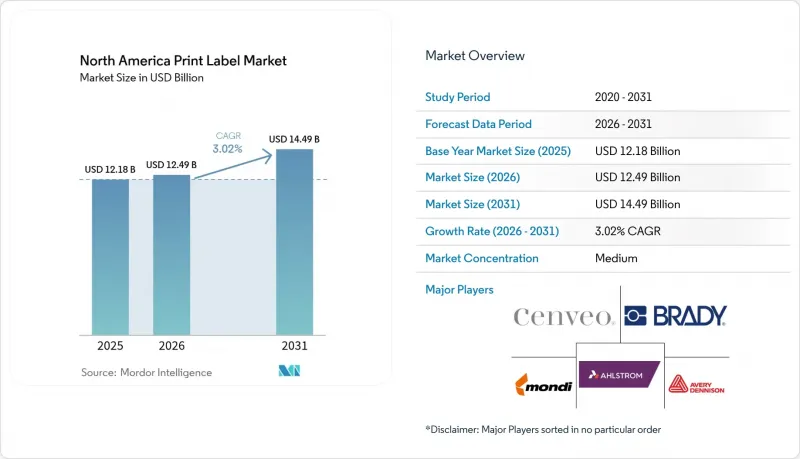
Mordor Intelligence에 의하면, 북미의 인쇄 라벨 시장 규모는 2025년 121억 8,000만 달러로 평가되었습니다. 2026년에는 124억 9,000만 달러로 확대되어 2031년까지 144억 9,000만 달러에 이를 것으로 예측되며, 2026년부터 2031년에 걸쳐 CAGR 3.02%로 성장할 전망입니다.
본 보고서는 기판(종이 및 판지, 폴리에틸렌 테레프탈레이트 등),인쇄 기술(플렉소 인쇄, 스크린 인쇄 등), 라벨 유형(습식 접착 라벨, 감압 접착 라벨, 라이너리스 라벨 등), 최종 사용자 산업(식품, 음료, 의료 및 의약품 등), 국가별로 분류되어 있습니다. 시장 예측은 금액(달러) 기준으로 제시되어 있습니다.
북미의 인쇄 라벨 시장 동향 및 인사이트
디지털 인쇄 기술에 대한 수요 증가
디지털 인쇄기는 5,000 리니어피트 미만의 소량 생산을 경제적으로 실현 가능하게 함으로써 북미의 인쇄 라벨 시장의 경제 구조를 변화시키고 있습니다. RR Donnelley사는 2025년 6월, HP Indigo 120K 인쇄기를 도입하고 로봇을 이용한 자재 이송 시스템과 결합함으로써 소량 생산의 효율화를 도모했습니다. Cimpress사는 2025년 5월, 자사 네트워크 전체에 최대 20대의 HP Indigo 유닛을 추가로 도입하기로 결정하며, 2027년까지의 맞춤형 패키징 수요에 대한 자신감을 나타냈습니다. Taylor Corporation의 사내 데이터에 따르면, 플렉소 인쇄와 비교한 디지털 인쇄의 손익분기점은 약 3,000피트로, 5년 전의 8,000피트에서 낮아졌습니다. 이러한 경제성 덕분에 소규모 컨버터라도 전국 규모의 소매업체들이 점점 더 요구하는 48시간 납기 조건에서 경쟁할 수 있게 되었습니다. 또한 디지털 플랫폼의 유연성 덕분에 아날로그 라인에서는 구현하기 어려운 일련번호 부여, 고유 QR 코드, 증강현실(AR) 트리거 등도 지원됩니다.
전자상거래 물류 분야의 가변 데이터 인쇄 급증
온라인 소매의 급속한 확장에 따라 고유 바코드, 반품 데이터, 브랜드 메시지가 필요한 배송 라벨의 수가 비약적으로 증가하고 있습니다. 미국의 주요 제3자 물류(3PL) 업체들은 현재 팔레트 분류 자동화를 위해 RFID(무선 주파수 식별) 지원 라벨을 지정하고 있으며, 이러한 요구 사항은 2025년부터 입고 팔레트에 RFID 태그 부착을 의무화하는 아마존의 정책에 의해 가속화되고 있습니다. 2025년 6월에 도입된 에이버리 데니슨의 APR 인증 단일 소재 RFID 라벨은 각 컨버터 기업들이 지속가능성과 스마트 라벨 기능을 어떻게 융합하고 있는지를 보여줍니다. 일련번호 라벨 수요의 급증에 따라, 각 컨버터 업체들은 고객의 엔터프라이즈 시스템에서 직접 대량의 데이터 스트림을 가져올 수 있는 디지털 프론트엔드 소프트웨어 도입을 피할 수 없게 되었습니다. 이와 동시에, 풀필먼트 센터에서는 고속 라벨 부착기에서 폐기물을 줄일 수 있는 라이너리스 형식이 선호되고 있어, 직접 와인딩 구조에 대한 수요 증가가 더욱 가속화되고 있습니다.
극저온 콜드체인 용도에서의 내구성 부족
초저온으로 운송되는 메신저 RNA 백신 및 세포 치료제로 인해 북미의 인쇄 라벨 시장에서 접착제 및 표면재의 결함이 드러났습니다. RxSource사는 동결·해동 주기 동안 라벨이 박리되거나 바코드가 퇴색되는 현상을 확인했으며, 유리 전이 온도가 40°C 미만인 아크릴계 시스템 외에도 취화 현상에 강한 폴리프로필렌 재질의 페이스 스톡 사용을 권장하고 있습니다. FDA의 우수 제조 관리 기준(GMP) 규정에 따르면, 라벨은 보관 기간 내내 판독 가능해야 하며, 재료에 결함이 발생할 경우 컨버터의 책임은 더욱 무거워집니다. 바이오젠(Biogen)은 -80°C에서 10회의 가속 동결·해동 시험을 통해 라벨을 검증하고 있으며, 이 프로토콜은 생명공학 업계 고객들 사이에서 점차 확산되고 있습니다. 접착제의 재조성으로 인해 재료비가 최대 25% 증가하여, 이미 까다로운 가격 조건으로 입찰된 계약의 이익률이 압박받고 있습니다. 극저온 대응 구조 인증을 취득할 수 있는 틈새 시장 변환업체들은 이 특수한 수요 분야에서 시장 점유율을 확보하고 있습니다.
부문별 분석
2025년, 폴리에틸렌 테레프탈레이트(PET)는 강인성, 투명성 및 고속 충진 적합성을 바탕으로 북미의 인쇄 라벨 시장에서 36.98%의 점유율을 유지했습니다. 순환 경제 목표를 추구하는 브랜드 소유주들은 바이오 및 퇴비화 가능한 필름의 채택을 추진하고 있으며, 이 시장은 연평균 성장률(CAGR) 4.56%로 확대되고 있지만, 현재의 높은 비용으로 인해 그 채택은 고급 유기농 제품 및 웰니스 제품 라인으로 제한되고 있습니다. 종이는 자연스러운 외관이 중시되는 와인 및 수제 식품 분야에서 여전히 중요한 역할을 하고 있는 반면, 폴리프로필렌은 형태 적응성이 요구되는 압출 포장 분야에서 주류를 이루고 있습니다. 폴리염화비닐(PVC)은 환경적 비판을 받아 점유율이 계속 줄어들고 있지만, 그 내용제성이 여전히 타의 추종을 불허하는 산업용 화학 약품 분야에서는 여전히 사용되고 있습니다. 플라스틱 재활용 협회(Association of Plastic Recyclers)가 제정한 설계 프로토콜은 현재 사양서에 영향을 미치고 있으며, 변환업체들이 폴리에틸렌 재활용 흐름을 오염시키는 표면재의 사용을 피하도록 권장하고 있습니다.
공급 부족으로 인해 기판 선정이 더욱 어려워지고 있습니다. Pixel사의 제지 공장 가동 중단으로 인해 가공업체들은 특수 코팅지를 확보하기 위해 분주하게 움직여야만 했으며, 일부 와인 브랜드는 공급망의 위험 없이 종이의 미관을 재현하는 질감 가공된 폴리프로필렌 표면재의 시험 도입을 단행했습니다. UPM사의 노스캐롤라이나주 확장으로 인해 박리 라이너의 생산량이 증가하여 유럽의 생산량 감소를 일부 상쇄했으나, 시장의 불안감은 여전히 남아 있습니다. Beontag사는 오하이오주에 4,000만 달러를 투자하여 특수 생산 라인을 설치하고, 고급 접착제의 현지 생산을 실현했습니다. 스마트 라벨의 성장도 또 다른 촉진요인이 되고 있으며, RFID 안테나에는 신호 감쇠를 억제하는 기판이 요구되고 있습니다. Avery Dennison사의 단일 소재 폴리에틸렌 구조는 이러한 요구를 충족시키는 동시에 재활용 업체의 수거 기준에도 부합합니다.
플렉소 인쇄는 1만피트를 초과하는 로트에서의 생산성과 저VOC 수성 잉크와의 호환성 덕분에 2025년에는 시장 점유율의 44.96%를 차지했습니다. HP Indigo, Xeikon 및 잉크젯 하이브리드가 주도하는 디지털 시스템은 각 컨버터 기업들이 지역 수제 맥주, 한정판 화장품 및 소비자용 직접 리필 팩 주문을 추구하는 가운데, 2026년부터 2031년까지 연평균 4.32%의 속도로 확대되고 있습니다. RR Donnelley의 조지아 주 시설에는 새로운 HP Indigo 120K와 자동 마감 공정이 통합되어 있으며, 이는 아날로그와 디지털이 대규모로 공존하고 있는 한 예입니다. Cimpress가 계획하고 있는 인쇄기 군 확충은 특히 대량 맞춤화 웹 포털을 통해 개인화된 인쇄물에 대한 수요가 지속되고 있음을 뒷받침합니다.
메탈릭 잉크나 고잉크량 인쇄가 필수적인 분야에서는 오프셋 인쇄와 스크린 인쇄가 틈새 시장을 유지하고 있습니다. 한편, 미국 환경보호청(EPA)은 2026년에 40 CFR Part 60 Subpart RR 규제를 강화할 예정이며, 이로 인해 용제형 잉크에 의존하고 있는 각 컨버터 업체들은 UV 경화형 또는 수성 시스템으로의 전환을 강요받게 될 것입니다. 캘리포니아주의 대기 관리 구역에서는 이미 엄격한 기준이 제정되어 있어, 디지털 인쇄기와 자연스럽게 조화를 이루는 저배출 플랫폼으로의 전환이 사실상 가속화되고 있습니다. 자금 문제는 여전히 장벽으로 남아 있습니다. 보급형 잉크젯 모델은 50만 달러에 육박하고, 대량 생산용 토너 라인은 100만 달러를 초과하기 때문에 규모의 경제를 추구하는 인쇄업체 간의 합병이 진행되고 있습니다.
기타 혜택 :
- 엑셀 형식 시장 예측(ME) 시트
- 3개월간의 애널리스트 지원
자주 묻는 질문
목차
제1장 서론
제2장 분석 방법
제3장 주요 요약
제4장 시장 구도
제5장 시장 규모 및 성장률 예측
제6장 경쟁 구도
제7장 시장 기회 및 향후 전망
KTH 26.09.14According to Mordor Intelligence, the North America print label market size is expected to increase from USD 12.18 billion in 2025 to USD 12.49 billion in 2026 and reach USD 14.49 billion by 2031, growing at a CAGR of 3.02% over 2026-2031.
This report is Segmented by Substrate Material (Paper and Paperboard, Polyethylene Terephthalate, and More), Print Technology (Flexography, Screen, and More), Label Type (Wet-Glued Labels, Pressure-Sensitive Labels, Liner-Less Labels, and More), End-User Industry (Food, Beverage, Healthcare and Pharmaceutical, and More), and Country. The Market Forecasts are Provided in Terms of Value (USD).
North America Print Label Market Trends and Insights
Growing Demand for Digital Print Technologies
Digital presses are changing the economics of the North America print label market by making runs under 5 000 linear feet financially viable. RR Donnelley installed an HP Indigo 120K press in June 2025, pairing it with robotic material handling to streamline short-run production. Cimpress committed in May 2025 to add up to 20 more HP Indigo units across its network, signaling confidence in personalized packaging demand through 2027. Taylor Corporation's in-house data pegs the digital break-even point versus flexography at roughly 3 000 feet, down from 8 000 feet five years ago. These economics allow smaller converters to compete on 48-hour turnaround times that national retailers increasingly expect. The flexibility of digital platforms also supports serialization, unique QR codes, and augmented-reality triggers that are impractical on analog lines.
Surge in Variable Data Printing for E-commerce Logistics
Rapid expansion of online retail has multiplied the number of shipping labels that require unique barcodes, return data, and branded messaging. Major U.S. third-party logistics operators now specify radio-frequency identification (RFID)- enabled labels to automate pallet sortation, a requirement accelerated by Amazon's mandate that inbound pallets carry RFID tags from 2025. Avery Dennison's APR-recognized mono-material RFID label, introduced in June 2025, demonstrates how converters are merging sustainability with smart-label functionality. The boom in serialized labels obliges converters to deploy digital front-end software capable of ingesting high-volume data streams directly from customer enterprise systems. In parallel, fulfillment centers prefer liner-less formats that reduce waste on high-speed applicators, reinforcing volume growth for direct-wound constructions.
Inadequate Durability in Extreme Cold-Chain Applications
Messenger RNA vaccines and cell therapies shipped at ultra-low temperatures have exposed adhesive and facestock failures within the North America print label market. RxSource identified delamination and barcode fading during freeze-thaw cycles and recommends acrylic systems with sub-40 °C glass-transition points plus polypropylene facestocks that resist embrittlement. FDA good manufacturing practice rules obligate labels to remain legible throughout shelf life, elevating converters' liability when materials fail. Biogen validates labels through 10 accelerated freeze-thaw tests at -80 °C, a protocol spreading across biotech customers. Reformulating adhesives increases material cost by up to 25%, squeezing margins on contracts already tendered at tight pricing. Niche converters able to certify cryogenic constructions capture a share in this specialized pocket of demand.
Other drivers and restraints analyzed in the detailed report include:
- Sustainability-Driven Switch to Liner-Less and Shrink-Sleeve Formats
- Healthcare UDI-Labeling Mandates
- Supply Volatility of Specialty Label-Stock Papers
For complete list of drivers and restraints, kindly check the Table Of Contents.
Segment Analysis
Polyethylene terephthalate maintained a 36.98% share of the North America print label market in 2025, supported by its toughness, transparency, and suitability for high-speed bottling. Brand owners pursuing circular-economy goals are adding biobased and compostable films that are advancing at a 4.56% CAGR, though current cost premiums confine adoption to premium organic and wellness lines. Paper retains relevance for wine and artisanal food where a natural look matters, while polypropylene dominates squeezable packaging that demands conformability. Polyvinyl chloride continues to retreat under environmental scrutiny, yet it persists in industrial chemicals where its solvent resistance remains unmatched. Association of Plastic Recyclers design protocols now influence specification sheets, encouraging converters to avoid facestocks that contaminate polyethylene recycling streams.
Supply shocks exacerbate substrate decisions. Pixelle's mill shutdown left converters scrambling for specialty coated papers, pushing some wine brands to test textured polypropylene facestocks that mimic paper aesthetics without supply-chain risk. UPM's expansion in North Carolina added release-liner output that partly offsets lost European tonnage, but market anxiety lingers. Beontag invested USD 40 million to install a specialty line in Ohio that localizes high-end self-adhesive materials. Smart-label growth is another driver, as RFID antennas demand substrates that limit signal attenuation; Avery Dennison's mono-material polyethylene construction meets this need while aligning with recycler acceptance criteria.
Flexography held 44.96% of the market share in 2025, thanks to its productivity on runs exceeding 10,000 feet and its compatibility with low-VOC water-based inks. Digital systems, led by HP Indigo, Xeikon, and inkjet hybrids, are expanding at 4.32% across 2026-2031 as converters chase orders for regional craft beer, limited-edition cosmetics, and direct-to-consumer replenishment packs. RR Donnelley's Georgia facility integrates a new HP Indigo 120K with automated finishing, an illustration of analog and digital coexistence at scale. Cimpress's planned fleet expansion confirms sustained appetite for personalized prints, especially across mass-customization web portals.
Offset and screen retain niche roles where metallic inks or heavy lay-downs are critical. Meanwhile, the U.S. Environmental Protection Agency will tighten 40 CFR Part 60 Subpart RR limits in 2026, pushing converters reliant on solvent inks toward UV-curable or aqueous systems. California air districts have already enacted stricter thresholds, effectively accelerating the pivot to lower-emission platforms that naturally align with digital presses. Capital remains a barrier: entry-level inkjet models cost near USD 500 000 and high-volume toner lines exceed USD 1 million, driving mergers among printers seeking economies of scale.
Complete Report Scope:
- By Substrate Material
- Paper and Paperboard
- Polyethylene Terephthalate (PET)
- Polypropylene (PP and BOPP)
- Polyvinyl Chloride (PVC)
- Biobased and Compostable Films
- Other Substrate Materials
- By Print Technology
- Offset
- Flexography
- Screen
- Digital Printing
- Other Print Technologies
- By Label Type
- Wet-glued Labels
- Pressure-Sensitive Labels
- Liner-less Labels
- In-mold Labels
- Shrink Sleeve Labels
- Other Label Types
- By End-user Industry
- Food
- Beverage
- Healthcare and Pharmaceutical
- Cosmetics and Personal Care
- Industrial
- Other End-user Industries
- By Country
- United States
- Canada
- Mexico
List of Companies Covered in this Report:
- Avery Dennison Corporation
- CCL Industries Inc.
- Multi-Color Corporation
- Brady Corporation
- Smurfit Westrock
- Mondi plc
- Ahlstrom-Munksjo Oyj
- Cenveo Worldwide Limited
- Resource Label Group, LLC
- Blue Label Packaging Company
- OMNI Systems Inc.
- Inovar Packaging Group
- Fort Dearborn Company
- RR Donnelley and Sons Company
- Fortis Solutions Group, LLC
- Traco Manufacturing, Inc.
- UPM-Raflatac Oy
- Brook + Whittle Holdings, LLC
- Lux Global Label Company
- Consolidated Label Co.
Additional Benefits:
- The market estimate (ME) sheet in Excel format
- 3 months of analyst support
TABLE OF CONTENTS
1 INTRODUCTION
- 1.1 Study Assumptions and Market Definition
- 1.2 Scope of the Study
2 RESEARCH METHODOLOGY
3 EXECUTIVE SUMMARY
4 MARKET LANDSCAPE
- 4.1 Market Overview
- 4.2 Market Drivers
- 4.2.1 Growing Demand for Digital Print Technologies
- 4.2.2 Surge in Variable Data Printing for E-commerce Logistics
- 4.2.3 Sustainability-Driven Switch to Linerless and Shrink-Sleeve Formats
- 4.2.4 Healthcare UDI-Labeling Mandates
- 4.2.5 AI-Enabled Print Workflow Automation Reducing Turnaround Time
- 4.2.6 Brand Protection and Anti-Counterfeit Features Integration
- 4.3 Market Restraints
- 4.3.1 Inadequate Durability in Extreme Cold-Chain Applications
- 4.3.2 Supply Volatility of Specialty Label-Stock Papers
- 4.3.3 Capital-Intensive Transition from Analog to Digital Presses
- 4.3.4 Stringent VOC and Ink-Migration Regulations Tightening in 2026
- 4.4 Industry Value Chain Analysis
- 4.5 Regulatory Landscape
- 4.6 Technological Outlook
- 4.7 Porter's Five Forces Analysis
- 4.7.1 Bargaining Power of Suppliers
- 4.7.2 Bargaining Power of Buyers
- 4.7.3 Threat of New Entrants
- 4.7.4 Threat of Substitutes
- 4.7.5 Competitive Rivalry
- 4.8 Impact of Macroeconomic Factors on the Market
5 MARKET SIZE AND GROWTH FORECASTS (VALUE)
- 5.1 By Substrate Material
- 5.1.1 Paper and Paperboard
- 5.1.2 Polyethylene Terephthalate (PET)
- 5.1.3 Polypropylene (PP and BOPP)
- 5.1.4 Polyvinyl Chloride (PVC)
- 5.1.5 Biobased and Compostable Films
- 5.1.6 Other Substrate Materials
- 5.2 By Print Technology
- 5.2.1 Offset
- 5.2.2 Flexography
- 5.2.3 Screen
- 5.2.4 Digital Printing
- 5.2.5 Other Print Technologies
- 5.3 By Label Type
- 5.3.1 Wet-glued Labels
- 5.3.2 Pressure-Sensitive Labels
- 5.3.3 Liner-less Labels
- 5.3.4 In-mold Labels
- 5.3.5 Shrink Sleeve Labels
- 5.3.6 Other Label Types
- 5.4 By End-user Industry
- 5.4.1 Food
- 5.4.2 Beverage
- 5.4.3 Healthcare and Pharmaceutical
- 5.4.4 Cosmetics and Personal Care
- 5.4.5 Industrial
- 5.4.6 Other End-user Industries
- 5.5 By Country
- 5.5.1 United States
- 5.5.2 Canada
- 5.5.3 Mexico
6 COMPETITIVE LANDSCAPE
- 6.1 Market Concentration
- 6.2 Strategic Moves
- 6.3 Market Share Analysis
- 6.4 Company Profiles (Includes Global Level Overview, Market Level Overview, Core Segments, Financials as Available, Strategic Information, Market Rank/Share, Products and Services, and Recent Developments)
- 6.4.1 Avery Dennison Corporation
- 6.4.2 CCL Industries Inc.
- 6.4.3 Multi-Color Corporation
- 6.4.4 Brady Corporation
- 6.4.5 Smurfit Westrock
- 6.4.6 Mondi plc
- 6.4.7 Ahlstrom-Munksjo Oyj
- 6.4.8 Cenveo Worldwide Limited
- 6.4.9 Resource Label Group, LLC
- 6.4.10 Blue Label Packaging Company
- 6.4.11 OMNI Systems Inc.
- 6.4.12 Inovar Packaging Group
- 6.4.13 Fort Dearborn Company
- 6.4.14 RR Donnelley and Sons Company
- 6.4.15 Fortis Solutions Group, LLC
- 6.4.16 Traco Manufacturing, Inc.
- 6.4.17 UPM-Raflatac Oy
- 6.4.18 Brook + Whittle Holdings, LLC
- 6.4.19 Lux Global Label Company
- 6.4.20 Consolidated Label Co.
7 MARKET OPPORTUNITIES AND FUTURE OUTLOOK
- 7.1 White-Space and Unmet-Need Assessment