
|
시장보고서
상품코드
2124071
마이크로 인버터 시장 : 점유율 분석, 업계 동향과 통계, 성장 예측(2026-2031년)Micro Inverter - Market Share Analysis, Industry Trends & Statistics, Growth Forecasts (2026 - 2031) |
||||||
 Mordor Intelligence
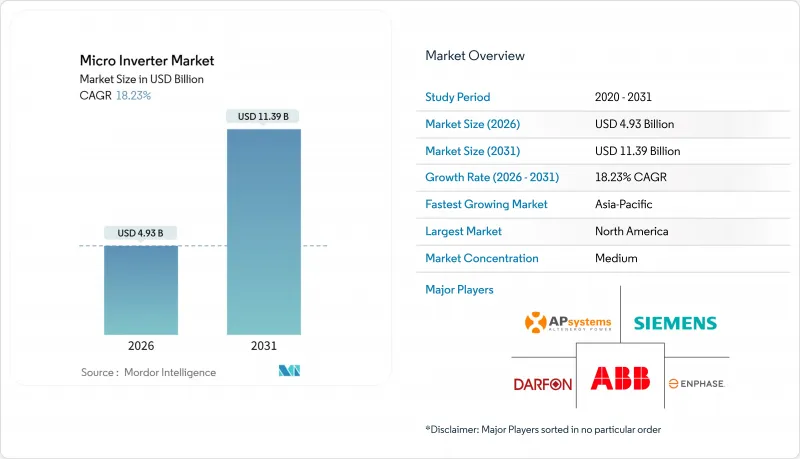
Mordor Intelligence에 의하면, 마이크로 인버터 시장 규모는 2026년에 49억 3,000만 달러가 되어, 2031년까지 113억 9,000만 달러에 이를 것으로 예측되며, 예측 기간중은 CAGR 18.23%로 성장할 전망입니다.
본 보고서는 상수(단상 및 3상), 통신 기술(유선 및 무선), 구성 요소(하드웨어, 소프트웨어, 서비스), 판매 채널(직접 판매(OEM/온라인), 간접 판매(유통업체/설치 업체)),용도(주거용 옥상, 상업 및 산업용 옥상, 태양광 발전소/유틸리티 규모), 지역별로 분류되어 있습니다. 시장 예측은 금액(달러) 기준으로 제시되어 있습니다.
세계 마이크로 인버터 시장 동향 및 인사이트
NEC 690.12의 화재 안전 요건
NEC 690.12를 시행하고 있는 미국의 관할 구역에서는 옥상 태양광 발전 시스템에 대해 비상 신호 발생 후 30초 이내에 도체 전압을 안전한 수준까지 낮출 것을 의무화하고 있으며, 이로 인해 기존의 스트링 인버터는 사실상 사용할 수 없게 되었습니다. 마이크로 인버터는 각 패널이 모듈 수준에서 절연되어 있기 때문에 추가적인 셧다운 박스나 배선이 필요하지 않아 기본적으로 이 규정을 충족합니다. VDE-AR-N 4105와 같은 유럽 표준도 이러한 요건을 반영하고 있으며, 독일과 프랑스에서도 유사한 아키텍처가 채택되고 있습니다. 급속 차단 규격 준수는 현재 설치 업체의 구매 기준이 되었으며, 규제 시행이 구조적인 성장의 원동력이 되고 있습니다. 규정을 준수하는 하드웨어와 디지털 시운전 도구를 세트로 판매하는 공급업체는 확고한 틈새 시장을 개척하고 있지만, 규제 시행이 지연되고 있는 시장에서는 보급률이 여전히 저조한 상태입니다.
600W를 초과하는 양면 수광형 PV 모듈의 보급
300W 단면 패널에서 600W 및 700W 양면 모듈로의 주류 전환으로 인해, 스트링으로 연결된 어레이에서 현저한 미스매치 손실이 발생하고 있습니다. 마이크로 인버터는 각 모듈에서 최대 전력점(MPP)을 추적함으로써 이 문제를 완화하고, 그늘이나 오염으로 인한 차이로 인해 손실될 뻔한 에너지의 5-8%를 회수합니다. 이에 대응하여 각 제조업체는 입력 전류 및 전압의 허용 범위를 확대되고 있습니다. Enphase사의 IQ9는 640W 모듈을 지원하므로, 설치 업체는 정격 출력을 낮추지 않고도 차세대 패널을 조합할 수 있습니다. 상업용 옥상에 채광창이나 공조 설비가 추가됨에 따라 에너지 효율 향상에 대한 논의가 활발해지고 있으며, 2020년대 중반까지 마이크로 인버터는 고출력 모듈을 위한 최적의 솔루션으로 자리매김할 것입니다.
1kW를 초과하는 3상 유닛의 부족
상업용 옥상은 208V 또는 480V의 3상 회로로 가동되지만, 대부분의 카탈로그에서는 여전히 500W 미만의 단상 모델이 상한선으로 설정되어 있습니다. APsystems는 2024년에 1.8 kW 3상 마이크로 인버터를 출시했지만, 생산량은 제한적이었고, 경쟁사들은 수익성이 높은 스트링형 제품을 우선시했습니다. 이러한 공급 부족으로 인해 설치 업체들은 회로 정격을 초과하는 부하를 가하거나 스트링 방식으로 되돌아갈 수밖에 없어, 100 kW를 초과하는 시스템 규모에서 마이크로 인버터의 보급이 지연되고 있습니다. 기술적 과제, 복잡한 게이트 드라이버, 대형 필터 뱅크, 고전압용 실리콘 등으로 인해 부품 비용이 약 30% 증가했으며, 새로운 팹이 부품 부족을 해소할 때까지는 규모의 경제 실현이 미뤄질 것입니다.
부문 분석
2025년에도 단상형 장치는 주택용 수요의 대부분을 계속 차지하며, 마이크로 인버터 시장 점유율의 53.44%를 차지했습니다. 이 부문의 도입 실적은 플러그 앤 플레이 방식의 배선, 간소화된 인허가 절차, 그리고 북미와 유럽 전역에 걸친 성숙한 공급망의 혜택을 받고 있습니다. 그러나 3상 장치는 2031년까지 연평균 성장률(CAGR) 18.77%로 성장할 전망이며, 대형 소매점, 창고, 경공업 시설의 옥상에서 더 높은 에너지 밀도가 요구됨에 따라 마이크로 인버터 시장에서의 점유율을 확대해 나갈 것입니다. 100kW를 초과하는 프로젝트에서는 208V 및 400V 네트워크 간에 부하를 균형 있게 분산시키는 이 아키텍처가 높이 평가받고 있으며, 중성점 전류를 감소시키고 전압 조절을 개선하고 있습니다.
또한, 상업용 설치 업체들은 호주와 캘리포니아주의 계통 지원 의무에 대해서도 언급하고 있습니다. 이는 분산형 무효 전력 주입을 권장하는 것으로, 3상 마이크로 인버터는 집중형 설계보다 더 세밀하게 이 기능을 구현하고 있습니다. 하지만 제품 공급 부족과 20-30%의 가격 프리미엄이 보급을 저해하고 있어, 일부 EPC 기업들은 그늘이 지지 않는 면에는 스트링 인버터를 병용하고, 복잡한 채광창 구역에만 마이크로 인버터를 설치하는 하이브리드 방식을 채택하고 있습니다. 실리콘 카바이드(SiC) 파워 스테이지의 양산화가 가능하고, 1kW를 초과하는 SKU 인증을 획득할 수 있는 공급업체는 향후 2년 동안 축적된 수요를 흡수할 가능성이 높습니다.
유선 데이터 플랫폼은 2025년에 59.83%의 시장 점유율을 확보했습니다. 이는 무선 간섭의 영향을 덜 받는 점과 중요 인프라 환경에서의 사이버 보안 강화 지침 준수가 높이 평가되었기 때문입니다. 그러나 Zigbee, Wi-Fi, 서브GHz 메쉬 등의 무선 링크는 2031년까지 연평균 성장률(CAGR) 18.72%를 나타낼 것으로 예측되며, 마이크로 인버터 시장에서의 점유율을 확대해 나갈 전망입니다. 리모델링 작업팀에 따르면, 특히 리모델링에 막대한 노력이 필요한 스페인식 기와 지붕의 경우, 배관 공사가 필요 없어짐에 따라 설치 시간이 최대 20% 단축된다고 보고되었습니다.
Enphase사의 ‘Envoy-S’ 게이트웨이는 2.4GHz 메시 네트워크를 통해 수백 대의 인버터를 통합하고, 주택 소유자의 라우터를 거치지 않고 암호화된 데이터를 클라우드 서버로 직접 전송합니다. 광대역 연결이 불안정한 호주나 인도의 농촌 지역에서는 셀룰러 백홀의 이용이 확대되고 있습니다. 하지만 대형 산업용 장비 근처에서는 여전히 RF 혼잡 및 간섭의 위험이 존재하기 때문에 대규모 상업 프로젝트에서는 코어 모니터링에는 전력선 통신(PLC)을, 보조 모듈에는 무선 통신을 결합한 하이브리드 토폴로지로의 전환이 진행되고 있습니다.
지역별 분석
북미는 2025년 마이크로 인버터 시장에서 36.94%의 점유율을 유지했습니다. 이는 NEC(일본전기)의 급속 차단 규정과 태양광 발전 및 에너지 저장 시스템 개조에 따른 투자 회수 기간을 단축하는 연방 정부의 세제 혜택에 힘입은 결과입니다. 캘리포니아주, 뉴욕주, 매사추세츠주가 설치 대수에서 선두를 차지한 반면, 온타리오주 등 캐나다의 일부 주에서는 입주자에게 요금을 청구할 때 패널 수준의 전자 장치를 활용하는 커뮤니티 솔라 시범 사업이 검토되었습니다. Enphase사는 브랜드 인지도와 하드웨어, 모니터링, 배터리를 묶은 직접 판매 모델의 혜택을 받아 북미 매출의 약 75%를 차지했습니다.
아시아태평양은 중국, 인도, 호주가 분산형 태양광 발전 정책을 추진하는 가운데, 2031년까지 연평균 성장률(CAGR) 19.27%를 기록하며 다른 지역을 앞지를 전망입니다. 중국의 ‘이산화탄소 배출 정점 도달 및 탄소 중립’ 목표와 각 성의 보조금에 힘입어 도시 지역의 지붕 설치 프로그램이 가속화되었으며, Hoymiles나 Envertech와 같은 국내 제조업체들은 수입품보다 저렴한 가격으로 제품을 공급하여 현지 조달 크레딧을 획득할 수 있었습니다. 인도는 2026년까지 40GW의 옥상 태양광 발전 용량을 목표로 하고 있으며, 밀집된 도시 지역의 그늘 영향을 완화하기 위해 마이크로 인버터에 의존하고 있습니다. 호주의 엄격한 AS/NZS 4777.2 계통 연계 규격에서는 전압 유지 기능 및 무효 전력 지원이 요구되지만, 이는 최신 마이크로 인버터에 기본으로 탑재된 기능으로, 프리미엄 모델의 도입률을 뒷받침하고 있습니다.
유럽에서는 독일의 ‘발코니 태양광’ 붐, 프랑스의 에너지 전환 로드맵, 그리고 영국의 스마트 수출 보증(Smart Export Guarantee)을 배경으로 꾸준한 성장이 이어지고 있습니다. 독일에서는 2025년에 내장형 마이크로 인버터를 갖춘 플러그인 키트의 설치 대수가 50만 대를 돌파했습니다. 스페인이나 이탈리아 등 남유럽 시장에서는 여전히 저렴한 스트링형 솔루션을 우대하는 관대한 고정가격임베디드제도(FIT)의 영향으로 보급 속도가 둔화되고 있지만, 자가 소비를 촉진하는 개정 규정에 따라 그 격차는 줄어들 것으로 예측됩니다. 중동 및 아프리카은 열적 디레이팅과 주택 경제의 취약성으로 인해 여전히 발전 단계에 머물러 있지만, 아랍에미리트와 남아프리카공화국에서의 시범 프로젝트는 관심이 높아지고 있음을 보여주고 있습니다. 남미의 성장 동력은 브라질에 집중되어 있으며, 통화 변동에도 불구하고 순계량제(net metering) 제도의 개혁이 옥상 태양광 발전 도입을 뒷받침하고 있습니다.
기타 혜택:
- 엑셀 형식 시장 예측(ME) 시트
- 3개월간 애널리스트 지원
자주 묻는 질문
목차
제1장 서론
제2장 조사 방법
제3장 주요 요약
제4장 시장 구도
제5장 시장 규모와 성장 예측
제6장 경쟁 구도
제7장 시장 기회와 향후 전망
JHS 26.09.07According to Mordor Intelligence, the micro inverter market size stood at USD 4.93 billion in 2026 and is projected to reach USD 11.39 billion by 2031, advancing at an 18.23% CAGR over the forecast period.
This report is Segmented by Phase Type (Single-Phase, and Three-Phase), Communication Technology (Wired, and Wireless), Component (Hardware, Software and Services), Sales Channel (Direct (OEM/Online), Indirect (Distributors/Installers)), Application (Residential Rooftop, Commercial and Industrial Rooftop, PV Power Plant / Utility-Scale), and Geography. The Market Forecasts are Provided in Terms of Value (USD).
Global Micro Inverter Market Trends and Insights
NEC 690.12 Fire-Safety Mandates
U.S. jurisdictions that enforce NEC 690.12 require rooftop PV systems to drop conductor voltage to safe levels within 30 seconds of an emergency signal, effectively sidelining legacy string inverters. Microinverters satisfy the rule by default because each panel is isolated at the module level, eliminating extra shutdown boxes and wiring. European standards such as VDE-AR-N 4105 echo these requirements, pulling Germany and France toward similar architectures. Rapid-shutdown compliance is now a purchase criterion for installers, turning code enforcement into a structural growth lever. Vendors that bundle rule-compliant hardware with digital commissioning tools have carved out a defensible niche, while markets with slower enforcement continue to show lagging penetration.
Proliferation of Above 600 W Bifacial PV Modules
The mainstream shift from 300 W monofacial panels to 600 W and 700 W bifacial modules has introduced pronounced mismatch losses in string-tied arrays. Microinverters mitigate the issue by tracking the maximum power point at each module, recapturing 5-8% of the energy otherwise lost to shade and soiling differentials. Manufacturers have responded by uprating input current and voltage thresholds; Enphase's IQ9 handles 640-W modules, enabling installers to pair next-generation panels without derating. As commercial rooftops add skylights and HVAC units, the energy-gain argument intensifies, positioning microinverters as the preferred solution for high-wattage modules through mid-decade.
Scarcity of Above 1 kW Three-Phase Units
Commercial rooftops run on 208 V or 480 V three-phase circuits, yet most catalogs still top out at sub-500 W single-phase models. APsystems released a 1.8 kW three-phase micro inverter in 2024, but production was limited, and rivals prioritized higher-margin string products. The shortage forces installers either to oversubscribe circuits or to revert to string architectures, slowing micro-inverter penetration above 100 kW system sizes. Technical hurdles, complex gate drivers, larger filter banks, and higher-voltage silicon inflate bill-of-material costs by roughly 30%, postponing economies of scale until new fabs alleviate component shortages.
Other drivers and restraints analyzed in the detailed report include:
- Integration With Residential Storage Ecosystems
- Balcony Solar Boom in Germany and the Netherlands
- SiC/GaN Semiconductor Bottlenecks
For complete list of drivers and restraints, kindly check the Table Of Contents.
Segment Analysis
Single-phase devices continued to capture the bulk of residential demand in 2025, accounting for 53.44% of the micro inverter market share. The segment's installed base benefits from plug-and-play wiring, straightforward permitting, and mature supply chains across North America and Europe. Yet three-phase units are poised for an 18.77% CAGR through 2031, raising their share of the micro inverter market as big-box retail, warehouse, and light-industrial rooftops chase higher energy densities. Projects above 100 kW laud the architecture for balanced loading across 208 V and 400 V networks, mitigating neutral currents and improving voltage regulation.
Commercial installers also cite grid-support mandates in Australia and California that favor distributed reactive-power injection, a function that three-phase microinverters implement more granularly than centralized designs. Still, product scarcity and a 20-30% price premium temper adoption, leaving some EPC firms to hybridize arrays with string inverters on non-shaded facets while reserving microinverters for complex skylight zones. Suppliers that can scale silicon-carbide power stages and qualify >1 kW SKUs are likely to capture pent-up demand over the next two years.
Wired data platforms secured a 59.83% share in 2025, favored for their immunity to radio interference and compliance with cyber-hardening guidelines in critical-infrastructure settings. However, wireless links such as Zigbee, Wi-Fi, and sub-GHz mesh are forecast to grow at an 18.72% CAGR through 2031, carving out a rising share of the micro inverter market. Retrofit crews report up to 20% lower installation hours when conduit runs are eliminated, especially on Spanish-tile roofs where retrofits are labor-intensive.
Enphase's Envoy-S gateway aggregates hundreds of inverters over a 2.4 GHz mesh, bypassing homeowner routers and pushing encrypted data directly to cloud servers. Cellular backhaul is gaining favor in rural Australia and India, where broadband access is erratic. Nonetheless, RF congestion and jamming risks persist near heavy industrial equipment, nudging large commercial projects toward hybrid topologies that combine power-line carrier for core monitoring and wireless for ancillary modules.
Complete Report Scope:
- By Phase Type
- Single-Phase
- Three-Phase
- By Communication Technology
- Wired
- Wireless
- By Component
- Hardware
- Software and Services
- By Sales Channel
- Direct (OEM/Online)
- Indirect (Distributors/Installers)
- By Application
- Residential Rooftop
- Commercial and Industrial Rooftop
- PV Power Plant / Utility-Scale
- By Geography
- North America
- United States
- Canada
- Mexico
- Europe
- Germany
- United Kingdom
- France
- Italy
- Rest of Europe
- Asia-Pacific
- China
- Japan
- India
- South Korea
- Australia
- Rest of Asia-Pacific
- Middle East and Africa
- Middle East
- Saudi Arabia
- United Arab Emirates
- Rest of Middle East
- Africa
- South Africa
- Egypt
- Rest of Africa
- Middle East
- South America
- Brazil
- Argentina
- Rest of South America
- North America
Geography Analysis
North America retained a 36.94% micro inverter market share in 2025, propelled by NEC's rapid-shutdown rules and federal tax incentives that shorten payback periods for solar-plus-storage retrofits. California, New York, and Massachusetts led installations, while Canadian provinces such as Ontario explored community solar pilots using panel-level electronics for tenant billing. Enphase commanded roughly 75% of North American revenues, benefiting from brand recognition and a direct-sales model that bundles hardware, monitoring, and batteries.
Asia-Pacific is poised for a 19.27% CAGR through 2031, eclipsing other regions as China, India, and Australia press ahead with distributed-solar policies. China's dual-carbon pledge and provincial subsidies accelerated urban rooftop programs, letting domestic makers like Hoymiles and Envertech underprice imports and capture local content credits. India targets 40 GW of rooftop solar capacity by 2026, relying on microinverters to mitigate shading in densely packed cities. Australia's stringent AS/NZS 4777.2 grid code requires voltage-ride-through and reactive-power support, features native to modern micro inverters, sustaining premium adoption rates.
Europe continues steady growth on the back of Germany's balcony-solar phenomenon, France's energy-transition roadmap, and the United Kingdom's smart export guarantee. Germany surpassed 500,000 plug-in kits in 2025, each equipped with embedded microinverters. Southern markets such as Spain and Italy saw slower uptake due to generous feed-in tariffs that still favor cheaper string solutions, yet revised rules targeting self-consumption are expected to narrow the gap. The Middle East and Africa remain nascent, hindered by thermal derating and weaker residential economies, though pilot projects in the United Arab Emirates and South Africa signal emerging interest. South America's momentum centers on Brazil, where net-metering reforms catalyze rooftop adoption despite currency volatility.
- Enphase Energy Inc.
- Altenergy Power Systems
- ABB Ltd.
- Darfon Electronics Corp.
- Siemens AG
- Hoymiles Power Electronics
- Delta Energy Systems
- SMA Solar Technology AG
- SunPower Corp.
- Zhejiang Envertech Corp.
- Omnik New Energy
- AEconversion GmbH and Co. KG
- Sparq Systems Inc.
- Sensata Technologies Inc.
- EnluxSolar Co. Ltd.
- Chilicon Power LLC
- Northern Electric Power
- ReneSola Power
- Tigo Energy Inc.
- SolarEdge Technologies Inc.
Additional Benefits:
- The market estimate (ME) sheet in Excel format
- 3 months of analyst support
TABLE OF CONTENTS
1 INTRODUCTION
- 1.1 Study Assumptions and Market Definition
- 1.2 Scope of the Study
2 RESEARCH METHODOLOGY
3 EXECUTIVE SUMMARY
4 MARKET LANDSCAPE
- 4.1 Market Overview
- 4.2 Market Drivers
- 4.2.1 Rapid Adoption of MLPE Driven by NEC 690.12 Fire-Safety Codes in the U.S. and Europe
- 4.2.2 Proliferation of above 600 W Bifacial PV Modules Requiring Per-Panel Optimization
- 4.2.3 Integration of Micro-Inverters with Residential Storage Ecosystems
- 4.2.4 Surge in "Balcony Solar" Installations in Germany and the Netherlands
- 4.2.5 Utility Hosting-Capacity Policies Mandating Advanced Grid-Support Functions
- 4.2.6 Standardization of Plug-In Solar Devices (DIN VDE V 0126-95) Unlocks DIY Sub-1 kW Segment
- 4.3 Market Restraints
- 4.3.1 Scarcity of above 1 kW Three-Phase Micro-Inverter SKUs Limits Commercial Uptake
- 4.3.2 Thermal Derating and Reliability Issues in Desert Climates
- 4.3.3 Vendor-Locked Proprietary Communication Protocols
- 4.3.4 SiC/GaN Chip Supply Constraints Inflate BOM Costs
- 4.4 Industry Value Chain Analysis
- 4.5 Technological Outlook
- 4.6 Regulatory Landscape
- 4.7 Porter's Five Forces Analysis
- 4.7.1 Threat of New Entrants
- 4.7.2 Bargaining Power of Buyers
- 4.7.3 Bargaining Power of Suppliers
- 4.7.4 Threat of Substitutes
- 4.7.5 Intensity of Competitive Rivalry
- 4.8 Pricing Analysis
- 4.9 Impact of Macroeconomic Factors on the Market
5 MARKET SIZE AND GROWTH FORECASTS (VALUE)
- 5.1 By Phase Type
- 5.1.1 Single-Phase
- 5.1.2 Three-Phase
- 5.2 By Communication Technology
- 5.2.1 Wired
- 5.2.2 Wireless
- 5.3 By Component
- 5.3.1 Hardware
- 5.3.2 Software and Services
- 5.4 By Sales Channel
- 5.4.1 Direct (OEM/Online)
- 5.4.2 Indirect (Distributors/Installers)
- 5.5 By Application
- 5.5.1 Residential Rooftop
- 5.5.2 Commercial and Industrial Rooftop
- 5.5.3 PV Power Plant / Utility-Scale
- 5.6 By Geography
- 5.6.1 North America
- 5.6.1.1 United States
- 5.6.1.2 Canada
- 5.6.1.3 Mexico
- 5.6.2 Europe
- 5.6.2.1 Germany
- 5.6.2.2 United Kingdom
- 5.6.2.3 France
- 5.6.2.4 Italy
- 5.6.2.5 Rest of Europe
- 5.6.3 Asia-Pacific
- 5.6.3.1 China
- 5.6.3.2 Japan
- 5.6.3.3 India
- 5.6.3.4 South Korea
- 5.6.3.5 Australia
- 5.6.3.6 Rest of Asia-Pacific
- 5.6.4 Middle East and Africa
- 5.6.4.1 Middle East
- 5.6.4.1.1 Saudi Arabia
- 5.6.4.1.2 United Arab Emirates
- 5.6.4.1.3 Rest of Middle East
- 5.6.4.2 Africa
- 5.6.4.2.1 South Africa
- 5.6.4.2.2 Egypt
- 5.6.4.2.3 Rest of Africa
- 5.6.4.1 Middle East
- 5.6.5 South America
- 5.6.5.1 Brazil
- 5.6.5.2 Argentina
- 5.6.5.3 Rest of South America
- 5.6.1 North America
6 COMPETITIVE LANDSCAPE
- 6.1 Market Concentration
- 6.2 Strategic Moves
- 6.3 Market Share Analysis
- 6.4 Company Profiles (includes Global Level Overview, Market Level Overview, Core Segments, Financials as Available, Strategic Information, Market Rank/Share for Key Companies, Products and Services, and Recent Developments)
- 6.4.1 Enphase Energy Inc.
- 6.4.2 Altenergy Power Systems
- 6.4.3 ABB Ltd.
- 6.4.4 Darfon Electronics Corp.
- 6.4.5 Siemens AG
- 6.4.6 Hoymiles Power Electronics
- 6.4.7 Delta Energy Systems
- 6.4.8 SMA Solar Technology AG
- 6.4.9 SunPower Corp.
- 6.4.10 Zhejiang Envertech Corp.
- 6.4.11 Omnik New Energy
- 6.4.12 AEconversion GmbH and Co. KG
- 6.4.13 Sparq Systems Inc.
- 6.4.14 Sensata Technologies Inc.
- 6.4.15 EnluxSolar Co. Ltd.
- 6.4.16 Chilicon Power LLC
- 6.4.17 Northern Electric Power
- 6.4.18 ReneSola Power
- 6.4.19 Tigo Energy Inc.
- 6.4.20 SolarEdge Technologies Inc.
7 MARKET OPPORTUNITIES AND FUTURE OUTLOOK
- 7.1 White-Space and Unmet-Need Assessment