
|
시장보고서
상품코드
2125572
중동 및 아프리카의 태양광 인버터 시장 : 점유율 분석, 업계 동향과 통계, 성장 예측(2026-2031년)Middle East And Africa Solar PV Inverters - Market Share Analysis, Industry Trends & Statistics, Growth Forecasts (2026 - 2031) |
||||||
 Mordor Intelligence
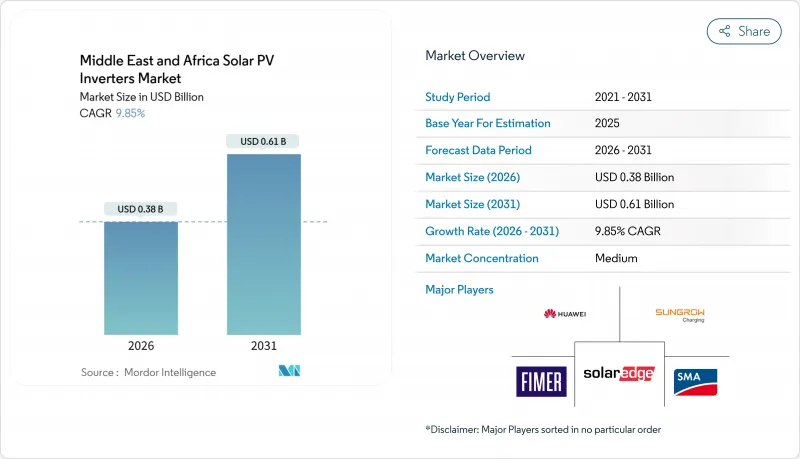
Mordor Intelligence에 의하면, 중동 및 아프리카 태양광 인버터 시장 규모는 2026년에 3억 8,000만 달러로 추정되고 있어 예측 기간(2026-2031년)에서 CAGR 9.85%로 확대되어 2031년에는 6억 1,000만 달러에 이를 전망입니다.

본 보고서는 인버터 유형(중앙형, 스트링형, 마이크로 인버터, 하이브리드/배터리 지원), 상(단상·3상),연결 유형(온그리드·Off-grid), 용도(주거용, 상업·공업용, 유틸리티 규모), 지역(아랍에미리트, 사우디아라비아, 이란, 남아프리카공화국, 이집트, 나이지리아, 모로코, 기타 중동 및 아프리카)별로 분류되어 있습니다.
중동 및 아프리카 태양광 인버터 시장 동향 및 분석
GCC 및 북아프리카 전역의 태양광 발전 입찰 프로젝트 파이프라인
2025년에는 정부 주도의 태양광 발전 입찰 발표 용량이 25GW를 넘어섰습니다. 이는 사우디아라비아 공공투자기금(PIF)이 ACWA Power 및 Masdar의 파트너와 공동으로 15GW 규모의 프로젝트에 83억 달러를 출자하겠다고 약속한 것이 큰 요인으로 작용했습니다. 2024년 하반기에 두바이 전력·수도청(DEWA)이 낙찰받은 2GW 규모의 태양광 발전·에너지 저장 복합 프로젝트와,아부다비의 자라프(Zarraf)·카즈나(Khazna) 프로젝트(각 1.5GW)는 중앙 인버터에 대한 유틸리티 규모 수요가 안정적으로 예상된다는 점을 뒷받침하고 있습니다. 계약 구조에서는 운영·유지보수·현지 조립이 세트로 포함되는 사례가 늘어나고 있어, 하드웨어 전문 벤더의 이익률은 압박받는 반면, 통합형 공급업체 시장 내 입지는 강화되고 있습니다. 2024년에 상업 운전을 시작하는 쿠웨이트의 1.1GW ‘알 디브디바’ 발전소와 이집트의 1.2GW ‘인피니티 파워’ 자금 조달 라운드는 여러 국가에서 계통 연계 장비에 대한 수요가 증가하고 있음을 여실히 보여주고 있습니다. 그 결과 조달 전망이 확고해짐에 따라, 전력 개발 사업자들은 은행 대출이 가능한 제품 보증과 소브링그레이드 서비스망을 갖춘 공급업체를 우선적으로 선택하고 있습니다.
이스라엘과 남아프리카공화국의 순계량제 및 옥상 설치 인센티브
이스라엘에서는 50kW 이하 시스템을 대상으로 하는 고정가격임베디드제도(FIT) 및 순계량제 규제로 인해, 2025년에는 대상 지붕의 8%에 주택용 태양광 발전이 도입되어 2023년 수준보다 두 배로 증가했습니다. 남아프리카공화국의 지자체 프로그램을 통해 상업시설은 2020년부터 2025년까지 연평균 12% 상승한 에스콤(Eskom)의 요금 인상분을 상쇄할 수 있게 되었습니다. 또한, 2024년 ‘전력 규제법’ 개정에 따라 1MW 미만의 태양광 발전 시스템에 대한 계통 연계 승인 기간이 18개월에서 6개월로 단축되었습니다. 이러한 조치로 인해 수요는 스트링 인버터와 마이크로 인버터 쪽으로 이동하고 있습니다. 이러한 모듈식 아키텍처는 옥상에서 흔히 볼 수 있는 그늘이나 방위 제약에 대응할 수 있기 때문입니다. 금융 기관 및 설치 업체에 따르면, BOS(Balance of System) 비용의 감소로 인해 일반 가정이나 쇼핑몰에서도 5년 이내에 투자 회수가 가능해지면서 분산형 인버터의 총 잠재 시장이 크게 확대되고 있습니다.
반도체 공급망의 변동
2025년 초, 절연 게이트형 바이폴라 트랜지스터(IGBT) 및 실리콘 카바이드 MOSFET의 리드타임이 8-12주로 늘어남에 따라 프로젝트 가동 시작이 지연되고, 운전 자금 수요가 증가했습니다. SMA Solar Technology사는 칩 부족으로 인해 2024년 상반기 출하량이 15% 부족했다고 밝혔습니다. 화웨이(Huawei)사는 수년에 걸친 웨이퍼 계약을 확보함으로써 이에 대처했으나, 소규모 기업들은 현물 시장의 가격 급등에 직면하여 고정 가격의 EPC 입찰이 어려워졌습니다.
부문 분석
2025년, 중동 및 아프리카의 태양광 인버터 시장에서 중앙 집중형 인버터가 61.8%의 점유율을 차지했습니다. 이러한 지배적인 지위는 와트당 설치 비용의 저렴함을 우선시하는 사우디아라비아와 UAE의 메가와트급 프로젝트에 기인합니다. 스트링형 인버터는 소폭의 비용 절감보다는 모듈성을 중시하는 상업 및 산업용 어레이에 채택되고 있는 반면, 마이크로 인버터는 이스라엘과 남아프리카공화국에서 옥상 설치가 보급됨에 따라 두 자릿수 성장을 기록했습니다. 하이브리드형 및 배터리 호환 모델은 계획 정전으로 인해 에너지 저장 시스템 도입이 촉진되고 있는 나이지리아와 이집트에서 부가가치를 창출하고 있습니다. 양면 모듈 및 2,000V 시스템 아키텍처로의 전환에 따라, 더 높은 입력 전압을 지원하도록 설계된 스트링형 및 중앙 집중형 플랫폼에 대한 조달 경향이 더욱 강해지고 있습니다.
중앙 인버터는 계통 연계 조사를 간소화하지만, 단일 고장 지점이 되기 때문에 일사량이 변동하기 쉬운 지역에서는 멀티 MPPT를 지원하는 스트링형 유닛에 대한 수요가 발생하고 있습니다. 마이크로 인버터는 비용은 높지만 모듈 수준의 최적화와 안전성 향상을 실현하지만, 그 복잡성 때문에 유틸리티 규모로의 도입 전망은 제한적입니다. 하이브리드 유닛은 계통 연계와 독립형 시스템 간 수요 격차를 해소하며, 시간대별 요금에 따른 차익 거래를 장려하는 요금 체계와 시너지 효과를 발휘합니다. 양면 수광형 및 고전압의 동향이 성숙해짐에 따라, 기존의 1,000V 장비는 노후화되어 중동 및 아프리카의 태양광 인버터 시장 전체에서 교체 수요를 자극하고 있습니다.
2025년 출하 대수의 80.1%를 3상 유닛이 차지하고 있으며, 이는 부하의 균등한 분산이 필요한 상업, 산업, 전력 회사를 위한 설치가 주류를 이루고 있음을 반영합니다. 일반적으로 10kW 미만의 단상 제품은 이스라엘, 남아프리카공화국, 이집트에서 중산층 주택의 옥상 태양광 발전 보급에 힘입어 연평균 성장률(CAGR) 10.2%로 증가할 전망입니다.
가성비가 뛰어난 플러그 앤 플레이 방식의 단상 키트는 주거용 DIY 부문을 끌어들이고 있지만, 3상 장비는 사우디아라비아 전력공사가 정한 5%의 THD 상한선 등 더 엄격한 고조파 제한을 충족해야 합니다. 그 결과, 3상 장비 공급업체들은 능동형 필터링 및 계통 동기화 알고리즘에 대한 투자를 확대하고 있으며, 이는 진입 장벽을 높이는 한편 중동 및 아프리카 태양광 인버터 업계에서 계통 적합성의 신뢰성을 높이고 있습니다.
기타 혜택:
- 엑셀 형식 시장 예측(ME) 시트
- 3개월간의 애널리스트 지원
자주 묻는 질문
목차
제1장 서론
제2장 조사 방법
제3장 주요 요약
제4장 시장 구도
제5장 시장 규모와 성장 예측
제6장 경쟁 구도
제7장 시장 기회와 향후 전망
JHS 26.09.17According to Mordor Intelligence, the Middle East and Africa solar PV inverters market size is estimated at USD 0.38 billion in 2026, and is expected to reach USD 0.61 billion by 2031, at a CAGR of 9.85% during the forecast period (2026-2031).
This report is Segmented by Inverter Type (Central, String, Microinverters, and Hybrid/Battery-Ready), Phase (Single-Phase and Three-Phase), Connection Type (On-Grid and Off-Grid), Application (Residential, Commercial and Industrial, and Utility-Scale), and Geography (United Arab Emirates, Saudi Arabia, Iran, South Africa, Egypt, Nigeria, Morocco, and Rest of Middle East and Africa).
Middle East And Africa Solar PV Inverters Market Trends and Insights
Solar-Tender Pipeline Across GCC and North Africa
Government-backed solar solicitations topped 25 GW of announced capacity during 2025, anchored by Saudi Arabia's Public Investment Fund pledge of USD 8.3 billion for 15 GW of projects with ACWA Power and Masdar partners. A 2 GW solar-plus-storage award from Dubai Electricity and Water Authority in late 2024 and Abu Dhabi's Zarraf and Khazna projects, each at 1.5 GW, reinforce predictable utility-scale demand for central inverters. Contract structures increasingly bundle operations, maintenance, and local assembly, trimming margins for pure-play hardware vendors yet deepening market stickiness for integrated suppliers. Kuwait's 1.1 GW Al Dibdibah plant entering commercial service in 2024 and Egypt's 1.2 GW Infinity Power financing round magnify the multi-country pull for grid-connected equipment. The resulting procurement certainty underpins utility developers' preference for suppliers with bankable product warranties and sovereign-grade service footprints.
Net-Metering and Rooftop Incentives in Israel and South Africa
Israel's feed-in tariff and net-metering rules covering systems up to 50 kW lifted residential solar penetration to 8% of eligible rooftops in 2025, doubling the 2023 level. South Africa's municipal programs allow commercial sites to offset Eskom tariff hikes that averaged 12% annually during 2020-2025, while 2024 Electricity Regulation Act amendments cut grid-connection approvals for sub-1 MW arrays from 18 months to 6 months. These measures steer demand toward string and microinverters, whose modular architectures cope with shading and orientation constraints common on rooftops. Financiers and installers report that falling balance-of-system costs have brought five-year paybacks within reach for households and malls, substantially widening the total addressable market for distributed inverters.
Semiconductor Supply-Chain Volatility
Insulated-gate bipolar transistors and silicon-carbide MOSFET lead times stretched to 8-12 weeks in early 2025, deferring project commissioning and inflating working-capital requirements. SMA Solar Technology disclosed a 15% shipment shortfall in 1H 2024 owing to chip shortages. Huawei countered by securing multi-year wafer contracts, but smaller firms lacking scale endured spot-market price spikes that complicated fixed-price EPC bids.
Other drivers and restraints analyzed in the detailed report include:
- Mandatory Smart-Inverter Grid Codes
- High-Temperature, Dust-Hardened Designs Lowering O&M Costs
- Fragmented After-Sales and Certification Ecosystem
For complete list of drivers and restraints, kindly check the Table Of Contents.
Segment Analysis
Central inverters captured 61.8% of the Middle East and Africa solar PV inverters market in 2025, a dominance linked to megawatt-scale projects in Saudi Arabia and the UAE that prioritize low installed cost per watt. String inverters serve commercial and industrial arrays where modularity outweighs minimal cost savings, while microinverters secured double-digit growth thanks to rooftop uptake in Israel and South Africa. Hybrid and battery-ready models add value in Nigeria and Egypt, where load-shedding propels storage integration. The shift toward bifacial modules and 2,000-V system architectures further tilts procurement toward string and central platforms engineered for higher input voltages.
Central inverters simplify interconnection studies yet represent single points of failure, creating openings for multi-MPPT string units in terrains with variable irradiance. Microinverters, though costlier, deliver module-level optimization and enhanced safety, but their complexity limits utility-scale prospects. Hybrid units bridge the gap between on-grid and off-grid needs, dovetailing with tariff structures that reward time-of-use arbitrage. As bifacial and high-voltage trends mature, legacy 1,000-V equipment faces obsolescence, stimulating replacement sales across the Middle East and Africa solar PV inverters market.
Three-phase units comprised 80.1% of 2025 shipments, mirroring the prevalence of commercial, industrial, and utility installations requiring balanced load distribution. Single-phase products, typically under 10 kW, will climb at a 10.2% CAGR as rooftop solar permeates middle-income housing in Israel, South Africa, and Egypt.
Cost-effective plug-and-play single-phase kits entice residential do-it-yourself segments, while three-phase devices must meet stricter harmonic limits, such as the Saudi Electricity Company's 5% THD cap. Consequently, three-phase vendors invest in active filtering and grid-synchronization algorithms, raising entry barriers but enhancing grid compliance credentials in the Middle East and Africa solar PV inverters industry.
Complete Report Scope:
- By Inverter Type
- Central Inverters
- String Inverters
- Microinverters
- Hybrid/Battery-Ready Inverters
- By Phase
- Single-Phase
- Three-Phase
- By Connection Type
- On-Grid
- Off-Grid
- By Application
- Residential
- Commercial and Industrial
- Utility-Scale
- By Geography
- United Arab Emirates
- Saudi Arabia
- Iran
- South Africa
- Egypt
- Nigeria
- Morocco
- Rest of Middle East and Africa
List of Companies Covered in this Report:
- Huawei Technologies Co. Ltd
- Sungrow Power Supply Co. Ltd
- SMA Solar Technology AG
- SolarEdge Technologies Inc.
- FIMER SpA
- GoodWe Technologies Co. Ltd
- Delta Electronics Inc.
- Omron Corporation
- Mitsubishi Electric Corporation
- Schneider Electric SE
- Siemens AG
- Enphase Energy Inc.
- Fronius International GmbH
- Growatt New Energy
- Ginlong Technologies (Solis)
- Power Electronics S.L.
- Ingeteam S.A.
- TBEA Sunoasis Co. Ltd
- KSTAR New Energy
- Sineng Electric Co. Ltd
Additional Benefits:
- The market estimate (ME) sheet in Excel format
- 3 months of analyst support
TABLE OF CONTENTS
1 Introduction
- 1.1 Study Assumptions & Market Definition
- 1.2 Scope of the Study
2 Research Methodology
3 Executive Summary
4 Market Landscape
- 4.1 Market Overview
- 4.2 Market Drivers
- 4.2.1 Solar-tender pipeline across GCC & North Africa
- 4.2.2 Net-metering & rooftop incentives in Israel, South Africa
- 4.2.3 Mandatory smart-inverter grid codes (e.g., Saudi Grid Code 2024)
- 4.2.4 High-temperature, dust-hardening designs lowering O&M costs
- 4.2.5 Hybrid-inverter demand from weak-grid/off-grid sites
- 4.3 Market Restraints
- 4.3.1 Semiconductor supply-chain volatility
- 4.3.2 Fragmented after-sales & certification ecosystem
- 4.3.3 Cyber-security concerns over remote access
- 4.4 Supply-Chain Analysis
- 4.5 Regulatory Landscape
- 4.6 Technological Outlook
- 4.7 Porter's Five Forces
- 4.7.1 Bargaining Power of Suppliers
- 4.7.2 Bargaining Power of Consumers
- 4.7.3 Threat of New Entrants
- 4.7.4 Threat of Substitutes
- 4.7.5 Intensity of Competitive Rivalry
5 Market Size & Growth Forecasts
- 5.1 By Inverter Type
- 5.1.1 Central Inverters
- 5.1.2 String Inverters
- 5.1.3 Microinverters
- 5.1.4 Hybrid/Battery-Ready Inverters
- 5.2 By Phase
- 5.2.1 Single-Phase
- 5.2.2 Three-Phase
- 5.3 By Connection Type
- 5.3.1 On-Grid
- 5.3.2 Off-Grid
- 5.4 By Application
- 5.4.1 Residential
- 5.4.2 Commercial and Industrial
- 5.4.3 Utility-Scale
- 5.5 By Geography
- 5.5.1 United Arab Emirates
- 5.5.2 Saudi Arabia
- 5.5.3 Iran
- 5.5.4 South Africa
- 5.5.5 Egypt
- 5.5.6 Nigeria
- 5.5.7 Morocco
- 5.5.8 Rest of Middle East and Africa
6 Competitive Landscape
- 6.1 Market Concentration
- 6.2 Strategic Moves (M&A, Partnerships, PPAs)
- 6.3 Market Share Analysis (Market Rank/Share for key companies)
- 6.4 Company Profiles (includes Global level Overview, Market level overview, Core Segments, Financials as available, Strategic Information, Products & Services, and Recent Developments)
- 6.4.1 Huawei Technologies Co. Ltd
- 6.4.2 Sungrow Power Supply Co. Ltd
- 6.4.3 SMA Solar Technology AG
- 6.4.4 SolarEdge Technologies Inc.
- 6.4.5 FIMER SpA
- 6.4.6 GoodWe Technologies Co. Ltd
- 6.4.7 Delta Electronics Inc.
- 6.4.8 Omron Corporation
- 6.4.9 Mitsubishi Electric Corporation
- 6.4.10 Schneider Electric SE
- 6.4.11 Siemens AG
- 6.4.12 Enphase Energy Inc.
- 6.4.13 Fronius International GmbH
- 6.4.14 Growatt New Energy
- 6.4.15 Ginlong Technologies (Solis)
- 6.4.16 Power Electronics S.L.
- 6.4.17 Ingeteam S.A.
- 6.4.18 TBEA Sunoasis Co. Ltd
- 6.4.19 KSTAR New Energy
- 6.4.20 Sineng Electric Co. Ltd
7 Market Opportunities & Future Outlook
- 7.1 White-Space & Unmet-Need Assessment