|
시장보고서
상품코드
2124129
유럽의 풍력발전 시장 : 점유율 분석, 업계 동향과 통계, 성장 예측(2026-2031년)Europe Wind Power - Market Share Analysis, Industry Trends & Statistics, Growth Forecasts (2026 - 2031) |
||||||
 Mordor Intelligence
Mordor Intelligence에 의하면, 유럽 풍력발전 시장 규모(설치용량 기반)는 2026년 336.90기가와트에서 2031년까지 479.25기가와트로 확대한다고 예측되고 있어 예측 기간(2026-2031년) CAGR은 7.30%를 나타낼 전망입니다.
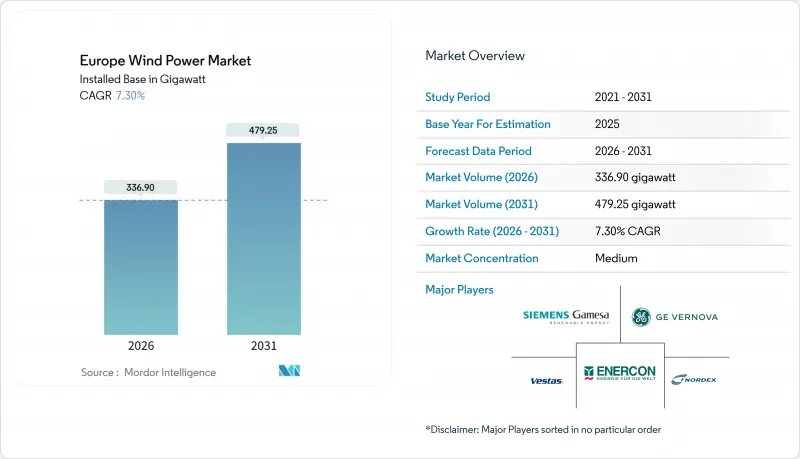
본 보고서는 설치 장소(육상 및 해상), 터빈 출력(3MW 이하, 3-6MW, 6MW 초과), 용도(유틸리티 규모, 상업 및 산업용, 커뮤니티 프로젝트), 지역(독일, 영국, 프랑스,스페인, 이탈리아, 폴란드, 스웨덴, 덴마크 및 기타 유럽)별로 분류되어 있습니다. 시장 규모 및 전망은 설치 용량(GW) 단위로 제시되어 있습니다.
유럽 풍력발전 시장 동향 및 인사이트
EU 그린딜 및 ‘Fit-for-55’ 목표
이 입법 패키지에 따라 회원국은 2년마다 국가 에너지·기후 계획을 갱신해야 할 의무가 부과되었으며, 2030년 재생에너지 전력 목표가 45%로 상향 조정되었습니다. 이는 500GW의 풍력발전 설비를 의미하며, 2025년 설비 용량을 63% 상회하는 수준입니다. 2026년부터 철강 및 시멘트에 대한 탄소 국경 조정세가 도입됨에 따라, 타워 및 기초 생산이 유럽 대륙 내로 회귀하고 있습니다. 독일은 2030년까지 145GW의 풍력발전 설비를 전력망에 통합하기 위해, 2025년에 46억 유로를 전력망 강화에 투입하기로 결정했습니다. 덴마크의 ‘에너지 아일랜드’는 10GW 규모의 해상 풍력발전을 핵심으로 하여 잉여 전력을 수출할 계획이며, 이는 국경을 초월한 협력이 각국의 발전 설비 확충을 어떻게 확대해 나갈 수 있는지를 보여주고 있습니다. 따라서 공급망의 역풍에도 불구하고, 정책적 추진력에 힘입어 유럽의 풍력발전 시장은 높은 성장 궤도를 유지하고 있습니다.
육상·해상 풍력 터빈의 LCOE 급격한 하락
2024년에는 육상 풍력발전의 균등화 발전 원가(LCOE)가 0.043-0.092유로/kWh까지 하락한 반면,해상 풍력발전의 LCOE는 15MW급 플랫폼이 시스템 외부 비용을 절감한 덕분에 0.055-0.103유로/kWh까지 하락했습니다. 영국의 2024년 CfD 입찰에서는 해상 풍력발전의 입찰 가격이 행사 가격보다 30% 낮은 결과를 기록했으며, 수요가 견조한 지역에서는 상거래 위험이 허용 가능한 수준임이 입증되었습니다. 폴란드의 육상 풍력발전 입찰에서는 처음으로 석탄 화력 발전 비용을 밑돌았으며, 발전소의 조기 폐쇄가 가속화되었습니다. 베스타스(Vestas)사의 V162-6.2 MW 터빈은 2025년 독일 내륙 지역에서 48%의 설비 가동률을 달성하며, 대형 로터가 기존 부지에서 발전량을 향상시킨다는 사실을 입증했습니다. 발전 비용의 하락은 기업용 PPA(전력 구매 계약)의 경쟁력 있는 가격 책정을 뒷받침하고 있으며, 유럽 풍력발전 시장을 주도하는 비용 우위를 입증하고 있습니다.
송전망 혼잡 및 계통 연계 설비 구축 지연
독일에서는 2023년에 8.2 TWh의 풍력발전이 억제되었으며, SuedLink 및 SuedOstLink의 완공이 2028년으로 연기됨에 따라 납세자들에게 31억 유로의 부담이 발생했습니다. 스페인에서는 2023년에 2.5 TWh의 발전 억제가 발생했으며, 영국의 송전망 대기 용량은 283 GW에 달하고 대기 시간은 7년에 이릅니다. 1.4GW 규모의 ‘NeuConnect’ 송전선이 일부 제약을 완화한 것을 제외하면, 유럽 대륙 내 전력 수급 불균형을 시정하는 데 필요한 송전 용량 중 가동 중인 것은 고작 2%에 불과합니다. RWE사가 카스카시에 설치한 500 MW 규모의 축전지는 전력 저장을 통해 유효 용량을 6퍼센트 포인트 회복할 수 있음을 보여주고 있지만, 대규모 송전망 구축은 여전히 유럽 풍력발전 시장의 단기적 성장을 제한하는 결정적인 병목 요인으로 작용하고 있습니다.
부문별 분석
부유식 플랫폼이 수심 60미터를 초과하는 해역에서의 개발을 가능하게 함에 따라, 해상 풍력은 연평균 성장률(CAGR) 17.2%로 확대되고 있으며, 이는 유럽 풍력발전 시장 평균의 2배에 해당합니다. 2025년 시점에서도 육상 풍력발전 자산은 여전히 유럽 풍력발전 시장 규모의 85.5%를 차지하고 있으며, 이는 독일의 60GW 설비 용량과 스페인의 30GW 기반에 힘입은 것입니다. ScotWind의 10.5GW 수주 프로젝트와 폴란드의 8GW에 달하는 발트해 지역 계획 프로젝트를 통해 2031년까지 해상 풍력의 점유율은 22%로 상승할 전망입니다. 해상 풍력 프로젝트는 45-55%의 설비 이용률과 15년간의 CfD(차액결제계약)를 갖추고 있어 수익 위험을 낮추고 있는 반면, 육상 풍력의 그린필드 건설은 토지 이용상의 제약에 직면해 있습니다. 가동 20년 차 풍력 터빈을 6MW급으로 리파워링함으로써 고정식 계통 연계선에서의 발전량은 3배로 증가하여, 육상 풍력발전의 중요성을 유지하면서도 유럽 풍력발전 시장 전체의 균형 잡힌 확장이 보장됩니다.
2세대 부유식 풍력발전 규격(IEC 61400-3-2)에 따라 요건이 통일되어 인증 비용이 15% 절감됩니다. 해상 풍력발전의 리드타임은 5-7년으로 육상보다 여전히 긴 편이지만, 높은 설비 이용률이 이를 상쇄하여 자본을 유치하고 있습니다. 현재 육상 풍력발전의 성장은 폴란드와 스웨덴에 집중되어 있는 반면, 덴마크와 네덜란드는 해상 프로젝트로 중심을 옮기고 있습니다. 이러한 변화하는 구성이 유럽 풍력발전 시장의 견고한 도입 전망을 뒷받침하고 있습니다.
기타 혜택:
- 엑셀 형식 시장 예측(ME) 시트
- 3개월간의 애널리스트 지원
자주 묻는 질문
목차
제1장 서론
제2장 조사 방법
제3장 주요 요약
제4장 시장 구도
제5장 시장 규모와 성장 예측
제6장 경쟁 구도
제7장 시장 기회와 향후 전망
JHS 26.09.11According to Mordor Intelligence, the Europe wind power market size in terms of installed base is expected to grow from 336.90 gigawatt in 2026 to 479.25 gigawatt by 2031, at a CAGR of 7.30% during the forecast period (2026-2031).
This report is Segmented by Location (Onshore and Offshore), Turbine Capacity (Up To 3 MW, 3 To 6 MW, and Above 6 MW), Application (Utility-Scale, Commercial and Industrial, and Community Projects), and Geography (Germany, United Kingdom, France, Spain, Italy, Poland, Sweden, Denmark, and Rest of Europe). The Market Sizes and Forecasts are Provided in Terms of Installed Capacity (GW).
Europe Wind Power Market Trends and Insights
EU Green Deal & Fit-for-55 Targets
The legislative package obliges member states to update national energy and climate plans every two years and lifts the 2030 renewable-electricity target to 45%, implying a 500 GW wind fleet, 63% above 2025 capacity. Carbon border adjustment on steel and cement from 2026 is steering tower and foundation production back into the continent. Germany earmarked EUR 4.6 billion in 2025 for grid reinforcement to integrate 145 GW of wind by 2030. Denmark's Energy Island will hub 10 GW of offshore wind and export surplus power, illustrating how transnational coordination multiplies national build-outs. Policy momentum, therefore, keeps the European wind power market on a high-growth trajectory despite supply-chain headwinds.
Rapid LCOE Decline of On- & Offshore Turbines
Onshore levelized costs slid to EUR 0.043-0.092 /kWh in 2024, while offshore costs fell to EUR 0.055-0.103 /kWh as 15 MW platforms trimmed balance-of-system expenses. The UK's 2024 CfD round cleared offshore bids 30% below the strike price, proving merchant risk tolerable in robust demand centers. Poland's onshore auction undercut coal generation for the first time, prompting accelerated plant retirements. Vestas' V162-6.2 MW turbine delivered a 48% capacity factor in inland Germany during 2025, underscoring how larger rotors boost yields on legacy sites. Declining generation costs underpin competitive pricing for corporate PPAs and confirm the cost advantage driving the European wind power market.
Grid Congestion & Weak Interconnection Build-Out
Germany curtailed 8.2 TWh of wind in 2023 at a taxpayer cost of EUR 3.1 billion as SuedLink and SuedOstLink slipped to 2028 completion. Spain faced 2.5 TWh in 2023 curtailments, and the UK's grid queue hit 283 GW with seven-year wait times. While the 1.4 GW NeuConnect link eased some constraints, only 2% of the transfer capacity needed to smooth continental imbalances is live. RWE's 500 MW battery at Kaskasi shows storage can claw back six percentage points of effective capacity, but large-scale transmission remains the critical bottleneck limiting near-term gains for the European wind power market.
Other drivers and restraints analyzed in the detailed report include:
- Surging Corporate PPA Demand
- Repowering of >15-Year Onshore Fleets
- Lengthy Permitting & Local Opposition
For complete list of drivers and restraints, kindly check the Table Of Contents.
Segment Analysis
Offshore wind is expanding at a 17.2% CAGR, double the European wind power market average, as floating platforms unlock water depths beyond 60 m. Onshore assets still represented 85.5% of the European wind power market size in 2025, grounded in Germany's 60 GW fleet and Spain's 30 GW base. ScotWind's 10.5 GW awards and Poland's 8 GW Baltic pipeline will lift offshore's share to 22% by 2031. Offshore projects carry 45-55% capacity factors and 15-year CfDs, de-risking revenues, whereas onshore greenfield builds battle land-use constraints. Repowering 20-year turbines with 6 MW machines triples output on fixed interconnections, preserving onshore relevance and ensuring a balanced expansion across the European wind power market.
Second-generation floating standards (IEC 61400-3-2) harmonize requirements, slicing certification costs by 15%. Offshore lead times of five to seven years remain longer than onshore, but capacity factors compensate, attracting capital. Onshore growth now clusters in Poland and Sweden, while Denmark and the Netherlands pivot toward sea-based projects. This evolving mix underpins a resilient deployment outlook for the Europe wind power market.
Complete Report Scope:
- By Location
- Onshore
- Offshore
- By Turbine Capacity
- Up to 3 MW
- 3 to 6 MW
- Above 6 MW
- By Application
- Utility-scale
- Commercial and Industrial
- Community Projects
- By Component (Qualitative Analysis)
- Nacelle/Turbine
- Blade
- Tower
- Generator and Gearbox
- Balance-of-System
- By Geography
- Germany
- United Kingdom
- France
- Spain
- Italy
- Poland
- Sweden
- Denmark
- Rest of Europe
List of Companies Covered in this Report:
- Acciona Energia
- Orsted
- EDF Renewables
- E.ON
- Iberdrola Renovables
- RWE Renewables
- Vattenfall
- Statkraft
- EnBW
- General Electric
- Siemens Gamesa
- Vestas
- Nordex
- Enercon
- Goldwind Europe
- MingYang Europe
- LM Wind Power
- Prysmian Group
- Nexans
Additional Benefits:
- The market estimate (ME) sheet in Excel format
- 3 months of analyst support
TABLE OF CONTENTS
1 Introduction
- 1.1 Study Assumptions & Market Definition
- 1.2 Scope of the Study
2 Research Methodology
3 Executive Summary
4 Market Landscape
- 4.1 Market Overview
- 4.2 Market Drivers
- 4.2.1 EU Green Deal & Fit-for-55 targets
- 4.2.2 Rapid LCOE decline of on- & offshore turbines
- 4.2.3 Surging corporate PPA demand
- 4.2.4 Repowering of >15-year onshore fleets
- 4.2.5 Commercialisation of floating offshore wind
- 4.2.6 Next-gen recyclable blade technology
- 4.3 Market Restraints
- 4.3.1 Grid congestion & weak interconnection build-out
- 4.3.2 Lengthy permitting & local opposition
- 4.3.3 Biodiversity litigation risk (birds, marine mammals)
- 4.3.4 Rare-earth magnet supply-chain exposure
- 4.4 Supply-Chain Analysis
- 4.5 Regulatory Landscape
- 4.6 Technological Outlook
- 4.7 Porter's Five Forces
- 4.7.1 Bargaining Power of Suppliers
- 4.7.2 Bargaining Power of Buyers
- 4.7.3 Threat of New Entrants
- 4.7.4 Threat of Substitutes
- 4.7.5 Competitive Rivalry
5 Market Size & Growth Forecasts
- 5.1 By Location
- 5.1.1 Onshore
- 5.1.2 Offshore
- 5.2 By Turbine Capacity
- 5.2.1 Up to 3 MW
- 5.2.2 3 to 6 MW
- 5.2.3 Above 6 MW
- 5.3 By Application
- 5.3.1 Utility-scale
- 5.3.2 Commercial and Industrial
- 5.3.3 Community Projects
- 5.4 By Component (Qualitative Analysis)
- 5.4.1 Nacelle/Turbine
- 5.4.2 Blade
- 5.4.3 Tower
- 5.4.4 Generator and Gearbox
- 5.4.5 Balance-of-System
- 5.5 By Geography
- 5.5.1 Germany
- 5.5.2 United Kingdom
- 5.5.3 France
- 5.5.4 Spain
- 5.5.5 Italy
- 5.5.6 Poland
- 5.5.7 Sweden
- 5.5.8 Denmark
- 5.5.9 Rest of Europe
6 Competitive Landscape
- 6.1 Market Concentration
- 6.2 Strategic Moves (M&A, Partnerships, PPAs)
- 6.3 Market Share Analysis (Market Rank/Share for key companies)
- 6.4 Company Profiles (includes Global level Overview, Market level overview, Core Segments, Financials as available, Strategic Information, Products & Services, and Recent Developments)
- 6.4.1 Acciona Energia
- 6.4.2 Orsted
- 6.4.3 EDF Renewables
- 6.4.4 E.ON
- 6.4.5 Iberdrola Renovables
- 6.4.6 RWE Renewables
- 6.4.7 Vattenfall
- 6.4.8 Statkraft
- 6.4.9 EnBW
- 6.4.10 General Electric
- 6.4.11 Siemens Gamesa
- 6.4.12 Vestas
- 6.4.13 Nordex
- 6.4.14 Enercon
- 6.4.15 Goldwind Europe
- 6.4.16 MingYang Europe
- 6.4.17 LM Wind Power
- 6.4.18 Prysmian Group
- 6.4.19 Nexans
7 Market Opportunities & Future Outlook
- 7.1 White-space & Unmet-need Assessment