|
시장보고서
상품코드
2124312
중동의 재생에너지 시장 : 시장 점유율 분석, 업계 동향 및 통계, 성장 예측(2026-2031년)Middle East Renewable Energy - Market Share Analysis, Industry Trends & Statistics, Growth Forecasts (2026 - 2031) |
||||||
 Mordor Intelligence
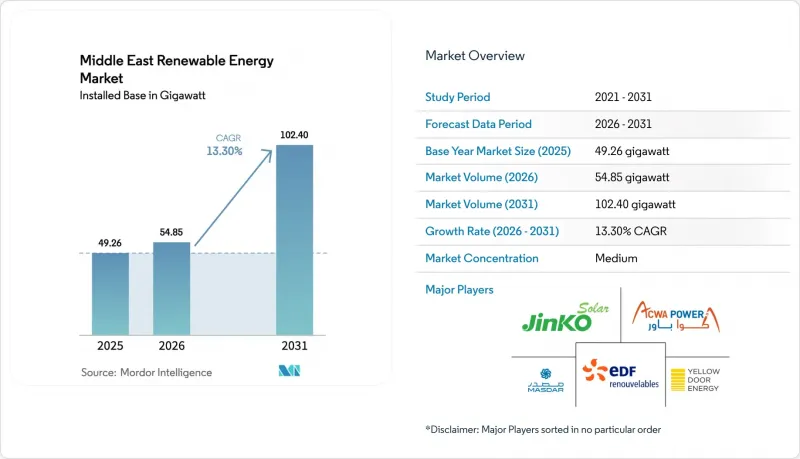
Mordor Intelligence에 의하면, 중동의 재생에너지 시장 규모(설치용량 기반)는 2025년 49.26기가와트로 평가되었고, 2026년 54.85기가와트로 추정되고, 2031년까지 102.40기가와트로 확대될 것으로 예측되며, 2026-2031년 기간에서 CAGR은 13.30%를 기록할 전망입니다.
본 보고서는 기술별(태양광 발전, 풍력 발전, 수력 발전, 바이오에너지, 지열, 해양 에너지), 최종 사용자별(전력 회사, 상업 및 산업, 주택), 지역별(아랍에미리트, 사우디아라비아, 오만, 이란,이스라엘, 요르단, 카타르, 쿠웨이트, 바레인 및 기타 중동)으로 분류되어 있습니다. 시장 규모 및 전망은 설치 용량(GW) 단위로 표시되어 있습니다.
중동의 재생에너지 시장 동향 및 인사이트
2030-2050년 야심찬 국가 재생에너지 목표
법적 구속력이 있는 청정 에너지 목표에 따라 공공 지출의 방향이 전환되고, 입찰이 가속화되며, 신규 화력 발전 용량이 점차 배제되고 있습니다. 사우디아라비아는 2030년 목표인 130GW를 달성하기 위해 연간 18GW를 추가해야 하는데, 이 속도는 2024년 기준을 훨씬 상회하는 수준입니다. UAE의 ‘전력의 50%를 청정 에너지로 충당한다’는 의무화 조치에 따라 정부 자금이 민관협력(PPP)에 투입되어 초기 개발 위험이 완화되고 있습니다. 카타르와 쿠웨이트는 규모는 작지만 상징적인 할당 목표를 설정했으며, 이로 인해 지역 내 조달 파이프라인이 확대되고 있습니다. 목표는 프로젝트의 가시성을 확보해 주지만, 송전망 업그레이드나 부지 확보 지연은 수소 및 해수 담수화에 대한 추가 투자를 늦추고, 자금 제공업체에게 프로젝트 일정에 대한 연쇄적인 위험을 초래할 가능성이 있습니다.
태양광 및 풍력 발전의 LCOE 급격한 하락
태양광 및 육상 풍력 발전의 전력 가격은 현재 가스 화력 발전보다 낮아, 신규 발전 설비에서는 재생에너지가 기본 선택지가 되고 있습니다. 이 지역의 태양광 발전 LCOE는 2025년 평균 37달러/MWh였으나, 2060년까지 17달러에 도달할 전망입니다. 사우디아라비아의 다와드미 풍력 발전 프로젝트 입찰 가격이 1.34센트/kWh로 결정됨에 따라, 신규 화력 발전소 건설에 대한 경제적 타당성은 사라졌습니다. 모듈공급 과잉, 양면 패널의 효율 향상, 그리고 트래커의 최적화로 인해 2024년 이후 시스템 외 비용은 22% 감소했습니다. 전력 회사가 2센트 미만의 요금으로 25년간의 전력 구매 계약(PPA)을 확보하는 한편, 장비 제조업체는 이익률 하락에 직면하여 차세대 기술 및 서비스 수익으로의 전환을 강요받고 있습니다.
지속되는 화석 연료 발전에 대한 보조금
걸프 국가들의 소매 요금은 1kWh당 0.048달러로 극히 낮아, 이로 인해 가정용 태양광 발전의 수익성이 저하되고 분산형 도입의 진전이 둔화되고 있습니다. 보조금을 1% 삭감할 때마다 재생에너지 발전량이 10.61% 증가하는 상관관계가 나타나지만, 정치적 고려로 인해 쿠웨이트와 카타르에서는 개혁이 2027년 이후로 미뤄지고 있습니다. 보조금 대상 가구는 여전히 전력망에 의존하는 반면, 경쟁 입찰을 통해 대규모 태양광 발전이 활성화되는 등 양극화된 시장이 형성되고 있습니다. 이러한 격차로 인해 주택용 설치 업체가 대응할 수 있는 수요가 제한되고, 대중 시장에서의 배터리 보급이 지연되고 있습니다.
부문 분석
2025년, 중동 재생에너지 시장에서 태양광 발전은 54.51%의 점유율을 차지했으며, 2031년까지 연평균 성장률(CAGR) 18.56%로 성장을 이어가고 있습니다. 이러한 압도적인 점유율은 사우디아라비아와 UAE의 2,200 kWh/m²를 초과하는 일사량, 모듈 가격의 급격한 하락, 그리고 지원적인 입찰 체계를 반영한 것입니다. 두바이의 950 MW ‘누르 에너지 1’과 같은 집광형 태양광 발전소는 5,907 MWh의 용융염 저장 용량을 추가하여, 태양광 발전만으로는 실현할 수 없는 저녁 시간대의 전력 공급을 가능하게 하고 있습니다. 풍력 발전 설비는 용량률이 40% 이상의 사우디아라비아 북부 고지대와 오만의 해안 지역에 집중되어 있습니다. 수력 발전과 바이오에너지는 자원 제약으로 인해 여전히 제한적이지만, 지열 및 해양 에너지 기술은 실증 단계에 있습니다.
적극적인 조달을 통해 고성능 하드웨어가 우선적으로 도입되고 있습니다. 퍼스트 솔라(First Solar)는 고온 내구성이 뛰어난 테르븀화 카드뮴 패널 1.8 GW를 출하한 반면, 진코 솔라(JinkoSolar)는 지표면의 알베도 효과를 활용한 양면 수광형 ‘Tiger Neo’ 모듈 3.1 GW를 납품했습니다. 지멘스 가메사와 베스타스는 사우디아라비아의 다와드미 프로젝트를 위해 1.5GW 규모의 풍력 터빈을 공급하기 위해 경쟁하고 있습니다. 향후 실시될 홍해 연안 조사에서 45% 이상의 설비 이용률이 확인된다면 중동의 풍력 재생에너지 시장 규모가 확대될 가능성이 있지만, 2031년까지는 태양광 발전이 핵심 기술로 남을 것입니다.
기타 혜택 :
- 엑셀 형식 시장 예측(ME) 시트
- 3개월간의 애널리스트 지원
자주 묻는 질문
목차
제1장 서론
제2장 조사 방법
제3장 주요 요약
제4장 시장 구도
제5장 시장 규모 및 성장 예측
제6장 경쟁 구도
제7장 시장 기회 및 향후 전망
AJYAccording to Mordor Intelligence, the Middle East renewable energy market size in terms of installed base is projected to expand from 49.26 gigawatt in 2025 and 54.85 gigawatt in 2026 to 102.40 gigawatt by 2031, registering a CAGR of 13.30% between 2026 to 2031.
This report is Segmented by Technology (Solar Energy, Wind Energy, Hydropower, Bioenergy, Geothermal, and Ocean Energy), End-User (Utilities, Commercial and Industrial, and Residential), and Geography (United Arab Emirates, Saudi Arabia, Oman, Iran, Israel, Jordan, Qatar, Kuwait, Bahrain, and Rest of Middle East). The Market Sizes and Forecasts are Provided in Terms of Installed Capacity (GW).
Middle East Renewable Energy Market Trends and Insights
Ambitious 2030-2050 National Renewable-Energy Targets
Binding clean-energy objectives are redirecting public spending, fast-tracking tenders, and crowding out new thermal capacity. Saudi Arabia must add 18 GW annually to hit its 130 GW 2030 goal, a pace that dwarfs its 2024 base. The UAE's 50% clean-power mandate funnels sovereign capital into public-private partnerships that de-risk early-stage development. Qatar and Kuwait have set smaller but symbolic quotas that broaden the regional procurement funnel. Targets anchor pipeline visibility, yet slippage in grid upgrades or land acquisition can delay follow-on investments in hydrogen and desalination, exposing financiers to cascading project-timeline risk.
Rapid Solar-PV and Wind LCOE Decline
Photovoltaic and onshore-wind tariffs now undercut gas-fired generation, making renewables the default choice for greenfield capacity. Regional solar LCOE averaged USD 37 per MWh in 2025 and is on track to hit USD 17 by 2060. Saudi Arabia's Dawadmi wind bid at 1.34 cents per kWh erased the economic rationale for new thermal plants. Module oversupply, bifacial-panel efficiency gains, and tracker optimization have sliced balance-of-system costs by 22% since 2024. While utilities secure 25-year PPAs at sub-2-cent tariffs, equipment makers face thinner margins, forcing a pivot toward next-generation technologies and service revenues.
Persistent Fossil-Fuel Power Subsidies
Gulf retail tariffs as low as USD 0.048 / kWh undercut rooftop-solar economics and slow distributed adoption. A 1% subsidy rollback correlates with a 10.61% jump in renewable generation, yet political sensitivities push reforms to 2027 and beyond in Kuwait and Qatar. Two-tier markets emerge where subsidized households stick with grid power while utility-scale solar flourishes under competitive tenders. The gap limits addressable demand for residential installers and defers mass-market battery uptake.
Other drivers and restraints analyzed in the detailed report include:
- Green-Hydrogen Export Mega-Projects Pipeline
- Off-Grid Hybrid Microgrids for Desert Tourism & Mining
- Limited Grid Interconnection & Storage Capacity
For complete list of drivers and restraints, kindly check the Table Of Contents.
Segment Analysis
Solar Energy held 54.51% of the Middle East renewable energy market in 2025 and is advancing at an 18.56% CAGR through 2031. This outsized share reflects irradiance levels above 2,200 kWh/m2 in Saudi Arabia and the UAE, rapid module cost declines, and supportive tender frameworks. Concentrated-solar-power plants such as Dubai's 950 MW Noor Energy 1 add 5,907 MWh of molten-salt storage, providing evening dispatch that photovoltaics alone cannot match. Wind installations cluster along Saudi Arabia's northern highlands and Oman's coasts, where capacity factors top 40%. Hydropower and bioenergy remain marginal due to resource limitations, while geothermal and ocean technologies sit at the pilot stage.
Aggressive procurement favors high-performance hardware. First Solar shipped 1.8 GW of cadmium-telluride panels prized for high-temperature resilience, whereas JinkoSolar delivered 3.1 GW of bifacial Tiger Neo modules that capitalize on ground-albedo gains. Siemens Gamesa and Vestas are vying to supply 1.5 GW of turbines for Saudi Arabia's Dawadmi project. The Middle East renewable energy market size for wind could swell if forthcoming Red Sea offshore studies confirm 45%-plus capacity factors, yet solar will remain the anchor technology through 2031.
Complete Report Scope:
- By Technology
- Solar Energy (PV and CSP)
- Wind Energy (Onshore and Offshore)
- Hydropower (Small, Large, PSH)
- Bioenergy
- Geothermal
- Ocean Energy (Tidal and Wave)
- By End-User
- Utilities
- Commercial and Industrial
- Residential
- By Geography
- United Arab Emirates
- Saudi Arabia
- Oman
- Iran
- Israel
- Jordan
- Qatar
- Kuwait
- Bahrain
- Rest of Middle East
List of Companies Covered in this Report:
- ACWA Power
- Masdar (Abu Dhabi Future Energy Co.)
- EDF Renewables
- Yellow Door Energy
- JinkoSolar
- First Solar
- Siemens Gamesa
- GE Renewable Energy
- Vestas
- Engie
- TotalEnergies Renewables
- Enel Green Power
- Scatec Solar
- Abengoa
- Canadian Solar
- Siraj Power
- MASE
- Enerwhere Sustainable Energy
- Akuo Energy
- ACWA Power Barka SAOG
- Solarwind ME
Additional Benefits:
- The market estimate (ME) sheet in Excel format
- 3 months of analyst support
TABLE OF CONTENTS
1 Introduction
- 1.1 Study Assumptions & Market Definition
- 1.2 Scope of the Study
2 Research Methodology
3 Executive Summary
4 Market Landscape
- 4.1 Market Overview
- 4.2 Market Drivers
- 4.2.1 Ambitious 2030-2050 national renewable-energy targets
- 4.2.2 Rapid solar-PV and wind LCOE decline
- 4.2.3 Abundant solar irradiance & wind corridors
- 4.2.4 Green-hydrogen export mega-projects pipeline
- 4.2.5 Off-grid hybrid micro-grids for desert tourism & mining
- 4.3 Market Restraints
- 4.3.1 Persistent fossil-fuel power subsidies
- 4.3.2 Limited grid interconnection & storage capacity
- 4.3.3 Desert soiling & water-usage challenges for PV
- 4.4 Supply-Chain Analysis
- 4.5 Regulatory Outlook
- 4.6 Technological Outlook
- 4.7 Porter's Five Forces Analysis
- 4.7.1 Bargaining Power of Suppliers
- 4.7.2 Bargaining Power of Buyers
- 4.7.3 Threat of New Entrants
- 4.7.4 Threat of Substitutes
- 4.7.5 Intensity of Competitive Rivalry
5 Market Size & Growth Forecasts
- 5.1 By Technology
- 5.1.1 Solar Energy (PV and CSP)
- 5.1.2 Wind Energy (Onshore and Offshore)
- 5.1.3 Hydropower (Small, Large, PSH)
- 5.1.4 Bioenergy
- 5.1.5 Geothermal
- 5.1.6 Ocean Energy (Tidal and Wave)
- 5.2 By End-User
- 5.2.1 Utilities
- 5.2.2 Commercial and Industrial
- 5.2.3 Residential
- 5.3 By Geography
- 5.3.1 United Arab Emirates
- 5.3.2 Saudi Arabia
- 5.3.3 Oman
- 5.3.4 Iran
- 5.3.5 Israel
- 5.3.6 Jordan
- 5.3.7 Qatar
- 5.3.8 Kuwait
- 5.3.9 Bahrain
- 5.3.10 Rest of Middle East
6 Competitive Landscape
- 6.1 Market Concentration
- 6.2 Strategic Moves (M&A, JVs, Funding, PPAs)
- 6.3 Market Share Analysis (Market Rank/Share for key companies)
- 6.4 Company Profiles (includes Global-level Overview, Market-level Overview, Core Segments, Financials, Strategic Information, Products & Services, Recent Developments)
- 6.4.1 ACWA Power
- 6.4.2 Masdar (Abu Dhabi Future Energy Co.)
- 6.4.3 EDF Renewables
- 6.4.4 Yellow Door Energy
- 6.4.5 JinkoSolar
- 6.4.6 First Solar
- 6.4.7 Siemens Gamesa
- 6.4.8 GE Renewable Energy
- 6.4.9 Vestas
- 6.4.10 Engie
- 6.4.11 TotalEnergies Renewables
- 6.4.12 Enel Green Power
- 6.4.13 Scatec Solar
- 6.4.14 Abengoa
- 6.4.15 Canadian Solar
- 6.4.16 Siraj Power
- 6.4.17 MASE
- 6.4.18 Enerwhere Sustainable Energy
- 6.4.19 Akuo Energy
- 6.4.20 ACWA Power Barka SAOG
- 6.4.21 Solarwind ME
7 Market Opportunities & Future Outlook
- 7.1 White-space & Unmet-need Assessment