

|
시장보고서
상품코드
2124467
싱가포르의 셀프 스토리지 : 시장 점유율 분석, 업계 동향과 통계, 성장 예측(2026-2031년)Singapore Self-Storage - Market Share Analysis, Industry Trends & Statistics, Growth Forecasts (2026 - 2031) |
||||||
 Mordor Intelligence
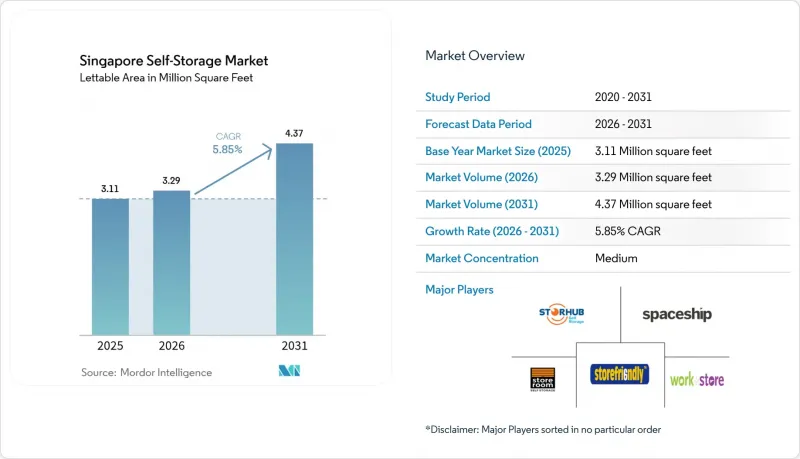
Mordor Intelligence에 의하면, 2026년 싱가포르의 셀프 스토리지 시장 규모는 329만sq. ft.로 추정되고 있어 2025년 311만 sq. ft.에서 2031년에는 437만 sq. ft.에 이를 것으로 예측됩니다.
또한 2026-2031년 연평균 성장률(CAGR)은 5.85%를 기록할 것으로 전망됩니다.
본 보고서는 최종 사용자(개인 및 법인), 보관 공간 크기(40제곱피트 미만의 중소형 유닛, 40제곱피트 이상의 대형 유닛, 기타), 보관 유형(공조 관리형 및 비공조 관리형), 소유 형태(자사 소유 시설 및 임대 시설)별로 분류되어 있습니다. 시장 전망은 수량(유닛) 기준으로 제시됩니다.
싱가포르의 셀프 스토리지 시장 동향 및 인사이트
높은 인구 밀도와 부유층의 존재가 자발적인 보관 수요를 뒷받침하고 있습니다.
싱가포르의 인구 밀도는 1제곱킬로미터당 약 8,000명으로, 이 수치는 소규모 국가를 제외한 아시아 국가들 중 유례를 찾아볼 수 없습니다. 주민들은 주거 공간의 제약을 가장 큰 스트레스 요인 중 하나로 꼽고 있으며, 50%는 “가능하다면 가정용품을 외부에 보관하고 있다”고 인정하고 있습니다. 가구 소득 증가는 정기적인 임대료 납부를 뒷받침하는 한편, 2024년에 5% 증가한 비거주자층은 이사 기간 동안 소지품을 보관할 수 있는 유연성을 중요시하고 있습니다. 50층짜리 공공 주택 단지로 대표되는 고층 도시 계획은 주거 밀도를 높이는 동시에 거주 편의성을 확보하고 있어, 간접적으로 싱가포르의 셀프 스토리지 시장 수요를 뒷받침하고 있습니다. GreenGov.SG와 같은 정부 프로그램은 “소유보다는 이용”이라는 사고방식을 더욱 정착시켜, 유료 보관 시설에 대한 구조적인 수요를 키우고 있습니다.
도시 재개발 프로젝트에 따른 주거 면적 축소
주요 지역의 용적률 상한선 상향 조정으로 인해 주택 총량은 증가하고 있음에도 불구하고, 세대당 면적은 축소되고 있습니다. 2019년 마스터플랜에 따라 5,000세대의 신규 주택 건설을 목적으로 탄종 루(Tanjong Ru) 지역의 용도 구역이 변경된 사례는 재개발이 콤팩트한 주거 단위를 우선시하는 경향을 여실히 보여줍니다. 2025년 상반기 정부 토지 매각 프로그램에서는 주로 복합 애플리케이션 개발 프로젝트 내에서 8,505세대의 민간 주택이 공급될 예정입니다. 오래된 주택 단지가 일괄 재개발됨에 따라, 가구들은 거주 공간을 축소할 수밖에 없게 되고, 이를 보완하기 위해 셀프 스토리지 공간을 임대하게 됩니다. 이러한 추세는 싱가포르의 셀프 스토리지 시장에 있어 장기적인 소비자층을 확보하는 요인이 됩니다.
높은 지가가 유닛 임대료를 끌어올리고 있다.
중심 지역의 산업용 토지월임대료는 1제곱미터당 20-23싱가포르 달러이며, 많은 사업자가 JTC로부터 부지를 확보하기 위해 이 기준을 상회하는 금액을 지불하고 있습니다. 부유층 이용자는 높은 요금을 감당할 수 있지만, 가격에 민감한 가구는 이용을 미루거나 이용 공간을 축소할 가능성이 있습니다. 입주율을 유지하기 위해 주요 브랜드들은 프로모션 패키지를 제공하고 있으며, StorHub의 경우 2개월치 임대료 면제에 더해 30% 할인을 실시했습니다. 따라서 명목 수익은 증가하고 있지만, 지속적인 임대료 상승이 싱가포르의 셀프 스토리지 시장의 장기적인 연평균 성장률(CAGR)을 억제하는 요인으로 작용하고 있습니다.
부문 분석
비즈니스 부문은 싱가포르의 셀프 스토리지 시장의 연평균 성장률(CAGR) 7.05%를 주도하고 있지만, 2025년에도 개인용 스토리지 시장 점유율은 여전히 61.12%를 차지하고 있습니다. 기업들은 에어컨이 완비된 유닛과 연중무휴 24시간 이용을 중요시하며, 평방피트당 수익을 높이는 프리미엄 요금을 기꺼이 지불하고 있습니다. 전자상거래 소규모 판매업자들은 배송 리드타임을 단축하기 위해 시설을 소규모 물류 거점으로 활용하고 있습니다. 한편, 개인 이용층은 아파트 이사에 따른 주거 공간의 소형화와 주재원의 교체 등을 배경으로 안정적인 수요 기반을 지속하고 있습니다. 이 두 요인이 맞물려 높은 가동률을 유지하고 있지만, 법인 고객은 더 높은 서비스 수준을 기대하고 있으며 가격 형성의 주도권을 쥐고 있습니다. RTS(당일 배송)를 가능하게 하는 양국 간 무역 흐름에 힘입어, 싱가포르의 셀프 스토리지 시장 중 법인 사용자 대상 규모는 2031년까지 170만 제곱피트에 육박할 것으로 예측됩니다.
싱가포르의 셀프 스토리지 시장 규모 중 중소형 유닛이 여전히 48.10%를 차지하고 있으며, 이는 개인 소비자가 가정 내 잉여품을 보관하고자 하는 수요를 반영하고 있습니다. 그러나 40제곱피트를 초과하는 유닛은 사업자가 재고를 최종 사용자당에 집중시키는 경향이 있어 연평균 성장률(CAGR) 6.62%로 성장을 지속하고, 있습니다. SingPost의 수용 능력 확대로 소포 처리량이 증가하고 있으며, 이에 따라 판매업자들은 먼 곳의 창고가 아닌 도심부에 재고를 일시적으로 보관하고 있습니다. 이에 대응하여 사업자 측은 상층부를 수요에 따라 분할 가능한 연속된 구획으로 재구성하고 있습니다. 이처럼 대형 유닛의 보급은 시장이 단순한 개인 물품 보관에서 옴니채널 소매의 성장에 맞춘 하이브리드 재고 솔루션으로 전환되고 있음을 보여줍니다.
기타 혜택:
- 엑셀 형식 시장 예측(ME) 시트
- 3개월간의 애널리스트 지원
자주 묻는 질문
목차
제1장 서론
제2장 조사 방법
제3장 주요 요약
제4장 시장 구도
제5장 싱가포르 시장 역학
제6장 시장 규모와 성장 예측
제7장 경쟁 구도
제8장 주요 셀프 스토리지 사업자 시장 점유율
제9장 시장 기회와 향후 전망
LSH 26.09.14According to Mordor Intelligence, Singapore self-Storage market size in 2026 is estimated at 3.29 million sq ft, growing from 2025 value of 3.11 million sq ft with 2031 projections showing 4.37 million sq ft, growing at 5.85% CAGR over 2026-2031.
This report is Segmented by End-User (Personal and Business), Storage Size (Small and Medium Units Less Than 40 Sq Ft, Large Units Above 40 Sq Ft, and More), Storage Type (Climate-Controlled and Non-Climate-Controlled), and Ownership Pattern (Owned Facilities and Leased Facilities). The Market Forecasts are Provided in Terms of Volume (Units).
Singapore Self-Storage Market Trends and Insights
High Population Density and Affluent Demographics Boost Discretionary Storage Demand
Singapore packs around 8,000 residents into each square kilometer, a figure unmatched in Asia outside of micro-states. Residents rank living-space constraints among their top stressors, and 50% admit shelving household items externally when feasible. Rising household incomes support recurring rental fees, while a non-resident population that climbed 5% in 2024 values the flexibility to store possessions between relocations. Vertical city planning, exemplified by 50-storey public-housing blocks, concentrates living yet safeguards livability, indirectly pushing belongings into the Singapore self-storage market. Government programs such as GreenGov.SG further normalize "access over ownership," nurturing structural demand for paid storage.
Shrinking Residential Floor Area from Urban Redevelopment Projects
Higher plot-ratio allowances in prime districts shrink flat sizes even as total housing stock rises. The 2019 Master Plan rezoning of Tanjong Rhu for 5,000 new homes exemplifies how redevelopment favors compact units. The 1H 2025 Government Land Sales program will introduce 8,505 private units, largely within integrated mixed-use projects. As older estates undergo en bloc redevelopment, households downgrade in space and compensate by renting self-storage. This trend guarantees a long-run feedstock of consumers for the Singapore self-storage market.
High Land Costs Inflating Unit Rental Rates
Industrial land in core districts commands SGD 20-23 per sq m monthly, a baseline many operators exceed to secure sites JTC. While affluent users absorb higher fees, price-sensitive households may delay adoption or downgrade unit sizes. To maintain occupancy, leading brands offer promotional bundles, StorHub enables two months free rent alongside 30% discounts. Sustained rental inflation therefore tempers the Singapore self-storage market's longer-term CAGR even as nominal revenue grows.
Other drivers and restraints analyzed in the detailed report include:
- SME and E-commerce Micro-Fulfilment Growth Needing Flexible Inventory Space
- Institutional Investors' Entry Improving Funding Access and Build-Out Pace
- Limited Supply of Industrial-Zoned Land for New Facilities
For complete list of drivers and restraints, kindly check the Table Of Contents.
Segment Analysis
The business segment contributes a 7.05% CAGR to the Singapore self-storage market while personal storage still commands 61.12% share in 2025. Companies favor climate-controlled units and 24/7 access, accepting premium tariffs that elevate revenue per square foot. E-commerce micro-sellers exploit facilities as mini-fulfillment nodes to shorten delivery lead times. Meanwhile, the personal cohort remains a stable volume anchor, driven by apartment downsizing and expatriate churn. Together they sustain broad occupancy, though enterprise clients set the pricing tone through higher service expectations. The Singapore self-storage market size allocated to business users is projected to approach 1.7 million sq ft by 2031, supported by RTS-enabled binational trade flows.
Small and medium units still account for 48.10% of the Singapore self-storage market size, reflecting individual consumers' need to stash household overflow. Yet units exceeding 40 sq ft post a 6.62% CAGR as merchants consolidate inventory nearer to end-customers. SingPost's capacity upgrade lifts parcel volumes, encouraging sellers to stage stock downtown rather than at distant warehouses. Operators respond by reconfiguring upper floors into contiguous blocks that can be subdivided on demand. Large-unit penetration thus signals the market's shift from pure personal-effects storage to hybrid inventory solutions aligned with omnichannel retail growth.
Complete Report Scope:
- By End-User
- Personal
- Business
- By Storage Size
- Small and Medium Units (less than 40 sq ft)
- Large Units (above 40 sq ft)
- Others (Lockers/Double-Stacked)
- By Storage Type
- Climate-Controlled
- Non-Climate-Controlled
- By Ownership Pattern
- Owned Facilities
- Leased Facilities
List of Companies Covered in this Report:
- StorHub Self Storage Pte Ltd
- Extra Space Self Storage Singapore Pte Ltd
- General Storage Company Pte Ltd ("Lock+Store")
- Store Friendly Management (Singapore) Pte Ltd
- Work Plus Store Pte Ltd ("Work+Store")
- Spaceship Singapore (Astore Pte Ltd)
- Store Room Pte Limited
- Beam Storage Pte Ltd
- Far East Organization Pte Ltd ("Store-Y")
- Mandarin Self Storage Pte Ltd
- Urban Space Self Storage Pte Ltd
- Singapore G Pte Ltd ("U-Store@SG")
- Cube Self Storage Pte Ltd
- Extra Space Asia Holdings Pte Ltd (Regional arm)
- MyStore Self Storage Pte Ltd
- Boxpark Storage Pte Ltd
- SelfStore Pte Ltd
- JustStoreIt! Pte Ltd
- StoreHub Group Pte Ltd
- Store-N-Go Pte Ltd
Additional Benefits:
- The market estimate (ME) sheet in Excel format
- 3 months of analyst support
TABLE OF CONTENTS
1 INTRODUCTION
- 1.1 Study Assumptions and Market Definition
- 1.2 Scope of the Study
2 RESEARCH METHODOLOGY
3 EXECUTIVE SUMMARY
4 MARKET LANDSCAPE
- 4.1 Market Overview
- 4.2 Market Drivers
- 4.2.1 High population density and affluent demographics boost discretionary storage demand
- 4.2.2 Shrinking residential floor area from urban redevelopment projects
- 4.2.3 SME and e-commerce micro-fulfilment growth needing flexible inventory space
- 4.2.4 Institutional investors' entry improving funding access and build-out pace
- 4.2.5 Rise of cross-border digital nomads using Singapore as an intermittent base
- 4.2.6 Mandatory Green-Mark retrofit storage compliance spiking temporary demand
- 4.3 Market Restraints
- 4.3.1 High land costs inflating unit rental rates
- 4.3.2 Limited supply of industrial-zoned land for new facilities
- 4.3.3 Stringent Fire-Safety Code-2025 raising cap-ex for multilevel facilities
- 4.3.4 Concierge storage start-ups cannibalising traditional unit occupancy
- 4.4 Impact of Macroeconomic Factors
- 4.5 Industry Value Chain Analysis
- 4.6 Regulatory Landscape
- 4.7 Technological Outlook
- 4.8 Porter's Five Forces Analysis
- 4.8.1 Bargaining Power of Suppliers
- 4.8.2 Bargaining Power of Buyers
- 4.8.3 Threat of New Entrants
- 4.8.4 Threat of Substitutes
- 4.8.5 Intensity of Competitive Rivalry
- 4.9 Investment Analysis
- 4.10 PESTEL Analysis
- 4.11 Key Considerations of Consumers while selecting a Self-Storage Facility
5 MARKET DYNAMICS IN SINGAPORE
- 5.1 Analysis of Occupancy Rates
- 5.2 Average Rental Trends
- 5.2.1 Pre-Covid and Post-Covid Market Implications
- 5.3 Profitability Analysis
- 5.3.1 Pre-Covid and Post-Covid Market Implications
- 5.4 Average Facility Size
6 MARKET SIZE AND GROWTH FORECASTS (UNITS)
- 6.1 By End-User
- 6.1.1 Personal
- 6.1.2 Business
- 6.2 By Storage Size
- 6.2.1 Small and Medium Units (less than 40 sq ft)
- 6.2.2 Large Units (above 40 sq ft)
- 6.2.3 Others (Lockers/Double-Stacked)
- 6.3 By Storage Type
- 6.3.1 Climate-Controlled
- 6.3.2 Non-Climate-Controlled
- 6.4 By Ownership Pattern
- 6.4.1 Owned Facilities
- 6.4.2 Leased Facilities
7 COMPETITIVE LANDSCAPE
- 7.1 Market Concentration
- 7.2 Strategic Moves
- 7.3 Market Share Analysis
- 7.4 Company Profiles (includes Global level Overview, Market level overview, Core Segments, Financials as available, Strategic Information, Market Rank/Share for key companies, Products and Services, Recent Developments)
- 7.4.1 StorHub Self Storage Pte Ltd
- 7.4.2 Extra Space Self Storage Singapore Pte Ltd
- 7.4.3 General Storage Company Pte Ltd ("Lock+Store")
- 7.4.4 Store Friendly Management (Singapore) Pte Ltd
- 7.4.5 Work Plus Store Pte Ltd ("Work+Store")
- 7.4.6 Spaceship Singapore (Astore Pte Ltd)
- 7.4.7 Store Room Pte Limited
- 7.4.8 Beam Storage Pte Ltd
- 7.4.9 Far East Organization Pte Ltd ("Store-Y")
- 7.4.10 Mandarin Self Storage Pte Ltd
- 7.4.11 Urban Space Self Storage Pte Ltd
- 7.4.12 Singapore G Pte Ltd ("U-Store@SG")
- 7.4.13 Cube Self Storage Pte Ltd
- 7.4.14 Extra Space Asia Holdings Pte Ltd (Regional arm)
- 7.4.15 MyStore Self Storage Pte Ltd
- 7.4.16 Boxpark Storage Pte Ltd
- 7.4.17 SelfStore Pte Ltd
- 7.4.18 JustStoreIt! Pte Ltd
- 7.4.19 StoreHub Group Pte Ltd
- 7.4.20 Store-N-Go Pte Ltd
8 MARKET SHARE OF KEY SELF-STORAGE OPERATORS
9 MARKET OPPORTUNITIES AND FUTURE OUTLOOK
- 9.1 White-space and Unmet-Need Assessment


