|
시장보고서
상품코드
2124675
기판 : 시장 점유율 분석, 업계 동향과 통계, 성장 예측(2026-2031년)Substrate - Market Share Analysis, Industry Trends & Statistics, Growth Forecasts (2026 - 2031) |
||||||
 Mordor Intelligence
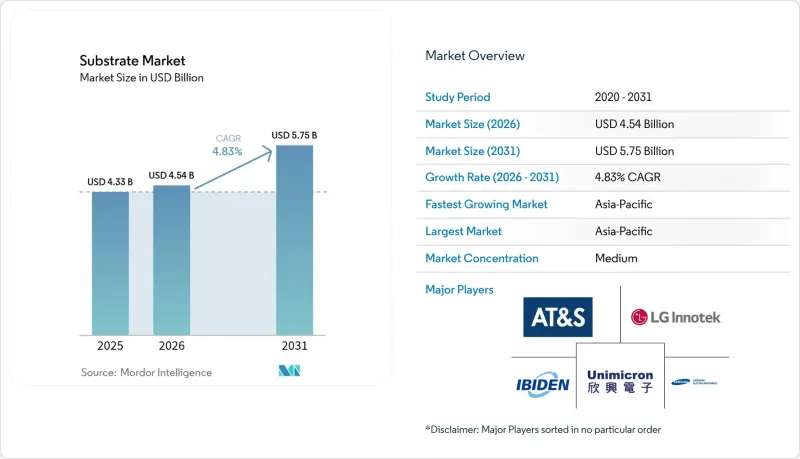
Mordor Intelligence에 의하면, 기판 시장 규모는 2025년에 43억 3,000만 달러로 평가되었고, 2026년 45억 4,000만 달러에서 2031년까지 57억 5,000만 달러에 이를 것으로 예측되며, 예측 기간(2026-2031년) CAGR은 4.83%를 기록할 전망입니다.
본 보고서는 기판 유형(리지드 FR-4, 플렉스, 리지드 플렉스 등), 소재(에폭시 유리 FR-4, 폴리이미드, BT 수지 등),제조 기술(PCB 에칭/라미네이션, 박막 증착 등), 최종 사용자 산업(컴퓨팅 및 데이터 스토리지, 소비자용 전자기기 등), 그리고 지역별로 분류되어 있습니다. 시장 예측은 금액(달러) 기준으로 제시되어 있습니다.
세계 기판 시장 동향 및 인사이트
AI 가속기에서의 이종 통합 확산
이종 통합을 통해 단일 패키지 내에서 여러 특수 다이가 연동하여 작동할 수 있게 됨에 따라, 기판의 복잡성에 대한 요구 사항이 높아지고 있습니다. 인텔은 유리 기판을 사용하여 유기 적층 기판에 비해 10배 높은 상호 연결 밀도를 실현하는 것을 목표로 하고 있으며, 이를 통해 신호 무결성의 저하를 초래하지 않으면서 로직,메모리, 그리고 가속기 칩렛을 공존시킬 수 있게 됩니다. 유기 FR-4는 미세 피치의 이러한 배선을 지원할 수 없기 때문에 설계자들은 유리, 첨단 유기 소재, 그리고 세라믹으로의 전환을 추진하고 있습니다. 현재의 패키지 아키텍처에서는 고속 인터페이스와 민감한 아날로그 레일이 인접하게 배치되기 때문에 유전체 손실, 열팽창 계수 및 비아의 신뢰성이 중요한 선정 기준이 되고 있습니다. 제조업체들은 10µm 미만의 라인/스페이스 규정을 충족하기 위해 고해상도 리소그래피 및 레이저 드릴링 기술에 투자하고 있습니다. AI 워크로드의 확장이 진행됨에 따라, 패키징에 기인한 성능 향상은 프런트엔드 노드 미세화와 마찬가지로 중요하며, 이를 통해 첨단 기판의 프리미엄 가격을 유지하고 있습니다.
모바일 및 웨어러블 기기의 소형화 수요
스마트폰 기판은 소형화가 진행되는 한편, 부품 수는 증가하고 있어, 공급업체는 더 얇고, 고밀도이며, 유연성이 높은 기판 구조를 제공해야 하는 압박을 받고 있습니다. 폴리이미드 코어를 채택한 리지드-플렉스 설계는 접힘 부근에 고속 버스를 배선할 때 균열을 방지하는 데 도움이 됩니다. 웨어러블 기기의 경우 적층 구조가 더욱 압축되기 때문에 코어 층 내에 수동 부품을 내장해야 할 필요성이 대두되고 있습니다. 중국, 한국, 베트남의 제조업체들은 2024년 이후의 설계 주기에서 플렉서블 라미네이트 주문량을 두 배로 늘려, 플렉서블 기판 공장의 가동률을 높이고 있습니다. 부품 간의 간격이 좁아지면 발열량이 증가하기 때문에 알루미늄 백킹이 적용된 메탈 코어 제품이 하이엔드 모바일 분야에 진입하고 있습니다. 이러한 추세로 인해 휴대폰 생산 대수가 정체되더라도 기판 1장당 부가가치가 서서히 높아짐에 따라, 기판 시장의 매출은 계속 확대되고 있습니다.
고 Tg 수지 공급망의 변동
유리 전이 온도(Tg)가 170℃를 초과하는 수지를 공급하는 화학 제조업체는 극소수에 불과하기 때문에 공급 중단이 발생하면 현물 시장공급이 부족해지고 가격이 급등합니다. 에폭시 전구체에 대한 무역 규제로 인해 2024년에는 리드타임이 24주로 늘어났고, 기판 공급업체들은 더 많은 안전 재고를 확보할 수밖에 없게 되었습니다. 재고 보유 비용은 특히 중소규모 제조업체의 이익률을 압박하고 있습니다. 자동차 및 항공우주 분야의 고객은 보닛 내부나 항공 전자 기기 조립에 고 Tg 기판의 사용을 의무화하고 있기 때문에 표준 FR-4로 대체하는 것은 현실적이지 않습니다. 공급업체들은 장기 계약을 체결하고 있지만, 동아시아의 주요 수지 생산 거점 주변에서 발생하는 지정학적 혼란의 영향을 받기 쉬운 상황이 지속되고 있습니다.
부문 분석
2025년, 리지드 FR-4는 기판 시장 점유율 54.98%를 유지했습니다. 이는 확립된 인프라와 낮은 단가를 반영한 결과입니다. 이 부문은 최첨단 성능보다는 1제곱인치당 비용을 중시하는 주류 노트북, TV, 가전제품을 대상으로 합니다. 대조적으로, 유리 기판은 5.54%의 연평균 성장률(CAGR)을 기록하고 있으며, 이는 모든 유형 중 가장 빠른 성장 속도입니다. 이는 AI 가속기 및 스위치 ASIC 로드맵에서 현재 최대 10배의 배선 밀도가 필수적이기 때문입니다. 이러한 요구 사항으로 인해, 더 엄격한 치수 공차와 낮은 열팽창 계수(CTE)의 불일치를 수용할 수 있는 유리 인터포저에 대한 수요가 증가하고 있습니다. 세라믹 기판은 고전력 밀도 회로 분야에서 안정적인 틈새 시장을 차지하고 있는 반면, 메탈 코어 기판은 LED 조명 및 중전력 설계 분야에서 수요가 증가하고 있습니다. 플렉서블 및 리지드-플렉서블 구조는 굽힘 반경 측면에서 리지드 기판을 능가하는 폴더블 스마트폰 및 자동차용 인포테인먼트 패널에서 시장 점유율을 유지하고 있습니다. 향후 수율 학습 곡선에 따라 층당 비용이 절감됨에 따라, 유리 기판 시장 규모는 2031년까지 10억 7,000만 달러를 넘어설 것으로 예측됩니다. 각 공급업체들은 경기 변동에 대한 헤지 수단으로, 다층 유리 기판과 비용이 최적화된 FR-4 기판 사이에 생산 능력을 배분하고 있습니다.
레티클 크기의 인터포저에 유리를 채택하는 칩 벤더가 증가하고 있어, 이로 인해 특수 패널 제조 공장의 수주 전망이 밝아지고, 장비 제조업체와의 제휴도 활발해지고 있습니다. 2025년 시범 생산에서 결함 밀도가 50ppm 미만으로 나타나, 2026년 이후의 양산 확대를 뒷받침하고 있습니다. 그렇지만 가격에 민감한 소비자용 전자기기 분야에서는 리지드 FR-4가 여전히 중요한 역할을 하고 있으며, 그 광범위한 공급 기반은 OEM 제조업체에게 협상상의 우위를 제공합니다. FR-4 쉘 내에 유리 코어를 적층한 하이브리드 적층 구조가 가교 기술로 부상하고 있으며, 고객이 설계를 전면적으로 재검토하지 않고도 전환할 수 있도록 지원하고 있습니다. 전반적으로 향후 5년간의 기판 구성은 완전한 대체가 아닌 공존이 주류를 이룰 것입니다.
FR-4 에폭시 유리는 균형 잡힌 기계적 강도, 난연성 및 저렴한 가격 덕분에 2025년에는 매출 점유율의 41.88%를 차지했습니다. 한편, 유리 소재는 더 미세한 라인·스페이스를 구현하고 대형 기판의 뒤틀림을 줄임으로써 2031년까지 연평균 성장률(CAGR) 5.42%라는 최고 수준의 성장률을 기록할 전망입니다. BT 수지는 고속 직렬 링크에 적합한 낮은 유전율을 제공하여 첨단 네트워크 카드 시장을 선점하고 있습니다. 폴리이미드 층은 최대 260°C까지의 연속 사용을 견딜 수 있어, FR-4로는 대응할 수 없는 항공우주 분야 및 광산 굴착용 전자기기를 뒷받침하고 있습니다. 질화 알루미늄 및 알루미나로 제작된 세라믹 플레이트는 150 W/mK를 초과하는 열전도율을 달성하여, SiC 기반 전기차용 인버터에서 필수적인 요소로 자리 잡고 있습니다. 메탈 코어 적층판은 구리 또는 알루미늄 백커와 프리프레그를 결합하여, LED 드라이버를 위해 비용과 성능의 균형을 맞춘 중간적인 열전도 단계를 제공합니다.
소재 혁신가들은 5G 프런트엔드 모듈에 매우 중요한 특성인 mm파 대역에서의 손실 탄젠트를 줄이기 위해 필러의 화학 성분을 최적화하고 있습니다. 지속가능성 노력에 따라 RoHS 및 REACH를 준수하는 무할로겐 대체 재료에 대한 수요가 증가하고 있으며, 수지 공급업체들의 신제품 출시가 잇따르고 있습니다. 이종 집적화로 인해 선폭이 좁아짐에 따라 기판과 실리콘 간의 열팽창 계수의 일치가 필수적이며, 층 수가 많아질수록 유리가 우위를 발휘합니다. 이러한 요인들을 종합해 볼 때, 단일 선택지로는 모든 성능 및 비용 목표를 충족할 수 없기 때문에 기판 시장은 소재군별로 세분화가 계속 진행되고 있습니다.
지역별 분석
아시아태평양은 2025년에 매출 점유율 37.92%를 유지하며, 대만, 한국, 중국의 전체 공급망에 걸친 규모의 경제 효과로 인해 2031년까지 연평균 성장률(CAGR) 5.29%로 확대되고 있습니다. 한국의 삼성일렉트로메카닉스와 LG이노텍은 국가 혁신 보조금을 일부 자금원으로 삼아 패널 수준의 팬아웃 생산 라인으로의 업그레이드를 추진하고 있습니다. 대만의 Zhen Ding Technology와 Unimicron은 주요 GPU 및 네트워크용 ASIC 로드맵에 맞추어 확장을 추진하며, 수년에 걸친 수주를 확보하고 있습니다. 중국 본토공급업체들은 수출 라이선스와 관련된 불확실성을 완화하기 위해 유리 기판의 자급자족을 추구하고 있으며, 정부의 지원을 받은 컨소시엄을 조직하여 주요 제조 장비의 현지화를 도모하고 있습니다.
북미에서는 ‘CHIPS 법’에 따라 첨단 패키징 장비 투자에 대해 25%의 투자 세액 공제가 적용되고, 실질적인 자본 집약도가 낮아짐에 따라 활동이 다시 활발해지고 있습니다. 텍사스주는 새로운 웨이퍼 제조 시설과 병설될 기판 제조 공장을 위해 14억 달러의 보조금을 편성했으며, 오리건주는 2030년까지 400억 달러의 반도체 관련 지출을 예상하고 있습니다. 각 OEM 기업들은 안정적인 공급과 엔지니어링 주기 단축을 목적으로 니어쇼어링을 중시하고 있으며, 이에 따라 기판 제조업체들은 규모는 작지만 이익률이 높은 국내 공장 건설을 검토하고 있습니다.
유럽은 전략적 자립성에 중점을 두고 있으며, 보조금을 자동차 전동화 로드맵과 연계하고 있습니다. 독일의 Tier 1 공급업체가 인버터 조립 라인을 자사 내로 이전함에 따라 세라믹 기판의 보급률이 높아지고 있습니다. 유럽연합(EU)이 제안한 에코디자인 규제로 인해 할로겐계 재료에 대한 감시가 강화되고, FR-4의 대체 재료가 우대받고 있습니다. 정책 주도형 수요가 환경 규제를 준수하는 공급업체를 우대하는 프리미엄 시장 부문을 형성하고 있습니다.
각 지역에서 환율 변동이 조달 결정에 영향을 미치고 있으며, 물류 병목 현상으로 인해 최종 조립 거점과의 근접성이 중요시되고 있습니다. 시장 다변화로 인해 아시아태평양의 점유율은 소폭 하락할 것으로 보이지만, 지역 간 경쟁이 기판 시장에 여러 성장 거점을 창출하고 있습니다.
기타 혜택:
- 엑셀 형식 시장 예측(ME) 시트
- 3개월간의 애널리스트 지원
자주 묻는 질문
목차
제1장 서론
제2장 조사 방법
제3장 주요 요약
제4장 시장 구도
제5장 시장 규모와 성장 예측
제6장 경쟁 구도
제7장 시장 기회와 향후 전망
LSH 26.09.14According to Mordor Intelligence, the substrate market size was valued at USD 4.33 billion in 2025 and estimated to grow from USD 4.54 billion in 2026 to reach USD 5.75 billion by 2031, at a CAGR of 4.83% during the forecast period (2026-2031).
This report is Segmented by Substrate Type (Rigid FR-4, Flex, Rigid-Flex, and More), Material (Epoxy Glass FR-4, Polyimide, BT Resin, and More), Manufacturing Technology (PCB Etching/Lamination, Thin-Film Deposition, and More), End-User Industry (Computing and Data Storage, Consumer Electronics, and More), and Geography. The Market Forecasts are Provided in Terms of Value (USD).
Global Substrate Market Trends and Insights
Proliferation of Heterogeneous Integration in AI Accelerators
Heterogeneous integration allows multiple specialized dies to work together inside a single package, raising substrate complexity requirements. Intel targets 10 X higher interconnect density over organic laminates using glass substrates, enabling logic, memory, and accelerator chiplets to coexist without signal-integrity losses. Organic FR-4 cannot match these routings at fine pitches, which encourages designers to transition toward glass, advanced organic, and ceramic options. Package architectures now mix high-speed interfaces next to sensitive analog rails, so dielectric loss, coefficient of thermal expansion, and via reliability become critical selection criteria. Fabricators invest in higher-resolution lithography and laser drilling to meet line/space rules under 10 µm. As AI workloads continue scaling, packaging-centric performance gains are as important as front-end node shrinks, sustaining premium pricing for advanced substrates.
Miniaturization Demand in Mobile and Wearable Devices
Smartphone boards are shrinking while component counts rise, pressing suppliers to deliver thinner, denser, and more flexible substrate constructions. Rigid-flex designs with polyimide cores help route high-speed buses around fold lines without cracking. Wearables further compress stack-ups, forcing the adoption of embedded passive components inside the core layers. Makers in China, South Korea, and Vietnam doubled orders for flexible laminates after 2024 design cycles, lifting utilization in flex substrate factories. Tighter component clearances heighten heat buildup; hence, metal-core variants with aluminum backing are entering high-end mobile segments. These dynamics keep substrate market revenue expanding even when handset unit volumes plateau because value per board creeps higher.
Supply-Chain Volatility for High-Tg Resins
Only a handful of chemical producers offer resins that survive above 170 °C glass-transition temperatures, so any outage tightens spot supply and spikes pricing. Trade restrictions on epoxy precursors raised lead times to 24 weeks during 2024, forcing substrate vendors to hold larger safety stocks. Inventory carrying costs erode margins, especially for small and mid-size shops. Automotive and aerospace customers mandate high-Tg boards for under-hood and avionics assemblies, so substitution with standard FR-4 is not feasible. Suppliers negotiate long-term contracts yet remain vulnerable to geopolitical disruptions around major resin-manufacturing centers in East Asia.
Other drivers and restraints analyzed in the detailed report include:
- 5G Roll-Outs Boosting High-Frequency RF Substrates
- EV Power-Electronics Adoption of Ceramic and Metal-Core Substrates
- CAPEX Intensity of Advanced Substrate Lines
For complete list of drivers and restraints, kindly check the Table Of Contents.
Segment Analysis
Rigid FR-4 retained a 54.98% slice of the substrate market share in 2025, reflecting entrenched infrastructure and low unit costs. The segment addresses mainstream notebooks, televisions, and home appliances that prize cost per square inch over bleeding-edge performance. In contrast, glass substrates record a 5.54% CAGR, the fastest pace across types, because AI accelerators and switch-ASIC roadmaps now mandate up to 10 X interconnect density. That requirement pulls demand toward glass interposers capable of tighter dimensional tolerances and low CTE mismatch. Ceramic substrates occupy a stable niche in power-dense circuits, while metal-core boards pick up LED lighting and mid-power designs. Flex and rigid-flex constructions hold share in foldable phones and automotive infotainment panels where bend radii beat rigid boards. Looking forward, the substrate market size for glass lines is projected to exceed USD 1.07 billion by 2031 as yield learning curves trim per-layer costs. Suppliers split capacity between high-layer glass and cost-optimized FR-4 to hedge cyclical swings.
A growing list of chip vendors adopt glass for reticle-sized interposers, lifting order visibility for specialty panel fabs and sparking partnerships with equipment makers. Pilot production runs delivered defect densities under 50 ppm in 2025, supporting volume ramps from 2026 onward. Yet rigid FR-4 remains relevant for price-sensitive consumer electronics, and its deep supply base provides negotiating leverage to OEMs. Hybrid stack-ups that laminate glass cores inside FR-4 shells emerge as a bridge technology, helping customers transition without wholesale redesigns. Overall, coexistence rather than outright replacement defines the next five-year substrate mix.
FR-4 epoxy glass held a 41.88% revenue share in 2025 thanks to its balanced mechanical strength, flame retardancy, and low price. Glass materials, however, chart the leading 5.42% CAGR through 2031 by enabling finer line/space and reducing warpage in large substrates. BT resin provides lower dielectric constants suited to high-speed serial links, capturing advanced networking cards. Polyimide layers withstand continuous service up to 260 °C, supporting aerospace and down-hole drilling electronics where FR-4 fails. Ceramic plates of aluminum nitride or alumina reach thermal conductivities above 150 W/mK, making them indispensable in SiC-based EV inverters. Metal-core laminates combine copper or aluminum backers with prepreg, offering an intermediate thermal step that balances cost and performance for LED drivers.
Material innovators tailor filler chemistry to lower loss tangent at mmWave bands, an attribute critical for 5G front-end modules. Sustainability drives demand for halogen-free alternatives compliant with RoHS and REACH, spurring incremental product launches from resin suppliers. As heterogeneous integration tightens line widths, coefficient of thermal expansion convergence between substrate and silicon becomes essential, giving glass an edge at high layer counts. Taken together, the substrate market continues fragmenting by material family as no single option satisfies every performance and cost target.
Complete Report Scope:
- By Substrate Type
- Rigid (FR-4)
- Flex
- Rigid-Flex
- Ceramic
- Glass
- Other Types
- By Material
- Epoxy Glass (FR-4)
- Polyimide
- BT Resin
- Ceramic (Alumina, AlN)
- Glass
- Metal-Core (Al, Cu)
- Other Materials
- By Manufacturing Technology
- PCB Etching and Lamination
- Thin-Film Deposition
- Additive Manufacturing / Printing
- Fan-Out Wafer-Level Packaging
- Embedded Die
- Other Technologies
- By End-User Industry
- Computing and Data Storage
- Consumer Electronics
- Automotive and Transportation
- Industrial and Medical
- Telecom and Infrastructure
- Aerospace and Defense
- Other End-User Industries
- By Geography
- North America
- United States
- Canada
- Mexico
- South America
- Brazil
- Argentina
- Rest of South America
- Europe
- Germany
- United Kingdom
- France
- Italy
- Spain
- Russia
- Rest of Europe
- Asia Pacific
- China
- Japan
- South Korea
- India
- Taiwan
- ASEAN
- Rest of Asia Pacific
- Middle East and Africa
- Middle East
- Saudi Arabia
- UAE
- Turkey
- Rest of Middle East
- Africa
- South Africa
- Nigeria
- Rest of Africa
- Middle East
- North America
Geography Analysis
Asia Pacific maintained a 37.92% revenue share in 2025 and advances at a 5.29% CAGR through 2031 thanks to scale economies across Taiwanese, South Korean, and Chinese supply chains. Korea's Samsung Electro-Mechanics and LG Innotek are upgrading to panel-level fan-out lines, funded partly by national innovation grants. Taiwan's Zhen Ding Technology and Unimicron synchronize expansions with leading GPU and networking ASIC roadmaps to secure multiyear loadings. Mainland Chinese vendors pursue glass substrate independence to mitigate export-license uncertainties, organizing government-backed consortia to localize key tooling.
North America witnesses resurging activity as the CHIPS Act provides a 25% investment tax credit for advanced-packaging equipment, reducing effective capital intensity. Texas earmarked USD 1.4 billion in grants for substrate fabs co-located with new wafer facilities, and Oregon projects USD 40 billion semiconductor spending by 2030. OEMs value near-shoring for secure supply and faster engineering turns, prompting substrate makers to weigh smaller but higher-margin domestic plants.
Europe focuses on strategic autonomy, aligning subsidies with its automotive electrification roadmap. Ceramic substrates see higher penetration because German Tier-1 suppliers shift inverter assembly lines in-house. The European Union's proposed Eco-Design regulation elevates scrutiny on halogenated materials, favoring FR-4 alternatives. Policy-driven demand shapes a premium market segment that rewards environmentally compliant suppliers.
Across regions, currency fluctuations influence sourcing decisions, and logistics bottlenecks incentivize closer proximity to final assembly. Diversification dilutes Asia Pacific's share only modestly, yet regional competition yields multiple growth nodes for the substrate market.
- Ibiden Co., Ltd.
- Unimicron Technology Corp.
- Samsung Electro-Mechanics Co., Ltd.
- AT&S AG
- Zhen Ding Technology Holding Ltd.
- Shinko Electric Industries Co., Ltd.
- Nan Ya PCB Corp.
- LG Innotek Co., Ltd.
- Compeq Manufacturing Co., Ltd.
- Kyocera Corporation
- Nippon Mektron, Ltd.
- Shenzhen Kinwong Electronic Co., Ltd.
- Fujikura Ltd.
- Young Poong Electronics Co., Ltd.
- Tripod Technology Corporation
- Wus Printed Circuit Co., Ltd.
- NCAB Group AB
- China Fastprint Technology Co., Ltd.
- Eltek Ltd.
- Flexium Interconnect, Inc.
- PCB Technologies Ltd.
- Advanced Semiconductor Engineering, Inc.
- JCET Group Co., Ltd.
Additional Benefits:
- The market estimate (ME) sheet in Excel format
- 3 months of analyst support
TABLE OF CONTENTS
1 INTRODUCTION
- 1.1 Study Assumptions and Market Definition
- 1.2 Scope of the Study
2 RESEARCH METHODOLOGY
3 EXECUTIVE SUMMARY
4 MARKET LANDSCAPE
- 4.1 Market Overview
- 4.2 Market Drivers
- 4.2.1 Proliferation of heterogeneous integration in AI accelerators
- 4.2.2 Miniaturization demand in mobile and wearable devices
- 4.2.3 5G roll-outs boosting high-frequency RF substrates
- 4.2.4 EV power-electronics adoption of ceramic and metal-core substrates
- 4.2.5 Emergence of chiplet-based packages
- 4.2.6 Regional semiconductor subsidy races
- 4.3 Market Restraints
- 4.3.1 Supply-chain volatility for high-Tg resins
- 4.3.2 CAPEX intensity of advanced substrate lines
- 4.3.3 Technological lock-in risk for legacy PCB fabs
- 4.3.4 Sustainability pressure on halogenated laminates
- 4.4 Industry Value Chain Analysis
- 4.5 Regulatory Landscape
- 4.6 Technological Outlook
- 4.7 Porter's Five Forces Analysis
- 4.7.1 Threat of New Entrants
- 4.7.2 Bargaining Power of Suppliers
- 4.7.3 Bargaining Power of Buyers
- 4.7.4 Threat of Substitutes
- 4.7.5 Competitive Rivalry
5 MARKET SIZE AND GROWTH FORECASTS (VALUE)
- 5.1 By Substrate Type
- 5.1.1 Rigid (FR-4)
- 5.1.2 Flex
- 5.1.3 Rigid-Flex
- 5.1.4 Ceramic
- 5.1.5 Glass
- 5.1.6 Other Types
- 5.2 By Material
- 5.2.1 Epoxy Glass (FR-4)
- 5.2.2 Polyimide
- 5.2.3 BT Resin
- 5.2.4 Ceramic (Alumina, AlN)
- 5.2.5 Glass
- 5.2.6 Metal-Core (Al, Cu)
- 5.2.7 Other Materials
- 5.3 By Manufacturing Technology
- 5.3.1 PCB Etching and Lamination
- 5.3.2 Thin-Film Deposition
- 5.3.3 Additive Manufacturing / Printing
- 5.3.4 Fan-Out Wafer-Level Packaging
- 5.3.5 Embedded Die
- 5.3.6 Other Technologies
- 5.4 By End-User Industry
- 5.4.1 Computing and Data Storage
- 5.4.2 Consumer Electronics
- 5.4.3 Automotive and Transportation
- 5.4.4 Industrial and Medical
- 5.4.5 Telecom and Infrastructure
- 5.4.6 Aerospace and Defense
- 5.4.7 Other End-User Industries
- 5.5 By Geography
- 5.5.1 North America
- 5.5.1.1 United States
- 5.5.1.2 Canada
- 5.5.1.3 Mexico
- 5.5.2 South America
- 5.5.2.1 Brazil
- 5.5.2.2 Argentina
- 5.5.2.3 Rest of South America
- 5.5.3 Europe
- 5.5.3.1 Germany
- 5.5.3.2 United Kingdom
- 5.5.3.3 France
- 5.5.3.4 Italy
- 5.5.3.5 Spain
- 5.5.3.6 Russia
- 5.5.3.7 Rest of Europe
- 5.5.4 Asia Pacific
- 5.5.4.1 China
- 5.5.4.2 Japan
- 5.5.4.3 South Korea
- 5.5.4.4 India
- 5.5.4.5 Taiwan
- 5.5.4.6 ASEAN
- 5.5.4.7 Rest of Asia Pacific
- 5.5.5 Middle East and Africa
- 5.5.5.1 Middle East
- 5.5.5.1.1 Saudi Arabia
- 5.5.5.1.2 UAE
- 5.5.5.1.3 Turkey
- 5.5.5.1.4 Rest of Middle East
- 5.5.5.2 Africa
- 5.5.5.2.1 South Africa
- 5.5.5.2.2 Nigeria
- 5.5.5.2.3 Rest of Africa
- 5.5.5.1 Middle East
- 5.5.1 North America
6 COMPETITIVE LANDSCAPE
- 6.1 Market Concentration
- 6.2 Strategic Moves
- 6.3 Market Share Analysis
- 6.4 Company Profiles (includes Global level Overview, Market level overview, Core Segments, Financials as available, Strategic Information, Market Rank/Share, Products and Services, Recent Developments)
- 6.4.1 Ibiden Co., Ltd.
- 6.4.2 Unimicron Technology Corp.
- 6.4.3 Samsung Electro-Mechanics Co., Ltd.
- 6.4.4 AT&S AG
- 6.4.5 Zhen Ding Technology Holding Ltd.
- 6.4.6 Shinko Electric Industries Co., Ltd.
- 6.4.7 Nan Ya PCB Corp.
- 6.4.8 LG Innotek Co., Ltd.
- 6.4.9 Compeq Manufacturing Co., Ltd.
- 6.4.10 Kyocera Corporation
- 6.4.11 Nippon Mektron, Ltd.
- 6.4.12 Shenzhen Kinwong Electronic Co., Ltd.
- 6.4.13 Fujikura Ltd.
- 6.4.14 Young Poong Electronics Co., Ltd.
- 6.4.15 Tripod Technology Corporation
- 6.4.16 Wus Printed Circuit Co., Ltd.
- 6.4.17 NCAB Group AB
- 6.4.18 China Fastprint Technology Co., Ltd.
- 6.4.19 Eltek Ltd.
- 6.4.20 Flexium Interconnect, Inc.
- 6.4.21 PCB Technologies Ltd.
- 6.4.22 Advanced Semiconductor Engineering, Inc.
- 6.4.23 JCET Group Co., Ltd.
7 MARKET OPPORTUNITIES AND FUTURE OUTLOOK
- 7.1 White-space and Unmet-Need Assessment