

|
시장보고서
상품코드
2124710
석유 및 가스 NDT : 시장 점유율 분석, 업계 동향 및 통계, 성장 예측(2026-2031년)Oil And Gas NDT - Market Share Analysis, Industry Trends & Statistics, Growth Forecasts (2026 - 2031) |
||||||
 Mordor Intelligence
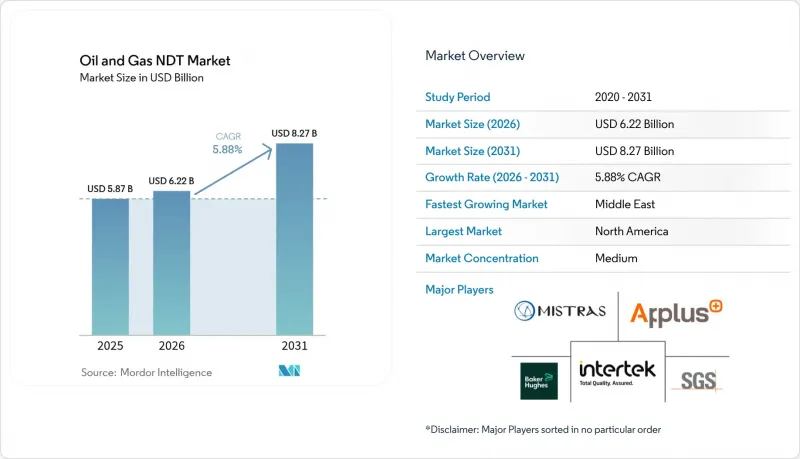
Mordor Intelligence에 의하면, 석유 및 가스 NDT 시장 규모는 2025년 58억 7,000만 달러로 평가되었습니다. 2026년에는 62억 2,000만 달러로 확대되어 2026년부터 2031년에 걸쳐 CAGR 5.88%로 성장을 지속하여, 2031년에는 82억 7,000만 달러에 이를 것으로 예측됩니다.
본 보고서는 구성 요소(장비, 소프트웨어 등), 검사 방법(초음파 검사, 방사선 검사, 자분 탐상 검사 등), 기법(기존/기존 방식, AI 활용형), 지역(북미, 남미, 유럽, 아시아태평양, 중동 및 아프리카)별로 분류되어 있습니다. 시장 예측은 금액(달러) 기준으로 제시되어 있습니다.
세계의 석유 및 가스 NDT 시장 동향 및 인사이트
업스트림 자산 건전성 관리의 디지털화가 비파괴 검사(NDT)의 변혁을 가속화
초음파 검사 및 육안 검사의 워크플로우에 통합된 인공지능(AI) 엔진 덕분에 판정에 소요되는 사이클 시간이 최대 90% 단축되었습니다. 클라우드 연결형 분석 도구를 도입한 사업자는 실시간 결함 분류 및 자동 보고서 생성 기능을 활용하여 규정 준수 부담을 줄일 수 있습니다. 정확도 94%를 달성한 AI 기반 용접부 분류 등 초기 도입 사례에서는 숙련된 인력 부족 문제를 해결하는 일관된 성과가 입증되었습니다. 이러한 알고리즘은 예방 정비 루틴도 지원하며, 검사를 일정 기반에서 위험 기반 트리거 방식으로 전환함으로써 자산 가동 시간을 향상시키고 검사 총비용을 절감하고 있습니다. 장비 공급업체들은 페이즈 어레이 프로브에 엣지 컴퓨팅 모듈을 번들로 제공하는 사례가 늘어나고 있으며, 하드웨어를 디지털 트윈에 데이터를 공급하는 데이터 노드로 변모시키고 있습니다. 데이터 레이크가 확대됨에 따라, 서비스 계약에서 시간당 단가가 아닌 성과 기반 요금이 규정되는 사례가 증가하고 있으며, 이는 측정 가능한 신뢰성 향상을 실현한 공급업체에 보상을 제공하는 구조로 작용하고 있습니다.
심해 탐사 프로젝트가 첨단 비파괴 검사(NDT) 요건을 주도
수심 3,000m를 초과하는 해역에 부유식 생산 시스템을 설치함에 따라, ±0.5mm의 두께 감소를 감지할 수 있는 해저용 위상 배열 스캐너에 대한 수요가 높아지고 있습니다. ROV(원격 조종 무인 탐사기)로 전개되는 계측 기기는 다이버가 위험에 노출될 위험을 제거하는 동시에 선박의 체류 시간을 최대 70% 단축합니다. 새로운 센서 패키지는 와전류 어레이와 음향 방출 모듈을 결합하여 극한의 동적 하중에 노출된 카테너리 라이저의 피로 핫스팟을 조사했습니다. 딥러닝 모델과 결합된 혁신적인 자기 메모리 진단 기술을 통해 라이저 내부의 피칭, 홈 모양의 두께 감소 및 마모 분류에서 95.4%의 검증 정확도를 달성했습니다. 배럴 비용의 상승에 따라, 운영사는 한 번의 동원만으로 완전한 디지털 데이터 세트를 제공하는 검사선에 대해 높은 일당을 지불하고 있습니다. 이러한 고부가가치 프로젝트는 수년에 걸친 서비스 계약을 보장하며, 심해 비파괴 검사 솔루션 공급업체에게 예측 가능한 현금 흐름을 확보해 줍니다.
원유 가격 변동이 서비스 수요를 억제
2025년 초 브렌트 원유 가격이 두 자릿수 하락을 보이며 배럴당 66.65달러가 된 것을 계기로, 원유 가격이 60달러 아래로 떨어질 경우 미국의 육상 활동이 20% 감소할 것이라는 예측이 제시되었습니다. 과거 실적을 보면 원유 가격이 5달러 하락할 때마다 셰일 관련 지출이 약 5% 감소했으며, 그 결과 검사가 필요한 용접부, 라이저, 플로우라인의 수가 감소하게 됩니다. 해외 사업은 가격 변동에 대한 민감도가 낮은 반면, 국내 서비스 기업들은 시추 장비 수 감축에 직면해 있어 가동률이 하락하고 일당 수입이 압박받고 있습니다. 동시에, 2,000억 달러 규모의 M&A 물결로 인해 구매력이 소수의 슈퍼 메이저에 집중되면서, 이들 기업은 더욱 엄격한 가격 조건이나 장기 지불 조건을 협상할 수 있게 되었습니다. 고사양의 심해 프로젝트는 여전히 영향을 받기 어렵지만, 단기 주기의 육상 활동은 가격 변동에 대한 탄력성이 강화되고 있습니다.
부문별 분석
운영사가 설비 소유에서 턴키 방식의 검사 결과 조달로 전환함에 따라 서비스 분야에 대한 예산 배분이 증가했습니다. 서비스 관련 시장 규모는 AI 분석, 로봇 공학 및 건전성 데이터 호스팅의 도입에 힘입어 연평균 성장률(CAGR) 6.62%로 성장할 전망입니다. 이로 인해 사내 팀보다 전문 벤더가 우위를 점하고 있습니다. 세계 서비스 체인은 다분야 팀과 클라우드 대시보드를 결합하여 내부 관리 비용을 절감하고 규제 당국에 대한 보고서를 즉시 제공합니다.
장비 부문은 위상 배열, 고속 방사선 촬영, 소형 CT 스캐너에 대한 설비 투자의 지원에 힘입어 여전히 47.25%라는 큰 수익 점유율을 유지하고 있습니다. 각 벤더는 검사 데이터를 기업의 자산 관리 플랫폼으로 직접 스트리밍하는 오픈 API를 통해 하드웨어 차별화를 꾀하고, 예측 유지보수 소프트웨어 및 교정 계약을 통해 라이프사이클 수익을 확대되고 있습니다.
지역별 분석
북미는 260만 마일에 달하는 파이프라인 네트워크와 더 엄격한 검사 빈도를 의무화하는 PHMSA(미국 석유 및 가스 안전청)의 엄격한 규제에 힘입어 2025년 전 세계 지출의 38.35%를 차지했습니다. 누출 감지 및 하드 스팟 평가에 관한 최근 규제로 인해 입찰 건수가 증가할 것으로 예상되는 한편, 공공 자금에 의한 교체 프로젝트로 인해 대상 파이프라인 연장 거리가 확대될 것으로 전망됩니다. 주요 서비스 제공업체들은 연구소, 현장 작업자, 디지털 플랫폼을 통합하는 인수를 통해 규모를 확대하고 있으며, 셰일 분지와 멕시코만 심해 유전 전반에 걸쳐 원스톱 솔루션을 제공합니다.
중동은 각국 석유 회사들이 ‘비전 2030’의 다각화 목표에 따라 건전성 관리 프로그램을 강화하고 있어 연평균 성장률(CAGR) 6.78%로 가장 빠른 성장 궤도를 그리고 있습니다. 아람코(Aramco) 및 ADNOC과의 장기적인 파트너십을 통해, 기존에는 피그 검사가 불가능했던 파이프라인에서 로봇 크롤러 및 인라인 검사 도구의 활용이 우선시되고 있습니다. 또한, 현지 조달 정책에 따라 현지 기술자를 인증하기 위한 새로운 연수 센터 설립이 추진되고 있습니다. 고온의 사막 환경에서는 원격 및 자율형 검사가 촉진되고 있으며, 파노라마 카메라와 위상 배열 프로브를 탑재한 드론 및 크롤러 로봇의 도입이 가속화되고 있습니다.
유럽에서는 성숙한 자산의 재생 및 엄격한 환경 목표와 관련하여 꾸준한 성장이 예상됩니다. 사업자들은 첨단 부식 매핑 기술과 용접 오버레이 기술을 활용하여 북해의 인프라를 개보수하고 있습니다. 동시에 EU의 메탄 규제로 인해 기존 초음파와 위성 데이터 피드를 결합한 고감도 누출 감지 수요가 증가하고 있습니다. 아시아태평양에서는 호주와 일본이 수명이 다한 가스 자산의 수명 연장에 주력하고 있는 반면, 인도와 동남아시아에서는 새로운 미드스트림 역량을 구축하고 있어, 건설 단계에서의 방사선 검사와 운영 단계에서의 초음파 매핑이라는 이중의 기회가 창출되고 있습니다. 라틴아메리카 및 아프리카 전역에서는 브라질과 모잠비크의 해양 사업으로 인해 검사 수요가 증가하고 있지만, 자금 조달 주기는 여전히 가격 변동이나 정치 정세의 변화에 영향을 받기 쉬운 상황입니다.
기타 혜택 :
- 엑셀 형식 시장 예측(ME) 시트
- 3개월간의 애널리스트 지원
자주 묻는 질문
목차
제1장 서론
제2장 조사 방법
제3장 주요 요약
제4장 시장 구도
제5장 시장 규모 및 성장 예측
제6장 경쟁 구도
제7장 시장 기회 및 향후 전망
KTH 26.09.14According to Mordor Intelligence, the oil and Gas NDT market size is expected to grow from USD 5.87 billion in 2025 to USD 6.22 billion in 2026 and is forecast to reach USD 8.27 billion by 2031 at 5.88% CAGR over 2026-2031.
This report is Segmented by Component (Equipment, Software, and More), Testing Method (Ultrasonic Testing, Radiographic Testing, Magnetic Particle Testing, and More), Technique (Traditional/Conventional and AI-Enabled), and Geography (North America, South America, Europe, Asia Pacific, Middle East, and Africa). The Market Forecasts are Provided in Terms of Value (USD).
Global Oil And Gas NDT Market Trends and Insights
Digitization of Upstream Asset Integrity Management Accelerates NDT Transformation
Artificial-intelligence engines embedded in ultrasonic and visual inspection workflows now cut interpretation cycle times by as much as 90%. Operators adopting cloud-connected analytics gain real-time defect classification and automated report generation that eases regulatory compliance. Early deployments, including AI-driven weld classification achieving 94% accuracy, demonstrate consistent outcomes that tackle skilled-labor shortages. The same algorithms underpin predictive maintenance routines that shift inspections from calendar-based schedules to risk-based triggers, elevating asset uptime and reducing total inspection spend. Equipment vendors are increasingly bundling edge computing modules with phased-array probes, transforming hardware into data nodes that feed digital twins. As data lakes grow, service contracts increasingly specify performance-based fees rather than hourly rates, rewarding vendors that deliver measurable reliability improvements.
Deepwater Exploration Projects Drive Advanced NDT Requirements
The installation of floating production systems at depths exceeding 3,000 m stimulates demand for subsea-rated phased-array scanners capable of detecting +-0.5 mm wall loss. ROV-deployed instruments eliminate diver exposure while trimming vessel time by up to 70%. New sensor packages combine eddy-current arrays with acoustic emission modules to survey fatigue hotspots in catenary risers that are subjected to extreme dynamic loads. Novel magnetic-memory diagnostics, paired with deep-learning models, have achieved 95.4% validation accuracy in classifying pitting, groove loss, and wear on riser interiors. Given higher barrel costs, operators accept premium day rates for inspection vessels that deliver full digital data sets during a single mobilization. These high-value projects secure multi-year service agreements, ensuring predictable cash flows for suppliers of deepwater NDT solutions.
Oil Price Volatility Constrains Service Demand
A double-digit slide in Brent prices to USD 66.65/bbl early 2025 prompted forecasts of a 20% dip in U.S. onshore activity if crude falls below USD 60. A decline of USD 5 historically reduces shale spending by about 5%, resulting in fewer welds, risers, and flowlines that require inspection. Although international work shows lower sensitivity, domestic service companies face rig-count retrenchments that compress utilization and squeeze day rates. Simultaneously, an M&A wave valued at USD 200 billion has concentrated purchasing power among fewer super-majors, enabling them to negotiate sharper pricing and longer payment terms. While high-spec deepwater projects remain insulated, short-cycle land activity displays amplified elasticity to price swings.
Other drivers and restraints analyzed in the detailed report include:
- Aging Pipeline Infrastructure Creates Sustained Inspection Demand
- Regulatory Compliance Tightens Inspection Requirements
- Workforce Limitations Challenge Technology Adoption
For complete list of drivers and restraints, kindly check the Table Of Contents.
Segment Analysis
Services captured growing budget allocations as operators pivoted from owning equipment to procuring turnkey inspection outcomes. The Oil and Gas NDT market size tied to services is on track for a 6.62% CAGR, driven by the adoption of AI analytics, robotics, and integrity data hosting, which favors specialized vendors over in-house crews. Global service chains bundle multidisciplinary teams with cloud dashboards that reduce internal administrative costs and provide instant regulatory reports.
Equipment retains a substantial 47.25% revenue share, underpinned by capital spending on phased-array arrays, high-speed radiography, and compact CT scanners. Vendors differentiate hardware through open APIs that stream inspection data directly into enterprise asset-management platforms, extending lifecycle revenues via predictive-maintenance software and calibration contracts.
Complete Report Scope:
- By Component
- Equipment
- Software
- Services
- Consumables
- By Testing Method
- Ultrasonic Testing
- Radiographic Testing
- Magnetic Particle Testing
- Liquid Penetrant Testing
- Visual Inspection Testing
- Eddy-Current Testing
- Acoustic Emission Testing
- Thermography / Infrared Testing
- Computed Tomography Testing
- By Technique
- Traditional / Conventional
- AI-enabled
- By Geography
- North America
- United States
- Canada
- Mexico
- South America
- Brazil
- Argentina
- Rest of South America
- Europe
- Germany
- United Kingdom
- France
- Italy
- Spain
- Rest of Europe
- Asia Pacific
- China
- Japan
- India
- South Korea
- South-East Asia
- Rest of Asia Pacific
- Middle East
- Saudi Arabia
- United Arab Emirates
- Turkey
- Rest of Middle East
- Africa
- South Africa
- Nigeria
- Rest of Africa
- North America
Geography Analysis
North America accounted for 38.35% of global 2025 spending, driven by a 2.6-million-mile pipeline grid and stringent PHMSA mandates that mandate tighter inspection frequencies. Recent rules on leak detection and hard-spot evaluation are expected to guarantee rising bid volumes, while public-funded replacement projects are expected to enlarge the addressable footage. Major service providers deepen scale through acquisitions that integrate labs, field crews, and digital platforms, enabling one-stop solutions across shale basins and Gulf of Mexico deepwater fields.
The Middle East is recording the fastest trajectory, with a 6.78% CAGR, as national oil companies upgrade their integrity programs in alignment with Vision 2030 diversification targets. Extended partnerships with Aramco and ADNOC prioritize the use of robotic crawlers and inline-inspection tools for previously unpiggable lines, while local content policies drive the establishment of new training centers to certify indigenous technicians. High-temperature desert settings encourage remote and autonomous inspections, accelerating the adoption of drones and crawler robots equipped with panoramic cameras and phased-array probes.
Europe posts steady gains tied to the rejuvenation of mature assets and stringent environmental objectives. Operators refurbish North Sea infrastructure with advanced corrosion-mapping and weld-overlay technologies. Simultaneously, EU methane regulations drive demand for high-sensitivity leak detection, blending conventional ultrasound with satellite data feeds. In the Asia-Pacific region, Australia and Japan focus on extending the life of end-of-life gas assets, whereas India and Southeast Asia build new midstream capacity, opening up dual opportunities for construction-phase radiography and operations-phase ultrasonic mapping. Across Latin America and Africa, demand for inspections tracks offshore campaigns in Brazil and Mozambique, although funding cycles remain more sensitive to price volatility and political shifts.
- Baker Hughes Company
- Mistras Group Inc
- SGS S.A.
- Intertek Group plc
- Applus Services SA
- Bureau Veritas SA
- TUV Rheinland AG
- ROSEN Group
- Oceaneering International Inc
- Eddyfi Technologies Inc
- TSC Subsea Ltd
- DNV AS
- Evident Corporation (Olympus)
- Zetec Inc
- Waygate Technologies
- YXLON International
- Magnaflux (Illinois Tool Works Inc)
- Sonatest Ltd
- FORCE Technology
- Innospection Ltd
- NDT Global GmbH and Co KG
- Acuren Inspection Inc
- Element Materials Technology Group
- TEAM Inc
- TUV SUD AG
Additional Benefits:
- The market estimate (ME) sheet in Excel format
- 3 months of analyst support
TABLE OF CONTENTS
1 INTRODUCTION
- 1.1 Study Assumptions and Market Definition
- 1.2 Scope of the Study
2 RESEARCH METHODOLOGY
3 EXECUTIVE SUMMARY
4 MARKET LANDSCAPE
- 4.1 Market Overview
- 4.2 Market Drivers
- 4.2.1 Digitization of upstream asset integrity management
- 4.2.2 Increasing deepwater and ultra-deepwater exploration projects
- 4.2.3 Aging pipeline infrastructure in mature fields
- 4.2.4 Mandated periodic inspection intervals tightened by regulators
- 4.2.5 Adoption of phased array ultrasonic and advanced computed tomography
- 4.2.6 Integration of drones and robotics for hazardous area inspection
- 4.3 Market Restraints
- 4.3.1 Volatile crude oil prices curbing CAPEX cycles
- 4.3.2 Limited skilled workforce for advanced NDT methods
- 4.3.3 Data security concerns with cloud-based NDT analytics
- 4.3.4 High initial cost of advanced equipment
- 4.4 Industry Value Chain Analysis
- 4.5 Impact of Macroeconomic Factors
- 4.6 Regulatory Landscape
- 4.7 Technological Outlook
- 4.8 Porter's Five Forces Analysis
- 4.8.1 Threat of New Entrants
- 4.8.2 Bargaining Power of Suppliers
- 4.8.3 Bargaining Power of Buyers
- 4.8.4 Threat of Substitutes
- 4.8.5 Intensity of Competitive Rivalry
5 MARKET SIZE AND GROWTH FORECASTS (VALUE)
- 5.1 By Component
- 5.1.1 Equipment
- 5.1.2 Software
- 5.1.3 Services
- 5.1.4 Consumables
- 5.2 By Testing Method
- 5.2.1 Ultrasonic Testing
- 5.2.2 Radiographic Testing
- 5.2.3 Magnetic Particle Testing
- 5.2.4 Liquid Penetrant Testing
- 5.2.5 Visual Inspection Testing
- 5.2.6 Eddy-Current Testing
- 5.2.7 Acoustic Emission Testing
- 5.2.8 Thermography / Infrared Testing
- 5.2.9 Computed Tomography Testing
- 5.3 By Technique
- 5.3.1 Traditional / Conventional
- 5.3.2 AI-enabled
- 5.4 By Geography
- 5.4.1 North America
- 5.4.1.1 United States
- 5.4.1.2 Canada
- 5.4.1.3 Mexico
- 5.4.2 South America
- 5.4.2.1 Brazil
- 5.4.2.2 Argentina
- 5.4.2.3 Rest of South America
- 5.4.3 Europe
- 5.4.3.1 Germany
- 5.4.3.2 United Kingdom
- 5.4.3.3 France
- 5.4.3.4 Italy
- 5.4.3.5 Spain
- 5.4.3.6 Rest of Europe
- 5.4.4 Asia Pacific
- 5.4.4.1 China
- 5.4.4.2 Japan
- 5.4.4.3 India
- 5.4.4.4 South Korea
- 5.4.4.5 South-East Asia
- 5.4.4.6 Rest of Asia Pacific
- 5.4.5 Middle East
- 5.4.5.1 Saudi Arabia
- 5.4.5.2 United Arab Emirates
- 5.4.5.3 Turkey
- 5.4.5.4 Rest of Middle East
- 5.4.6 Africa
- 5.4.6.1 South Africa
- 5.4.6.2 Nigeria
- 5.4.6.3 Rest of Africa
- 5.4.1 North America
6 COMPETITIVE LANDSCAPE
- 6.1 Market Concentration
- 6.2 Strategic Moves
- 6.3 Market Share Analysis
- 6.4 Company Profiles (includes Global level Overview, Market level overview, Core Segments, Financials as available, Strategic Information, Market Rank/Share for key companies, Products and Services, and Recent Developments)
- 6.4.1 Baker Hughes Company
- 6.4.2 Mistras Group Inc
- 6.4.3 SGS S.A.
- 6.4.4 Intertek Group plc
- 6.4.5 Applus Services SA
- 6.4.6 Bureau Veritas SA
- 6.4.7 TUV Rheinland AG
- 6.4.8 ROSEN Group
- 6.4.9 Oceaneering International Inc
- 6.4.10 Eddyfi Technologies Inc
- 6.4.11 TSC Subsea Ltd
- 6.4.12 DNV AS
- 6.4.13 Evident Corporation (Olympus)
- 6.4.14 Zetec Inc
- 6.4.15 Waygate Technologies
- 6.4.16 YXLON International
- 6.4.17 Magnaflux (Illinois Tool Works Inc)
- 6.4.18 Sonatest Ltd
- 6.4.19 FORCE Technology
- 6.4.20 Innospection Ltd
- 6.4.21 NDT Global GmbH and Co KG
- 6.4.22 Acuren Inspection Inc
- 6.4.23 Element Materials Technology Group
- 6.4.24 TEAM Inc
- 6.4.25 TUV SUD AG
7 MARKET OPPORTUNITIES AND FUTURE OUTLOOK
- 7.1 White-space and unmet-need assessment


