
|
시장보고서
상품코드
2124811
중국의 시설 관리 : 시장 점유율 분석, 업계 동향과 통계, 성장 예측(2026-2031년)China Facility Management - Market Share Analysis, Industry Trends & Statistics, Growth Forecasts (2026 - 2031) |
||||||
 Mordor Intelligence
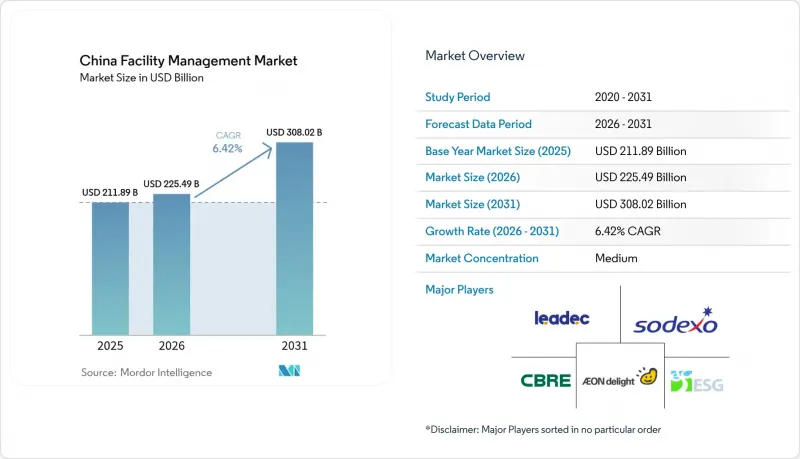
Mordor Intelligence에 의하면, 중국의 시설 관리 시장 규모는 2025년 2,118억 9,000만 달러에서 2026년에는 2,254억 9,000만 달러에 이르고, 2026-2031년 CAGR 6.42%로 성장을 지속하여 2031년에는 3,080억 2,000만 달러에 달할 것으로 예측됩니다.
본 보고서는 서비스 유형(하드 서비스, 소프트 서비스), 제공 형태(사내 제공, 외부 위탁), 최종 사용자 산업(상업(IT 및 통신, 소매·창고), 호스피탈리티(호텔, 음식점, 레스토랑), 의료(공공·민간 시설) 등)별로 분류되어 있습니다. 시장 예측은 금액(달러) 기준으로 제시되어 있습니다.
중국의 시설 관리 시장 동향 및 인사이트
국유 기업의 아웃소싱 도입 증가
2024년, 중앙 국유기업은 2조 6,000억 위안(3,600억 달러)의 이익과 39조 8,000억 위안(5조 5,100억 달러)의 매출을 기록했으며,비핵심 업무를 아웃소싱함으로써 전략적 우선순위에 집중하기 위한 자금을 확보했습니다. 주가 연동형 감독 체제로 인해 업무 효율성에 대한 압박이 높아지면서, 전문 서비스 제공업체에 대한 종합적 계약의 지속적인 유입이 촉진되고 있습니다. 국유자산감독관리위원회(SASAC)는 아웃소싱 정책을 국가 목표와 연계함으로써, 중국의 시설 관리 시장에 국유 기업 포트폴리오로부터 예측 가능한 프로젝트 파이프라인을 제공합니다. 운송, 에너지, 통신 분야에서 더 많은 지방 국유 기업들이 중앙 정부의 청사진을 모방함에 따라 중기적 성장은 더욱 강화되고 있습니다.
스마트 빌딩 기술과 IoT를 활용한 예측형 FM의 통합
AI를 활용한 빌딩 관리 시스템은 대규모 오피스 타워에서 에너지 사용량과 이산화탄소 배출량을 최대 30%까지 절감하고 있으며, IoT 진단은 97%의 고장 감지 정확도를 달성하고 있습니다. 프로퍼티 테크 기업은 주요 복합 시설에 1만 개 이상의 센서를 도입하여 인건비를 62% 절감했습니다. 생성형 AI 도구는 인더스트리 4.0 워크플로우에 대응하도록 플랜트 레이아웃을 재설계하는 것조차 가능하여, 설치 리드타임과 다운타임을 단축하고 있습니다. 임차인들이 실내 환경의 질을 인재 유지와 연결 짓게 되면서, 중국의 시설 관리 시장에서는 엔드투엔드 디지털 트윈, 클라우드 대시보드, 데이터 기반 에너지 개조를 제공하는 사업자에게 프리미엄 가격이 책정되고 있습니다.
부동산 부채 위기가 신규 시설 공급과 개보수 예산을 제한
중국 반케(China Vanke)와 같은 대형 개발사들은 62억 달러의 손실을 기록했으며, 상업용 부동산 거래액은 2021년 603억 달러에서 2024년 386억 달러로 감소했습니다. 대폭적인 가격 인하를 동반한 부실 자산 매각으로 인해 리모델링에 투입될 자본이 유출되면서 FM 예산이 압박받고 있습니다. 특히 베이징에서는 사무실 공실률이 21%를 초과함에 따라 서비스 제공업체들은 가격 협상 격화에 직면해 있습니다. 단기적인 역풍은 재무제표 건전화를 통해 착공이 재개되어야 비로소 완화될 것입니다.
부문별 분석
2025년 중국의 시설 관리 시장에서 하드 서비스가 61.15%를 차지했습니다. 이는 소방 규정 ‘GB 55037-2022’에 따라 인명 안전 확보 및 MEP(기계·전기·배관) 설비의 유지 관리가 의무화되었기 때문입니다. 수요는 공조 설비 개보수, 자산의 신뢰성 확보, 그리고 법정 검사를 중심으로 집중되어 있습니다. 소프트 서비스는 2031년까지 연평균 성장률(CAGR) 7.18%를 나타낼 것으로 예측되며, 팬데믹 이후 강화된 위생 기준, 민첩한 업무 환경에 대한 대응, 그리고 시범 쇼핑몰에서 연간 125만 위안 절감을 실현한 AI 기반 에너지 관리의 혜택을 받고 있습니다. ESG 공시 확대에 따라 소프트 서비스 공급업체들은 현재 폐기물 재활용 및 케이터링 분야의 탄소 배출량 추적을 프리미엄 부가 서비스로 묶어 제공합니다. 그 결과, 중국의 시설 관리 시장에서 소프트 서비스 시장 규모는 하드 서비스에 비해 더 가파른 성장 궤도에 올라 있습니다.
기타 혜택:
- 엑셀 형식 시장 예측(ME) 시트
- 3개월간의 애널리스트 지원
자주 묻는 질문
목차
제1장 서론
제2장 조사 방법
제3장 주요 요약
제4장 시장 구도
제5장 시장 규모와 성장 예측
제6장 경쟁 구도
제7장 시장 기회와 향후 전망
LSH 26.09.14According to Mordor Intelligence, the China facility management market size is expected to grow from USD 211.89 billion in 2025 to USD 225.49 billion in 2026 and is forecast to reach USD 308.02 billion by 2031 at 6.42% CAGR over 2026-2031.
This report is Segmented by Service Type (Hard Services, Soft Services), Offering Type (In-House, Outsourced), End-User Industry (Commercial (IT and Telecom, Retail and Warehousing), Hospitality (Hotels, Eateries, and Restaurants), Healthcare (Public and Private Facilities), and More). The Market Forecasts are Provided in Terms of Value (USD).
China Facility Management Market Trends and Insights
Rising Outsourcing Adoption Among State-Owned Enterprises
Central SOEs booked profits of CNY 2.6 (USD 0.36) trillion and revenue of CNY 39.8 (USD 5.51) trillion in 2024, freeing capital to concentrate on strategic priorities while outsourcing non-core operations. Stock-performance-linked oversight heightened pressure on operational efficiency, prompting a steady flow of bundled contracts to professional providers. The State-owned Assets Supervision and Administration Commission (SASAC) aligns outsourcing policy with national goals, giving the China facility management market a predictable pipeline from SOE portfolios. Medium-term growth is reinforced as more provincial SOEs replicate the central blueprint in transport, energy, and telecom estates.
Integration of Smart Building Technologies and IoT-Driven Predictive FM
AI-enabled building-management systems cut energy use and carbon emissions by up to 30% in large office towers, while IoT diagnostics achieve 97% fault-identification accuracy. Property technology firms deploy more than 10,000 sensors in flagship complexes, slashing labor cost by 62%. Generative AI tools even redesign plant layouts to meet Industry 4.0 workflows, shrinking installation lead-time and downtime. As tenants equate indoor-environment quality with talent retention, the China facility management market sees premium pricing for providers offering end-to-end digital twins, cloud dashboards, and data-driven energy retrofits.
Real-Estate Debt Crisis Limiting New Facility Supply and Renovation Budgets
Major developers such as China Vanke reported USD 6.2 billion losses, and commercial deals slid to USD 38.6 billion in 2024 from USD 60.3 billion in 2021. Distressed-asset sales at steep discounts divert capital from refurbishment, compressing FM budgets. Providers face intensified price negotiations, especially in offices where vacancies exceed 21% in Beijing. Short-term headwinds will be eased only after balance-sheet repair unlocked construction starts
Other drivers and restraints analyzed in the detailed report include:
- Growth of Green Building Stock Driving Demand for Energy-Efficient FM
- Expansion of Commercial Real Estate in Tier-2 and Tier-3 Chinese Cities
- Rising Competition from In-House FM Teams of Large Technology Conglomerates
For complete list of drivers and restraints, kindly check the Table Of Contents.
Segment Analysis
Hard services contributed 61.15% of the China facility management market in 2025 due to mandatory life-safety and MEP upkeep under GB 55037-2022 fire code. Demand clusters around HVAC retrofits, asset reliability, and statutory inspections. Soft services, projected at a 7.18% CAGR to 2031, gain from heightened post-pandemic hygiene standards, agile workplace support, and AI-enabled energy stewardship that delivered annual savings of CNY 1.25 million in pilot malls. With ESG disclosures expanding, soft-service vendors now bundle waste diversion and catering carbon-tracking as premium add-ons. As a result, the China facility management market size for soft services is on a steeper trajectory than its hard-services counterpart
Complete Report Scope:
- By Service Type
- Hard Services
- Asset Management
- MEP and HVAC Services
- Fire Systems and Safety
- Other Hard FM Services
- Soft Services
- Office Support and Security
- Cleaning Services
- Catering Services
- Other Soft FM Services
- Hard Services
- By Offering Type
- In-house
- Outsourced
- Single FM
- Bundled FM
- Integrated FM
- By End-user Industry
- Commercial (IT and Telecom, Retail and Warehouses, etc.)
- Hospitality (Hotels, Eateries, Large-scale Restaurants)
- Institutional and Public Infrastructure (Govt, Education, Transportation)
- Healthcare (Public and Private Facilities)
- Industrial and Process (Manufacturing, Energy, Mining)
- Other End-user Industries (Multi-housing, Entertainment, Sports and Leisure)
List of Companies Covered in this Report:
- Leadec Industrial Services (Shanghai) Co., Ltd.
- Sodexo China
- ESG Holdings Limited
- Aeon Delight Co., Ltd.
- Diversey Holdings LTD
- Serco Group Consultants (Shanghai) Ltd.
- China Shine (EQT Investors)
- ISS Group
- Colliers International Property Services Ltd.
- G4S China
- Aden Group
- Onewo Space-Tech Service Co., Ltd
- CBRE
- Cushman & Wakefield
- Jones Lang LaSalle IP, Inc.
Additional Benefits:
- The market estimate (ME) sheet in Excel format
- 3 months of analyst support
TABLE OF CONTENTS
1 INTRODUCTION
- 1.1 Study Assumptions and Market Definition
- 1.2 Scope of the Study
2 RESEARCH METHODOLOGY
3 EXECUTIVE SUMMARY
4 MARKET LANDSCAPE
- 4.1 Market Overview
- 4.1.1 Current Occupancy Rates
- 4.1.2 Profitability Rates of Major FM Players
- 4.1.3 Workforce Indicators - Labor Participation
- 4.1.4 Facility Management Market Share (%), by Service Type
- 4.1.5 Facility Management Market Share (%), by Hard Services
- 4.1.6 Facility Management Market Share (%), by Soft Services
- 4.1.7 Urbanization and Population Growth in Major Metros
- 4.1.8 Sector Investment Priorities in China's Infrastructure Pipeline
- 4.1.9 Regulatory Drivers Specific to Labour and Safety Standards
- 4.2 Drivers
- 4.2.1 Rising outsourcing adoption among state-owned enterprises (SOEs)
- 4.2.2 Integration of smart building technologies and IoT-driven predictive FM
- 4.2.3 Growth of green building stock driving demand for energy-efficient FM
- 4.2.4 Expansion of commercial real estate in Tier-2 and Tier-3 Chinese cities
- 4.2.5 Government mixed-ownership reforms enabling private FM participation in public assets
- 4.2.6 Specialized FM needs for cross-border e-commerce logistics and cold-chain hubs
- 4.3 Restraints
- 4.3.1 Real-estate debt crisis limiting new facility supply and renovation budgets
- 4.3.2 Rising competition from in-house FM teams of large technology conglomerates
- 4.3.3 Fragmented provincial fire-safety codes increasing multi-site compliance costs
- 4.3.4 Impending carbon-audit penalties under China's national emissions trading scheme compressing FM margins
- 4.4 Value Chain Analysis
- 4.5 PESTEL Analysis
- 4.6 Regulatory and Legislative Framework for Market Entrants
- 4.7 Impact of Macroeconomic Indicators on FM Demand
- 4.8 Porter's Five Forces Analysis
- 4.8.1 Bargaining Power of Suppliers
- 4.8.2 Bargaining Power of Buyers
- 4.8.3 Threat of New Entrants
- 4.8.4 Threat of Substitute Services
- 4.8.5 Intensity of Competitive Rivalry
- 4.9 Investment and Funding Analysis
5 MARKET SIZE AND GROWTH FORECASTS (VALUE)
- 5.1 By Service Type
- 5.1.1 Hard Services
- 5.1.1.1 Asset Management
- 5.1.1.2 MEP and HVAC Services
- 5.1.1.3 Fire Systems and Safety
- 5.1.1.4 Other Hard FM Services
- 5.1.2 Soft Services
- 5.1.2.1 Office Support and Security
- 5.1.2.2 Cleaning Services
- 5.1.2.3 Catering Services
- 5.1.2.4 Other Soft FM Services
- 5.1.1 Hard Services
- 5.2 By Offering Type
- 5.2.1 In-house
- 5.2.2 Outsourced
- 5.2.2.1 Single FM
- 5.2.2.2 Bundled FM
- 5.2.2.3 Integrated FM
- 5.3 By End-user Industry
- 5.3.1 Commercial (IT and Telecom, Retail and Warehouses, etc.)
- 5.3.2 Hospitality (Hotels, Eateries, Large-scale Restaurants)
- 5.3.3 Institutional and Public Infrastructure (Govt, Education, Transportation)
- 5.3.4 Healthcare (Public and Private Facilities)
- 5.3.5 Industrial and Process (Manufacturing, Energy, Mining)
- 5.3.6 Other End-user Industries (Multi-housing, Entertainment, Sports and Leisure)
6 COMPETITIVE LANDSCAPE
- 6.1 Market Concentration
- 6.2 Strategic Moves and Partnerships
- 6.3 Market Share Analysis
- 6.4 Company Profiles (includes Global level Overview, Market level overview, Core Segments, Financials as available, Strategic Information, Market Rank/Share for key companies, Products and Services, and Recent Developments)
- 6.4.1 Leadec Industrial Services (Shanghai) Co., Ltd.
- 6.4.2 Sodexo China
- 6.4.3 ESG Holdings Limited
- 6.4.4 Aeon Delight Co., Ltd.
- 6.4.5 Diversey Holdings LTD
- 6.4.6 Serco Group Consultants (Shanghai) Ltd.
- 6.4.7 China Shine (EQT Investors)
- 6.4.8 ISS Group
- 6.4.9 Colliers International Property Services Ltd.
- 6.4.10 G4S China
- 6.4.11 Aden Group
- 6.4.12 Onewo Space-Tech Service Co., Ltd
- 6.4.13 CBRE
- 6.4.14 Cushman & Wakefield
- 6.4.15 Jones Lang LaSalle IP, Inc.
7 MARKET OPPORTUNITIES AND FUTURE OUTLOOK
- 7.1 White-space and Unmet-Need Assessment
- 7.2 Technology-led Integrated FM (IoT, BMS, AI-based Predictive Maintenance)
- 7.3 ESG-compliant FM Solutions Demand
- 7.4 Future Service-Model Shifts (Outcome-based Contracts)