
|
시장보고서
상품코드
2124849
말레이시아의 시설 관리: 시장 점유율 분석, 업계 동향과 통계, 성장 예측(2026-2031년)Malaysia Facility Management - Market Share Analysis, Industry Trends & Statistics, Growth Forecasts (2026 - 2031) |
||||||
 Mordor Intelligence
Mordor Intelligence에 의하면, 말레이시아의 시설 관리시장 규모는 2025년 85억 9,000만 달러에서 2026년에는 89억 7,000만 달러에 이르고, 2026-2031년 CAGR 4.39%로 성장을 지속하여 2031년에는 111억 2,000만 달러에 달할 것으로 예측됩니다.
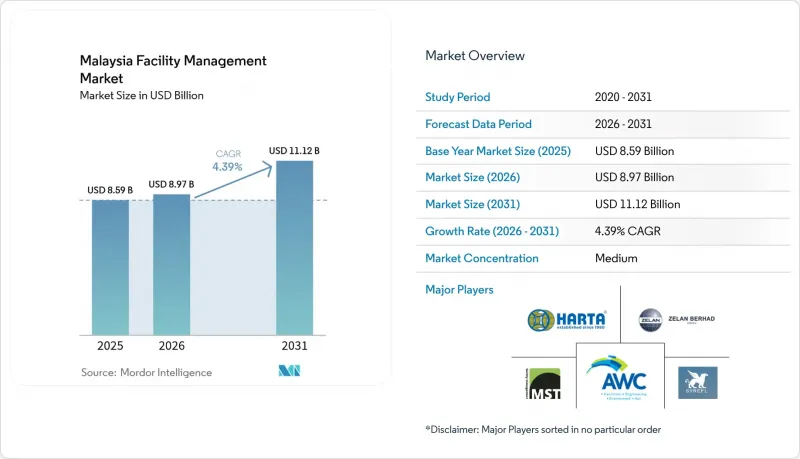
본 보고서는 서비스 유형(하드 서비스, 소프트 서비스), 제공 형태(사내 대응, 외부 위탁), 최종 사용자 산업(상업, 호스피탈리티, 공공·인프라, 의료, 산업·공정, 기타 최종 사용자 산업)별로 분류되어 있습니다. 시장 예측은 금액(달러) 기준으로 제시되어 있습니다.
말레이시아의 시설 관리시장 동향 및 인사이트
규제의 근본적인 재검토를 통해 규정 준수 규칙이 재구성됩니다.
2024년 6월 1일에 시행된 ‘2022년 산업안전보건 개정법’에 따라 적용 범위가 모든 직장으로 확대되었으며, 위반 시 부과되는 벌금이 10배인 50만 링깃(117,771.76 달러)으로 인상되었습니다. 병원, 사립 학교, 코워킹 스페이스에서는 현재 전문 시설 관리자를 채용하여 위험 감사를 실시하고, 산업 안전 보건 코디네이터를 교육하며, 디지털 규정 준수 로그를 유지 관리하고 있습니다. 의료 사업자들은 운영 비용 증가분을 상쇄하고 있으며, 말레이아 대학 의료 센터에서는 안전 대책에 대한 투자 비용을 충당하기 위해 일부 전문의의 진료비를 200% 이상 인상했습니다. 수요가 가장 높은 곳은 쿠알라룸푸르로, 고층 빌딩이 밀집해 있고 다중 임차인 구조로 인해 대피 계획이 복잡해지고 있습니다. 공인 안전 엔지니어를 보유하고 실시간 사고 대시보드를 갖춘 서비스 제공업체는 규정 위반에 대한 성과 벌칙 조항이 포함된 다년 계약을 수주하고 있습니다.
기술 통합으로 운영 효율 향상
디지털 나시오날 벨하드(Digital Nasional Berhad)의 AI 기반 네트워크 관리는 99.8%의 가동률을 달성하고 경보 건수를 500% 감소시킴으로써, 예측형 건물 유지보수의 명확한 벤치마크를 제공합니다. IoT 계량기에서 에너지 대시보드로 데이터가 전송되어, 비정상적인 소비 패턴을 며칠이 아닌 몇 분 이내에 감지합니다. 디지털 트윈 도입으로 유지보수 비용은 30% 절감되었고, 예기치 못한 설비 고장은 70% 감소했습니다. 쿠알라룸푸르의 오피스 빌딩에서는 IoT 에너지 관리 시스템을 도입한 결과, 쾌적성이 향상되고 공조 설비의 가동 시간이 단축되었습니다. 고급 호텔에서 AI를 활용한 칠러 최적화를 통해 9%의 에너지 절감 효과는 물론, 규정 준수 보고의 신속화도 실현했습니다. UEM Edgenta사의 ‘SmartConnect’와 같은 통합 플랫폼을 통해 포트폴리오의 원격 모니터링 및 표준화된 KPI 스코어카드 작성이 가능해집니다.
노동 시장 동향이 서비스 제공에 과제를 안겨주고 있습니다.
말레이시아 전역의 기업들은 외식 산업에서 25%의 인력 부족을 보고하고 있으며, 영업 시간 단축을 피할 수 없어 매출이 15% 감소했습니다. 하드 서비스 역량의 기반이 되는 건설업은 여전히 외국인 노동자에 의존하고 있으며, 농장에서는 해외 노동자의 비율이 70%를 초과하고 있습니다. 정부는 채용을 가속화하기 위해 업종별 할당제를 폐지했으나, 특히 숙련 기술자의 경우 비자 처리의 병목 현상이 여전히 남아 있습니다. 임금 인플레이션이 가속화되고 있어, 대형 정부계 투자 회사는 생활 임금의 최저 기준을 3,100링깃(730.18달러)으로 설정했으며, 이는 청소, 경비, 유지보수 분야의 임금 수준에도 파급되고 있습니다. 서비스 제공 기업들은 인건비 상승을 완화하기 위해 자율형 청소 로봇이나 통합 헬프데스크를 도입하고 있지만, 인력 부족은 여전히 단기적인 운영상 가장 큰 위험 요인으로 남아 있습니다.
부문별 분석
2025년, 하드 서비스는 말레이시아의 시설 관리시장 점유율의 62.08%를 차지했습니다. 이는 화재 안전, MEP(기계·전기·배관) 및 자산 건전성 점검과 관련된 규정 준수 지출 증가에 힘입은 결과입니다. 조호르바루의 데이터센터 확장만으로도 1.6GW의 중요 용량이 추가되어 24시간 기계·전기 관리가 필요해졌습니다. 소프트 서비스는 시장 규모는 작지만, 하이브리드 오피스에서 업무 환경 경험이 경쟁 우위로 부상함에 따라 2031년까지 연평균 성장률(CAGR) 4.42%로 성장할 전망입니다. 비접촉형 청소 로봇, 온디맨드 케이터링 플랫폼, 예측형 인력 배치 시스템은 우량 임차인들 사이에서 보급이 확대되고 있습니다. 각 제공업체는 방문자 분석 및 모바일 헬프데스크를 활용하여 입주자 만족도 점수를 향상시키고, 비용 센터에서 수익 창출 부문으로의 전환을 촉진하고 있습니다.
기타 혜택:
- 엑셀 형식 시장 예측(ME) 시트
- 3개월간의 애널리스트 지원
자주 묻는 질문
목차
제1장 서론
제2장 조사 방법
제3장 주요 요약
제4장 시장 구도
제5장 시장 규모와 성장 예측
제6장 경쟁 구도
제7장 시장 기회와 향후 전망
LSH 26.09.14According to Mordor Intelligence, the Malaysia facility management market size is expected to grow from USD 8.59 billion in 2025 to USD 8.97 billion in 2026 and is forecast to reach USD 11.12 billion by 2031 at 4.39% CAGR over 2026-2031.
This report is Segmented by Service Type (Hard Services, Soft Services), Offering Type (In-House, Outsourced), End-User Industry (Commercial, Hospitality, Institutional and Public Infrastructure, Healthcare, Industrial and Process, Other End-User Industries). The Market Forecasts are Provided in Terms of Value (USD).
Malaysia Facility Management Market Trends and Insights
Regulatory overhaul reshapes compliance rules
The Occupational Safety and Health Amendment Act 2022, effective 1 June 2024, broadens coverage to every workplace and raises violation fines tenfold to RM500,000 (USD 117,771.76). Hospitals, private schools, and co-working sites now hire specialist facility managers to conduct risk audits, train OSH coordinators, and keep digital compliance logs. Healthcare operators are absorbing higher operating costs, with Universiti Malaya Medical Centre raising some specialist fees by over 200% to offset safety investments. Demand is strongest in Kuala Lumpur, where high-rise density and multi-tenant structures complicate evacuation plans. Service providers with certified safety engineers and real-time incident dashboards are winning multi-year contracts that embed performance penalties for non-compliance.
Technology integration lifts operational efficiency
Digital Nasional Berhad's AI-driven network management delivered 99.8% uptime and cut alarm counts by 500%, offering a clear benchmark for predictive building maintenance. IoT meters feed energy dashboards that spot abnormal consumption patterns within minutes rather than days. Digital twin rollouts trim maintenance expenses by 30% and slash unscheduled equipment failures by 70%. A Kuala Lumpur office block recorded comfort improvements and lower HVAC runtime after deploying an IoT energy management system. AI chiller optimization at a luxury hotel yielded 9% energy savings plus faster compliance reporting. Integrated platforms, such as UEM Edgenta's SmartConnect, enable remote portfolio oversight and standardized KPI scorecards.
Labor market dynamics challenge service delivery
Businesses across Malaysia report 25% understaffing in food-service operations, forcing shorter opening hours and lowering revenue by 15%. The construction trades that underpin hard-service capacity still rely on foreign workers, with plantations running at more than 70% overseas labor share. The government has waived industry quotas to speed recruitment, yet visa processing bottlenecks persist, especially for skilled technicians. Wage inflation is accelerating; large Government-Linked Investment Companies set a RM3,100 (USD 730.18) living-wage floor, cascading into cleaning, security, and maintenance pay scales. Providers now deploy autonomous cleaning robots and centralized help-desks to mitigate rising payroll costs, yet talent scarcity remains the top short-term operational risk.
Other drivers and restraints analyzed in the detailed report include:
- ESG compliance gains strategic weight
- Outcome-based contracts deepen partnerships
- Currency volatility lifts imported tech costs
For complete list of drivers and restraints, kindly check the Table Of Contents.
Segment Analysis
Hard Services generated 62.08% of the Malaysia facility management market share in 2025, supported by rising compliance spending on fire safety, MEP, and asset integrity inspections. Data-center expansion in Johor Bahru alone adds 1.6 GW of critical capacity that requires round-the-clock mechanical and electrical coverage. Soft Services, although smaller in value, will grow at a 4.42% CAGR to 2031 as workplace experience becomes a competitive tool in hybrid offices. Contactless cleaning robots, on-demand catering platforms, and predictive staffing engines are gaining traction among blue-chip tenants. Providers leverage visitor analytics and mobile help-desks to raise occupant satisfaction scores, backing the shift from cost-center to revenue-protection logic.
Complete Report Scope:
- By Service Type
- Hard Services
- Asset Management
- MEP and HVAC Services
- Fire Systems and Safety
- Other Hard FM Services
- Soft Services
- Office Support and Security
- Cleaning Services
- Catering Services
- Other Soft FM Services
- Hard Services
- By Offering Type
- In-house
- Outsourced
- Single FM
- Bundled FM
- Integrated FM
- By End-user Industry
- Commercial (IT and Telecom, Retail and Warehouses, etc.)
- Hospitality (Hotels, Eateries, Large-scale Restaurants)
- Institutional and Public Infrastructure (Govt, Education, Transportation)
- Healthcare (Public and Private Facilities)
- Industrial and Process (Manufacturing, Energy, Mining)
- Other End-user Industries (Multi-housing, Entertainment, Sports and Leisure)
List of Companies Covered in this Report:
- AWC Berhad
- MST Facilities Sdn Bhd.
- Harta Maintenance Sdn Bhd
- Zelan AM Services Sdn Bhd
- SDE Facilities Management Sdn Bhd
- SYREFL Holdings Sdn Bhd
- UDA Dayaurus Sdn. Bhd.
- Sepadu Group
- TH Properties Sdn Bhd
- Savills Malaysia
- SPS Facilities
- ISS Facility Services
- GFM Services Berhad
- CBRE
- Cushman & Wakefield Inc.
Additional Benefits:
- The market estimate (ME) sheet in Excel format
- 3 months of analyst support
TABLE OF CONTENTS
1 INTRODUCTION
- 1.1 Study Assumptions and Market Definition
- 1.2 Scope of the Study
2 RESEARCH METHODOLOGY
3 EXECUTIVE SUMMARY
4 MARKET LANDSCAPE
- 4.1 Market Overview
- 4.1.1 Current Occupancy Rates
- 4.1.2 Profitability Rates of Major FM Players
- 4.1.3 Workforce Indicators - Labor Participation
- 4.1.4 Facility Management Market Share (%), by Service Type
- 4.1.5 Facility Management Market Share (%), by Hard Services
- 4.1.6 Facility Management Market Share (%), by Soft Services
- 4.1.7 Urbanization and Population Growth in Major Metros
- 4.1.8 Sector Investment Priorities in Malaysia's Infrastructure Pipeline
- 4.1.9 Regulatory Drivers Specific to Labour and Safety Standards
- 4.2 Market Drivers
- 4.2.1 Regulatory Overhaul Reshapes Compliance Requirements
- 4.2.2 Technology Integration Drives Operational Efficiency
- 4.2.3 ESG Compliance Becomes Competitive Differentiator
- 4.2.4 Outcome-Based Contracting Anchors Long-Term Partnerships
- 4.2.5 Smart Building Mandates Propel Demand for FM Digital Twins
- 4.2.6 Public-Private Partnership Projects Accelerate FM Outsourcing
- 4.3 Market Restraints
- 4.3.1 Labor Market Dynamics Challenge Service Delivery
- 4.3.2 Rising Interest Rates Constrain Capital Budgets
- 4.3.3 Fragmented Vendor Landscape Limits Standardization
- 4.3.4 Currency Volatility Increases Cost of Imported FM Technologies
- 4.4 Value Chain Analysis
- 4.5 PESTEL Analysis
- 4.6 Regulatory and Legislative Framework for Market Entrants
- 4.7 Impact of Macroeconomic Indicators on FM Demand
- 4.8 Porter's Five Forces Analysis
- 4.8.1 Bargaining Power of Suppliers
- 4.8.2 Bargaining Power of Buyers
- 4.8.3 Threat of New Entrants
- 4.8.4 Threat of Substitute Services
- 4.8.5 Intensity of Competitive Rivalry
- 4.9 Investment and Funding Analysis
5 MARKET SIZE AND GROWTH FORECASTS (VALUE)
- 5.1 By Service Type
- 5.1.1 Hard Services
- 5.1.1.1 Asset Management
- 5.1.1.2 MEP and HVAC Services
- 5.1.1.3 Fire Systems and Safety
- 5.1.1.4 Other Hard FM Services
- 5.1.2 Soft Services
- 5.1.2.1 Office Support and Security
- 5.1.2.2 Cleaning Services
- 5.1.2.3 Catering Services
- 5.1.2.4 Other Soft FM Services
- 5.1.1 Hard Services
- 5.2 By Offering Type
- 5.2.1 In-house
- 5.2.2 Outsourced
- 5.2.2.1 Single FM
- 5.2.2.2 Bundled FM
- 5.2.2.3 Integrated FM
- 5.3 By End-user Industry
- 5.3.1 Commercial (IT and Telecom, Retail and Warehouses, etc.)
- 5.3.2 Hospitality (Hotels, Eateries, Large-scale Restaurants)
- 5.3.3 Institutional and Public Infrastructure (Govt, Education, Transportation)
- 5.3.4 Healthcare (Public and Private Facilities)
- 5.3.5 Industrial and Process (Manufacturing, Energy, Mining)
- 5.3.6 Other End-user Industries (Multi-housing, Entertainment, Sports and Leisure)
6 COMPETITIVE LANDSCAPE
- 6.1 Market Concentration
- 6.2 Strategic Moves and Partnerships
- 6.3 Market Share Analysis
- 6.4 Company Profiles (includes Global level Overview, Market level overview, Core Segments, Financials as available, Strategic Information, Market Rank/Share for key companies, Products and Services, and Recent Developments)
- 6.4.1 AWC Berhad
- 6.4.2 MST Facilities Sdn Bhd.
- 6.4.3 Harta Maintenance Sdn Bhd
- 6.4.4 Zelan AM Services Sdn Bhd
- 6.4.5 SDE Facilities Management Sdn Bhd
- 6.4.6 SYREFL Holdings Sdn Bhd
- 6.4.7 UDA Dayaurus Sdn. Bhd.
- 6.4.8 Sepadu Group
- 6.4.9 TH Properties Sdn Bhd
- 6.4.10 Savills Malaysia
- 6.4.11 SPS Facilities
- 6.4.12 ISS Facility Services
- 6.4.13 GFM Services Berhad
- 6.4.14 CBRE
- 6.4.15 Cushman & Wakefield Inc.
7 MARKET OPPORTUNITIES AND FUTURE OUTLOOK
- 7.1 White-space and Unmet-Need Assessment
- 7.2 Technology-led Integrated FM (IoT, BMS, AI-based Predictive Maintenance)
- 7.3 ESG-compliant FM Solutions Demand
- 7.4 Future Service-Model Shifts (Outcome-based Contracts)