

|
시장보고서
상품코드
2124895
센서 및 액추에이터 : 시장 점유율 분석, 업계 동향 및 통계, 성장 예측(2026-2031년)Sensors And Actuators - Market Share Analysis, Industry Trends & Statistics, Growth Forecasts (2026 - 2031) |
||||||
 Mordor Intelligence
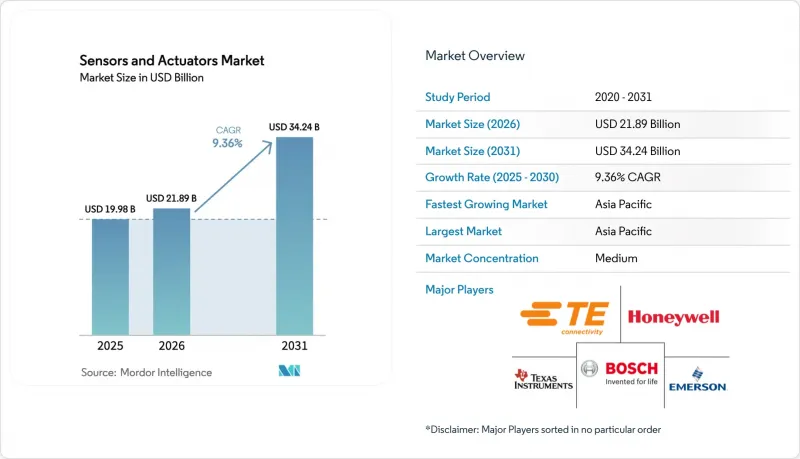
Mordor Intelligence에 의하면, 센서 및 액추에이터 시장 규모는 2025년에 199억 8,000만 달러로 평가되었습니다. 2026년에 218억 9,000만 달러에 달하고, 2031년까지 342억 4,000만 달러에 이를 것으로 예측되며, 2026-2031년에 걸쳐 CAGR 9.36%로 성장할 전망입니다.
본 보고서는 제품 유형(센서, 액추에이터), 기술(MEMS, 비MEMS), 연결 방식(유선, 무선), 출력 신호(디지털, 아날로그), 최종 사용자 산업(자동차·모빌리티, 산업용 자동화·로보틱스, 소비자용 전자기기·웨어러블 기기, 헬스케어 및 의료기기, 기타), 지역별로 분류되어 있습니다. 시장 예측은 금액(달러) 기준으로 제시되어 있습니다.
세계의 센서 및 액추에이터 시장 동향 및 인사이트
저전력 MEMS 센서의 보급이 새로운 IoT 활용 사례를 개척하고 있습니다.
배터리 소모가 적은 MEMS 가속도 센서, 자이로스코프, 환경 센서는 현재 1차 전지로 최대 10년간 작동이 가능하며, 스마트 시티의 공기질 모니터링 네트워크, 농업용 토양 수분 프로브, 콜드체인 자산 추적기의 구현을 가능하게 하고 있습니다. 중국에서는 지자체 도입을 견인력으로 삼아, 2025년에 10마이크로암페어 이하의 센서를 8억 개 이상 출하했습니다. 한편, 인도의 각 도시에서는 같은 해에 20만 개 이상의 무선 누수 감지 노드가 설치되었습니다. 새로운 MEMS 패키징에는 진동 및 열 에너지 하베스터가 통합되어 있어, 10년 수명 주기 전체에 걸쳐 총 소유 비용을 약 3분의 1로 절감합니다. 이러한 경제성 덕분에 공공 부문 및 산업 부문 구매자의 투자 회수 기간이 단축되어 두 자릿수 성장세가 지속되고 있습니다.
유럽 자동차 제조 업계의 급속한 전동화와 ADAS 통합
유럽의 자동차 플랫폼에서는 OEM 각사가 레벨 2 이상의 운전 지원 시스템 및 배터리식 전기 파워트레인으로의 전환을 추진함에 따라, 차량 1대당 35-50개의 센싱 노드가 탑재되게 되었습니다. 2025년 독일에서 등록된 자동차의 3분의 2 이상이 어댑티브 크루즈 컨트롤 및 차선 유지 보조 기능을 갖추고 있으며, 각각 레이더, 초음파, 광학 이미지 센서가 필요합니다. 각 부품 공급업체들은 77GHz 레이더 모듈과 고동적범위 CMOS 이미저에 대해 20억 유로(22억 달러)가 넘는 다년 계약을 체결했습니다. 배터리 팩에는 열 폭주를 방지하기 위해 수십 개의 전류, 전압, 온도 센서가 추가되어, 이로 인해 센서 탑재 수가 증가함에 따라 자동차용 MEMS 파운드리 생산 능력에 대한 수요가 더욱 높아지고 있습니다.
희토류 자석의 가격 변동이 정밀 액추에이터의 BOM 비용을 끌어올렸습니다.
수출 할당량 감축과 채굴 차질로 인해 네오디뮴·철·붕소 자석 가격은 2024년 중반부터 2025년 초까지 3분의 1 이상 상승했습니다. 자기 액추에이터 공급업체들은 부품 원가(BOM)가 12%-18% 상승하면서 매출 총이익률이 약 250 베이시스 포인트 축소되었습니다. 대안이 될 수 있는 페라이트 자석은 토크 밀도를 낮추는 반면, 스위치드 릴랙턴스 방식은 복잡한 제어 알고리즘이 필요하기 때문에 대체 여지는 제한적입니다. 대규모 조달 계약을 맺지 않은 중소 공급업체들은 수직 통합형 다국적 기업들에게 시장 점유율을 빼앗기면서 가장 심각한 타격을 입고 있습니다.
부문별 분석
화학 바이오 센서는 2031년까지 연평균 성장률(CAGR) 10.40%를 나타낼 것으로 예측되며, 이는 제품 카테고리 중 가장 빠른 속도입니다. 이 센서들은 혈당, 젖산, 코르티솔을 측정하는 웨어러블 기기의 기반이 되며, 감염병의 신속한 진단을 가능하게 함에 따라 병원 및 소비자 건강 브랜드의 조달 수요가 증가하고 있습니다. 압력 센서는 자동차 타이어 공기압 모니터링 시스템, HVAC 컨트롤러, 공정 계측 기기에서 여전히 출하량의 대부분을 차지하고 있는 반면, 온도 센서는 배터리 관리 및 콜드체인 이용 사례에서 활용되고 있습니다. 정밀한 동작 특성이 요구되는 부문에서는 공압식 유닛을 대신해 전동 액추에이터가 점점 더 선호되고 있지만, 중장비 건설 및 항공우주 비행 제어 시스템에서는 유압식이 여전히 표준으로 자리 잡고 있습니다.
이미지 센서, 특히 CMOS 디바이스는 자동차의 ADAS 및 산업용 비전에 활용되고 있으며, 레벨 2 이상의 자율주행 보급에 따라 출하 대수가 증가하고 있습니다. 유량 센서와 토크 센서는 특수 의료용 인공호흡기나 전기차의 파워트레인용으로 제공되며, 고가 대에서 거래되고 있습니다. 이러한 동향들이 맞물리면서 센서 및 액추에이터 시장은 소형화, 멀티모달 통합, 수명 주기 비용 절감을 축으로 혁신이 집적되는 다속도 시장 구조를 공고히 하고 있습니다.
2025년, MEMS 디바이스는 센서 및 액추에이터 시장 점유율의 68.43%를 차지했습니다. 실리콘의 배치 생산을 통해 단가는 2달러 이하로 낮아진 동시에, ASIC 로직의 공동 패키징이 가능해졌습니다. 유럽의 주요 공급업체들의 총 출하 대수는 스마트폰, 웨어러블 기기, 자동차용 수주에 힘입어 2025년에는 40억 대를 돌파했습니다. 가스 터빈이나 해저 유정 등 MEMS의 신뢰성이 저하되는 가혹한 환경에서는 여전히 기존 매크로 스케일 센서가 사용되고 있지만, 기밀성이 뛰어난 웨이퍼 레벨 패키징을 통해 MEMS의 내열성 및 내진동 범위가 확대됨에 따라 그 틈새 시장은 점차 축소되고 있습니다.
무선 네트워크는 MEMS 부품의 매력을 더욱 높이고 있습니다. 동전형 배터리로 수년 동안 구동할 수 있는 반면, 기존 센서는 유선 연결이 필요한 경우가 많기 때문입니다. 대만과 일본의 파운드리 업체들은 2025년에 자동차 안전 장치 및 산업용 진동 감지 용도를 대상으로 8인치 MEMS 생산 라인 확장에 5억 달러 이상을 투자했습니다. 패키징 기술의 혁신이 진행됨에 따라, MEMS의 보급은 공정 자동화, 항공우주, 의료기기 각 부문에서 더욱 심화되어 센서 및 액추에이터 시장 규모를 더욱 확대시킬 것으로 보입니다.
지역별 분석
아시아태평양은 2025년에 전 세계 매출의 37.38%를 차지했으며, 2031년까지 연평균 성장률(CAGR) 12.88%로 성장할 것으로 전망됩니다. 이러한 성장의 원동력은 중국의 29만 대 신규 로봇 도입, 인도의 전자기기 도입 의무화, 한국의 산업용 5G 네트워크입니다. 일본에서는 웨이퍼 생산 능력 확충으로 인해 이전의 MEMS 부족 현상이 완화되고 있는 반면, 호주의 광산 업체에서는 LiDAR 및 레이더를 탑재한 자율 운반 시스템이 도입되고 있습니다.
북미는 정유시설 및 이산형 제조업 분야에서 예측 유지보수 도입이 진행되고 있어 2위를 차지하고 있습니다. 미국 공장에서는 진동 및 온도 데이터를 처리하는 엣지 AI 게이트웨이가 통합되어 있으며, 캐나다 오일샌드 생산 업체에서는 SAGD 유정에 고온 센서를 사후 장착하고 있습니다. 멕시코의 자동차 공장에서는 니어쇼어링을 통해 전기차 생산이 가속화되는 가운데, 압력 센서와 가속도 센서가 추가되고 있습니다.
유럽에서는 전동화된 구동계나 레벨 2 이상의 ADAS를 통해 센서 탑재가 진행되고 있지만, NIS2 사이버 보안 규제에 따라 중요 인프라에서의 무선 기술 도입은 주춤하고 있습니다. 중동에서는 특수한 계측 장비가 필요한 수소 파이프라인이나 탄소 포집 메가 프로젝트가 우선시되고 있습니다. 브라질과 칠레의 남미 광산에서는 내환경성이 뛰어난 센서군을 활용해 차량군의 자동화가 진행되고 있으며, 아프리카의 유틸리티 회사에서는 인프라 지출 증가에 따라 수질 및 대기질 측정 노드가 점차 도입되고 있습니다.
기타 혜택
- 엑셀 형식 시장 예측(ME) 시트
- 3개월간의 애널리스트 지원
자주 묻는 질문
목차
제1장 서론
제2장 조사 방법
제3장 주요 요약
제4장 시장 구도
제5장 시장 규모 및 성장 예측
제6장 경쟁 구도
제7장 시장 기회 및 향후 전망
KTH 26.09.14According to Mordor Intelligence, the sensors and actuators market size is projected to be USD 19.98 billion in 2025, USD 21.89 billion in 2026, and reach USD 34.24 billion by 2031, growing at a CAGR of 9.36% from 2026 to 2031.
This report is Segmented by Product Type (Sensors, and Actuators), Technology (MEMS, and Non-MEMS), Connectivity (Wired, and Wireless), Output Signal (Digital, and Analog), End-User Industry (Automotive and Mobility, Industrial Automation and Robotics, Consumer Electronics and Wearables, Healthcare and Medical Devices, and More), and Geography. The Market Forecasts are Provided in Terms of Value (USD).
Global Sensors And Actuators Market Trends and Insights
Proliferation Of Low-Power MEMS Sensors Unlocking New IoT Use-Cases
Battery-sipping MEMS accelerometers, gyroscopes, and environmental sensors now operate for up to a decade on primary cells, enabling smart-city air-quality grids, agricultural soil-moisture probes, and cold-chain asset trackers. China shipped more than 800 million sub-10-microampere sensors in 2025, driven by municipal deployments, while Indian cities installed over 200,000 wireless leak-detection nodes the same year. New MEMS packages integrate vibration or thermal energy harvesters, lowering total cost of ownership by roughly one-third across a ten-year life cycle. These economics are shortening payback periods for public-sector and industrial buyers, sustaining double-digit unit growth.
Rapid Electrification And ADAS Integration In European Automotive Manufacturing
European vehicle platforms now contain 35-50 sensing nodes per car as OEMs migrate to Level 2-plus driver assistance and battery-electric powertrains. More than two-thirds of cars registered in Germany in 2025 featured adaptive cruise control and lane-keeping support, each requiring radar, ultrasonic, and optical image sensors. Component suppliers have inked multi-year contracts exceeding EUR 2 billion (USD 2.2 billion) for 77 GHz radar modules and high-dynamic-range CMOS imagers. Battery packs add dozens of current, voltage, and temperature sensors for thermal-runaway prevention, extending the sensor content and reinforcing demand for automotive-grade MEMS foundry capacity.
Rare-Earth Magnet Price Volatility Inflating Precision Actuator BOM Costs
Neodymium-iron-boron magnet prices climbed more than one-third between mid-2024 and early 2025 after export-quota cuts and mining disruptions. Magnetic actuator suppliers faced 12%-18% bill-of-materials inflation and saw gross margins compress by roughly 250 basis points. Alternate ferrite magnets reduce torque density, while switched-reluctance designs introduce complex control algorithms, limiting substitution. Smaller vendors without scale procurement contracts feel the squeeze most acutely as they cede share to vertically integrated multinationals.
Other drivers and restraints analyzed in the detailed report include:
- High Adoption Of Predictive-Maintenance Platforms Amplifying Smart Actuator Demand
- Hydrogen And CCUS Megaproject Investments Spurring Specialty Sensor Demand
- EU Data-Security Legislation Slowing Wireless Sensor-Network Adoption
For complete list of drivers and restraints, kindly check the Table Of Contents.
Segment Analysis
Chemical and bio-sensors are forecast to grow at a 10.40% CAGR through 2031, the quickest pace among product classes. They underpin glucose, lactate, and cortisol wearables and deliver rapid infectious-disease diagnostics, driving heightened procurement from hospitals and consumer-health brands. Pressure sensors still dominate volume in automotive tire-pressure monitoring, HVAC controllers, and process instrumentation, while temperature devices serve battery-management and cold-chain use cases. Electric actuators are increasingly preferred over pneumatic units for precise motion profiles, though hydraulics remain standard in heavy construction and aerospace flight controls.
Image sensors, particularly CMOS devices, serve automotive ADAS and industrial vision, with shipments rising in line with Level 2-plus automation. Flow and torque sensors cater to specialized medical ventilators and electric-vehicle powertrains, commanding premium pricing. Together these dynamics reinforce the sensors and actuators market as a multi-speed landscape where innovation clusters around miniaturization, multi-modal integration, and lifecycle cost reduction.
MEMS devices accounted for 68.43% of the sensors and actuators market share in 2025. Batch silicon fabrication lowers unit cost to under USD 2 while enabling co-packaged ASIC logic. Total shipments from a leading European supplier surpassed 4 billion units in 2025, buoyed by smartphone, wearable, and automotive orders. Conventional macroscale sensors still serve harsh environments such as gas turbines and subsea wells where MEMS reliability tapers, yet that niche is narrowing as hermetic wafer-level packaging broadens MEMS temperature and vibration envelopes.
Wireless networks amplify the appeal of MEMS parts because coin-cell batteries can power them for years, whereas conventional sensors often require wired feeds. Foundries in Taiwan and Japan committed more than USD 500 million to expand 8-inch MEMS lines in 2025, targeting automotive safety and industrial vibration applications. As packaging innovation advances, MEMS penetration should deepen across process-automation, aerospace, and medical devices, further enlarging the sensors and actuators market size.
Complete Report Scope:
- By Product Type
- Sensors
- Pressure Sensors
- Temperature Sensors
- Position Sensors
- Level Sensors
- Image Sensors
- Chemical/Bio-Sensors
- Torque Sensors
- Flow Sensors
- Actuators
- Hydraulic Actuators
- Pneumatic Actuators
- Electric Actuators
- Magnetic Actuators
- Mechanical Actuators
- Linear Actuators
- Rotary Actuators
- Sensors
- By Technology
- MEMS
- Non-MEMS / Conventional
- By Connectivity
- Wired
- Wireless
- By Output Signal
- Digital
- Analog
- By End-User Industry
- Automotive and Mobility
- Industrial Automation and Robotics
- Consumer Electronics and Wearables
- Healthcare and Medical Devices
- Oil, Gas and Energy
- Aerospace and Defense
- Building Automation and HVAC
- Utilities, Water and Waste-Water, Power
- Mining and Metals
- By Geography
- North America
- United States
- Canada
- Mexico
- South America
- Brazil
- Argentina
- Rest of South America
- Europe
- Germany
- United Kingdom
- France
- Italy
- Spain
- Rest of Europe
- Asia Pacific
- China
- Japan
- South Korea
- India
- Australia
- New Zealand
- Rest of Asia-Pacific
- Middle East and Africa
- Middle East
- United Arab Emirates
- Saudi Arabia
- Turkey
- Rest of Middle East
- Africa
- South Africa
- Nigeria
- Kenya
- Rest of Africa
- Middle East
- North America
Geography Analysis
Asia-Pacific accounted for 37.38% of global revenue in 2025 and will grow at a 12.88% CAGR to 2031, fueled by China's 290,000 new robot installations, India's electronics mandates, and South Korea's industrial 5G networks. Japan's wafer-capacity additions are easing earlier MEMS shortages, while Australian miners deploy autonomous haulage systems laden with LiDAR and radar.
North America ranks second as predictive-maintenance adoption climbs in refineries and discrete manufacturing. U.S. factories integrate edge-AI gateways that crunch vibration and temperature streams, while Canadian oil-sands producers retrofit high-temp sensors into SAGD wells. Mexican automotive plants add pressure and inertial sensors as near-shoring accelerates electric-vehicle production.
Europe advances sensor content through electrified drivetrains and Level 2-plus ADAS, but wireless rollouts in critical infrastructure have slowed under NIS2 cyber-security rules. The Middle East prioritizes hydrogen pipelines and carbon-capture megaprojects that need specialty instrumentation. South American mines in Brazil and Chile automate fleets with ruggedized sensory suites, and African utilities gradually adopt water-quality and air-quality nodes as infrastructure spending ticks upward.
- TE Connectivity
- Honeywell International Inc.
- Bosch Sensortec GmbH
- Emerson Electric Co.
- Texas Instruments Incorporated
- Schneider Electric SE
- Siemens AG
- SMC Corporation
- Parker-Hannifin Corporation
- Renesas Electronics Corporation
- Infineon Technologies AG
- ABB Ltd.
- Rockwell Automation Inc.
- NXP Semiconductors N.V.
- Denso Corporation
- Analog Devices Inc.
- Flowserve Corporation
- Schlumberger Limited
- Balluff GmbH
- OMRON Corporation
- STMicroelectronics N.V.
- KYOCERA AVX Components
- Festo SE and Co. KG
Additional Benefits:
- The market estimate (ME) sheet in Excel format
- 3 months of analyst support
TABLE OF CONTENTS
1 INTRODUCTION
- 1.1 Study Assumptions and Market Definition
- 1.2 Scope of the Study
2 RESEARCH METHODOLOGY
3 EXECUTIVE SUMMARY
4 MARKET LANDSCAPE
- 4.1 Market Overview
- 4.2 Market Drivers
- 4.2.1 Proliferation of Low-Power MEMS Sensors Unlocking New IoT Use-Cases Across Asia
- 4.2.2 Rapid Electrification and ADAS Integration in European Automotive Manufacturing
- 4.2.3 High Adoption of Predictive-Maintenance Platforms Amplifying Smart Actuator Demand in North America
- 4.2.4 Hydrogen and CCUS Megaproject Investments Spurring Specialty Sensor Demand in Middle East Oil and Gas
- 4.2.5 Accelerated 5G and Edge-AI Roll-outs Elevating Industrial Sensor Uptake in South Korea and Taiwan
- 4.2.6 Surge in Wearable Health-Monitoring Devices Requiring Miniature Multi-Modal Sensors in the United States
- 4.3 Market Restraints
- 4.3.1 Rare-Earth Magnet Price Volatility Inflating Precision Actuator BOM Costs
- 4.3.2 EU Data-Security Legislation Slowing Wireless Sensor-Network Adoption
- 4.3.3 High Calibration Complexity of Multi-Axis Sensors Hindering SME Uptake
- 4.3.4 Semiconductor Wafer Shortages Curtailing MEMS Sensor Supply in Japan
- 4.4 Industry Value-Chain Analysis
- 4.5 Regulatory Landscape
- 4.6 Technological Outlook
- 4.7 Porter's Five Forces Analysis
- 4.7.1 Bargaining Power of Buyers
- 4.7.2 Bargaining Power of Suppliers
- 4.7.3 Threat of New Entrants
- 4.7.4 Threat of Substitutes
- 4.7.5 Competitive Rivalry
5 MARKET SIZE AND GROWTH FORECASTS (VALUE)
- 5.1 By Product Type
- 5.1.1 Sensors
- 5.1.1.1 Pressure Sensors
- 5.1.1.2 Temperature Sensors
- 5.1.1.3 Position Sensors
- 5.1.1.4 Level Sensors
- 5.1.1.5 Image Sensors
- 5.1.1.6 Chemical/Bio-Sensors
- 5.1.1.7 Torque Sensors
- 5.1.1.8 Flow Sensors
- 5.1.2 Actuators
- 5.1.2.1 Hydraulic Actuators
- 5.1.2.2 Pneumatic Actuators
- 5.1.2.3 Electric Actuators
- 5.1.2.4 Magnetic Actuators
- 5.1.2.5 Mechanical Actuators
- 5.1.2.6 Linear Actuators
- 5.1.2.7 Rotary Actuators
- 5.1.1 Sensors
- 5.2 By Technology
- 5.2.1 MEMS
- 5.2.2 Non-MEMS / Conventional
- 5.3 By Connectivity
- 5.3.1 Wired
- 5.3.2 Wireless
- 5.4 By Output Signal
- 5.4.1 Digital
- 5.4.2 Analog
- 5.5 By End-User Industry
- 5.5.1 Automotive and Mobility
- 5.5.2 Industrial Automation and Robotics
- 5.5.3 Consumer Electronics and Wearables
- 5.5.4 Healthcare and Medical Devices
- 5.5.5 Oil, Gas and Energy
- 5.5.6 Aerospace and Defense
- 5.5.7 Building Automation and HVAC
- 5.5.8 Utilities, Water and Waste-Water, Power
- 5.5.9 Mining and Metals
- 5.6 By Geography
- 5.6.1 North America
- 5.6.1.1 United States
- 5.6.1.2 Canada
- 5.6.1.3 Mexico
- 5.6.2 South America
- 5.6.2.1 Brazil
- 5.6.2.2 Argentina
- 5.6.2.3 Rest of South America
- 5.6.3 Europe
- 5.6.3.1 Germany
- 5.6.3.2 United Kingdom
- 5.6.3.3 France
- 5.6.3.4 Italy
- 5.6.3.5 Spain
- 5.6.3.6 Rest of Europe
- 5.6.4 Asia Pacific
- 5.6.4.1 China
- 5.6.4.2 Japan
- 5.6.4.3 South Korea
- 5.6.4.4 India
- 5.6.4.5 Australia
- 5.6.4.6 New Zealand
- 5.6.4.7 Rest of Asia-Pacific
- 5.6.5 Middle East and Africa
- 5.6.5.1 Middle East
- 5.6.5.1.1 United Arab Emirates
- 5.6.5.1.2 Saudi Arabia
- 5.6.5.1.3 Turkey
- 5.6.5.1.4 Rest of Middle East
- 5.6.5.2 Africa
- 5.6.5.2.1 South Africa
- 5.6.5.2.2 Nigeria
- 5.6.5.2.3 Kenya
- 5.6.5.2.4 Rest of Africa
- 5.6.5.1 Middle East
- 5.6.1 North America
6 COMPETITIVE LANDSCAPE
- 6.1 Market Concentration
- 6.2 Strategic Moves
- 6.3 Market Share Analysis
- 6.4 Company Profiles (includes Global Level Overview, Market Level Overview, Core Segments, Financials as available, Strategic Information, Market Rank/Share, Products and Services, Recent Developments)
- 6.4.1 TE Connectivity
- 6.4.2 Honeywell International Inc.
- 6.4.3 Bosch Sensortec GmbH
- 6.4.4 Emerson Electric Co.
- 6.4.5 Texas Instruments Incorporated
- 6.4.6 Schneider Electric SE
- 6.4.7 Siemens AG
- 6.4.8 SMC Corporation
- 6.4.9 Parker-Hannifin Corporation
- 6.4.10 Renesas Electronics Corporation
- 6.4.11 Infineon Technologies AG
- 6.4.12 ABB Ltd.
- 6.4.13 Rockwell Automation Inc.
- 6.4.14 NXP Semiconductors N.V.
- 6.4.15 Denso Corporation
- 6.4.16 Analog Devices Inc.
- 6.4.17 Flowserve Corporation
- 6.4.18 Schlumberger Limited
- 6.4.19 Balluff GmbH
- 6.4.20 OMRON Corporation
- 6.4.21 STMicroelectronics N.V.
- 6.4.22 KYOCERA AVX Components
- 6.4.23 Festo SE and Co. KG
7 MARKET OPPORTUNITIES AND FUTURE OUTLOOK
- 7.1 White-Space and Unmet-Need Assessment


