

|
시장보고서
상품코드
2125301
저전압 전기 구동 : 시장 점유율 분석, 업계 동향 및 통계, 성장 예측(2026-2031년)Low Voltage Electric Drives - Market Share Analysis, Industry Trends & Statistics, Growth Forecasts (2026 - 2031) |
||||||
 Mordor Intelligence
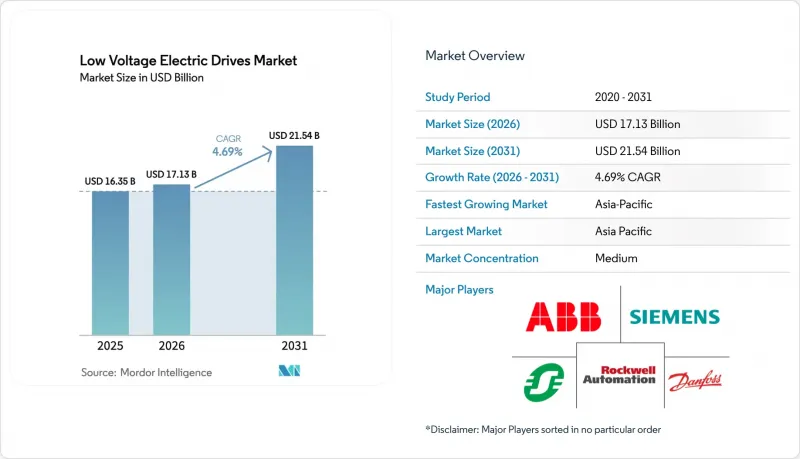
Mordor Intelligence에 의하면, 저전압 전기 구동 시장 규모는 2025년 163억 5,000만 달러로 평가되었습니다. 2026년에는 171억 3,000만 달러로 확대되어 2031년까지 215억 4,000만 달러에 이를 것으로 예상되고 2026년부터 2031년에 걸쳐 CAGR 4.69%로 성장할 전망입니다.
본 보고서는 구동 방식별(AC 구동, DC 구동, 서보 구동), 정격 출력별(5kW 이하, 5-50kW, 50-200kW, 200kW 이상), 최종 사용자 산업(자동차·EV 제조, 석유 및 가스,화학제품 및 석유화학제품, 식품 및 음료, 상하수도, 발전, 금속 및 광업 등), 지역별로 분류되어 있습니다. 시장 예측은 금액(달러) 기준으로 제시되어 있습니다.
세계의 저전압 전기 구동 시장 동향 및 인사이트
산업용 모터에 대한 의무적 에너지 효율 규제
IEC 60034-30-1 : 2025의 새로운 IE5 분류 및 IEC 61800-9-2의 시스템 수준 정격은 구형 IE2 모터의 교체를 크게 촉진하고 있습니다. EU의 에코디자인 규정 2021/341 및 중국의 GB 18613-2020에 따라 에너지 효율이 낮은 모터는 사실상 사라지고 있으며, 개조 수요가 급증하고 있습니다. 이러한 개조를 통해 상당한 비용 절감이 가능하며, 예를 들어 100 kW 기계를 연간 6,000시간 가동할 경우 연간 약 2,400달러를 절약할 수 있습니다. 또한, ISO 50001 인증을 취득한 시설에서는 규정을 준수하지 않는 설비를 계속 가동할 경우, 감사를 통해 벌금을 부과받을 위험이 있습니다. 또한, EU 택소노미에서는 그린본드 발행 요건이 구동 시스템을 통해 달성된 문서화된 에너지 절약 실적과 직접 연계되어 있어, 이러한 규정 및 표준을 준수하는 것이 재정적으로 중요한 영향을 미칩니다는 점이 강조되고 있습니다.
이산 제조 및 포장 라인의 급속한 자동화
아시아태평양에서는 주로 다양한 산업 분야에서 고정밀 및 고속화에 대한 수요가 증가함에 따라 서보 시스템에 대한 수요가 현저히 증가하고 있습니다. 현재 전자기기, 섬유, 식품 포장 공장에서는 ±0.01mm의 정밀도와 200밀리초 미만의 사이클 타임을 실현할 수 있는 시스템이 요구되고 있으며, 이것이 서보 시스템 도입 확대에 기여하는 주요 요인이 되고 있습니다. 서보 시장의 주요 기업인 야스카와 전기는 2025년도 중국向け 서보 출하 대수가 전년 대비 23% 증가하는 등 현저한 성장세를 기록했다고 보고했습니다. 이러한 출하량의 상당 부분은 스마트폰 제조나 배터리 모듈 조립 등의 용도로 활용되고 있으며, 첨단 생산 공정에서 서보 시스템의 중요성이 점점 더 커지고 있음을 여실히 보여주고 있습니다. 산업용 이더넷 프로토콜의 통합이 진행됨에 따라 시운전 시간이 대폭 단축되어(40% 감축 달성) 업무 효율이 한층 더 향상되었습니다. 이러한 기술적 진보로 인해 업종을 불문하고 공정이 합리화되고 생산성이 향상되었습니다. 또한, 성과 연동형 리스 모델의 도입으로 중소기업은 고액의 초기 투자 부담을 지지 않고도 서보 시스템을 도입할 수 있게 되었습니다. 이러한 모델에서는 생산량에 따라 대금이 지급되므로, 도입 시 자금 면의 장벽이 효과적으로 낮아져 첨단 자동화 솔루션의 보급이 촉진되고 있습니다.
저고조파 프리미엄 구동의 높은 초기 비용
액티브 프론트 엔드(AFE)나 멀티레벨 설계는 전체 고조파 왜곡을 5% 미만으로 줄이는 데 매우 효과적입니다. 그러나 이러한 첨단 설계는 가격이 상당히 비싸며, 6펄스 방식 제품에 비해 40%-60% 더 비쌉니다. 이러한 상당한 비용 차이는 특히 재정 상황이 어려워 예산이 제한된 전력 회사나 지방자치단체의 정수장에 있어 큰 과제가 되고 있습니다. 이러한 설계에는 막대한 초기 투자가 필요하기 때문에 기술적인 이점이 있음에도 불구하고 조직이 도입을 주저하는 경우가 많습니다. 초기 재정적 부담을 완화하기 위한 리스 프로그램도 이용 가능하지만, 그 도입은 비교적 더딘 임베디드니다. 이러한 도입 지연은 전력 품질에 관한 규제 및 그 시행이 여전히 불충분하거나 일관성이 부족한 지역에서 특히 두드러지며, 이러한 첨단 설계의 광범위한 도입을 더욱 저해하고 있습니다. 그 결과, 많은 조직은 동등한 성능이나 효율을 제공하지 않더라도 더 저렴한 대안에 계속 의존하고 있습니다.
부문별 분석
2025년에는 AC 구동이 매출의 71.23%라는 압도적인 점유율을 차지했으며, 저전압 전기 구동 시장에서 가장 빠르게 성장하는 부문으로 서보 유닛이 부상하고 있어 2026년부터 2031년까지 연평균 성장률(CAGR) 8.41%가 전망됩니다. AC 아키텍처는 펌프나 컨베이어에서 비용 효율성이 뛰어나지만, 0.01도의 분해능과 1밀리초의 응답 시간을 자랑하는 서보 플랫폼은 스마트폰, 웨어러블 기기, 나아가 배터리 모듈 조립 라인과 같이 정밀성이 요구되는 분야의 요구를 충족시키고 있습니다. 이러한 특징 덕분에 서보 유닛은 높은 정밀도와 빠른 응답 시간이 요구되는 산업 분야에서 필수적인 요소가 되었으며, 다양한 용도로의 채택을 더욱 촉진하고 있습니다.
야스카와 전기의 ‘Sigma-7’ 시리즈는 기계적 공진을 50% 저감하는 AI 구동 진동 억제 기능을 새롭게 탑재하여, 활기 넘치는 중국의 전자 산업 거점에서 꾸준히 시장 점유율을 확대되고 있습니다. 이 혁신적인 기술은 가동 효율을 높이고 가동 중지 시간을 최소화하므로, 경쟁이 치열한 시장에서 제조업체에게 최적의 선택지가 되고 있습니다. 모터와 구동을 일체화한 컨셉의 매력은 부인할 수 없습니다. 니덱(Nidec)의 IMD 서보는 케이스 설치 공간을 40% 줄임으로써 포장 장비 및 섬유 장비 OEM 제조업체들로부터 주목받고 있습니다. 이 공간 절약형 설계는 공장 레이아웃을 최적화할 뿐만 아니라 설치 비용 절감으로도 이어져 그 매력을 한층 더 높이고 있습니다. 이노반스는 일본 및 유럽의 경쟁사 대비 최대 30%의 가격 인하를 단행하며 가격 면에서 압박을 가하고 있지만, 전통 있는 기업들은 강화된 소프트웨어 제공과 종합적인 라이프사이클 서비스를 통해 이익률을 지켜내며 이러한 과제에 대응하고 있습니다. 이러한 전략을 통해 기존 기업들은 역동적인 시장 환경에서 끊임없이 변화하는 고객의 요구에 대응하면서도 경쟁 우위를 유지할 수 있게 되었습니다.
지역별 분석
2025년, 아시아태평양은 저전압 전기 구동 시장의 47.41%를 차지했으며, 2031년까지 연평균 성장률(CAGR) 7.11%로 확대될 것으로 예측됩니다. 중국의 ‘이산화탄소 배출 정점 달성 및 탄소 중립’ 정책에 따라 0.75kW를 초과하는 모터에는 IE3 효율이 의무화되었으며, 2025년까지 에너지 집약도를 13.5% 감축하는 것을 목표로 하고 있어, 이를 통해 연간 약 80만 건의 구동 시스템 개조가 촉진되고 있습니다. 인도의 ‘생산 연계형 인센티브(PLI)’ 프로그램에서는 전자기기 제조에 7,380억 루피(89억 달러)가 투입되어, 표면 실장 라인에서의 서보 수요를 견인하고 있습니다. 일본과 한국은 고정밀 서보 모터를 수출하고 있는 반면, 호주는 광업의 전기화 과정에서 VFD에 의존하고 있습니다.
유럽은 2025년 매출의 25%를 차지했습니다. 에코디자인 규정 2021/341에서는 VFD와 IE3 모터의 조합이 의무화되어 있으며, 지침 2024/1275에서는 15kW를 초과하는 건물의 HVAC(공조·환기·급탕) 시스템 개조가 의무화되어 있습니다. 독일에서는 에너지 전환(Energiewende) 목표를 달성하기 위해 자동차 공장의 구동 시스템을 업그레이드하고 있으며, 영국의 Ofwat는 수도 유틸리티자에 대한 보조금 지급을 VFD를 통한 절수 효과와 연계하고 있습니다. 스페인은 전기차 부품의 거점으로 부상하고 있으며, 새로운 배터리 생산 라인을 위한 서보 수주를 확보하고 있습니다.
2025년에는 북미가 22%를 차지했습니다. 미국의 IIJA(인플레이션 억제법)는 연방 정부 건물의 HVAC·급수 시스템에 대한 VFD 개보수에 자금을 지원하고 있으며, 한편 CHIPS법은 반도체 제조 공장을 위한 저고조파 장치를 장려하고 있습니다. 캐나다는 오일샌드 사업을 전기화하고 있으며, 멕시코는 근해로 이전된 전기차 생산 능력의 혜택을 받고 있습니다. 중동은 해수 담수화와 지역 냉방에 주력하고 있는 반면, 남아프리카공화국과 나이지리아는 디젤 의존도를 줄이기 위해 광산과 시멘트 공장에 구동 장치를 도입하여 개조를 추진하고 있습니다.
기타 혜택 :
- 엑셀 형식 시장 예측(ME) 시트
- 3개월간의 애널리스트 지원
자주 묻는 질문
목차
제1장 서론
제2장 조사 방법
제3장 주요 요약
제4장 시장 구도
제5장 시장 규모 및 성장 예측
제6장 경쟁 구도
제7장 시장 기회 및 향후 전망
KTH 26.09.14According to Mordor Intelligence, the low voltage electric drives market size is expected to increase from USD 16.35 billion in 2025 to USD 17.13 billion in 2026 and reach USD 21.54 billion by 2031, growing at a CAGR of 4.69% over 2026-2031.
This report is Segmented by Drive Type (AC Drives, DC Drives, and Servo Drives), Power Rating (Up To 5 KW, 5-50 KW, 50-200 KW, and Above 200 KW), End-User Industry (Automotive and EV Manufacturing, Oil and Gas, Chemical and Petrochemical, Food and Beverage, Water and Wastewater, Power Generation, Metals and Mining, and More), and Geography. Market Forecasts are Provided in Terms of Value (USD).
Global Low Voltage Electric Drives Market Trends and Insights
Mandatory Energy-Efficiency Regulations for Industrial Motors
New IE5 classifications in IEC 60034-30-1:2025 and system-level ratings in IEC 61800-9-2 are significantly driving the replacement of older IE2 motors. The EU's Ecodesign Regulation 2021/341 and China's GB 18613-2020 have effectively rendered inefficient motors obsolete, creating a surge in retrofit demand. These retrofits can result in substantial cost savings, with approximately USD 2,400 saved annually on a 100 kW machine operating for 6,000 hours. Additionally, sites certified under ISO 50001 are at risk of facing audit penalties if they continue to operate non-compliant assets. Furthermore, the EU Taxonomy directly links green-bond eligibility to documented energy savings achieved through drive systems, emphasizing the critical financial implications of adhering to these regulations and standards.
Rapid Automation in Discrete Manufacturing and Packaging Lines
In the Asia-Pacific region, the demand for servo systems is experiencing significant growth, primarily driven by the increasing need for high precision and speed in various industries. Electronics, textiles, and food-packaging plants now require systems capable of achieving +-0.01 mm accuracy and sub-200 millisecond cycles, which has been a major factor contributing to the rising adoption of servo systems. Yaskawa, a prominent player in the servo market, reported a notable 23% year-on-year increase in servo shipments to China during fiscal 2025. A substantial portion of these shipments was utilized in applications such as smartphone manufacturing and battery-module assembly, highlighting the growing importance of servo systems in advanced production processes. The adoption of converging industrial-Ethernet protocols has further enhanced operational efficiency by significantly reducing commissioning time, achieving a 40% decrease. This technological advancement has streamlined processes and improved productivity across industries. Moreover, the introduction of outcome-based leasing models has provided smaller firms with an opportunity to adopt servo systems without the burden of high upfront capital investment. These models allow companies to pay based on output units, effectively lowering the financial barriers to entry and enabling broader adoption of advanced automation solutions.
High Upfront Cost of Low-Harmonic Premium Drives
Active-front-end or multi-level designs are highly effective in reducing total harmonic distortion to below 5%. However, these advanced designs come with a significantly higher price tag, costing 40%-60% more than their six-pulse counterparts. This substantial cost premium creates a notable challenge for utilities and municipal water plants, particularly those operating under constrained financial conditions and tight budgets. The high initial investment required for these designs often deters organizations from adopting them, despite their technical advantages. Although leasing programs are available to alleviate the upfront financial burden, their adoption has been relatively slow. This slow uptake is especially evident in regions where power-quality regulations and enforcement remain weak or inconsistent, further hindering the widespread implementation of these advanced designs. As a result, many organizations continue to rely on less expensive alternatives, even if they do not offer the same level of performance or efficiency.
Other drivers and restraints analyzed in the detailed report include:
- Expansion of HVAC Retrofits for Building Decarbonisation
- Rise of Compact Integrated-Motor-Drive Architectures
- Escalating Cybersecurity-Compliance Costs for IIoT-Connected Drives
For complete list of drivers and restraints, kindly check the Table Of Contents.
Segment Analysis
Despite AC drives commanding a dominant 71.23% of the revenue in 2025, servo units emerged as the fastest-growing segment in the low voltage electric drives market, boasting a projected CAGR of 8.41% from 2026 to 2031. While AC architectures prove cost-effective for pumps and conveyors, servo platforms, with their 0.01-degree resolution and 1-millisecond settling times, cater to the precise demands of smartphone and wearable devices, as well as battery-module assembly lines. These features make servo units indispensable in industries requiring high precision and rapid response times, further driving their adoption across various applications.
Yaskawa's Sigma-7 series, now featuring AI-driven vibration suppression that reduces mechanical resonance by 50%, is making inroads into China's bustling electronics hubs. This innovation enhances operational efficiency and minimizes downtime, making it a preferred choice for manufacturers in competitive markets. The allure of the integrated-motor-drive concept is undeniable: Nidec's IMD servo, by cutting cabinet space requirements by 40%, has caught the attention of packaging and textile OEMs. This space-saving design not only optimizes factory layouts but also reduces installation costs, adding to its appeal. While Inovance exerts pricing pressure by slashing prices up to 30% compared to Japanese and European competitors, established players counterbalance this challenge, safeguarding their margins through enhanced software offerings and comprehensive lifecycle services. These strategies enable incumbents to maintain their competitive edge while addressing evolving customer needs in a dynamic market environment.
Complete Report Scope:
- By Drive Type
- AC Drives
- DC Drives
- Servo Drives
- By Power Rating
- Up to 5 kW
- 5 - 50 kW
- 50 - 200 kW
- Above 200 kW
- By End-User Industry
- Automotive and EV Manufacturing
- Oil and Gas
- Chemical and Petrochemical
- Food and Beverage
- Water and Wastewater
- Power Generation
- Metals and Mining
- Pulp and Paper
- HVAC and Building Services
- Discrete Industries (Electronics, Packaging, Textiles)
- By Geography
- North America
- United States
- Canada
- Mexico
- South America
- Brazil
- Argentina
- Rest of South America
- Europe
- Germany
- United Kingdom
- France
- Italy
- Spain
- Rest of Europe
- Asia Pacific
- China
- Japan
- South Korea
- India
- Australia
- New Zealand
- Rest of Asia-Pacific
- Middle East and Africa
- Middle East
- United Arab Emirates
- Saudi Arabia
- Turkey
- Rest of Middle East
- Africa
- South Africa
- Nigeria
- Kenya
- Rest of Africa
- Middle East
- North America
Geography Analysis
Asia-Pacific owned 47.41% of the low voltage electric drives market in 2025 and is projected to expand at 7.11% CAGR through 2031. China's dual-carbon policy enforces IE3 motor efficiency above 0.75 kW and targets a 13.5% energy-intensity cut by 2025, stimulating about 800,000 annual drive retrofits. India's Production-Linked Incentive program funnels INR 738 billion (USD 8.9 billion) into electronics manufacturing, driving servo demand in surface-mount lines. Japan and South Korea supply high-precision servo exports, while Australia leans on VFDs for mining electrification.
Europe contributed 25% of 2025 revenue. The Ecodesign Regulation 2021/341 mandates VFD pairing with IE3 motors, and Directive 2024/1275 forces HVAC retrofits in buildings above 15 kW. Germany upgrades drives in automotive plants to meet Energiewende goals; the United Kingdom's Ofwat links water-utility allowances to VFD-driven savings. Spain is emerging as an EV-component hub, drawing servo orders for new battery lines.
North America represented 22% in 2025. The U.S. IIJA funds HVAC and water VFD retrofits in federal buildings, while the CHIPS Act drives premium low-harmonic units for semiconductor fabs. Canada electrifies oil-sands operations, and Mexico benefits from nearshored EV capacity. The Middle East focuses on desalination and district cooling, whereas South Africa and Nigeria retrofit mining and cement plants with drives to curb diesel reliance.
- ABB Ltd.
- Siemens AG
- Schneider Electric SE
- Danfoss A/S
- Rockwell Automation, Inc.
- Mitsubishi Electric Corp.
- Hitachi Ltd.
- Yaskawa Electric Corp.
- Nidec Corp.
- Fuji Electric Co. Ltd.
- Eaton Corp. plc
- Parker Hannifin Corp.
- Delta Electronics Inc.
- Lenze SE
- SEW-Eurodrive GmbH
- WEG SA
- CG Power and Industrial Solutions Ltd.
- Johnson Controls Intl. plc
- Beckhoff Automation GmbH
- Hiconics Eco-Energy Technology Co.
- Bonfiglioli Riduttori SpA
- Inovance Technology Co.
Additional Benefits:
- The market estimate (ME) sheet in Excel format
- 3 months of analyst support
TABLE OF CONTENTS
1 INTRODUCTION
- 1.1 Study Assumptions and Market Definition
- 1.2 Scope of the Study
2 RESEARCH METHODOLOGY
3 EXECUTIVE SUMMARY
4 MARKET LANDSCAPE
- 4.1 Market Overview
- 4.2 Market Drivers
- 4.2.1 Mandatory Energy-Efficiency Regulations for Industrial Motors
- 4.2.2 Rapid Automation in Discrete Manufacturing and Packaging Lines
- 4.2.3 Expansion of HVAC Retrofits for Building Decarbonisation
- 4.2.4 Rise of Compact Integrated-Motor-Drive (IMD) Architectures
- 4.2.5 Adoption of SiC/GaN Power Modules Enabling Smaller LV Drives
- 4.2.6 Emergence of Pay-per-Use "Drive-as-a-Service" Business Models
- 4.3 Market Restraints
- 4.3.1 High Upfront Cost of Low-Harmonic Premium Drives
- 4.3.2 Global Semiconductor Shortages Constraining Drive Production
- 4.3.3 Skill Gap in Tuning VFDs for Variable-Torque Applications
- 4.3.4 Escalating Cybersecurity-Compliance Costs for IIoT-Connected Drives
- 4.4 Industry Value-Chain Analysis
- 4.5 Regulatory Landscape
- 4.6 Technological Outlook
- 4.7 Porter's Five Forces Analysis
- 4.7.1 Bargaining Power of Buyers
- 4.7.2 Bargaining Power of Suppliers
- 4.7.3 Threat of New Entrants
- 4.7.4 Threat of Substitutes
- 4.7.5 Competitive Rivalry
5 MARKET SIZE AND GROWTH FORECASTS (VALUE)
- 5.1 By Drive Type
- 5.1.1 AC Drives
- 5.1.2 DC Drives
- 5.1.3 Servo Drives
- 5.2 By Power Rating
- 5.2.1 Up to 5 kW
- 5.2.2 5 - 50 kW
- 5.2.3 50 - 200 kW
- 5.2.4 Above 200 kW
- 5.3 By End-User Industry
- 5.3.1 Automotive and EV Manufacturing
- 5.3.2 Oil and Gas
- 5.3.3 Chemical and Petrochemical
- 5.3.4 Food and Beverage
- 5.3.5 Water and Wastewater
- 5.3.6 Power Generation
- 5.3.7 Metals and Mining
- 5.3.8 Pulp and Paper
- 5.3.9 HVAC and Building Services
- 5.3.10 Discrete Industries (Electronics, Packaging, Textiles)
- 5.4 By Geography
- 5.4.1 North America
- 5.4.1.1 United States
- 5.4.1.2 Canada
- 5.4.1.3 Mexico
- 5.4.2 South America
- 5.4.2.1 Brazil
- 5.4.2.2 Argentina
- 5.4.2.3 Rest of South America
- 5.4.3 Europe
- 5.4.3.1 Germany
- 5.4.3.2 United Kingdom
- 5.4.3.3 France
- 5.4.3.4 Italy
- 5.4.3.5 Spain
- 5.4.3.6 Rest of Europe
- 5.4.4 Asia Pacific
- 5.4.4.1 China
- 5.4.4.2 Japan
- 5.4.4.3 South Korea
- 5.4.4.4 India
- 5.4.4.5 Australia
- 5.4.4.6 New Zealand
- 5.4.4.7 Rest of Asia-Pacific
- 5.4.5 Middle East and Africa
- 5.4.5.1 Middle East
- 5.4.5.1.1 United Arab Emirates
- 5.4.5.1.2 Saudi Arabia
- 5.4.5.1.3 Turkey
- 5.4.5.1.4 Rest of Middle East
- 5.4.5.2 Africa
- 5.4.5.2.1 South Africa
- 5.4.5.2.2 Nigeria
- 5.4.5.2.3 Kenya
- 5.4.5.2.4 Rest of Africa
- 5.4.5.1 Middle East
- 5.4.1 North America
6 COMPETITIVE LANDSCAPE
- 6.1 Market Concentration
- 6.2 Strategic Moves
- 6.3 Market Share Analysis
- 6.4 Company Profiles (includes Global Level Overview, Market Level Overview, Core Segments, Financials as available, Strategic Information, Market Rank/Share, Products and Services, Recent Developments)
- 6.4.1 ABB Ltd.
- 6.4.2 Siemens AG
- 6.4.3 Schneider Electric SE
- 6.4.4 Danfoss A/S
- 6.4.5 Rockwell Automation, Inc.
- 6.4.6 Mitsubishi Electric Corp.
- 6.4.7 Hitachi Ltd.
- 6.4.8 Yaskawa Electric Corp.
- 6.4.9 Nidec Corp.
- 6.4.10 Fuji Electric Co. Ltd.
- 6.4.11 Eaton Corp. plc
- 6.4.12 Parker Hannifin Corp.
- 6.4.13 Delta Electronics Inc.
- 6.4.14 Lenze SE
- 6.4.15 SEW-Eurodrive GmbH
- 6.4.16 WEG SA
- 6.4.17 CG Power and Industrial Solutions Ltd.
- 6.4.18 Johnson Controls Intl. plc
- 6.4.19 Beckhoff Automation GmbH
- 6.4.20 Hiconics Eco-Energy Technology Co.
- 6.4.21 Bonfiglioli Riduttori SpA
- 6.4.22 Inovance Technology Co.
7 MARKET OPPORTUNITIES AND FUTURE OUTLOOK
- 7.1 White-Space and Unmet-Need Assessment


