
|
시장보고서
상품코드
2125365
아시아태평양의 프로그래매틱 광고 : 시장 점유율 분석, 업계 동향과 통계, 성장 예측(2026-2031년)Asia-Pacific Programmatic Advertising - Market Share Analysis, Industry Trends & Statistics, Growth Forecasts (2026 - 2031) |
||||||
 Mordor Intelligence
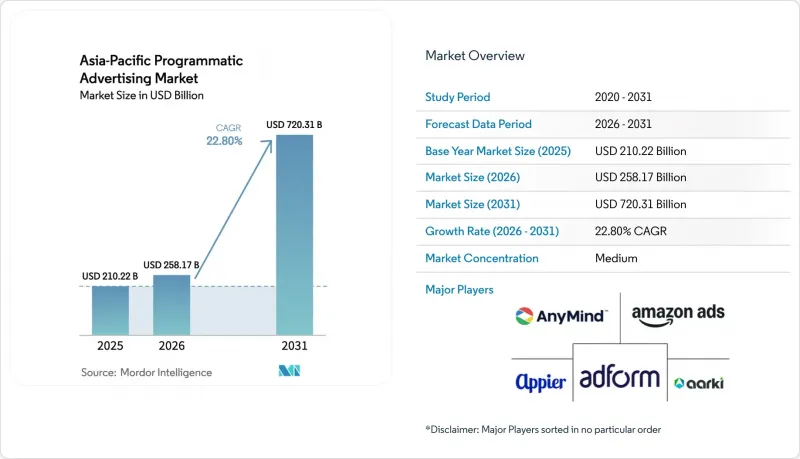
Mordor Intelligence에 따르면 아시아태평양의 프로그래매틱 광고 시장 규모는 2025년 2,102억 2,000만 달러에서 2026년에는 2,581억 7,000만 달러로 확대하며, 2026-2031년에 CAGR 22.8%로 추이하며, 2031년에는 7,203억 1,000만 달러에 달할 것으로 예측됩니다.
이 보고서는 거래 플랫폼(실시간 입찰, 프라이빗 마켓플레이스·가란티드 등), 광고 매체(디지털 디스플레이, 모바일 디스플레이 등), 기업 규모(중소기업 및 대기업), 산업 분야(E-Commerce·소매, BFSI 등), 그리고 국가별로 분류되어 있습니다. 시장 전망은 금액(달러) 기준으로 제시되어 있습니다.
아시아태평양 프로그래매틱 광고 시장의 동향 및 인사이트
광고 예산의 디지털 채널로의 급속한 전환
2025년, 각 브랜드가 기존 미디어에서는 실현하기 어려웠던 측정 가능한 오디언스 수준의 성과를 추구한 결과, 아시아태평양 전체에서 디지털 미디어가 광고비에서 더 큰 점유율을 차지했습니다. 마케터들이 크로스 채널 여정을 실시간으로 최적화하는 어트리뷰션 툴을 도입함에 따라 프로그래매틱 플랫폼도 그 혜택을 누렸습니다. 인도네시아나 베트남 등 기존에 선형 TV의 도달 범위가 제한적이었던 시장에서는 모바일 주도형 프로그래매틱 모델로 단숨에 전환되었습니다. 규제 당국은 자동 거래를 지원하는 투명성 및 데이터 접근 기준을 의무화함으로써 이러한 전환을 촉진했습니다. 그 결과, 과거에는 TV에 배정되던 브랜드 구축 예산까지 프로그래매틱으로 유입되면서 대상 광고 지출의 풀이 확대되고 있습니다.
모바일 우선 생태계가 인앱 광고 공간을 견인
아시아태평양의 모든 주요 시장에서 모바일 기기를 통한 노출 수는 데스크톱을 상회하고 있으며, 앱내 광고 공간은 아시아태평양 프로그래매틱 광고 시장에서 가장 매력적인 광고 슬롯으로 자리 잡고 있습니다. 높은 참여율과 풍부한 행동 데이터 덕분에 입찰 밀도와 실효 CPM이 향상되고 있습니다. AnyMind Group과 InMobi와 같은 제휴를 통해 수요 소스 간의 매디에이션이 자동화되면서 퍼블리셔의 수익은 전년 대비 4.3배 증가했습니다. 광고주는 위치 정보와 앱 이용 현황 신호를 결합하여 매장 주변에서 실시간 오퍼를 제공하고 있습니다. 한편, 퍼블리셔는 완료율을 90% 이상으로 끌어올리는 리워드 동영상 및 플레이어블 형식을 도입하고 있습니다. 또한 풍부한 모바일 데이터는 브라우저의 쿠키 폐지를 보완하는 개인정보 보호 규정을 준수하는 룩얼라이크 모델링을 지원하고 있습니다.
분산된 개인정보 보호 규제가 규정 준수 비용을 증가시키고 있습니다.
국가마다 데이터 보호법이 다르기 때문에 각 플랫폼 기업은 시장별로 개별적인 동의 획득 절차, 데이터 보관 장소, 보고 서식을 유지해야만 하며, 이는 간접비 증가와 캠페인 시작 지연을 초래하고 있습니다. 대형 벤더들은 전담 법무팀을 통해 이러한 부담을 흡수하고 있지만, 중소 사업자들은 벌금 위험을 감수하거나 수익성이 낮은 시장에서 철수할 수밖에 없는 상황에 처해 있습니다. 국경을 넘는 캠페인의 경우, 많은 경우 사용자 데이터를 분할해야 하므로 규모의 경제 효과가 저하됩니다. 제재 조치를 우려하는 광고주는 규정 준수 감사를 통과한 인증을 보유한 파트너를 우선적으로 선택하는 경향이 있으며, 그 결과 광고비가 집중되어 스타트업의 혁신이 제한될 가능성이 있습니다.
부문 분석
실시간 입찰(RTB)은 그 유연성과 동적 가격 책정의 이점을 반영하여, 2025년에는 아시아태평양의 프로그래매틱 광고 시장에서 매출 점유율 46.45%를 차지하며 가장 큰 점유율을 기록할 것으로 보입니다. 이 부문의 규모는 오픈 익스체인지의 유동성과 과다 지불을 최소화하는 고급 입찰 조정 툴에 기인합니다. 그러나 인벤토리 품질에 대한 우려와 브랜드 안전성 요건으로 인해 프리미엄 광고주들은 ‘자동 보장(Automated Guaranteed)’을 통해 예산을 투자하고 있으며, 이 분야는 연평균 성장률(CAGR) 24.06%로 성장하고 있습니다. 퍼블리셔가 노출도가 높은 광고 슬롯을 고정 요금으로 패키지화하고, 피크 시간대인 이벤트 기간 중도 예측 가능한 노출을 보장하므로 아시아태평양의 프로그래매틱 광고 시장에서 ‘자동 보장(Automated Guaranteed)’의 점유율은 상승하고 있습니다. ‘프라이빗 마켓플레이스 게런티드(Private Marketplace Guaranteed)’는 두 모델을 모두 겸비하고 있으며, 구매자는 우대 조건으로 엄선된 노출에 접근할 수 있습니다. 한편, ‘비예약형 고정 요금’은 도달 범위보다 요금의 안정성을 우선시하는 캠페인을 위한 틈새 선택지로 남아 있습니다.
하이브리드 구매 전략도 부상하고 있습니다. 브랜드는 먼저 보장형 블록을 통해 프라임 슬롯을 확보한 뒤, 노출 빈도 제한(Frequency Cap)에 도달한 단계에서 RTB를 통해 도달 범위를 단계적으로 확대해 나갑니다. X가 Magnite를 도입해 소셜 광고의 잉여 인벤토리를 수익화하고 있는 것과 같은 플랫폼 통합 사례는 퍼블리셔가 직접 판매와 경매 채널을 결합하여 수익을 극대화하고 있음을 보여줍니다. 그 결과, 구매자는 확실성과 효율성 사이에서 유연하게 선택할 수 있게 되었으며, 플랫폼 유형에 관계없이 수입원을 확대할 수 있는 거래 환경이 형성되고 있습니다.
모바일 디스플레이는 스마트폰의 보급과 뛰어난 참여 지표 덕분에 아시아태평양 프로그래매틱 광고 시장 규모의 49.10%를 차지하고 있습니다. 상세한 인앱 데이터와 퍼스트 파티 식별자가 모바일 타겟팅의 우위를 강화하는 한편, 리워드 광고와 플레이어블 광고가 게임 앱 및 커머스 앱의 성과를 견인하고 있습니다. 커넥티드 TV/OTT는 현재 규모는 작지만, 시청자들이 선형 TV에서 스트리밍으로 전환함에 따라 연평균 성장률(CAGR) 24.5%로 확대되고 있습니다. 현재 프로그래매틱 광고의 전달 경로는 지역 방송국 및 OTT 서비스와도 연결되어 있으며, 브랜드는 과거 업프론트 계약으로만 제한되었던 대형 화면 환경에서도 시청자를 대상으로 광고를 구매할 수 있게 되었습니다. 데스크톱용 디지털 디스플레이 광고는 사무실 중심의 부문에서 여전히 일정한 영향력을 유지하고 있는 반면, pDOOH는 시청자의 이동 패턴에 연동된 동적 스케줄링을 통해 야외 광고의 패러다임을 혁신하고 있습니다.
삼성이 Hivestack과 공동으로 진행한 헬스케어 분야의 pDOOH 캠페인에서는 모바일 리타게팅을 연계하여 인지도를 높이고 매장 방문객 수를 증가시키는 옴니채널 스토리텔링을 입증했습니다. 광대역의 보급이 확대됨에 따라 CTV의 광고 노출량은 증가하고 있으며, 가구내 동시 시청이 도달 범위를 더욱 확대하고 있습니다. 이에 따라 광고주는 스크린 전반에 걸쳐 예산을 배분하고, 각 매체에서의 노출을 통합한 빈도 제한(Frequency Cap)을 적용하는 옴니채널 측정 툴을 강화하고 있습니다.
기타 혜택:
- 엑셀 형식의 시장 예측(ME) 시트
- 3개월간의 애널리스트 지원
자주 묻는 질문
목차
제1장 서론
제2장 조사 방법
제3장 개요
제4장 시장 구도
제5장 시장 역학
제6장 시장 규모와 성장 예측
제7장 경쟁 구도
제8장 시장 기회와 향후 전망
KSA 26.09.08According to Mordor Intelligence, the Asia-Pacific programmatic advertising market size is expected to grow from USD 210.22 billion in 2025 to USD 258.17 billion in 2026 and is forecast to reach USD 720.31 billion by 2031 at 22.8% CAGR over 2026-2031.
This report is Segmented by Trading Platform (Real-Time Bidding, Private Marketplace Guaranteed, and More), Advertising Media (Digital Display, Mobile Display, and More), Enterprise Size (Small and Mid-Sized Enterprises and Large Enterprises), Industry Vertical (E-Commerce and Retail, BFSI, and More), and Country. The Market Forecasts are Provided in Terms of Value (USD).
Asia-Pacific Programmatic Advertising Market Trends and Insights
Rapid shift of ad budgets to digital channels
Digital media captured a larger share of advertising spend across Asia-Pacific in 2025 as brands pursued measurable, audience-level outcomes that traditional media struggled to deliver. Programmatic platforms benefited as marketers adopted attribution tools that optimize cross-channel journeys in real time. Markets with historically limited linear TV reach, such as Indonesia and Vietnam, leapfrogged directly into mobile-led programmatic models. Regulators reinforced the shift by mandating transparency and data-access standards that favor automated trading. As a result, programmatic now attracts even brand-building budgets that once defaulted to television, widening the addressable pool of spend.
Mobile-first ecosystem fuels in-app inventory
Mobile devices generate more impressions than desktops across every major APAC market, making in-app ad space the prime real estate for the Asia-Pacific programmatic advertising market. Higher engagement rates and richer behavioral data raise bid density and effective CPMs. Partnerships such as AnyMind Group with InMobi yielded 4.3X year-over-year revenue gains for publishers by automating mediation across demand sources. Advertisers are layering geo-location and app-usage signals to serve real-time offers near stores, while publishers roll out rewarded video and playable formats that drive completion rates above 90%. The depth of mobile data also supports privacy-compliant look-alike modeling that compensates for cookie deprecation on browsers.
Fragmented privacy regulations add compliance cost
Divergent data-protection laws force platforms to maintain market-specific consent flows, data shores, and reporting templates, inflating overheads and delaying campaign launches. Larger vendors absorb the burden through dedicated legal teams, while smaller players risk fines or exit less-profitable markets. Cross-border campaigns must often partition user data, reducing scale advantages. Advertisers, wary of penalties, favor partners with audited compliance credentials, concentrating spend and potentially limiting innovation from startups.
Other drivers and restraints analyzed in the detailed report include:
- AI and machine learning transform optimization
- Government 5G roll-outs create premium inventory
- Talent shortage outside top metros hampers scaling
For complete list of drivers and restraints, kindly check the Table Of Contents.
Segment Analysis
Real-Time Bidding represents the largest slice of the Asia-Pacific programmatic advertising market at 46.45% revenue share in 2025, reflecting its flexibility and dynamic pricing benefits. The segment's scale stems from open exchange liquidity and sophisticated bid-shading tools that minimize overpayment. However, inventory quality concerns and brand-safety requirements have led premium advertisers to commit budgets through Automated Guaranteed, which is growing at a 24.06% CAGR. The Asia-Pacific programmatic advertising market share for Automated Guaranteed is rising as publishers package high-visibility placements with fixed rates, ensuring predictable delivery during peak events. Private Marketplace Guaranteed straddles both models, letting buyers access curated impressions with preferential terms, while Unreserved Fixed-Rate remains a niche option for campaigns prioritizing rate stability over reach.
Hybrid buying strategies are emerging: brands start with a guaranteed block to secure prime slots, then chase incremental reach via RTB as frequency caps are met. Platform integrations, such as X deploying Magnite to monetize remnant social inventory, illustrate how publishers blend direct and auction channels to maximize yield. The outcome is a trading landscape where buyers flex between certainty and efficiency, broadening revenue streams across platform types.
Mobile Display holds 49.10% of the Asia-Pacific programmatic advertising market size due to smartphone ubiquity and superior engagement metrics. Deep in-app data and first-party identifiers reinforce mobile's targeting edge, while rewarded and playable ads drive performance for gaming and commerce apps. Connected TV/OTT, though smaller today, is scaling at a 24.5% CAGR as viewers migrate from linear TV to streaming. Programmatic pipes now plug into local broadcasters and over-the-top services, letting brands execute audience buys across large-screen environments once reserved for upfront deals. Digital Display on desktop maintains pockets of influence in office-centric segments, whereas pDOOH is reinventing outdoor with dynamic scheduling tied to audience movement patterns.
Samsung's healthcare pDOOH campaign with Hivestack synchronized mobile retargeting, showcasing omnichannel storytelling that boosts recall and lifts foot traffic. As broadband penetration widens, CTV ad loads rise, and household co-viewing provides incremental reach. Advertisers, therefore, allocate budgets across screens, reinforcing omnichannel measurement tools that stitch exposures into unified frequency caps.
Complete Report Scope:
- By Trading Platform
- Real-Time Bidding (RTB)
- Private Marketplace Guaranteed
- Automated Guaranteed
- Unreserved Fixed-Rate
- By Advertising Media
- Digital Display (Web)
- Mobile Display (In-App and Web)
- Connected TV/OTT
- Digital Out-of-Home
- By Enterprise Size
- Small and Mid-sized Enterprises (SMEs)
- Large Enterprises
- By Industry Vertical
- E-commerce and Retail
- Media and Entertainment
- BFSI
- Travel and Hospitality
- Automotive
- Other Industry Verticals
- By Country
- China
- Japan
- India
- South Korea
- Australia
- Thailand
- Singapore
- Malaysia
- Rest of Asia-Pacific
List of Companies Covered in this Report:
- Amazon.com LLC (Amazon Advertising)
- Appier Inc.
- Aarki, Inc.
- Adform A/S
- AnyMind Group Pte. Ltd.
- Criteo S.A.
- Digital Turbine, Inc.
- FreakOut Holdings, Inc.
- Google LLC
- Hivestack Inc.
- Index Exchange Inc.
- InMobi Pte. Ltd.
- Integral Ad Science Holding Corp.
- Komli Media India Private Ltd.
- LoopMe Ltd.
- Magnite, Inc.
- MediaMath, Inc.
- Moloco, Inc.
- PubMatic, Inc.
- Smaato, Inc.
- The Trade Desk, Inc.
- Xandr LLC
Additional Benefits:
- The market estimate (ME) sheet in Excel format
- 3 months of analyst support
TABLE OF CONTENTS
1 INTRODUCTION
- 1.1 Study Assumptions and Market Definitions
- 1.2 Scope of the Study
2 RESEARCH METHODOLOGY
3 EXECUTIVE SUMMARY
4 MARKET LANDSCAPE
- 4.1 Market Overview
- 4.2 Industry Stakeholder Analysis
- 4.3 Porter's Five Forces Analysis
- 4.3.1 Bargaining Power of Suppliers
- 4.3.2 Bargaining Power of Buyers/Consumers
- 4.3.3 Threat of New Entrants
- 4.3.4 Threat of Substitute Products
- 4.3.5 Intensity of Competitive Rivalry
- 4.4 Industry Value Chain Analysis
- 4.5 Regulatory Landscape
- 4.6 Technological Outlook
- 4.7 Impact of Macroeconomic Factors
5 MARKET DYNAMICS
- 5.1 Market Drivers
- 5.1.1 Rapid shift of Asia Pacific ad budgets from traditional to digital channels
- 5.1.2 Mobile-first user base fuelling in-app inventory growth
- 5.1.3 Government-led 5G roll-outs expanding high-quality ad slots
- 5.1.4 Rising adoption of AI/ML for real-time campaign optimisation
- 5.1.5 Brand-safety algorithms tailored for Asian languages and cultures
- 5.1.6 Emergence of programmatic digital out-of-home networks in tier-2 Asian cities
- 5.2 Market Restraints
- 5.2.1 Fragmented data-privacy regulations across Asia Pacific markets
- 5.2.2 Shortage of skilled programmatic talent outside top metro areas
- 5.2.3 Browser and OEM-level restrictions on device IDs in China and India
- 5.2.4 Limited premium local inventory for vernacular content in South-East Asia
6 MARKET SIZE AND GROWTH FORECASTS (VALUES)
- 6.1 By Trading Platform
- 6.1.1 Real-Time Bidding (RTB)
- 6.1.2 Private Marketplace Guaranteed
- 6.1.3 Automated Guaranteed
- 6.1.4 Unreserved Fixed-Rate
- 6.2 By Advertising Media
- 6.2.1 Digital Display (Web)
- 6.2.2 Mobile Display (In-App and Web)
- 6.2.3 Connected TV/OTT
- 6.2.4 Digital Out-of-Home
- 6.3 By Enterprise Size
- 6.3.1 Small and Mid-sized Enterprises (SMEs)
- 6.3.2 Large Enterprises
- 6.4 By Industry Vertical
- 6.4.1 E-commerce and Retail
- 6.4.2 Media and Entertainment
- 6.4.3 BFSI
- 6.4.4 Travel and Hospitality
- 6.4.5 Automotive
- 6.4.6 Other Industry Verticals
- 6.5 By Country
- 6.5.1 China
- 6.5.2 Japan
- 6.5.3 India
- 6.5.4 South Korea
- 6.5.5 Australia
- 6.5.6 Thailand
- 6.5.7 Singapore
- 6.5.8 Malaysia
- 6.5.9 Rest of Asia-Pacific
7 COMPETITIVE LANDSCAPE
- 7.1 Market Concentration
- 7.2 Strategic Moves
- 7.3 Market Share Analysis
- 7.4 Company Profiles (includes Global level Overview, Market level overview, Core Segments, Financials as available, Strategic Information, Market Rank/Share for key companies, Products and Services, and Recent Developments)
- 7.4.1 Amazon.com LLC (Amazon Advertising)
- 7.4.2 Appier Inc.
- 7.4.3 Aarki, Inc.
- 7.4.4 Adform A/S
- 7.4.5 AnyMind Group Pte. Ltd.
- 7.4.6 Criteo S.A.
- 7.4.7 Digital Turbine, Inc.
- 7.4.8 FreakOut Holdings, Inc.
- 7.4.9 Google LLC
- 7.4.10 Hivestack Inc.
- 7.4.11 Index Exchange Inc.
- 7.4.12 InMobi Pte. Ltd.
- 7.4.13 Integral Ad Science Holding Corp.
- 7.4.14 Komli Media India Private Ltd.
- 7.4.15 LoopMe Ltd.
- 7.4.16 Magnite, Inc.
- 7.4.17 MediaMath, Inc.
- 7.4.18 Moloco, Inc.
- 7.4.19 PubMatic, Inc.
- 7.4.20 Smaato, Inc.
- 7.4.21 The Trade Desk, Inc.
- 7.4.22 Xandr LLC
8 MARKET OPPORTUNITIES AND FUTURE OUTLOOK
- 8.1 White-space and Unmet-Need Assessment