

|
시장보고서
상품코드
2154249
싱가포르의 선박 대리점 서비스 : 시장 점유율 분석, 업계 동향과 통계, 성장 예측(2026-2031년)Singapore Shipping Agency Services - Market Share Analysis, Industry Trends & Statistics, Growth Forecasts (2026 - 2031) |
||||||
 Mordor Intelligence
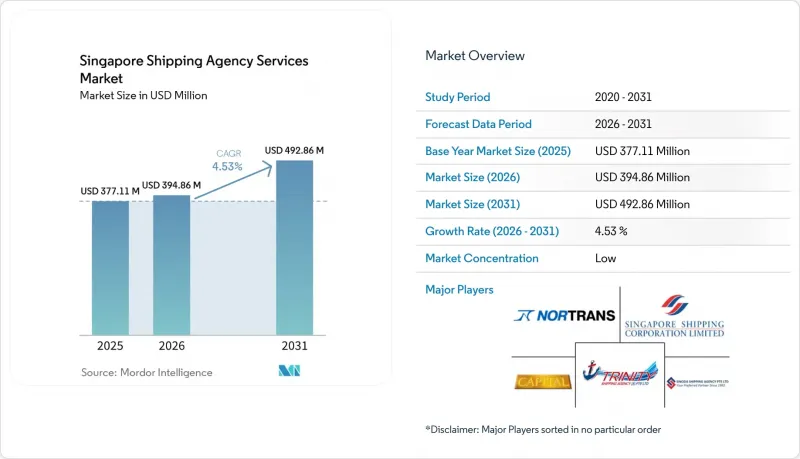
에 따르면 싱가포르의 선박 대리점 서비스 시장은 2025년에 3억 7,711만 달러 규모이며, 2026년 3억 9,486만 달러에서 2031년까지 4억 9,286만 달러에 달할 것으로 예측되고 있으며, 예측 기간(2026-2031년)에 CAGR은 4.53%에 달할 전망입니다.
싱가포르 선박 대리점 서비스 시장은 주요 항만 허브로서 싱가포르의 역할에 힘입어, 상선 활동으로 인해 인가받은 대리점에 대한 지속적인 수요가 발생하고 있습니다. 이 보고서는 대리점 유형(항만 대리점, 화물 대리점, 용선 대리점, 기타), 고객 유형(선주, 용선자/임차인, 기타 고객 유형) 및 서비스 유형(포장 서비스, 해운 서비스, 통관, 물류 지원 서비스, 기타 서비스)별로 분류되어 있습니다. 시장 예측은 금액(달러) 기준으로 제시되어 있습니다.
싱가포르 선박 대리점 서비스 시장의 동향 및 인사이트
싱가포르 항만의 처리량 및 선박 입항 건수의 증가
싱가포르 선박 대리점 서비스 시장은 상업적 기항시 현지 대리점의 지원이 필요하므로 선박 입항 수 및 컨테이너 처리량을 직접적인 거래량의 기반으로 삼고 있습니다. 2025년 선박 입항 총톤수는 32억 2,000만 GT에 달했으며, 컨테이너 처리량은 4,466만 TEU에 달했습니다. MPA법 및 항만 규정에 따라 인가를 받은 대리점은 digitalPORT&SG(TM)를 통해 입항 신고 및 통관 서류 처리를 수행해야 합니다. 2025년, 싱가포르의 선박 등록 총톤수는 27% 증가하여 1억 3,746만 GT에 달했으며, 이에 따라 현지 대리점을 지정할 수 있는 선주의 수가 확대되었습니다. 이러한 확대에는 단순한 거래 기반의 서비스가 아닌, 보다 광범위한 선박 관리 지원을 필요로 하는 LNG 선단 관리자 및 해양 선박 운항 사업자도 포함됩니다. 2024년 시작 이래 150개 이상의 항만 이용자가 ‘적시 계획 및 조정 플랫폼’에 참여하고 있으며, 부두 및 해사 서비스 이용 여유가 부족한 상황에서 실시간 조정이 점점 더 중요해지고 있습니다.
벙커링 및 대체 선박 연료 취급량 확대
2025년, 싱가포르 항만의 대체 선박 연료 취급량은 44% 증가하여 195만 톤에 달했습니다. 같은 해 바이오연료 혼합량은 54% 증가했고, LNG는 24% 증가했으며, 메탄올 취급량은 3,000톤에 달했습니다. 싱가포르는 2026년 1월 1일부터 유효한 상업용 메탄올 벙커링 면허를 발급하고, 기술 기준 TR129에 기반한 새로운 워크플로우를 일반적인 기항 조정에 통합했습니다. 선박 대리점은 이러한 기항시 연료별 인증, 질량 유량계 검증 및 전자 벙커링 납품 전표(BDN) 절차를 조정해야 합니다. MPA(해사항만청)와 기업 싱가포르는 2026년에 LNG 벙커링 공급에 관한 기술 기준을 싱가포르 표준으로 격상할 예정이며, 암모니아 벙커링 공급에 관한 기술 기준도 2026년에 제정될 전망입니다. 따라서 싱가포르 선박 대리점 서비스 시장에서는 선박 일정을 차질 없이 유지하면서 여러 연료 관련 서류 절차를 관리할 수 있도록 훈련받은 직원에 대한 평가가 높아지고 있습니다.
세분화된 경쟁 구조와 가격 압박
국제적인 네트워크를 운영하는 사업자부터 직원 10명 미만의 소규모 전문 기업에 이르기까지 100개 이상의 인가받은 대리점이 싱가포르 기항에 대한 위탁 계약을 놓고 경쟁을 벌이고 있습니다. 이러한 구조로 인해 하위 계층의 지급 수수료 및 선박 관리 수수료에는 지속적인 압박이 가해지고 있습니다. OCEANS-X 및 TradeTrust 호환 플랫폼과의 디지털 연동은 일부 위탁처에게 최소한의 요건이 되어가고 있지만, 이익률이 낮기 때문에 소규모 대리점의 투자는 제한되고 있습니다. 싱가포르 해운협회(SSA) 회원사들은 2025년 11월 MPA-SSA CEO 대화에 앞서 운영 비용 상승을 주요 우려 사항으로 꼽았습니다. 가장 빠르게 성장하고 있는 고객층인 용선사/임차인은 일반적으로 각 공급자의 대리점 수수료를 비교하고 있으며, 표준 서비스에 대해 가격을 중시하는 태도를 강화할 가능성이 있습니다. 싱가포르 해운 대리점 서비스 시장은 전문적인 연료 업무, 신뢰할 수 있는 디지털 실행 또는 폭넓은 서비스 범위를 통해 차별화를 꾀하는 기업에게 여전히 매력적인 시장으로 남아 있습니다.
부문 분석
2025년, 싱가포르 해운 대리점 서비스 시장에서 항만 대리점은 55.97%의 점유율을 차지했습니다. 이는 현지 항만 체계 하에서 상선 입항시 포괄적인 대리점 지원이 필요하기 때문입니다. 이 서비스에는 입·출항 관련 서류 절차, 당국과의 조정, 그리고 선박 정박 중의 실무 지원이 포함됩니다. 싱가포르 해운 대리점 서비스 시장에서 항만 대리점 시장 규모는 상업용 선박의 기항 시마다 발생하는 절차의 반복성에 의해 지원되고 있습니다. 이 부문의 선박 관리 및 연료 보급 업무는 2026년 1월 메탄올 연료 보급이 시작되고, 2026년을 향해 암모니아 관련 절차가 정비되고 있음에 따라 더욱 세분화되고 있습니다. 이러한 기항을 처리하는 대리점은 연료별 증명서, 질량 유량계 점검 및 전자 연료 인도장(BDN) 기록을 관리해야 합니다. 또한 용선자나 화주가 자신의 책임 하에 선박 관리 절차를 감독하기 위해 별도의 대리점을 지정하는 경우, 보호 대리점(Protective agency)의 중요성도 높아지고 있습니다. 이로 인해 1회 기항과 관련된 대리점 계약 건수가 증가할 가능성이 있습니다. 화물 대리점 업무는 2025년 싱가포르에서 처리된 4,466만 TEU를 포함하여 컨테이너, 건화물, 액체 벌크 및 일반 화물(Breakbulk) 활동으로부터 계속해서 혜택을 받고 있습니다. 또한 2029년까지 갱신된 ‘블록 면제령’의 적용을 받는 선박 공유 계약 덕분에 정기선 화물 대리점도 안정적인 취급량 기반을 확보하고 있습니다.
용선 대리점은 2026-2031년까지 연평균 성장률(CAGR) 5.33%로 성장할 것으로 예측되며, 싱가포르 해운 대리점 서비스 시장에서 가장 빠르게 성장하는 대리점 부문이 될 전망입니다. 이러한 증가는 선종 및 무역 노선에 걸친 용선 활동의 다양화를 반영하고 있습니다. 싱가포르에는 2025년에 개설된 인도 및 한국과의 회랑을 포함하여 9개의 그린·디지털 해운 회랑이 존재합니다. 이러한 항로는 새로운 항해 구조를 창출하여 지정 대리점에 대한 추가적인 조정 필요성을 야기할 가능성이 있습니다. 대체 연료 선박의 경우, 연료 규정 준수 검사에 대한 책임을 정의하는 용선 계약 조항이 필요할 수 있습니다. 이러한 책임은 기항시 지정 대리점이 담당하는 경우가 많습니다. 따라서 LNG 선박, 메탄올 대응 선박, 프로젝트 화물선에서 선주 지정 및 용선자 지정 용선 대리점 서비스가 모두 확대되고 있습니다. 한편, 화물 대리점 및 NVOCC(비선박 운송 사업자)의 지원 업무는 디지털 플랫폼을 통해 일상적인 서류 작업이 간소화됨에 따라 여전히 가격에 대한 민감도가 비교적 높은 상황입니다. 이러한 역할 자체는 지속되고 있지만, 전문적인 현지 업무 수행이 필요하지 않은 경우 서비스 제공업체가 대체될 위험이 높아지고 있습니다.
기타 혜택:
- 엑셀 형식의 시장 예측(ME) 시트
- 3개월간의 애널리스트 지원
자주 묻는 질문
목차
제1장 서론
- 조사 전제조건과 시장 정의
- 조사 범위
제2장 조사 방법
제3장 개요
제4장 시장 구도
- 시장 개요
- 현재 시장 상황
- 시장 성장 촉진요인
- 시장 성장 억제요인
- 밸류·공급망 분석
- 규제 상황
- 기술 전망
- Porter's Five Forces 분석
- 지정학적 이벤트가 시장에 미치는 영향
제5장 시장 규모와 성장 예측
- 시장 규모와 예측
- 대리점 유형별
- 클라이언트 유형별
- 서비스 유형별
제6장 경쟁 구도
- 시장 집중도
- 전략적 동향
- 시장 점유율 분석
- 기업 개요
- Sinoda Shipping Agency Pte Ltd
- Nortrans
- Singapore Shipping Corporation Limited
- Capital Shipping Agency(S) Pte Ltd
- Trinity Shipping Agency(S) Pte Ltd
- AlfaShip Agencies(Singapore) Pte Ltd
- Singapore Maritime Services
- Golden Harvest Shipping Agency
- Straits Link Ship Agencies & Management Pte Ltd
- Pacmar Shipping Pte Ltd
- Atomic Shipping & Trading Co Pte Ltd
- Amancare Marine Offshore Pte Ltd
- Focal Shipping Services Pte Ltd
- RTA Shipping
- Himo Marine Service Pte Ltd
- Edtech Marine
- Singapore Marine Agency Pte. Ltd.
- Amigoz Singapore Pte Ltd
- Parsh Marine
- Crystal Offshore Pte Ltd
제7장 시장 기회와 향후 전망
제8장 부록
KSAAccording to Mordor Intelligence, the Singapore shipping agency services market was valued at USD 377.11 million in 2025 and estimated to grow from USD 394.86 million in 2026 to reach USD 492.86 million by 2031, at a CAGR of 4.53% during the forecast period (2026-2031).
The Singapore shipping agency services market is supported by Singapore's role as a major port hub, where commercial vessel activity creates a continuing need for licensed agents. This report is Segmented by Agency Type (Port Agency, Cargo Agency, Charter Agency, Others), by Client Type (Shipowners, Charterers/Lessee, Other Client Type), and by Service Type (Packaging Services, Shipping Services, Customs Clearance, Logistical Support Services, Other Services). The Market Forecasts are Provided in Terms of Value (USD).
Singapore Shipping Agency Services Market Trends and Insights
Growth in Singapore Port Throughput and Vessel Arrivals
The Singapore shipping agency services market draws a direct volume base from vessel arrivals and container handling because commercial calls require local agency support. Vessel arrivals reached 3.22 billion GT in 2025, while container throughput reached 44.66 million TEUs. The MPA Act and port regulations require a licensed agent to handle arrival declarations and clearance documentation through digitalPORT@SG(TM). The Singapore Registry of Ships expanded 27% to 137.46 million GT in 2025, which increased the group of vessel principals that can appoint local agents. This expansion included LNG fleet managers and offshore vessel operators that often need wider husbandry support rather than narrow, transaction-based services. More than 150 port users had joined the Just-In-Time Planning and Coordination Platform after its 2024 launch, making real-time coordination more important when berth and marine-service windows are tighter.
Expansion of Bunkering and Alternative Marine Fuel Calls
Alternative marine fuel volume at the Port of Singapore rose 44% to 1.95 million tons in 2025. Biofuel blends rose 54%, LNG rose 24%, and methanol volume reached 3,000 tons during the year. Singapore issued commercial methanol bunkering licenses effective January 1, 2026, bringing new workflows under Technical Reference TR129 into ordinary port-call coordination. Agents must coordinate fuel-specific certification, mass flow meter verification, and electronic Bunker Delivery Note processes during these calls. MPA and Enterprise Singapore are upgrading the LNG bunkering technical reference to a Singapore Standard in 2026, and an ammonia bunkering technical reference is expected in 2026. The Singapore shipping agency services market, therefore, places greater value on trained staff who can manage several fuel-documentation procedures without disrupting vessel schedules.
Fragmented Competitive Structure and Pricing Pressure
More than 100 licensed agencies compete for Singapore port-call mandates, including international network operators and boutique firms with fewer than 10 employees. This structure keeps pressure on disbursement margins and husbandry fees in the lower tier. Digital integration with OCEANS-X and TradeTrust-enabled platforms is becoming a minimum capability for some principals, but thin margins restrict investment by smaller agencies. Singapore Shipping Association members identified rising operating costs as a leading concern before the November 2025 MPA-SSA CEO dialogue. Charterers/Lessees, which are the fastest-growing client group, commonly compare agent fees across providers and may increase the price focus for standard services. The Singapore shipping agency services market remains more attractive for firms that differentiate through specialist fuel work, reliable digital execution, or broader service coverage.
Other drivers and restraints analyzed in the detailed report include:
- Adoption of Interoperable Electronic Bills of Lading
- Rising Demand for Integrated Port Call and Husbandry Services
- Shortage of Skilled Maritime and Port-Operations Personnel
For complete list of drivers and restraints, kindly check the Table Of Contents.
Segment Analysis
Port agency held 55.97% of the Singapore shipping agency services market share in 2025 because commercial vessel arrivals need full-agency support under the local port framework. The service includes arrival and departure documentation, coordination with authorities, and practical support during a vessel's stay. The Singapore shipping agency services market size for Port agency is supported by the recurring nature of formalities at every commercial call. Husbandry and bunker work within this category have become more detailed as methanol bunkering started in January 2026, and ammonia procedures are under development for 2026. Agents handling these calls must manage fuel-specific certificates, mass flow meter checks, and electronic bunker delivery note records. Protective agency is also gaining relevance when charterers and cargo interests appoint a separate agent to oversee husbandry arrangements for their own account. This can increase the number of agency appointments connected with one vessel call. Cargo Agency continues to benefit from container, dry bulk, liquid bulk, and breakbulk activity, including the 44.66 million TEUs processed in Singapore during 2025. Liner cargo agencies also receive a stable volume base from vessel-sharing arrangements covered by the Block Exemption Order renewed through 2029.
Charter agency is projected to grow at a 5.33% CAGR from 2026 to 2031, making it the fastest-growing agency category in the Singapore shipping agency services market. The increase reflects a broader mix of charter activity across vessel types and trade routes. Singapore had 9 green and digital shipping corridors, including corridors with India and Korea established in 2025. These routes can create new voyage structures and additional coordination needs for appointed agents. Alternative-fuel vessels may require charter-party clauses that define responsibilities for fuel-compliance checks. Those responsibilities often involve the nominated agent during the call. Shipowner-nominated and charterer-nominated charter agency services are therefore growing together across LNG, methanol-capable, and project-cargo vessels. Freight agency and NVOCC support remain more price-sensitive because digital platforms can simplify routine documentation. Their role persists, but their providers face a greater risk of being replaced when the work does not require specialized local execution.
Complete Report Scope:
- Market Size and Forecast
- By Agency Type
- Port Agency
- Cargo Agency
- Charter Agency
- Others
- By Client Type
- Ship Owners
- Charterers/Lessee
- Other Client Types
- By Service Type
- Packaging Services
- Shipping Services
- Customs Clearance
- Logistical Support Services
- Other Services
List of Companies Covered in this Report:
- Sinoda Shipping Agency Pte Ltd
- Nortrans
- Singapore Shipping Corporation Limited
- Capital Shipping Agency (S) Pte Ltd
- Trinity Shipping Agency (S) Pte Ltd
- AlfaShip Agencies (Singapore) Pte Ltd
- Singapore Maritime Services
- Golden Harvest Shipping Agency
- Straits Link Ship Agencies & Management Pte Ltd
- Pacmar Shipping Pte Ltd
- Atomic Shipping & Trading Co Pte Ltd
- Amancare Marine Offshore Pte Ltd
- Focal Shipping Services Pte Ltd
- RTA Shipping
- Himo Marine Service Pte Ltd
- Edtech Marine
- Singapore Marine Agency Pte. Ltd.
- Amigoz Singapore Pte Ltd
- Parsh Marine
- Crystal Offshore Pte Ltd
Additional Benefits:
- The market estimate (ME) sheet in Excel format
- 3 months of analyst support
TABLE OF CONTENTS
1 INTRODUCTION
- 1.1 Study Assumptions and Market Definition
- 1.2 Scope of the Study
2 RESEARCH METHODOLOGY
3 EXECUTIVE SUMMARY
4 MARKET LANDSCAPE
- 4.1 Market Overview
- 4.2 Current Market Scenario
- 4.3 Market Drivers
- 4.3.1 Growth in Singapore Port Throughput and Vessel Arrivals
- 4.3.2 Expansion of Bunkering and Alternative Marine Fuel Calls
- 4.3.3 Strategic Location on the Strait of Malacca
- 4.3.4 Rising Demand for Integrated Port Call and Husbandry Services
- 4.3.5 Adoption of Interoperable Electronic Bills of Lading
- 4.3.6 Increasing Need for Cybersecurity and Digital Compliance Support
- 4.4 Market Restraints
- 4.4.1 Fragmented Competitive Structure and Pricing Pressure
- 4.4.2 Shortage of Skilled Maritime and Port-Operations Personnel
- 4.4.3 Interoperability Gaps Across Digital Trade Platforms
- 4.4.4 Rising Cybersecurity, Data-Integrity, and Liability Exposure
- 4.5 Value / Supply-Chain Analysis
- 4.6 Regulatory Landscape
- 4.7 Technological Outlook
- 4.8 Porter's Five Forces Analysis
- 4.8.1 Bargaining Power of Suppliers
- 4.8.2 Bargaining Power of Buyers
- 4.8.3 Threat of New Entrants
- 4.8.4 Threat of Substitutes
- 4.8.5 Industry Rivalry
- 4.9 Impact of Geopolitical Events on the Market
5 MARKET SIZE AND GROWTH FORECASTS
- 5.1 Market Size and Forecast
- 5.2 By Agency Type
- 5.2.1 Port Agency
- 5.2.2 Cargo Agency
- 5.2.3 Charter Agency
- 5.2.4 Others
- 5.3 By Client Type
- 5.3.1 Ship Owners
- 5.3.2 Charterers/Lessee
- 5.3.3 Other Client Types
- 5.4 By Service Type
- 5.4.1 Packaging Services
- 5.4.2 Shipping Services
- 5.4.3 Customs Clearance
- 5.4.4 Logistical Support Services
- 5.4.5 Other Services
6 COMPETITIVE LANDSCAPE
- 6.1 Market Concentration
- 6.2 Strategic Moves
- 6.3 Market Share Analysis
- 6.4 Company Profiles (includes Global Level Overview, Market Level Overview, Core Segments, Financials as available, Strategic Information, Market Rank/Share, Products and Services, Recent Developments)
- 6.4.1 Sinoda Shipping Agency Pte Ltd
- 6.4.2 Nortrans
- 6.4.3 Singapore Shipping Corporation Limited
- 6.4.4 Capital Shipping Agency (S) Pte Ltd
- 6.4.5 Trinity Shipping Agency (S) Pte Ltd
- 6.4.6 AlfaShip Agencies (Singapore) Pte Ltd
- 6.4.7 Singapore Maritime Services
- 6.4.8 Golden Harvest Shipping Agency
- 6.4.9 Straits Link Ship Agencies & Management Pte Ltd
- 6.4.10 Pacmar Shipping Pte Ltd
- 6.4.11 Atomic Shipping & Trading Co Pte Ltd
- 6.4.12 Amancare Marine Offshore Pte Ltd
- 6.4.13 Focal Shipping Services Pte Ltd
- 6.4.14 RTA Shipping
- 6.4.15 Himo Marine Service Pte Ltd
- 6.4.16 Edtech Marine
- 6.4.17 Singapore Marine Agency Pte. Ltd.
- 6.4.18 Amigoz Singapore Pte Ltd
- 6.4.19 Parsh Marine
- 6.4.20 Crystal Offshore Pte Ltd
7 MARKET OPPORTUNITIES AND FUTURE OUTLOOK
- 7.1 White-Space and Unmet-Need Assessment
- 7.2 Future Market Outlook, 2026-2031


