
|
시장보고서
상품코드
2119851
아시아태평양 소량 화물 혼적(LCL) : 시장 점유율 분석, 업계 동향 및 통계, 성장 예측(2026-2031년)Asia-Pacific Less-than-Container-Load (LCL) - Market Share Analysis, Industry Trends & Statistics, Growth Forecasts (2026 - 2031) |
||||||
 Mordor Intelligence
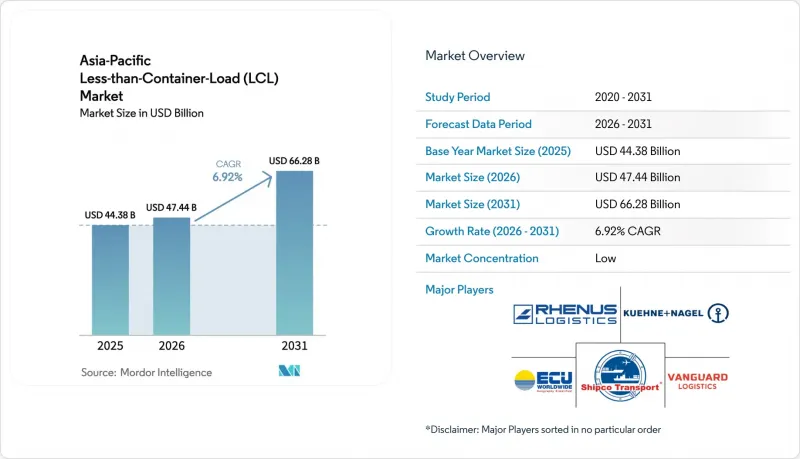
Mordor Intelligence에 의하면, 아시아태평양 소량 화물 혼적(LCL) 시장 규모는 2025년에 443억 8,000만 달러로 평가되었습니다. 2026년 474억 4,000만 달러에서 2031년까지 662억 8,000만 달러에 이를 것으로 예상되며, 예측 기간 CAGR은 6.92%를 나타낼 전망입니다(2026-2031년).
본 보고서는 서비스 유형(혼적 서비스, 혼적 해제·배송), 목적지(국내, 국제), 사업 형태(포워딩, NVOCC), 최종 사용자(제조·자동차, 소매 및 전자상거래, 기타), 국가(중국, 인도, 인도네시아, 말레이시아, 기타)별로 분류되어 있습니다. 시장 전망은 금액(달러) 기준으로 제시되어 있습니다.
아시아태평양 소량 화물 혼적(LCL) 시장 동향 및 인사이트
전자상거래의 급속한 성장과 국경 간 소포 무역
동남아시아의 소매 전자상거래 매출액은 2028년까지 1,930억 달러에 달하여 소매 지출 총액의 17.4%를 차지할 것으로 예측됩니다. 온라인 주문 증가에 따라 LCL의 경제성에 적합한, 더 소규모이고 빈도가 높은 배송이 요구되고 있습니다. 필리핀과 베트남에서는 각각 온라인 소매의 연평균 성장률(CAGR)이 20%를 넘어설 것으로 예측되어, 기존 풀컨테이너 계약으로는 감당할 수 없는 끊임없는 수요 급증이 발생하고 있습니다. RCEP에 따른 통관 절차 간소화는 거래 비용을 절감하고 소량 화물의 통관을 신속화함으로써, 사업자들을 지역 내 재고 허브로 유도하고 있습니다. 옴니채널 모델의 보급으로 인해 여러 시장에서 동시에 재고를 보충해야 할 필요가 대두되면서, 재고 흐름의 동기화에서 LCL의 역할이 더욱 중요해지고 있습니다. 시장이 ‘동주 내 배송’을 약속하는 가운데, 화주들은 운임의 절대적 최소화보다 유연한 출항 일정을 우선시하고 있습니다.
아시아태평양 제조업 공급망의 다각화
2024년, 기업들이 ‘중국+1’ 전략을 실행함에 따라 해외 직접 투자가 동남아시아로 이동하기 시작했습니다. 인도, 베트남, 인도네시아에 산재한 소규모 생산 거점은 최종 조립이나 직접 수출을 위해 여러 원산지에서 화물을 집하해야 하므로, 이에 따라 LCL 처리량이 증가하고 있습니다. 일본의 주요 전자 기업들은 보조 생산 라인을 태국이나 필리핀으로 이전하고, 전문 혼적 업체와 계약하여 수출 흐름을 동기화했습니다. 이처럼 분산된 생산량을 처리하기 위해서는 해당 지역에 600억 달러 규모의 물류 자산이 추가로 필요하며, 이로 인해 혼적 수요는 더욱 증가하고 있습니다. 지정학적 긴장이 고조되면서 이전 일정이 가속화되고 있어, 여러 국가에 걸쳐 있는 공장의 규모가 확대되는 동안 기동성이 뛰어난 LCL 허브가 일시적인 해결책으로 주목받고 있습니다. 구매자들이 공급업체를 다각화함에 따라 2차 항구에 혼적 센터가 등장하여 내륙 운송 거리가 단축되고 처리 시간이 개선되고 있습니다.
항만 혼잡 및 처리 능력 제약
2025년 초 홍해 우회 항로의 영향으로 싱가포르와 콜롬보에서는 선박 대기 시간이 길어졌습니다. 부두 부족은 피더선 운항 일정에도 파급되어, LCL 마감 시간을 뒷받침하는 컨테이너 하역 기한 지연을 초래하고 있습니다. 피더선 운항사는 혼잡 할증료를 부과하고 있으며, 이는 LCL의 단위 비용을 직접적으로 상승시키고 있습니다. 인력 부족과 야간 게이트 운영 시간 제한으로 인해, 특히 우선적인 처리가 필요한 온도 관리 화물의 경우 취급량이 더욱 제한되고 있습니다. 자동화 프로젝트를 통해 처리 능력 개선이 기대되지만, 당분간 컨테이너 도착과 야드 슬롯 간의 불일치가 지속된다면 LCL 집하 기간에 계속해서 혼란을 초래할 것으로 보입니다. 이해관계자들은 성수기 혼잡을 완화하기 위해 보다 적절한 선석 배정 알고리즘과 데이터 공유를 요구하고 있습니다.
부문 분석
2025년 매출 중 혼적 서비스가 64.45%를 차지했습니다. 이러한 우위는 아시아태평양 소량 화물 혼적(LCL) 시장의 경제성에서 기인합니다. 이 시장에서는 화물을 공동 컨테이너에 통합함으로써 단위당 비용이 낮아지고 출항 빈도가 높아집니다. 200개 이상의 직항 노선을 보유한 머스크(Maersk)의 상하이 게이트웨이는 매일 혼합 적재를 유지하기 위해 필요한 규모를 여실히 보여줍니다. 혼적 해제 및 배송은 규모는 작지만, 소매업체들이 전자상거래의 신속한 주문 이행을 위해 목적지에서의 개별 적재 운송을 요구함에 따라 2031년까지 연평균 성장률(CAGR) 4.21%를 나타낼 것으로 전망됩니다. 통합형 공급업체는 국내 배송과 업스트림 혼적을 결합하여 도어 투 도어 계약을 확보하고 있습니다.
아시아 전역에서 옴니채널 재고 거점을 보유한 사업자가 늘어남에 따라, 혼적 서비스에 대한 수요도 높아지고 있습니다. 이에 대응하여 아시아태평양의 소량 화물 혼적(LCL) 시장에서는 페낭, 세부, 수라바야에 새로운 허브 앤 스포크형 시설이 개설되고 있습니다. 또한, 혼합 화물 해체 부문의 성장은 자유무역지역 내에서 화물의 분할, 라벨 부착, 반품 처리가 이루어지는 보세 전자상거래 창고의 도입을 반영하고 있습니다. 키팅(kitting)이나 간이 조립과 같은 부가가치가 높은 물류 업무를 통해 혼합 화물 업체는 서비스 수준을 향상시키고 더 높은 이익률을 확보할 수 있게 됩니다.
2025년 시장 규모의 60.40%는 국제 운송이 차지했으며, 이는 많은 아시아 생산 거점이 수출 지향적임을 보여줍니다. 해외 노선과 관련된 아시아태평양의 소량 화물 혼적(LCL) 시장 규모는 여전히 북미와 유럽의 소비 주기에 좌우되고 있습니다. 아시아 역내 조달이 확대됨에 따라, 국내 LCL 노선은 4.66%라는 비교적 높은 연평균 성장률(CAGR, 2026-2031년)을 기록할 것으로 예측됩니다. RCEP의 공동 원산지 규정에 따라 역내 무역이 900억 달러 확대되고, 국내 집하 및 운송 흐름이 촉진될 것으로 예측됩니다.
국내 소량 화물 혼적(LCL) 시장의 확대는 현지에서 조립되는 수입 부품에 대한 중산층 수요 증가와 맞물려 진행되고 있습니다. 이러한 동향은 전자 및 자동차 산업의 다국간 생산 체인을 뒷받침하며, 반제품의 왕복 운송을 촉진하고 있습니다. 각 혼적 업체들은 집하 거점이 증가하더라도 컨테이너 적재 기한을 확실히 준수할 수 있도록, 퍼스트 마일 집하에 활용되는 트럭 운송 제휴 체제를 정비하고 있습니다. 또한, 각 포워더 업체들은 토지가 제한된 대도시권에서 데포 임대 계약을 재협상하여 육상 운송 거리를 단축하고 있습니다.
기타 혜택
- 엑셀 형식 시장 예측(ME) 시트
- 3개월간 애널리스트의 지원
목차
제1장 서론
제2장 조사 방법
제3장 주요 요약
제4장 시장 구도
제5장 시장 규모 및 성장 예측
제6장 경쟁 구도
제7장 시장 기회 및 향후 전망
KTHAccording to Mordor Intelligence, the Asia-Pacific less-than-Container-Load market size was valued at USD 44.38 billion in 2025 and estimated to grow from USD 47.44 billion in 2026 to reach USD 66.28 billion by 2031, at a CAGR of 6.92% during the forecast period (2026-2031).
This report is Segmented by Service Type (Consolidation Services and De-Consolidation & Distribution), Destination (Domestic and International), Nature of Business (Freight Forwarding and NVOCCs), End User (Manufacturing and Automotive, Retail & E-Commerce, and More), Country (China, India, Indonesia, Malaysia, and More). The Market Forecasts are Provided in Terms of Value (USD).
Asia-Pacific Less-than-Container-Load (LCL) Market Trends and Insights
E-commerce boom & cross-border parcel trade
Retail e-commerce sales in Southeast Asia are expected to hit USD 193 billion by 2028, equal to 17.4% of total retail spend. Rising online orders require smaller, more frequent shipments that suit LCL economics. The Philippines and Vietnam each anticipate online-retail CAGRs above 20%, creating constant demand spikes that traditional full-container contracts cannot match. RCEP customs simplification lowers transaction costs, speeding up small-batch clearances and pushing merchants toward regional inventory hubs. Omnichannel models mean inventory must be replenished across multiple markets simultaneously, reinforcing LCL's role in synchronized stock flows. As marketplaces promote same-week delivery promises, shippers prioritize flexible sailings over absolute rate minimization.
Supply-chain diversification of Asia-Pacific manufacturing
Foreign direct investment began shifting toward Southeast Asia during 2024 as firms executed "China + 1" strategies. Smaller production footprints scattered across India, Vietnam, and Indonesia require multi-origin pick-ups for final assembly or direct export, thereby elevating LCL volumes. Japanese electronics groups moved auxiliary lines to Thailand and the Philippines, contracting specialist consolidators to synchronize outbound flows. The region needs an additional USD 60 billion in logistics assets to handle this dispersed output, further magnifying consolidation demand. Heightened geopolitical tension accelerates relocation timelines, making agile LCL nodes attractive stopgaps while multi-country plants scale. As buyers diversify suppliers, consolidation centers emerge in secondary ports, shortening inland haulage and improving turnaround.
Port congestion & capacity constraints
Singapore and Colombo experienced extended vessel waits after Red Sea diversions in early 2025. Berth shortages ripple into feeder schedules, delaying container de-stuffing deadlines that underpin LCL cut-off times. Feeder operators imposed congestion surcharges that directly lift LCL unit costs. Labor shortages and limited night-gate hours further restrict throughput, especially for temperature-sensitive cargo needing priority handling. Automation projects promise capacity relief, but near-term mismatches between container arrivals and yard slots will continue disrupting LCL consolidation windows. Stakeholders advocate for better berth-allocation algorithms and data-sharing to smooth peaks.
Other drivers and restraints analyzed in the detailed report include:
- Cost-efficiency of LCL over air freight for SMEs
- Digital freight platforms offering LCL spot rates
- Volatility in ocean-freight rates
For complete list of drivers and restraints, kindly check the Table Of Contents.
Segment Analysis
Consolidation services commanded 64.45% of 2025 revenue. Their dominance stems from the Asia-Pacific Less-than-Container-Load market economics in which cargo aggregation into shared containers drives lower per-unit costs and faster sailing frequency. Maersk's Shanghai gateway with more than 200 direct lanes evidences the scale required to sustain daily consolidations. De-consolidation and distribution, though smaller, post a 4.21% CAGR to 2031 as retailers seek destination-side break-bulk for rapid e-commerce fulfillment. Integrated providers bundle in-country distribution with upstream consolidation to secure door-to-door contracts.
Demand for consolidation services rises with each additional omnichannel stock-point merchant set up across Asia. The Asia-Pacific Less-than-Container-Load market responds by opening new hub-and-spoke facilities in Penang, Cebu, and Surabaya. De-consolidation growth also mirrors the adoption of bonded e-commerce warehouses, where shipment splitting, labeling, and returns handling occur inside free-trade zones. Value-added distribution tasks, such as kitting or light assembly, allow consolidators to move up the service ladder, capturing higher margins.
International shipments generated 60.40% of the 2025 value, illustrating the export-oriented nature of many Asian production centers. The Asia-Pacific Less-than-Container-Load market size tied to overseas routes remains anchored by North American and European consumption cycles. Nevertheless, domestic LCL lanes are expected to post a faster 4.66% CAGR (2026-2031) as intra-Asia sourcing spreads. RCEP's common rule of origin is forecast to add USD 90 billion to regional trade and feed domestic consolidation flows.
Domestic LCL expansion pairs with rising middle-class demand for imported components assembled locally. This trend supports multi-country production chains in electronics and automotive, triggering back-and-forth movements of semi-finished goods. Consolidators refine trucking alliances for first-mile pick-ups to ensure container stuffing deadlines remain intact when origin points multiply. Forwarders also renegotiate depot leases in land-constrained metro areas to shorten drayage.
Complete Report Scope:
- By Service Type
- Consolidation Services
- De-consolidation & Distribution
- By Destination
- Domestic
- International
- By Nature of Business
- Freight Forwarding
- NVOCCs
- By End User
- Manufacturing and Automotive
- Retail & E-commerce
- Healthcare & Pharmaceuticals
- Agriculture & Forestry
- Other End Users
- By Country
- China
- India
- Indonesia
- Japan
- Malaysia
- Thailand
- Vietnam
- Australia
- Rest of Asia-Pacific
List of Companies Covered in this Report:
- ECU Worldwide (Part of All Cargo Logistics)
- Shipco
- Vanguard Logistics
- Rhenus Logistics
- Kuehne + Nagel
- DHL Global Forwarding
- DSV
- CEVA Logistics
- Rohlig Logistics
- GEODIS
- Gulf Agency Company (GAC)
- Kerry Logistics Network
- Sinotrans
- Nippon Express
- CJ Logistics
- JAS Worldwide
- APL Logistics
- Dimerco Express Group
- Yusen Logistics (Part of NYK Line)
- Toll Group
Additional Benefits:
- The market estimate (ME) sheet in Excel format
- 3 months of analyst support
TABLE OF CONTENTS
1 Introduction
- 1.1 Study Assumptions & Market Definition
- 1.2 Scope of the Study
2 Research Methodology
3 Executive Summary
4 Market Landscape
- 4.1 Market Overview
- 4.2 Market Drivers
- 4.2.1 E-commerce boom & cross-border parcel trade
- 4.2.2 Supply-chain diversification of Asia-Pacific manufacturing
- 4.2.3 Cost-efficiency of LCL over air-freight for SMEs
- 4.2.4 Port infrastructure expansion & FTAs
- 4.2.5 Digital freight platforms offering LCL spot rates
- 4.2.6 Green-shipping initiatives favouring load optimisation
- 4.3 Market Restraints
- 4.3.1 Port congestion & capacity constraints
- 4.3.2 Volatility in ocean-freight rates
- 4.3.3 Limited cold-chain LCL infrastructure
- 4.3.4 Emerging ESG compliance burdens
- 4.4 Value / Supply-Chain Analysis
- 4.5 Regulatory Landscape
- 4.6 Technological Outlook
- 4.7 Porter's Five Forces Analysis
- 4.7.1 Bargaining Power of Suppliers
- 4.7.2 Bargaining Power of Buyers
- 4.7.3 Threat of New Entrants
- 4.7.4 Threat of Substitutes
- 4.7.5 Intensity of Competitive Rivalry
- 4.8 Impact of COVID-19 & Geo-Political Events
5 Market Size & Growth Forecasts
- 5.1 By Service Type
- 5.1.1 Consolidation Services
- 5.1.2 De-consolidation & Distribution
- 5.2 By Destination
- 5.2.1 Domestic
- 5.2.2 International
- 5.3 By Nature of Business
- 5.3.1 Freight Forwarding
- 5.3.2 NVOCCs
- 5.4 By End User
- 5.4.1 Manufacturing and Automotive
- 5.4.2 Retail & E-commerce
- 5.4.3 Healthcare & Pharmaceuticals
- 5.4.4 Agriculture & Forestry
- 5.4.5 Other End Users
- 5.5 By Country
- 5.5.1 China
- 5.5.2 India
- 5.5.3 Indonesia
- 5.5.4 Japan
- 5.5.5 Malaysia
- 5.5.6 Thailand
- 5.5.7 Vietnam
- 5.5.8 Australia
- 5.5.9 Rest of Asia-Pacific
6 Competitive Landscape
- 6.1 Market Concentration
- 6.2 Strategic Moves
- 6.3 Market Share Analysis
- 6.4 Company Profiles {(includes Global level Overview, Market level overview, Core Segments, Financials as available, Strategic Information, Market Rank/Share for key companies, Products & Services, and Recent Developments)}
- 6.4.1 ECU Worldwide (Part of All Cargo Logistics)
- 6.4.2 Shipco
- 6.4.3 Vanguard Logistics
- 6.4.4 Rhenus Logistics
- 6.4.5 Kuehne + Nagel
- 6.4.6 DHL Global Forwarding
- 6.4.7 DSV
- 6.4.8 CEVA Logistics
- 6.4.9 Rohlig Logistics
- 6.4.10 GEODIS
- 6.4.11 Gulf Agency Company (GAC)
- 6.4.12 Kerry Logistics Network
- 6.4.13 Sinotrans
- 6.4.14 Nippon Express
- 6.4.15 CJ Logistics
- 6.4.16 JAS Worldwide
- 6.4.17 APL Logistics
- 6.4.18 Dimerco Express Group
- 6.4.19 Yusen Logistics (Part of NYK Line)
- 6.4.20 Toll Group
7 Market Opportunities & Future Outlook
- 7.1 White-space & Unmet-need Assessment