
|
시장보고서
상품코드
2117979
유럽의 단거리 해상 롤온 롤오프 해운 운송 : 시장 점유율 분석, 업계 동향 및 통계, 성장 예측(2026-2031년)Europe Short Sea Ro-Ro Ocean Freight Transport - Market Share Analysis, Industry Trends & Statistics, Growth Forecasts (2026 - 2031) |
||||||
 Mordor Intelligence
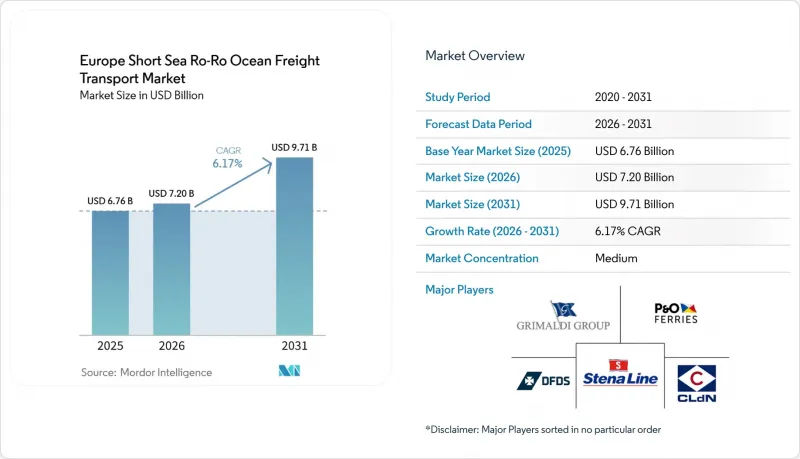
Mordor Intelligence에 의하면, 유럽의 단거리 해상 롤온 롤오프 해운 운송 시장 규모는 2025년에 67억 6,000만 달러로 평가되었습니다. 2026년에는 72억 달러로 확대되어 2031년까지 97억 1,000만 달러에 이를 것으로 예측됩니다. 2026-2031년 CAGR 6.17%로 성장할 전망입니다.
유럽의 단거리 해상 롤온 롤오프 해운 운송 시장은 해당 지역 내 주요 생산·유통 거점 간 연안 차량 운송을 여전히 중시하는 자동차 물류 동향에 힘입고 있습니다. 본 보고서는 화물 유형(승용차, 상용차, 기타), 선박 크기(소형 선박, 중형 선박, 기타),화물 물동량/노선 클러스터(영국-유럽 대륙, 북해-스칸디나비아/독일 회랑, 기타), 최종 사용자 산업(OEM, 딜러, 기타), 국가별(영국, 독일, 스페인, 기타)로 세분화되어 있습니다. 시장 전망은 금액(달러) 기준으로 제시되어 있습니다.
유럽의 단거리 해상 롤온 롤오프 해운 운송 시장 동향 및 인사이트
유럽 내 자동차 생산 및 무역의 회복
유럽의 단거리 해상 롤온 롤오프 해운 운송 시장은 연안에서의 선적이 지역 자동차 유통에서 여전히 중심적인 역할을 수행하고 있기 때문에 완성차 유통과 밀접하게 연결되어 있습니다. ACEA에 따르면, 2025년에는 EU에 거점을 둔 제조업체가 EU 시장의 73%를 공급했으며, EU산 승용차의 3분의 1 이상이 EU 역외에서 판매된 것으로 나타났습니다. 이는 자동차 생산과 해상 운송이 여전히 밀접하게 연관되어 있음을 보여줍니다. 이러한 구조는 주요 자동차 터미널, 특히 독일, 벨기에,스페인에 위치한 주요 자동차 터미널의 안정적인 수요를 뒷받침하고 있습니다. 이들 국가에서는 수출 및 재유통 활동이 근해 운송 네트워크를 활성화시키고 있습니다. 또한, 이러한 구조는 생산 거점과 항만 관문 간의 항로 밀도를 높여, 일부 수출 항로가 부진한 경우에도 운항 사업자가 가동률을 유지하는 데 도움이 되고 있습니다. 자동차 운송이 유럽 내에서만 이루어지거나 인근 연안 회랑을 경유하는 사례가 늘어남에 따라, 이 지역에서는 계속해서 Ro-Ro 운항 패턴에 부합하는 화물이 창출되고 있습니다. 이로 인해 자동차 관련 수요는 유럽의 단거리 해상 롤온 롤오프 해운 운송 시장에서 가장 확실한 운송량 기반 중 하나로 자리 잡고 있습니다.
도로 운송에서 무인 단거리 해상 운송으로의 전환
유럽의 단거리 해상 롤온 롤오프 해운 운송 시장은 장거리 도로 운송에서 무인 근해 운송 서비스로의 꾸준한 전환으로부터도 혜택을 받고 있습니다. 이는 운항 빈도, 항만 접근성, 정기적인 산업 수요가 모달 시프트에 유리한 조건을 만들어내는 북해, 발트해, 영국-프랑스 해협의 항로에서 점점 더 중요해지고 있습니다. 그 매력은 실용적 측면과 경제적 측면 모두에 있습니다. 운항 사업자는 모든 운송 노선에서 장거리 운전 기사를 항상 확보할 수 있는지 여부에 의존하지 않고도 트레일러를 운송할 수 있기 때문입니다. 이베리아 반도 및 스칸디나비아 방면으로의 노선 다각화도 이러한 전환을 뒷받침하고 있습니다. 신규 및 확충된 서비스를 통해 화물 구매자는 기존 노선 패턴에 얽매이지 않고 더 많은 선택지를 얻을 수 있게 되었기 때문입니다. DFDS가 2026년 9월부터 칼스함?클라이페다 항로의 운송 능력을 증강하기로 결정한 것은 발트해 항로에서 대형 선박의 취항을 정당화할 만큼 수요가 여전히 견조함을 보여줍니다. 이러한 운송 경로 선택지가 확대됨에 따라, 유럽의 근해 Ro-Ro 해상 화물 시장은 기존의 자동차 운송을 기반으로 한 틀을 넘어, 더욱 다양한 화물 운송에 대응해 나가고 있습니다.
브렉시트로 인한 마찰과 국경 통관 지연
브렉시트와 관련된 마찰은 유럽의 단거리 해상 롤온 롤오프 해운 운송 시장, 특히 2025년에 최대 노선 점유율을 차지했던 영국과 유럽 대륙 간의 회랑에 계속해서 무거운 부담으로 작용하고 있습니다. 행정 절차의 복잡성은 예측 가능한 국경 간 이동에 의존하는 화물의 시기, 계획, 여유 시간 요건에 여전히 영향을 미치고 있습니다. 이는 단거리 및 빈번한 항로에서 가장 중요한 문제이며, 사소한 지연이라도 인근 노선에서 직접적인 육상 운송 수단에 비해 해상 서비스가 갖는 상대적 우위를 훼손할 가능성이 있습니다. 이 시장의 일부는 발트해와 동유럽의 광범위한 회랑에 대한 불확실성에 여전히 노출되어 있습니다. 이 지역에서는 분쟁으로 인한 혼란으로 인해 항로 선택이 변경되어, 운송업체들이 선박 배치 계획을 재검토해야 할 수도 있습니다. 이로 인해 시간적 제약이 있는 화물이나 여러 지역 항로를 아우르는 혼합 화물 포트폴리오를 취급하는 사업자에게는 추가적인 압박이 가해질 것입니다. 그 결과, 주요 회랑 수요 기초는 견조하게 유지되고 있음에도 불구하고, 유럽의 단거리 해상 롤온 롤오프 해운 운송 시장에서는 보다 신중한 운영 환경이 조성되고 있습니다.
부문별 분석
2025년, 승용차는 유럽의 단거리 해상 롤온 롤오프 해운 운송 시장 점유율의 52.39%를 차지하여, 이 부문은 다른 모든 화물 범주를 확실히 앞질렀습니다. 이러한 우위는 브레머하펜, 제브루헤, 에멘 등 항만에 확립된 자동차 터미널 네트워크가 집중되어 있음을 반영하며, 이들 항만에서는 자동차 수출 및 재유통 흐름이 이미 정기 근해 운항에 통합되어 있습니다. 또한, 이 부문은 유럽 자동차 물류 체계의 이점도 누리고 있습니다. 이는 완제품 자동차의 대규모 물량이 생산 기지에서 연안 터미널로 이동한 후, 거기서 해상 운송으로 이어지기 때문입니다. ACEA 보고서에 따르면, 2025년 EU의 승용차 수출은 6.2% 감소했습니다. 이는 유럽 내 유통이 여전히 중요한 반면, 일부 유럽 외 항로에서는 이 부문이 여전히 압박에 직면해 있음을 보여줍니다. 따라서 운송업체는 핵심 운송량을 뒷받침하기 위해 밀집된 지역 노선에 의존할 수 있기 때문에 유럽 내 운영 효율성의 중요성이 더욱 높아지고 있습니다.
오프로드 차량은 2031년까지 연평균 성장률(CAGR) 7.86%를 나타낼 것으로 예측되며, 유럽의 단거리 해상 롤온 롤오프 해운 운송 시장에서 가장 빠르게 성장하는 화물 부문이 될 것입니다. 이 부문에는 건설 기계, 농업 기계, 직접적인 바퀴 취급이 필요한 경우 Ro-Ro 적재에 적합한 기타 대형·중량물 유닛이 포함됩니다. UECC 보고서에 따르면, 2025년에는 130만 대의 승용차에 더해 2만 대의 대형·중량 화물이 운송되었습니다. 이는 적절한 선박 구성을 갖춘 사업자에게 있어 이 카테고리가 이미 중요한 위치를 차지하고 있음을 보여줍니다. 프로젝트 화물 및 특수한 바퀴 달린 화물이 기존 서비스 내에서 점유율을 확대하는 가운데, 오프로드 차량의 운송량은 승용차 기반 운송량에 더해 유용한 성장 동력을 제공합니다.
2,000-4,000 CEU 규모의 중형 선박은 2025년 유럽의 단거리 해상 롤온 롤오프 해운 운송 시장 규모의 44.62%를 차지했으며, 여전히 시장의 중심적인 존재로 남아 있습니다. 이러한 확고한 입지는 발트해와 북해 항로에서 수년에 걸친 운항 실적을 반영한 것으로, 이 항로들에서는 많은 서비스가 중형 선박에 적합한 항만 제한, 램프 제약, 항로의 경제성을 고려하여 구축되어 왔습니다. 이러한 선박들은 반드시 초대형 선박이 필요하지 않은 기존 항로에서 여전히 운항 빈도와 수송 능력의 현실적인 균형을 제공합니다. 한편, 압도적인 시장 점유율에도 불구하고 배기가스 규제와 연료비 급등으로 인해 모든 선종에서 효율성이 점점 더 중요해지고 있어, 현대화에 대한 압력은 계속해서 높아지고 있습니다. 이것이 중형 선박이 현재의 운항 상황에서 여전히 지배적인 위치를 차지하고 있는 반면, 그 미래의 역할은 선단의 노후화, 연료의 유연성, 항로의 전문화에 점점 더 좌우되는 이유입니다.
4,000CEU를 초과하는 대형 선박은 2031년까지 연평균 성장률(CAGR) 8.24%를 나타낼 것으로 예측되며, 이는 선박 크기별로는 가장 빠른 성장 속도로서, 유럽의 단거리 해상 롤온 롤오프 해운 운송 시장 규모 전망에서 그 위상을 높이고 있습니다. 스테나 RoRo는 자사의 신형 ‘C-Flexer’ 선박이 화물 유형에 관계없이 유연한 갑판 구성을 실현하도록 설계되어, 주요 항로에서 더 크고 다목적성이 높은 선박으로의 전환을 촉진할 것이라고 밝혔습니다. UECC 역시 4,500CEU와 3,000CEU 선박을 모두 발주함으로써 이 전략의 분기를 보여주고 있으며, 이는 운항사가 선박 규모를 항로 및 화물 요건에 더 밀접하게 맞추려고 하고 있음을 시사합니다. 2,000CEU 미만의 소형 선박은 흘수 제한이 있는 피더 항로나 2차 터미널에서는 여전히 중요하지만, 대형 선박이 단위당 수익성이 더 높은 분야에서는 더 큰 압박을 받고 있습니다. 이로 인해 유럽의 단거리 해상 롤온 롤오프 해운 운송 산업의 선박 구성은 더욱 세분화되었으며, 선박 크기의 결정은 이전보다 규제 준수 위험이나 항로 수요 강도에 더 직접적으로 좌우되고 있습니다.
기타 혜택
- 엑셀 형식 시장 예측(ME) 시트
- 3개월간의 애널리스트 지원
자주 묻는 질문
목차
제1장 서론
제2장 조사 방법
제3장 개요
제4장 시장 구도
제5장 시장 규모 및 성장 예측(금액, 2026-2031년)
제6장 경쟁 구도
제7장 시장 기회 및 향후 전망
KTH 26.09.02According to Mordor Intelligence, the Europe short sea Ro-Ro ocean freight transport market size was valued at USD 6.76 billion in 2025 and is projected to grow to USD 7.20 billion in 2026, reaching USD 9.71 billion by 2031, growing at a CAGR of 6.17% from 2026 to 2031.
The Europe short sea Ro-Ro ocean freight transport market is supported by automotive logistics patterns that still favor coastal vehicle movement between major production and distribution hubs across the region. This report is Segmented by Cargo Type (Passenger Vehicles, Commercial Vehicles, and More), by Vessel Size (Small-Size, Mid-Size, and More), by Route Clusters (UK-Continental Europe, North Sea-Scandinavia/Germany, and More), by End-User Industry (OEMs, Dealers, Others) and by Country (United Kingdom, Germany, Spain, and More). The Market Forecasts are Provided in Terms of Value (USD).
Europe Short Sea Ro-Ro Ocean Freight Transport Market Trends and Insights
Resurgence in Intra-European Vehicle Production and Trade
The Europe short sea Ro-Ro ocean freight transport market remains closely tied to finished vehicle flows, as coastal dispatch continues to play a central role in regional automotive distribution. ACEA stated that EU-based manufacturers supplied 73% of the EU market in 2025, and more than one-third of EU-made passenger cars were sold outside the bloc, indicating that vehicle production and maritime vehicle handling remain closely linked. That structure supports steady demand at major vehicle terminals, especially in Germany, Belgium, and Spain, where export and redistribution activities feed short sea shipping networks. It also strengthens route density between production clusters and port gateways, which helps operators maintain utilization even when some export lanes soften. As more vehicle movements remain within Europe or pass through nearby coastal corridors, the region continues to generate cargo that aligns well with Ro-Ro operating patterns. This keeps automotive-linked demand as one of the clearest volume anchors for the Europe short sea Ro-Ro ocean freight transport market.
Shift From Road to Unaccompanied Short Sea Freight
The Europe short sea Ro-Ro ocean freight transport market is also benefiting from the steady shift of freight away from long-distance road transport and toward unaccompanied short sea services. This is becoming more important on North Sea, Baltic, and Channel routes, where service frequency, port access, and regular industrial demand create favorable conditions for modal substitution. The appeal is both practical and financial, because operators can move trailers without depending on the full availability of long-haul drivers across every corridor. Route diversification toward Iberia and Scandinavia adds to this shift, since new and expanded services give freight buyers more options beyond older route patterns. The DFDS decision to add capacity on the Karlshamn to Klaipeda route from September 2026 shows that demand remains strong enough to justify deploying larger vessels on the Baltic lanes. As these corridor options expand, the European short sea Ro-Ro ocean freight market is moving beyond its traditional automotive base and serving a broader mix of freight movements.
Brexit Friction and Border Processing Delays
Brexit-related friction continues to weigh on the Europe short sea Ro-Ro ocean freight transport market, especially on the United Kingdom and Continental Europe corridor, which held the largest route share in 2025. Administrative complexity still affects timing, planning, and buffer requirements for freight that depends on predictable cross-border movement. This matters most on short, frequent crossings, where even modest delays can erode the relative advantage of maritime services over direct road options on nearby routes. The same part of the market also remains exposed to wider corridor uncertainty in the Baltic and Eastern European region, where conflict-related disruptions can alter routing choices and force carriers to rework vessel deployments. That creates added pressure for operators serving time-sensitive freight or mixed cargo portfolios across several regional lanes. The result is a more cautious operating environment for the Europe short sea Ro-Ro ocean freight transport market, even though demand fundamentals on core corridors remain intact.
Other drivers and restraints analyzed in the detailed report include:
- Fleet Renewal Toward Lower-Emission Ro-Ro Vessels
- Digital Berth Planning and Vehicle Flow Visibility
- EU Carbon Compliance Cost Inflation
For complete list of drivers and restraints, kindly check the Table Of Contents.
Segment Analysis
Passenger vehicles held 52.39% of Europe short sea Ro-Ro ocean freight transport market share in 2025, keeping this segment clearly ahead of all other cargo categories. This lead reflects the concentration of established car terminal networks in ports such as Bremerhaven, Zeebrugge, and Emden, where vehicle export and redistribution flows are already embedded in regular short sea operations. The segment also benefits from the way European automotive logistics are organized, because large batches of finished vehicles move from production locations to coastal terminals before onward maritime dispatch. ACEA reported that EU passenger car exports declined 6.2% in 2025, indicating that the segment still faces pressure on some extra-European lanes even as intra-European distribution remains important. That makes operating efficiency inside Europe more valuable, since carriers can rely on dense regional routes to support baseline volumes.
Off-road vehicles are projected to grow at a 7.86% CAGR through 2031, making them the fastest-growing cargo segment in the Europe short sea Ro-Ro ocean freight transport market. This segment includes construction equipment, agricultural machinery, and other high-and-heavy units that lend themselves well to Ro-Ro loading when direct wheeled handling is important. UECC reported transporting 20,000 high-and-heavy cargo units in 2025 alongside 1.3 million passenger cars, indicating that this category is already meaningful for operators with the right vessel mix. As project cargo and specialized rolling freight gain space within existing services, off-road volumes provide a useful growth layer beyond the passenger vehicle base.
Mid-size vessels with 2,000 to 4,000 CEU accounted for 44.62% of the Europe short sea Ro-Ro ocean freight transport market size in 2025, keeping them at the center of the market. Their strong position reflects the long-standing operating profile of Baltic and North Sea corridors, where many services were built around port limits, ramp constraints, and route economics suited to mid-size ships. These vessels still offer a practical balance between frequency and capacity on established lanes that do not always require very large tonnage. At the same time, their leading share does not remove the growing pressure to modernize, because emissions rules and fuel costs are making efficiency more important across vessel classes. This is why mid-size vessels continue to dominate current deployment, while their future role increasingly depends on fleet age, fuel flexibility, and route specialization.
Large vessels above 4,000 CEU are projected to grow at an 8.24% CAGR through 2031, the fastest pace within vessel sizing, which lifts their position in the Europe short sea Ro-Ro ocean freight transport market size outlook. Stena RoRo stated that its new C-Flexer vessels were designed for flexible deck configurations across cargo types, supporting the move toward larger, more versatile ships on core routes. UECC also showed this split in strategy by ordering both 4,500-CEU and 3,000-CEU vessels, suggesting that operators are matching ship size more closely to route and cargo requirements. Small vessels below 2,000 CEU still matter on restricted-draft feeder routes and secondary terminals, but they are under greater pressure where larger ships can deliver stronger unit economics. This leaves the Europe short sea Ro-Ro ocean freight transport industry with a more divided vessel base, where size decisions are tied more directly to compliance exposure and corridor strength than in the past.
Complete Report Scope:
- By Cargo Type
- Passenger Vehicles (incl. 2 and 3-wheeler vehicles)
- Commercial Vehicles
- Off-road Vehicles
- By Vessel-size
- Small-size Vessels (Less than 2,000 CEU)
- Mid-size Vessels (2,000 - 4,000 CEU)
- Large vessels (More than 4,000 CEU)
- By Flows/Route Clusters
- UK - Continental Europe (Channel/North Sea)
- North Sea - Scandinavia/Germany Corridor
- Baltic/Poland - Scandinavia/Germany
- Mediterranean Intra-Europe
- All Other Intra-European Short-sea Lanes
- By End-user Industry
- OEMs
- Dealers
- Others (Rental Companies, Fleet leasing companies, Government & Defense Fleets, etc.)
- By Country
- United Kingdom
- Germany
- Netherlands
- Belgium
- Spain
- Italy
- Rest of Europe
List of Companies Covered in this Report:
- DFDS A/S
- CLdN Group
- Grimaldi Group
- Stena Line (Stena AB)
- P&O Ferries
- Brittany Ferries
- Irish Ferries (Irish Continental Group plc)
- Attica Group
- GNV (Grandi Navi Veloci S.p.A.)
- Balearia Eurolineas Maritimas S.A.
- Color Line AS
- TT-Line GmbH & Co. KG
- Scandlines GmbH
- Tallink Grupp AS
- Viking Line Abp
- Naviera Armas Trasmediterranea
- UECC (United European Car Carriers)
- Polferries (Polska Zegluga Baltycka S.A.)
- Unity Line
- Eckero Line Oy
- Transfennica Ltd. (Spliethoff Group)
Additional Benefits:
- The market estimate (ME) sheet in Excel format
- 3 months of analyst support
TABLE OF CONTENTS
1 Introduction
- 1.1 Study Assumptions and Market Definition
- 1.2 Scope of the Study
2 Research Methodology
3 Executive Summary
4 Market Landscape
- 4.1 Market Overview and Importance of Short Sea Ro-Ro Ocean Freight Transport
- 4.2 Market Drivers
- 4.2.1 Resurgence in Intra-European Vehicle Production and Trade
- 4.2.2 Shift From Road To Unaccompanied Short-Sea Freight
- 4.2.3 Route Diversification Toward Iberia and Scandinavia Corridors
- 4.2.4 Port-Adjacent Automotive Logistics Reconfiguration
- 4.2.5 Fleet Renewal Toward Lower-Emission Ro-Ro Vessels
- 4.2.6 Digital Berth Planning and Vehicle Flow Visibility
- 4.3 Market Restraints
- 4.3.1 Brexit Friction and Border Processing Delays
- 4.3.2 Ukraine-Related Corridor Disruptions and Risk Re-Routing
- 4.3.3 EU Carbon Compliance Cost Inflation
- 4.3.4 Limited Port-Side Ramp And Yard Capacity At Secondary Hubs
- 4.4 Regulatory Framework
- 4.5 Value Chain and Distribution Channel Architecture Analysis
- 4.6 Technology Innovations Outlook
- 4.7 Porter's Five Forces Analysis
- 4.7.1 Threat of New Entrants
- 4.7.2 Bargaining Power of Suppliers
- 4.7.3 Bargaining Power of Buyers
- 4.7.4 Threat of Substitutes
- 4.7.5 Rivalry Among Competitors
- 4.8 Comparison of Ro-Ro Freight versus Other Transportation Modes
- 4.9 Port and Terminal Infrastructure Analysis
- 4.10 Sustainability and ESG Analysis
- 4.11 Evolution of European Short Sea Ro-Ro Shipping
- 4.12 Impact of Geo-Political Events on Supply Chain Shifts
5 Market Size and Growth Forecasts (Value, 2026-2031)
- 5.1 By Cargo Type
- 5.1.1 Passenger Vehicles (incl. 2 and 3-wheeler vehicles)
- 5.1.2 Commercial Vehicles
- 5.1.3 Off-road Vehicles
- 5.2 By Vessel-size
- 5.2.1 Small-size Vessels (Less than 2,000 CEU)
- 5.2.2 Mid-size Vessels (2,000 - 4,000 CEU)
- 5.2.3 Large vessels (More than 4,000 CEU)
- 5.3 By Flows/Route Clusters
- 5.3.1 UK - Continental Europe (Channel/North Sea)
- 5.3.2 North Sea - Scandinavia/Germany Corridor
- 5.3.3 Baltic/Poland - Scandinavia/Germany
- 5.3.4 Mediterranean Intra-Europe
- 5.3.5 All Other Intra-European Short-sea Lanes
- 5.4 By End-user Industry
- 5.4.1 OEMs
- 5.4.2 Dealers
- 5.4.3 Others (Rental Companies, Fleet leasing companies, Government & Defense Fleets, etc.)
- 5.5 By Country
- 5.5.1 United Kingdom
- 5.5.2 Germany
- 5.5.3 Netherlands
- 5.5.4 Belgium
- 5.5.5 Spain
- 5.5.6 Italy
- 5.5.7 Rest of Europe
6 Competitive Landscape
- 6.1 Market Concentration
- 6.2 Key Strategic Moves
- 6.3 Market Share Analysis
- 6.4 Company Profiles (includes Global level Overview, Market level overview, Core Segments, Financials as available, Strategic Information, Market Rank/Share for key companies, Products & Services, and Recent Developments)
- 6.4.1 DFDS A/S
- 6.4.2 CLdN Group
- 6.4.3 Grimaldi Group
- 6.4.4 Stena Line (Stena AB)
- 6.4.5 P&O Ferries
- 6.4.6 Brittany Ferries
- 6.4.7 Irish Ferries (Irish Continental Group plc)
- 6.4.8 Attica Group
- 6.4.9 GNV (Grandi Navi Veloci S.p.A.)
- 6.4.10 Balearia Eurolineas Maritimas S.A.
- 6.4.11 Color Line AS
- 6.4.12 TT-Line GmbH & Co. KG
- 6.4.13 Scandlines GmbH
- 6.4.14 Tallink Grupp AS
- 6.4.15 Viking Line Abp
- 6.4.16 Naviera Armas Trasmediterranea
- 6.4.17 UECC (United European Car Carriers)
- 6.4.18 Polferries (Polska Zegluga Baltycka S.A.)
- 6.4.19 Unity Line
- 6.4.20 Eckero Line Oy
- 6.4.21 Transfennica Ltd. (Spliethoff Group)
7 Market Opportunities and Future Outlook
- 7.1 White-space and Unmet-Need Assessment