

|
시장보고서
상품코드
2154291
EV 충전 서비스 : 시장 점유율 분석, 업계 동향과 통계, 성장 예측(2026-2031년)EV Charging As A Service - Market Share Analysis, Industry Trends & Statistics, Growth Forecasts (2026 - 2031) |
||||||
 Mordor Intelligence
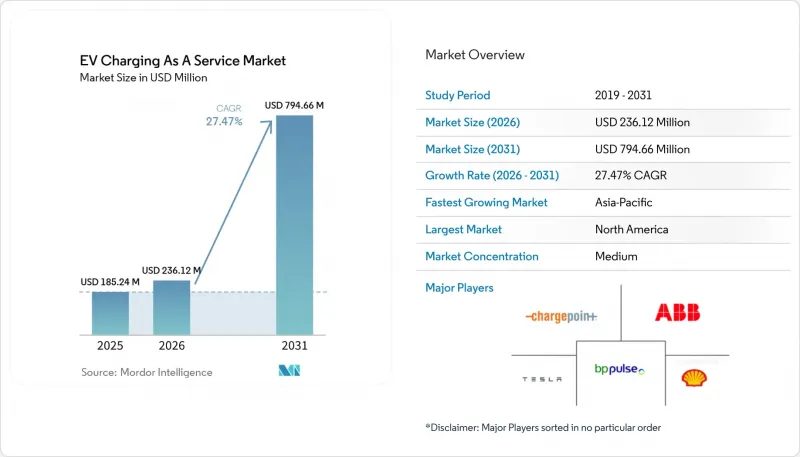
에 따르면 EV 충전 서비스(EV Charging as a Service) 시장은 2025년에 1억 8,524만 달러 규모에 달하며, 2026년 2억 3,612만 달러에서 2031년까지 7억 9,466만 달러로 성장하며, 예측 기간(2026-2031년)에 CAGR 27.47%를 기록할 것으로 전망되고 있습니다.
전 세계 전기자동차 충전 서비스 시장의 동향 및 인사이트
공공 충전 인프라 구축을 위한 정부의 보조금 및 규제
연방 및 지역 차원의 프로그램을 통해 정책 목표가 의무적인 조달 일정으로 구체화되고 있으며, 이는 전기자동차 충전 서비스(Charging-as-a-Service) 시장에 긍정적인 영향을 미치고 있습니다. NEVI는 중기적으로 막대한 자금을 지원함과 동시에 높은 가동률을 확보하기 위해, 보조금 수혜자에게 일정 간격으로 대용량 충전기를 설치할 것을 의무화하고 있습니다. 이러한 중점 방침에 따라 원격 진단 기능을 갖춘 풀서비스 제공업체에 대한 보조금 지급이 진행되고 있습니다. AFIR는 EU 회원국들에게 2025년까지 주요 간선도로를 따라 60km마다 400kW 충전소 군을 설치할 것을 의무화하고 있으며, 이에 따라 고속도로 운영 사업자들은 자본 투자와 운영을 일체화한 10년짜리 CaaS 계약을 체결하도록 권장받고 있습니다.
기업의 차량 전기화 추진 현황
전 세계 물류 및 서비스 기업은 충전 규격의 진화에 따른 자산의 노후화를 피하기 위해 수년에 걸친 CaaS 계약을 체결하고 있습니다. 아마존은 리비안(Rivian)제 밴 10만 대를 구매하고, 부지내 수요를 2MW 미만으로 억제하기 위해 충전 시간을 분산시키는 거점 인프라를 확보함으로써 고액 요금 적용을 방지하는 조치를 취하고 있습니다. UPS는 2020년대 중반까지 국내에서 신규 구매하는 차량의 상당 부분을 전동화할 계획입니다. 이 회사는 또한 다수의 시설에 ‘매니지드 차징(Managed Charging)’을 도입하여 전력 소비량을 실시간 요금 체계에 맞춰 조정하고 있습니다. 사내에 엔지니어링 부서가 없는 소규모 사업자를 대상으로 한 ‘Ford Pro’는 포트당 고정 요금에 정기 이용료를 결합한 포괄적인 차량 충전 솔루션을 제공하고 있습니다. 옥토퍼스 에너지(Octopus Energy)는 유럽의 차량 관리 부문을 통해 동적 요금 체계에 맞춰 야간 AC 충전 시점을 전략적으로 조정하여, 유리한 조건의 도매 가격을 활용하고 있습니다. 한편, 볼보 트럭은 대형 차량 고객을 대상으로 차고 인프라, 예측 유지보수 및 ‘충전 서비스(Charging-as-a-Service)’를 결합한 패키지를 제공하고 있으며, 성능이 일정 임계값 이하로 떨어질 경우 가동률 저하에 대한 페널티가 적용됩니다.
급속 충전기 및 송전망 업그레이드에 따른 막대한 설비 투자
사업자는 대용량 충전기 1대를 설치하는 것만으로도 막대한 비용이 소요되며, 변압기나 개폐기의 교체가 필요해지면 그 비용은 더욱 증가합니다. 캘리포니아주 일부나 영국 등 일부 지역에서는 계통 연계 대기 기간이 수년에 달하기도 하여, CaaS 사업자는 수익을 창출하기도 전에 부채 상환을 관리해야 하는 상황에 몰리고 있습니다. 수요 요금은 종종 고액이며, 평균 이용률이 낮더라도 단기간의 출력 피크만으로도 월 요금이 상당한 금액에 달할 수 있습니다. 축전지는 이러한 피크 시간대의 요금 부담을 경감하는 데 도움이 되지만, 설치 장소에 막대한 비용이 드는 데다 경년 열화로 인해 점차 용량이 감소합니다. 일부 사업자는 수요 반응(Demand Response) 프로그램에 참여함으로써 요금 감면 조치를 협상하고 있습니다. 그러나 이러한 계약에 따른 실시간 출력 억제는 저녁 피크 시간대 등 수요가 높은 시간대에 충전기의 이용 가능성을 제한할 가능성이 있습니다.
부문 분석
2025년, EV 충전 서비스(EV Charging As A Service) 시장 점유율의 71.27%를 AC 충전기가 차지했습니다. 이는 호스트가 기존의 208볼트 배전반에 레벨 2 충전기를 연결할 수 있고, 설치 비용이 2,000-5,000달러로 50kW DC 시스템에 필요한 투자액의 극히 일부에 불과하기 때문입니다. 직장이나 소매 시설이 체류 시간 연장을 유도하는 노상 설비를 확충함에 따라 AC 기기를 활용한 ‘EV Charging As A Service’ 시장 규모는 꾸준히 확대될 것으로 전망됩니다. 고전압 부품의 수가 적고 수동 냉각 방식을 채택하여 유지 관리 비용을 낮게 유지할 수 있으므로, 서비스 제공업체는 합리적인 월 이용료로 높은 가동률을 보장할 수 있게 됩니다.
DC 급속 충전기는 2031년까지 연평균 27.49%의 성장이 예상되며, 그 원동력은 현대 ‘아이오닉 5’나 포르쉐 ‘타이칸’ 등, 스로틀링 없이 350kW 충전을 지원할 수 있는 800볼트 차량 아키텍처입니다. 서비스 제공업체는 여러 충전기 간에 용량을 분배하는 전력 공유 캐비닛을 도입함으로써 고액의 설비 투자(CAPEX) 문제를 해결하고, 가동률을 향상시키며, 투자 회수 기간을 단축하고 있습니다.
2025년 현재, 회사 차량 및 차량 풀은 ‘EV Charging As A Service’ 시장의 27.65%를 차지하고 있으며, 이는 기업이 설비 투자를 하지 않고도 직원이 충전할 수 있는 세제 혜택이 있는 복리후생 제도를 반영한 것입니다. 이 부문에서는 개인용과 업무용을 구분하여 정산하기 위한 스마트 카드와 결합된 AC 포트가 선호되고 있습니다. EV 충전 서비스 시장에서 배송 차량은 가장 빠르게 성장하는 부문으로 간주되며, E-Commerce 사업자의 경우 라스트 마일 배송용 밴에 대한 예측 가능한 거점 충전 및 탄소 배출량 산정이 필요하므로 연평균 성장률(CAGR) 27.55%의 성장이 예상됩니다.
승객 대상 차량 호출 서비스와 렌터카는 전체 수익의 상당 부분을 차지하며, 로밍 계약에 크게 의존하고 있습니다. 이러한 계약은 상당한 할인을 제공하지만, 운전자 데이터 공유가 요구됩니다. 또한 지방자치단체의 대중교통 차량도 수익에서 상당한 비중을 차지하고 있습니다. 특히 로스앤젤레스와 같은 도시에서는 엄격한 성과 기반 계약이 시행되고 있으며, 높은 가동률이 의무화되어 있으며, 출발 지연 등에 대해서는 벌칙이 부과되고 있습니다.
지역별 분석
2025년 전기자동차 충전 서비스(EV Charging As A Service) 시장에서 북미는 46.21%의 시장 점유율로 1위를 차지했습니다. 이러한 급속한 성장은 주로 대규모 정부 프로그램에 의해 주도된 것으로, 해당 프로그램에서는 높은 가동률 달성이 의무화된 회랑형 충전기에 자금을 지원하고 있으며, 이 기준은 전문 서비스 제공업체의 요구와 완벽하게 부합합니다. 2026년 초까지 미국은 성장세를 이어가며 매달 상당한 수의 직류 급속 충전소가 신설되었습니다. 이러한 노력은 수많은 거점에 걸쳐 광범위한 충전소 네트워크 구축이라는 형태로 결실을 맺었습니다. 특히 테슬라가 선두를 달리며 직류 충전소의 대부분을 차지하게 되었습니다. 이 회사는 자사 충전소의 상당 부분을 타사 브랜드에도 개방함으로써 이 이정표를 달성했습니다.
아시아태평양은 2031년까지 연평균 성장률(CAGR) 27.61%로 확대될 것으로 예측됩니다. 중국에서는 큰 변화가 진행 중입니다. 중국의 광범위한 충전기 네트워크는 국가 감독에서 민간 관리로 전환되고 있습니다. 이러한 변화로 인해 사업자는 부가적인 전력망 서비스를 이용 요금에 포함시킬 수 있게 됩니다. 한편, 인도에서는 정부 주도의 주요 구상로 주요 간선 도로를 따라 급속 충전기를 설치하는 사업이 추진되고 있으며, 장기 관리형 서비스 계약이 명확히 우선시되고 있습니다. 일본 또한 설치 비용의 대부분을 보조하는 방침을 내놓고 있습니다. 다만, 조건이 있습니다. 공급업체는 10년에 걸친 가동 보증 계약을 체결해야 합니다.
미래를 내다보는 유럽은 전략적인 규제와 제휴의 성과를 누리고 있습니다. 2025년 매출에서 큰 비중을 차지할 유럽의 기세는 일정 대수의 BEV(배터리식 전기자동차)당 1기의 공공 충전기를 설치하도록 하는 지침에 힘입어 더욱 가속화되고 있습니다. 또한 다수의 국가에 있는 충전기를 원활하게 통합하는 ‘ChargeLeague’ 로밍 얼라이언스가 유럽의 입지를 더욱 공고히 하고 있습니다. 현재 점유율은 미미하지만, 중동 및 아프리카는 야심 찬 목표를 내걸고 있습니다. 예를 들어 UAE는 2030년까지 상당수의 공공 급속 충전기를 설치하는 것을 목표로 하고 있습니다.
기타 혜택:
- 엑셀 형식의 시장 예측(ME) 시트
- 3개월간의 애널리스트 지원
자주 묻는 질문
목차
제1장 서론
- 조사 전제조건과 시장 정의
- 조사 범위
제2장 조사 방법
제3장 개요
제4장 시장 구도
- 시장 개요
- 시장 성장 촉진요인
- 시장 성장 억제요인
- 밸류·공급망 분석
- 규제 상황
- 기술 전망
- Porter's Five Forces 분석
제5장 시장 규모와 성장 예측
- 충전 유형별
- 플릿 서비스의 유형별
- 최종 용도별
- 출력별
- 지역별
- 북미
- 미국
- 캐나다
- 기타 북미 국가
- 남미
- 브라질
- 아르헨티나
- 기타 남미 국가
- 유럽
- 영국
- 독일
- 스페인
- 이탈리아
- 프랑스
- 러시아
- 기타 유럽 국가
- 아시아태평양
- 인도
- 중국
- 일본
- 인도네시아
- 말레이시아
- 싱가포르
- 베트남
- 필리핀
- 한국
- 기타 아시아태평양 국가
- 중동 및 아프리카
- 아랍에미리트
- 사우디아라비아
- 튀르키예
- 이집트
- 남아프리카공화국
- 기타 중동 및 아프리카 국가
- 북미
제6장 경쟁 구도
- 시장 집중도
- 전략적 동향
- 시장 점유율 분석
- 기업 개요
- ChargePoint Holdings Inc.
- Tesla Inc.
- Shell Recharge Solutions
- BP Pulse(Chargemaster Limited)
- ABB Ltd.
- Electrify America, LLC
- EVgo Services LLC
- TotalEnergies Charging Services, S.A.S.
- Blink Charging Co.
- Enel S.p.A.
- Ionity GmbH
- Fastned B.V.
- Tritium DCFC Ltd
- Pod Point PLC
- SparkCharge Inc.
제7장 시장 기회와 향후 전망
KSA 26.10.23According to Mordor Intelligence, the EV charging as a Service Market was valued at USD 185.24 million in 2025, and is projected to grow from USD 236.12 million in 2026 to USD 794.66 million by 2031, registering a CAGR of 27.47% during the forecast period (2026-2031).
Global EV Charging As A Service Market Trends and Insights
Government Subsidies and Mandates for Public Charging Roll-Outs
Federal and regional programs are translating policy goals into mandatory procurement schedules, benefiting the EV Charging-as-a-Service market. NEVI, committing substantial funding through the mid-term, mandates that grant recipients install high-capacity chargers at regular intervals to ensure high uptime. This focus directs awards towards full-service providers equipped with remote diagnostics . AFIR obliges EU states to install 400-kW pools every 60 km along core corridors by 2025, prompting highway operators to sign 10-year CaaS contracts that bundle capital and operations .
Corporate Fleet-Electrification Commitments
Global logistics and service companies are locking in multi-year CaaS deals to avoid stranded assets as charging standards evolve. Amazon purchased 100,000 Rivian vans and secured depot infrastructure that staggers charging to keep site demand below 2 MW, protecting against punitive tariffs . By the middle of the decade, UPS plans to electrify a significant portion of its new domestic fleet purchases. The company also employs managed charging at numerous facilities, synchronizing its power draw with real-time pricing. Ford Pro, targeting smaller operators without in-house engineering, provides a comprehensive fleet charging solution at a fixed cost per port, supplemented by a recurring fee. Octopus Energy, through its European fleet division, strategically times overnight AC charging to align with dynamic tariffs, taking advantage of wholesale prices during favorable conditions. Meanwhile, Volvo Trucks offers a bundled package for heavy-duty clients that combines depot infrastructure, predictive maintenance, and charging-as-a-service, with uptime penalties applied if performance falls below a certain threshold.
High Cap-Ex for Fast Chargers and Grid Upgrades
Operators incur high costs to install a single high-capacity dispenser, and these costs increase further if transformers or switchgear require replacement. In some regions, such as parts of California and the UK, interconnection queues can extend for several years, forcing CaaS operators to manage debt obligations before generating revenue. Demand charges are often substantial, and even brief periods of high output can result in considerable monthly fees, despite low average utilization. Battery storage can help mitigate these peak charges, but it adds a notable expense to the site and experiences gradual capacity loss over time due to degradation. Some operators negotiate tariff relief by participating in demand-response programs. However, real-time curtailment under these agreements can limit charger availability during periods of high demand, such as evening peaks.
Other drivers and restraints analyzed in the detailed report include:
- Rapid Build-Out Of DC Fast-Charging Corridors
- Mobile On-Demand Charging Services Gain Traction
- Interoperability Gaps (CCS Vs NACS Vs CHAdeMO)
For complete list of drivers and restraints, kindly check the Table Of Contents.
Segment Analysis
AC chargers accounted for 71.27% of the EV Charging As A Service market share in 2025 because hosts can plug Level 2 units into existing 208-volt panels for USD 2,000-5,000 in installed cost, a fraction of the investment required for 50 kW DC systems. The EV Charging As A Service market size for AC equipment is projected to scale steadily as workplaces and retail plazas expand curbside amenities that encourage longer dwell times. Lower upkeep-fewer high-voltage parts and passive cooling-enables service providers to offer aggressive uptime guarantees at modest subscription fees.
DC fast chargers are slated to grow at a 27.49% rate through 2031, fueled by 800-volt vehicle architectures such as the Hyundai Ioniq 5 and the Porsche Taycan that can accept 350 kW without throttling. Service providers combat high capex with power-sharing cabinets that distribute capacity among multiple dispensers, raising utilization and shortening payback.
Company cars and motor pools accounted for 27.65% of the EV Charging As A Service market share in 2025, reflecting tax-advantaged benefit schemes that allow employees to charge without corporate capex. This cohort favors AC ports paired with smart cards that track personal versus business usage for reimbursement. The EV Charging As A Service market sees delivery fleets as the fastest-growing segment, projected to grow at a 27.55% CAGR because e-commerce players need predictable depot charging and carbon accounting for last-mile vans.
Passenger ride-hailing and rentals contribute a significant portion of overall revenue, heavily relying on roaming agreements. These agreements offer substantial discounts but require sharing driver data. Municipal transit fleets also account for a notable share of the revenue. Notably, cities like Los Angeles enforce stringent performance-based contracts, mandating high uptime and imposing penalties for any missed departures.
Complete Report Scope:
- By Charger Type
- AC Chargers
- DC Fast Chargers
- Wireless / Inductive Chargers
- By Fleet Service Type
- Company Vehicles & Motor Pools
- Delivery & Logistics Fleets
- Passenger Fleets (Ride-hail, Rental)
- Municipal & Transit Fleets
- By End-Use
- Semi-Public Set-Ups (Workplace, Retail)
- Public Charging Set-Ups (Highway, Urban)
- Depot / Fleet-Hub Charging
- Mobile On-Demand Charging
- By Power Output
- Level 1 / AC (Below 22 kW)
- Level 2 (22 - 50 kW)
- Fast (50 - 150 kW)
- High-Power (Above 150 kW)
- By Geography
- North America
- United States
- Canada
- Rest of North America
- South America
- Brazil
- Argentina
- Rest of South America
- Europe
- United Kingdom
- Germany
- Spain
- Italy
- France
- Russia
- Rest of Europe
- Asia-Pacific
- India
- China
- Japan
- Indonesia
- Malaysia
- Singapore
- Vietnam
- Philippines
- South Korea
- Rest of Asia-Pacific
- Middle East and Africa
- United Arab Emirates
- Saudi Arabia
- Turkey
- Egypt
- South Africa
- Rest of Middle East and Africa
- North America
Geography Analysis
North America led with 46.21% market share in the EV Charging As A Service market in 2025. This surge was largely driven by a substantial government program, which funds corridor chargers mandated to achieve high uptime - a benchmark that aligns perfectly with specialized service providers. By early 2026, the U.S. was on a roll, adding a considerable number of DC fast-charging stations each month. This effort culminated in a vast network of ports spread across numerous sites. Notably, Tesla emerged as a frontrunner, commanding a majority of the DC stalls and achieving this milestone after opening a significant portion of its ports to brands beyond its own.
Asia-Pacific is forecast to expand at 27.61% CAGR through 2031. In China, a significant transition is underway. The nation's extensive network of chargers is moving from state oversight to private management. This shift empowers operators to integrate ancillary grid services with their utilization fees. Over in India, a major government initiative is championing corridor fast chargers and showing a clear preference for long-term managed-service contracts. Japan is playing its cards too, offering to subsidize a large portion of installation costs. However, there's a catch: vendors must commit to decade-long uptime agreements.
Europe, with its sights set on the future, is reaping the rewards of strategic mandates and alliances. Commanding a significant share of 2025 revenue, Europe's momentum is fueled by a directive to install one public charger for every set number of BEVs. Additionally, the ChargeLeague roaming alliance, which seamlessly integrates chargers across numerous nations, bolsters the continent's standing. The Middle East and Africa, currently holding a modest share, have ambitious targets. The UAE, for instance, is eyeing a substantial number of public fast chargers by 2030.
- ChargePoint Holdings Inc.
- Tesla Inc.
- Shell Recharge Solutions
- BP Pulse (Chargemaster Limited)
- ABB Ltd.
- Electrify America, LLC
- EVgo Services LLC
- TotalEnergies Charging Services, S.A.S.
- Blink Charging Co.
- Enel S.p.A.
- Ionity GmbH
- Fastned B.V.
- Tritium DCFC Ltd
- Pod Point PLC
- SparkCharge Inc.
Additional Benefits:
- The market estimate (ME) sheet in Excel format
- 3 months of analyst support
TABLE OF CONTENTS
1 Introduction
- 1.1 Study Assumptions & Market Definition
- 1.2 Scope of the Study
2 Research Methodology
3 Executive Summary
4 Market Landscape
- 4.1 Market Overview
- 4.2 Market Drivers
- 4.2.1 Government Subsidies and Mandates For Public Charging Roll-Outs
- 4.2.2 Corporate Fleet-Electrification Commitments
- 4.2.3 Rapid Build-Out of DC Fast-Charging Corridors
- 4.2.4 Subscription-Based Caas Financing Models
- 4.2.5 Mobile On-Demand Charging Services Gain Traction
- 4.2.6 Micro-Grid + Storage Pairing Cuts Operating Costs
- 4.3 Market Restraints
- 4.3.1 High Cap-Ex for Fast Chargers & Grid Upgrades
- 4.3.2 Shortage Of Certified Field-Service Technicians
- 4.3.3 Interoperability Gaps (CCS Vs NACS Vs Chademo)
- 4.3.4 Volatile Peak-Tariff Exposure For CaaS Operators
- 4.4 Value / Supply-Chain Analysis
- 4.5 Regulatory Landscape
- 4.6 Technological Outlook
- 4.7 Porter's Five Forces Analysis
- 4.7.1 Threat of New Entrants
- 4.7.2 Bargaining Power of Suppliers
- 4.7.3 Bargaining Power of Buyers
- 4.7.4 Threat of Substitutes
- 4.7.5 Competitive Rivalry
5 Market Size & Growth Forecasts (Value (USD))
- 5.1 By Charger Type
- 5.1.1 AC Chargers
- 5.1.2 DC Fast Chargers
- 5.1.3 Wireless / Inductive Chargers
- 5.2 By Fleet Service Type
- 5.2.1 Company Vehicles & Motor Pools
- 5.2.2 Delivery & Logistics Fleets
- 5.2.3 Passenger Fleets (Ride-hail, Rental)
- 5.2.4 Municipal & Transit Fleets
- 5.3 By End-Use
- 5.3.1 Semi-Public Set-Ups (Workplace, Retail)
- 5.3.2 Public Charging Set-Ups (Highway, Urban)
- 5.3.3 Depot / Fleet-Hub Charging
- 5.3.4 Mobile On-Demand Charging
- 5.4 By Power Output
- 5.4.1 Level 1 / AC (Below 22 kW)
- 5.4.2 Level 2 (22 - 50 kW)
- 5.4.3 Fast (50 - 150 kW)
- 5.4.4 High-Power (Above 150 kW)
- 5.5 By Geography
- 5.5.1 North America
- 5.5.1.1 United States
- 5.5.1.2 Canada
- 5.5.1.3 Rest of North America
- 5.5.2 South America
- 5.5.2.1 Brazil
- 5.5.2.2 Argentina
- 5.5.2.3 Rest of South America
- 5.5.3 Europe
- 5.5.3.1 United Kingdom
- 5.5.3.2 Germany
- 5.5.3.3 Spain
- 5.5.3.4 Italy
- 5.5.3.5 France
- 5.5.3.6 Russia
- 5.5.3.7 Rest of Europe
- 5.5.4 Asia-Pacific
- 5.5.4.1 India
- 5.5.4.2 China
- 5.5.4.3 Japan
- 5.5.4.4 Indonesia
- 5.5.4.5 Malaysia
- 5.5.4.6 Singapore
- 5.5.4.7 Vietnam
- 5.5.4.8 Philippines
- 5.5.4.9 South Korea
- 5.5.4.10 Rest of Asia-Pacific
- 5.5.5 Middle East and Africa
- 5.5.5.1 United Arab Emirates
- 5.5.5.2 Saudi Arabia
- 5.5.5.3 Turkey
- 5.5.5.4 Egypt
- 5.5.5.5 South Africa
- 5.5.5.6 Rest of Middle East and Africa
- 5.5.1 North America
6 Competitive Landscape
- 6.1 Market Concentration
- 6.2 Strategic Moves
- 6.3 Market Share Analysis
- 6.4 Company Profiles (Includes Global Level Overview, Market Level Overview, Core Segments, Financials as Available, Strategic Information, Market Rank/Share for Key Companies, Products and Services, SWOT Analysis, and Recent Developments)
- 6.4.1 ChargePoint Holdings Inc.
- 6.4.2 Tesla Inc.
- 6.4.3 Shell Recharge Solutions
- 6.4.4 BP Pulse (Chargemaster Limited)
- 6.4.5 ABB Ltd.
- 6.4.6 Electrify America, LLC
- 6.4.7 EVgo Services LLC
- 6.4.8 TotalEnergies Charging Services, S.A.S.
- 6.4.9 Blink Charging Co.
- 6.4.10 Enel S.p.A.
- 6.4.11 Ionity GmbH
- 6.4.12 Fastned B.V.
- 6.4.13 Tritium DCFC Ltd
- 6.4.14 Pod Point PLC
- 6.4.15 SparkCharge Inc.
7 Market Opportunities & Future Outlook
- 7.1 White-space & Unmet-Need Assessment


