

|
시장보고서
상품코드
2154370
만성 플라크 건선 치료 : 시장 점유율 분석, 업계 동향과 통계, 성장 예측(2026-2031년)Chronic Plaque Psoriasis Treatment - Market Share Analysis, Industry Trends & Statistics, Growth Forecasts (2026 - 2031) |
||||||
 Mordor Intelligence
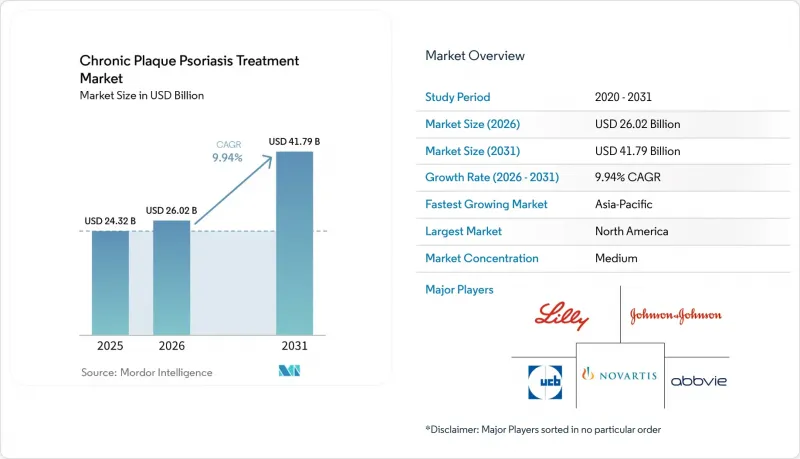
에 따르면 만성반장 건선 치료 시장 규모는 2025년 243억 2,000만 달러에서 2026년에는 260억 2,000만 달러로 확대하며, 2031년까지 417억 9,000만 달러에 달할 것으로 예상되고 있으며, 2026-2031년에 CAGR 9.94%로 성장할 것으로 전망되고 있습니다.
전 세계 만성 반점형 건선 치료 시장의 동향 및 인사이트
고효능 IL-17 및 IL-23 억제제의 보급
만성 반점형 건선 치료 시장은 PASI 90 및 PASI 100 반응을 점점 더 중시하는 더 높은 임상 기준의 확산으로 인해 혜택을 받고 있습니다. PSoHO 관찰 연구에 따르면 IL-17A 억제제는 24개월 시점에 환자의 39.70%가 PASI 100을, 55.20%에서 PASI 90을 달성한 반면, 항-TNF-α 제제를 투여받은 환자 중 PASI 100을 달성한 비율은 32.80%에 그쳤습니다. 2026년에 실시된, 약 14,000명의 참가자를 대상으로 한 32건의 무작위 대조 시험에 대한 메타분석에 따르면 아시아인 집단에서 IL-17 및 IL-23 억제제가 위약보다 우월한 것으로 나타났으며, 로그 오즈비는 1.40, 95% 신뢰구간은 1.17-1.62였습니다. 이러한 결과는 비서구계 환자 집단에 대한 근거가 치료 결정에 영향을 미치는 시장에서 보험 적용 범위 확대를 지원하는 것입니다. 약물의 지속적 사용에 관한 근거 또한 신약을 지지하는 바입니다. 바이오의약품 사용 경험이 있는 환자에서 비메키주맙, 구셀쿠맙, 리산키주맙은 우스테키누맙에 비해 2년 동안의 투여 중단 위험이 낮은 것으로 나타났습니다. 따라서 만성 반점형 건선 치료 시장은 신약에 대한 접근성이 제한된 환자에게 기존 치료법이 여전히 중요한 지역이라 하더라도, 구형 생물제제에서 계속해서 전환되고 있습니다.
경구용 표적 면역조절제의 확대
경구 요법은 주사제 치료에 수반되는 실용적인 부담을 줄일 수 있으므로 만성 일반성 건선 치료 시장을 변화시키고 있습니다. 존슨앤드존슨은 2026년 3월, IL-23 수용체를 표적으로 하는 경구용 펩티드 제제 ‘이코트로킨라’에 대해 중등도 내지 중증의 일반성 건선을 가진 성인 및 12세 이상의 청소년을 대상으로 FDA 승인을 획득했습니다. 2,500명의 환자를 대상으로 한 4건의 3상 ICONIC 임상시험에서 16주 시점에 70%의 환자가 ‘피부가 깨끗하거나 거의 깨끗함’이라는 임상시험 책임의사의 종합 평가(IGA)를 달성했으며, 55%의 환자가 PASI 90을 달성한 것으로 확인되었습니다. 유럽의약품청(EMA)은 2026년 7월, 이코트로킨라의 판매 승인을 권고했습니다. 이에 따라 IL-23 수용체를 표적으로 하는 경구용 약제로서, 일반 건선에 대해 CHMP(의약품위원회)로부터 긍정적인 견해를 얻은 최초의 약물이 되었습니다(EMA). 다케다 제약은 2026년 6월, 3상 임상시험에서 자소시티닙이 데우클라바시티닙에 비해 통계적으로 우월성을 보였으며, 치료를 받은 환자의 절반 이상이 PASI 90을 달성했다고 보고했습니다(다케다 제약). 이러한 신약의 출시 및 후기 임상 개발 단계에 있는 프로그램들은 주사에 대한 거부감, 안전성에 대한 우려 또는 전문 약국에서의 조제 요건과 같은 요인으로 인해 치료가 지연되었던, 지금까지 치료를 받지 못한 환자들을 만성 일반 건선 치료 시장으로 유입시킬 가능성이 있습니다.
바이오의약품의 높은 비용과 지불 주체에 의한 이용 제한
치료비 급등과 이용 제한은 첨단 치료법이 우수한 임상 성과를 보여주고 있는 경우에도 만성 반점성 건선 치료 시장의 성장을 둔화시킬 가능성이 있습니다. 민간 보험사의 프로토콜에서는 환자가 새로운 생물제제나 경구약을 이용할 수 있게 되기 전에 몇 가지 치료 단계를 완료해야 하는 경우가 종종 있습니다. 2025년에 실시된 미국의 194건 민간 단계적 치료 프로토콜에 대한 분석에 따르면 99.40%가 임상 지침에서 지지하는 것 이상의 요건을 부과하고 있었으며, 건선성 관절염 프로토콜의 68.40%가 지침의 권장 사항을 초과하고 있었습니다. 이 조사에서 조사 대상 의사의 92%는 이러한 제한이 임상 결과에 부정적인 영향을 미치고 있다고 보고했습니다. 이러한 불일치는 두피, 손톱, 생식기 또는 손바닥·발바닥에 병변이 있는 환자에게 특히 어려운 문제가 될 수 있습니다. 이러한 부위는 체표면적이 제한적임에도 불구하고 삶의 질(QOL)에 심각한 부담을 줄 수 있기 때문입니다. 2025년까지 미국 38개 주에서 단계적 치료 보호법을 제정했으며, 제안된 ‘세이프 스텝 법(Safe Step Act)’에 따르면 보험사는 예외 신청에 대해 24시간에서 72시간 이내에 답변할 의무가 있습니다.
부문 분석
2025년, 치료법별 매출에서 생물제제는 만성 반점형 건선 치료 시장의 58.32% 점유율을 차지했습니다. IL-17 및 IL-23 억제제는 높은 관해율을 보이며, 전문의의 진료 현장에서 장기 사용 실적이 확립되어 있으며, 중등도에서 중증 질환에 대한 주요 치료 옵션으로 자리 잡고 있습니다. 네트워크 메타분석에 따르면 비메키주맙, 익세키주맙, 브로달마브는 빠르면 투여 시작 후 6-8주 만에 PASI 90을 달성했습니다. RWD(Real World Data)에서도 리산키주맙 및 구셀쿠맙에 대해 양호한 약물 지속률이 확인되었으며, 이는 IL-23 억제제의 지속적 사용을 지원하는 것입니다.
경구용 전신 약물은 2026-2031년에 연평균 성장률(CAGR) 14.94%로 성장할 것으로 예측되며, 이는 치료법 중 가장 높은 성장률입니다. 이러한 성장의 주요 요인은 TYK2 억제제 및 경구용 IL-23 수용체 치료제입니다. 2026년에 승인된 이코트로킨라는 기존에는 주로 주사용 생물제제에서만 볼 수 있었던 효능을 목표로 하는 새로운 경구 치료 옵션을 확립했습니다. 또한 병용 요법도 영향이 큰 병변이나 치료가 어려운 사례에서 여전히 임상적 역할을 수행하고 있습니다.
2025년 기준, 투여 경로별로 본 만성 일반성 건선 치료 시장의 점유율 중 주사제가 57.62%를 차지했습니다. 이러한 위상은 중등도에서 중증의 일반성 건선에서 피하 투여형 IL-17 및 IL-23 바이오로직이 오랫동안 수행해 온 역할을 반영합니다. 덴마크의 실제 임상 데이터에 따르면 구셀쿠맙과 리산키주맙은 생물제제를 처음 사용하는 환자에서 높은 치료 지속률을 보였습니다.
경구 투여 경로는 2026-2031년까지 연평균 성장률(CAGR) 11.55%로 확대될 것으로 예측됩니다. 이코트로킨라는 3상 임상시험에서 16주 시점에 환자의 55%가 PASI 90을 달성하여, 경구 요법으로도 첨단 주사제 치료와 동등한 효과를 발휘할 수 있음을 입증했습니다. 경구 치료제는 주사에 대한 거부감을 완화하고, 환자와 의료 기관 모두에게 치료 시작 절차를 간소화할 가능성이 있습니다. 외용제는 처방 건수 측면에서 여전히 중요한 위치를 차지하고 있지만, 단가가 낮기 때문에 수익에 기여하는 정도는 낮습니다.
지역별 분석
2025년, 북미는 만성 반점형 건선 치료 시장 점유율의 38.98%를 차지했습니다. 이 지역은 생물제제의 높은 보급률, 밀집된 전문의 네트워크, 그리고 궁극적으로 많은 적격 환자에게 첨단 치료법을 승인하는 보험 제도의 혜택을 받고 있습니다. UnitedHealthcare의 2026년 기준에는 이코트로킨라, 리산키주맙, 구셀쿠맙, 섹티니맙, 데우클라바시티닙 및 우선적으로 적용되는 아달리무맙 바이오시밀러가 보험 적용 대상에 포함되었습니다.
유럽은 만성 반점형 건선 치료 시장에서 두 번째로 큰 비중을 차지하고 있으며, 독일, 프랑스, 영국, 이탈리아, 스페인이 주도적인 역할을 하고 있습니다. 독일의 ‘Arzneimittel-Atlas’는 2024년 법정 건강보험 지출 증가율이 가장 두드러진 6대 의약품 카테고리 중 하나로 건선을 꼽았습니다.
아시아태평양은 2026-2031년까지 연평균 성장률(CAGR) 11.67%로 성장할 것으로 예측되며, 이는 지역별 부문 중 가장 높은 성장률입니다. 중국, 일본, 인도, 한국, 호주가 이러한 성장의 중심이 될 시장입니다. 중국에서는 2026년 4월 엔스틸라(Enstilar)의 국가약품감독관리국(NMPA) 승인을 비롯해, 보험 적용 범위 갱신 및 현지 규제 당국의 승인을 통해 접근성이 개선되고 있습니다.
기타 혜택:
- 엑셀 형식의 시장 예측(ME) 시트
- 3개월간의 애널리스트 지원
자주 묻는 질문
목차
제1장 서론
- 조사 전제조건과 시장 정의
- 조사 범위
제2장 조사 방법
제3장 개요
제4장 시장 구도
- 시장 개요
- 시장 성장 촉진요인
- 시장 성장 억제요인
- 공급망 분석
- 규제 상황
- 기술 전망
- Porter's Five Forces
제5장 시장 규모와 성장 예측
- 치료 모달리티별
- 투여 경로별
- 질환 중증도별
- 환자 유형별
- 유통 채널별
- 지역별
- 북미
- 미국
- 캐나다
- 멕시코
- 유럽
- 독일
- 영국
- 프랑스
- 이탈리아
- 스페인
- 기타 유럽 국가
- 아시아태평양
- 중국
- 인도
- 일본
- 호주
- 한국
- 기타 아시아태평양 국가
- 중동 및 아프리카
- GCC
- 남아프리카공화국
- 기타 중동 및 아프리카 국가
- 남미
- 브라질
- 아르헨티나
- 기타 남미 국가
- 북미
제6장 경쟁 구도
- 시장 집중도
- 시장 점유율 분석
- 기업 개요
- AbbVie Inc.
- Affibody AB
- Alumis Inc.
- Alvotech
- Amgen Inc.
- Arcutis Biotherapeutics, Inc.
- Boehringer Ingelheim International GmbH
- Bristol Myers Squibb Company
- Dr. Reddy's Laboratories Limited
- Eli Lilly and Company
- Johnson & Johnson
- LEO Pharma A/S
- Meiji Seika Pharma Co., Ltd.
- Novartis AG
- Organon & Co.
- Pfizer Inc.
- Soligenix, Inc.
- Sun Pharmaceutical Industries Ltd
- Takeda Pharmaceutical Company Limited
- UCB S.A.
제7장 시장 기회와 향후 전망
KSAAccording to Mordor Intelligence, the chronic plaque psoriasis treatment market size is expected to increase from USD 24.32 billion in 2025 to USD 26.02 billion in 2026 and reach USD 41.79 billion by 2031, growing at a CAGR of 9.94% over 2026-2031.
Global Chronic Plaque Psoriasis Treatment Market Trends and Insights
Uptake of High-Efficacy IL-17 and IL-23 Inhibitors
The chronic plaque psoriasis treatment market is benefiting from a higher clinical standard that increasingly emphasizes PASI 90 and PASI 100 responses. In the PSoHO observational study, IL-17A inhibitors achieved PASI 100 in 39.70% of patients and PASI 90 in 55.20% at 24 months, compared with PASI 100 in 32.80% of patients receiving anti-TNFa agents. A 2026 meta-analysis of 32 randomized controlled trials involving nearly 14,000 participants found that IL-17 and IL-23 inhibitors were superior to placebo in Asian populations, with a log odds ratio of 1.40 and a 95% confidence interval of 1.17 to 1.62. These results support broader formulary adoption in markets where evidence in non-Western patient populations influences treatment decisions. Drug-survival evidence also favors newer agents, as bimekizumab, guselkumab, and risankizumab showed lower 2-year discontinuation risk than ustekinumab among bio-experienced patients. The chronic plaque psoriasis treatment market, therefore, continues to shift away from older biologic classes, even where those treatments remain important for patients with limited access to newer medicines.
Expansion of Oral Targeted Immunomodulators
Oral therapies are changing the chronic plaque psoriasis treatment market because they can reduce the practical burden of injectable treatment. Johnson & Johnson received FDA approval in March 2026 for icotrokinra, an oral peptide that targets the IL-23 receptor, for adults and adolescents aged 12 years and older with moderate-to-severe plaque psoriasis. Four Phase 3 ICONIC studies involving 2,500 patients found that 70% achieved an Investigator's Global Assessment of clear or almost clear skin and 55% achieved PASI 90 at Week 16. The European Medicines Agency recommended marketing authorization for icotrokinra in July 2026, making it the first oral medicine targeting the IL-23 receptor to receive a positive CHMP opinion for plaque psoriasis EMA.Takeda reported that zasocitinib was statistically superior to deucravacitinib in a Phase 3 study during June 2026, with more than half of treated patients achieving PASI 90 TAKEDA. These launches and late-stage programs can bring previously untreated patients into the chronic plaque psoriasis treatment market when injection aversion, perceived safety concerns, or specialty-dispensing requirements had delayed care.
High Biologic Costs and Payer Utilization Controls
High treatment costs and utilization controls can slow the chronic plaque psoriasis treatment market even when advanced therapies show strong clinical outcomes. Commercial payer protocols often require patients to complete several treatment steps before gaining access to newer biologics or oral medicines. A 2025 analysis of 194 U.S. commercial step-therapy protocols found that 99.40% imposed more requirements than clinical guidelines supported, while 68.40% of psoriatic arthritis protocols exceeded guideline recommendations. The same research found that 92% of surveyed physicians reported a negative effect on clinical outcomes from these restrictions. The mismatch can be especially difficult for people with scalp, nail, genital, or palmoplantar disease, where quality-of-life burden can be severe despite limited body surface area. Thirty-eight U.S. states had enacted step-therapy protection laws by 2025, and the proposed Safe Step Act would require payers to respond to exception requests within 24 to 72 hours.
Other drivers and restraints analyzed in the detailed report include:
- Emerging-Market Biologic and Biosimilar Access
- Pediatric Label Expansion and Age-Appropriate Formulations
- Longitudinal Loss of Response and Treatment Persistence Attrition
For complete list of drivers and restraints, kindly check the Table Of Contents.
Segment Analysis
Biologic Drugs held 58.32% of the chronic plaque psoriasis treatment market share within treatment modality revenue in 2025. IL-17 and IL-23 inhibitors have become central options for moderate-to-severe disease because they offer high clearance rates and established long-term use in specialist practice. In network meta-analyses, bimekizumab, ixekizumab, and brodalumab achieved PASI 90 as early as Weeks 6 to 8. Real-world evidence also found favorable drug survival for risankizumab and guselkumab, which supports continued use of IL-23 inhibitors.
Oral Systemic Drugs are forecast to grow at a 14.94% CAGR from 2026 to 2031, the fastest rate among treatment modalities. TYK2 inhibitors and oral IL-23 receptor therapies are the main reasons for this expansion. Icotrokinra's 2026 approval established a new oral treatment option that aims for efficacy previously associated mainly with injectable biologics. Combination regimens also retain a clinical role for high-impact-site disease and difficult-to-treat presentations.
Injectable therapies accounted for 57.62% of the chronic plaque psoriasis treatment market share by route of administration in 2025. Their position reflects the long-standing role of subcutaneous IL-17 and IL-23 biologics in moderate-to-severe plaque psoriasis. Guselkumab and risankizumab showed strong drug survival among bio-naive patients in Danish real-world evidence.
The Oral route is forecast to expand at an 11.55% CAGR from 2026 to 2031. Icotrokinra demonstrated that an oral therapy can approach the performance range of advanced injectable treatments, with 55% of patients reaching PASI 90 at Week 16 in its Phase 3 program. Oral options can reduce concerns around injection aversion and may simplify treatment initiation for patients and practices. The Topical route remains important by prescription volume but contributes less revenue because of its lower unit price.
Complete Report Scope:
- By Treatment Modality
- Biologic Drugs
- TNF Inhibitors
- IL-17 Inhibitors
- IL-23 Inhibitors
- IL-12/23 Inhibitors
- T-Cell Inhibitors
- Oral Systemic Drugs
- PDE4 Inhibitors
- TYK2 Inhibitors
- JAK Inhibitors
- Retinoids
- Topical Therapies
- Corticosteroids
- Vitamin D Analogues
- Topical PDE4 Inhibitors
- Topical Roflumilast
- Tapinarof
- Combination Regimens
- Biologic Drugs
- By Route of Administration
- Injectable
- Oral
- Topical
- By Disease Severity
- Mild
- Moderate
- Severe
- By Patient Type
- Adults
- Pediatric
- Geriatric
- By Distribution Channel
- Hospital Pharmacies
- Retail Pharmacies
- Online Pharmacies
- Specialty Pharmacies
- Other Distribution Channels
- By Geography
- North America
- United States
- Canada
- Mexico
- Europe
- Germany
- United Kingdom
- France
- Italy
- Spain
- Rest of Europe
- Asia-Pacific
- China
- India
- Japan
- Australia
- South Korea
- Rest of Asia-Pacific
- Middle East and Africa
- GCC
- South Africa
- Rest of Middle East and Africa
- South America
- Brazil
- Argentina
- Rest of South America
- North America
Geography Analysis
North America held 38.98% of the chronic plaque psoriasis treatment market share in 2025. The region benefits from high biologic penetration, a dense specialist network, and insurance systems that eventually authorize advanced therapy for many eligible patients. UnitedHealthcare's 2026 criteria included icotrokinra, risankizumab, guselkumab, secukinumab, deucravacitinib, and preferred adalimumab biosimilars as coverage options.
Europe is the second-largest contributor to the chronic plaque psoriasis treatment market, led by Germany, France, the United Kingdom, Italy, and Spain. Germany's Arzneimittel-Atlas identified psoriasis among the 6 drug categories associated with the strongest statutory health-insurance spending growth during 2024.
Asia-Pacific is forecast to grow at an 11.67% CAGR from 2026 to 2031, the fastest rate among geographic segments. China, Japan, India, South Korea, and Australia are the central markets for this expansion. China is improving access through reimbursement updates and local regulatory approvals, including NMPA approval of Enstilar in April 2026.
- Abbvie
- Affibody AB
- Alumis Inc.
- Alvotech
- Amgen
- Arcutis Biotherapeutics, Inc.
- Boehringer Ingelheim
- Bristol-Myers Squibb
- Dr. Reddy's Laboratories
- Eli Lilly and Company
- Johnson & Johnson
- Leo Pharma
- Meiji Seika Pharma Co., Ltd.
- Novartis
- Organon
- Pfizer
- Soligenix, Inc.
- Sun Pharmaceuticals Industries
- Takeda Pharmaceuticals
- UCB
Additional Benefits:
- The market estimate (ME) sheet in Excel format
- 3 months of analyst support
TABLE OF CONTENTS
1 Introduction
- 1.1 Study Assumptions & Market Definition
- 1.2 Scope of the Study
2 Research Methodology
3 Executive Summary
4 Market Landscape
- 4.1 Market Overview
- 4.2 Market Drivers
- 4.2.1 Uptake of High-Efficacy IL-17 and IL-23 Inhibitors
- 4.2.2 Expansion of Oral Targeted Immunomodulators
- 4.2.3 Improved Diagnosis, Specialist Capacity, and Reimbursement
- 4.2.4 Biologic and Biosimilar Access Expansion in Emerging Markets
- 4.2.5 High-Impact-Site Severity Reclassification Expanding Systemic-Therapy Eligibility
- 4.2.6 Pediatric Label Expansion and Age-Appropriate Formulations
- 4.3 Market Restraints
- 4.3.1 High Biologic Costs and Payer Utilization Controls
- 4.3.2 Safety Monitoring and Long-Term Immunosuppression Concerns
- 4.3.3 Payer Step-Therapy Mismatch with High-Impact-Site Disease
- 4.3.4 Longitudinal Loss of Response and Treatment Persistence Attrition
- 4.4 Supply Chain Analysis
- 4.5 Regulatory Landscape
- 4.6 Technological Outlook
- 4.7 Porter's Five Forces
- 4.7.1 Threat of New Entrants
- 4.7.2 Bargaining Power of Suppliers
- 4.7.3 Bargaining Power of Buyers
- 4.7.4 Threat of Substitutes
- 4.7.5 Industry Rivalry
5 Market Size & Growth Forecasts (Value, USD)
- 5.1 By Treatment Modality
- 5.1.1 Biologic Drugs
- 5.1.1.1 TNF Inhibitors
- 5.1.1.2 IL-17 Inhibitors
- 5.1.1.3 IL-23 Inhibitors
- 5.1.1.4 IL-12/23 Inhibitors
- 5.1.1.5 T-Cell Inhibitors
- 5.1.2 Oral Systemic Drugs
- 5.1.2.1 PDE4 Inhibitors
- 5.1.2.2 TYK2 Inhibitors
- 5.1.2.3 JAK Inhibitors
- 5.1.2.4 Retinoids
- 5.1.3 Topical Therapies
- 5.1.3.1 Corticosteroids
- 5.1.3.2 Vitamin D Analogues
- 5.1.3.3 Topical PDE4 Inhibitors
- 5.1.3.4 Topical Roflumilast
- 5.1.3.5 Tapinarof
- 5.1.4 Combination Regimens
- 5.1.1 Biologic Drugs
- 5.2 By Route of Administration
- 5.2.1 Injectable
- 5.2.2 Oral
- 5.2.3 Topical
- 5.3 By Disease Severity
- 5.3.1 Mild
- 5.3.2 Moderate
- 5.3.3 Severe
- 5.4 By Patient Type
- 5.4.1 Adults
- 5.4.2 Pediatric
- 5.4.3 Geriatric
- 5.5 By Distribution Channel
- 5.5.1 Hospital Pharmacies
- 5.5.2 Retail Pharmacies
- 5.5.3 Online Pharmacies
- 5.5.4 Specialty Pharmacies
- 5.5.5 Other Distribution Channels
- 5.6 By Geography
- 5.6.1 North America
- 5.6.1.1 United States
- 5.6.1.2 Canada
- 5.6.1.3 Mexico
- 5.6.2 Europe
- 5.6.2.1 Germany
- 5.6.2.2 United Kingdom
- 5.6.2.3 France
- 5.6.2.4 Italy
- 5.6.2.5 Spain
- 5.6.2.6 Rest of Europe
- 5.6.3 Asia-Pacific
- 5.6.3.1 China
- 5.6.3.2 India
- 5.6.3.3 Japan
- 5.6.3.4 Australia
- 5.6.3.5 South Korea
- 5.6.3.6 Rest of Asia-Pacific
- 5.6.4 Middle East and Africa
- 5.6.4.1 GCC
- 5.6.4.2 South Africa
- 5.6.4.3 Rest of Middle East and Africa
- 5.6.5 South America
- 5.6.5.1 Brazil
- 5.6.5.2 Argentina
- 5.6.5.3 Rest of South America
- 5.6.1 North America
6 Competitive Landscape
- 6.1 Market Concentration
- 6.2 Market Share Analysis
- 6.3 Company Profiles {(includes Global level Overview, Market level overview, Core Segments, Financials as available, Strategic Information, Market Rank/Share for key companies, Products & Services, and Recent Developments)}
- 6.3.1 AbbVie Inc.
- 6.3.2 Affibody AB
- 6.3.3 Alumis Inc.
- 6.3.4 Alvotech
- 6.3.5 Amgen Inc.
- 6.3.6 Arcutis Biotherapeutics, Inc.
- 6.3.7 Boehringer Ingelheim International GmbH
- 6.3.8 Bristol Myers Squibb Company
- 6.3.9 Dr. Reddy's Laboratories Limited
- 6.3.10 Eli Lilly and Company
- 6.3.11 Johnson & Johnson
- 6.3.12 LEO Pharma A/S
- 6.3.13 Meiji Seika Pharma Co., Ltd.
- 6.3.14 Novartis AG
- 6.3.15 Organon & Co.
- 6.3.16 Pfizer Inc.
- 6.3.17 Soligenix, Inc.
- 6.3.18 Sun Pharmaceutical Industries Ltd
- 6.3.19 Takeda Pharmaceutical Company Limited
- 6.3.20 UCB S.A.
7 Market Opportunities & Future Outlook
- 7.1 White-space & unmet-need assessment


