

|
시장보고서
상품코드
2154490
에이전틱 AI 매니지드 서비스 : 시장 점유율 분석, 업계 동향과 통계, 성장 예측(2026-2031년)Agentic AI Managed Services - Market Share Analysis, Industry Trends & Statistics, Growth Forecasts (2026 - 2031) |
||||||
 Mordor Intelligence
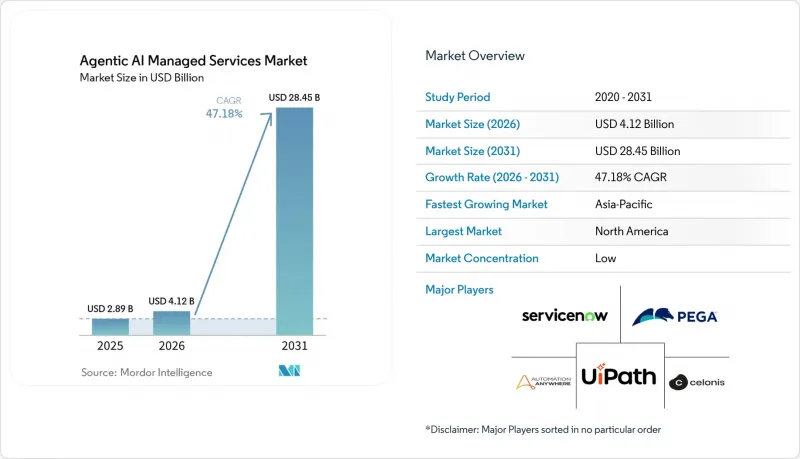
에 따르면 에이전틱 AI 매니지드 서비스 시장 규모는 2025년 28억 9,000만 달러에서 2026년에는 41억 2,000만 달러로 확대되어, 2031년까지 284억 5,000만 달러에 달할 것으로 예측되며, 2026년부터 2031년까지 연평균 성장률(CAGR)은 47.18%가 될 전망입니다.
전 세계 에이전틱 AI 매니지드 서비스 시장의 동향 및 인사이트
자율적인 엔드투엔드 워크플로우 실행에 대한 기업의 수요
단순한 업무 수준 지원에 대한 수요보다, 전체 프로세스의 자동화에 대한 수요가 에이전틱 AI 관리형 서비스 시장을 더욱 강력하게 견인하고 있습니다. 기업들은 개별 어시스턴트에서 재무, 운영, 고객 서비스, 기술 등 각 기능 전반에 걸쳐 연계된 작업을 수행할 수 있는 에이전트로 초점을 옮겨가고 있습니다. 이러한 전환에 따라, 에이전트를 전사적 자원 관리(ERP), 고객관계관리(CRM), IT 서비스 관리 시스템과 통합할 수 있는 제공업체에 대한 수요가 증가하고 있습니다. 레거시 시스템과의 통합 작업, 변동하는 AI 운영 비용, 디지털 노동의 경제성 등의 요인으로 인해 이러한 프로그램을 사내의 소규모 팀만으로 운영하기는 어렵습니다. 그 결과, 도입 및 통합에 관한 계약은 일회성 도입 작업이 아닌 지속적인 운영 계약으로 전환되고 있습니다. 또한, 사용량이나 성과에 기반한 가격 책정을 통해 공급업체의 업무는 고객이 자동화된 워크플로우에서 기대하는 가치와 부합하도록 되어 있습니다.
프로덕션 환경에서 에이전트 모니터링 및 가시성에 대한 요구
에이전틱 AI 관리형 서비스 시장은 신뢰할 수 있는 프로덕션 환경 모니터링에 의존하고 있습니다. 자율형 시스템은 기존 애플리케이션 도구로는 감지할 수 없는 방식으로 장애를 일으킬 가능성이 있기 때문입니다. 프로덕션 환경의 에이전트는 부적절한 프롬프트 경로를 따르거나, 도구를 잘못 사용하거나, 예상치 못한 속도로 토큰을 소모할 수 있지만, 이러한 현상은 기존의 시스템 오류로는 감지되지 않을 수 있습니다. Arize AI는 2025년 2월, 엔터프라이즈 환경 내 대규모 언어 모델 및 AI 에이전트를 위한 평가·가시성 도구를 확충하기 위해 7,000만 달러를 조달했습니다. 각 모니터링 제공업체는 추적, 평가, 예산 관리, 회귀 테스트, 에스컬레이션 규칙을 통해 이 과제에 대응하고 있습니다. 매니지드 서비스 제공업체는 이러한 활동을 수동 검토 절차와 결합함으로써 고객을 위한 보다 종합적인 운영 모델을 지원할 수 있습니다. 기업이 에이전트가 비정상적인 상황이나 고위험 상황에 어떻게 대응하는지 테스트함에 따라, 프로덕션 환경 도입 전 평가 단계의 중요성이 높아지고 있습니다.
자율적 의사결정에서 책임 소재의 불명확성
금융, 운영 및 고객 대응 프로세스에서의 자율적 의사결정은 설명 책임에 대한 의문을 불러일으키며, 에이전틱 AI 매니지드 서비스 시장의 성장을 둔화시킬 가능성이 있습니다. 제공업체는 에이전트가 어떻게 특정 행동에 이르렀는지, 어떤 데이터와 도구를 사용했는지, 그리고 인간이 언제 개입할 수 있었는지를 보여줄 수 있어야 합니다. 2026년 8월 2일 제50조의 투명성 의무가 시행됨에 따라, 유럽 내 관련 도입 사례에서 에이전트의 이력을 문서화해야 할 필요성이 커지고 있습니다. 이 문제는 여러 에이전트가 연계되는 시스템의 경우, 일련의 관련 조치 전반에 걸쳐 책임을 추적해야 하기 때문에 더욱 복잡해집니다. BFSI(은행·금융·보험) 및 의료 분야의 고객은 공급업체가 신뢰할 수 있는 의사결정 과정을 제시하지 못할 경우, 도입을 승인할 가능성이 낮아집니다. 따라서 감사 기록, 인간에 의한 에스컬레이션 절차, 그리고 공급업체와 고객 팀 간의 명확한 책임 분담이 매우 중요합니다.
부문 분석
2025년, 에이전트 배포 및 통합 서비스는 에이전틱 AI 관리 서비스 시장 점유율의 38.72%를 차지했습니다. 이러한 상황은 에이전트를 기존의 기업 자원 계획(ERP), 고객관계관리(CRM) 및 IT 서비스 관리(ITSM) 플랫폼과 연동하는 것을 최우선 과제로 삼고 있음을 반영합니다. 고객은 기존 업무를 중단하지 않고 에이전트를 설계 단계에서 실제 운영 프로세스로 전환하기 위한 지원을 필요로 하는 경우가 많습니다. 모니터링 및 가시성 서비스는 초기 도입 단계를 완료하고 보다 안정적인 일상 업무가 필요한 조직에 도움이 됩니다. 버전 관리 및 라이프사이클 관리 서비스는 프롬프트, 모델, 도구, 에이전트 설정에 걸친 변경 사항을 관리해야 할 필요성을 충족시킵니다. 비용 최적화 및 서비스 수준 계약(SLA) 관리를 포함한 기타 서비스는 토큰 사용 현황 및 성능 보장에 대한 우려를 해소합니다.
에이전트 거버넌스 및 규정 준수 서비스는 2031년까지 연평균 성장률(CAGR) 48.16%로 확대될 것으로 예측됩니다. 이러한 높은 성장률은 자율적인 행동이 규제 대상 프로세스나 고객 대응 프로세스에 영향을 미치기 전에 적절한 관리 조치를 취해야 할 필요성을 반영합니다. 도입 주기의 후반부에 관리에 실패할 경우 막대한 비용이 드는 롤백이 필요할 수 있으므로, 거버넌스 노력은 도입 주기의 초기 단계부터 검토되고 있습니다. 또한, 고객이 비정상적인 상황에서도 에이전트가 적절하게 작동한다는 증거를 필요로 하는 경우, 실제 운영 전 테스트의 중요성도 높아지고 있습니다. 구축 계약에 거버넌스 및 규정 준수 기능을 포함시킨 공급업체는 전체 워크플로가 출시되기 전에 이러한 우려 사항을 해결할 수 있습니다. 에이전틱 AI 관리형 서비스 업계에서 이러한 접근 방식은 구축 후 고객이 중대한 관리상의 결함을 발견할 위험을 줄임으로써 업무 연속성을 향상시킬 수 있습니다.
2025년 기준, 에이전틱 AI 관리형 서비스 시장 규모의 66.38%를 클라우드 배포가 차지하고 있으며, 2031년까지 연평균 성장률(CAGR) 47.58%로 확대될 것으로 예측됩니다. 이러한 위상은 탄력적인 인프라, 통합된 모니터링 도구, 관리형 ID 제어, 그리고 구현 주기 단축에 의해 뒷받침되고 있습니다. AWS Bedrock AgentCore, Google Cloud Vertex AI Agent Engine, 그리고 Microsoft Foundry Agent Service는 공급자가 서비스를 설계하고 운영하는 방식에 영향을 미치는 관리형 환경을 제공합니다. 클라우드 플랫폼을 통해 제공업체는 고객마다 동일한 기반 인프라를 구축하지 않고도 재현 가능한 프로세스를 제공할 수 있습니다. 비즈니스 애플리케이션의 클라우드 환경으로의 지속적인 전환이 이 모델을 뒷받침하고 있습니다. 또한, 동등한 기능을 갖춘 온프레미스형 대안이 제한적이라는 점도 클라우드 채택을 촉진하고 있습니다.
데이터 주권, 에어갭 방식의 보안, 혹은 엄격한 지연 시간 요구 사항으로 인해 클라우드 이용이 제한되는 경우, 온프레미스 환경은 여전히 중요한 역할을 수행하고 있습니다. 금융 시장 인프라 운영 사업자, 방위 관련 기업 및 국가 정부 기관은 이러한 도입에 있어 중요한 수요층입니다. 이러한 조직들은 하이퍼스케일 인프라 없이는 프로덕션 수준의 에이전트 환경을 유지하는 것이 운영상 복잡하기 때문에 프리미엄 서비스 계약을 요구할 수 있습니다. Agent2Agent나 Model Context Protocol과 같은 상호운용성 표준은 이러한 고객에게 서비스를 제공하는 공급자에게 유용한 기술적 기반이 되고 있습니다. 서비스 제공업체는 고객의 보안 체계를 훼손하지 않으면서 모델, 도구, 데이터 소스 간의 연결을 관리해야 합니다. 이를 통해 클라우드 기반 제공이 주요 도입 모델로 남아 있는 상황에서도 온프레미스 서비스의 중요한 역할이 유지됩니다.
지역별 분석
2025년, 북미는 에이전틱 AI 관리형 서비스 시장의 38.73%를 차지했습니다. 이 지역은 고밀도의 하이퍼스케일러 인프라와 프로덕션 환경에서 에이전트를 운영 중인 다수의 BFSI(은행·금융·보험) 기관을 모두 갖추고 있습니다. 또한 가시성, 거버넌스, 엔터프라이즈 자동화 분야의 공급업체도 폭넓게 존재합니다. 시티(Citi)의 ‘Arc’ 플랫폼, HSBC와 Google Cloud의 은행 업무 분야 제휴, 그리고 Broadridge의 프로덕션 환경에서의 활동은 이 지역 금융 서비스 시장의 활기를 여실히 보여줍니다. Arize AI, Patronus AI, Automation Anywhere는 이러한 수요를 뒷받침하는 벤더 기반의 일부를 구성하고 있습니다. 따라서 에이전틱 AI 관리형 서비스 시장은 확립된 기술 생태계와 복잡한 도입에 자금을 투자할 수 있는 고객 기반의 혜택을 누리고 있습니다.
아시아태평양은 2031년까지 연평균 성장률(CAGR) 48.19%로 확대될 것으로 예측됩니다. 인도의 기술 서비스 역량, 싱가포르의 핀테크 분야에서의 역할, 그리고 일본, 한국, 싱가포르에서의 엔터프라이즈 AI의 급속한 도입이 이 지역의 전망을 뒷받침하고 있습니다. DBS 그룹은 2026년 7월 싱가포르의 법인 고객 35만 개사를 대상으로 에이전틱 AI 어시스턴트를 도입하고, 2026년 9월까지 홍콩의 사용자 10만 명으로 서비스를 확대할 계획이었습니다. 이러한 확장 규모는 해당 지역의 금융 서비스 기업들이 업무 전반에 걸쳐 AI를 광범위하게 활용하기 시작하고 있음을 보여줍니다. 인도에서 서비스 제공 역량을 갖춘 공급업체는 현지 데이터, 언어, 규제 상황에 맞춰 서비스를 조정하면서 지역 고객을 지원할 수 있습니다. 이러한 요인들이 결합되어 아시아태평양은 에이전틱 AI 관리형 서비스 시장의 주요 성장 영역으로 부상하고 있습니다.
유럽은 두 번째로 큰 지역 시장이며, 영국, 독일, 프랑스가 고부가가치 기업 고객을 차지하고 있습니다. 독일에서 보안에 중점을 둔 관리형 서비스의 도입은, 특히 도입에 공식적인 통제 구조가 요구되는 경우, 거버넌스 기능을 갖춘 AI 서비스에 대한 수요를 뒷받침하고 있습니다. EU AI법은 고객이 자율형 에이전트에 대해 투명성이 높은 운영 절차와 문서를 요구하는 또 다른 이유가 되고 있습니다. 2026년 3월, 산탄데르 은행과 마스터카드는 규제된 은행 업무 프레임워크 내에서 AI 에이전트가 실행한 유럽 최초의 실제 운영 엔드투엔드 결제를 완료했습니다. 중동에서는 아랍에미리트와 사우디아라비아의 정부 및 금융 서비스 프로그램을 통해 시장이 부상하고 있습니다. 아프리카는 여전히 초기 단계에 있지만, 남아프리카공화국과 나이지리아가 핀테크 및 IT·통신 분야의 활용 사례에서 초기 거점으로 자리 잡고 있습니다. 한편, 남미에서는 국제 고객에게 서비스를 제공하는 핀테크 및 IT 아웃소싱 채널을 통해 시장이 탄력을 받고 있습니다.
기타 혜택:
- 엑셀 형식의 시장 예측(ME) 시트
- 3개월간의 애널리스트 지원
목차
제1장 소개
- 조사 가정과 시장 정의
- 조사 범위
제2장 조사 방법
제3장 주요 요약
제4장 시장 구도
- 시장 개요
- 시장 성장 촉진요인
- 시장 성장 억제요인
- 거시경제 요인이 시장에 미치는 영향
- 업계 밸류체인 분석
- 규제 상황
- 기술 전망
- Porter's Five Forces 분석
제5장 시장 규모와 성장 예측
- 서비스 유형별
- 전개 모델별
- 조직 규모별
- 최종 이용 산업별
- 지역별
- 북미
- 미국
- 캐나다
- 멕시코
- 남미
- 브라질
- 아르헨티나
- 기타 남미 국가
- 유럽
- 영국
- 독일
- 프랑스
- 이탈리아
- 스페인
- 러시아
- 기타 유럽 국가
- 아시아태평양
- 중국
- 인도
- 일본
- 한국
- 싱가포르
- 호주
- 기타 아시아태평양 국가
- 중동
- 아랍에미리트
- 사우디아라비아
- 튀르키예
- 기타 중동 국가
- 아프리카
- 남아프리카공화국
- 나이지리아
- 이집트
- 기타 아프리카 국가
- 북미
제6장 경쟁 구도
- 시장 집중도
- 전략적 동향
- 시장 점유율 분석
- 기업 개요
- UiPath, Inc.
- Automation Anywhere, Inc.
- Pegasystems Inc.
- Appian Corporation
- Celonis SE
- ServiceNow, Inc.
- SS&C Technologies Holdings, Inc.
- Amelia US LLC
- Aisera, Inc.
- Moveworks, Inc.
- Kore.ai, Inc.
- Cognigy GmbH
- Yellow.ai, Inc.
- Haptik Infotech Private Limited
- Relevance AI Pty Ltd
- Lyzr AI Private Limited
- LangChain, Inc.
- Arize, Inc.
- WhyLabs, Inc.
- Humanloop, Inc.
- Patronus AI, Inc.
- Braintrust Data, Inc.
- Galileo Technologies, Inc.
- Dust, Inc.
- Glean Technologies, Inc.
제7장 시장 기회와 향후 전망
KSMAccording to Mordor Intelligence, the agentic AI managed services market size is projected to expand from USD 2.89 billion in 2025 to USD 4.12 billion in 2026, and to USD 28.45 billion by 2031, registering a CAGR of 47.18% between 2026 and 2031.
Global Agentic AI Managed Services Market Trends and Insights
Enterprise Demand for Autonomous End-to-End Workflow Execution
Demand for full-process automation is driving the agentic AI managed services market more strongly than demand for task-level support. Organizations are shifting their focus from isolated assistants to agents capable of completing connected actions across finance, operations, customer service, and technology functions. This transition creates a need for providers that can integrate agents with enterprise resource planning, customer relationship management, and IT service management systems. Legacy integration work, variable AI operating costs, and digital labor economics make these programs difficult to run with a small internal team. Deployment and integration contracts are consequently shifting toward continuing operations arrangements rather than one-time implementation work. Consumption and outcome-based pricing also align the provider's work with the value that a customer expects from an automated workflow.
Production Need for Agent Monitoring and Observability
The agentic AI managed services market depends on reliable production monitoring because autonomous systems can fail in ways that traditional application tools may not detect. A production agent can follow an unsuitable prompt path, use a tool incorrectly, or consume tokens at an unexpected rate without creating a conventional system error. Arize AI raised USD 70 million in February 2025 to expand evaluation and observability tools for large language models and AI agents in enterprise environments. Monitoring providers are addressing this gap through tracing, evaluation, budget controls, regression checks, and escalation rules. Managed service providers can package those activities with human review procedures, which support a more complete operating model for customers. The evaluation layer is becoming important before production as enterprises test how agents respond to unusual or high-risk conditions.
Unclear Accountability for Autonomous Decisions
Autonomous decisions in financial, operational, and customer-facing processes create accountability questions that can slow the agentic AI managed services market. A provider must be able to show how an agent reached an action, what data and tools it used, and when a human could intervene. Article 50 transparency obligations took effect on August 2, 2026, increasing the need for documented agent provenance in relevant European deployments. The issue is more difficult for multi-agent systems because responsibility must be traced across several connected actions. Customers in BFSI and healthcare are less likely to approve deployments if a vendor cannot provide a reliable decision trail. This places a premium on audit records, human escalation procedures, and clear responsibility across the provider and customer teams.
Other drivers and restraints analyzed in the detailed report include:
- Expansion of Multi-Agent Orchestration Across Enterprise Systems
- Cloud-Native AI Infrastructure and Managed Runtime Adoption
- Data Privacy, Security, and Regulatory Exposure
For complete list of drivers and restraints, kindly check the Table Of Contents.
Segment Analysis
Agent Deployment and Integration Services held 38.72% of the agentic AI managed services market share in 2025. This position reflects the immediate priority of connecting agents with established enterprise resource planning, customer relationship management, and IT service management platforms. Customers often need support to move an agent from design into a live process without interrupting existing operations. Monitoring and observability services serve organizations that have passed initial implementation and now need more stable daily operations. Versioning and lifecycle management services address the need to control changes across prompts, models, tools, and agent configurations. Other services, including cost optimization and service-level agreement management, address concerns about token usage and performance commitments.
Agent Governance and Compliance Services is projected to expand at a 48.16% CAGR through 2031. The higher rate reflects the need to place controls around autonomous actions before they affect regulated or customer-facing processes. Governance work is increasingly considered earlier in a deployment cycle because a later control failure can require a costly rollback. Pre-production testing is also becoming more important when a customer needs evidence that an agent behaves properly under unusual conditions. Providers that include governance and compliance capabilities in a deployment agreement can address these concerns before a full workflow is released. Within the agentic AI managed services industry, this approach can improve continuity by reducing the risk that customers discover material control gaps after deployment.
Cloud deployment accounted for 66.38% of the agentic AI managed services market size in 2025 and is projected to expand at a 47.58% CAGR through 2031. Its position is supported by elastic infrastructure, integrated monitoring tools, managed identity controls, and shorter implementation cycles. AWS Bedrock AgentCore, Google Cloud Vertex AI Agent Engine, and Microsoft Foundry Agent Service provide managed environments that influence how providers design and operate services. Cloud platforms enable a provider to offer repeatable processes without having to build the same foundational infrastructure for each client. Ongoing migration of business applications to cloud environments supports this model. The limited availability of on-premises alternatives with comparable capabilities also favors cloud adoption.
On-premises environments remain relevant where data sovereignty, air-gapped security, or strict latency needs limit cloud use. Financial market infrastructure operators, defense contractors, and national government agencies are important demand groups for these deployments. These organizations can require premium service arrangements because maintaining a production-grade agent environment without hyperscale infrastructure is operationally complex. Interoperability standards such as Agent2Agent and Model Context Protocol are becoming a useful technical baseline for providers serving these customers. A provider must manage connections among models, tools, and data sources without weakening the customer's security posture. This preserves a focused role for on-premises services even as cloud-based delivery remains the main deployment model.
Complete Report Scope:
- By Service Type
- Agent Deployment and Integration Services
- Agent Monitoring and Tracking Services
- Agent Versioning and Lifecycle Management Services
- Agent Governance and Compliance Services
- Other Service Types
- By Deployment Model
- Cloud
- On-Premises
- By Organization Size
- Large Enterprises
- Small and Medium Enterprises
- By End-User Industry
- Banking, Financial Services, and Insurance
- Information Technology and Telecommunications
- Healthcare and Life Sciences
- Retail and E-Commerce
- Manufacturing
- Government and Public Sector
- Professional Services
- Energy and Utilities
- Transportation and Logistics
- Media and Entertainment
- Other End-User Industries
- By Geography
- North America
- United States
- Canada
- Mexico
- South America
- Brazil
- Argentina
- Rest of South America
- Europe
- United Kingdom
- Germany
- France
- Italy
- Spain
- Russia
- Rest of Europe
- Asia-Pacific
- China
- India
- Japan
- South Korea
- Singapore
- Australia
- Rest of Asia-Pacific
- Middle East
- United Arab Emirates
- Saudi Arabia
- Turkey
- Rest of Middle East
- Africa
- South Africa
- Nigeria
- Egypt
- Rest of Africa
- North America
Geography Analysis
North America held 38.73% of the agentic AI managed services market in 2025. The region combines dense hyperscaler infrastructure with numerous BFSI organizations running agents in production. It also has a wide base of observability, governance, and enterprise automation suppliers. Citi's Arc platform, HSBC's Google Cloud banking collaboration, and Broadridge's production work illustrate the level of financial services activity in the region. Arize AI, Patronus AI, and Automation Anywhere represent part of the supplier base supporting this demand. The agentic AI managed services market, therefore, benefits from an established technology ecosystem and a customer base capable of funding complex deployments.
Asia-Pacific is projected to expand at a 48.19% CAGR through 2031. India's technology services capacity, Singapore's role in financial technology, and faster enterprise AI adoption in Japan, South Korea, and Singapore support the regional outlook. DBS Group introduced an agentic AI assistant for 350,000 corporate clients in Singapore in July 2026 and planned to extend it to 100,000 additional users in Hong Kong by September 2026. The scale of this rollout indicates that financial services organizations in the region are moving toward broad operational use. Providers with delivery capabilities in India can support regional customers while adapting services to local data, language, and regulatory conditions. This combination makes Asia-Pacific a central expansion area for the agentic AI managed services market.
Europe is the second-largest regional market, with the United Kingdom, Germany, and France representing high-value enterprise buyers. Germany's security-oriented adoption of managed services supports demand for governance-enabled AI services, particularly where deployment requires formal control structures. The EU AI Act provides an additional reason for customers to seek transparent operating procedures and documentation for autonomous agents. Santander and Mastercard completed Europe's first live end-to-end payment executed by an AI agent in a regulated banking framework in March 2026. The Middle East is emerging through government and financial services programs in the United Arab Emirates and Saudi Arabia. Africa remains early-stage, with South Africa and Nigeria serving as early centers for financial technology and telecommunications use cases, while South America is gaining traction through financial technology and IT outsourcing channels that serve international clients.
- UiPath, Inc.
- Automation Anywhere, Inc.
- Pegasystems Inc.
- Appian Corporation
- Celonis SE
- ServiceNow, Inc.
- SS&C Technologies Holdings, Inc.
- Amelia US LLC
- Aisera, Inc.
- Moveworks, Inc.
- Kore.ai, Inc.
- Cognigy GmbH
- Yellow.ai, Inc.
- Haptik Infotech Private Limited
- Relevance AI Pty Ltd
- Lyzr AI Private Limited
- LangChain, Inc.
- Arize, Inc.
- WhyLabs, Inc.
- Humanloop, Inc.
- Patronus AI, Inc.
- Braintrust Data, Inc.
- Galileo Technologies, Inc.
- Dust, Inc.
- Glean Technologies, Inc.
Additional Benefits:
- The market estimate (ME) sheet in Excel format
- 3 months of analyst support
TABLE OF CONTENTS
1 INTRODUCTION
- 1.1 Study Assumptions and Market Definition
- 1.2 Scope of the Study
2 RESEARCH METHODOLOGY
3 EXECUTIVE SUMMARY
4 MARKET LANDSCAPE
- 4.1 Market Overview
- 4.2 Market Drivers
- 4.2.1 Enterprise Demand for Autonomous End-to-End Workflow Execution
- 4.2.2 Production Need for Agent Monitoring and Observability
- 4.2.3 Expansion of Multi-Agent Orchestration Across Enterprise Systems
- 4.2.4 Cloud-Native AI Infrastructure and Managed Runtime Adoption
- 4.2.5 Agentic Managed Services for Legacy-System Modernization
- 4.2.6 Shortage of Internal AgentOps Engineering and Governance Talent
- 4.3 Market Restraints
- 4.3.1 Unclear Accountability for Autonomous Decisions
- 4.3.2 Data Privacy, Security, and Regulatory Exposure
- 4.3.3 Unstable Agent Behavior Across Model and Tool Updates
- 4.3.4 Agentic Workload Cost Leakage and Unpredictable Usage
- 4.4 Impact of Macroeconomic Factors on the Market
- 4.5 Industry Value Chain Analysis
- 4.6 Regulatory Landscape
- 4.7 Technological Outlook
- 4.8 Porter's Five Forces Analysis
- 4.8.1 Bargaining Power of Buyers
- 4.8.2 Bargaining Power of Suppliers
- 4.8.3 Threat of New Entrants
- 4.8.4 Threat of Substitutes
- 4.8.5 Intensity of Competitive Rivalry
5 MARKET SIZE AND GROWTH FORECASTS (VALUE)
- 5.1 By Service Type
- 5.1.1 Agent Deployment and Integration Services
- 5.1.2 Agent Monitoring and Tracking Services
- 5.1.3 Agent Versioning and Lifecycle Management Services
- 5.1.4 Agent Governance and Compliance Services
- 5.1.5 Other Service Types
- 5.2 By Deployment Model
- 5.2.1 Cloud
- 5.2.2 On-Premises
- 5.3 By Organization Size
- 5.3.1 Large Enterprises
- 5.3.2 Small and Medium Enterprises
- 5.4 By End-User Industry
- 5.4.1 Banking, Financial Services, and Insurance
- 5.4.2 Information Technology and Telecommunications
- 5.4.3 Healthcare and Life Sciences
- 5.4.4 Retail and E-Commerce
- 5.4.5 Manufacturing
- 5.4.6 Government and Public Sector
- 5.4.7 Professional Services
- 5.4.8 Energy and Utilities
- 5.4.9 Transportation and Logistics
- 5.4.10 Media and Entertainment
- 5.4.11 Other End-User Industries
- 5.5 By Geography
- 5.5.1 North America
- 5.5.1.1 United States
- 5.5.1.2 Canada
- 5.5.1.3 Mexico
- 5.5.2 South America
- 5.5.2.1 Brazil
- 5.5.2.2 Argentina
- 5.5.2.3 Rest of South America
- 5.5.3 Europe
- 5.5.3.1 United Kingdom
- 5.5.3.2 Germany
- 5.5.3.3 France
- 5.5.3.4 Italy
- 5.5.3.5 Spain
- 5.5.3.6 Russia
- 5.5.3.7 Rest of Europe
- 5.5.4 Asia-Pacific
- 5.5.4.1 China
- 5.5.4.2 India
- 5.5.4.3 Japan
- 5.5.4.4 South Korea
- 5.5.4.5 Singapore
- 5.5.4.6 Australia
- 5.5.4.7 Rest of Asia-Pacific
- 5.5.5 Middle East
- 5.5.5.1 United Arab Emirates
- 5.5.5.2 Saudi Arabia
- 5.5.5.3 Turkey
- 5.5.5.4 Rest of Middle East
- 5.5.6 Africa
- 5.5.6.1 South Africa
- 5.5.6.2 Nigeria
- 5.5.6.3 Egypt
- 5.5.6.4 Rest of Africa
- 5.5.1 North America
6 COMPETITIVE LANDSCAPE
- 6.1 Market Concentration
- 6.2 Strategic Moves
- 6.3 Market Share Analysis
- 6.4 Company Profiles (includes Global Level Overview, Market Level Overview, Core Segments, Financials as available, Strategic Information, Market Rank/Share, Products and Services, Recent Developments)
- 6.4.1 UiPath, Inc.
- 6.4.2 Automation Anywhere, Inc.
- 6.4.3 Pegasystems Inc.
- 6.4.4 Appian Corporation
- 6.4.5 Celonis SE
- 6.4.6 ServiceNow, Inc.
- 6.4.7 SS&C Technologies Holdings, Inc.
- 6.4.8 Amelia US LLC
- 6.4.9 Aisera, Inc.
- 6.4.10 Moveworks, Inc.
- 6.4.11 Kore.ai, Inc.
- 6.4.12 Cognigy GmbH
- 6.4.13 Yellow.ai, Inc.
- 6.4.14 Haptik Infotech Private Limited
- 6.4.15 Relevance AI Pty Ltd
- 6.4.16 Lyzr AI Private Limited
- 6.4.17 LangChain, Inc.
- 6.4.18 Arize, Inc.
- 6.4.19 WhyLabs, Inc.
- 6.4.20 Humanloop, Inc.
- 6.4.21 Patronus AI, Inc.
- 6.4.22 Braintrust Data, Inc.
- 6.4.23 Galileo Technologies, Inc.
- 6.4.24 Dust, Inc.
- 6.4.25 Glean Technologies, Inc.
7 MARKET OPPORTUNITIES AND FUTURE OUTLOOK
- 7.1 White-Space and Unmet-Need Assessment


