

|
시장보고서
상품코드
2156979
인증 오케스트레이션 : 시장 점유율 분석, 업계 동향과 통계, 성장 예측(2026-2031년)Authentication Orchestration - Market Share Analysis, Industry Trends & Statistics, Growth Forecasts (2026 - 2031) |
||||||
 Mordor Intelligence
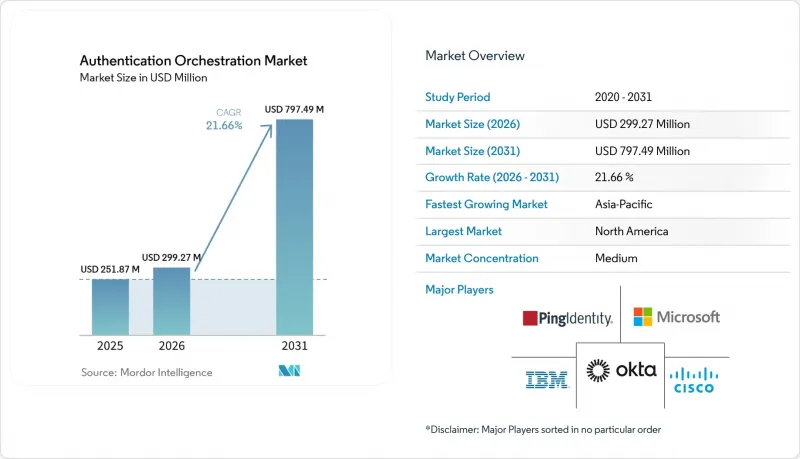
에 따르면 인증 오케스트레이션 시장 규모는 2025년에 2억 5,187만 달러로, 2026년 2억 9,927만 달러에서 2031년까지 7억 9,749만 달러에 달할 것으로 예측되고 있으며, 2026-2031년 예측 기간의 CAGR은 21.66%에 달할 전망입니다.
글로벌 인증 오케스트레이션 시장의 동향 및 인사이트
ID 중심의 제로 트러스트 도입이 기업의 인증 관련 지출을 견인
제로 트러스트 프로그램은 많은 조직, 특히 규제 대상 데이터를 취급하거나 복잡한 직원 액세스 관리를 수행하는 조직에서 단순한 보안 계획에서 적극적인 구매 요건으로 전환되고 있습니다. 지속적인 검증에는 세션, 디바이스, 애플리케이션 및 액세스 요청에 걸친 점검이 필요합니다. 단일 인증 엔진으로는 여러 ID 제공업체나 위험 신호를 확실하게 관리할 수 없다는 사실이 인증 오케스트레이션 시장에 호재로 작용하고 있습니다. 초기 단계의 프로그램에서는 각 애플리케이션마다 서로 다른 제어를 유지하는 대신, 오케스트레이션 소프트웨어를 사용하여 별도의 환경 전반에 걸쳐 다단계 인증을 일관되게 적용하고 있습니다. 보다 성숙한 프로그램에서는 그 기반에 지속적인 세션 점검 및 행동 점수 산정을 추가하고 있으며, 이를 통해 초기 도입 후 정책의 적용 범위가 확대됩니다. 미국 국가안보국(NSA)은 2026년 1월 ‘국가안보 시스템을 위한 제로 트러스트 구현 지침’을 발간하여, 정부 공급망 전반에 걸쳐 표준 기반의 조달을 지원하고 있습니다.
피싱에 강한 인증 요건이 조달 주기를 단축
규제 요건으로 인해 피싱에 강한 인증은 중대한 디지털 접근 위험을 안고 있는 조직에게 더욱 시급한 조달 과제가 되고 있습니다. NIS2 제21조는 중요 사업체에 대해 다중 요소 인증 또는 지속적인 인증을 의무화하고 있습니다. 인증 오케스트레이션 시장은 조직이 단일 액세스 프로세스 내에서 FIDO2, 패스키 및 기존 인증 방법을 활용할 수 있도록 함으로써 규정 준수를 지원할 수 있습니다. NIST는 2025년 7월 SP 800-63-4를 최종 확정하고, 동기화 가능한 패스키를 ‘인증기 보증 수준 2’로 인정했습니다. 2026년에는 영국의 국가 사이버 보안 센터(NCSC)가 서비스가 패스키를 지원하는 경우 항상 그 사용을 권장한다고 발표했습니다. 이러한 기한 설정을 통해 여러 의무가 중복되는 규제 대상 금융 서비스 조직에서 기술 평가부터 구매까지의 기간을 단축할 수 있게 됩니다.
레거시 애플리케이션 및 프로토콜 통합 비용이 도입을 지연시키고 있습니다.
레거시 시스템의 통합은 인증 프로세스를 교체하려는 조직, 특히 고도로 맞춤화된 내부 애플리케이션 간에 여전히 중대한 장벽으로 남아 있습니다. RACF, LDAP 또는 SOAP를 기반으로 구축된 애플리케이션의 경우, 새로운 정책을 프로덕션 환경에서 운영하기 전에 대개 시스템 조사 작업이 필요합니다. 또한 세션 기반 인증 모델은 현재의 OAuth 2.0 리프레시 토큰 설계와 충돌할 가능성이 있습니다. 인증 오케스트레이션 시장에서는 고객이 대규모 온프레미스 환경이나 문서화되지 않은 액세스 흐름을 관리하는 경우, 단기적으로는 도입 속도가 둔화될 수 있습니다. 이러한 조직에서는 애플리케이션 전반에 걸쳐 정책 적용 범위가 통일될 때까지 12-36개월 동안 하이브리드 시스템을 운영하게 됩니다. 구형 프로토콜용 사전 인증된 커넥터를 제공하는 벤더는 도입 부담을 줄이고, 장기적인 교체 주기에서 우위를 점할 수 있습니다.
부문 분석
2025년, 소프트웨어는 인증 오케스트레이션 시장 점유율의 67.33%를 차지했습니다. 이러한 선도적 지위는 다양한 채널과 인증 방법에 걸쳐 프로그래밍 가능한 정책 엔진에 대한 수요를 반영합니다. 조직은 이러한 플랫폼을 활용하여 위험 상황, 사용자 행동, 규정 준수 규칙에 따라 적절한 인증 수단을 선택하고 있습니다. 이러한 접근 방식을 통해 개별 토큰이나 생체인식 센서에 집중된 구매에서 벗어날 수 있습니다. 또한 하드웨어 업그레이드나 애플리케이션의 반복적인 재배포도 피할 수 있습니다. 소프트웨어는 ID 제공자나 액세스 채널이 변경되더라도 팀이 일관된 정책 로직을 유지할 수 있도록 지원합니다.
서비스 시장은 2026-2031년까지 연평균 성장률(CAGR) 23.71%로 성장할 것으로 예측됩니다. 도입 대상이 더 많은 ID 제공자, 리스크 엔진, 채널별 인증 흐름을 포괄함에 따라 전문적인 도입 지원, 관리형 서비스 및 전문가 지원의 중요성이 높아지고 있습니다. 구매자는 인증 프로세스 설정, 적응형 위험 임계값 조정, 정책 변경에 대한 명확한 거버넌스 유지에 대한 지원이 필요합니다. 또한 프로토콜 변경이나 애플리케이션에 새로운 통합 요구 사항이 추가됨에 따라 커넥터 업데이트도 필요해집니다. Okta는 2026년 초, Mosaic Platform SDK와 AI 에이전트 및 디지털 자격 증명을 위한 Auth0 플랫폼 기능을 통해 오케스트레이션 기능을 확장했습니다. 이러한 출시 소식은 인증 오케스트레이션 시장에서 소프트웨어 구독뿐만 아니라 도입에 관한 전문 지식이 여전히 중요한 이유를 보여줍니다.
2025년, 인증 오케스트레이션 시장의 59.89%를 클라우드가 차지했습니다. 클라우드 기반 제공 방식은 분산형 애플리케이션 환경 및 Identity-as-a-Service(IaaS) 운영 모델과 부합합니다. 이를 통해 고객은 모든 인프라를 직접 유지 관리할 필요 없이 여러 애플리케이션에 걸친 인증을 지원할 수 있습니다. 온프레미스 배포는 주권 데이터 환경이나 기밀 취급이 필요한 정부 네트워크에서 여전히 중요한 역할을 수행하고 있습니다. 또한 PCI DSS 및 HIPAA 요건에 따라 단일 테넌트(single-tenant) 배포가 필요한 은행에서도 활용되고 있습니다. 그러나 클라우드 관리형 및 자체 호스팅형 운영 모델의 관리가 용이해짐에 따라 온프레미스 배포의 상대적 위상은 점차 낮아지고 있습니다.
하이브리드 배포는 2031년까지 연평균 성장률(CAGR) 23.02%로 성장할 것으로 예측됩니다. 레거시 온프레미스 환경과 클라우드 네이티브 애플리케이션을 병행하는 조직은 반드시 완전히 클라우드 기반 모델을 신속하게 도입할 수 있는 것은 아닙니다. 이러한 조직에는 공통된 정책 규칙에 따라 관리되며, 클라우드 서비스와 내부 애플리케이션 모두에서 수용되는 토큰을 발급하는 ID 계층이 필요합니다. 이를 통해 레거시 환경이 요청할 때마다 클라우드 공급자에 대해 재인증할 필요 없이 현대화를 추진할 수 있습니다. 마이크로소프트는 2026년 3월 Entra 릴리스에서 피싱 방지 기능을 갖춘 다단계 인증 자격 증명을 위해 패스키 프로필과 리눅스 지원을 추가했습니다. 이러한 기능은 하이브리드 환경 및 인증 오케스트레이션 시장에 대한 공급업체의 지속적인 투자를 반영합니다.
지역별 분석
2025년, 북미는 인증 오케스트레이션 시장의 35.16%를 차지했습니다. 이 지역은 풍부한 기업 보안 예산, 적극적인 규제, 그리고 집중된 벤더 기반을 모두 갖추고 있습니다. 미국 연방 정부의 제로 트러스트(Zero Trust) 요건에 따라 각 기관 및 계약업체의 네트워크 전반에 걸쳐 피싱 방지 기능을 갖춘 다중 요소 인증의 도입이 촉진되고 있습니다. NIST SP 800-63-4는 연방 시스템 및 규제 대상 민간 조직을 위한 현행 디지털 ID 프레임워크를 규정하고 있습니다. 마이크로소프트는 테넌트 간 Azure 로그인시 다단계 인증을 의무화하고 있으며, 규정 준수 유예 기간은 2026년 7월까지 연장되었습니다.
유럽은 인증 오케스트레이션 시장에서 두 번째로 큰 지역 시장입니다. NIS2, DORA 및 eIDAS 2.0에 따라 금융 서비스, 의료, 대규모 디지털 플랫폼 전반에 걸쳐 병행되는 규정 준수 요건이 마련되어 있습니다. 유럽연합(EU)의 27개 회원국 모두는 2026년 12월까지 ‘유럽 디지털 ID 지갑(EUDI Wallet)’을 제공해야 합니다. FIDO 얼라이언스는 2025년 9월, EUDI 지갑에 등록된 FIDO 패스키가 eIDAS의 높은 보증 수준에 따른 의존 당사자 인증 요건을 충족할 수 있다고 발표했습니다. 독일, 영국, 프랑스 및 베네룩스 국가들이 해당 지역의 조달을 주도하고 있습니다. 패스키에 관한 NCSC의 권고 사항은 구매자에게 정부 방침에 부합하는 보다 명확한 지침을 제공하고 있습니다. 남미에서는 도입이 아직 초기 단계에 있지만, 브라질과 아르헨티나에서는 주요 금융 기관들의 수요가 나타나고 있습니다.
아시아태평양은 2031년까지 연평균 성장률(CAGR) 22.67%로 성장할 것으로 예측됩니다. 인도의 통합 결제 인터페이스(UPI)는 2025년에 1,020억 건의 인증 요청을 기록하며, 인증 인프라에 규모와 복잡성을 더하고 있습니다. Razorpay는 2026년 3월, 온라인 카드 거래를 위해 마스터카드와 공동으로 인도 중앙은행(RBI)의 규정을 준수하는 생체 인증 패스키 솔루션을 출시했습니다. 후지쯔는 2026년 2월, SMBC 닛코 증권의 온라인 거래를 위해 FIDO2 패스키 서비스를 도입했습니다. 중동 지역에서도 움직임이 활발해지고 있으며, 2026년 7월에는 요르단 중앙은행이 국가적 생체 인증 구상의 일환으로 BIO-key International을 선정했습니다. 이러한 노력에 힘입어 인증 오케스트레이션 시장은 기존의 북미 및 유럽 기반을 넘어 확대되고 있습니다.
기타 혜택:
- 엑셀 형식의 시장 예측(ME) 시트
- 3개월간의 애널리스트 지원
자주 묻는 질문
목차
제1장 서론
- 조사 전제조건과 시장 정의
- 조사 범위
제2장 조사 방법
제3장 개요
제4장 시장 구도
- 시장 개요
- 시장 성장 촉진요인
- 시장 성장 억제요인
- 밸류체인 분석
- 거시경제 요인의 영향
- 규제 상황
- 기술 전망
- 사용 사례
- Porter's Five Forces 분석
제5장 시장 규모와 성장 예측
- 컴포넌트별
- 배포 모드별
- 조직 규모별
- 산업 분야별
- 지역별
- 북미
- 미국
- 캐나다
- 멕시코
- 남미
- 브라질
- 아르헨티나
- 기타 남미 국가
- 유럽
- 독일
- 영국
- 프랑스
- 이탈리아
- 베네룩스
- 기타 유럽 국가
- 아시아태평양
- 중국
- 일본
- 인도
- 한국
- 호주
- 기타 아시아태평양 국가
- 중동 및 아프리카
- 중동
- 아랍에미리트
- 사우디아라비아
- 기타 중동 국가
- 아프리카
- 남아프리카공화국
- 나이지리아
- 이집트
- 기타 아프리카 국가
- 중동
- 북미
제6장 경쟁 구도
- 시장 집중도
- 전략적 동향
- 시장 점유율 분석
- 기업 개요
- Okta, Inc.
- Microsoft Corporation
- Ping Identity Corporation
- IBM Corporation
- Transmit Security, Inc.
- Cisco Systems, Inc.
- Thales
- CyberArk Software Ltd.
- RSA Security LLC
- ForgeRock, Inc.
- Entrust Corporation
- OneSpan Inc.
- HID Global Corporation
- Yubico AB
- SecureAuth Corporation
- OneLogin, Inc.
- Descope, Inc.
- Stytch, Inc.
- Strata Identity, Inc.
- Monokee S.r.l.
- Cross Identity
- Authsignal Limited
- Veriff OU
- BioCatch Ltd.
- IDEMIA Identity and Security France S.A.S.
- NEC Corporation
제7장 시장 기회와 향후 동향
- 화이트 스페이스 및 미충족 요구의 평가
According to Mordor Intelligence, the authentication orchestration market size was USD 251.87 million in 2025 and is estimated to grow from USD 299.27 million in 2026 to reach USD 797.49 million by 2031, at a CAGR of 21.66% during the forecast period 2026-2031.
Global Authentication Orchestration Market Trends and Insights
Identity-Centric Zero-Trust Adoption Anchors Enterprise Authentication Spending
Zero-trust programs are moving from security plans into active purchasing requirements for many organizations, particularly those handling regulated data and complex workforce access. Continuous verification requires checks across sessions, devices, applications, and access requests. The authentication orchestration market benefits from the fact that a single authentication engine cannot reliably manage multiple identity providers and risk signals. Early-stage programs use orchestration software to apply multi-factor authentication consistently across separate environments, instead of maintaining different controls in each application. More mature programs add continuous session checks and behavioral scoring to those foundations, which expands the policy scope after initial deployment. The National Security Agency issued Zero Trust Implementation Guidelines for National Security Systems in January 2026, supporting standards-based procurement across government supply chains.
Phishing-Resistant Authentication Requirements Shorten Procurement Cycles
Regulatory requirements are making phishing-resistant authentication a more immediate purchasing issue for organizations with material digital access risk. NIS2 Article 21 requires multi-factor or continuous authentication for essential entities. The authentication orchestration market can support compliance by enabling organizations to use FIDO2, passkeys, and legacy authentication methods within a single access journey. NIST finalized SP 800-63-4 in July 2025 and recognized syncable passkeys at Authenticator Assurance Level 2. In 2026, the United Kingdom's National Cyber Security Center stated that it recommends using passkeys whenever services support them. These deadlines can reduce the time between technology evaluation and purchasing for regulated financial services organizations with overlapping obligations.
Legacy Application and Protocol Integration Cost Delays Deployment
Legacy integration remains a material barrier for organizations replacing authentication processes, particularly across heavily customized internal applications. Applications built around RACF, LDAP, or SOAP often need discovery work before new policies can go live. Session-based authentication models can also conflict with current OAuth 2.0 refresh-token designs. The authentication orchestration market may face slower near-term adoption where customers manage large on-premises estates and undocumented access flows. These organizations can operate hybrid systems for 12-36 months before policy coverage becomes consistent across their applications. Vendors that offer pre-certified connectors for older protocols can reduce deployment effort and improve their position in long replacement cycles.
Other drivers and restraints analyzed in the detailed report include:
- Account-Takeover and Transaction-Fraud Escalation Forces Authentication Modernization
- Cloud and Hybrid Identity-Stack Complexity Creates Demand for Orchestration Layers
- Privacy and Biometric Data-Governance Constraints Raise Compliance Costs
For complete list of drivers and restraints, kindly check the Table Of Contents.
Segment Analysis
Software held 67.33% of the authentication orchestration market share in 2025. The leading position reflects demand for programmable policy engines across different channels and authentication methods. Organizations use these platforms to select the appropriate authenticator based on the risk context, user behavior, and compliance rules. This approach moves purchasing away from a focus on individual tokens or biometric sensors. It also avoids hardware upgrades and repeated application redeployment. Software can help teams maintain consistent policy logic as identity providers and access channels change.
Services are projected to grow at a 23.71% CAGR from 2026 to 2031. Professional implementation, managed services, and specialist support are becoming important as deployments cover more identity providers, risk engines, and channel-specific authentication journeys. Buyers need help configuring authentication journeys, tuning adaptive risk thresholds, and maintaining clear governance over policy changes. They also need connectors updated as protocols change and as applications add new integration requirements. Okta expanded its orchestration capabilities in early 2026 through its Mosaic Platform SDK and Auth0 platform features for AI agents and digital credentials. These releases show why implementation expertise remains important alongside software subscriptions in the authentication orchestration market.
Cloud accounted for 59.89% of the authentication orchestration market in 2025. Cloud delivery aligns with distributed application estates and identity-as-a-service operating models. It can support authentication across multiple applications without requiring customers to maintain all the infrastructure themselves. On-premises deployment remains relevant in sovereign data environments and classified government networks. It also serves banks that need single-tenant deployments under PCI DSS and HIPAA requirements. Its relative position is narrowing as cloud-managed and self-hosted operating models become easier to manage.
Hybrid deployment is projected to grow at a 23.02% CAGR through 2031. Organizations with legacy on-premises estates and cloud-native applications cannot always quickly adopt a fully cloud-based model. They need an identity layer that issues tokens accepted by both cloud services and internal applications, governed by common policy rules. This supports modernization without requiring the legacy environment to reauthenticate against a cloud provider for every request. Microsoft added passkey profiles and Linux support for phishing-resistant multi-factor authentication credentials in its March 2026 Entra releases. These capabilities reflect ongoing vendor investment in hybrid environments and the authentication orchestration market.
Complete Report Scope:
- By Component
- Software
- Services
- By Deployment Mode
- Cloud
- On-Premises
- Hybrid
- By Organization Size
- Large Enterprises
- Small and Medium-Sized Enterprises
- By Industry Vertical
- Government and Public Administration
- Retail and E-Commerce
- Transportation and Logistics
- Energy and Utilities
- IT and Telecommunication
- Media and Entertainment
- Healthcare and Life Sciences
- Banking, Financial Services, and Insurance (BFSI)
- Other Industry Verticals
- By Geography
- North America
- United States
- Canada
- Mexico
- South America
- Brazil
- Argentina
- Rest of South America
- Europe
- Germany
- United Kingdom
- France
- Italy
- BENELUX
- Rest of Europe
- Asia-Pacific
- China
- Japan
- India
- South Korea
- Australia
- Rest of Asia-Pacific
- Middle East and Africa
- Middle East
- United Arab Emirates
- Saudi Arabia
- Rest of Middle East
- Africa
- South Africa
- Nigeria
- Egypt
- Rest of Africa
- Middle East
- North America
Geography Analysis
North America held 35.16% of the authentication orchestration market share in 2025. The region combines extensive enterprise security budgets, active regulation, and a concentrated vendor base. U.S. federal zero-trust requirements have supported procurement of phishing-resistant multi-factor authentication across agencies and contractor networks. NIST SP 800-63-4 sets a current digital identity framework for federal systems and regulated private organizations. Microsoft required multi-factor authentication for Azure sign-ins across tenants, with extended compliance deadlines continuing through July 2026.
Europe is the second-largest regional market in the authentication orchestration market. NIS2, DORA, and eIDAS 2.0 create parallel compliance requirements across financial services, healthcare, and large digital platforms. All 27 European Union member states must provide a European Digital Identity Wallet by December 2026. The FIDO Alliance stated in September 2025 that a FIDO passkey enrolled in an EUDI Wallet can meet relying-party authentication requirements at high eIDAS assurance levels. Germany, the United Kingdom, France, and the Benelux countries lead regional procurement. The NCSC recommendation for passkeys provides buyers with a clearer, government-aligned reference point. South America remains earlier in adoption, with Brazil and Argentina showing demand from larger financial institutions.
Asia-Pacific is projected to grow at a 22.67% CAGR through 2031. India's Unified Payments Interface logged 102 billion authentication calls in 2025, adding scale and complexity to the authentication infrastructure. Razorpay launched a Reserve Bank of India-compliant biometric passkey solution with Mastercard in March 2026 for online card transactions. Fujitsu deployed its FIDO2 passkey service for SMBC Nikko Securities in February 2026 for online trading. The Middle East is also becoming more active, following the Central Bank of Jordan's selection of BIO-key International for a national biometric authentication initiative in July 2026. These programs extend the authentication orchestration market beyond its established North American and European base.
- Okta, Inc.
- Microsoft Corporation
- Ping Identity Corporation
- IBM Corporation
- Transmit Security, Inc.
- Cisco Systems, Inc.
- Thales
- CyberArk Software Ltd.
- RSA Security LLC
- ForgeRock, Inc.
- Entrust Corporation
- OneSpan Inc.
- HID Global Corporation
- Yubico AB
- SecureAuth Corporation
- OneLogin, Inc.
- Descope, Inc.
- Stytch, Inc.
- Strata Identity, Inc.
- Monokee S.r.l.
- Cross Identity
- Authsignal Limited
- Veriff OU
- BioCatch Ltd.
- IDEMIA Identity and Security France S.A.S.
- NEC Corporation
Additional Benefits:
- The market estimate (ME) sheet in Excel format
- 3 months of analyst support
TABLE OF CONTENTS
1 INTRODUCTION
- 1.1 Study Assumptions and Market Definition
- 1.2 Scope of the Study
2 RESEARCH METHODOLOGY
3 EXECUTIVE SUMMARY
4 MARKET LANDSCAPE
- 4.1 Market Overview
- 4.2 Market Drivers
- 4.2.1 Identity-Centric Zero-Trust Adoption
- 4.2.2 Regulatory Push for Phishing-Resistant Authentication
- 4.2.3 Cloud and Hybrid Identity-Stack Complexity
- 4.2.4 Account-Takeover and Transaction-Fraud Escalation
- 4.2.5 AI-Agent Identity Journeys and Non-Human Access
- 4.2.6 Authentication Policy Portability Across Identity Providers
- 4.3 Market Restraints
- 4.3.1 Legacy Application and Protocol Integration Cost
- 4.3.2 Privacy and Biometric Data-Governance Constraints
- 4.3.3 Passkey Recovery and Credential-Lifecycle Gaps
- 4.3.4 Risk-Model Explainability and False-Positive Exposure
- 4.4 Value Chain Analysis
- 4.5 Impact of Macroeconomic Factors
- 4.6 Regulatory Landscape
- 4.7 Technological Outlook
- 4.8 Use Cases
- 4.8.1 Customer Login and Registration Modernization
- 4.8.2 Passwordless Authentication and Passkey Adoption
- 4.8.3 Workforce Access and Single Sign-On (SSO) Transformation
- 4.8.4 Multi-Factor Authentication (MFA) Orchestration Across Channels
- 4.8.5 Adaptive and Risk-Based Authentication for Fraud Prevention
- 4.9 Porter's Five Forces Analysis
- 4.9.1 Threat of Substitutes
- 4.9.2 Bargaining Power of Buyers
- 4.9.3 Bargaining Power of Suppliers
- 4.9.4 Threat of New Entrants
- 4.9.5 Competitive Rivalry
5 MARKET SIZE AND GROWTH FORECASTS (VALUE)
- 5.1 By Component
- 5.1.1 Software
- 5.1.2 Services
- 5.2 By Deployment Mode
- 5.2.1 Cloud
- 5.2.2 On-Premises
- 5.2.3 Hybrid
- 5.3 By Organization Size
- 5.3.1 Large Enterprises
- 5.3.2 Small and Medium-Sized Enterprises
- 5.4 By Industry Vertical
- 5.4.1 Government and Public Administration
- 5.4.2 Retail and E-Commerce
- 5.4.3 Transportation and Logistics
- 5.4.4 Energy and Utilities
- 5.4.5 IT and Telecommunication
- 5.4.6 Media and Entertainment
- 5.4.7 Healthcare and Life Sciences
- 5.4.8 Banking, Financial Services, and Insurance (BFSI)
- 5.4.9 Other Industry Verticals
- 5.5 By Geography
- 5.5.1 North America
- 5.5.1.1 United States
- 5.5.1.2 Canada
- 5.5.1.3 Mexico
- 5.5.2 South America
- 5.5.2.1 Brazil
- 5.5.2.2 Argentina
- 5.5.2.3 Rest of South America
- 5.5.3 Europe
- 5.5.3.1 Germany
- 5.5.3.2 United Kingdom
- 5.5.3.3 France
- 5.5.3.4 Italy
- 5.5.3.5 BENELUX
- 5.5.3.6 Rest of Europe
- 5.5.4 Asia-Pacific
- 5.5.4.1 China
- 5.5.4.2 Japan
- 5.5.4.3 India
- 5.5.4.4 South Korea
- 5.5.4.5 Australia
- 5.5.4.6 Rest of Asia-Pacific
- 5.5.5 Middle East and Africa
- 5.5.5.1 Middle East
- 5.5.5.1.1 United Arab Emirates
- 5.5.5.1.2 Saudi Arabia
- 5.5.5.1.3 Rest of Middle East
- 5.5.5.2 Africa
- 5.5.5.2.1 South Africa
- 5.5.5.2.2 Nigeria
- 5.5.5.2.3 Egypt
- 5.5.5.2.4 Rest of Africa
- 5.5.5.1 Middle East
- 5.5.1 North America
6 COMPETITIVE LANDSCAPE
- 6.1 Market Concentration
- 6.2 Strategic Moves
- 6.3 Market Share Analysis
- 6.4 Company Profiles (includes Global Level Overview, Market Level Overview, Core Segments, Financials as available, Strategic Information, Market Rank/Share, Products and Services, Recent Developments)
- 6.4.1 Okta, Inc.
- 6.4.2 Microsoft Corporation
- 6.4.3 Ping Identity Corporation
- 6.4.4 IBM Corporation
- 6.4.5 Transmit Security, Inc.
- 6.4.6 Cisco Systems, Inc.
- 6.4.7 Thales
- 6.4.8 CyberArk Software Ltd.
- 6.4.9 RSA Security LLC
- 6.4.10 ForgeRock, Inc.
- 6.4.11 Entrust Corporation
- 6.4.12 OneSpan Inc.
- 6.4.13 HID Global Corporation
- 6.4.14 Yubico AB
- 6.4.15 SecureAuth Corporation
- 6.4.16 OneLogin, Inc.
- 6.4.17 Descope, Inc.
- 6.4.18 Stytch, Inc.
- 6.4.19 Strata Identity, Inc.
- 6.4.20 Monokee S.r.l.
- 6.4.21 Cross Identity
- 6.4.22 Authsignal Limited
- 6.4.23 Veriff OU
- 6.4.24 BioCatch Ltd.
- 6.4.25 IDEMIA Identity and Security France S.A.S.
- 6.4.26 NEC Corporation
7 MARKET OPPORTUNITIES AND FUTURE TRENDS
- 7.1 White-Space and Unmet-Need Assessment


