

|
시장보고서
상품코드
2106281
전신 홍반성 루푸스 시장 : 분자 유형·약제 클래스·투여 경로·치료법, 지역별 동향 및 판매 예측(-2035년)Systemic Lupus Erythematosus Market by Type of Molecule, Drug Class, Route of Administration, Type of Therapy, Geographical Regions and Sales Forecast - Trends and Forecast, Till 2035 |
||||||

전신성 홍반성 루푸스 시장 : 개요
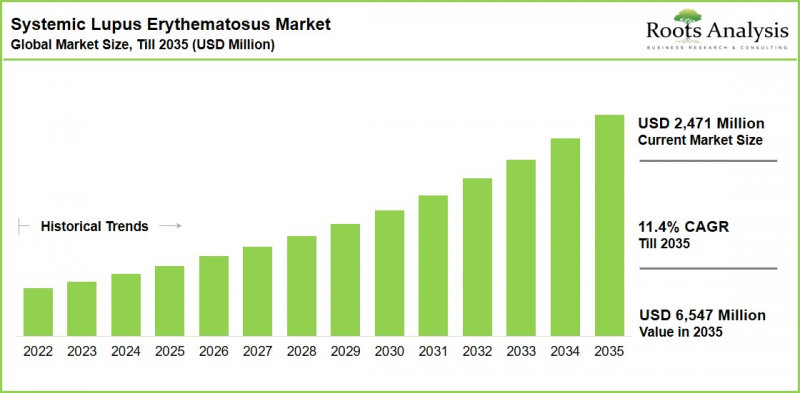
Roots Analysis 조사에 의하면, 전신 홍반성 루푸스 시장 규모는 올해 24억 7,100만 달러에서 2035년에는 65억 4,700만 달러로 성장할 것으로 추정되며, 2035년까지 예측 기간에서 CAGR은 11.4%를 나타낼 전망입니다.
전신성 홍반성 루푸스 시장 : 성장 및 동향
전신성 홍반성 루푸스 및 관련 루푸스 질환은 자가면역 질환 분야에서 미충족 의료 수요가 특히 큰 영역입니다. 루푸스는 다양한 증상과 다기관 침범을 특징으로 하는 만성 염증성 자가면역 질환입니다. 미국 루푸스 재단(Lupus Foundation of America)에 따르면, 미국에서는 약 150만 명, 전 세계적으로는 500만 명 이상이 어떤 형태의 루푸스에 걸려 있습니다. 이 질환은 신생아 루푸스, 디스크형 루푸스, 약물 유발성 루푸스, 전신성 홍반성 루푸스(SLE)라는 4가지 주요 유형으로 분류됩니다.
이 중 전신성 홍반성 루푸스(SLE)는 유병률이 가장 높고 임상적으로도 복잡한 형태이며, 면역 활동 조절 장애를 동반하는 만성 류마티스성 자가면역 질환으로 분류됩니다. 이 질환에서는 면역계가 실수로 건강한 조직이나 장기를 공격하게 됩니다. SLE는 피부, 관절, 신장, 중추신경계, 심혈관계 등 여러 장기계에 영향을 미칠 수 있습니다. SLE의 정확한 병인은 여전히 불분명하지만, 그 발병은 유전적 소인, 환경적 유발 요인, 호르몬의 영향, 그리고 특정 약물에 의한 다인자적 상호작용의 결과로 여겨집니다.
전신성 홍반성 루푸스(SLE)는 모든 연령대에서 발병할 수 있지만, 발병이 가장 많은 연령대는 15세에서 44세 사이입니다. 역학 데이터에 따르면, 성인에서는 남녀 간에 현저한 차이가 나타나며, 여성은 남성에 비해 SLE 발병 위험이 9배에서 13배 더 높은 것으로 알려져 있습니다. 한편, 소아의 발병률 추세를 살펴보면, 남성이 비교적 높은 유병률을 보이며, 여성에 비해 2-3배 더 발병하기 쉬운 것으로 보고되고 있습니다. 현재 추정에 따르면, 전 세계 유병률은 인구 10만 명당 약 43.7건이며, 이는 전 세계적으로 약 360만 명의 환자가 있음을 의미합니다.
SLE의 임상적 이질성과 복잡성은 진단법 및 치료법 개발에 있어 현저한 혁신을 가져왔습니다. 현재까지 SLE 치료제로 규제 당국의 승인을 특이적으로 획득한 약물은 단 3가지뿐이며, GSK의 Benlysta, AstraZeneca의 Saphnelo, RemeGen이 개발한 Ta'ai입니다. 이러한 치료제들은 현재 표준 치료와 병용하여 사용되고 있습니다.
이와 병행하여, SLE의 다양한 임상 증상에 효과적으로 대처하는 것을 목적으로 한 표적형 생물학적 제제 및 새로운 면역 조절 접근법의 개발을 추진하는 바이오의약품 기업과 연구 기관이 증가하고 있습니다. 지속적인 연구 개발 노력, 확대되는 치료 파이프라인, 정밀 진단 기술의 발전에 힘입어 전 세계 SLE 시장은 예측 기간 동안 상당한 성장이 예상됩니다.
전신성 홍반성 루푸스 시장
시장 규모 및 기회 분석은 다음 매개변수를 기준으로 분류됩니다.
분자 유형별
- 생물학적 제제
- 저분자 의약품
약제 분류별
- 단일클론 항체
- 융합 단백질
- 억제제
- 면역 조절제
투여 경로별
- 정맥 내
- 피하
- 경구
치료법별
- 단일 요법
- 병용 요법
지역별
- 북미
- 미국
- 캐나다
- 유럽
- 영국
- 독일
- 프랑스
- 이탈리아
- 스페인
- 기타
- 아시아태평양
- 중국
- 일본
- 한국
- 호주
- 중동·북아프리카
- 사우디아라비아
- 아랍에미리트
- 라틴아메리카
- 브라질
- 아르헨티나
전신성 홍반성 루푸스 시장 : 주요 부문
전신성 홍반성 루푸스 시장의 지역별·부문별 분석
북미는 현재 전 세계 전신성 홍반성 루푸스(SLE) 시장의 80% 이상을 차지하며, 최대 시장 점유율을 확보할 것으로 예측됩니다. 이러한 우위는 주로 SLE 유병률 상승, 표적형 생물학적 제제의 신속한 보급, 확립된 보험 급여 제도에 의해 뒷받침되고 있습니다. 한편, 유럽은 비교적 높은 성장세를 보일 것으로 예측되며, 예측 기간 동안 연평균 성장률(CAGR)은 20.8%를 나타낼 것으로 전망됩니다. 이러한 성장은 향후 예정된 신약 승인 및 치료 접근성 확대를 통해 뒷받침될 것으로 보입니다.
단일클론항체가 최대 점유율을 차지할 전망
약제 분류별로 보면, 단일클론항체가 시장을 독점하며 약 95%의 점유율을 차지할 것으로 예측됩니다. 이러한 시장 우위는 주로 Benlysta나 Saphnelo와 같은 승인된 치료제의 적응증 확대가 지속되고 있으며, 임상 현장에서 널리 채택되고 있기 때문입니다. 이러한 치료제는 질환 활동성 감소, 장기 손상 억제, 코르티코스테로이드 의존도 감소 측면에서 유효성을 보여주고 있습니다. 한편, 억제제 부문은 예측 기간 동안 더 높은 성장률을 보일 것으로 전망됩니다. 그 주된 요인은 Cenerimod, Deucravacitinib, Upadacitinib 등의 경구용 저분자 치료제의 승인이 기대되고 있기 때문입니다.
본 보고서에서는 전 세계 전신성 홍반성 루푸스 시장을 조사했으며,, 시장 개요, 배경, 시장 영향요인 분석, 시장 규모 추이 및 전망, 각종 분류·지역/주요 국가별 상세 분석, 경쟁 현황, 주요 기업 프로파일 등을 정리했습니다.
목차
제1장 배경
제2장 조사 방법
제3장 시장 역학
제4장 거시경제 지표
제5장 주요 요약
제6장 서론
제7장 전신 홍반성 루푸스 치료제 시장 구도
제8장 스타트업 생태계 분석
제9장 기업 개요
제10장 임상시험 분석
제11장 약제 개발 실패 분석
제12장 시장 영향 분석 : 촉진요인, 저해요인, 기회, 과제
제13장 세계의 전신 홍반성 루푸스 시장
제14장 전신 홍반성 루푸스 시장 : 분자 유형별
제15장 전신 홍반성 루푸스 시장 : 약제 클래스별
제16장 전신 홍반성 루푸스 시장 : 투여 경로별
제17장 전신 홍반성 루푸스 시장 : 치료법별
제18장 전신 홍반성 루푸스 시장 : 지역별
제19장 전신 홍반성 루푸스 시장 : 판매 예측
제20장 결론
제21장 표 형식 데이터
제22장 기업 및 조직 리스트
LSH 26.08.19SYSTEMIC LUPUS ERYTHEMATOSUS MARKET: OVERVIEW
As per Roots Analysis, the systemic lupus erythematosus market is estimated to grow from USD 2,471 million in the current year to USD 6,547 million by 2035, at a CAGR of 11.4% during the forecast period, till 2035.
SYSTEMIC LUPUS ERYTHEMATOSUS MARKET: GROWTH AND TRENDS
Systemic lupus and related lupus disorders represent a significant area of unmet medical need within the autoimmune disease landscape. Lupus is a chronic inflammatory autoimmune condition characterized by diverse symptoms and multi-organ system involvement. According to the Lupus Foundation of America, approximately 1.5 million individuals in the United States and over 5 million people globally are affected by some form of lupus. The disease is broadly classified into four primary subtypes namely neonatal lupus, discoid lupus, drug-induced lupus, and systemic lupus erythematosus (SLE).
Among these, systemic lupus erythematosus (SLE) is the most prevalent and clinically complex form, classified as a chronic rheumatic autoimmune disorder involving dysregulated immune activity, wherein the immune system erroneously attacks healthy tissues and organs. SLE can affect multiple organ systems, including the skin, joints, kidneys, central nervous system, and cardiovascular system. While the precise etiology of SLE remains unclear, its development is believed to result from a multifactorial interplay of genetic predisposition, environmental triggers, hormonal influences, and certain pharmacological agents.
While systemic lupus erythematosus (SLE) can occur across all age groups, disease onset most commonly occurs between 15 and 44 years of age. Epidemiological data indicate a strong gender disparity in adults, with women being 9 to 13 times more likely to develop SLE than men. Conversely, pediatric incidence patterns suggest a relatively higher prevalence among males, who are reported to be two to three times more likely to develop the condition compared to females. Current estimates indicate a global prevalence of approximately 43.7 cases per 100,000 individuals, translating to nearly 3.6 million affected patients worldwide.
The clinical heterogeneity and complexity of SLE has driven substantial innovation in both diagnostic and therapeutic development. To date, only three therapies have received regulatory approval specifically for SLE treatment: Benlysta by GSK, Saphnelo by AstraZeneca, and Ta'ai developed by RemeGen. These therapies are currently administered in combination with standard-of-care treatment regimens.
In parallel, a growing number of biopharmaceutical companies and research institutions are advancing targeted biologics and novel immunomodulatory approaches aimed at addressing the diverse clinical manifestations of SLE more effectively. Supported by sustained research and development efforts, an expanding therapeutic pipeline, and advancements in precision diagnostics, the global SLE market is positioned for substantial growth over the forecast period.
Growth Drivers: Strategic Enablers of Market Expansion
The systemic lupus erythematosus (SLE) treatment landscape is undergoing a significant transformation, driven by the growing adoption of targeted biologics and continued innovation in drug development. Limitations associated with conventional therapies, including corticosteroids, antimalarials, and immunosuppressants particularly their long-term safety concerns, have accelerated the shift toward advanced treatment modalities such as monoclonal antibodies, B-cell inhibitors, and cell-based therapies. Notably, biologics such as Benlysta and Saphnelo have collectively generated approximately USD 2.7 billion in sales, reflecting strong market uptake and improved clinical outcomes, including enhanced efficacy and steroid-sparing benefits. In parallel, advancements in drug delivery are enhancing patient convenience and adherence, exemplified by the European Union approval of a subcutaneous, self-administered formulation of Saphnelo in December 2025, which has demonstrated a significant reduction in disease activity among patients receiving standard-of-care therapies.
Furthermore, a robust late-stage pipeline including candidates such as Deucravacitinib by Bristol Myers Squibb, Litifilimab by Biogen, and Upadacitinib by AbbVie is expected to introduce novel mechanisms of action that address existing therapeutic gaps, including high placebo response rates, while offering safer and more targeted alternatives. Complementing these advancements, increasing strategic partnerships and investment activities are playing a pivotal role in accelerating innovation, expanding clinical development programs, and strengthening companies' global market presence. A notable example is Royalty Pharma's USD 250 million R&D investment to support Biogen's monoclonal antibody program for Litifilimab, underscoring the growing emphasis on collaborative funding models to advance the development and commercialization of novel lupus therapies.
Market Challenges: Critical Barriers Impeding Progress
The growth of the systemic lupus erythematosus (SLE) market is constrained by significant challenges in both diagnosis and therapeutic development. The heterogeneous nature of systemic lupus erythematosus (SLE) and the frequent overlap of symptoms with those of other conditions often result in significant diagnostic delays. According to the Lupus Foundation of America, patients experience an average delay of nearly seven years before receiving an accurate diagnosis. This delay frequently results in patients being diagnosed at advanced stages of the disease, leading to irreversible organ damage and a reduced pool of patients eligible for timely intervention. These challenges are further intensified by the high attrition rate in SLE drug development, which remains one of the most difficult therapeutic areas within autoimmune disorders. Several candidates, including Rituximab, Abatacept, and Epratuzumab, demonstrated promising results in early-stage trials but failed to achieve desired outcomes in Phase III studies. These setbacks are primarily driven by the heterogeneous nature of the disease, challenges in establishing clinically meaningful endpoints, and limitations in trial design, all of which constrain investment and impede innovation across the SLE therapeutics landscape.
SYSTEMIC LUPUS ERYTHEMATOSUS MARKET: KEY INSIGHTS
The report delves into the current state of the systemic lupus erythematosus market and identifies potential growth opportunities within industry. Some key findings from the report include:
1. More than 130 therapies are currently approved / being investigated across various stages of development for the treatment of systemic lupus erythematosus; of these, 96% are under different phases of clinical trials.
2. Majority (42%) of the SLE drugs are cell therapies, of these, 83% of the therapies are CAR-Ts that are being investigated as monotherapy / in combination under different stages of clinical development.
3. Over 45% of the systemic lupus erythematosus therapy developers are based in Asia-Pacific and rest of the world, with China and Japan emerging as the key hub for these companies
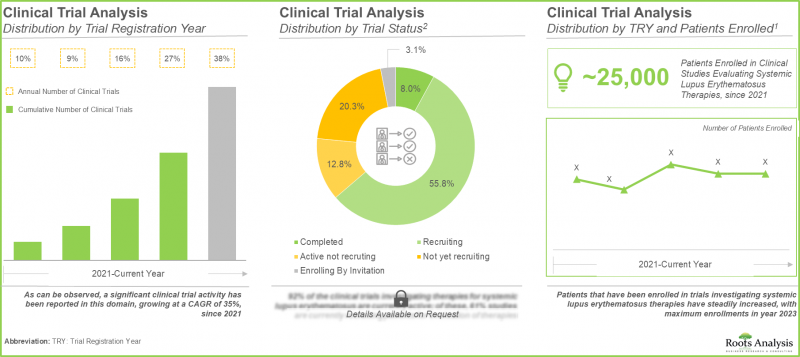
4. Around 25,000 patients have been enrolled in clinical trials underway to investigate SLE therapies, notably, ~10,000 patients were enrolled in last two years.
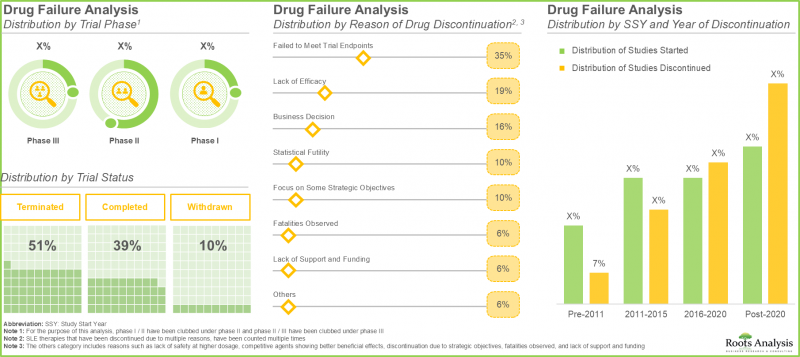
5. More than 30 therapies have been discontinued for systemic lupus erythematosus, notably, majority (~20%) of the therapies were discontinued in a year alone.
6. Close to 55% of the SLE drugs were discontinued in Phase II clinical trials; further, 35% of the drugs were discontinued due to failure in meeting primary endpoints in trials.
7. The overall systemic lupus erythematosus market is likely to be worth USD 2,471 million in the current year and this value is projected to reach around USD 6,547 million in 2035, growing at a CAGR of 11.4%.
8. Given the rising adoption of targeted biologics and ongoing research efforts in this domain, the systemic lupus erythematosus market is expected to witness significant growth in the coming future.
Systemic Lupus Erythematosus Market
The market sizing and opportunity analysis has been segmented across the following parameters:
By Type of Molecule
- Biologics
- Small Molecules
By Drug Class
- Monoclonal Antibodies
- Fusion Proteins
- Inhibitors
- Immunomodulators
By Route of Administration
- Intravenous
- Subcutaneous
- Oral
By Type of Therapy
- Monotherapies
- Combination Therapies
By Geographical Regions
- North America
- US
- Canada
- Europe
- UK
- Germany
- France
- Italy
- Spain
- Rest of Europe
- Asia-Pacific
- China
- Japan
- South Korea
- Australia
- Middle East and North Africa
- Saudi Arabia
- UAE
- Latin America
- Brazil
- Argentina
SYSTEMIC LUPUS ERYTHEMATOSUS MARKET: KEY SEGMENTS
Regional and Segment Analysis of the Systemic Lupus Erythematosus Market
North America is expected to capture the highest market share, accounting for over 80% of the global systemic lupus erythematosus (SLE) market share in the current year. This dominance is primarily driven by a rising prevalence of the disease, rapid adoption of targeted biologic therapies, and well-established reimbursement frameworks. In contrast, Europe is projected to exhibit comparatively faster growth, with an anticipated compound annual growth rate (CAGR) of 20.8% throughout the forecast period, supported by upcoming drug approvals and expanding treatment access.
Monoclonal Antibodies Account for the Largest Systemic Lupus Erythematosus Market Share
From a therapeutic class perspective, monoclonal antibodies are anticipated to dominate the market, capturing approximately 95% share in the current year. This leadership is largely attributed to continued label expansions and strong clinical adoption of approved therapies such as Benlysta and Saphnelo, which have demonstrated efficacy in reducing disease activity, minimizing organ damage, and lowering reliance on corticosteroids. However, the inhibitors segment is expected to witness higher growth over the forecast period, driven by the anticipated approval of oral small-molecule therapies, including Cenerimod, Deucravacitinib, and Upadacitinib.
Intravenous Segment Dominates the Systemic Lupus Erythematosus Market
In terms of route of administration, intravenous therapies are projected to account for the largest market share, nearly 70% in the current year owing to the administration profile of most currently approved and near-term pipeline drugs. Nevertheless, oral therapies are expected to register the fastest growth, with a projected CAGR of 47.3%, supported by their non-invasive nature, ease of administration, and improved patient adherence compared to alternative delivery methods.
Example Players in Systemic Lupus Erythematosus Market
- AbbVie
- Amgen
- AstraZeneca
- Bristol-Myers Squibb
- GSK
- Novartis
- Pfizer
- Roche
- Sanofi
SYSTEMIC LUPUS ERYTHEMATOSUS MARKET: RESEARCH COVERAGE
- Market Sizing and Opportunity Analysis: The report features an in-depth analysis of the systemic lupus erythematosus market, focusing on key market segments, including [A] type of molecule, [B] drug class, [C] route of administration, [D] type of therapy, [E] geographical regions, and [F] sales forecast.
- Systemic Lupus Erythematosus Therapies Market Landscape: A detailed assessment of the overall systemic lupus erythematosus therapies market landscape, along with information on several relevant parameters, such as [A] stage of development, [B] drug class, [C] type of molecule, [D] type of therapy, [E] therapy role, [F] route of administration, [G] drug frequency, [H] patient type, [I] year of establishment, [J] company size, and [K] location of headquarters.
- Start Up Ecosystem Analysis: An in-depth start-up ecosystem analysis based on various relevant parameters, such as [A] stage of development [B] type of molecule, [C] drug class [D] type of therapy, [E] route of administration, [F] year of establishment, [G] company size and [H] location of headquarters.
- Company Profiles: In-depth profiles of key companies based in North America, Europe and Asia-Pacific based on several parameters such as [A] year of establishment, [B] location of headquarters, [C] product portfolio, [D] recent developments and [E] an informed future outlook.
- Clinical Trial Analysis: an analysis of completed and ongoing clinical trials related to atrial fibrillation, based on several relevant parameters, such as [A] trial registration year, [B] enrolled patient population, [C] trial phase, [D] trial status, [E] type of sponsor / collaborator, [F] patient gender, [G] study design, [H] leading industry and non-industry players and [I] geography.
- Drug Failure Analysis: An insightful drug failure analysis, based on several parameters, such as [A] trial phase, [B] trial status, [C] reason of drug discontinuation, [D] study start year, [E] year of discontinuation, [F] type of molecule, and [G] route of administration.
- Market Impact Analysis: An in-depth analysis of the factors that can impact the growth of the market. It also features identification and analysis of key drivers, potential restraints, emerging opportunities, and existing challenges in this domain.
KEY QUESTIONS ANSWERED IN THIS REPORT
- Which are the leading companies in the systemic lupus erythematosus market?
- Which region dominates the systemic lupus erythematosus market?
- What are the key trends observed in the systemic lupus erythematosus market?
- What factors are likely to influence the evolution of this market?
- What are the primary challenges faced by systemic lupus erythematosus therapy developers?
- What is the current and future market size?
- What is the CAGR of this market?
- How is the current and future market opportunity likely to be distributed across key market segments?
REASONS TO BUY THIS REPORT
- The report provides a comprehensive market analysis, offering detailed revenue projections of the overall market and its specific sub-segments. This information is valuable to both established market leaders and emerging entrants.
- The report offers stakeholders a comprehensive overview of the market, including key drivers, barriers, opportunities, and challenges. This information empowers stakeholders to stay abreast of market trends and make data-driven decisions to capitalize on growth prospects.
- The report can aid businesses in identifying future opportunities in any sector. It also helps in understanding if those opportunities are worth pursuing.
- The report helps in identifying customer demand by understanding the needs, preferences, and behavior of the target audience in order to tailor products or services effectively.
- The report equips new entrants with requisite information regarding a particular market to help them build successful business strategies.
- The report allows for more effective communication with the audience and in building strong business relations.
ADDITIONAL BENEFITS
- Complementary PPT Insights Pack
- Complimentary Excel Data Packs for all Analytical Modules in the Report
- 15% Free Content Customization
- Detailed Report Walkthrough Session with Research Team
- Free Updated report if the report is 6-12 months old or older
TABLE OF CONTENTS
1. BACKGROUND
- 1.1. Context
- 1.2. Project Objectives
2. RESEARCH METHODOLOGY
- 2.1. Chapter Overview
- 2.2. Research Assumptions
- 2.2.1. Market Landscape and Market Trends
- 2.2.2. Market Forecast and Opportunity Analysis
- 2.2.3. Comparative Analysis
- 2.3. Database Building
- 2.3.1. Data Collection
- 2.3.2. Data Validation
- 2.3.3. Data Analysis
- 2.4. Project Methodology
- 2.4.1. Secondary Research
- 2.4.1.1. Annual Reports
- 2.4.1.2. Academic Research Papers
- 2.4.1.3. Company Websites
- 2.4.1.4. Investor Presentations
- 2.4.1.5. Regulatory Filings
- 2.4.1.6. White Papers
- 2.4.1.7. Industry Publications
- 2.4.1.8. Conferences and Seminars
- 2.4.1.9. Government Portals
- 2.4.1.10. Media and Press Releases
- 2.4.1.11. Newsletters
- 2.4.1.12. Industry Databases
- 2.4.1.13. Roots Proprietary Databases
- 2.4.1.14. Paid Databases and Sources
- 2.4.1.15. Social Media Portals
- 2.4.1.16. Other Secondary Sources
- 2.4.2. Primary Research
- 2.4.2.1. Types of Primary Research
- 2.4.2.1.1. Qualitative Research
- 2.4.2.1.2. Quantitative Research
- 2.4.2.1.3. Hybrid Approach
- 2.4.2.2. Advantages of Primary Research
- 2.4.2.3. Techniques for Primary Research
- 2.4.2.3.1. Interviews
- 2.4.2.3.2. Surveys
- 2.4.2.3.3. Focus Groups
- 2.4.2.3.4. Observational Research
- 2.4.2.3.5. Social Media Interactions
- 2.4.2.4. Key Opinion Leaders Considered in Primary Research
- 2.4.2.4.1. Company Executives (CXOs)
- 2.4.2.4.2. Board of Directors
- 2.4.2.4.3. Company Presidents and Vice Presidents
- 2.4.2.4.4. Research and Development Heads
- 2.4.2.4.5. Technical Experts
- 2.4.2.4.6. Subject Matter Experts
- 2.4.2.4.7. Scientists
- 2.4.2.4.8. Doctors and Other Healthcare Providers
- 2.4.2.5. Ethics and Integrity
- 2.4.2.5.1. Research Ethics
- 2.4.2.5.2. Data Integrity
- 2.4.2.1. Types of Primary Research
- 2.4.3. Analytical Tools and Databases
- 2.4.1. Secondary Research
- 2.5. Robust Quality Control
3. MARKET DYNAMICS
- 3.1. Chapter Overview
- 3.2. Forecast Methodology
- 3.2.1. Top-down Approach
- 3.2.2. Bottom-up Approach
- 3.2.3. Hybrid Approach
- 3.3. Market Assessment Framework
- 3.3.1. Total Addressable Market (TAM)
- 3.3.2. Serviceable Addressable Market (SAM)
- 3.3.3. Serviceable Obtainable Market (SOM)
- 3.3.4. Currently Acquired Market (CAM)
- 3.4. Forecasting Tools and Techniques
- 3.4.1. Qualitative Forecasting
- 3.4.2. Correlation
- 3.4.3. Regression
- 3.4.4. Extrapolation
- 3.4.5. Convergence
- 3.4.6. Sensitivity Analysis
- 3.4.7. Scenario Planning
- 3.4.8. Data Visualization
- 3.4.9. Time Series Analysis
- 3.4.10. Forecast Error Analysis
- 3.5. Key Considerations
- 3.5.1. Demographics
- 3.5.2. Government Regulations
- 3.5.3. Reimbursement Scenarios
- 3.5.4. Market Access
- 3.5.5. Supply Chain
- 3.5.6. Industry Consolidation
- 3.5.7. Pandemic / Unforeseen Disruptions Impact
- 3.6. Limitations
4. MACRO-ECONOMIC INDICATORS
- 4.1. Chapter Overview
- 4.2. Market Dynamics
- 4.2.1. Time Period
- 4.2.1.1. Historical Trends
- 4.2.1.2. Current and Forecasted Estimates
- 4.2.2. Currency Coverage
- 4.2.2.1. Major Currencies Affecting the Market
- 4.2.2.2. Factors Affecting Currency Fluctuations on the Industry
- 4.2.2.3. Impact of Currency Fluctuations on the Industry
- 4.2.3. Foreign Currency Exchange Rate
- 4.2.3.1. Impact of Foreign Exchange Rate Volatility on the Market
- 4.2.3.2. Strategies for Mitigating Foreign Exchange Risk
- 4.2.4. Recession
- 4.2.4.1. Assessment of Current Economic Conditions and Potential Impact on the Market
- 4.2.4.2. Historical Analysis of Past Recessions and Lessons Learnt
- 4.2.5. Inflation
- 4.2.5.1. Measurement and Analysis of Inflationary Pressures in the Economy
- 4.2.5.2. Potential Impact of Inflation on the Market Evolution
- 4.2.6. Interest Rates
- 4.2.6.1. Interest Rates and Their Impact on the Market
- 4.2.6.2. Strategies for Managing Interest Rate Risk
- 4.2.7. Commodity Flow Analysis
- 4.2.7.1. Type of Commodity
- 4.2.7.2. Origins and Destinations
- 4.2.7.3. Values and Weights
- 4.2.7.4. Modes of Transportation
- 4.2.8. Global Trade Dynamics
- 4.2.8.1. Import Scenario
- 4.2.8.2. Export Scenario
- 4.2.8.3. Trade Policies
- 4.2.8.4. Strategies for Mitigating the Risks Associated with Trade Barriers
- 4.2.8.5. Impact of Trade Barriers on the Market
- 4.2.9. War Impact Analysis
- 4.2.9.1. Russian-Ukraine War
- 4.2.9.2. Israel-Hamas War
- 4.2.10. COVID Impact / Related Factors
- 4.2.10.1. Global Economic Impact
- 4.2.10.2. Industry-specific Impact
- 4.2.10.3. Government Response and Stimulus Measures
- 4.2.10.4. Future Outlook and Adaptation Strategies
- 4.2.11. Other Indicators
- 4.2.11.1. Fiscal Policy
- 4.2.11.2. Consumer Spending
- 4.2.11.3. Gross Domestic Product
- 4.2.11.4. Employment
- 4.2.11.5. Taxes
- 4.2.11.6. Stock Market Performance
- 4.2.11.7. Cross Border Dynamics
- 4.2.1. Time Period
- 4.3. Conclusion
5. EXECUTIVE SUMMARY
6. INTRODUCTION
- 6.1. An Overview of Systemic Lupus Erythematosus
- 6.2. Pathogenesis of Systemic Lupus Erythematosus
- 6.3. Symptoms of Systemic Lupus Erythematosus
- 6.4. Global Statistics of Systemic Lupus Erythematosus
- 6.5. Treatment Guidelines for Systemic Lupus Erythematosus
- 6.6. Diagnosis of Systemic Lupus Erythematosus
- 6.7. Future Perspectives
7. MARKET LANDSCAPE OF SYSTEMIC LUPUS ERYTHEMATOSUS THERAPIES
- 7.1. Methodology and Key Parameters
- 7.2. Systemic Lupus Erythematosus Therapies: Market Landscape
- 7.2.1. Analysis by Stage of Development
- 7.2.2. Analysis by Drug Class
- 7.2.3. Analysis by Type of Molecule
- 7.2.4. Analysis by Type of Therapy
- 7.2.5. Analysis by Therapy Role
- 7.2.6. Analysis by Route of Administration
- 7.2.7. Analysis by Drug Frequency
- 7.2.8. Analysis by Patient Type
- 7.2.9. Analysis by Year of Establishment
- 7.2.10. Analysis by Company Size
- 7.2.11. Analysis by Location of Headquarters
8. STARTUP ECOSYSTEM ANALYSIS
- 8.1. Methodology and Key Parameters
- 8.2. Systemic Lupus Erythematosus Therapies: Startup Ecosystem Analysis
- 8.2.1. Analysis by Stage of Development
- 8.2.2. Analysis by Type of Molecule
- 8.2.3. Analysis by Drug Class
- 8.2.4. Analysis by Type of Therapy
- 8.2.5. Analysis by Route of Administration
- 8.2.6. Analysis by Year of Establishment
- 8.2.7. Analysis by Company Size
- 8.2.8. Analysis by Location of Headquarters
9. COMPANY PROFILES
- 9.1. Overview
- 9.2. Leading Systemic Lupus Erythematosus Therapy Developers
- 9.2.1. AbbVie
- 9.2.1.1. Company Overview
- 9.2.1.2. Business Segments
- 9.2.1.3. SLE Therapies Portfolio
- 9.2.1.4. Key Initiatives
- 9.2.2. Amgen
- 9.2.3. AstraZeneca
- 9.2.4. Bristol-Myers Squibb
- 9.2.5. GSK
- 9.2.6. Novartis
- 9.2.7. Pfizer
- 9.2.8. Roche
- 9.2.9. Sanofi
- 9.2.1. AbbVie
10. CLINICAL TRIAL ANALYSIS
- 10.1. Methodology and Key Parameters
- 10.2. Systemic Lupus Erythematosus Therapies: Clinical Trial Analysis
- 10.2.1. Analysis by Trial Registration Year
- 10.2.2. Analysis by Trial Status
- 10.2.3. Analysis by Trial Registration Year and Trial Status
- 10.2.4. Analysis by Trial Registration Year and Patients Enrolled
- 10.2.5. Analysis by Trial Phase
- 10.2.6. Analysis by Trial Registration Year and Trial Phase
- 10.2.7. Analysis of Patients Enrolled by Trial Phase
- 10.2.8. Analysis by Patient Gender
- 10.2.9. Analysis by Study Design
- 10.2.9.1. Analysis by Design Masking
- 10.2.9.2. Analysis by Intervention Model
- 10.2.9.3. Analysis by Trial Purpose
- 10.2.9.4. Analysis by Allocation
- 10.2.10. Analysis by Target Patient Population
- 10.2.11. Most Active Sponsor / Collaborator: Analysis by Number of Registered Trials
- 10.2.11.1. Analysis by Leading Industry Players
- 10.2.11.2. Analysis by Leading Non-Industry Players
- 10.2.13. Analysis by Geography
- 10.2.13.1. Analysis of Clinical Trials by Trial Status and Geography
- 10.2.13.2. Analysis of Patients Enrolled by Trial Status and Geography
11. DRUG FAILURE ANALYSIS
- 11.1. Methodology and Key Parameters
- 11.2. Systemic Lupus Erythematosus Therapies: Drug Failure Analysis
- 11.2.1. Analysis by Trial Phase
- 11.2.2. Analysis by Trial Status
- 11.2.3. Analysis by Reason of Drug Discontinuation
- 11.2.4. Analysis by Study Start Year and Year of Discontinuation
- 11.2.5. Analysis by Type of Molecule and Drug Class
- 11.2.6. Analysis by Type of Therapy
- 11.2.7. Analysis by Route of Administration
12. MARKET IMPACT ANALYSIS: DRIVERS, RESTRAINTS, OPPORTUNITIES AND CHALLENGES
- 12.1. Market Drivers
- 12.2. Market Restraints
- 12.3. Market Opportunities
- 12.4. Market Challenges
13. GLOBAL SYSTEMIC LUPUS ERYTHEMATOSUS MARKET
- 13.1. Key Assumptions and Methodology
- 13.2. Global Systemic Lupus Erythematosus Market, Historical Trends (since 2023) and Forecasted Estimates (till 2035)
- 13.2.1. Multivariate Scenario Analysis
- 13.2.1.1. Conservative Scenario
- 13.2.1.2. Optimistic Scenario
- 13.2.1. Multivariate Scenario Analysis
- 13.3. Key Market Segmentations
14. SYSTEMIC LUPUS ERYTHEMATOSUS MARKET, BY TYPE OF MOLECULE
- 14.1. Key Assumptions and Methodology
- 14.2. Systemic Lupus Erythematosus Market: Distribution by Type of Molecule
- 14.2.1. Systemic Lupus Erythematosus Market for Biologics, Historical Trends (since 2023) and Forecasted Estimates (till 2035)
- 14.2.2. Systemic Lupus Erythematosus Market for Small Molecules, Forecasted Estimates (till 2035)
- 14.3. Data Triangulation and Validation
15. SYSTEMIC LUPUS ERYTHEMATOSUS MARKET, BY DRUG CLASS
- 15.1. Key Assumptions and Methodology
- 15.2. Systemic Lupus Erythematosus Market: Distribution by Drug Class
- 15.2.1. Systemic Lupus Erythematosus Market for Monoclonal Antibodies, Historical Trends (since 2023) and Forecasted Estimates (till 2035)
- 15.2.2. Systemic Lupus Erythematosus Market for Fusion Proteins, Historical Trends (since 2023) and Forecasted Estimates (till 2035)
- 15.2.3. Systemic Lupus Erythematosus Market for Inhibitors, Forecasted Estimates (till 2035)
- 15.2.4. Systemic Lupus Erythematosus Market for Immunomodulators, Forecasted Estimates (till 2035)
- 15.3. Data Triangulation and Validation
16. SYSTEMIC LUPUS ERYTHEMATOSUS MARKET, BY ROUTE OF ADMINISTRATION
- 16.1. Key Assumptions and Methodology
- 16.2. Systemic Lupus Erythematosus Market: Distribution by Route of Administration
- 16.2.1. Systemic Lupus Erythematosus Market for Intravenous Route, Historical Trends (since 2023) and Forecasted Estimates (till 2035)
- 16.2.2. Systemic Lupus Erythematosus Market for Subcutaneous Route, Historical Trends (since 2023) and Forecasted Estimates (till 2035)
- 16.2.3. Systemic Lupus Erythematosus Market for Oral Route, Forecasted Estimates (till 2035)
- 16.3. Data Triangulation and Validation
17. SYSTEMIC LUPUS ERYTHEMATOSUS MARKET, BY TYPE of THERAPY
- 17.1. Key Assumptions and Methodology
- 17.2. Systemic Lupus Erythematosus Market: Distribution by Type of Therapy
- 17.2.1. Systemic Lupus Erythematosus Market for Monotherapies, Historical Trends (since 2023) and Forecasted Estimates (till 2035)
- 17.2.2. Systemic Lupus Erythematosus Market for Combination Therapies, Historical Trends (since 2023) and Forecasted Estimates (till 2035)
- 17.3. Data Triangulation and Validation
18. SYSTEMIC LUPUS ERYTHEMATOSUS MARKET, BY GEOGRAPHICAL REGIONS
- 18.1. Key Assumptions and Methodology
- 18.2. Systemic Lupus Erythematosus Market: Distribution by Geographical Regions
- 18.2.1. Systemic Lupus Erythematosus Market in North America, Historical Trends (since 2023) and Forecasted Estimates (till 2035)
- 18.2.1.1. Systemic Lupus Erythematosus Market in the US, Historical Trends (since 2023) and Forecasted Estimates (till 2035)
- 18.2.1.2. Systemic Lupus Erythematosus Market in Canada, Historical Trends (since 2023) and Forecasted Estimates (till 2035)
- 18.2.2. Systemic Lupus Erythematosus Market in Europe, Historical Trends (since 2023) and Forecasted Estimates (till 2035)
- 18.2.2.1. Systemic Lupus Erythematosus Market in the UK, Historical Trends (since 2023) and Forecasted Estimates (till 2035)
- 18.2.2.2. Systemic Lupus Erythematosus Market in Germany, Historical Trends (since 2023) and Forecasted Estimates (till 2035)
- 18.2.2.3. Systemic Lupus Erythematosus Market in France, Historical Trends (since 2023) and Forecasted Estimates (till 2035)
- 18.2.2.4. Systemic Lupus Erythematosus Market in Italy, Historical Trends (since 2023) and Forecasted Estimates (till 2035)
- 18.2.2.5. Systemic Lupus Erythematosus Market in Spain, Historical Trends (since 2023) and Forecasted Estimates (till 2035)
- 18.2.2.6. Systemic Lupus Erythematosus Market in Rest of Europe, Historical Trends (since 2023) and Forecasted Estimates (till 2035)
- 18.2.3. Systemic Lupus Erythematosus Market in Asia-Pacific, Historical Trends (since 2023) and Forecasted Estimates (till 2035)
- 18.2.3.1. Systemic Lupus Erythematosus Market in China, Historical Trends (since 2023) and Forecasted Estimates (till 2035)
- 18.2.3.2. Systemic Lupus Erythematosus Market in Japan, Historical Trends (since 2023) and Forecasted Estimates (till 2035)
- 18.2.3.3. Systemic Lupus Erythematosus Market in South Korea, Historical Trends (since 2023) and Forecasted Estimates (till 2035)
- 18.2.3.4. Systemic Lupus Erythematosus Market in Australia, Historical Trends (since 2023) and Forecasted Estimates (till 2035)
- 18.2.4. Systemic Lupus Erythematosus Market in Middle East and North Africa, Historical Trends (since 2023) and Forecasted Estimates (till 2035)
- 18.2.4.1. Systemic Lupus Erythematosus Market in Saudi Arabia, Historical Trends (since 2023) and Forecasted Estimates (till 2035)
- 18.2.4.2. Systemic Lupus Erythematosus Market in the UAE, Historical Trends (since 2023) and Forecasted Estimates (till 2035)
- 18.2.5. Systemic Lupus Erythematosus Market in Latin America, Historical Trends (since 2023) and Forecasted Estimates (till 2035)
- 18.2.5.1. Systemic Lupus Erythematosus Market in Brazil, Historical Trends (since 2023) and Forecasted Estimates (till 2035)
- 18.2.5.2. Systemic Lupus Erythematosus Market in Argentina, Historical Trends (since 2023) and Forecasted Estimates (till 2035)
- 18.2.1. Systemic Lupus Erythematosus Market in North America, Historical Trends (since 2023) and Forecasted Estimates (till 2035)
- 18.4. Data Triangulation and Validation
19. SYSTEMIC LUPUS ERYTHEMATOSUS MARKET, SALES FORECAST
- 19.1. Key Assumptions and Methodology
- 19.2. Systemic Lupus Erythematosus Market: Sales Forecast
- 19.2.1. Systemic Lupus Erythematosus Market for Benlysta, Historical Trends (since 2023) and Forecasted Estimates (till 2035)
- 19.2.2. Systemic Lupus Erythematosus Market for Saphnelo Historical Trends (since 2023) and Forecasted Estimates (till 2035)
- 19.2.3. Systemic Lupus Erythematosus Market for Telitacicept, Historical Trends (since 2023) and Forecasted Estimates (till 2035)
- 19.2.4. Systemic Lupus Erythematosus Market for Dapirolizumab Pegol, Forecasted Estimates (till 2035)
- 19.2.5. Systemic Lupus Erythematosus Market for Obinutuzumab, Forecasted Estimates (till 2035)
- 19.2.6. Systemic Lupus Erythematosus Market for Litifilimab, Forecasted Estimates (till 2035)
- 19.2.7. Systemic Lupus Erythematosus Market for Cenerimod Forecasted Estimates (till 2035)
- 19.2.8. Systemic Lupus Erythematosus Market for Deucravacitinib, Forecasted Estimates (till 2035)
- 19.2.9. Systemic Lupus Erythematosus Market for Upadacitinib, Forecasted Estimates (till 2035)
- 19.2.10. Systemic Lupus Erythematosus Market for Ianalumab, Forecasted Estimates (till 2035)
- 19.3. Data Triangulation and Validation


