|
시장보고서
상품코드
1871315
식품 안전 검사 시장 : 기회, 성장요인, 업계 동향 분석, 예측(2025-2034년)Food Safety Testing Market Opportunity, Growth Drivers, Industry Trend Analysis, and Forecast 2025 - 2034 |
||||||

세계 식품 안전 검사 시장은 2024년 242억 달러로 평가되었으며, 2034년까지 연평균 복합 성장률(CAGR) 6.7%로 성장하여 454억 달러에 이를 것으로 예측됩니다.
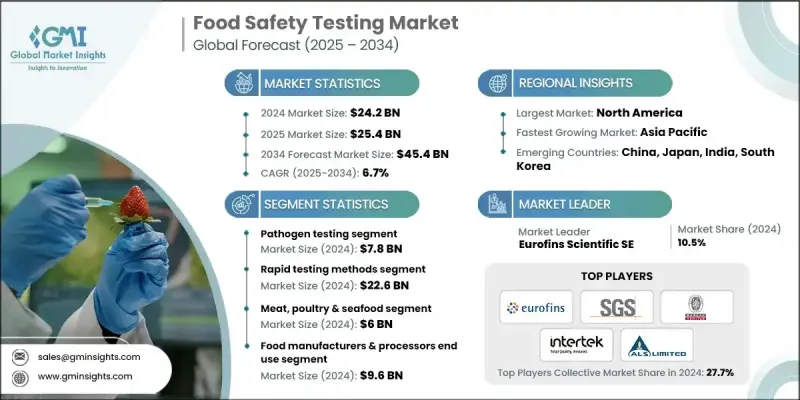
세계적인 식중독 발생률의 상승과 오염 우려의 고조를 배경으로 시장은 현저한 성장을 보이고 있습니다. 유해한 병원체, 독소, 화학물질 잔류물에 대한 노출 사례 증가로 규제 당국과 식품 산업 모두 검사 프로토콜의 강화를 강요하고 있습니다. 소비자의 식품위생에 대한 의식의 고조도, 식품의 생산·가공·포장의 각 단계에 있어서의 안전 검사 기술의 채택을 가속시키고 있습니다. FDA(미국식품의약국), EFSA(유럽식품안전기관), FSSAI(인도식품안전기준국) 등의 조직에 의한 보다 엄격한 세계 식품안전규제의 실시로 여러 식품 카테고리에서 검사가 의무화되어 검사의 빈도와 범위가 확대되고 있습니다. 기업은 인증 기준 및 국제 품질 규정을 준수하기 위해 고급 실험실 및 자동화 시스템에 많은 투자를 하고 있습니다. 세계 식품 공급망의 복잡성과 국경을 넘어 무역이 증가함에 따라 운송 및 보관 중 오염 위험이 증가하고 있습니다. 그 결과 식품 유통 프로세스의 모든 단계에서 일관된 안전 기준을 확보하기 위해 제3자 검증, 추적성 솔루션 및 국제적으로 인증된 실험실에 대한 수요가 급증하고 있습니다.
| 시장 범위 | |
|---|---|
| 시작 연도 | 2024년 |
| 예측 연도 | 2025-2034년 |
| 시작 금액 | 242억 달러 |
| 예측 금액 | 454억 달러 |
| CAGR | 6.7% |
병원체 검사 부문은 2024년 78억 달러로 평가되었으며, 2025년부터 2034년까지 연평균 복합 성장률(CAGR)은 6.9%를 보일 것으로 예측됩니다. 제조업체가 소비자의 건강 및 규제 기준을 준수하는 것을 우선시하는 동안 식품 안전 검사 시장은 병원체 검사 및 알레르겐 검사 범주에서 꾸준히 성장하고 있습니다. 가공식품이나 즉식제품에 있어서의 미생물 오염 사례 증가에 의해 병원체 검사 수요가 급증하고 있습니다. 마찬가지로, 보다 엄격한 표시 요건과 식품 알레르기에 대한 일반 인식 증가가 빠르고 정확한 결과를 제공하는 보다 빠르고 정밀한 검출 방법으로 기업의 이행을 촉진하고, 알레르겐 검사도 기세를 늘리고 있습니다.
신속 검사 방법 부문은 2024년에 226억 달러로 평가되었고, 2034년까지 연평균 복합 성장률(CAGR) 6.7%로 성장할 것으로 예측됩니다. 고급 면역 측정법과 PCR 기술을 기반으로 한 신속 검사 솔루션은 여러 오염 물질을 신속하고 정확하며 동시에 검출 할 수 있는 능력으로 널리 채택되었습니다. ELISA 및 PCR과 같은 기술은 다양한 식품 유형에서 병원체, 알레르겐 및 유전자 변형 성분을 식별하는 데 선호되는 도구가되고 있습니다. 그 확장성과 신뢰성은 특히 정밀도와 속도가 필수적인 대규모 식품 제조 현장에서 대량의 품질 보증 및 공정 내 검사에 이상적입니다.
북미의 식품 안전 검사 시장은 2024년 91억 달러로 평가되었으며 예측기간 동안 견고한 성장을 기록할 것으로 전망됩니다. 이 지역의 식품 안전 컴플라이언스에 대한 강한 중시와 소비자 의식 증가가 시장 확대를 크게 뒷받침하고 있습니다. FDA 및 USDA와 같은 기관에 의한 엄격한 규제 프레임워크의 구현으로 식품 제조업체는 보다 빠르고 정밀한 검사 기술의 채택을 촉진하고 있습니다. 미생물 오염 및 화학물질 오염과 관련된 제품 리콜 건수 증가, 포장된 식품 및 조리된 식품의 소비 확대가 함께 미국 및 캐나다에서의 검사 수요를 지속적으로 견인하고 있습니다.
세계 식품 안전 검사 시장의 주요 기업으로는 Intertek Group PLC, Eurofins Scientific SE, Bureau Veritas, SGS S.A., ALS Limited, 기타 등이 있습니다. 식품 안전 검사 시장의 주요 기업은 세계 존재감을 확대하고 경쟁력을 강화하기 위해 다양한 전략적 노력을 결합하고 있습니다. Eurofins Scientific SE, Intertek Group PLC, and Bureau Veritas 등의 기업들은 새로운 검사 시설의 설립과 지역 파트너십을 통한 능력 확대에 주력하고 있습니다. 검사 속도와 정밀도를 높이기 위해 자동화, AI 구동형 분석, 차세대 분자진단 플랫폼에 많은 투자를 실시했습니다. 시장 접근 강화와 서비스 포트폴리오 확대를 위해 합병 및 인수는 여전히 중요한 전략입니다.
자주 묻는 질문
목차
제1장 조사 방법
- 시장 범위와 정의
- 조사 설계
- 조사 접근
- 데이터 수집 방법
- 데이터 마이닝 소스
- 세계
- 지역별/국가별
- 기본 추정치와 계산
- 기준연도 계산
- 시장 추정에서의 주요 동향
- 1차 조사 및 검증
- 1차 정보
- 예측 모델
- 조사의 전제조건과 제한 사항
제2장 주요 요약
제3장 업계 인사이트
- 생태계 분석
- 공급자의 상황
- 이익률
- 각 단계에서의 부가가치
- 밸류체인에 영향을 주는 요인
- 혁신
- 업계에 미치는 영향요인
- 성장 촉진요인
- 업계의 잠재적 위험 및 과제
- 공급망의 복잡성
- 시장 기회
- 성장 가능성 분석
- 규제 상황
- 북미
- 유럽
- 아시아태평양
- 라틴아메리카
- 중동 및 아프리카
- Porter's Five Forces 분석
- PESTEL 분석
- 가격 동향
- 지역별
- 제품별
- 장래 시장 동향
- 기술과 혁신의 상황
- 현재의 기술 동향
- 신규기술
- 특허 상황
- 무역 통계(주 : 무역 통계는 주요 국가에서만 제공됨)
- 주요 수입국
- 주요 수출국
- 지속가능성과 환경적 측면
- 지속가능한 대처
- 폐기물 감축 전략
- 생산에 있어서의 에너지 효율
- 환경에 배려한 대처
제4장 경쟁 구도
- 소개
- 기업의 시장 점유율 분석
- 지역별
- 북미
- 유럽
- 아시아태평양
- 라틴아메리카
- 중동 및 아프리카
- 지역별
- 기업 매트릭스 분석
- 주요 시장 기업의 경쟁 분석
- 경쟁 포지셔닝 매트릭스
- 주요 발전
- 합병 및 인수
- 제휴 및 협력관계
- 신제품 발매
- 확대 계획
제5장 시장 추정 및 예측 : 검사 유형별, 2021-2034
- 주요 동향
- 병원체 검사
- 알레르겐 검사
- 화학물질·오염물질 검사
- 유전자 재조합 생물(GMO) 검사
- 영양 표시의 검증
- 보존 기간 및 안정성 시험
제6장 시장 추정 및 예측 : 기술별, 2021-2034
- 주요 동향
- 종래법
- 배양 베이스
- 현미경 검사
- 신속 검사법
- 면역측정법(예: ELISA)
- PCR 베이스(중합효소 연쇄반응)
- 크로마토그래피(예: HPLC, GC)
- 분광법(예: 질량 분석법)
- 바이오센서
- 차세대 시퀀싱(NGS)
제7장 시장 추정 및 예측 : 식품 유형별, 2021-2034
- 주요 동향
- 육류, 닭고기 및 해산물
- 유제품
- 제빵 및 과자류
- 과일·야채
- 가공식품
- 곡물 및 콩류
- 음료
- 알코올 음료
- 무알코올 음료
- 기타 식품
제8장 시장 추정 및 예측 : 최종 용도별, 2021-2034
- 주요 동향
- 식품 제조업체 및 가공업자
- 소매업체·유통업체
- 정부·규제기관
- 연구소·시험 시설
- 음식점 및 케이터링 서비스
제9장 시장 추정 및 예측 : 지역별, 2021-2034
- 주요 동향
- 북미
- 미국
- 캐나다
- 유럽
- 독일
- 영국
- 프랑스
- 이탈리아
- 스페인
- 기타 유럽
- 아시아태평양
- 중국
- 인도
- 일본
- 호주
- 한국
- 기타 아시아태평양
- 라틴아메리카
- 브라질
- 멕시코
- 아르헨티나
- 기타 라틴아메리카
- 중동 및 아프리카
- 사우디아라비아
- 남아프리카
- 아랍에미리트(UAE)
- 기타 중동 및 아프리카
제10장 기업 프로파일
- SGS SA
- NSF International
- Bureau Veritas
- Eurofins Scientific SE
- Intertek Group PLC
- Thermo Fisher Scientific Inc.
- Merieux Nutrisciences
- TUV SUD
- UL LLC
- AsureQuality Ltd
- Agilent Technologies, Inc.
- QIAGEN
- Bio-Rad Laboratories, Inc.
- ALS Limited
The Global Food Safety Testing Market was valued at USD 24.2 billion in 2024 and is estimated to grow at a CAGR of 6.7% to reach USD 45.4 billion by 2034.
The market is witnessing substantial growth driven by the rising incidence of foodborne diseases and contamination concerns worldwide. Increasing cases of exposure to harmful pathogens, toxins, and chemical residues have pushed both regulatory authorities and the food industry to strengthen testing protocols. Growing awareness among consumers about food hygiene has also accelerated the adoption of safety testing technologies across food production, processing, and packaging stages. The implementation of stricter global food safety regulations by organizations such as the FDA, EFSA, and FSSAI has made testing mandatory across several food categories, thereby expanding the frequency and scope of inspections. Companies are heavily investing in advanced laboratories and automated systems to comply with certification standards and international quality regulations. The growing complexity of the global food supply chain, coupled with cross-border trade, has heightened contamination risks during transport and storage. As a result, demand for third-party verification, traceability solutions, and internationally accredited laboratories has surged to ensure consistent safety standards across all stages of the food distribution process.
| Market Scope | |
|---|---|
| Start Year | 2024 |
| Forecast Year | 2025-2034 |
| Start Value | $24.2 Billion |
| Forecast Value | $45.4 Billion |
| CAGR | 6.7% |
The pathogen testing segment was valued at USD 7.8 billion in 2024 and is projected to grow at a CAGR of 6.9% between 2025 and 2034. The food safety testing market continues to grow steadily across pathogen and allergen testing categories, as manufacturers prioritize consumer well-being and compliance with regulatory norms. Pathogen testing demand has surged due to increased microbial contamination incidents in processed and ready-to-eat products. Similarly, allergen testing is gaining momentum as stricter labeling requirements and rising public awareness of food allergies push companies toward faster and more precise detection methods that deliver rapid and accurate results.
The rapid testing methods segment reached USD 22.6 billion in 2024 and is estimated to register a CAGR of 6.7% through 2034. Rapid testing solutions using advanced immunoassay and PCR-based technologies are being widely adopted because of their ability to provide quick, accurate, and simultaneous detection of multiple contaminants. Techniques like ELISA and PCR are becoming preferred tools for identifying pathogens, allergens, and genetically modified ingredients across various food types. Their scalability and dependability make them ideal for high-volume quality assurance and in-process testing, especially in large-scale food manufacturing setups where accuracy and speed are essential.
North America Food Safety Testing Market was valued at USD 9.1 billion in 2024 and is projected to record robust growth during the forecast period. The region's strong emphasis on food safety compliance and consumer awareness has significantly boosted market expansion. Stringent regulatory frameworks enforced by bodies such as the FDA and USDA have encouraged food producers to adopt faster and more precise testing technologies. The increasing number of product recalls linked to microbial and chemical contamination, coupled with the growing consumption of packaged and ready-to-eat foods, continues to drive testing demand in the U.S. and Canada.
Major players in the Global Food Safety Testing Market include Intertek Group PLC, Eurofins Scientific SE, Bureau Veritas, SGS S.A., ALS Limited, and others. Leading companies in the food safety testing market are adopting a mix of strategic initiatives to expand their global presence and enhance competitiveness. Firms such as Eurofins Scientific SE, Intertek Group PLC, and Bureau Veritas are focusing on capacity expansion through new laboratory establishments and regional partnerships. They are investing heavily in automation, AI-driven analytics, and next-generation molecular diagnostic platforms to increase testing speed and precision. Mergers and acquisitions remain key strategies to strengthen market access and broaden service portfolios.
Table of Contents
Chapter 1 Methodology
- 1.1 Market scope and definition
- 1.2 Research design
- 1.2.1 Research approach
- 1.2.2 Data collection methods
- 1.3 Data mining sources
- 1.3.1 Global
- 1.3.2 Regional/Country
- 1.4 Base estimates and calculations
- 1.4.1 Base year calculation
- 1.4.2 Key trends for market estimation
- 1.5 Primary research and validation
- 1.5.1 Primary sources
- 1.6 Forecast model
- 1.7 Research assumptions and limitations
Chapter 2 Executive Summary
- 2.1 Industry 3600 synopsis
- 2.2 Key market trends
- 2.2.1 Regional
- 2.2.2 Testing Type
- 2.2.3 Technology
- 2.2.4 Food Type
- 2.2.5 End Use
- 2.3 TAM Analysis, 2025-2034
- 2.4 CXO perspectives: Strategic imperatives
- 2.4.1 Executive decision points
- 2.4.2 Critical success factors
- 2.5 Future Outlook and Strategic Recommendations
Chapter 3 Industry Insights
- 3.1 Industry ecosystem analysis
- 3.1.1 Supplier Landscape
- 3.1.2 Profit Margin
- 3.1.3 Value addition at each stage
- 3.1.4 Factor affecting the value chain
- 3.1.5 Disruptions
- 3.2 Industry impact forces
- 3.2.1 Growth drivers
- 3.2.2 Industry pitfalls and challenges
- 3.2.2.1 Supply chain complexity
- 3.2.3 Market opportunities
- 3.3 Growth potential analysis
- 3.4 Regulatory landscape
- 3.4.1 North America
- 3.4.2 Europe
- 3.4.3 Asia Pacific
- 3.4.4 Latin America
- 3.4.5 Middle East & Africa
- 3.5 Porter's analysis
- 3.6 PESTEL analysis
- 3.7 Price trends
- 3.7.1 By region
- 3.7.2 By product
- 3.8 Future market trends
- 3.9 Technology and Innovation landscape
- 3.9.1 Current technological trends
- 3.9.2 Emerging technologies
- 3.10 Patent Landscape
- 3.11 Trade statistics (Note: the trade statistics will be provided for key countries only)
- 3.11.1 Major importing countries
- 3.11.2 Major exporting countries
- 3.12 Sustainability and Environmental Aspects
- 3.12.1 Sustainable Practices
- 3.12.2 Waste Reduction Strategies
- 3.12.3 Energy Efficiency in Production
- 3.12.4 Eco-friendly Initiatives
Chapter 4 Competitive Landscape, 2024
- 4.1 Introduction
- 4.2 Company market share analysis
- 4.2.1 By region
- 4.2.1.1 North America
- 4.2.1.2 Europe
- 4.2.1.3 Asia Pacific
- 4.2.1.4 LATAM
- 4.2.1.5 MEA
- 4.2.1 By region
- 4.3 Company matrix analysis
- 4.4 Competitive analysis of major market players
- 4.5 Competitive positioning matrix
- 4.6 Key developments
- 4.6.1 Mergers & acquisitions
- 4.6.2 Partnerships & collaborations
- 4.6.3 New Product Launches
- 4.6.4 Expansion Plans
Chapter 5 Market Estimates and Forecast, By Testing Type, 2021 - 2034 (USD Billion, Million Tests)
- 5.1 Key trends
- 5.2 Pathogen testing
- 5.3 Allergen testing
- 5.4 Chemical & contaminant testing
- 5.5 Genetically modified organism (GMO) testing
- 5.6 Nutritional labeling verification
- 5.7 Shelf-life & stability testing
Chapter 6 Market Estimates and Forecast, By Technology, 2021 - 2034 (USD Billion, Million Tests)
- 6.1 Key trends
- 6.2 Traditional methods
- 6.2.1 Culture-based
- 6.2.2 Microscopy
- 6.3 Rapid testing methods
- 6.3.1 Immunoassay (e.g., ELISA)
- 6.3.2 PCR-based (Polymerase Chain Reaction)
- 6.3.3 Chromatography (e.g., HPLC, GC)
- 6.3.4 Spectroscopy (e.g., Mass Spectrometry)
- 6.3.5 Biosensors
- 6.3.6 Next-generation sequencing (NGS)
Chapter 7 Market Estimates and Forecast, By Food Type, 2021 - 2034 (USD Billion, Million Tests)
- 7.1 Key trends
- 7.2 Meat, poultry & seafood
- 7.3 Dairy products
- 7.4 Bakery & confectionery
- 7.5 Fruits & vegetables
- 7.6 Processed foods
- 7.7 Cereals & grains
- 7.8 Beverages
- 7.8.1 Alcoholic
- 7.8.2 Non-alcoholic
- 7.9 Other foods
Chapter 8 Market Estimates and Forecast, By End Use, 2021 - 2034 (USD Billion, Million Tests)
- 8.1 Key trends
- 8.2 Food manufacturers & processors
- 8.3 Retailers & distributors
- 8.4 Government & regulatory bodies
- 8.5 Laboratories & testing facilities
- 8.6 Restaurants & catering services
Chapter 9 Market Estimates and Forecast, By Region, 2021 - 2034 (USD Billion, Million Tests)
- 9.1 Key trends
- 9.2 North America
- 9.2.1 U.S.
- 9.2.2 Canada
- 9.3 Europe
- 9.3.1 Germany
- 9.3.2 UK
- 9.3.3 France
- 9.3.4 Italy
- 9.3.5 Spain
- 9.3.6 Rest of Europe
- 9.4 Asia Pacific
- 9.4.1 China
- 9.4.2 India
- 9.4.3 Japan
- 9.4.4 Australia
- 9.4.5 South Korea
- 9.4.6 Rest of Asia Pacific
- 9.5 Latin America
- 9.5.1 Brazil
- 9.5.2 Mexico
- 9.5.3 Argentina
- 9.5.4 Rest of Latin America
- 9.6 Middle East & Africa
- 9.6.1 Saudi Arabia
- 9.6.2 South Africa
- 9.6.3 UAE
- 9.6.4 Rest of Middle East & Africa
Chapter 10 Company Profiles
- 10.1 SGS S.A.
- 10.2 NSF International
- 10.3 Bureau Veritas
- 10.4 Eurofins Scientific SE
- 10.5 Intertek Group PLC
- 10.6 Thermo Fisher Scientific Inc.
- 10.7 Merieux Nutrisciences
- 10.8 TUV SUD
- 10.9 UL LLC
- 10.10 AsureQuality Ltd
- 10.11 Agilent Technologies, Inc.
- 10.12 QIAGEN
- 10.13 Bio-Rad Laboratories, Inc.
- 10.14 ALS Limited