

|
시장보고서
상품코드
1982298
심혈관 중재시술 및 말초혈관 기기 시장 기회, 성장 촉진요인, 업계 동향 분석 및 예측(2026-2035년)Interventional Cardiology and Peripheral Vascular Devices Market Opportunity, Growth Drivers, Industry Trend Analysis, and Forecast 2026 - 2035 |
||||||

세계의 심혈관 중재시술 및 말초혈관 기기 시장은 2025년에 277억 달러로 평가되었으며, CAGR 8.2%로 성장하여 2035년까지 608억 달러에 달할 것으로 추정됩니다.
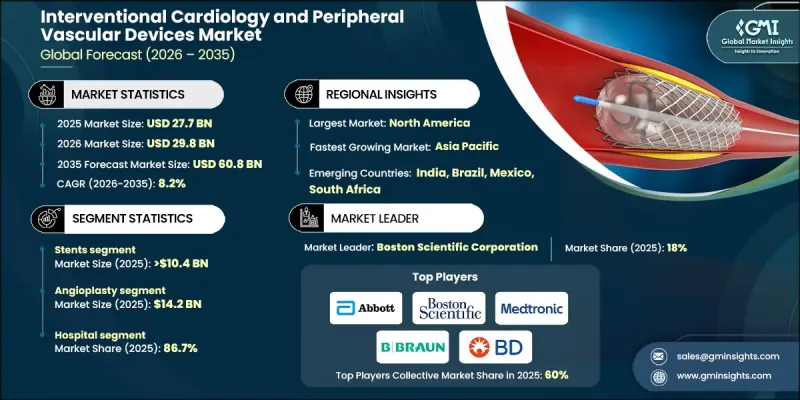
이러한 성장은 전 세계 혈관 질환의 유병률 증가, 말초혈관 기기의 지속적인 기술 혁신, 최소침습 수술의 보급 확대, 심혈관질환의 부담을 해결하기 위한 정부의 의료비 지출 증가에 의해 주도되고 있습니다. 스텐트, 풍선, 카테터 등의 의료기기를 통해 의료진은 큰 수술을 하지 않고도 심장 및 혈관 질환을 치료할 수 있습니다. 최소침습적 치료는 환자의 회복 기간을 단축하고, 시술에 따른 위험을 줄이며, 임상 결과를 개선하기 때문에 현대 심혈관 의료에서 매우 바람직한 것으로 여겨지고 있습니다. 공중 보건 정책 및 상환 정책은 첨단 의료기기의 보급을 더욱 촉진하고 있으며, 첨단 의료기기의 접근성을 높이고 비용 효율을 높이고 있습니다. 혁신적인 기기 설계, 규제적 지원, 그리고 보다 안전한 시술을 원하는 환자들의 의지가 결합되어 세계 시장 확대를 주도하고 있습니다.
| 시장 범위 | |
|---|---|
| 시작 연도 | 2025년 |
| 예측 기간 | 2026-2035년 |
| 개시시 시장 규모 | 277억 달러 |
| 예측액 | 608억 달러 |
| CAGR | 8.2% |
스텐트 시장은 2025년 104억 달러에 달했습니다. 스텐트는 좁아지거나 막힌 동맥의 혈류를 회복시켜 관상동맥 및 말초혈관 중재시술에 사용되는 확장 가능한 작은 그물망 모양의 튜브입니다. 임상적 유효성, 신뢰성, 그리고 지속적인 디자인 개선으로 인해 최소침습적 치료에서 최적의 솔루션이 되고 있습니다. 약물 용출형 스텐트는 기존 수술에 비해 재협착 및 재시술을 줄이고 회복기간을 단축시켜 시장에서의 우위를 더욱 강화하고 있습니다.
혈관성형술 부문은 2025년 142억 달러에 달했으며, 2026년부터 2035년까지 연평균 8.3%의 성장률을 기록할 것으로 예상됩니다. 혈관성형술은 동맥 내에 풍선을 부풀려 막힌 혈관을 뚫어주는 시술로, 이후 스텐트 삽입을 시행하는 경우가 많습니다. 관상동맥질환 및 말초동맥질환에 널리 시행되고 있으며, 개흉수술의 필요성을 줄이고 환자의 회복을 앞당기는 역할을 하고 있습니다. 최소침습성과 심혈관질환 치료의 효과로 인해 혈관성형술은 전 세계적으로 가장 많이 시행되는 시술 중 하나가 되었습니다.
2025년 기준, 북미 중재적 심장 및 말초혈관 기기 시장은 28%의 점유율을 차지했습니다. 이 지역 시장에서의 선도적 지위는 높은 심혈관질환 유병률, 선진화된 의료 인프라, 유리한 상환 정책, 최소침습적 기술의 조기 도입으로 뒷받침되고 있습니다. 심혈관질환 관리에 대한 인식의 증가, 기술 발전, 최소침습적 시술에 대한 환자들의 선호도가 높아지면서 북미 시장에서의 지배적 지위를 더욱 공고히 하고 있습니다.
자주 묻는 질문
목차
제1장 조사 방법과 범위
제2장 주요 요약
제3장 업계 인사이트
제4장 경쟁 구도
제5장 시장 추정 및 예측 : 제품별, 2022-2035
제6장 시장 추정 및 예측 : 용도별, 2022-2035
제7장 시장 추정 및 예측 : 최종 용도별, 2022-2035
제8장 시장 추정 및 예측 : 지역별, 2022-2035
제9장 기업 개요
KSM 26.04.10The Global Interventional Cardiology and Peripheral Vascular Devices Market was valued at USD 27.7 billion in 2025 and is estimated to grow at a CAGR of 8.2% to reach USD 60.8 billion by 2035.
This growth is fueled by the rising prevalence of vascular diseases worldwide, continuous technological innovations in peripheral vascular devices, increasing adoption of minimally invasive procedures, and growing government healthcare spending to address cardiovascular disease burdens. These devices, including stents, balloons, and catheters, enable healthcare professionals to treat heart and blood vessel conditions without major surgery. Minimally invasive interventions reduce patient recovery time, lower procedural risks, and improve clinical outcomes, making them highly desirable in modern cardiovascular care. Public health initiatives and reimbursement policies further support widespread adoption, making advanced devices more accessible and cost-effective. The combination of innovative device design, regulatory support, and patient preference for safer procedures continues to drive market expansion globally.
| Market Scope | |
|---|---|
| Start Year | 2025 |
| Forecast Year | 2026-2035 |
| Start Value | $27.7 Billion |
| Forecast Value | $60.8 Billion |
| CAGR | 8.2% |
The stents segment generated USD 10.4 billion in 2025. Stents, small expandable mesh tubes, restore blood flow in narrowed or blocked arteries and are used in both coronary and peripheral interventions. Their clinical effectiveness, reliability, and continuous design improvements make them the preferred solution for minimally invasive treatments. Drug-eluting stents reduce restenosis and repeat procedures while shortening recovery time compared to traditional surgery, reinforcing their market dominance.
The angioplasty segment reached USD 14.2 billion in 2025 and is expected to grow at a CAGR of 8.3% during 2026-2035. Angioplasty involves inflating a balloon inside an artery to open blocked vessels, often followed by stent placement. It is widely performed for coronary and peripheral artery disease, reducing the need for open-heart surgery and promoting faster patient recovery. Its minimally invasive nature and effectiveness in treating cardiovascular conditions make angioplasty one of the most performed procedures worldwide.
North America Interventional Cardiology and Peripheral Vascular Devices Market held a 28% share in 2025. The region's market leadership is supported by a high prevalence of cardiovascular conditions, advanced healthcare infrastructure, favorable reimbursement policies, and the early adoption of minimally invasive technologies. Increasing awareness of cardiovascular disease management, technological advancements, and patient preference for less invasive procedures continue to strengthen North America's dominant market position.
Key players in the Global Interventional Cardiology and Peripheral Vascular Devices Market include Abbott Laboratories, AngioDynamics, B. Braun Melsungen AG, Becton, Dickinson and Company, Biotronik SE & Co. KG, Boston Scientific Corporation, Cardinal Health, Cook Medical, Cordis, Endologix, iVascular, Medtronic Plc, Teleflex Inc., Terumo Corporation, and W.L. Gore & Associates, Inc. Companies in the Interventional Cardiology and Peripheral Vascular Devices Market strengthen their position by investing heavily in R&D to enhance device performance, safety, and design. Strategic collaborations with hospitals, research institutions, and technology partners enable the development of next-generation stents, balloons, and catheters. Firms focus on expanding global distribution networks, securing regulatory approvals in new regions, and offering training programs for healthcare providers to increase adoption. Marketing efforts highlight clinical efficacy and procedural benefits to reinforce trust among physicians and patients.
Table of Contents
Chapter 1 Methodology and Scope
- 1.1 Market scope and definition
- 1.2 Research design
- 1.2.1 Research approach
- 1.2.2 Data collection methods
- 1.3 Data mining sources
- 1.3.1 Global
- 1.3.2 Regional/country
- 1.4 Base estimates and calculations
- 1.4.1 Base year calculation
- 1.4.2 Key trends for market estimation
- 1.5 Primary research and validation
- 1.5.1 Primary sources
- 1.6 Forecast model
- 1.7 Research assumptions and limitations
Chapter 2 Executive Summary
- 2.1 Industry 360° synopsis
- 2.2 Key market trends
- 2.2.1 Regional trends
- 2.2.2 Product trends
- 2.2.3 Application trends
- 2.2.4 End use trends
- 2.3 CXO perspectives: Strategic imperatives
Chapter 3 Industry Insights
- 3.1 Industry ecosystem analysis
- 3.2 Industry impact forces
- 3.2.1 Growth drivers
- 3.2.1.1 Growing prevalence of vascular diseases worldwide
- 3.2.1.2 Technological advancements in peripheral vascular devices
- 3.2.1.3 Rising adoption of minimally invasive procedures
- 3.2.1.4 Increasing government spending pertaining to cardiovascular diseases burden
- 3.2.2 Industry Pitfalls and Challenges:
- 3.2.2.1 Stringent regulatory framework
- 3.2.2.2 Post-procedural complications associated with devices
- 3.2.3 Market Opportunities
- 3.2.3.1 Growth in outpatient and ambulatory surgical centers
- 3.2.3.2 Increasing use of robotics in interventions
- 3.2.1 Growth drivers
- 3.3 Growth potential analysis
- 3.4 Regulatory landscape
- 3.5 Technological advancements (Driven by Primary Research)
- 3.5.1 Current technological trends
- 3.5.2 Emerging technologies
- 3.6 Future market trends (Driven by Primary Research)
- 3.7 Reimbursement scenario (Driven by Primary Research)
- 3.8 Porter's analysis
- 3.9 PESTEL analysis
Chapter 4 Competitive Landscape, 2025
- 4.1 Introduction
- 4.2 Company market share analysis
- 4.3 Company matrix analysis
- 4.4 Competitive analysis of major market players
- 4.5 Competitive positioning matrix
- 4.6 Key developments
- 4.6.1 Mergers and acquisitions
- 4.6.2 Partnerships and collaborations
- 4.6.3 New product launches
- 4.6.4 Expansion plans
Chapter 5 Market Estimates and Forecast, By Product, 2022 - 2035 ($ Mn)
- 5.1 Key trends
- 5.2 Interventional catheters
- 5.3 Guidewires
- 5.4 Stents
- 5.4.1 Bioabsorbable stents
- 5.4.2 Drug eluting stents
- 5.4.3 Bare metal stents
- 5.4.4 Other stents
- 5.5 PTCA balloons
- 5.6 Atherectomy devices
- 5.7 Chronic total occlusion devices
- 5.8 Synthetic surgical grafts
- 5.9 Embolic protection devices
- 5.10 Inferior vena cava filters
- 5.11 Other products
Chapter 6 Market Estimates and Forecast, By Application, 2022 - 2035 ($ Mn)
- 6.1 Key trends
- 6.2 Congenital heart defect correction
- 6.3 Coronary thrombectomy
- 6.4 Angioplasty
- 6.5 Valvuloplasty
- 6.6 Percutaneous valve repair
- 6.7 Other applications
Chapter 7 Market Estimates and Forecast, By End Use, 2022 - 2035 ($ Mn)
- 7.1 Key trends
- 7.2 Hospitals
- 7.3 Ambulatory surgical centers
- 7.4 Other end users
Chapter 8 Market Estimates and Forecast, By Region, 2022 - 2035 ($ Mn)
- 8.1 Key trends
- 8.2 North America
- 8.2.1 U.S.
- 8.2.2 Canada
- 8.3 Europe
- 8.3.1 Germany
- 8.3.2 UK
- 8.3.3 France
- 8.3.4 Spain
- 8.3.5 Italy
- 8.3.6 Netherlands
- 8.4 Asia Pacific
- 8.4.1 China
- 8.4.2 India
- 8.4.3 Japan
- 8.4.4 Australia
- 8.4.5 South Korea
- 8.5 Latin America
- 8.5.1 Brazil
- 8.5.2 Mexico
- 8.5.3 Argentina
- 8.6 Middle East and Africa
- 8.6.1 Saudi Arabia
- 8.6.2 South Africa
- 8.6.3 UAE
Chapter 9 Company Profiles
- 9.1 Abbott Laboratories
- 9.2 AngioDynamics
- 9.3 B. Braun Melsungen AG
- 9.4 Becton, Dickinson and Company
- 9.5 Biotronik SE & Co. KG
- 9.6 Boston Scientific Corporation
- 9.7 Cardinal Health
- 9.8 Cook Medical
- 9.9 Cordis
- 9.10 Endologix
- 9.11 iVascular
- 9.12 Medtronic Plc
- 9.13 Teleflex Inc.
- 9.14 Terumo Corporation
- 9.15 W.L. Gore & Associates, Inc.


