

|
시장보고서
상품코드
2038754
마이크로 가스 터빈 시장 : 시장 기회, 성장요인, 업계 동향 분석 및 예측(2026-2035년)Micro Gas Turbine Market Opportunity, Growth Drivers, Industry Trend Analysis, and Forecast 2026 - 2035 |
||||||

세계의 마이크로 가스 터빈 시장은 2025년에 34억 달러로 평가되었고, 2035년까지 연평균 복합 성장률(CAGR) 11.9%로 성장할 전망이며, 107억 달러에 이를 것으로 추정되고 있습니다.
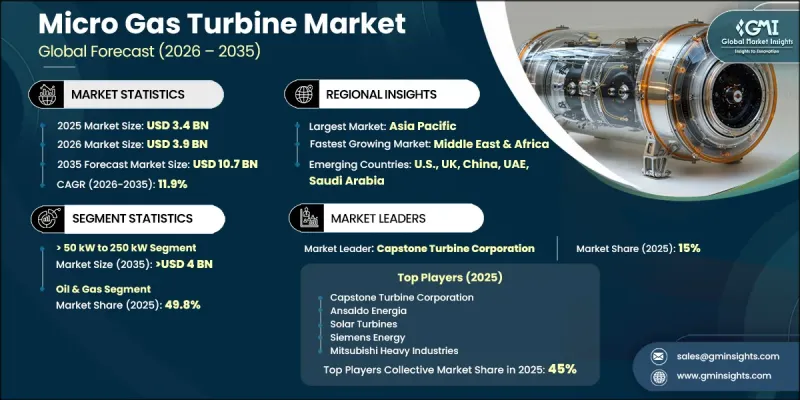
이 시장의 성장은 특히 전력망 연결이 제한적이거나 불가능한 해양 석유 및 가스 플랫폼과 고립된 생산 현장에서 원격지 발전 시스템에 대한 의존도가 높아짐에 따라 성장세를 보이고 있습니다. 산업 분야 전반에 걸쳐 분산형 고신뢰성 전력 솔루션에 대한 수요가 증가하고 있는 점도 도입을 더욱 촉진하고 있습니다. 또한, 연소 시스템의 발전과 항공우주 및 국방 분야에서의 하이브리드 발전 기술의 통합이 진행됨에 따라 시스템의 성능과 운영 효율이 향상되고 있습니다. 전 세계 전력 수요 증가와 저배출 분산형 에너지 시스템으로의 전환도 시장 확대에 기여하고 있습니다. 마이크로 가스 터빈은 콤팩트한 디자인, 높은 효율, 기존 시스템에 비해 온실가스 배출량이 적어 주목받고 있습니다. 열병합발전(CHP) 용도과 폐열 회수 시스템을 지원할 수 있는 능력으로 인해 상업, 산업 및 원격지 인프라 환경에서의 도입이 더욱 가속화되고 있습니다.
| 시장 범위 | |
|---|---|
| 개시 연도 | 2025년 |
| 예측 기간 | 2026-2035년 |
| 개시 연도 시장 규모 | 34억 달러 |
| 예측 시장 규모 | 107억 달러 |
| CAGR | 11.9% |
50kW-250kW 출력의 마이크로 가스 터빈 시장은 2035년까지 40억 달러에 달할 것으로 예측됩니다. 이 부문의 성장은 지역 열 공급 네트워크의 채택 확대와 에너지 효율적 인프라 개발에 대한 관심 증가에 힘입어 성장세를 보이고 있습니다. 상업용 건축 활동의 확대와 분산형 에너지 발전 시스템에 대한 관심 증가도 시장 침투를 촉진하고 있습니다. 또한, 이러한 시스템이 재생에너지 및 오프 그리드 에너지 용도에 통합됨에 따라 장기적인 수요 전망이 강화되고 있습니다.
2025년 기준, 석유 및 가스 용도 분야는 49.8%의 점유율을 차지했습니다. 업스트림 및 중류 사업 수요는 특히 기존의 송전망 인프라를 도입하기 어렵거나 비용 효율성이 낮은 오지 및 접근하기 어려운 지역에서 지속적으로 강세를 보이고 있습니다. 이러한 터빈은 모듈형 및 컨테이너형 구성으로 도입이 증가하고 있으며, 변화하는 채굴 및 생산 현장에 유연하고 신속하게 설치할 수 있습니다. 이것이 이 부문의 성장세를 지속해서 뒷받침하고 있습니다.
2025년 미국의 마이크로 가스 터빈 시장 규모는 6억 9,510만 달러로 평가되었습니다. 시장 확대는 전력망에 대한 접근이 제한적인 원격 운영 환경에서 분산형 전력 시스템의 도입 확대에 의해 뒷받침되고 있습니다. 이 터빈은 시추 현장, 생산 시설, 파이프라인 인프라에서 중단 없는 전력 공급을 보장하기 위해 널리 사용되고 있습니다. 노후화된 에너지 인프라에 대한 의존도가 지속되고 있고, 중앙집중식 발전 시스템에 대한 의존도를 낮추려는 노력이 강화되고 있는 것도 시장 발전에 기여하고 있습니다.
자주 묻는 질문
목차
제1장 조사 방법 및 범위
제2장 주요 요약
제3장 업계 인사이트
제4장 경쟁 구도
제5장 시장 규모 및 예측 : 용량별(2022-2035년)
제6장 시장 규모 및 예측 : 용도별(2022-2035년)
제7장 시장 규모 및 예측 : 지역별(2022-2035년)
제8장 기업 개요
AJY 26.06.11The Global Micro Gas Turbine Market was valued at USD 3.4 billion in 2025 and is estimated to grow at a CAGR of 11.9% to reach USD 10.7 billion by 2035.
The market growth is driven by the continued reliance on remote energy generation systems, particularly across offshore oil and gas platforms and isolated production sites where grid connectivity remains limited or unavailable. Rising demand for decentralized and reliable power solutions across industrial sectors is further strengthening adoption. In addition, advancements in combustion systems and the increasing integration of hybrid power technologies across aerospace and defense applications are enhancing system performance and operational efficiency. Growing global electricity demand, combined with the shift toward low-emission distributed energy systems, is also contributing to market expansion. Micro gas turbines are gaining traction due to their compact design, high efficiency, and lower greenhouse gas emissions compared to conventional systems. Their ability to support combined heat and power applications and waste heat recovery systems is further accelerating deployment across commercial, industrial, and remote infrastructure environments.
| Market Scope | |
|---|---|
| Start Year | 2025 |
| Forecast Year | 2026-2035 |
| Start Value | $3.4 Billion |
| Forecast Value | $10.7 Billion |
| CAGR | 11.9% |
The market for micro gas turbines above 50 kW to 250 kW capacity is projected to reach USD 4 billion by 2035. Growth in this segment is supported by increasing adoption in district energy networks and rising emphasis on energy-efficient infrastructure development. Expansion of commercial construction activities and growing interest in decentralized energy generation systems are also supporting market penetration. In addition, the integration of these systems into renewable and off-grid energy applications is strengthening their long-term demand outlook.
The oil and gas application segment accounted for 49.8% share in 2025. Demand from upstream and midstream operations remains strong, particularly in remote or hard-to-access locations where traditional grid infrastructure is not feasible or cost-effective. These turbines are increasingly deployed in modular and containerized configurations, enabling flexible and rapid installation across evolving extraction and production sites, which continues to support segment growth.
U.S. Micro Gas Turbine Market was valued at USD 695.1 million in 2025. Market expansion is being supported by growing deployment of distributed power systems in remote operational environments where grid access is limited. These turbines are widely used across drilling sites, production facilities, and pipeline infrastructure to ensure uninterrupted power supply. Continued reliance on aging energy infrastructure and increasing efforts to reduce dependence on centralized power generation systems are also contributing to market development.
Key companies operating in the Micro Gas Turbine Industry include Siemens Energy, Solar Turbines, Mitsubishi Heavy Industries, Capstone Turbine Corporation, Kawasaki Gas Turbine, Ansaldo Energia, Centrax Gas Turbines, IHI Corporation, Bladon Jets, Ebara Elliott Energy, Flex Energy Solutions, Aurelia Technologies, Destinus Energy, ENN Energy Power Technology (Shanghai), Brayton Energy, Apugenius, Pyropower, Erlson Precision Components, Turbotech Precision Engineering, and Toyota Motor Corporation. Companies in the Micro Gas Turbine Market are focusing on improving fuel efficiency and reducing emissions through continuous advancements in combustion technology and system design. Many players are investing in modular and scalable turbine solutions that support flexible deployment across industrial and remote applications. Strategic collaborations with energy operators and infrastructure developers are helping expand market reach and application diversity. Firms are also enhancing product offerings with hybrid and cogeneration capabilities to support combined heat and power applications. Increasing investment in R&D is enabling the development of high-performance, low-maintenance turbine systems suitable for harsh environments.
Table of Contents
Chapter 1 Methodology & Scope
- 1.1 Research approach
- 1.2 Quality commitments
- 1.2.1 GMI AI policy & data integrity commitment
- 1.2.1.1 Source consistency protocol
- 1.2.1 GMI AI policy & data integrity commitment
- 1.3 Research trail & confidence scoring
- 1.3.1 Research trail components
- 1.3.2 Scoring components
- 1.4 Data collection
- 1.4.1 Partial list of primary sources
- 1.5 Data mining sources
- 1.5.1 Paid sources
- 1.5.1.1 Sources, by region
- 1.5.1 Paid sources
- 1.6 Base estimates and calculations
- 1.6.1 Base year calculation for any one approach
- 1.7 Market estimates & forecasts parameters
- 1.8 Forecast model
- 1.8.1 Quantified market impact analysis
- 1.8.1.1 Mathematical impact of growth parameters on forecast
- 1.8.1 Quantified market impact analysis
- 1.9 Research transparency addendum
- 1.9.1 Source attribution framework
- 1.9.2 Quality assurance metrics
- 1.9.3 Our commitment to trust
- 1.10 Market definitions
Chapter 2 Executive Summary
- 2.1 Industry synopsis, 2022 - 2035
- 2.1.1 Business trends
- 2.1.2 Capacity trends
- 2.1.3 Application trends
- 2.1.4 Regional trends
Chapter 3 Industry Insights
- 3.1 Industry ecosystem analysis
- 3.1.1 Raw material availability & sourcing analysis
- 3.1.2 Manufacturing capacity assessment
- 3.1.3 Supply chain resilience & risk factors
- 3.1.4 Distribution network analysis
- 3.2 Industry impact forces
- 3.2.1 Growth drivers
- 3.2.2 Industry pitfalls & challenges
- 3.3 Regulatory landscape
- 3.4 Growth potential analysis
- 3.5 Porter's analysis
- 3.5.1 Bargaining power of suppliers
- 3.5.2 Bargaining power of buyers
- 3.5.3 Threat of new entrants
- 3.5.4 Threat of substitutes
- 3.6 PESTEL analysis
- 3.6.1 Political factors
- 3.6.2 Economic factors
- 3.6.3 Social factors
- 3.6.4 Technological factors
- 3.6.5 Legal factors
- 3.6.6 Environmental factors
- 3.7 Cost structure analysis of micro gas turbine
- 3.8 Growth in untapped markets & applications
- 3.9 Digitalization & IoT integration
- 3.10 Investment analysis & future prospects
- 3.11 Price trend analysis (USD/kW) (Driven by Primary Research)
- 3.11.1 By region (Driven by Primary Research)
- 3.11.2 By capacity (Driven by Primary Research)
- 3.12 Trade data analysis (Driven by Primary Research)
- 3.12.1 Import/export value trends (Driven by Primary Research)
- 3.12.2 Key trade corridors & tariff impact (Driven by Primary Research)
- 3.13 Capacity & production landscape (Driven by Primary Research)
- 3.13.1 Capacity by region & key producer (Driven by Primary Research)
- 3.13.2 Capacity utilization rates & expansion pipelines (Driven by Primary Research)
- 3.14 Impact of AI & Generative AI on the market (Driven by Primary Research)
- 3.14.1 AI-Driven production optimization (Driven by Primary Research)
- 3.14.2 Predictive maintenance & fault detection (Driven by Primary Research)
Chapter 4 Competitive Landscape, 2026
- 4.1 Introduction
- 4.2 Company market share analysis, by region, 2025
- 4.2.1 North America
- 4.2.2 Europe
- 4.2.3 Asia Pacific
- 4.2.4 Middle East & Africa
- 4.2.5 Latin America
- 4.3 Competitive analysis of major market players
- 4.4 Competitive positioning matrix
- 4.5 Key developments
- 4.5.1 Mergers & acquisitions
- 4.5.2 Partnerships & collaborations
- 4.5.3 New product launches
- 4.5.4 Expansion plans & funding
- 4.6 Company tier benchmarking
- 4.6.1 Tier classification criteria & qualifying thresholds
- 4.6.2 Tier positioning matrix by revenue, geography & innovation
Chapter 5 Market Size and Forecast, By Capacity, 2022 - 2035 (USD Million & kW)
- 5.1 Key trends
- 5.2 ≤ 50 kW
- 5.3 > 50 kW to 250 kW
- 5.4 > 250 kW to 500 kW
- 5.5 > 500 kW
Chapter 6 Market Size and Forecast, By Application, 2022 - 2035 (USD Million & kW)
- 6.1 Key trends
- 6.2 Power generation
- 6.3 Oil & gas
- 6.4 Commercial & industrial CHP
- 6.5 Renewable
- 6.6 Hybrid vehicles
- 6.7 Marine
- 6.8 Others
Chapter 7 Market Size and Forecast, By Region, 2022 - 2035 (USD Million & kW)
- 7.1 Key trends
- 7.2 North America
- 7.2.1 U.S.
- 7.2.2 Canada
- 7.2.3 Mexico
- 7.3 Europe
- 7.3.1 UK
- 7.3.2 France
- 7.3.3 Germany
- 7.3.4 Russia
- 7.3.5 Italy
- 7.3.6 Netherlands
- 7.4 Asia Pacific
- 7.4.1 China
- 7.4.2 Australia
- 7.4.3 Japan
- 7.4.4 India
- 7.4.5 South Korea
- 7.4.6 Indonesia
- 7.4.7 Thailand
- 7.5 Middle East & Africa
- 7.5.1 Saudi Arabia
- 7.5.2 UAE
- 7.5.3 Qatar
- 7.5.4 Kuwait
- 7.5.5 Oman
- 7.5.6 Egypt
- 7.5.7 Iraq
- 7.5.8 Turkey
- 7.5.9 South Africa
- 7.6 Latin America
- 7.6.1 Brazil
- 7.6.2 Argentina
- 7.6.3 Chile
Chapter 8 Company Profiles
- 8.1 Ansaldo Energia
- 8.2 Apugenius Oy
- 8.3 Aurelia Technologies
- 8.4 Bladon Jets
- 8.5 Brayton Energy
- 8.6 Capstone Turbine Corporation
- 8.7 Centrax Gas Turbines
- 8.8 Destinus Energy
- 8.9 Ebara Elliott Energy
- 8.10 ENN Energy Power Technology (Shanghai) Co., LTD
- 8.11 Erlson Precision Components Ltd
- 8.12 Flex Energy Solutions
- 8.13 IHI Corporation
- 8.14 Kawasaki Gas Turbine
- 8.15 Mitsubishi Heavy Industries
- 8.16 Pyropower GmbH
- 8.17 Siemens Energy
- 8.18 Solar Turbines
- 8.19 Toyota Motor Corporation
- 8.20 Turbotech Precision Engineering


